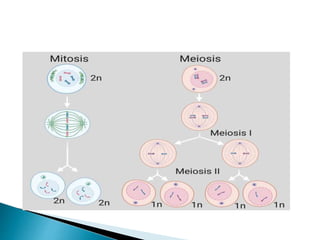
 There are two types of cell division: mitosis
and meiosis.
 Most of the time “cell division,” mean Mitosis,
the process of making new body cells.
 Meiosis is the type of cell division that creates
egg and sperm cells.
 Features of Mitosis
 In each cycle of cell division, two daughter
cells are formed from the parent cell.
 The division is also known as equational cell
division because the chromosome number in
the parent cell and daughter cell is the same.
 Segregation and combination do not occur in
this process.
 It results in 2 numbers of daughter cells.
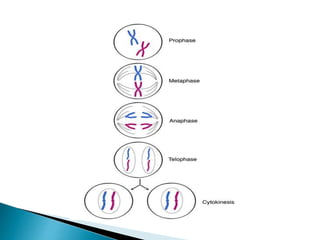
 The processes of mitosis have been divided
into different stages as follows:
 Prophase
 Prophase immediately follows the S and G2
phases of the cycle and is marked by
condensation of the genetic material to form
chromosomes composed of two chromatids
attached at the centromere.
 The nuclear envelope starts disintegrating.
 Prometaphase
 In the prometaphase, the nuclear envelop
disintegrates.
 Now from the centromere of the of
chromosomes by the help of kinetochore
allows the movement of chromosomes on
spindle fibers made up of microtubules.
 Metaphase
 At this stage, the microtubules start pulling
the chromosomes with equal force and the
chromosome line up on the equatorial plate.
 This region is known as the metaphase plate.
Thus, each cell gets an entire functioning
genome.
 Anaphase
 The splitting of the sister chromatids marks
the onset of anaphase.
 These sister chromatids become the
chromosome of the daughter nuclei.
 The chromosomes are then pulled towards
the pole by the fibres attached to the
kinetochores of each chromosome.
 The centromere of each chromosome face to
the poles while the arms face to the
metaphasic plate.
 Telophase
 The chromosomes are present at the two
poles and the nuclear envelope starts forming
around it.
 The nucleolus, Golgi bodies and ER complex,
which had disappeared after prophase start
to reappear.
 Telophase is followed by cytokinesis, which
denotes the division of the cytoplasm to form
two daughter cells.
 Thus, it marks the completion of cell division.
 The other type of cell division, meiosis,
ensures that humans have the same number
of chromosomes in each generation.
 It is a two-step process that reduces the
chromosome number by half—from 46 to
23—to form sperm and egg cells.
 When the sperm and egg cells unite at zygot
formation, each contributes 23 chromosomes
so the resulting embryo will have the usual
46.
 Meiosis also allows genetic variation through
a process of recombination and segraggation
while the cells are dividing.
 Meiosis results in 4 numbers of daughter
cells which are called as male and female
gametes.
 Meiosis I
 Prophase I
 The nuclear envelope disintegrates.
 Chromosomes begin to condense.
 Spindle fibres appear.
 Spindle fibres attach to the chromosomes at
the centromere.
 Exchange of genetic material occurs in this
stage.
 Metaphase I
 The homologous chromosomes align at the
equatorial plate ensuring genetic diversity
 Anaphase I
 The homologous chromosomes are pulled
towards the opposite poles.
 Telophase I
 Spindle fibres disappear.
 Nuclear envelope is reformed.
 Cytokinesis I
 The cytoplasm and the cell division result in 2
non-identical haploid daughter cells.
 Meiosis II
 Prophase II
 The chromatin condenses into chromosomes.
 Nuclear envelope disintegrates.
 Centrosomes migrate to either poles.
 Spindle fibres are reformed.
 Metaphase II
 The chromosomes align along the equatorial
plate. On the contrary, the chromosomes in
metaphase I were in homologous pairs.
 Anaphase II
 Sister chromatids are pulled to the opposite
poles.
 Telophase II
 Nuclear envelope redevelops and the spindle
fibres disappear.
 Cytokinesis II
 The cytoplasm and cell divide producing 4
non-identical haploid daughter cells.
CELL DIVISION

CELL DIVISION

  • 2.
     There aretwo types of cell division: mitosis and meiosis.  Most of the time “cell division,” mean Mitosis, the process of making new body cells.  Meiosis is the type of cell division that creates egg and sperm cells.
  • 3.
     Features ofMitosis  In each cycle of cell division, two daughter cells are formed from the parent cell.  The division is also known as equational cell division because the chromosome number in the parent cell and daughter cell is the same.  Segregation and combination do not occur in this process.  It results in 2 numbers of daughter cells.
  • 6.
     The processesof mitosis have been divided into different stages as follows:  Prophase  Prophase immediately follows the S and G2 phases of the cycle and is marked by condensation of the genetic material to form chromosomes composed of two chromatids attached at the centromere.  The nuclear envelope starts disintegrating.
  • 7.
     Prometaphase  Inthe prometaphase, the nuclear envelop disintegrates.  Now from the centromere of the of chromosomes by the help of kinetochore allows the movement of chromosomes on spindle fibers made up of microtubules.
  • 8.
     Metaphase  Atthis stage, the microtubules start pulling the chromosomes with equal force and the chromosome line up on the equatorial plate.  This region is known as the metaphase plate. Thus, each cell gets an entire functioning genome.
  • 9.
     Anaphase  Thesplitting of the sister chromatids marks the onset of anaphase.  These sister chromatids become the chromosome of the daughter nuclei.  The chromosomes are then pulled towards the pole by the fibres attached to the kinetochores of each chromosome.  The centromere of each chromosome face to the poles while the arms face to the metaphasic plate.
  • 10.
     Telophase  Thechromosomes are present at the two poles and the nuclear envelope starts forming around it.  The nucleolus, Golgi bodies and ER complex, which had disappeared after prophase start to reappear.  Telophase is followed by cytokinesis, which denotes the division of the cytoplasm to form two daughter cells.  Thus, it marks the completion of cell division.
  • 11.
     The othertype of cell division, meiosis, ensures that humans have the same number of chromosomes in each generation.  It is a two-step process that reduces the chromosome number by half—from 46 to 23—to form sperm and egg cells.  When the sperm and egg cells unite at zygot formation, each contributes 23 chromosomes so the resulting embryo will have the usual 46.
  • 12.
     Meiosis alsoallows genetic variation through a process of recombination and segraggation while the cells are dividing.  Meiosis results in 4 numbers of daughter cells which are called as male and female gametes.
  • 14.
     Meiosis I Prophase I  The nuclear envelope disintegrates.  Chromosomes begin to condense.  Spindle fibres appear.  Spindle fibres attach to the chromosomes at the centromere.  Exchange of genetic material occurs in this stage.  Metaphase I  The homologous chromosomes align at the equatorial plate ensuring genetic diversity
  • 15.
     Anaphase I The homologous chromosomes are pulled towards the opposite poles.  Telophase I  Spindle fibres disappear.  Nuclear envelope is reformed.  Cytokinesis I  The cytoplasm and the cell division result in 2 non-identical haploid daughter cells.
  • 16.
     Meiosis II Prophase II  The chromatin condenses into chromosomes.  Nuclear envelope disintegrates.  Centrosomes migrate to either poles.  Spindle fibres are reformed.  Metaphase II  The chromosomes align along the equatorial plate. On the contrary, the chromosomes in metaphase I were in homologous pairs.
  • 17.
     Anaphase II Sister chromatids are pulled to the opposite poles.  Telophase II  Nuclear envelope redevelops and the spindle fibres disappear.  Cytokinesis II  The cytoplasm and cell divide producing 4 non-identical haploid daughter cells.