By,
Devi Priya Sugathan
Msc. Biochemistry
and molecular biology.
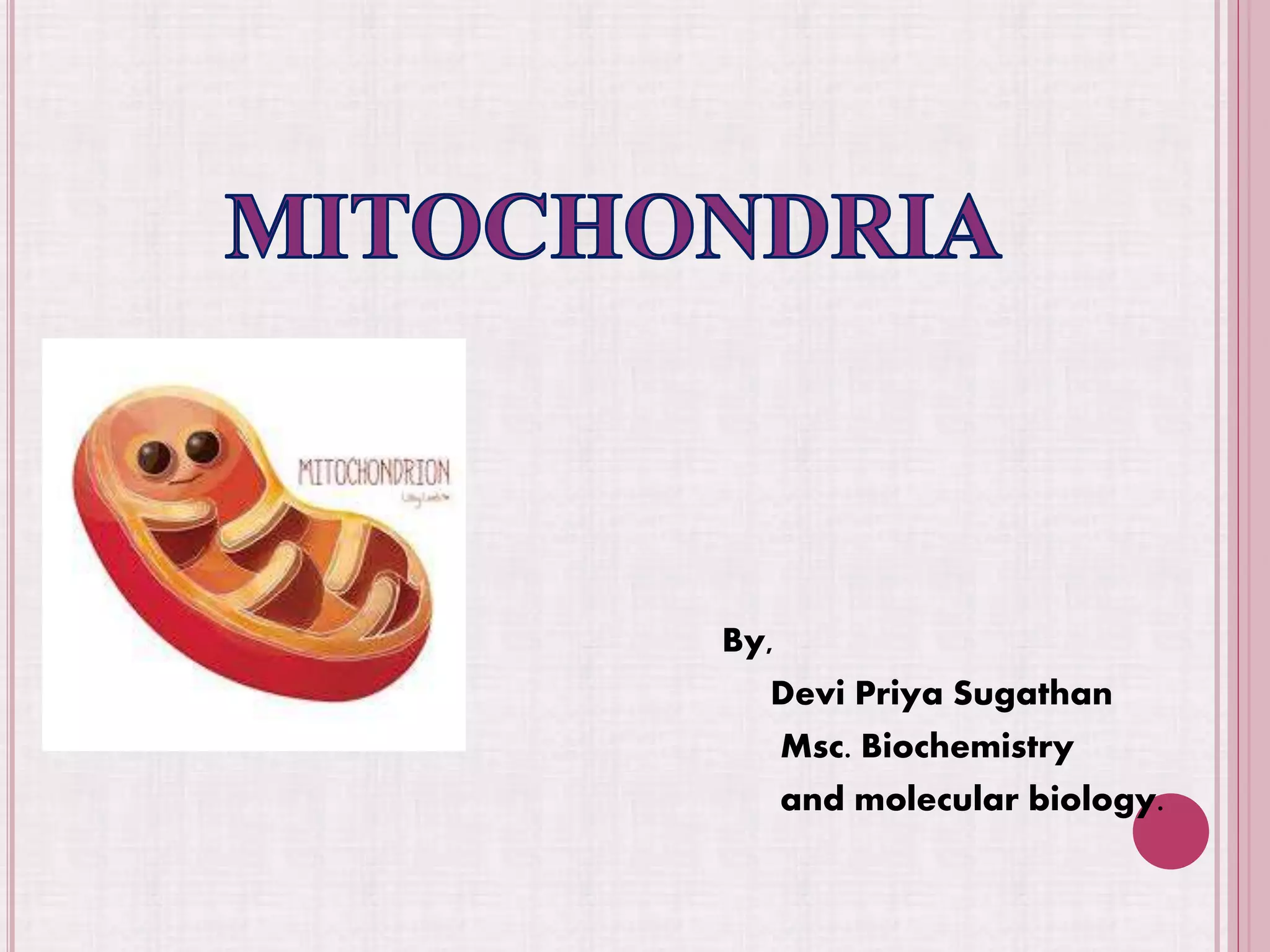
INTRODUCTION
 Mitochondria is a double
membrane bound organelle
found in cytoplasm of
eukaryotic cells.
 Mito – thread, chondrion –
granule like.
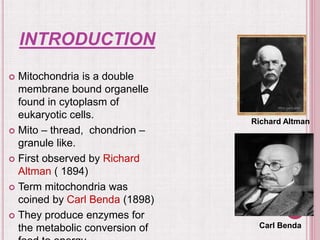
 First observed by Richard
Altman ( 1894)
 Term mitochondria was
coined by Carl Benda (1898)
 They produce enzymes for
the metabolic conversion of
Richard Altman
Carl Benda
POWERHOUSE OF THE CELL
Mitochondria are
responsible for the conversion of nutrients
into energy–yielding molecule ATP to fuel
the cells activities. The function known as
aerobic respiration is the reason
mitochondria are frequently referred to as
the powerhouse of the cell.
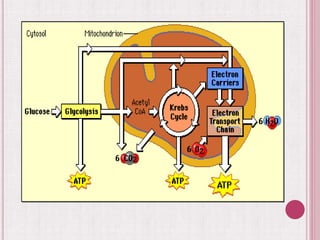
Aerobic respiration involves:
Glycolysis
Krebs
cycle
Electron
ORIGIN OF MITOCHONDRIA
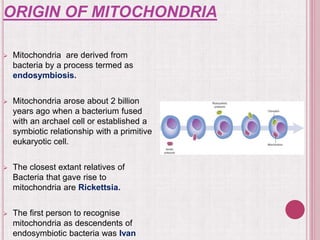
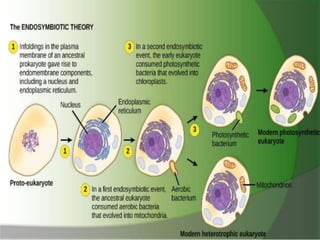
 Mitochondria are derived from
bacteria by a process termed as
endosymbiosis.
 Mitochondria arose about 2 billion
years ago when a bacterium fused
with an archael cell or established a
symbiotic relationship with a primitive
eukaryotic cell.
 The closest extant relatives of
Bacteria that gave rise to
mitochondria are Rickettsia.
 The first person to recognise
mitochondria as descendents of
endosymbiotic bacteria was Ivan
BIOGENESIS
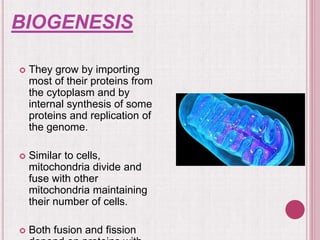
 They grow by importing
most of their proteins from
the cytoplasm and by
internal synthesis of some
proteins and replication of
the genome.
 Similar to cells,
mitochondria divide and
fuse with other
mitochondria maintaining
their number of cells.
 Both fusion and fission
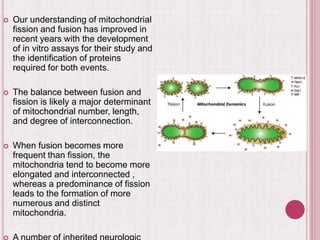
 Our understanding of mitochondrial
fission and fusion has improved in
recent years with the development
of in vitro assays for their study and
the identification of proteins
required for both events.
 The balance between fusion and
fission is likely a major determinant
of mitochondrial number, length,
and degree of interconnection.
 When fusion becomes more
frequent than fission, the
mitochondria tend to become more
elongated and interconnected ,
whereas a predominance of fission
leads to the formation of more
numerous and distinct
mitochondria.
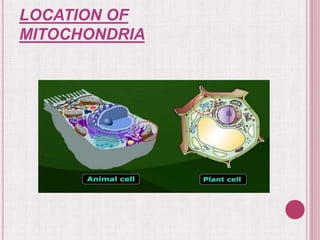
LOCATION OF
MITOCHONDRIA
MORPHOLOGY
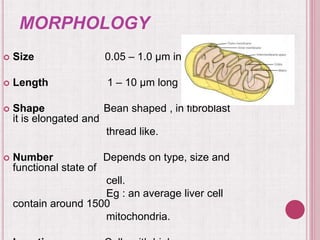
 Size 0.05 – 1.0 µm in diameter.
 Length 1 – 10 µm long
 Shape Bean shaped , in fibroblast
it is elongated and
thread like.
 Number Depends on type, size and
functional state of
cell.
Eg : an average liver cell
contain around 1500
mitochondria.
STRUCTURE
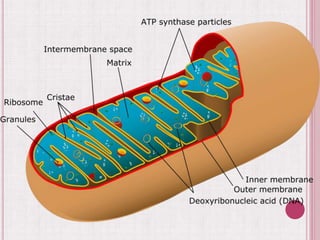
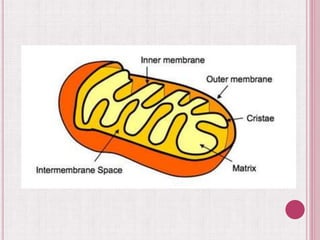
 OUTER MEMBRANE
 INTERMEMBRANE SPACE
 INNER MEMBRANE
 CRISTAE
 MATRIX
 The outer and inner
membrane is composed of
phospholipid bilayers and
proteins. The two
membranes have different
properties.
OUTER MEMBRANE
 Simple phospholipid bilayer.
 It encloses the mitochondrian.
 Contain large number of integral protein structures called porins,
which allows molecules to freely diffuse from one side of the
membrane to the other.
 Porins pass molecules less then 5000 D.
 Ions, nutrient molecules, ATP, ADP etc can pass through the
outer membrane with ease.
 The outer mitochondrial membrane is composed of about 50%
INTER MEMBRANE
SPACE
 It is also known as Perimitochondrial space.
 The space between inner membrane and
outer membrane .
 It has high proton concentration.
 The space between inner and outer
membrane is approximately 70 A.
 Because the outer membrane is freely
permeable to small molecules, the
concentration of small molecules such as ions
and sugars in the intermembrane space is
same as that of the cytosol.
 Proteins present, participate in ATP synthesis
INNER
MEMBRANE
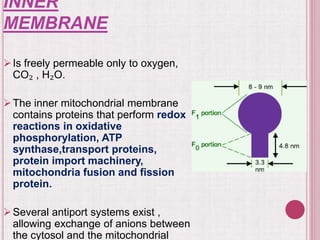
Is freely permeable only to oxygen,
CO₂ , H₂O.
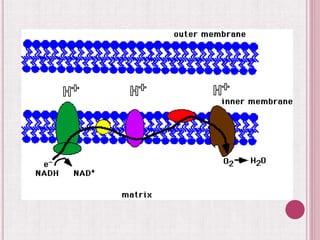
The inner mitochondrial membrane
contains proteins that perform redox
reactions in oxidative
phosphorylation, ATP
synthase,transport proteins,
protein import machinery,
mitochondria fusion and fission
protein.
Several antiport systems exist ,
allowing exchange of anions between
the cytosol and the mitochondrial
CRISTAE
 Are folds of inner mitochondrial
membrane, which expand its
surface area , enhancing its ability to
produce ATP.
 Stalked particles or inner
membrane spheres :
cristae is covered with this
inner membrane
spheres called stalked
particles or knobs or
heads.
MATRIX
 It is the space enclosed by the inner membrane.
 Gel like consistency ,Dense , homogenous.
 Contains 2/3 rd of total protein of mitochondria.
 Matrix have enzymes, DNA genome, ribosomes,
tRNA, granules, fibrils and tubules.
 The matrix is important in the production of ATP with the
aid of the ATP synthase contained in the inner
membane.
 Major enzymes include enzymes involved in
- Synthesis of nucleic acid and
proteins.
UNIQ
UE
 Mitochondria are unique in their own way
containing their own circular DNA and
their own ribosomes.
 The DNA in the cell nucleus does not
code for the construction of mitochondria.
MITOCHONDRIAL DNA
(MTDNA)
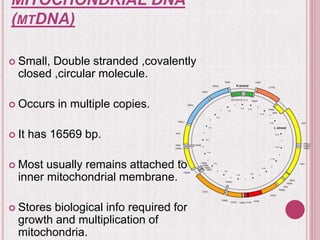
 Small, Double stranded ,covalently
closed ,circular molecule.
 Occurs in multiple copies.
 It has 16569 bp.
 Most usually remains attached to
inner mitochondrial membrane.
 Stores biological info required for
growth and multiplication of
mitochondria.
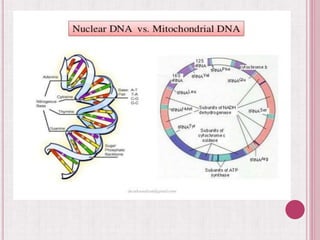
 Encode RNA s and proteins that are
essential for mitochondrial function.
 It codes 2rRNAs , 22 tRNAs and 13
mitochondrial membrane proteins.
 Can undergo replication and
duplication.
 Not absolutely autonomous depends
on nuclear DNA.
INHERITANCE OF MTDNA
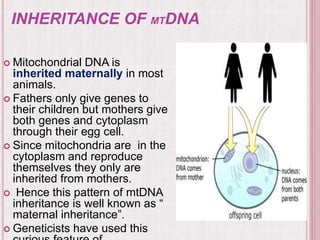
 Mitochondrial DNA is
inherited maternally in most
animals.
 Fathers only give genes to
their children but mothers give
both genes and cytoplasm
through their egg cell.
 Since mitochondria are in the
cytoplasm and reproduce
themselves they only are
inherited from mothers.
 Hence this pattern of mtDNA
inheritance is well known as “
maternal inheritance”.
 Geneticists have used this
FUNCTI
ON
 Aerobic respiration – Mitochondria uses
complex molecules and oxygen to produce a
higher energy molecule known as ATP.
 Mitochondria are more abundant in the cell
that contain a lot of energy.
Eg : muscle.
 Extra mitochondrial inheritance:
mtDNA contains plasma
genes.
 Synthesis of mtDNA , RNA, protein.
 Bring about gene expression through gene
duplication transcription and translation.
 Synthesis 13 different polypeptides in
human.
SITE OF SEVERAL METABOLIC REACTIONS
OUTER MEMBRANE Oxidation of epinephrine
Degradation of tryptophan
Elongation of fatty acid
INNER MEMBRANE Oxidative phosphorylation
MATRIX Kreb’s cycle
Beta oxidation
Detoxification of ammonia in
urea cycle
Storage of calcium ions.
OTHER FUNCTIONS
 Production of heat( non
shivering thermogenesis).
 Role in apoptosis (
programmed cell death).
 Synthesis of estrogen and
testosterone.
 Role in neurotransmitter
metabolism.
 Role on cholesterol
metabolism.
 Role in heme synthesis.
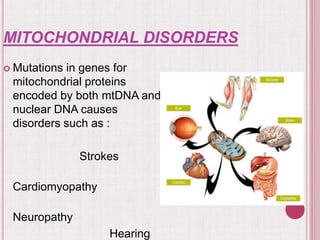
MITOCHONDRIAL DISORDERS
 Mutations in genes for
mitochondrial proteins
encoded by both mtDNA and
nuclear DNA causes
disorders such as :
Strokes
Cardiomyopathy
Neuropathy
Hearing
THANK
YOU

Mitochondria ppt

  • 1.
    By, Devi Priya Sugathan Msc.Biochemistry and molecular biology.
  • 2.
    INTRODUCTION  Mitochondria isa double membrane bound organelle found in cytoplasm of eukaryotic cells.  Mito – thread, chondrion – granule like.  First observed by Richard Altman ( 1894)  Term mitochondria was coined by Carl Benda (1898)  They produce enzymes for the metabolic conversion of Richard Altman Carl Benda
  • 3.
    POWERHOUSE OF THECELL Mitochondria are responsible for the conversion of nutrients into energy–yielding molecule ATP to fuel the cells activities. The function known as aerobic respiration is the reason mitochondria are frequently referred to as the powerhouse of the cell. Aerobic respiration involves: Glycolysis Krebs cycle Electron
  • 4.
    ORIGIN OF MITOCHONDRIA Mitochondria are derived from bacteria by a process termed as endosymbiosis.  Mitochondria arose about 2 billion years ago when a bacterium fused with an archael cell or established a symbiotic relationship with a primitive eukaryotic cell.  The closest extant relatives of Bacteria that gave rise to mitochondria are Rickettsia.  The first person to recognise mitochondria as descendents of endosymbiotic bacteria was Ivan
  • 6.
    BIOGENESIS  They growby importing most of their proteins from the cytoplasm and by internal synthesis of some proteins and replication of the genome.  Similar to cells, mitochondria divide and fuse with other mitochondria maintaining their number of cells.  Both fusion and fission
  • 7.
     Our understandingof mitochondrial fission and fusion has improved in recent years with the development of in vitro assays for their study and the identification of proteins required for both events.  The balance between fusion and fission is likely a major determinant of mitochondrial number, length, and degree of interconnection.  When fusion becomes more frequent than fission, the mitochondria tend to become more elongated and interconnected , whereas a predominance of fission leads to the formation of more numerous and distinct mitochondria.
  • 9.
  • 10.
    MORPHOLOGY  Size 0.05– 1.0 µm in diameter.  Length 1 – 10 µm long  Shape Bean shaped , in fibroblast it is elongated and thread like.  Number Depends on type, size and functional state of cell. Eg : an average liver cell contain around 1500 mitochondria.
  • 11.
    STRUCTURE  OUTER MEMBRANE INTERMEMBRANE SPACE  INNER MEMBRANE  CRISTAE  MATRIX  The outer and inner membrane is composed of phospholipid bilayers and proteins. The two membranes have different properties.
  • 13.
    OUTER MEMBRANE  Simplephospholipid bilayer.  It encloses the mitochondrian.  Contain large number of integral protein structures called porins, which allows molecules to freely diffuse from one side of the membrane to the other.  Porins pass molecules less then 5000 D.  Ions, nutrient molecules, ATP, ADP etc can pass through the outer membrane with ease.  The outer mitochondrial membrane is composed of about 50%
  • 14.
    INTER MEMBRANE SPACE  Itis also known as Perimitochondrial space.  The space between inner membrane and outer membrane .  It has high proton concentration.  The space between inner and outer membrane is approximately 70 A.  Because the outer membrane is freely permeable to small molecules, the concentration of small molecules such as ions and sugars in the intermembrane space is same as that of the cytosol.  Proteins present, participate in ATP synthesis
  • 15.
    INNER MEMBRANE Is freely permeableonly to oxygen, CO₂ , H₂O. The inner mitochondrial membrane contains proteins that perform redox reactions in oxidative phosphorylation, ATP synthase,transport proteins, protein import machinery, mitochondria fusion and fission protein. Several antiport systems exist , allowing exchange of anions between the cytosol and the mitochondrial
  • 16.
    CRISTAE  Are foldsof inner mitochondrial membrane, which expand its surface area , enhancing its ability to produce ATP.  Stalked particles or inner membrane spheres : cristae is covered with this inner membrane spheres called stalked particles or knobs or heads.
  • 17.
    MATRIX  It isthe space enclosed by the inner membrane.  Gel like consistency ,Dense , homogenous.  Contains 2/3 rd of total protein of mitochondria.  Matrix have enzymes, DNA genome, ribosomes, tRNA, granules, fibrils and tubules.  The matrix is important in the production of ATP with the aid of the ATP synthase contained in the inner membane.  Major enzymes include enzymes involved in - Synthesis of nucleic acid and proteins.
  • 18.
    UNIQ UE  Mitochondria areunique in their own way containing their own circular DNA and their own ribosomes.  The DNA in the cell nucleus does not code for the construction of mitochondria.
  • 19.
    MITOCHONDRIAL DNA (MTDNA)  Small,Double stranded ,covalently closed ,circular molecule.  Occurs in multiple copies.  It has 16569 bp.  Most usually remains attached to inner mitochondrial membrane.  Stores biological info required for growth and multiplication of mitochondria.
  • 20.
     Encode RNAs and proteins that are essential for mitochondrial function.  It codes 2rRNAs , 22 tRNAs and 13 mitochondrial membrane proteins.  Can undergo replication and duplication.  Not absolutely autonomous depends on nuclear DNA.
  • 22.
    INHERITANCE OF MTDNA Mitochondrial DNA is inherited maternally in most animals.  Fathers only give genes to their children but mothers give both genes and cytoplasm through their egg cell.  Since mitochondria are in the cytoplasm and reproduce themselves they only are inherited from mothers.  Hence this pattern of mtDNA inheritance is well known as “ maternal inheritance”.  Geneticists have used this
  • 23.
    FUNCTI ON  Aerobic respiration– Mitochondria uses complex molecules and oxygen to produce a higher energy molecule known as ATP.  Mitochondria are more abundant in the cell that contain a lot of energy. Eg : muscle.  Extra mitochondrial inheritance: mtDNA contains plasma genes.
  • 24.
     Synthesis ofmtDNA , RNA, protein.  Bring about gene expression through gene duplication transcription and translation.  Synthesis 13 different polypeptides in human.
  • 25.
    SITE OF SEVERALMETABOLIC REACTIONS OUTER MEMBRANE Oxidation of epinephrine Degradation of tryptophan Elongation of fatty acid INNER MEMBRANE Oxidative phosphorylation MATRIX Kreb’s cycle Beta oxidation Detoxification of ammonia in urea cycle Storage of calcium ions.
  • 28.
    OTHER FUNCTIONS  Productionof heat( non shivering thermogenesis).  Role in apoptosis ( programmed cell death).  Synthesis of estrogen and testosterone.  Role in neurotransmitter metabolism.  Role on cholesterol metabolism.  Role in heme synthesis.
  • 29.
    MITOCHONDRIAL DISORDERS  Mutationsin genes for mitochondrial proteins encoded by both mtDNA and nuclear DNA causes disorders such as : Strokes Cardiomyopathy Neuropathy Hearing
  • 30.