COMSATS Institute Of Information Technology
Contents
• Introduction to Cell Cycle
• Interphase
• Mitosis
• Mitotic Apparatus and Karyokinesis
• Phases of Mitosis and Cytokinesis
• Significance of Mitosis
• Meiosis
• Phases of Meiosis I, Meiosis II and Cytokinesis
• Significance of Meiosis COMSATS Institute Of Information Technology
2
Introduction
• The cell undergoes sequence of changes, which involves period of
growth, DNA replication and cell division and this process is called
cell cycle
• It involves 2 phases;
 Interphase (period between two consecutive cell divisions,
misleadingly called resting phase)
 Mitotic phase (cell division period)
COMSATS Institute Of Information Technology
3
Interphase
COMSATS Institute Of Information Technology
4
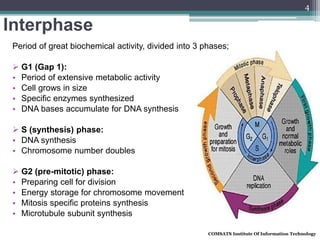
Period of great biochemical activity, divided into 3 phases;
 G1 (Gap 1):
• Period of extensive metabolic activity
• Cell grows in size
• Specific enzymes synthesized
• DNA bases accumulate for DNA synthesis
 S (synthesis) phase:
• DNA synthesis
• Chromosome number doubles
 G2 (pre-mitotic) phase:
• Preparing cell for division
• Energy storage for chromosome movement
• Mitosis specific proteins synthesis
• Microtubule subunit synthesis
Mitosis
• Type of cell division that ensures same number of chromosomes in
daughter cells as that in parent cells
• Takes place in haploid and diploid cells in all body parts whenever
required
• It is a continuous process
• For understanding, divided into 2 phases
 Karyokinesis (division of nucleus)
 Cytokinesis (division of whole cell)
COMSATS Institute Of Information Technology
5
Mitotic Apparatus and Karyokinesis
• At beginning, partition of two pair of centrioles (duplicated in interphase)
occurs and they migrate towards opposite sides of nucleus
• Three microtubule sets originate from each centriole pair
• One set is astral microtubule that radiate outward and form aster (polar
microtubules)
• Other two sets form the spindle (kinetochore microtubules)
COMSATS Institute Of Information Technology
6
Mitotic Apparatus and Karyokinesis
• Spindle fibers attach to chromosomes at kinetochore
• Astral microtubule forms connection with other astral
microtubules from opposite pole
• Spindle and aster together forms mitotic apparatus
• Designed to attach, capture, align and separate chromosomes to
ensure equal distribution
• Karyokinesis divided into 4 phases (prophase, metaphase,
anaphase, telophase)
7
Prophase
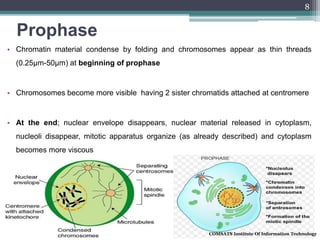
• Chromatin material condense by folding and chromosomes appear as thin threads
(0.25µm-50μm) at beginning of prophase
• Chromosomes become more visible having 2 sister chromatids attached at centromere
• At the end; nuclear envelope disappears, nuclear material released in cytoplasm,
nucleoli disappear, mitotic apparatus organize (as already described) and cytoplasm
becomes more viscous
COMSATS Institute Of Information Technology
8
Metaphase
COMSATS Institute Of Information Technology
9
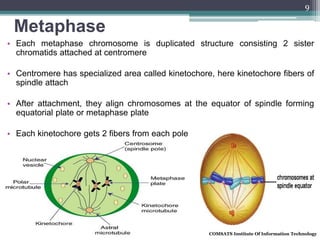
• Each metaphase chromosome is duplicated structure consisting 2 sister
chromatids attached at centromere
• Centromere has specialized area called kinetochore, here kinetochore fibers of
spindle attach
• After attachment, they align chromosomes at the equator of spindle forming
equatorial plate or metaphase plate
• Each kinetochore gets 2 fibers from each pole
Anaphase
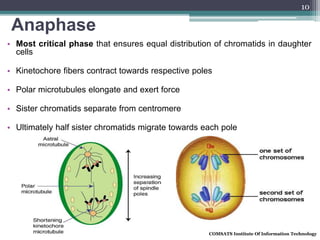
• Most critical phase that ensures equal distribution of chromatids in daughter
cells
• Kinetochore fibers contract towards respective poles
• Polar microtubules elongate and exert force
• Sister chromatids separate from centromere
• Ultimately half sister chromatids migrate towards each pole
COMSATS Institute Of Information Technology
10
Telophase
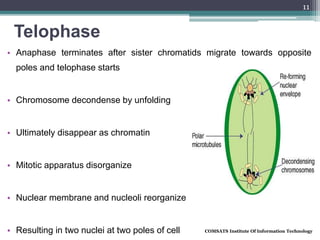
• Anaphase terminates after sister chromatids migrate towards opposite
poles and telophase starts
• Chromosome decondense by unfolding
• Ultimately disappear as chromatin
• Mitotic apparatus disorganize
• Nuclear membrane and nucleoli reorganize
• Resulting in two nuclei at two poles of cell COMSATS Institute Of Information Technology
11
Cytokinesis
COMSATS Institute Of Information Technology
12
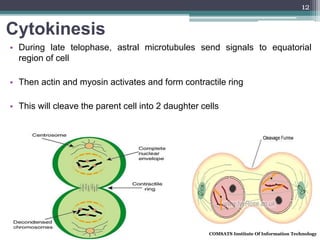
• During late telophase, astral microtubules send signals to equatorial
region of cell
• Then actin and myosin activates and form contractile ring
• This will cleave the parent cell into 2 daughter cells
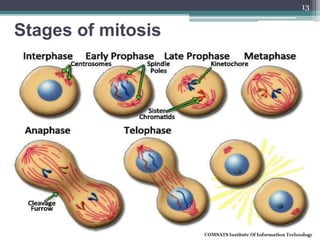
Stages of mitosis
13
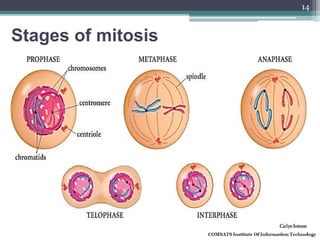
Stages of mitosis
14
Importance of mitosis
• Hereditary material is equally distributed in daughter cells
• Genetic information remains unchanged from parent to daughter cells
since there is no crossing over, ensuring continuity of same information
• Regeneration, wound healing and older cells are replaced are all gifts of
mitosis (asexual reproduction)
• Multicellular organisms depend on controlled mitosis for development
and growth
• Tissue culture and cloning seek help through mitosis
COMSATS Institute Of Information Technology
15
Meiosis
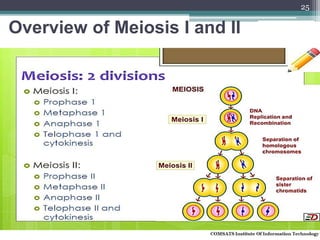
• Special type of cell division in which chromosome number in daughter
cells reduced to half, as compared to parent cell
• Takes place in diploid cells only (gamete formation in animals and spore
formation in plants)
• Each diploid cell forms 4 haploid cells due to two consecutive divisions
after single replication of DNA
• Two divisions are meiosis I and meiosis II
• Meiosis I is reduction division
• Meiosis II is just like mitosis
• Both divisions are further divided into prophase I, metaphase I, anaphase
I, telophase I and same names used for meiosis II
16
Prophase I
• A very prolonged phase different from prophase of mitosis as chromosomes
behave as homologous pairs
• Each diploid cell contains two chromosomes as homologous pairs, one
from each parent due to male and female gamete fusion
• Each chromosome contains 2 chromatids, since chromosomes have been
replicated during interphase
• These similar (not necessarily identical) chromosomes are called homologous
chromosomes
• Prophase I further contains 5 stages:
 Leptotene
 Zygotene
 Pachytene
 Diplotene
 Diakinesis
17
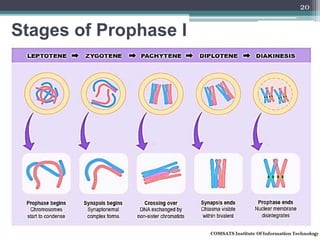
Stages of Prophase I
 Leptotene
• Chromosomes become visible, shorten and thick
• Nucleus size increases
• Homologous chromosomes start getting closer
 Zygotene
• Critical phase as pairing of homologous chromosomes (synapsis)
• Pairing is highly specific and pointed
• Each paired but not fused complex structure is called bivalent or tetrad (4
chromatids)
 Pachytene
• Pairing completed and each bivalent wrap around each other
• Chromosomes become more thick
• Non-sister chromatids exchange segments by chiasmata formation
(crossing over)
• Reshuffling of genetic material producing recombinations
• This phase lasts for days, weeks or years while former two lasts for few
hours
18
Stages of Prophase I
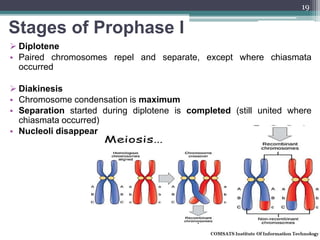
 Diplotene
• Paired chromosomes repel and separate, except where chiasmata
occurred
 Diakinesis
• Chromosome condensation is maximum
• Separation started during diplotene is completed (still united where
chiasmata occurred)
• Nucleoli disappear
19
Stages of Prophase I
20
Meiosis I
 Metaphase I
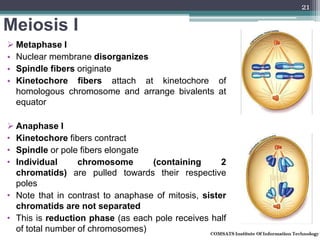
• Nuclear membrane disorganizes
• Spindle fibers originate
• Kinetochore fibers attach at kinetochore of
homologous chromosome and arrange bivalents at
equator
 Anaphase I
• Kinetochore fibers contract
• Spindle or pole fibers elongate
• Individual chromosome (containing 2
chromatids) are pulled towards their respective
poles
• Note that in contrast to anaphase of mitosis, sister
chromatids are not separated
• This is reduction phase (as each pole receives half
of total number of chromosomes)
21
Telophase I and Cytokinesis
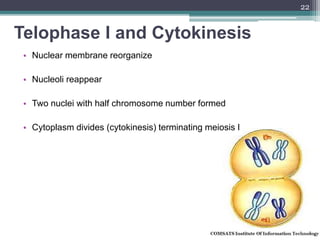
• Nuclear membrane reorganize
• Nucleoli reappear
• Two nuclei with half chromosome number formed
• Cytoplasm divides (cytokinesis) terminating meiosis I
22
Meiosis II
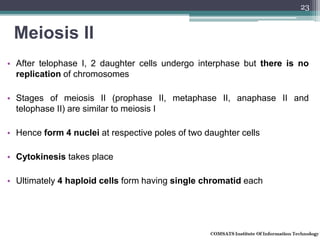
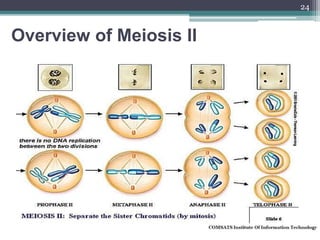
• After telophase I, 2 daughter cells undergo interphase but there is no
replication of chromosomes
• Stages of meiosis II (prophase II, metaphase II, anaphase II and
telophase II) are similar to meiosis I
• Hence form 4 nuclei at respective poles of two daughter cells
• Cytokinesis takes place
• Ultimately 4 haploid cells form having single chromatid each
23
Overview of Meiosis II
24
Overview of Meiosis I and II
25
Importance of Meiosis
• Two important events of meiosis are crossing over and random
assortment
• Crossing over between parental segments leads to large number of
recombinations
• Assortment of homologous chromosomes is random during anaphase
• This leads to wide variety of gametes
• Both events give rise to evolution
• Make every individual specific and unique in characteristics
• Even progeny of same parents are not identical
• Maintains constant number of chromosomes generation after generation
26
COMSATS Institute Of Information Technology
27

Cell cycle

  • 1.
    COMSATS Institute OfInformation Technology
  • 2.
    Contents • Introduction toCell Cycle • Interphase • Mitosis • Mitotic Apparatus and Karyokinesis • Phases of Mitosis and Cytokinesis • Significance of Mitosis • Meiosis • Phases of Meiosis I, Meiosis II and Cytokinesis • Significance of Meiosis COMSATS Institute Of Information Technology 2
  • 3.
    Introduction • The cellundergoes sequence of changes, which involves period of growth, DNA replication and cell division and this process is called cell cycle • It involves 2 phases;  Interphase (period between two consecutive cell divisions, misleadingly called resting phase)  Mitotic phase (cell division period) COMSATS Institute Of Information Technology 3
  • 4.
    Interphase COMSATS Institute OfInformation Technology 4 Period of great biochemical activity, divided into 3 phases;  G1 (Gap 1): • Period of extensive metabolic activity • Cell grows in size • Specific enzymes synthesized • DNA bases accumulate for DNA synthesis  S (synthesis) phase: • DNA synthesis • Chromosome number doubles  G2 (pre-mitotic) phase: • Preparing cell for division • Energy storage for chromosome movement • Mitosis specific proteins synthesis • Microtubule subunit synthesis
  • 5.
    Mitosis • Type ofcell division that ensures same number of chromosomes in daughter cells as that in parent cells • Takes place in haploid and diploid cells in all body parts whenever required • It is a continuous process • For understanding, divided into 2 phases  Karyokinesis (division of nucleus)  Cytokinesis (division of whole cell) COMSATS Institute Of Information Technology 5
  • 6.
    Mitotic Apparatus andKaryokinesis • At beginning, partition of two pair of centrioles (duplicated in interphase) occurs and they migrate towards opposite sides of nucleus • Three microtubule sets originate from each centriole pair • One set is astral microtubule that radiate outward and form aster (polar microtubules) • Other two sets form the spindle (kinetochore microtubules) COMSATS Institute Of Information Technology 6
  • 7.
    Mitotic Apparatus andKaryokinesis • Spindle fibers attach to chromosomes at kinetochore • Astral microtubule forms connection with other astral microtubules from opposite pole • Spindle and aster together forms mitotic apparatus • Designed to attach, capture, align and separate chromosomes to ensure equal distribution • Karyokinesis divided into 4 phases (prophase, metaphase, anaphase, telophase) 7
  • 8.
    Prophase • Chromatin materialcondense by folding and chromosomes appear as thin threads (0.25µm-50μm) at beginning of prophase • Chromosomes become more visible having 2 sister chromatids attached at centromere • At the end; nuclear envelope disappears, nuclear material released in cytoplasm, nucleoli disappear, mitotic apparatus organize (as already described) and cytoplasm becomes more viscous COMSATS Institute Of Information Technology 8
  • 9.
    Metaphase COMSATS Institute OfInformation Technology 9 • Each metaphase chromosome is duplicated structure consisting 2 sister chromatids attached at centromere • Centromere has specialized area called kinetochore, here kinetochore fibers of spindle attach • After attachment, they align chromosomes at the equator of spindle forming equatorial plate or metaphase plate • Each kinetochore gets 2 fibers from each pole
  • 10.
    Anaphase • Most criticalphase that ensures equal distribution of chromatids in daughter cells • Kinetochore fibers contract towards respective poles • Polar microtubules elongate and exert force • Sister chromatids separate from centromere • Ultimately half sister chromatids migrate towards each pole COMSATS Institute Of Information Technology 10
  • 11.
    Telophase • Anaphase terminatesafter sister chromatids migrate towards opposite poles and telophase starts • Chromosome decondense by unfolding • Ultimately disappear as chromatin • Mitotic apparatus disorganize • Nuclear membrane and nucleoli reorganize • Resulting in two nuclei at two poles of cell COMSATS Institute Of Information Technology 11
  • 12.
    Cytokinesis COMSATS Institute OfInformation Technology 12 • During late telophase, astral microtubules send signals to equatorial region of cell • Then actin and myosin activates and form contractile ring • This will cleave the parent cell into 2 daughter cells
  • 13.
  • 14.
  • 15.
    Importance of mitosis •Hereditary material is equally distributed in daughter cells • Genetic information remains unchanged from parent to daughter cells since there is no crossing over, ensuring continuity of same information • Regeneration, wound healing and older cells are replaced are all gifts of mitosis (asexual reproduction) • Multicellular organisms depend on controlled mitosis for development and growth • Tissue culture and cloning seek help through mitosis COMSATS Institute Of Information Technology 15
  • 16.
    Meiosis • Special typeof cell division in which chromosome number in daughter cells reduced to half, as compared to parent cell • Takes place in diploid cells only (gamete formation in animals and spore formation in plants) • Each diploid cell forms 4 haploid cells due to two consecutive divisions after single replication of DNA • Two divisions are meiosis I and meiosis II • Meiosis I is reduction division • Meiosis II is just like mitosis • Both divisions are further divided into prophase I, metaphase I, anaphase I, telophase I and same names used for meiosis II 16
  • 17.
    Prophase I • Avery prolonged phase different from prophase of mitosis as chromosomes behave as homologous pairs • Each diploid cell contains two chromosomes as homologous pairs, one from each parent due to male and female gamete fusion • Each chromosome contains 2 chromatids, since chromosomes have been replicated during interphase • These similar (not necessarily identical) chromosomes are called homologous chromosomes • Prophase I further contains 5 stages:  Leptotene  Zygotene  Pachytene  Diplotene  Diakinesis 17
  • 18.
    Stages of ProphaseI  Leptotene • Chromosomes become visible, shorten and thick • Nucleus size increases • Homologous chromosomes start getting closer  Zygotene • Critical phase as pairing of homologous chromosomes (synapsis) • Pairing is highly specific and pointed • Each paired but not fused complex structure is called bivalent or tetrad (4 chromatids)  Pachytene • Pairing completed and each bivalent wrap around each other • Chromosomes become more thick • Non-sister chromatids exchange segments by chiasmata formation (crossing over) • Reshuffling of genetic material producing recombinations • This phase lasts for days, weeks or years while former two lasts for few hours 18
  • 19.
    Stages of ProphaseI  Diplotene • Paired chromosomes repel and separate, except where chiasmata occurred  Diakinesis • Chromosome condensation is maximum • Separation started during diplotene is completed (still united where chiasmata occurred) • Nucleoli disappear 19
  • 20.
  • 21.
    Meiosis I  MetaphaseI • Nuclear membrane disorganizes • Spindle fibers originate • Kinetochore fibers attach at kinetochore of homologous chromosome and arrange bivalents at equator  Anaphase I • Kinetochore fibers contract • Spindle or pole fibers elongate • Individual chromosome (containing 2 chromatids) are pulled towards their respective poles • Note that in contrast to anaphase of mitosis, sister chromatids are not separated • This is reduction phase (as each pole receives half of total number of chromosomes) 21
  • 22.
    Telophase I andCytokinesis • Nuclear membrane reorganize • Nucleoli reappear • Two nuclei with half chromosome number formed • Cytoplasm divides (cytokinesis) terminating meiosis I 22
  • 23.
    Meiosis II • Aftertelophase I, 2 daughter cells undergo interphase but there is no replication of chromosomes • Stages of meiosis II (prophase II, metaphase II, anaphase II and telophase II) are similar to meiosis I • Hence form 4 nuclei at respective poles of two daughter cells • Cytokinesis takes place • Ultimately 4 haploid cells form having single chromatid each 23
  • 24.
  • 25.
  • 26.
    Importance of Meiosis •Two important events of meiosis are crossing over and random assortment • Crossing over between parental segments leads to large number of recombinations • Assortment of homologous chromosomes is random during anaphase • This leads to wide variety of gametes • Both events give rise to evolution • Make every individual specific and unique in characteristics • Even progeny of same parents are not identical • Maintains constant number of chromosomes generation after generation 26
  • 27.
    COMSATS Institute OfInformation Technology 27