Types and Causes
Causes
Cerebral palsy is due to damage occurring to the developing
brain. This damage can occur during pregnancy, delivery, the
first month of life, or less commonly in early childhood.
Structural problems in the brain are seen in 80% of cases,
most commonly within the white matter .More than three
quarters of cases are believed to result from issues that
occur during pregnancy.
Causes
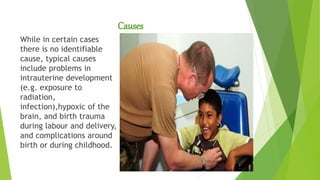
While in certain cases
there is no identifiable
cause, typical causes
include problems in
intrauterine development
(e.g. exposure to
radiation,
infection),hypoxic of the
brain, and birth trauma
during labour and delivery,
and complications around
birth or during childhood.
Prematurity
Between 40% and 50% of all children who develop cerebral
palsy were born prematurely. Most of these cases (75-90%)
are believed to be due to issues that occur around the time
of birth, often just after birth. Multiple-birth infants are also
more likely than single-birth infants to have CP. They are
also more likely to be born with a low birth weight.
In those who are born with a weight between 1 kg and 1.5 kg
CP occurs in 6%.Among those born before 28 weeks
of gestation it occurs in 11%. Genetic factors are believed to
play an important role in prematurity and cerebral palsy
generally. While in those who are born between 34 and
37 weeks the risk is 0.4% (three times normal).
Terminfants
In babies that are born at term risk factors include:
problems with the placenta, birth defects, low birth
weight, breathing meconium into the lungs, a delivery
requiring either the use of instruments or an
emergency caesarean section, birth asphyxia, seizures just
after birth, respiratory distress syndrome, low blood sugar,
and infections in the baby.
It is unclear how much of a role birth asphyxia plays as a
cause. It is believed, however, that only a small number of
cases are caused by lack of oxygen during birth. It is unclear
if the size of the placenta plays a role.
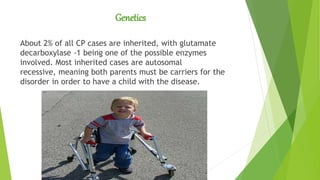
Genetics
About 2% of all CP cases are inherited, with glutamate
decarboxylase -1 being one of the possible enzymes
involved. Most inherited cases are autosomal
recessive, meaning both parents must be carriers for the
disorder in order to have a child with the disease.
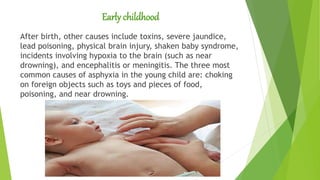
Early childhood
After birth, other causes include toxins, severe jaundice,
lead poisoning, physical brain injury, shaken baby syndrome,
incidents involving hypoxia to the brain (such as near
drowning), and encephalitis or meningitis. The three most
common causes of asphyxia in the young child are: choking
on foreign objects such as toys and pieces of food,
poisoning, and near drowning.
Other
Infections in the mother, even infections that are not easily
detected, may triple the risk of the child developing the
disorder. Infections of the fetal membranes known as
chorioamnionitis increases the risk.
 Intrauterine and neonatal insults (many of which are
infectious in nature) increase the risk.
 It has been hypothesised that many cases of cerebral palsy
are caused by the death in very early pregnancy of an
identical twin.
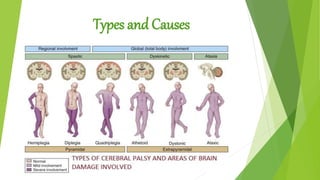
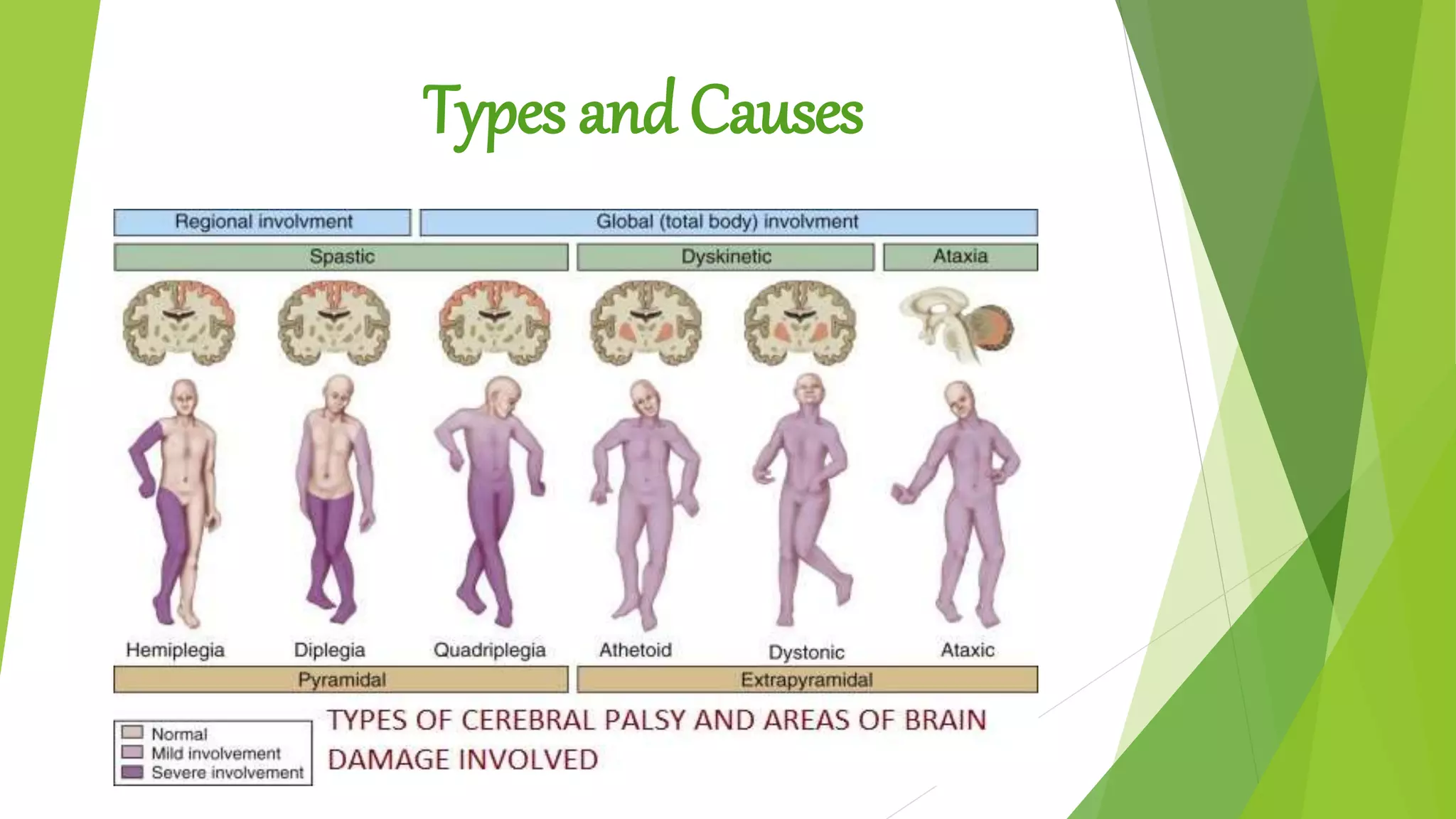
Types
 Physiological Grouping
 Spasticity
Spasticity is defined as a velocity-dependent increased
muscle tone, determined by passively flexing and extending
muscle groups across a joint. A satisfactory, reproducible
system of grading muscle tone has never been developed,
although the Ashworth and Tardieu scales are commonly used
in research. Most physicians describe the tone as being
normal, increased or decreased. Associated with spasticity
are enhanced deep tendon reflexes, usually associated with
clonus and extensor plantar responses. However, the latter
are sometimes difficult to elicit in the infant and even in the
older child with spastic CP.
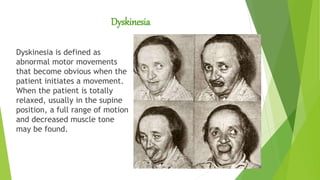
Dyskinesia
Dyskinesia is defined as
abnormal motor movements
that become obvious when the
patient initiates a movement.
When the patient is totally
relaxed, usually in the supine
position, a full range of motion
and decreased muscle tone
may be found.
Dyskinesia patients are subdivided into twosubgroups
The hyperkinetic or choreo-athetoid children show
purposeless, often massive involuntary movements with
motor overflow, that is, the initiation of a movement of one
extremity leads to movement of other muscle groups.
The dystonic group manifest abnormal shifts of general
muscle tone induced by movement. Typically, these children
assume and retain abnormal and distorted postures in a
stereotyped pattern. Both types of dyskinesia may occur in
the same patient. Simply stated, spasticity you feel;
dystonia you see.
Dyskinesia
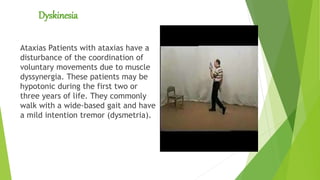
Ataxias Patients with ataxias have a
disturbance of the coordination of
voluntary movements due to muscle
dyssynergia. These patients may be
hypotonic during the first two or
three years of life. They commonly
walk with a wide-based gait and have
a mild intention tremor (dysmetria).
Dyskinesia
Mixed Group The fourth category that is commonly used in
the physiologic and motor classification is the mixed group.
Patients in this category commonly have mild spasticity,
dystonia, and/or athetoid movements. Ataxia may also be a
component of the motoric dysfunction in patients placed in
this group.
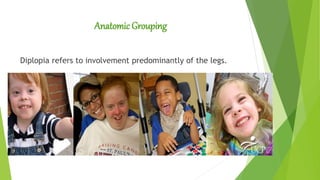
AnatomicGrouping
Diplopia refers to involvement predominantly of the legs.
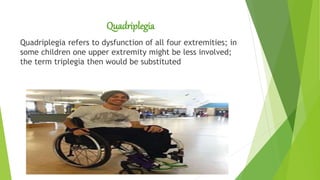
Quadriplegia
Quadriplegia refers to dysfunction of all four extremities; in
some children one upper extremity might be less involved;
the term triplegia then would be substituted
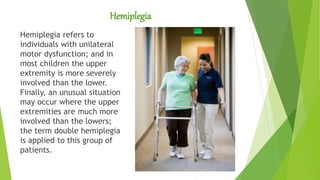
Hemiplegia
Hemiplegia refers to
individuals with unilateral
motor dysfunction; and in
most children the upper
extremity is more severely
involved than the lower.
Finally, an unusual situation
may occur where the upper
extremities are much more
involved than the lowers;
the term double hemiplegia
is applied to this group of
patients.

Celebral Palsy

  • 1.
  • 2.
    Causes Cerebral palsy isdue to damage occurring to the developing brain. This damage can occur during pregnancy, delivery, the first month of life, or less commonly in early childhood. Structural problems in the brain are seen in 80% of cases, most commonly within the white matter .More than three quarters of cases are believed to result from issues that occur during pregnancy.
  • 3.
    Causes While in certaincases there is no identifiable cause, typical causes include problems in intrauterine development (e.g. exposure to radiation, infection),hypoxic of the brain, and birth trauma during labour and delivery, and complications around birth or during childhood.
  • 4.
    Prematurity Between 40% and50% of all children who develop cerebral palsy were born prematurely. Most of these cases (75-90%) are believed to be due to issues that occur around the time of birth, often just after birth. Multiple-birth infants are also more likely than single-birth infants to have CP. They are also more likely to be born with a low birth weight. In those who are born with a weight between 1 kg and 1.5 kg CP occurs in 6%.Among those born before 28 weeks of gestation it occurs in 11%. Genetic factors are believed to play an important role in prematurity and cerebral palsy generally. While in those who are born between 34 and 37 weeks the risk is 0.4% (three times normal).
  • 5.
    Terminfants In babies thatare born at term risk factors include: problems with the placenta, birth defects, low birth weight, breathing meconium into the lungs, a delivery requiring either the use of instruments or an emergency caesarean section, birth asphyxia, seizures just after birth, respiratory distress syndrome, low blood sugar, and infections in the baby. It is unclear how much of a role birth asphyxia plays as a cause. It is believed, however, that only a small number of cases are caused by lack of oxygen during birth. It is unclear if the size of the placenta plays a role.
  • 6.
    Genetics About 2% ofall CP cases are inherited, with glutamate decarboxylase -1 being one of the possible enzymes involved. Most inherited cases are autosomal recessive, meaning both parents must be carriers for the disorder in order to have a child with the disease.
  • 7.
    Early childhood After birth,other causes include toxins, severe jaundice, lead poisoning, physical brain injury, shaken baby syndrome, incidents involving hypoxia to the brain (such as near drowning), and encephalitis or meningitis. The three most common causes of asphyxia in the young child are: choking on foreign objects such as toys and pieces of food, poisoning, and near drowning.
  • 8.
    Other Infections in themother, even infections that are not easily detected, may triple the risk of the child developing the disorder. Infections of the fetal membranes known as chorioamnionitis increases the risk.  Intrauterine and neonatal insults (many of which are infectious in nature) increase the risk.  It has been hypothesised that many cases of cerebral palsy are caused by the death in very early pregnancy of an identical twin.
  • 9.
    Types  Physiological Grouping Spasticity Spasticity is defined as a velocity-dependent increased muscle tone, determined by passively flexing and extending muscle groups across a joint. A satisfactory, reproducible system of grading muscle tone has never been developed, although the Ashworth and Tardieu scales are commonly used in research. Most physicians describe the tone as being normal, increased or decreased. Associated with spasticity are enhanced deep tendon reflexes, usually associated with clonus and extensor plantar responses. However, the latter are sometimes difficult to elicit in the infant and even in the older child with spastic CP.
  • 10.
    Dyskinesia Dyskinesia is definedas abnormal motor movements that become obvious when the patient initiates a movement. When the patient is totally relaxed, usually in the supine position, a full range of motion and decreased muscle tone may be found.
  • 11.
    Dyskinesia patients aresubdivided into twosubgroups The hyperkinetic or choreo-athetoid children show purposeless, often massive involuntary movements with motor overflow, that is, the initiation of a movement of one extremity leads to movement of other muscle groups. The dystonic group manifest abnormal shifts of general muscle tone induced by movement. Typically, these children assume and retain abnormal and distorted postures in a stereotyped pattern. Both types of dyskinesia may occur in the same patient. Simply stated, spasticity you feel; dystonia you see.
  • 12.
    Dyskinesia Ataxias Patients withataxias have a disturbance of the coordination of voluntary movements due to muscle dyssynergia. These patients may be hypotonic during the first two or three years of life. They commonly walk with a wide-based gait and have a mild intention tremor (dysmetria).
  • 13.
    Dyskinesia Mixed Group Thefourth category that is commonly used in the physiologic and motor classification is the mixed group. Patients in this category commonly have mild spasticity, dystonia, and/or athetoid movements. Ataxia may also be a component of the motoric dysfunction in patients placed in this group.
  • 14.
    AnatomicGrouping Diplopia refers toinvolvement predominantly of the legs.
  • 15.
    Quadriplegia Quadriplegia refers todysfunction of all four extremities; in some children one upper extremity might be less involved; the term triplegia then would be substituted
  • 16.
    Hemiplegia Hemiplegia refers to individualswith unilateral motor dysfunction; and in most children the upper extremity is more severely involved than the lower. Finally, an unusual situation may occur where the upper extremities are much more involved than the lowers; the term double hemiplegia is applied to this group of patients.