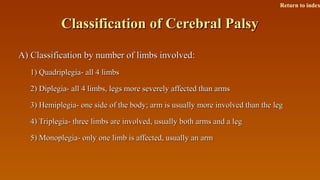
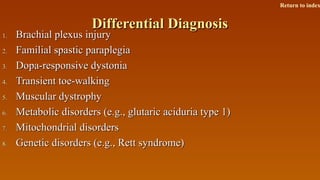
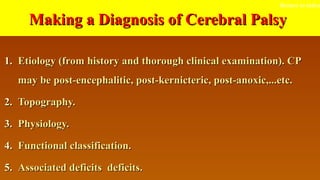
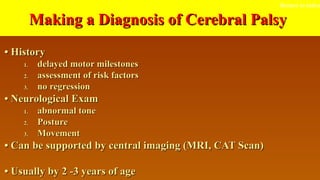
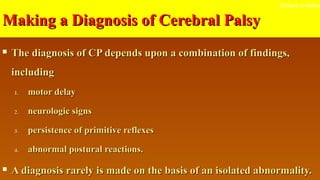
Cerebral palsy is defined as a group of permanent disorders of movement and posture caused by non-progressive disturbances in the developing brain before birth or in early childhood. It results in motor impairment and can be accompanied by sensory, cognitive, communication, perception, and/or behavioral and epilepsy problems. The document discusses the classification, epidemiology, risk factors, pathophysiology, etiology, clinical features, and subtypes of cerebral palsy.






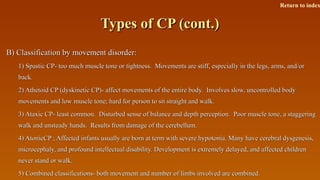

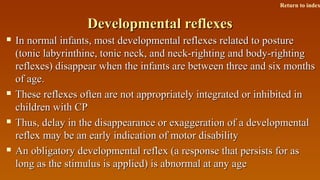
![ increased deep tendon reflexesincreased deep tendon reflexes
sustained clonussustained clonus
HypertoniaHypertonia
clasp-knife responseclasp-knife response
Persistent primitive reflex patternsPersistent primitive reflex patterns
• (e.g., asymmetric tonic neck reflex [ATNR], labyrinthine)(e.g., asymmetric tonic neck reflex [ATNR], labyrinthine)
Cerebral Hypertonia: SpasticityCerebral Hypertonia: Spasticity
Return to index](https://image.slidesharecdn.com/comprehensiveincerebralpalsy-170308151631/85/Comprehensive-in-cerebral-palsy-20-320.jpg)
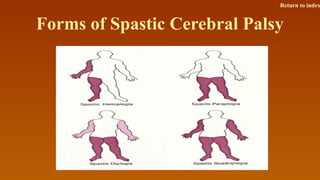


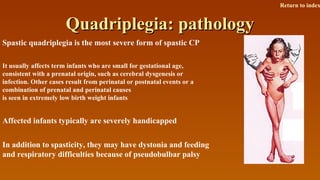
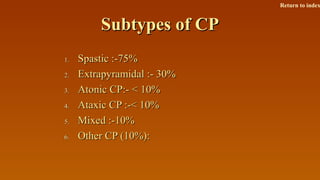
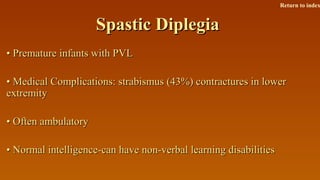
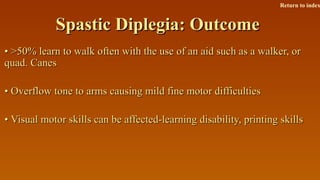
![Spastic DiplegiaSpastic Diplegia
Spastic diplegia affects both term,preterm infants
Spastic diplegia in preterm infants often is associated with periventricular
leukomalacia (PVL), and the risk is greater with increasing prematurity.
The lower limbs are affected predominantly
Patients with mild PVL may have relatively good hand function and fewer
associated disabilities. In more severely affected patients, upper limb function
also may be compromised, depending upon the degree of spasticity, presence of
contractures, sensory loss, associated involuntary movements, and intelligence.
Sensory disturbances of central nervous system origin, such as poor two-point
discrimination and astereognosis, are common in all the spastic syndromes [6].
Vasomotor abnormalities also occur
Return to index](https://image.slidesharecdn.com/comprehensiveincerebralpalsy-170308151631/85/Comprehensive-in-cerebral-palsy-34-320.jpg)



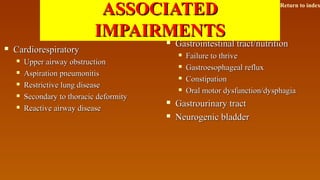
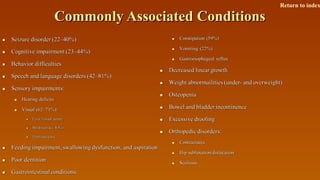
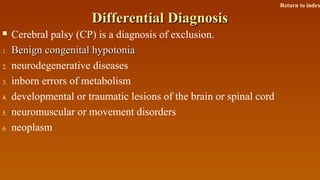
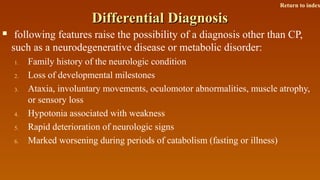
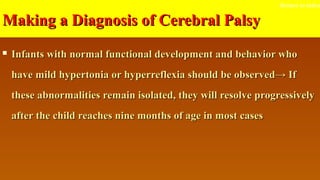
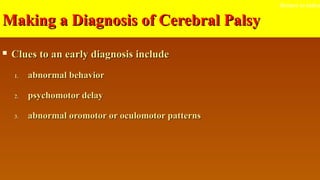
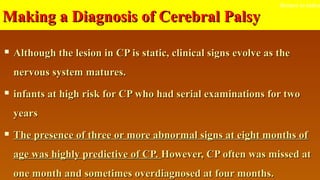
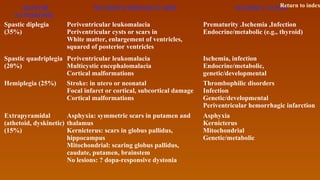
![Levine (POSTER) criteria for the diagnosis of CPLevine (POSTER) criteria for the diagnosis of CP
1.1. P :- Posturing/abnormal movementsP :- Posturing/abnormal movements
2.2. O :- Oropharyngeal problemsO :- Oropharyngeal problems
(e.g., tongue thrusts, swallowing abnormalities)(e.g., tongue thrusts, swallowing abnormalities)
1.1. S :- StrabismusS :- Strabismus
2.2. T :- Tone (hyper- or hypotonia)T :- Tone (hyper- or hypotonia)
3.3. E :- Evolutional maldevelopmentE :- Evolutional maldevelopment
(primitive reflexes persist or protective/equilibrium reflexes fail to develop [e.g., lateral prop, parachute reflex])(primitive reflexes persist or protective/equilibrium reflexes fail to develop [e.g., lateral prop, parachute reflex])
1.1. R :- Reflexes (increased deep tendon reflexes/persistent Babinski's reflex)R :- Reflexes (increased deep tendon reflexes/persistent Babinski's reflex)
Abnormalities in four of these six categories strongly point to the diagnosis of CPAbnormalities in four of these six categories strongly point to the diagnosis of CP
Abnormalities in four of these six categories strongly point to the diagnosis of
CP
Return to index](https://image.slidesharecdn.com/comprehensiveincerebralpalsy-170308151631/85/Comprehensive-in-cerebral-palsy-70-320.jpg)






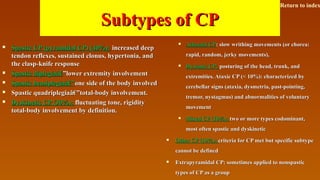
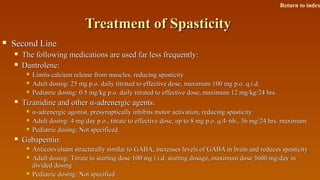
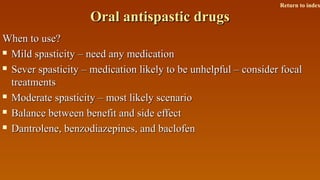
![Treatment of SpasticityTreatment of Spasticity
First LineFirst Line
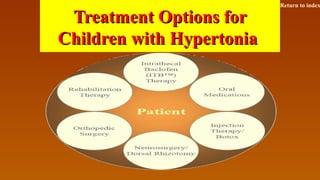
Baclofen (10)[C]:Baclofen (10)[C]:
γ-γ-aminobutyric acid B (GABAaminobutyric acid B (GABABB) agonist, facilitates presynaptic inhibition of mono- and polysynaptic reflexes) agonist, facilitates presynaptic inhibition of mono- and polysynaptic reflexes
Adults: Initial dose is 5 mg t.i.d. and increase dosage every 3 days to an average maintenance dose of 20 mg t.i.d. 80 mg/24-hrAdults: Initial dose is 5 mg t.i.d. and increase dosage every 3 days to an average maintenance dose of 20 mg t.i.d. 80 mg/24-hr
maximummaximum
Pediatric dose (>2 y/o): Initial 10–15 mg/24 hrs. Titrate to effective dose. <8 y/o = 40 mg/24 hrs. maximum. >8 y/o 60 mg/24Pediatric dose (>2 y/o): Initial 10–15 mg/24 hrs. Titrate to effective dose. <8 y/o = 40 mg/24 hrs. maximum. >8 y/o 60 mg/24
hrs. maximumhrs. maximum
Intrathecal Baclofen (Baclofen Pump) :Intrathecal Baclofen (Baclofen Pump) :
Continuous intrathecal route allows greater maximal response with smaller dosageContinuous intrathecal route allows greater maximal response with smaller dosage
Significantly reduces spasticity in children with cerebral palsySignificantly reduces spasticity in children with cerebral palsy
Multiple adverse effects due to catheter placement and medication side effectsMultiple adverse effects due to catheter placement and medication side effects
Diazepam (10)[C]:Diazepam (10)[C]:
A GABAA GABAAA agonist, facilitating CNS inhibition at spinal and supraspinal levels to reduce spasticityagonist, facilitating CNS inhibition at spinal and supraspinal levels to reduce spasticity
Adult dose: 2–12 mg/dose p.o. q. 6–12 hrs.Adult dose: 2–12 mg/dose p.o. q. 6–12 hrs.
Pediatric dose (<12 yrs): 0.12–0.8 mg/kg/24 h. p.o., divided q.6–8h.Pediatric dose (<12 yrs): 0.12–0.8 mg/kg/24 h. p.o., divided q.6–8h.
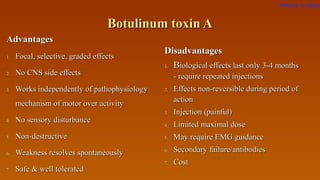
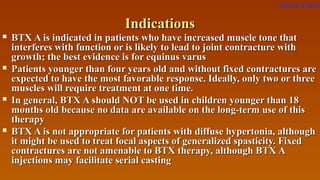
Botulinum toxin type A:Botulinum toxin type A:
Injected directly into muscles of interestInjected directly into muscles of interest
Acts at neuromuscular junction to inhibit the release of acetylcholineActs at neuromuscular junction to inhibit the release of acetylcholine
Chemically denervates muscles, reducing toneChemically denervates muscles, reducing tone
Lasts for 12–16 weeks following injectionLasts for 12–16 weeks following injection
Return to index](https://image.slidesharecdn.com/comprehensiveincerebralpalsy-170308151631/85/Comprehensive-in-cerebral-palsy-90-320.jpg)















![cerebral palsy[1].pptxcerebral palsy management etiopathogenesis](https://cdn.slidesharecdn.com/ss_thumbnails/cerebralpalsy1-251219125140-a80c6a48-thumbnail.jpg?width=640&height=640&fit=bounds)


