POLIOMYELITIS
AND ITS
MANAGEMENT
Dr. Arojuraye S. A
(MBBS, FWACS, FMCOrtho)
Consultant Orthopaedic & Trauma Surgeon
National Orthopaedic Hospital, Dala - Kano
Refresher Course in Orthopaedic Nursing, June 2019.
doctoraroju@yahoo.com
Outline
 Introduction
 Aetiopathogenesis
 Clinical Spectrum
 Differential diagnosis
 Orthopaedic complications
 Management
 Prevention
 Treatment
 West African Peculiarities
 Conclusion
Refresher Course in Orthopaedic Nursing, June 2019.
doctoraroju@yahoo.com
Introduction
 Poliomyelitis: Acute infectious viral disease
spread by the oropharyngeal route.
 Major cause of morbidity & mortality until
1960s
 Large epidemics in 1940s & 1950s in
developed world
Refresher Course in Orthopaedic Nursing, June 2019.
doctoraroju@yahoo.com
Introduction…
 Only 10% of patients exhibit any symptoms
 CNS involvement occurs in < 1%
 “Silent circulation”
 Many may be infected prior to the development of
a single case of paralysis
 WHO:
 a single confirmed case of polio in an area of low
occurrence is an epidemic
Refresher Course in Orthopaedic Nursing, June 2019.
doctoraroju@yahoo.com
Introduction…
 Effects:
 Anterior horn cells of the spinal cord & brainstem
 Flaccid paralysis of the affected muscle groups
 Rare disease (1988):
 Due to vaccination
 Effects of previous dx are still with us
Refresher Course in Orthopaedic Nursing, June
2019. doctoraroju@yahoo.com
Introduction…
 Affects any age & Sex
 Most common in children (<5yrs)
 M:F = 3:1
 Immunity
 Maternal immunity disappear during the first six
month of the life.
 Immunity after the infection is life long but
reinjection
 No cross immunity: types I, II & III
Refresher Course in Orthopaedic Nursing, June 2019.
doctoraroju@yahoo.com
Introduction…
 3 countries are endemic (2014):
 Pakistan
 Nigeria
 Afghanistan
 WHO (25/09/2015):
 Nigeria out of polio - endemic list
 Sporadic cases occur in many others
Refresher Course in Orthopaedic Nursing, June 2019.
doctoraroju@yahoo.com
Introduction…
 Patients with polio sequelae:
 Still abundant
 They are not infectious
 They are crippled & outcast in modern society
The role of Orthopedic surgeon & nurses is not
during acute phase, but to effectively treat its
sequelae to help these people lead a more
normal life
Refresher Course in Orthopaedic Nursing, June 2019.
doctoraroju@yahoo.com
Aetiopathogenesis
 Infection is caused by poliomyelitis virus:
 Group: Enterovirus
 Family: Picornavirus
 Single-stranded RNA
 3 different strains of virus: type I, II, III
 No cross immunity
 Polio virus can survive for long periods in the
external environment
 4 months in water & 6 months in faeces
Refresher Course in Orthopaedic Nursing, June 2019.
doctoraroju@yahoo.com
Aetiopathogenesis…
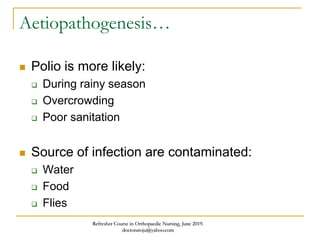
 Polio is more likely:
 During rainy season
 Overcrowding
 Poor sanitation
 Source of infection are contaminated:
 Water
 Food
 Flies
Refresher Course in Orthopaedic Nursing, June 2019.
doctoraroju@yahoo.com
Aetiopathogenesis…
 Route:
 Oral route
 Multiplies in intestine (may manifest as diarrhea)
 Reaches the nervous system via bloodstream
 Incubation period: 7 – 14 days
 Affinity:
 Some brainstem nuclei
 Anterior horn cells of the spinal cord
(lumbar & cervical enlargements of the cord)
Refresher Course in Orthopaedic Nursing, June 2019.
doctoraroju@yahoo.com
Aetiopathogenesis…
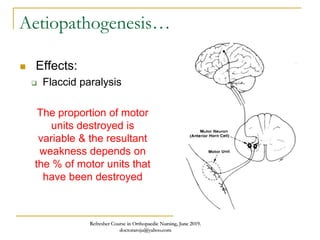
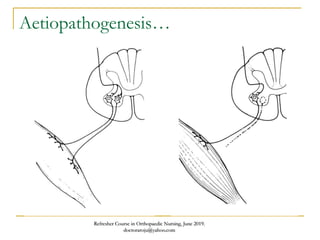
 Effects:
 Flaccid paralysis
The proportion of motor
units destroyed is
variable & the resultant
weakness depends on
the % of motor units that
have been destroyed
Refresher Course in Orthopaedic Nursing, June 2019.
doctoraroju@yahoo.com
Aetiopathogenesis…
Refresher Course in Orthopaedic Nursing, June 2019.
doctoraroju@yahoo.com
Clinical Spectrum
 Polio passes through several clinical phases:
 Acute illness
 Paralysis
 Convalescence
 Residual paralysis
Refresher Course in Orthopaedic Nursing, June 2019.
doctoraroju@yahoo.com
Clinical Spectrum (Acute illness)
 Prodromal symptoms (1/3):
 Sore throat
 Mild headache
 Slight pyrexia
 Diarrhea
 With increase in severity:
 Neck stiffness (like in meningitis)
 Joints flexed; the muscles are painful & tender
 Passive stretching provokes painful spasms
Refresher Course in Orthopaedic Nursing, June 2019.
doctoraroju@yahoo.com
Clinical Spectrum
(Paralysis)
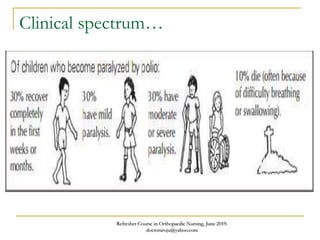
 Muscle weakness appears:
 It reaches a peak in 2–3 days
 May give rise to dyspnea & dysphagia
 May die or survive
 If the patient does not succumb:
 Pain and pyrexia subside after 7–10
 Patient is infective for at least 4 weeks
Refresher Course in Orthopaedic Nursing, June 2019.
doctoraroju@yahoo.com
Clinical spectrum…
Refresher Course in Orthopaedic Nursing, June 2019.
doctoraroju@yahoo.com
Clinical Spectrum
(Recovery & Convalescence)
 Return of muscle power:
 Most noticeable within the first 6 months
 There may be continuing improvement:
 For up to 2 years.
Refresher Course in Orthopaedic Nursing, June 2019.
doctoraroju@yahoo.com
Clinical spectrum
(Residual paralysis)
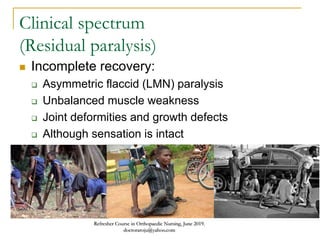
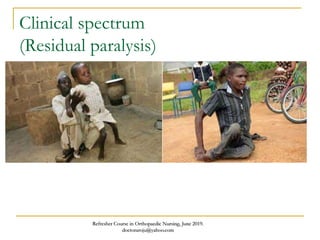
 Incomplete recovery:
 Asymmetric flaccid (LMN) paralysis
 Unbalanced muscle weakness
 Joint deformities and growth defects
 Although sensation is intact
Refresher Course in Orthopaedic Nursing, June 2019.
doctoraroju@yahoo.com
Clinical spectrum
(Residual paralysis)
Refresher Course in Orthopaedic Nursing, June 2019.
doctoraroju@yahoo.com
Clinical Spectrum
(Post-polio Syndrome)
 Reactivation of the virus (50% of cases):
 Progressive muscle weakness
 Unaccustomed fatigue
 Diagnosis:
 Patients with a confirmed history of poliomyelitis
 Period of neurological stability of at least 15 years
 Diagnosis of exclusion
Refresher Course in Orthopaedic Nursing, June 2019.
doctoraroju@yahoo.com
Differential diagnosis
 Diagnosis of polio must be considered in
endemic areas whenever a child presents
with acute flaccid paralysis
 Differentials:
 Guillain-Barré syndrome
 Acute transverse myelitis
 Traumatic paraplegia
 Myopathy, Neuropathy
 Spinal dysraphism
Refresher Course in Orthopaedic Nursing, June 2019.
doctoraroju@yahoo.com
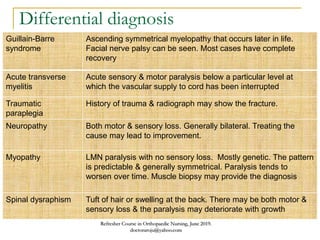
Differential diagnosis
Guillain-Barre
syndrome
Ascending symmetrical myelopathy that occurs later in life.
Facial nerve palsy can be seen. Most cases have complete
recovery
Acute transverse
myelitis
Acute sensory & motor paralysis below a particular level at
which the vascular supply to cord has been interrupted
Traumatic
paraplegia
History of trauma & radiograph may show the fracture.
Neuropathy Both motor & sensory loss. Generally bilateral. Treating the
cause may lead to improvement.
Myopathy LMN paralysis with no sensory loss. Mostly genetic. The pattern
is predictable & generally symmetrical. Paralysis tends to
worsen over time. Muscle biopsy may provide the diagnosis
Spinal dysraphism Tuft of hair or swelling at the back. There may be both motor &
sensory loss & the paralysis may deteriorate with growth
Refresher Course in Orthopaedic Nursing, June 2019.
doctoraroju@yahoo.com
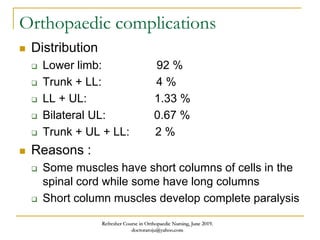
Orthopaedic complications
 Distribution
 Lower limb: 92 %
 Trunk + LL: 4 %
 LL + UL: 1.33 %
 Bilateral UL: 0.67 %
 Trunk + UL + LL: 2 %
 Reasons :
 Some muscles have short columns of cells in the
spinal cord while some have long columns
 Short column muscles develop complete paralysis
Refresher Course in Orthopaedic Nursing, June 2019.
doctoraroju@yahoo.com
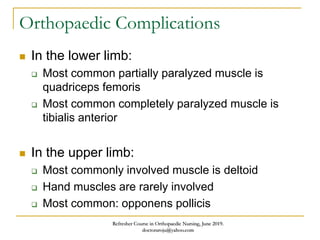
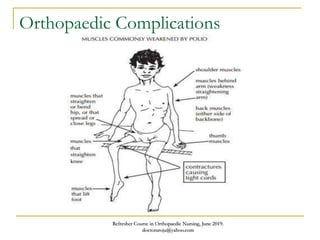
Orthopaedic Complications
 In the lower limb:
 Most common partially paralyzed muscle is
quadriceps femoris
 Most common completely paralyzed muscle is
tibialis anterior
 In the upper limb:
 Most commonly involved muscle is deltoid
 Hand muscles are rarely involved
 Most common: opponens pollicis
Refresher Course in Orthopaedic Nursing, June 2019.
doctoraroju@yahoo.com
Orthopaedic Complications
Refresher Course in Orthopaedic Nursing, June 2019.
doctoraroju@yahoo.com
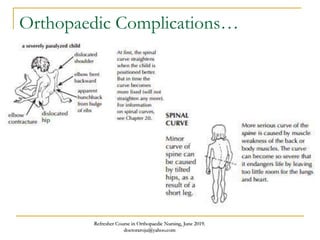
Orthopaedic Complications…
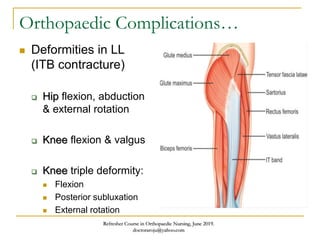
 Deformities in LL
(ITB contracture)
 Hip flexion, abduction
& external rotation
 Knee flexion & valgus
 Knee triple deformity:
 Flexion
 Posterior subluxation
 External rotation
Refresher Course in Orthopaedic Nursing, June 2019.
doctoraroju@yahoo.com
Orthopaedic Complications…
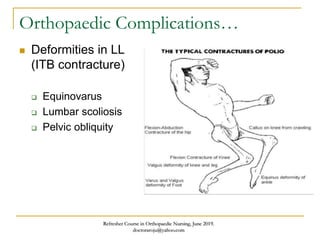
 Deformities in LL
(ITB contracture)
 Equinovarus
 Lumbar scoliosis
 Pelvic obliquity
Refresher Course in Orthopaedic Nursing, June 2019.
doctoraroju@yahoo.com
Orthopaedic Complications…
Refresher Course in Orthopaedic Nursing, June 2019.
doctoraroju@yahoo.com
Orthopaedic Complications…
Refresher Course in Orthopaedic Nursing, June 2019.
doctoraroju@yahoo.com
Orthopaedic Complications
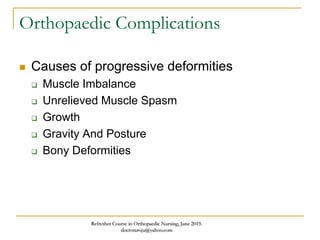
 Causes of progressive deformities
 Muscle Imbalance
 Unrelieved Muscle Spasm
 Growth
 Gravity And Posture
 Bony Deformities
Refresher Course in Orthopaedic Nursing, June 2019.
doctoraroju@yahoo.com
Management (Prevention)
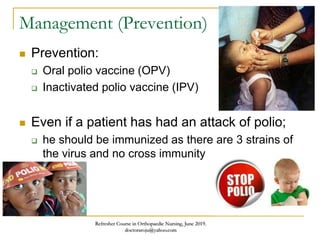
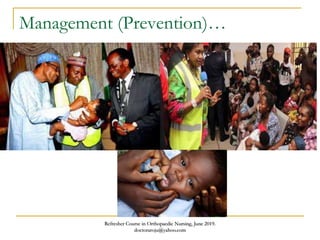
 Prevention:
 Oral polio vaccine (OPV)
 Inactivated polio vaccine (IPV)
 Even if a patient has had an attack of polio;
 he should be immunized as there are 3 strains of
the virus and no cross immunity
Refresher Course in Orthopaedic Nursing, June 2019.
doctoraroju@yahoo.com
Management (Prevention)…
Refresher Course in Orthopaedic Nursing, June 2019.
doctoraroju@yahoo.com
Management (Treatment)
Depends on the phase of the dx.
 Acute phase:
 Symptomatic as the disease run its course
 Bed rest & splintage of paralyzed limbs
 Active movements are avoided
 Ventilatory support for resp. paralysis
Refresher Course in Orthopaedic Nursing, June 2019.
doctoraroju@yahoo.com
Management (Treatment)…
 Convalescent phase:
 Joints are splinted to reduce pain
 Joint mobilization exercises are begun
 Paralysis:
 Limit the resultant deformities
Refresher Course in Orthopaedic Nursing, June 2019.
doctoraroju@yahoo.com
Management (Treatment)…
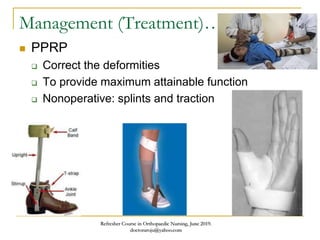
 PPRP
 Correct the deformities
 To provide maximum attainable function
 Nonoperative: splints and traction
Refresher Course in Orthopaedic Nursing, June 2019.
doctoraroju@yahoo.com
Management (Treatment)…
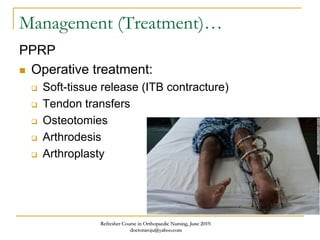
PPRP
 Operative treatment:
 Soft-tissue release (ITB contracture)
 Tendon transfers
 Osteotomies
 Arthrodesis
 Arthroplasty
Refresher Course in Orthopaedic Nursing, June 2019.
doctoraroju@yahoo.com
Prognosis
 Depends on 2 factors:
 Severity of initial paralysis
 Diffuseness of its regional distribution.
Refresher Course in Orthopaedic Nursing, June 2019.
doctoraroju@yahoo.com
Prognosis…
Generally:
 If total paralysis persists beyond the 2nd month,
significant recovery is unlikely.
 If the initial paralysis is partial, prognosis is better
 The more extensive the paralysis in the first 10
days of illness the more severe the ultimate
disability
Refresher Course in Orthopaedic Nursing, June 2019.
doctoraroju@yahoo.com
References
 WHO Fact sheet on Poliomyelitis, March 1 2019.
https://www.who.int/news-room/fact-sheets/detail/poliomyelitis.
 Deborah E. Poliomyelitis In: Apleys GA, Solomon L. Apleys System
of Orthopaedics & Trauma; Neuromuscular disorders. CRC Press,
2018; Chp 10: 261 – 265.
 Mukul M, Jitesh JK. Poliomyelitis In: Fundamentals of
Orthopaedics; Neuromuscular disorders. Jaypee Brothers Medical
Publishers, 2016; Chp 8: 311 – 314.
Refresher Course in Orthopaedic Nursing, June 2019.
doctoraroju@yahoo.com

Poliomyelitis and its management

  • 1.
    POLIOMYELITIS AND ITS MANAGEMENT Dr. ArojurayeS. A (MBBS, FWACS, FMCOrtho) Consultant Orthopaedic & Trauma Surgeon National Orthopaedic Hospital, Dala - Kano Refresher Course in Orthopaedic Nursing, June 2019. doctoraroju@yahoo.com
  • 2.
    Outline  Introduction  Aetiopathogenesis Clinical Spectrum  Differential diagnosis  Orthopaedic complications  Management  Prevention  Treatment  West African Peculiarities  Conclusion Refresher Course in Orthopaedic Nursing, June 2019. doctoraroju@yahoo.com
  • 3.
    Introduction  Poliomyelitis: Acuteinfectious viral disease spread by the oropharyngeal route.  Major cause of morbidity & mortality until 1960s  Large epidemics in 1940s & 1950s in developed world Refresher Course in Orthopaedic Nursing, June 2019. doctoraroju@yahoo.com
  • 4.
    Introduction…  Only 10%of patients exhibit any symptoms  CNS involvement occurs in < 1%  “Silent circulation”  Many may be infected prior to the development of a single case of paralysis  WHO:  a single confirmed case of polio in an area of low occurrence is an epidemic Refresher Course in Orthopaedic Nursing, June 2019. doctoraroju@yahoo.com
  • 5.
    Introduction…  Effects:  Anteriorhorn cells of the spinal cord & brainstem  Flaccid paralysis of the affected muscle groups  Rare disease (1988):  Due to vaccination  Effects of previous dx are still with us Refresher Course in Orthopaedic Nursing, June 2019. doctoraroju@yahoo.com
  • 6.
    Introduction…  Affects anyage & Sex  Most common in children (<5yrs)  M:F = 3:1  Immunity  Maternal immunity disappear during the first six month of the life.  Immunity after the infection is life long but reinjection  No cross immunity: types I, II & III Refresher Course in Orthopaedic Nursing, June 2019. doctoraroju@yahoo.com
  • 7.
    Introduction…  3 countriesare endemic (2014):  Pakistan  Nigeria  Afghanistan  WHO (25/09/2015):  Nigeria out of polio - endemic list  Sporadic cases occur in many others Refresher Course in Orthopaedic Nursing, June 2019. doctoraroju@yahoo.com
  • 8.
    Introduction…  Patients withpolio sequelae:  Still abundant  They are not infectious  They are crippled & outcast in modern society The role of Orthopedic surgeon & nurses is not during acute phase, but to effectively treat its sequelae to help these people lead a more normal life Refresher Course in Orthopaedic Nursing, June 2019. doctoraroju@yahoo.com
  • 9.
    Aetiopathogenesis  Infection iscaused by poliomyelitis virus:  Group: Enterovirus  Family: Picornavirus  Single-stranded RNA  3 different strains of virus: type I, II, III  No cross immunity  Polio virus can survive for long periods in the external environment  4 months in water & 6 months in faeces Refresher Course in Orthopaedic Nursing, June 2019. doctoraroju@yahoo.com
  • 10.
    Aetiopathogenesis…  Polio ismore likely:  During rainy season  Overcrowding  Poor sanitation  Source of infection are contaminated:  Water  Food  Flies Refresher Course in Orthopaedic Nursing, June 2019. doctoraroju@yahoo.com
  • 11.
    Aetiopathogenesis…  Route:  Oralroute  Multiplies in intestine (may manifest as diarrhea)  Reaches the nervous system via bloodstream  Incubation period: 7 – 14 days  Affinity:  Some brainstem nuclei  Anterior horn cells of the spinal cord (lumbar & cervical enlargements of the cord) Refresher Course in Orthopaedic Nursing, June 2019. doctoraroju@yahoo.com
  • 12.
    Aetiopathogenesis…  Effects:  Flaccidparalysis The proportion of motor units destroyed is variable & the resultant weakness depends on the % of motor units that have been destroyed Refresher Course in Orthopaedic Nursing, June 2019. doctoraroju@yahoo.com
  • 13.
    Aetiopathogenesis… Refresher Course inOrthopaedic Nursing, June 2019. doctoraroju@yahoo.com
  • 14.
    Clinical Spectrum  Poliopasses through several clinical phases:  Acute illness  Paralysis  Convalescence  Residual paralysis Refresher Course in Orthopaedic Nursing, June 2019. doctoraroju@yahoo.com
  • 15.
    Clinical Spectrum (Acuteillness)  Prodromal symptoms (1/3):  Sore throat  Mild headache  Slight pyrexia  Diarrhea  With increase in severity:  Neck stiffness (like in meningitis)  Joints flexed; the muscles are painful & tender  Passive stretching provokes painful spasms Refresher Course in Orthopaedic Nursing, June 2019. doctoraroju@yahoo.com
  • 16.
    Clinical Spectrum (Paralysis)  Muscleweakness appears:  It reaches a peak in 2–3 days  May give rise to dyspnea & dysphagia  May die or survive  If the patient does not succumb:  Pain and pyrexia subside after 7–10  Patient is infective for at least 4 weeks Refresher Course in Orthopaedic Nursing, June 2019. doctoraroju@yahoo.com
  • 17.
    Clinical spectrum… Refresher Coursein Orthopaedic Nursing, June 2019. doctoraroju@yahoo.com
  • 18.
    Clinical Spectrum (Recovery &Convalescence)  Return of muscle power:  Most noticeable within the first 6 months  There may be continuing improvement:  For up to 2 years. Refresher Course in Orthopaedic Nursing, June 2019. doctoraroju@yahoo.com
  • 19.
    Clinical spectrum (Residual paralysis) Incomplete recovery:  Asymmetric flaccid (LMN) paralysis  Unbalanced muscle weakness  Joint deformities and growth defects  Although sensation is intact Refresher Course in Orthopaedic Nursing, June 2019. doctoraroju@yahoo.com
  • 20.
    Clinical spectrum (Residual paralysis) RefresherCourse in Orthopaedic Nursing, June 2019. doctoraroju@yahoo.com
  • 21.
    Clinical Spectrum (Post-polio Syndrome) Reactivation of the virus (50% of cases):  Progressive muscle weakness  Unaccustomed fatigue  Diagnosis:  Patients with a confirmed history of poliomyelitis  Period of neurological stability of at least 15 years  Diagnosis of exclusion Refresher Course in Orthopaedic Nursing, June 2019. doctoraroju@yahoo.com
  • 22.
    Differential diagnosis  Diagnosisof polio must be considered in endemic areas whenever a child presents with acute flaccid paralysis  Differentials:  Guillain-Barré syndrome  Acute transverse myelitis  Traumatic paraplegia  Myopathy, Neuropathy  Spinal dysraphism Refresher Course in Orthopaedic Nursing, June 2019. doctoraroju@yahoo.com
  • 23.
    Differential diagnosis Guillain-Barre syndrome Ascending symmetricalmyelopathy that occurs later in life. Facial nerve palsy can be seen. Most cases have complete recovery Acute transverse myelitis Acute sensory & motor paralysis below a particular level at which the vascular supply to cord has been interrupted Traumatic paraplegia History of trauma & radiograph may show the fracture. Neuropathy Both motor & sensory loss. Generally bilateral. Treating the cause may lead to improvement. Myopathy LMN paralysis with no sensory loss. Mostly genetic. The pattern is predictable & generally symmetrical. Paralysis tends to worsen over time. Muscle biopsy may provide the diagnosis Spinal dysraphism Tuft of hair or swelling at the back. There may be both motor & sensory loss & the paralysis may deteriorate with growth Refresher Course in Orthopaedic Nursing, June 2019. doctoraroju@yahoo.com
  • 24.
    Orthopaedic complications  Distribution Lower limb: 92 %  Trunk + LL: 4 %  LL + UL: 1.33 %  Bilateral UL: 0.67 %  Trunk + UL + LL: 2 %  Reasons :  Some muscles have short columns of cells in the spinal cord while some have long columns  Short column muscles develop complete paralysis Refresher Course in Orthopaedic Nursing, June 2019. doctoraroju@yahoo.com
  • 25.
    Orthopaedic Complications  Inthe lower limb:  Most common partially paralyzed muscle is quadriceps femoris  Most common completely paralyzed muscle is tibialis anterior  In the upper limb:  Most commonly involved muscle is deltoid  Hand muscles are rarely involved  Most common: opponens pollicis Refresher Course in Orthopaedic Nursing, June 2019. doctoraroju@yahoo.com
  • 26.
    Orthopaedic Complications Refresher Coursein Orthopaedic Nursing, June 2019. doctoraroju@yahoo.com
  • 27.
    Orthopaedic Complications…  Deformitiesin LL (ITB contracture)  Hip flexion, abduction & external rotation  Knee flexion & valgus  Knee triple deformity:  Flexion  Posterior subluxation  External rotation Refresher Course in Orthopaedic Nursing, June 2019. doctoraroju@yahoo.com
  • 28.
    Orthopaedic Complications…  Deformitiesin LL (ITB contracture)  Equinovarus  Lumbar scoliosis  Pelvic obliquity Refresher Course in Orthopaedic Nursing, June 2019. doctoraroju@yahoo.com
  • 29.
    Orthopaedic Complications… Refresher Coursein Orthopaedic Nursing, June 2019. doctoraroju@yahoo.com
  • 30.
    Orthopaedic Complications… Refresher Coursein Orthopaedic Nursing, June 2019. doctoraroju@yahoo.com
  • 31.
    Orthopaedic Complications  Causesof progressive deformities  Muscle Imbalance  Unrelieved Muscle Spasm  Growth  Gravity And Posture  Bony Deformities Refresher Course in Orthopaedic Nursing, June 2019. doctoraroju@yahoo.com
  • 32.
    Management (Prevention)  Prevention: Oral polio vaccine (OPV)  Inactivated polio vaccine (IPV)  Even if a patient has had an attack of polio;  he should be immunized as there are 3 strains of the virus and no cross immunity Refresher Course in Orthopaedic Nursing, June 2019. doctoraroju@yahoo.com
  • 33.
    Management (Prevention)… Refresher Coursein Orthopaedic Nursing, June 2019. doctoraroju@yahoo.com
  • 34.
    Management (Treatment) Depends onthe phase of the dx.  Acute phase:  Symptomatic as the disease run its course  Bed rest & splintage of paralyzed limbs  Active movements are avoided  Ventilatory support for resp. paralysis Refresher Course in Orthopaedic Nursing, June 2019. doctoraroju@yahoo.com
  • 35.
    Management (Treatment)…  Convalescentphase:  Joints are splinted to reduce pain  Joint mobilization exercises are begun  Paralysis:  Limit the resultant deformities Refresher Course in Orthopaedic Nursing, June 2019. doctoraroju@yahoo.com
  • 36.
    Management (Treatment)…  PPRP Correct the deformities  To provide maximum attainable function  Nonoperative: splints and traction Refresher Course in Orthopaedic Nursing, June 2019. doctoraroju@yahoo.com
  • 37.
    Management (Treatment)… PPRP  Operativetreatment:  Soft-tissue release (ITB contracture)  Tendon transfers  Osteotomies  Arthrodesis  Arthroplasty Refresher Course in Orthopaedic Nursing, June 2019. doctoraroju@yahoo.com
  • 38.
    Prognosis  Depends on2 factors:  Severity of initial paralysis  Diffuseness of its regional distribution. Refresher Course in Orthopaedic Nursing, June 2019. doctoraroju@yahoo.com
  • 39.
    Prognosis… Generally:  If totalparalysis persists beyond the 2nd month, significant recovery is unlikely.  If the initial paralysis is partial, prognosis is better  The more extensive the paralysis in the first 10 days of illness the more severe the ultimate disability Refresher Course in Orthopaedic Nursing, June 2019. doctoraroju@yahoo.com
  • 40.
    References  WHO Factsheet on Poliomyelitis, March 1 2019. https://www.who.int/news-room/fact-sheets/detail/poliomyelitis.  Deborah E. Poliomyelitis In: Apleys GA, Solomon L. Apleys System of Orthopaedics & Trauma; Neuromuscular disorders. CRC Press, 2018; Chp 10: 261 – 265.  Mukul M, Jitesh JK. Poliomyelitis In: Fundamentals of Orthopaedics; Neuromuscular disorders. Jaypee Brothers Medical Publishers, 2016; Chp 8: 311 – 314. Refresher Course in Orthopaedic Nursing, June 2019. doctoraroju@yahoo.com

Editor's Notes

  • #32 MUSCLE IMBALANCE – • Flaccid paralysis is the main cause of functional loss and muscle imbalance . • when a muscle or a group of muscle is paralysed,the opponent strong muscle pull the joints to their side. UNRELIEVED MUSCLE SPASM • Muscle spasm,” a principal manifestation of poliomyelitis in its early stages, is characterized by protective contraction of the muscles to prevent a potentially painful movement • This can be prevented by passive stretching and splinting. GROWTH • Bony growth depends upon the stimulus by active healthy stretching around the growth plate , which is lacking in case of polio affected childrens causing limb length inequality , attenuation of blood vessels and reduced blood supply leading to reduced growth of the bone. GRAVITY AND POSTURE • Gravity plays an important role in maintaining the posture and deformity. • Paralysed group of muscles are not in a position to maintain posture. • Bony Deformities • Apart from deformities due to soft tissue stretching and contracture, bony deformities duly occur in polio patients over a period of time. • eg:, genu valgus due to persistent iliotibial band contracture which subsequently lead to subluxation at the knee