
STROKE
Dr Akshay Shetty
Asst.Professor
SSRAMCH Inchal
This Photo by Unknown Author is licensed under CC BY-NC-ND
Contents
• Objectives
• Definition of Stroke
• Risk factors of Stroke
• Pathophysiology of Stroke
• Classification of stroke
• Ischemic stroke
• Haemorrhagic stroke
• Diagnosis
• Summary
• References
30/06/2020 STROKE (Dr Akshay Shetty) 2
Objectives
By the end of the presentation the students must be able to
1. Define Stroke
2. List Risk factors of Stroke
3. Explain Pathophysiology of Stroke
4. Classify stroke
5. Discuss Ischemic stroke
6. Discuss Haemorrhagic stroke
7. State Diagnosis
30/06/2020 STROKE (Dr Akshay Shetty) 3
Definition
• Stroke or CVA results from ischemia to a part of the brain or
hemorrhage into the brain that results in death of brain cells.
30/06/2020 STROKE (Dr Akshay Shetty) 4
Cerebrovascular Accident
Risk Factors
Nonmodifiable:
Age – Occurrence doubles each decade >55 years
Gender – Equal for men & women; women die more frequently than men
Race – African Americans, Hispanics, Native Americans, Asian Americans --
higher incidence
Heredity – family history, prior transient ischemic attack, or prior stroke
increases risk
30/06/2020 STROKE (Dr Akshay Shetty) 5
Contd…
Controllable Risks with Medical Treatment & Lifestyle Changes:
High blood pressure Diabetes
Cigarette smoking TIA (Aspirin)
High blood cholesterol Obesity
Heart Disease Atrial fibrillation
Oral contraceptive use Physical inactivity
Sickle cell disease Asymptomatic carotid stenosis
Hypercoagulability
30/06/2020 STROKE (Dr Akshay Shetty) 6
Cerebrovascular Accident
Pathophysiology
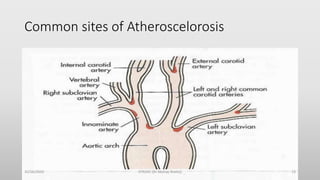
Atherosclerosis: major cause of CVA
ļ‚§ Thrombus formation & emboli development
Abnormal filtration of lipids in the intimal layer of the arterial wall
Plaque develops & locations of increased turbulence of blood -
bifurcations
Increased turbulence of blood or a tortuous area
Calcified plaques rupture or fissure
Platelets & fibrin adhere to the plaque
Narrowing or blockage of an artery by thrombus or emboli
Cerebral Infarction: blocked artery with blood supply cut off beyond
the blockage
30/06/2020 STROKE (Dr Akshay Shetty) 7
Transient Ischemic Attack
Temporary focal loss of neurologic function
Caused by ischemia of one of the vascular territories of the brain
Micro emboli with temporary blockage of blood flow
Lasts less than 24 hrs. – often less than 15 mins
Most resolve within 3 hours
Warning sign of progressive cerebrovascular disease
30/06/2020 STROKE (Dr Akshay Shetty) 8
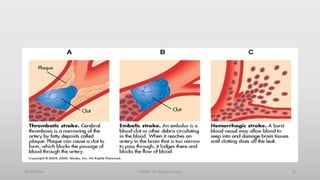
Classification
Ischemic Stroke
ļ‚§Thrombotic
ļ‚§Embolic
Hemorrhagic Stroke
ļ‚§Intracerebral Hemorrhage
ļ‚§Subarachnoid Hemorrhage
ļ‚§Aneurysm
30/06/2020 STROKE (Dr Akshay Shetty) 9
30/06/2020 STROKE (Dr Akshay Shetty) 10
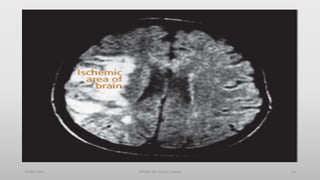
Ischemic – Thrombotic Stroke
Lumen of the blood vessels narrow – then becomes
occluded – infarction
Associated with HTN and Diabetes Mellitus
>60% of strokes
50% are preceded by TIA
Lacunar Stroke: development of cavity in place of infarcted
brain tissue – results in considerable deficits – motor
hemiplegia, contralateral loss of sensation or motor ability
30/06/2020 STROKE (Dr Akshay Shetty) 11
30/06/2020 STROKE (Dr Akshay Shetty) 12
Common sites of Atheroscelorosis
30/06/2020 STROKE (Dr Akshay Shetty) 13
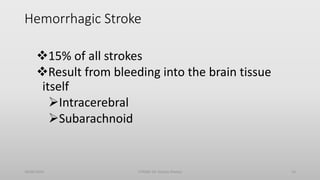
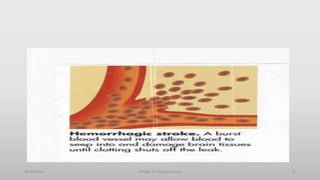
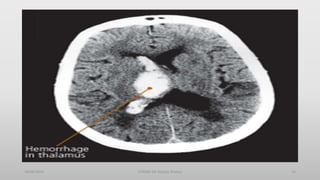
Hemorrhagic Stroke
15% of all strokes
Result from bleeding into the brain tissue
itself
Intracerebral
Subarachnoid
30/06/2020 STROKE (Dr Akshay Shetty) 14
30/06/2020 STROKE (Dr Akshay Shetty) 15
30/06/2020 STROKE (Dr Akshay Shetty) 16
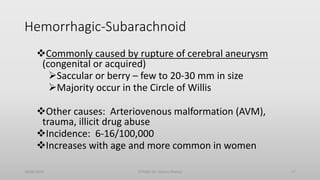
Hemorrhagic-Subarachnoid
Commonly caused by rupture of cerebral aneurysm
(congenital or acquired)
Saccular or berry – few to 20-30 mm in size
Majority occur in the Circle of Willis
Other causes: Arteriovenous malformation (AVM),
trauma, illicit drug abuse
Incidence: 6-16/100,000
Increases with age and more common in women
30/06/2020 STROKE (Dr Akshay Shetty) 17
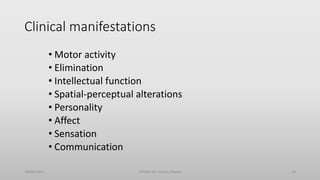
Clinical manifestations
• Motor activity
• Elimination
• Intellectual function
• Spatial-perceptual alterations
• Personality
• Affect
• Sensation
• Communication
30/06/2020 STROKE (Dr Akshay Shetty) 18
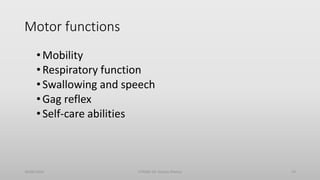
Motor functions
•Mobility
•Respiratory function
•Swallowing and speech
•Gag reflex
•Self-care abilities
30/06/2020 STROKE (Dr Akshay Shetty) 19
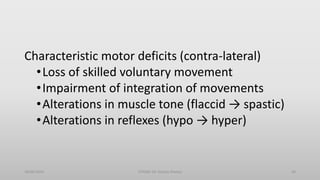
Characteristic motor deficits (contra-lateral)
•Loss of skilled voluntary movement
•Impairment of integration of movements
•Alterations in muscle tone (flaccid → spastic)
•Alterations in reflexes (hypo → hyper)
30/06/2020 STROKE (Dr Akshay Shetty) 20
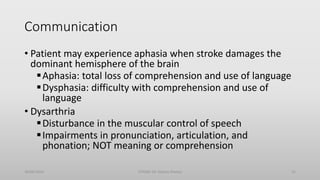
Communication
• Patient may experience aphasia when stroke damages the
dominant hemisphere of the brain
ļ‚§Aphasia: total loss of comprehension and use of language
ļ‚§Dysphasia: difficulty with comprehension and use of
language
• Dysarthria
ļ‚§Disturbance in the muscular control of speech
ļ‚§Impairments in pronunciation, articulation, and
phonation; NOT meaning or comprehension
30/06/2020 STROKE (Dr Akshay Shetty) 21
Affect
• May have difficulty controlling their emotions
• Emotional responses may be exaggerated or unpredictable
• Depression , impaired body image and loss of function can
make this worse
• May be frustrated by mobility and communication problems
30/06/2020 STROKE (Dr Akshay Shetty) 22
Intellectual function
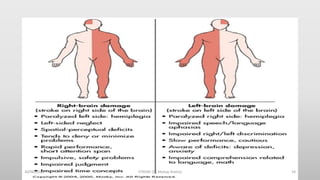
•Memory and judgment may be impaired
•Left-brain stroke: more likely to result in memory
problems related to language
30/06/2020 STROKE (Dr Akshay Shetty) 23
30/06/2020 STROKE (Dr Akshay Shetty) 24
Spatial-Perceptual Alterations
• Stroke on the right side of the brain is more likely to cause problems
in spatial-perceptual orientation
• However, this may occur with left-brain stroke
30/06/2020 STROKE (Dr Akshay Shetty) 25
Spatial-perceptual problems may be divided into four
categories
1. Incorrect perception of self and illness (may deny
illness or body parts)
2. Erroneous perception of self in space (e.g., neglect all
input from affected side; distance judgement)
3. Inability to recognize an object by sight, touch, or
hearing
4. Inability to carry out learned sequential movements
on command
30/06/2020 STROKE (Dr Akshay Shetty) 26
Elimination
• Most problems with elimination occur initially and are
temporary
• Prognosis for normal bladder function is excellent
when only one hemisphere of brain is affected
30/06/2020 STROKE (Dr Akshay Shetty) 27
Diagnosis
• CT Scan
• MRI
• PET Scan
30/06/2020 STROKE (Dr Akshay Shetty) 28
Summary
Define stroke
1.List Risk factors of Stroke
1.Explain Pathophysiology of Stroke
Classify stroke
Discuss Ischemic stroke
Discuss Haemorrhagic stroke
State Diagnosis
30/06/2020 STROKE (Dr Akshay Shetty) 29
References
• Davidson Principles Of Medicine & Practice Of Medicine .20th Ed.
• Harrison’s PRINCIPLES OF INTERNAL MEDICINE Seventeenth Edition
• https://www.cdc.gov/stroke/types_of_stroke.htm
• https://www.nhs.uk/conditions/stroke/
30/06/2020 STROKE (Dr Akshay Shetty) 30
Thank you
30/06/2020 STROKE (Dr Akshay Shetty) 31

Stroke

  • 1.
    STROKE Dr Akshay Shetty Asst.Professor SSRAMCHInchal This Photo by Unknown Author is licensed under CC BY-NC-ND
  • 2.
    Contents • Objectives • Definitionof Stroke • Risk factors of Stroke • Pathophysiology of Stroke • Classification of stroke • Ischemic stroke • Haemorrhagic stroke • Diagnosis • Summary • References 30/06/2020 STROKE (Dr Akshay Shetty) 2
  • 3.
    Objectives By the endof the presentation the students must be able to 1. Define Stroke 2. List Risk factors of Stroke 3. Explain Pathophysiology of Stroke 4. Classify stroke 5. Discuss Ischemic stroke 6. Discuss Haemorrhagic stroke 7. State Diagnosis 30/06/2020 STROKE (Dr Akshay Shetty) 3
  • 4.
    Definition • Stroke orCVA results from ischemia to a part of the brain or hemorrhage into the brain that results in death of brain cells. 30/06/2020 STROKE (Dr Akshay Shetty) 4
  • 5.
    Cerebrovascular Accident Risk Factors Nonmodifiable: Age– Occurrence doubles each decade >55 years Gender – Equal for men & women; women die more frequently than men Race – African Americans, Hispanics, Native Americans, Asian Americans -- higher incidence Heredity – family history, prior transient ischemic attack, or prior stroke increases risk 30/06/2020 STROKE (Dr Akshay Shetty) 5
  • 6.
    Contd… Controllable Risks withMedical Treatment & Lifestyle Changes: High blood pressure Diabetes Cigarette smoking TIA (Aspirin) High blood cholesterol Obesity Heart Disease Atrial fibrillation Oral contraceptive use Physical inactivity Sickle cell disease Asymptomatic carotid stenosis Hypercoagulability 30/06/2020 STROKE (Dr Akshay Shetty) 6
  • 7.
    Cerebrovascular Accident Pathophysiology Atherosclerosis: majorcause of CVA ļ‚§ Thrombus formation & emboli development Abnormal filtration of lipids in the intimal layer of the arterial wall Plaque develops & locations of increased turbulence of blood - bifurcations Increased turbulence of blood or a tortuous area Calcified plaques rupture or fissure Platelets & fibrin adhere to the plaque Narrowing or blockage of an artery by thrombus or emboli Cerebral Infarction: blocked artery with blood supply cut off beyond the blockage 30/06/2020 STROKE (Dr Akshay Shetty) 7
  • 8.
    Transient Ischemic Attack Temporaryfocal loss of neurologic function Caused by ischemia of one of the vascular territories of the brain Micro emboli with temporary blockage of blood flow Lasts less than 24 hrs. – often less than 15 mins Most resolve within 3 hours Warning sign of progressive cerebrovascular disease 30/06/2020 STROKE (Dr Akshay Shetty) 8
  • 9.
    Classification Ischemic Stroke ļ‚§Thrombotic ļ‚§Embolic Hemorrhagic Stroke ļ‚§IntracerebralHemorrhage ļ‚§Subarachnoid Hemorrhage ļ‚§Aneurysm 30/06/2020 STROKE (Dr Akshay Shetty) 9
  • 10.
    30/06/2020 STROKE (DrAkshay Shetty) 10
  • 11.
    Ischemic – ThromboticStroke Lumen of the blood vessels narrow – then becomes occluded – infarction Associated with HTN and Diabetes Mellitus >60% of strokes 50% are preceded by TIA Lacunar Stroke: development of cavity in place of infarcted brain tissue – results in considerable deficits – motor hemiplegia, contralateral loss of sensation or motor ability 30/06/2020 STROKE (Dr Akshay Shetty) 11
  • 12.
    30/06/2020 STROKE (DrAkshay Shetty) 12
  • 13.
    Common sites ofAtheroscelorosis 30/06/2020 STROKE (Dr Akshay Shetty) 13
  • 14.
    Hemorrhagic Stroke 15% ofall strokes Result from bleeding into the brain tissue itself Intracerebral Subarachnoid 30/06/2020 STROKE (Dr Akshay Shetty) 14
  • 15.
    30/06/2020 STROKE (DrAkshay Shetty) 15
  • 16.
    30/06/2020 STROKE (DrAkshay Shetty) 16
  • 17.
    Hemorrhagic-Subarachnoid Commonly caused byrupture of cerebral aneurysm (congenital or acquired) Saccular or berry – few to 20-30 mm in size Majority occur in the Circle of Willis Other causes: Arteriovenous malformation (AVM), trauma, illicit drug abuse Incidence: 6-16/100,000 Increases with age and more common in women 30/06/2020 STROKE (Dr Akshay Shetty) 17
  • 18.
    Clinical manifestations • Motoractivity • Elimination • Intellectual function • Spatial-perceptual alterations • Personality • Affect • Sensation • Communication 30/06/2020 STROKE (Dr Akshay Shetty) 18
  • 19.
    Motor functions •Mobility •Respiratory function •Swallowingand speech •Gag reflex •Self-care abilities 30/06/2020 STROKE (Dr Akshay Shetty) 19
  • 20.
    Characteristic motor deficits(contra-lateral) •Loss of skilled voluntary movement •Impairment of integration of movements •Alterations in muscle tone (flaccid → spastic) •Alterations in reflexes (hypo → hyper) 30/06/2020 STROKE (Dr Akshay Shetty) 20
  • 21.
    Communication • Patient mayexperience aphasia when stroke damages the dominant hemisphere of the brain ļ‚§Aphasia: total loss of comprehension and use of language ļ‚§Dysphasia: difficulty with comprehension and use of language • Dysarthria ļ‚§Disturbance in the muscular control of speech ļ‚§Impairments in pronunciation, articulation, and phonation; NOT meaning or comprehension 30/06/2020 STROKE (Dr Akshay Shetty) 21
  • 22.
    Affect • May havedifficulty controlling their emotions • Emotional responses may be exaggerated or unpredictable • Depression , impaired body image and loss of function can make this worse • May be frustrated by mobility and communication problems 30/06/2020 STROKE (Dr Akshay Shetty) 22
  • 23.
    Intellectual function •Memory andjudgment may be impaired •Left-brain stroke: more likely to result in memory problems related to language 30/06/2020 STROKE (Dr Akshay Shetty) 23
  • 24.
    30/06/2020 STROKE (DrAkshay Shetty) 24
  • 25.
    Spatial-Perceptual Alterations • Strokeon the right side of the brain is more likely to cause problems in spatial-perceptual orientation • However, this may occur with left-brain stroke 30/06/2020 STROKE (Dr Akshay Shetty) 25
  • 26.
    Spatial-perceptual problems maybe divided into four categories 1. Incorrect perception of self and illness (may deny illness or body parts) 2. Erroneous perception of self in space (e.g., neglect all input from affected side; distance judgement) 3. Inability to recognize an object by sight, touch, or hearing 4. Inability to carry out learned sequential movements on command 30/06/2020 STROKE (Dr Akshay Shetty) 26
  • 27.
    Elimination • Most problemswith elimination occur initially and are temporary • Prognosis for normal bladder function is excellent when only one hemisphere of brain is affected 30/06/2020 STROKE (Dr Akshay Shetty) 27
  • 28.
    Diagnosis • CT Scan •MRI • PET Scan 30/06/2020 STROKE (Dr Akshay Shetty) 28
  • 29.
    Summary Define stroke 1.List Riskfactors of Stroke 1.Explain Pathophysiology of Stroke Classify stroke Discuss Ischemic stroke Discuss Haemorrhagic stroke State Diagnosis 30/06/2020 STROKE (Dr Akshay Shetty) 29
  • 30.
    References • Davidson PrinciplesOf Medicine & Practice Of Medicine .20th Ed. • Harrison’s PRINCIPLES OF INTERNAL MEDICINE Seventeenth Edition • https://www.cdc.gov/stroke/types_of_stroke.htm • https://www.nhs.uk/conditions/stroke/ 30/06/2020 STROKE (Dr Akshay Shetty) 30
  • 31.
    Thank you 30/06/2020 STROKE(Dr Akshay Shetty) 31