Arnold-Chiari malformation
BY
MANJULA.S
ASST PROF
VISTAS
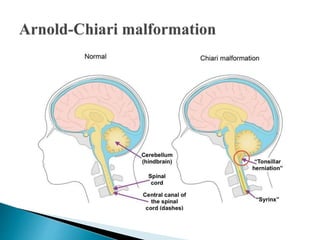
Arnold-Chiari malformation, often referred to as Chiari
malformation, named after Hans Chiari and Julius
Arnold.It is a structural defect in the cerebellum, that
controls balance. This condition is characterized by the
displacement of the cerebellar tonsils (the lower part of
the cerebellum) through the opening at the base of the
skull, known as the foramen magnum, and into the
spinal canal.
 Type I: The cerebellar tonsils extend into the foramen
magnum but doesn't involve the brainstem. This type is
often asymptomatic or may cause mild symptoms.
 Type II: This is also known as Arnold-Chiari malformation.
It involves the extension of both the cerebellar and
brainstem tissue into the foramen magnum. Type II Chiari
malformation is usually associated with myelomeningocele,
a form of spina bifida.
 Type III: This is a more severe form where cerebellar
tissue and the brainstem protrude through the foramen
magnum and into a sac-like structure.
 Type IV: Characterized by an underdeveloped cerebellum,
this type may lead to hydrocephalus (accumulation of
cerebrospinal fluid in the brain).
 headaches (usually at the back of the head and often
made worse by coughing, sneezing or straining)
 neck pain
 dizziness and balance problems
 hearing loss and/or tinnitus
 muscle weakness and paralysis
 visual problems and nystagmus
 swallowing difficulties
 dysesthesia in the limbs
 problems with hand coordination and fine motor skills.
 Medical History: Discussing symptoms and their
progression.
 Neurological Examination: Assessing reflexes,
muscle strength, and coordination.
 Imaging Studies: MRI (Magnetic Resonance Imaging)
is typically used to visualize the brain and spinal cord
and identify the extent of herniation.
 Myelomeningocele repair and management of
neurogenic bladder
 Ventricular shunting - improves the cranial nerve and
brainstem function
 Craniovertebral decompression may be required in
neonates with brainstem dysfunction
 Physiotherapy can help with many of the symptoms
caused by Arnold Chiari Malformation:
 Vestibular Rehabilitation is indicated when patients
have vestibular problems
 Conservative physiotherapy -soft tissue techniques may
be of benefit for cervical pain
 Soft tissue techniques may be of benefit for headaches
 Regular follow-up and monitoring may be necessary
ARNOLD CHIARI MALFORMATION-STRUCTURAL DEFECTS IN BRAIN AND SPINAL CORD

ARNOLD CHIARI MALFORMATION-STRUCTURAL DEFECTS IN BRAIN AND SPINAL CORD

  • 1.
  • 2.
    Arnold-Chiari malformation, oftenreferred to as Chiari malformation, named after Hans Chiari and Julius Arnold.It is a structural defect in the cerebellum, that controls balance. This condition is characterized by the displacement of the cerebellar tonsils (the lower part of the cerebellum) through the opening at the base of the skull, known as the foramen magnum, and into the spinal canal.
  • 4.
     Type I:The cerebellar tonsils extend into the foramen magnum but doesn't involve the brainstem. This type is often asymptomatic or may cause mild symptoms.  Type II: This is also known as Arnold-Chiari malformation. It involves the extension of both the cerebellar and brainstem tissue into the foramen magnum. Type II Chiari malformation is usually associated with myelomeningocele, a form of spina bifida.  Type III: This is a more severe form where cerebellar tissue and the brainstem protrude through the foramen magnum and into a sac-like structure.  Type IV: Characterized by an underdeveloped cerebellum, this type may lead to hydrocephalus (accumulation of cerebrospinal fluid in the brain).
  • 5.
     headaches (usuallyat the back of the head and often made worse by coughing, sneezing or straining)  neck pain  dizziness and balance problems  hearing loss and/or tinnitus  muscle weakness and paralysis  visual problems and nystagmus  swallowing difficulties  dysesthesia in the limbs  problems with hand coordination and fine motor skills.
  • 6.
     Medical History:Discussing symptoms and their progression.  Neurological Examination: Assessing reflexes, muscle strength, and coordination.  Imaging Studies: MRI (Magnetic Resonance Imaging) is typically used to visualize the brain and spinal cord and identify the extent of herniation.
  • 7.
     Myelomeningocele repairand management of neurogenic bladder  Ventricular shunting - improves the cranial nerve and brainstem function  Craniovertebral decompression may be required in neonates with brainstem dysfunction
  • 8.
     Physiotherapy canhelp with many of the symptoms caused by Arnold Chiari Malformation:  Vestibular Rehabilitation is indicated when patients have vestibular problems  Conservative physiotherapy -soft tissue techniques may be of benefit for cervical pain  Soft tissue techniques may be of benefit for headaches  Regular follow-up and monitoring may be necessary