Torticollis
DR/ MAHMOUD SALAMA
2016
QENA FEVER, GIT AND HEPATOLOGY HOSPITAL
Introduction: What is Torticollis?
• Derived from the
Latin: tortus
(twisted) + collis
(neck or collar)
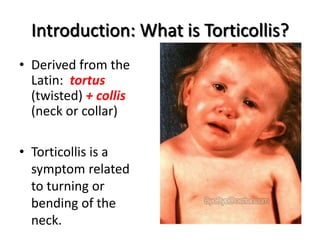
• Torticollis is a
symptom related
to turning or
bending of the
neck.
Introduction
• Many different causes are possible.
• In newborns, Torticollis usually results from
injury during labour and delivery or the
infant’s position in the utreus. Less often, it is
caused by birth defects.
• In older children, torticollis may result from
injuries to the neck muscles, common
infections, or other causes.
Introduction
• Torticollis refers to a symptom rather than a
distinct disease process
• It can be caused by a wide variety of
conditions (over 80 causes have been
described) which range from relatively simple
self limited to life-threatening
• May be congenital or acquired
• Occurs more frequently in children than in
adults
• The right side is affected in 75% of patients
What does it look like?
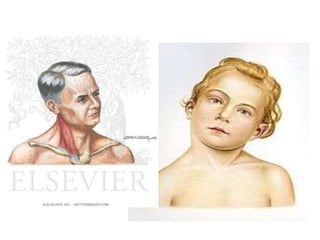
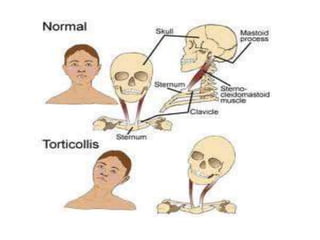
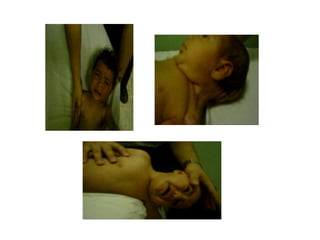
• Abnormal twisting of the neck. Usually, child’s
head is tipped toward one side, with the chin
pointing in the other direction.
• Painful spasms of the neck muscles may occur.
• Other symptoms may be present, depending
on the cause.
• For example, there may be a tender lymph
node (gland) if the cause is infection.
Causes of Torticollis
1. Congenital muscular torticollis
2. Acquired torticollis
Congenital muscular torticollis (CMT)
• CMT refers to muscular disorders causing
torticollis at birth or shortly after due to
unilateral shortening of the
sternocleidomastoid muscle.
• More common in males and on the right side.
• The affected muscle develops fibrotic changes
which can be associated with a mass
(fibromatosis colli) or without a mass
Congenital muscular torticollis
• Presentation is usually during the first 4
weeks of life with torticollis and / or
nontender neck mass.
• Thought to be caused by intrauterine
and perinatal events. Risk factors for CMT
include overcrowding environments
,first-born, oligohydramnios, breech
presentation and difficult delivery.
Congenital muscular torticollis
Ultrasound (US) is the imaging modality of
choice for initial investigation.
• There is diffuse or focal enlargement of the
sternocleidomastoid muscle.
• Focal mass is usually hypoechoic and
homogenous (fig 3).
• The mass usually resolve within the first year
of life with conservative treatment.
Congenital muscular torticollis
• the condition is treated with physical
therapies, such as stretching to release
tightness, strengthening exercises to improve
muscular balance, and handling to stimulate
symmetry.
• A Collar is sometimes applied.
• About 5–10% of cases fail to respond to
stretching and require surgical release of the
muscle.
2- Acquired torticollis
Acquired torticollis
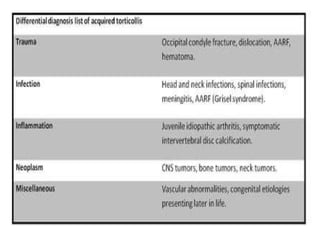
the most common etiologies
1. self-limiting
2. Trauma,
3. infections
4. inflammatory conditions,
5. central nervous system tumors or lesions
1- self-limiting
• A self-limiting spontaneously occurring
form of torticollis with one or more
painful neck muscles is by far the most
common ('stiff neck') and will pass
spontaneously in 1–4 weeks.
• Usually the sternocleidomastoid muscle or
the trapezius muscle is involved.
• colds or unusual postures are implicated;
however in many cases no clear cause is
found.
2- Trauma
• Occipital condyle fracture and facet dislocation
may present with torticollis
• Atlanto-axial rotatory fixation (AARF) of C2
• Spontaneous spinal epidural hematoma is a
rare disorder which might manifest with painful
torticollis followed by weakness and sensory
loss and is mostly common at the cervico-
thoracic level
• Subarachnoid hemorrhage
Trauma
• CT is the modality of choice in most
trauma cases.
• MRI is indicated in any case of
concern for ligamentous injury or
when there is a neurologic deficit.
3- Infection and inflammation
• Head and neck and spinal column
infections may cause torticollis either
by muscular or ligamentous irritation
or from direct spinal disease.
Infectious and Inflammatory Causes of
Torticollis
• CNS related
– Meningitis
• Head and Neck related
– Upper respiratory infections
– Otitis media
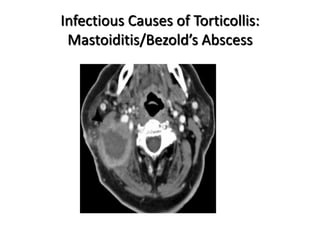
– Mastoiditis/Bezold’s abscess
– Cervical adenitis
– Retropharyngeal abscess
• Spine related
– Vertebral osteomyelitis and/or discitis
– Epidural abscess
– Rheumatoid arthritis
Infection
• Lateral neck X RAY radiograph will show
increased soft tissue thickness anterior to the
C spine in retropharyngeal abscess
• US may show superficial lymphadenitis and
abscess.
• CT is used to visualize the deep neck spaces
and for pre-surgical planning.
• MRI is useful in spinal column infections due
to its increased sensitivity and its ability to
show soft tissue and epidural extension
Infectious Causes of Torticollis:
Mastoiditis/Bezold’s Abscess
4- Tumors
• Tumors of the CNS, spine and neck may cause
torticollis
• • CNS tumors are usually in the posterior fossa
or C spine.
• The common presentation of C spine tumor is
pain due to dural irritation.
• Posterior fossa tumors ( CERBELLAR tumor)
may also have signs of increased intracranial
pressure.
4- Tumors
• In any case of insidious development
of torticollis the possibility of a
tumor should be considered.
• MRI is the imaging modality of
choice
Other causes
• The use of certain drugs, such as
antipsychotics , Antiemetics ,
Neuroleptic Class and
Phenothiazines , can cause torticollis.
Treatment:
• Treatment for torticollis depends on
the cause:
• For newborns with torticollis, gentle
motion of the head and neck is
recommended to stretch the
muscles. Often, a physical therapist is
involved. To avoid injury, this should
be done only as recommended by a
doctor.
• For older children with torticollis related
to infection or inflammation, treatment
may include:
• Antibiotics for the specific infection.
• Rest.
• Anti-inflammatory medications (such as
ibuprofen).
• Passive motion to keep the muscles from
getting stiff.
• Surgery if indicated
• If the cause is related to trauma
(even sleeping position) treatments
may include:
• Muscle relaxants - Valium (generic
name: diazepam) and Passive
motion.
• A soft collar or brace to support the
neck.
Conclusion
• Torticollis is a clinical sign that might signify
an underlying disorder.
• In newborn infants with CMT, ultrasound is
preferred and often diagnostic.
• In older children CT is used to diagnose
traumatic insult, neck infection and vertebral
anomalies.
• MRI is used to diagnose inflammatory and
infectiouc spinal disorders and in cases in
which CNS or neck malignancy is suspected.
Torticollis

Torticollis

  • 3.
    Torticollis DR/ MAHMOUD SALAMA 2016 QENAFEVER, GIT AND HEPATOLOGY HOSPITAL
  • 5.
    Introduction: What isTorticollis? • Derived from the Latin: tortus (twisted) + collis (neck or collar) • Torticollis is a symptom related to turning or bending of the neck.
  • 6.
    Introduction • Many differentcauses are possible. • In newborns, Torticollis usually results from injury during labour and delivery or the infant’s position in the utreus. Less often, it is caused by birth defects. • In older children, torticollis may result from injuries to the neck muscles, common infections, or other causes.
  • 7.
    Introduction • Torticollis refersto a symptom rather than a distinct disease process • It can be caused by a wide variety of conditions (over 80 causes have been described) which range from relatively simple self limited to life-threatening • May be congenital or acquired • Occurs more frequently in children than in adults • The right side is affected in 75% of patients
  • 8.
    What does itlook like? • Abnormal twisting of the neck. Usually, child’s head is tipped toward one side, with the chin pointing in the other direction. • Painful spasms of the neck muscles may occur. • Other symptoms may be present, depending on the cause. • For example, there may be a tender lymph node (gland) if the cause is infection.
  • 10.
  • 11.
    1. Congenital musculartorticollis 2. Acquired torticollis
  • 12.
    Congenital muscular torticollis(CMT) • CMT refers to muscular disorders causing torticollis at birth or shortly after due to unilateral shortening of the sternocleidomastoid muscle. • More common in males and on the right side. • The affected muscle develops fibrotic changes which can be associated with a mass (fibromatosis colli) or without a mass
  • 13.
    Congenital muscular torticollis •Presentation is usually during the first 4 weeks of life with torticollis and / or nontender neck mass. • Thought to be caused by intrauterine and perinatal events. Risk factors for CMT include overcrowding environments ,first-born, oligohydramnios, breech presentation and difficult delivery.
  • 14.
    Congenital muscular torticollis Ultrasound(US) is the imaging modality of choice for initial investigation. • There is diffuse or focal enlargement of the sternocleidomastoid muscle. • Focal mass is usually hypoechoic and homogenous (fig 3). • The mass usually resolve within the first year of life with conservative treatment.
  • 15.
    Congenital muscular torticollis •the condition is treated with physical therapies, such as stretching to release tightness, strengthening exercises to improve muscular balance, and handling to stimulate symmetry. • A Collar is sometimes applied. • About 5–10% of cases fail to respond to stretching and require surgical release of the muscle.
  • 16.
  • 17.
    Acquired torticollis the mostcommon etiologies 1. self-limiting 2. Trauma, 3. infections 4. inflammatory conditions, 5. central nervous system tumors or lesions
  • 18.
    1- self-limiting • Aself-limiting spontaneously occurring form of torticollis with one or more painful neck muscles is by far the most common ('stiff neck') and will pass spontaneously in 1–4 weeks. • Usually the sternocleidomastoid muscle or the trapezius muscle is involved. • colds or unusual postures are implicated; however in many cases no clear cause is found.
  • 19.
    2- Trauma • Occipitalcondyle fracture and facet dislocation may present with torticollis • Atlanto-axial rotatory fixation (AARF) of C2 • Spontaneous spinal epidural hematoma is a rare disorder which might manifest with painful torticollis followed by weakness and sensory loss and is mostly common at the cervico- thoracic level • Subarachnoid hemorrhage
  • 20.
    Trauma • CT isthe modality of choice in most trauma cases. • MRI is indicated in any case of concern for ligamentous injury or when there is a neurologic deficit.
  • 21.
    3- Infection andinflammation • Head and neck and spinal column infections may cause torticollis either by muscular or ligamentous irritation or from direct spinal disease.
  • 22.
    Infectious and InflammatoryCauses of Torticollis • CNS related – Meningitis • Head and Neck related – Upper respiratory infections – Otitis media – Mastoiditis/Bezold’s abscess – Cervical adenitis – Retropharyngeal abscess • Spine related – Vertebral osteomyelitis and/or discitis – Epidural abscess – Rheumatoid arthritis
  • 23.
    Infection • Lateral neckX RAY radiograph will show increased soft tissue thickness anterior to the C spine in retropharyngeal abscess • US may show superficial lymphadenitis and abscess. • CT is used to visualize the deep neck spaces and for pre-surgical planning. • MRI is useful in spinal column infections due to its increased sensitivity and its ability to show soft tissue and epidural extension
  • 24.
    Infectious Causes ofTorticollis: Mastoiditis/Bezold’s Abscess
  • 25.
    4- Tumors • Tumorsof the CNS, spine and neck may cause torticollis • • CNS tumors are usually in the posterior fossa or C spine. • The common presentation of C spine tumor is pain due to dural irritation. • Posterior fossa tumors ( CERBELLAR tumor) may also have signs of increased intracranial pressure.
  • 26.
    4- Tumors • Inany case of insidious development of torticollis the possibility of a tumor should be considered. • MRI is the imaging modality of choice
  • 27.
    Other causes • Theuse of certain drugs, such as antipsychotics , Antiemetics , Neuroleptic Class and Phenothiazines , can cause torticollis.
  • 28.
    Treatment: • Treatment fortorticollis depends on the cause: • For newborns with torticollis, gentle motion of the head and neck is recommended to stretch the muscles. Often, a physical therapist is involved. To avoid injury, this should be done only as recommended by a doctor.
  • 30.
    • For olderchildren with torticollis related to infection or inflammation, treatment may include: • Antibiotics for the specific infection. • Rest. • Anti-inflammatory medications (such as ibuprofen). • Passive motion to keep the muscles from getting stiff. • Surgery if indicated
  • 31.
    • If thecause is related to trauma (even sleeping position) treatments may include: • Muscle relaxants - Valium (generic name: diazepam) and Passive motion. • A soft collar or brace to support the neck.
  • 33.
    Conclusion • Torticollis isa clinical sign that might signify an underlying disorder. • In newborn infants with CMT, ultrasound is preferred and often diagnostic. • In older children CT is used to diagnose traumatic insult, neck infection and vertebral anomalies. • MRI is used to diagnose inflammatory and infectiouc spinal disorders and in cases in which CNS or neck malignancy is suspected.