CATFISH
CULTURE-1
INTRODUCTION
Catfishes belonging to family Ictaluridae, Claridae,
Pangasidae and Siluridae are widely distributed in
different parts of the world.
Culture practices are traditional in some parts of
South East and South Asia.
WHY CATFISH FARMING?
Hardy in nature and ability to remain alive out
of the water for long periods have been of
special value in tropical countries.
Grows fast and feeds on a large variety of
agriculture by- products.
Can be raised in high densities resulting in
high net yields (6–10 t/ha/year).
Sold live at the market.
Can tolerate adverse water quality conditions
GLOBAL COMMERCIALLY
CULTIVABLE CATFISH SPP.
Ictalurus punctatus - (Channel catfish)
Clarias gariepinus- (Thai magur / African sharptooth catfish)
Pangasius sutchi or P. hypophthalmus - (River/silver
stripped/sutchi/swai catfish /siamese shark)
BIOLOGY AND
PHYSIOLOGY
Reported to live up to forty years
Lack of scales
Dorsal and pectoral fins have sharp, hard spines which
can inflict a nasty, painful wound.
Possess very keen senses of smell and taste at the
pits of their nostrils are very sensitive odor sensing organs with
a very high concentration of olfactory receptors
Taste buds distributed over the surface of their entire body
especially concentrated on the four pair of barbels surrounding
the mouth
Breathes by sucking water in through the mouth where it flows
directly over the gill filaments
BEHAVIOR
Mostly active during times when there’s very little light.
Spawn when the water temperature exceeds 72°F and eggs are
laid in an adhesive mass.
Once egg laying and fertilization are complete the male will
chase the female from the nesting area and tend to the eggs by
fanning the mass with his fins to keep oxygenated water moving
over them.
Their young ones show cannibalism.
NUTRITION
REQUIREMENTS
Catfish are fed a diet of high-protein pellets feed.
Should contain from 26 to 38% crude protein plus all essential vitamins and
minerals.
32% crude protein is adequate and most economical for food fish production.
36 to 40% crude protein for starter diets for young fry.
The prepared feeds consist of various combinations of plant proteins (soybean
meal, cottonseed meal, corn meal, peanut meal, and wheat, supplemented with
vegetable oil, vitamins, and minerals.
Both sinking (pelleted) or floating (extruded) feed can be fed to catfish.
CONTD..
The daily feed ration for channel catfish is affected by a variety of
factors:
• water temperature
• fish size
• water quality
Newly-hatched fry should be fed several times daily at 6-10% of fish
weight.
The daily feed ration for fingerling and brood fish should be divided
into two or more feedings per day.
In general, fingerlings are fed between 2 and 5 percent of their body
weight per day, and brood fish, 1 to 2% of their weight.
CHANNEL CATFISH
Interest in channel catfish began when the United States Fish and
Fisheries Commission began stocking fish collected from the wild
in the 1870s.
Channel catfish were native primarily to the Mississippi River
Valley but were widely introduced throughout the nation by the
Commission.
The ancestry of channel catfish farm-stocks is still unknown, but
the majority of them are believed to have originated from
Oklahoma stocks around 1949.
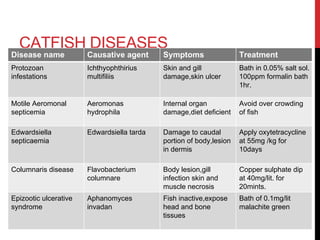
CATFISH DISEASES
Disease name Causative agent Symptoms Treatment
Protozoan
infestations
Ichthyophthirius
multifiliis
Skin and gill
damage,skin ulcer
Bath in 0.05% salt sol.
100ppm formalin bath
1hr.
Motile Aeromonal
septicemia
Aeromonas
hydrophila
Internal organ
damage,diet deficient
Avoid over crowding
of fish
Edwardsiella
septicaemia
Edwardsiella tarda Damage to caudal
portion of body,lesion
in dermis
Apply oxytetracycline
at 55mg /kg for
10days
Columnaris disease Flavobacterium
columnare
Body lesion,gill
infection skin and
muscle necrosis
Copper sulphate dip
at 40mg/lit. for
20mints.
Epizootic ulcerative
syndrome
Aphanomyces
invadan
Fish inactive,expose
head and bone
tissues
Bath of 0.1mg/lit
malachite green
CHANNEL CATFISH FARMING:
OVERVIEW
The channel catfish is the primary species of farm-raised fish in
the United States.
Arkansas - first state to produce farm-raised catfish on a
commercial level – 1963.
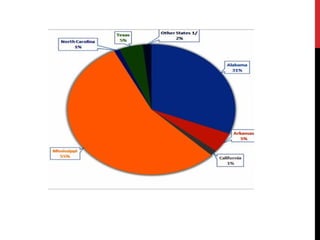
Leading commercial catfish producing states: Mississippi,
Arkansas, Alabama, and Louisiana.
CONTD…
U.S. farm-raised catfish was sixth in the Top 10 fish and seafood
consumption list of Americans in 2008.
The common industry developed in the southern United States
within the original range of the species.
At least 90 percent of the farmed fish are produced in the
Mississippi River Valley region.
REPRODUCTION &
MANAGEMENT
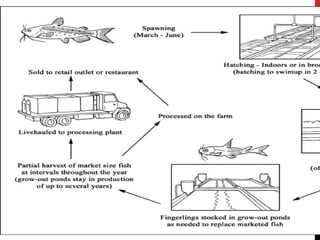
Spawning occurs in the spring, conducted in open ponds where
adults are stocked at a density ranging from 60-325/ha from 1:1 to
1:4 (male : female) and allowed to select their own mates.
Alternatively, adults may be paired in pens within a spawning pond.
In both instances nests comprised of metal cans, drain tiles,
wooden boxes or other types of enclosures of appropriate size are
utilized.
CONTD..
Fertilized eggs are collected and placed in controlled hatchery
tanks after seven days at a temperature of 78° F.
The yolk sac is used up, the fish begin to swim and are moved
to a special pond where they grow into fingerlings.
At 4 to 6 inches in length, they are transferred to catfish ponds
in a ratio of approximately 4,500 fingerlings per surface acre of
water.

CATFISH CULTURE-1.pdf

  • 1.
  • 2.
    INTRODUCTION Catfishes belonging tofamily Ictaluridae, Claridae, Pangasidae and Siluridae are widely distributed in different parts of the world. Culture practices are traditional in some parts of South East and South Asia.
  • 3.
    WHY CATFISH FARMING? Hardyin nature and ability to remain alive out of the water for long periods have been of special value in tropical countries. Grows fast and feeds on a large variety of agriculture by- products. Can be raised in high densities resulting in high net yields (6–10 t/ha/year). Sold live at the market. Can tolerate adverse water quality conditions
  • 4.
    GLOBAL COMMERCIALLY CULTIVABLE CATFISHSPP. Ictalurus punctatus - (Channel catfish) Clarias gariepinus- (Thai magur / African sharptooth catfish) Pangasius sutchi or P. hypophthalmus - (River/silver stripped/sutchi/swai catfish /siamese shark)
  • 5.
    BIOLOGY AND PHYSIOLOGY Reported tolive up to forty years Lack of scales Dorsal and pectoral fins have sharp, hard spines which can inflict a nasty, painful wound. Possess very keen senses of smell and taste at the pits of their nostrils are very sensitive odor sensing organs with a very high concentration of olfactory receptors Taste buds distributed over the surface of their entire body especially concentrated on the four pair of barbels surrounding the mouth Breathes by sucking water in through the mouth where it flows directly over the gill filaments
  • 6.
    BEHAVIOR Mostly active duringtimes when there’s very little light. Spawn when the water temperature exceeds 72°F and eggs are laid in an adhesive mass. Once egg laying and fertilization are complete the male will chase the female from the nesting area and tend to the eggs by fanning the mass with his fins to keep oxygenated water moving over them. Their young ones show cannibalism.
  • 7.
    NUTRITION REQUIREMENTS Catfish are feda diet of high-protein pellets feed. Should contain from 26 to 38% crude protein plus all essential vitamins and minerals. 32% crude protein is adequate and most economical for food fish production. 36 to 40% crude protein for starter diets for young fry. The prepared feeds consist of various combinations of plant proteins (soybean meal, cottonseed meal, corn meal, peanut meal, and wheat, supplemented with vegetable oil, vitamins, and minerals. Both sinking (pelleted) or floating (extruded) feed can be fed to catfish.
  • 8.
    CONTD.. The daily feedration for channel catfish is affected by a variety of factors: • water temperature • fish size • water quality Newly-hatched fry should be fed several times daily at 6-10% of fish weight. The daily feed ration for fingerling and brood fish should be divided into two or more feedings per day. In general, fingerlings are fed between 2 and 5 percent of their body weight per day, and brood fish, 1 to 2% of their weight.
  • 10.
    CHANNEL CATFISH Interest inchannel catfish began when the United States Fish and Fisheries Commission began stocking fish collected from the wild in the 1870s. Channel catfish were native primarily to the Mississippi River Valley but were widely introduced throughout the nation by the Commission. The ancestry of channel catfish farm-stocks is still unknown, but the majority of them are believed to have originated from Oklahoma stocks around 1949.
  • 11.
    CATFISH DISEASES Disease nameCausative agent Symptoms Treatment Protozoan infestations Ichthyophthirius multifiliis Skin and gill damage,skin ulcer Bath in 0.05% salt sol. 100ppm formalin bath 1hr. Motile Aeromonal septicemia Aeromonas hydrophila Internal organ damage,diet deficient Avoid over crowding of fish Edwardsiella septicaemia Edwardsiella tarda Damage to caudal portion of body,lesion in dermis Apply oxytetracycline at 55mg /kg for 10days Columnaris disease Flavobacterium columnare Body lesion,gill infection skin and muscle necrosis Copper sulphate dip at 40mg/lit. for 20mints. Epizootic ulcerative syndrome Aphanomyces invadan Fish inactive,expose head and bone tissues Bath of 0.1mg/lit malachite green
  • 12.
    CHANNEL CATFISH FARMING: OVERVIEW Thechannel catfish is the primary species of farm-raised fish in the United States. Arkansas - first state to produce farm-raised catfish on a commercial level – 1963. Leading commercial catfish producing states: Mississippi, Arkansas, Alabama, and Louisiana.
  • 15.
    CONTD… U.S. farm-raised catfishwas sixth in the Top 10 fish and seafood consumption list of Americans in 2008. The common industry developed in the southern United States within the original range of the species. At least 90 percent of the farmed fish are produced in the Mississippi River Valley region.
  • 16.
    REPRODUCTION & MANAGEMENT Spawning occursin the spring, conducted in open ponds where adults are stocked at a density ranging from 60-325/ha from 1:1 to 1:4 (male : female) and allowed to select their own mates. Alternatively, adults may be paired in pens within a spawning pond. In both instances nests comprised of metal cans, drain tiles, wooden boxes or other types of enclosures of appropriate size are utilized.
  • 17.
    CONTD.. Fertilized eggs arecollected and placed in controlled hatchery tanks after seven days at a temperature of 78° F. The yolk sac is used up, the fish begin to swim and are moved to a special pond where they grow into fingerlings. At 4 to 6 inches in length, they are transferred to catfish ponds in a ratio of approximately 4,500 fingerlings per surface acre of water.