Presented by- Jyoti Saroj
Department.- Fisheries Resource Management
College of Fisheries, Veraval
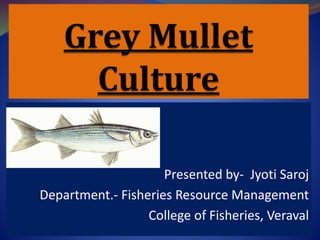
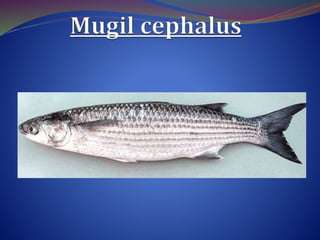
 Mugil cephalus is commonly known as striped
mullet.
 It is a euryhaline fish, cultured either alone or in
combination with other fishes such as
Tilapia/Milk fish/Pearl spot/Chinese carp.
 Grey mullet has been farmed for centuries in
extensive and semi-intensive ponds.
 Subsistence farming in ponds and enclosures has
been traditional in the Mediterranean region, South
East Asia, Taiwan Province of China, Japan and
Hawaii.
 Since the early 1960s, flathead grey mullet has also
been cultured in semi-intensive ponds with tilapia
and carps in Egypt.
 This species was first introduced to be cultured with
carp in Israel in 1957.
• Italy
• Israel
• Egypt
• Mexico
• Peru
• Hong kong
• Singapore
• Greece
• Taiwan province of China
• Mugil cephalus is cosmopolitan in the coastal
waters.
• It is found from Nova Scotia, Canada south to
Brazil, including the Gulf of Mexico and absent
in the Bahamas and the Caribbean Sea.
• The flathead grey mullet is catadromous.
• Flathead grey mullet is a diurnal feeder,
consuming mainly zooplankton, dead plant
matter and detritus.
• Mullet have thick-walled gizzard-like segments
in their stomach.
 The sexes are separate. Males are generally smaller and
slender whereas, in females belly shall be distended and
swollen during spawning season.
 In India Mugil cephalus breeds during the post monsoon
period.
 Absolute fecundity of Mugil cephalus in India is
13,20,000 and relative fecundity is 849 eggs/g body
weight.
• Collected from river mouths, tidal streams, tidal
creeks, swamps and tidal flats.
• In India, the fry of Mugil cephalus are restricted
to the period from June to August.
• The early mullet fry are collected using dip nets,
hapa nets and closed-meshed seines during high
tides.
• Large numbers of sexually mature individuals are
kept under optimum environmental conditions.
• Ripe fish are selected and placed in plastic or
fibreglass tanks filled with seawater.
• Male:Female ratio 2–3:1 shortly before
spawning.
• Females are injected by pituitary gonadotropin.
Females spawn after 12 hours.
• Eggs are produced at a rate of 650–850/g body
weight.
• Hatching takes place after 50-64 hrs .
 After acclimatization, fry are stocked in earthen
nurseries at high densities, where they depend
mainly on natural food.
 Fry are kept in the nursery ponds for 4–6 months.
 Stocking density 30,000/ha in nursery pond.
 Rice or wheat bran is sometimes used as an
additional source of food.
• Grey mullet are usually culture in poly culture in
semi-intensive pond with common carp, grass
carp, silver carp, tilapia and milk fish
• Intensive polyculture of mullets along with
Chinese carps is carried out in Honkong.
• Mullet fingerlings stocked @ 10,000-15,000/ha
and Chinese carp fingerlings stocked @ 1000-
2000/ha
 Rice or wheat bran added daily in amount of
0.5-1 % of biomass
 Growing season is normally about 7-8 months.
After 7-8 months mullet reach 75-1 kg.
• Monoculture : Natural foods, grain mills
and rice polishing plants.
• Polyculture: Extruded pellets are used in
feed for Tilapia and Common carp
 Using gill nets.
 Seine nets.
 Total drain harvesting.
• Modified estuaries are called Valli, produce
primarily eels but mullet are the principal crop
in the most advanced valli.
• Four Species are commonly stocked, according
to the season, largest and most valued species is
Mugil cephalus is found in the lagoon.
 Valli including all the 300-500 ha structures in
the venice area, located above the high tide line
and connected with sea, from which brackish
water pumped at high tide, creating an artificial
tide.
 The total annual yield of valli ranges from 90-
200kg/ha of fish.
• Mainly in West Bengal, Karnataka, Kerala and Goa.
• In monoculture stocking density is 6000no./ha
production rate is 1189-1200kg/ha/year.
• Mullet is cultured with pearl spot and milk fish in
south India
• Various species of shrimp often stocked in mullet.
• The net production in the grey mullet-milk fish
combination ranged between 1600 and 2189
kg/ha/year.
 Egypt is the largest producer country in
the mullet culture.
Sr.
No.
Year Production in tones
1. 1997 25600
2. 2003 147000
 Ergasilus lizae
 Caligus paget (Sea lice)
 Bacterial fin rot
 Saprolegnia infections
 Large scale natural mortalities occur during
nursery rearing.
 As aquaculture grey mullet depends largely on
collection of wild fry, it is affecting the resources
for capture fisheries.
 In countries where wild fry collection for
aquaculture practiced, social problems usually
result from the competition for resources
between fish farmers and fisherman.
• The grey mullet are polycultured with other
compatible species of fish and shrimps.
• Production average 2.0-2.5 tonns/ha/year
during 8-9 months grow out periods.
• Intensive farming is restricted due to non
availabilty hatchery seeds.
• Highly production comes from traditional
culture system such as Valli culture in Italy.
• Milk fish production is also very high in
combination with Mullet culture.
• T.V.R. Pillay and M. N. Kutty, Aquacultre
Principles and Practices, Page No.(417-423)
• Dr. P.C.Thomas, Dr. Suresh Ch. Rath, Dr.(Mrs)
Kanta Das Mohapatra, Breeding and Seed
Production of Fin Fish and Shell Fish, Page
No.(138-141)
• John E. Bardach, John H. Ryther, and William O.
McLarney, Aquaculture the Farming and
Husbandry of Freshwater and Marine Organisms,
Page No.(285-300)
Grey mullet culture

Grey mullet culture

  • 1.
    Presented by- JyotiSaroj Department.- Fisheries Resource Management College of Fisheries, Veraval
  • 2.
     Mugil cephalusis commonly known as striped mullet.  It is a euryhaline fish, cultured either alone or in combination with other fishes such as Tilapia/Milk fish/Pearl spot/Chinese carp.
  • 3.
     Grey mullethas been farmed for centuries in extensive and semi-intensive ponds.  Subsistence farming in ponds and enclosures has been traditional in the Mediterranean region, South East Asia, Taiwan Province of China, Japan and Hawaii.  Since the early 1960s, flathead grey mullet has also been cultured in semi-intensive ponds with tilapia and carps in Egypt.  This species was first introduced to be cultured with carp in Israel in 1957.
  • 4.
    • Italy • Israel •Egypt • Mexico • Peru • Hong kong • Singapore • Greece • Taiwan province of China
  • 5.
    • Mugil cephalusis cosmopolitan in the coastal waters. • It is found from Nova Scotia, Canada south to Brazil, including the Gulf of Mexico and absent in the Bahamas and the Caribbean Sea. • The flathead grey mullet is catadromous. • Flathead grey mullet is a diurnal feeder, consuming mainly zooplankton, dead plant matter and detritus. • Mullet have thick-walled gizzard-like segments in their stomach.
  • 7.
     The sexesare separate. Males are generally smaller and slender whereas, in females belly shall be distended and swollen during spawning season.  In India Mugil cephalus breeds during the post monsoon period.  Absolute fecundity of Mugil cephalus in India is 13,20,000 and relative fecundity is 849 eggs/g body weight.
  • 8.
    • Collected fromriver mouths, tidal streams, tidal creeks, swamps and tidal flats. • In India, the fry of Mugil cephalus are restricted to the period from June to August. • The early mullet fry are collected using dip nets, hapa nets and closed-meshed seines during high tides.
  • 9.
    • Large numbersof sexually mature individuals are kept under optimum environmental conditions. • Ripe fish are selected and placed in plastic or fibreglass tanks filled with seawater. • Male:Female ratio 2–3:1 shortly before spawning.
  • 10.
    • Females areinjected by pituitary gonadotropin. Females spawn after 12 hours. • Eggs are produced at a rate of 650–850/g body weight. • Hatching takes place after 50-64 hrs .
  • 11.
     After acclimatization,fry are stocked in earthen nurseries at high densities, where they depend mainly on natural food.  Fry are kept in the nursery ponds for 4–6 months.  Stocking density 30,000/ha in nursery pond.  Rice or wheat bran is sometimes used as an additional source of food.
  • 12.
    • Grey mulletare usually culture in poly culture in semi-intensive pond with common carp, grass carp, silver carp, tilapia and milk fish • Intensive polyculture of mullets along with Chinese carps is carried out in Honkong. • Mullet fingerlings stocked @ 10,000-15,000/ha and Chinese carp fingerlings stocked @ 1000- 2000/ha
  • 13.
     Rice orwheat bran added daily in amount of 0.5-1 % of biomass  Growing season is normally about 7-8 months. After 7-8 months mullet reach 75-1 kg.
  • 14.
    • Monoculture :Natural foods, grain mills and rice polishing plants. • Polyculture: Extruded pellets are used in feed for Tilapia and Common carp
  • 15.
     Using gillnets.  Seine nets.  Total drain harvesting.
  • 17.
    • Modified estuariesare called Valli, produce primarily eels but mullet are the principal crop in the most advanced valli. • Four Species are commonly stocked, according to the season, largest and most valued species is Mugil cephalus is found in the lagoon.
  • 18.
     Valli includingall the 300-500 ha structures in the venice area, located above the high tide line and connected with sea, from which brackish water pumped at high tide, creating an artificial tide.  The total annual yield of valli ranges from 90- 200kg/ha of fish.
  • 19.
    • Mainly inWest Bengal, Karnataka, Kerala and Goa. • In monoculture stocking density is 6000no./ha production rate is 1189-1200kg/ha/year. • Mullet is cultured with pearl spot and milk fish in south India • Various species of shrimp often stocked in mullet. • The net production in the grey mullet-milk fish combination ranged between 1600 and 2189 kg/ha/year.
  • 20.
     Egypt isthe largest producer country in the mullet culture. Sr. No. Year Production in tones 1. 1997 25600 2. 2003 147000
  • 21.
     Ergasilus lizae Caligus paget (Sea lice)  Bacterial fin rot  Saprolegnia infections  Large scale natural mortalities occur during nursery rearing.
  • 22.
     As aquaculturegrey mullet depends largely on collection of wild fry, it is affecting the resources for capture fisheries.  In countries where wild fry collection for aquaculture practiced, social problems usually result from the competition for resources between fish farmers and fisherman.
  • 23.
    • The greymullet are polycultured with other compatible species of fish and shrimps. • Production average 2.0-2.5 tonns/ha/year during 8-9 months grow out periods. • Intensive farming is restricted due to non availabilty hatchery seeds. • Highly production comes from traditional culture system such as Valli culture in Italy. • Milk fish production is also very high in combination with Mullet culture.
  • 24.
    • T.V.R. Pillayand M. N. Kutty, Aquacultre Principles and Practices, Page No.(417-423) • Dr. P.C.Thomas, Dr. Suresh Ch. Rath, Dr.(Mrs) Kanta Das Mohapatra, Breeding and Seed Production of Fin Fish and Shell Fish, Page No.(138-141) • John E. Bardach, John H. Ryther, and William O. McLarney, Aquaculture the Farming and Husbandry of Freshwater and Marine Organisms, Page No.(285-300)