A SEMINER ON
BREEDINGANDCULTUREOF CATFISHES(MAGUR & SINGHI)
SUBMITTEDBY:-Ashishsahu
CONTENTS
 Introduction
 Classification of Magur and Singhi
 Reproductive biology of Magur and singhi
 Brood stock maintenance
 Hormone administration and induce breeding
 Hatchery technology
 Culture of catfishes
CATFISH INTRODUCTION
 Catfishes have 2-4 pairs of barbles.
 Scale absent.
 Some catfish have adipose fin.
 Have Assessory Respiratory Organ(ARO)
 Cat fishes are mainly divided into two
categories-
1. Air breathing cat fishes
2. Non-air breathing cat fishes
AIR BREATHING CAT FISHES.
 External Respiratory Organ are present like skin, buccopharyngeal
epithelium.
 C. batrachus, H. fossilis are air breathing cat fishes
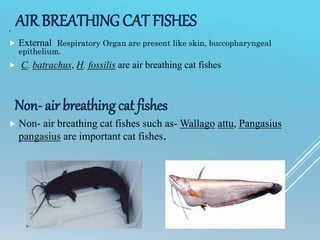
Non- air breathing cat fishes
 Non- air breathing cat fishes such as- Wallago attu, Pangasius
pangasius are important cat fishes.
CLASSIFICATION OF CAT FISH
Kingdom Animalia
Phylum- Chordata
Sub-phylum- Vertebrata
Class- Pisces
Sub-class- Teleostomi
Order- Siluriformes
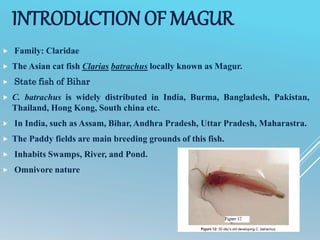
INTRODUCTION OF MAGUR
 Family: Claridae
 The Asian cat fish Clarias batrachus locally known as Magur.
 State fish of Bihar
 C. batrachus is widely distributed in India, Burma, Bangladesh, Pakistan,
Thailand, Hong Kong, South china etc.
 In India, such as Assam, Bihar, Andhra Pradesh, Uttar Pradesh, Maharastra.
 The Paddy fields are main breeding grounds of this fish.
 Inhabits Swamps, River, and Pond.
 Omnivore nature
INTRODUCTION OF SINGHI
 Family-Heteropneustidae
 Heteropneustes fossilis commonly known as singhi or stinging
catfish
 Body Cylindrical
 Dark Brown Colour
 Omnivore nature, Bottom feeder
 Size: 45 cm.
 ARO present.
 It contribute 15% in inland landing
 It is polygamous in nature
 Spawning period July-Aug.
REPRODUCTIVE BIOLOGY OF SINGHI & MAGUR
Age at first sexual maturity
 Magur -1 year, 100-150 gm.
 Singhi - 1 year, 8-12cm.
Sexual dimorphism
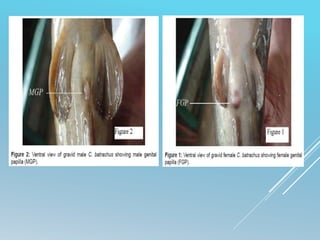
 Genital papilla in male is long and pointed.
 It is round or oval, button shaped in female .
 the vent in the mature female is reddish, round& bulging but in male it is slender and
whitish.
Breeding season
 It breeds only once in a year from June-August.
 Peak period being July.
fecundity .
 Fecundity of Magur - between 15000-20000 per kg body weight
 Fecundity of singhi- 1500-2000 egg /gm./ovary
.
MAINTENANCE OF BROODSTOCKSINGHI & MAGUR
Brood fishes collected from culture pond are
stocked at 2-3 fishes/m2 in cemented tank in case
of magur.
 In case of singhi, Brood stock density 3-5 no/m2
A soil base of 5-10cm thickness provided.
Facilitate continuous water flow 2 litter/min.
A mixture of fish meal, groundnut oil cake,
soybean meal & rice bran with vitamin mineral
provided.
Fed should be 30% protein and provide at 2-3%
body weight
HORMONE ADMINISTRATIONIN INDUCED BREEDING SINGHI &
MAGUR
Pituitary gland extract-
Female dose- 30mg/kg body weight fish in magur
 60 & 80 mg carp pituitary/kg body weight of male &
female respectively in singhi
Ovaprim-
For female-0.4 ml/kg fish in magur
 Ovaprim -0.6-0.9ml/kg body wt.
HORMONE ADMINISTRATION
intramuscularly: below the dorsal fin and above lateral line in
posterior region of body
intraperitoneally : inner side of base of pectoral fin
PREPARATION OF SPERMSUSPENSION
 Milt does not ooze out in singhi & magur.
 Collection of milt is done by grinding the testis in 0.9 % saline
after sacrificing the mature male.
 Sacrifice a male fish by decapitation and remove the testis.
 Cut the testis into small pieces by a fine scissor and crush it
with pestle.
EGG COLLECTION BY STRIPPING
 Stripping the female is done
about 14 to 18 hours after the
injection of CPGE/Ovaprim at
27°C to 30°C.
 Fully mature eggs look dark
brown or brownish green in
colour
 Eggs and milt are mixed well by
feather or finger
 Mixing gives high fertilization
rate because, sperm activated
for a limited period about
90sec.
MIXING OF EGGS ANDMILT
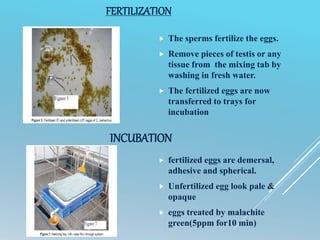
FERTILIZATION
 The sperms fertilize the eggs.
 Remove pieces of testis or any
tissue from the mixing tab by
washing in fresh water.
 The fertilized eggs are now
transferred to trays for
incubation
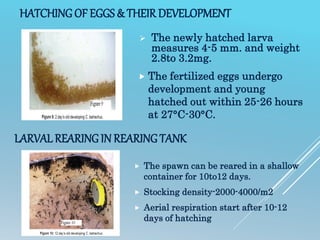
INCUBATION
 fertilized eggs are demersal,
adhesive and spherical.
 Unfertilized egg look pale &
opaque
 eggs treated by malachite
green(5ppm for10 min)
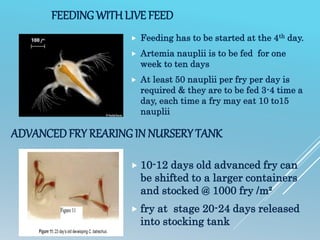
HATCHING OF EGGS & THEIR DEVELOPMENT
 The newly hatched larva
measures 4-5 mm. and weight
2.8to 3.2mg.
 The fertilized eggs undergo
development and young
hatched out within 25-26 hours
at 27°C-30°C.
LARVALREARING IN REARING TANK
 The spawn can be reared in a shallow
container for 10to12 days.
 Stocking density-2000-4000/m2
 Aerial respiration start after 10-12
days of hatching
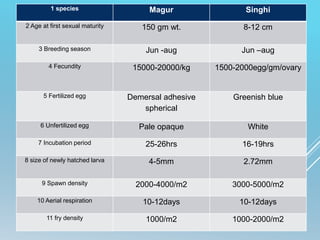
FEEDINGWITH LIVE FEED
 Feeding has to be started at the 4th day.
 Artemia nauplii is to be fed for one
week to ten days
 At least 50 nauplii per fry per day is
required & they are to be fed 3-4 time a
day, each time a fry may eat 10 to15
nauplii
ADVANCEDFRY REARINGIN NURSERY TANK
 10-12 days old advanced fry can
be shifted to a larger containers
and stocked @ 1000 fry /m²
 fry at stage 20-24 days released
into stocking tank
CHART
1 species Magur Singhi
2 Age at first sexual maturity 150 gm wt. 8-12 cm
3 Breeding season Jun -aug Jun –aug
4 Fecundity 15000-20000/kg 1500-2000egg/gm/ovary
5 Fertilized egg Demersal adhesive
spherical
Greenish blue
6 Unfertilized egg Pale opaque White
7 Incubation period 25-26hrs 16-19hrs
8 size of newly hatched larva 4-5mm 2.72mm
9 Spawn density 2000-4000/m2 3000-5000/m2
10 Aerial respiration 10-12days 10-12days
11 fry density 1000/m2 1000-2000/m2
CULTURE OF SINGHI & MAGUR:
 Culture of air breathing fishes like Clarias batrachus and
Heteropneustes fossilis, etc. occupy the second position next to carp
in India.
 An All India Coordinated Research Project (AICRP) on the culture
of air breathing fishes was launched in May 1971, with the
objective of developing appropriate technology for the culture of Air
breathing fishes in swamps, pond, tanks, cage, and pens for
harvesting the natural resources.
 Cat fishes have highly market value and good demand
ADVANTAGE OF CULTURE OF SINGHI &MAGUR:
 There are more demand of singhi & magur in the market and
that’s why more profit can be obtained by their culture.
 Method of culture is easy. They can be culture in any type of
water body even in water reservoir and cage .
 They can be survive in adverse environment such as less as
oxygen, high temp.
 They can be culture in less water and with more density.
 Less affected by disease and high tolerant.
 If caring properly, fishes can be marketed early.(7-8 month)
 They can also cultured with carp fishes tilapia fish etc. as mixed
culture.
SELECTION & PREPARATION OF POND FOR
CULTURE
 The pond should be1-1.5 meter deep for culturing of singhi & magur
 It should be better if the pond area is 10 to 30 decimal.
 Water hyacinth with other aquatic weed of the pond should be
removed out.
 Predatory and unnecessary fishes in pond should be remove out.
 This can be done by drying pond, repeatedly netting or rotenone
applied in pond water.
 After drying pond, lime, cow dung or poultry faeces, urea, DSP
fertilizer, should be applied properly at required level per decimal.
 During preparation of pond for culturing singhi & magur, it is an
important work to make fence or net with 30cm high around the
pond. Due to this fish cannot go outside of the pond during rainfall.
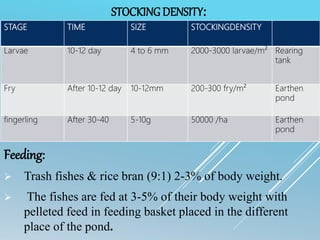
STOCKINGDENSITY:
Feeding:
 Trash fishes & rice bran (9:1) 2-3% of body weight.
 The fishes are fed at 3-5% of their body weight with
pelleted feed in feeding basket placed in the different
place of the pond.
STAGE TIME SIZE STOCKINGDENSITY
Larvae 10-12 day 4 to 6 mm 2000-3000 larvae/m² Rearing
tank
Fry After 10-12 day 10-12mm 200-300 fry/m² Earthen
pond
fingerling After 30-40 5-10g 50000 /ha Earthen
pond
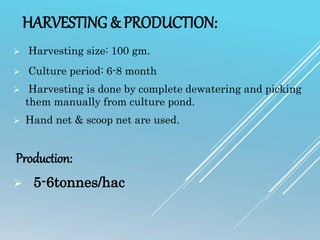
HARVESTING & PRODUCTION:
 Harvesting size: 100 gm.
 Culture period: 6-8 month
 Harvesting is done by complete dewatering and picking
them manually from culture pond.
 Hand net & scoop net are used.
Production:
 5-6tonnes/hac
REFERENCE
 Breeding and seed production of fin fish and shell fish.(Dr.
P.C. Thomas) edition 2003
Page no. 113 to 118
 Handbook of Fisheries and aquaculture (Dr.S. Ayyappan)
page no- 401 to412
 WWW.researchget.net/Publication/Training Manual on
Breeding Rearing and Management of IMC (C.S.Chaturvedi)
 Inslideshare.

Cat fish breeding Ashish sahu

  • 1.
    A SEMINER ON BREEDINGANDCULTUREOFCATFISHES(MAGUR & SINGHI) SUBMITTEDBY:-Ashishsahu
  • 2.
    CONTENTS  Introduction  Classificationof Magur and Singhi  Reproductive biology of Magur and singhi  Brood stock maintenance  Hormone administration and induce breeding  Hatchery technology  Culture of catfishes
  • 3.
    CATFISH INTRODUCTION  Catfisheshave 2-4 pairs of barbles.  Scale absent.  Some catfish have adipose fin.  Have Assessory Respiratory Organ(ARO)  Cat fishes are mainly divided into two categories- 1. Air breathing cat fishes 2. Non-air breathing cat fishes
  • 4.
    AIR BREATHING CATFISHES.  External Respiratory Organ are present like skin, buccopharyngeal epithelium.  C. batrachus, H. fossilis are air breathing cat fishes Non- air breathing cat fishes  Non- air breathing cat fishes such as- Wallago attu, Pangasius pangasius are important cat fishes.
  • 5.
    CLASSIFICATION OF CATFISH Kingdom Animalia Phylum- Chordata Sub-phylum- Vertebrata Class- Pisces Sub-class- Teleostomi Order- Siluriformes
  • 6.
    INTRODUCTION OF MAGUR Family: Claridae  The Asian cat fish Clarias batrachus locally known as Magur.  State fish of Bihar  C. batrachus is widely distributed in India, Burma, Bangladesh, Pakistan, Thailand, Hong Kong, South china etc.  In India, such as Assam, Bihar, Andhra Pradesh, Uttar Pradesh, Maharastra.  The Paddy fields are main breeding grounds of this fish.  Inhabits Swamps, River, and Pond.  Omnivore nature
  • 7.
    INTRODUCTION OF SINGHI Family-Heteropneustidae  Heteropneustes fossilis commonly known as singhi or stinging catfish  Body Cylindrical  Dark Brown Colour  Omnivore nature, Bottom feeder  Size: 45 cm.  ARO present.  It contribute 15% in inland landing  It is polygamous in nature  Spawning period July-Aug.
  • 8.
    REPRODUCTIVE BIOLOGY OFSINGHI & MAGUR Age at first sexual maturity  Magur -1 year, 100-150 gm.  Singhi - 1 year, 8-12cm. Sexual dimorphism  Genital papilla in male is long and pointed.  It is round or oval, button shaped in female .  the vent in the mature female is reddish, round& bulging but in male it is slender and whitish. Breeding season  It breeds only once in a year from June-August.  Peak period being July. fecundity .  Fecundity of Magur - between 15000-20000 per kg body weight  Fecundity of singhi- 1500-2000 egg /gm./ovary
  • 9.
  • 10.
    MAINTENANCE OF BROODSTOCKSINGHI& MAGUR Brood fishes collected from culture pond are stocked at 2-3 fishes/m2 in cemented tank in case of magur.  In case of singhi, Brood stock density 3-5 no/m2 A soil base of 5-10cm thickness provided. Facilitate continuous water flow 2 litter/min. A mixture of fish meal, groundnut oil cake, soybean meal & rice bran with vitamin mineral provided. Fed should be 30% protein and provide at 2-3% body weight
  • 11.
    HORMONE ADMINISTRATIONIN INDUCEDBREEDING SINGHI & MAGUR Pituitary gland extract- Female dose- 30mg/kg body weight fish in magur  60 & 80 mg carp pituitary/kg body weight of male & female respectively in singhi Ovaprim- For female-0.4 ml/kg fish in magur  Ovaprim -0.6-0.9ml/kg body wt.
  • 12.
    HORMONE ADMINISTRATION intramuscularly: belowthe dorsal fin and above lateral line in posterior region of body intraperitoneally : inner side of base of pectoral fin PREPARATION OF SPERMSUSPENSION  Milt does not ooze out in singhi & magur.  Collection of milt is done by grinding the testis in 0.9 % saline after sacrificing the mature male.  Sacrifice a male fish by decapitation and remove the testis.  Cut the testis into small pieces by a fine scissor and crush it with pestle.
  • 13.
    EGG COLLECTION BYSTRIPPING  Stripping the female is done about 14 to 18 hours after the injection of CPGE/Ovaprim at 27°C to 30°C.  Fully mature eggs look dark brown or brownish green in colour  Eggs and milt are mixed well by feather or finger  Mixing gives high fertilization rate because, sperm activated for a limited period about 90sec. MIXING OF EGGS ANDMILT
  • 14.
    FERTILIZATION  The spermsfertilize the eggs.  Remove pieces of testis or any tissue from the mixing tab by washing in fresh water.  The fertilized eggs are now transferred to trays for incubation INCUBATION  fertilized eggs are demersal, adhesive and spherical.  Unfertilized egg look pale & opaque  eggs treated by malachite green(5ppm for10 min)
  • 15.
    HATCHING OF EGGS& THEIR DEVELOPMENT  The newly hatched larva measures 4-5 mm. and weight 2.8to 3.2mg.  The fertilized eggs undergo development and young hatched out within 25-26 hours at 27°C-30°C. LARVALREARING IN REARING TANK  The spawn can be reared in a shallow container for 10to12 days.  Stocking density-2000-4000/m2  Aerial respiration start after 10-12 days of hatching
  • 16.
    FEEDINGWITH LIVE FEED Feeding has to be started at the 4th day.  Artemia nauplii is to be fed for one week to ten days  At least 50 nauplii per fry per day is required & they are to be fed 3-4 time a day, each time a fry may eat 10 to15 nauplii ADVANCEDFRY REARINGIN NURSERY TANK  10-12 days old advanced fry can be shifted to a larger containers and stocked @ 1000 fry /m²  fry at stage 20-24 days released into stocking tank
  • 17.
    CHART 1 species MagurSinghi 2 Age at first sexual maturity 150 gm wt. 8-12 cm 3 Breeding season Jun -aug Jun –aug 4 Fecundity 15000-20000/kg 1500-2000egg/gm/ovary 5 Fertilized egg Demersal adhesive spherical Greenish blue 6 Unfertilized egg Pale opaque White 7 Incubation period 25-26hrs 16-19hrs 8 size of newly hatched larva 4-5mm 2.72mm 9 Spawn density 2000-4000/m2 3000-5000/m2 10 Aerial respiration 10-12days 10-12days 11 fry density 1000/m2 1000-2000/m2
  • 18.
    CULTURE OF SINGHI& MAGUR:  Culture of air breathing fishes like Clarias batrachus and Heteropneustes fossilis, etc. occupy the second position next to carp in India.  An All India Coordinated Research Project (AICRP) on the culture of air breathing fishes was launched in May 1971, with the objective of developing appropriate technology for the culture of Air breathing fishes in swamps, pond, tanks, cage, and pens for harvesting the natural resources.  Cat fishes have highly market value and good demand
  • 19.
    ADVANTAGE OF CULTUREOF SINGHI &MAGUR:  There are more demand of singhi & magur in the market and that’s why more profit can be obtained by their culture.  Method of culture is easy. They can be culture in any type of water body even in water reservoir and cage .  They can be survive in adverse environment such as less as oxygen, high temp.  They can be culture in less water and with more density.  Less affected by disease and high tolerant.  If caring properly, fishes can be marketed early.(7-8 month)  They can also cultured with carp fishes tilapia fish etc. as mixed culture.
  • 20.
    SELECTION & PREPARATIONOF POND FOR CULTURE  The pond should be1-1.5 meter deep for culturing of singhi & magur  It should be better if the pond area is 10 to 30 decimal.  Water hyacinth with other aquatic weed of the pond should be removed out.  Predatory and unnecessary fishes in pond should be remove out.  This can be done by drying pond, repeatedly netting or rotenone applied in pond water.  After drying pond, lime, cow dung or poultry faeces, urea, DSP fertilizer, should be applied properly at required level per decimal.  During preparation of pond for culturing singhi & magur, it is an important work to make fence or net with 30cm high around the pond. Due to this fish cannot go outside of the pond during rainfall.
  • 21.
    STOCKINGDENSITY: Feeding:  Trash fishes& rice bran (9:1) 2-3% of body weight.  The fishes are fed at 3-5% of their body weight with pelleted feed in feeding basket placed in the different place of the pond. STAGE TIME SIZE STOCKINGDENSITY Larvae 10-12 day 4 to 6 mm 2000-3000 larvae/m² Rearing tank Fry After 10-12 day 10-12mm 200-300 fry/m² Earthen pond fingerling After 30-40 5-10g 50000 /ha Earthen pond
  • 22.
    HARVESTING & PRODUCTION: Harvesting size: 100 gm.  Culture period: 6-8 month  Harvesting is done by complete dewatering and picking them manually from culture pond.  Hand net & scoop net are used. Production:  5-6tonnes/hac
  • 23.
    REFERENCE  Breeding andseed production of fin fish and shell fish.(Dr. P.C. Thomas) edition 2003 Page no. 113 to 118  Handbook of Fisheries and aquaculture (Dr.S. Ayyappan) page no- 401 to412  WWW.researchget.net/Publication/Training Manual on Breeding Rearing and Management of IMC (C.S.Chaturvedi)  Inslideshare.