Click here to download this powerpoint template : Green Floral Free Powerpoint Template
For more : Powerpoint Template Presentations
Page 1
CREDIT SEMINAR ON
Presented By:- Jadhav Kiran Ashokrao
M.F.Sc (Aquaculture)
 Mussel farming has a long history that dates back to the
thirteenth century.
 The main producers of mussels are countries such as
China, Korea, Spain, Netherlands, Denmark, Philippines,
France and New Zealand.
 Approximately 17 species of edible mussels are cultured and
harvested worldwide.
A) 1. Introduction
 China ranks first in the production of cultured mussels in the
world.
 In India, mussel culture is becoming popular in the Malabar
area
 In India, two species of marine mussels coming under the
genus Perna, namely, P. viridis & P. indica are regularly fished.
 The technology of farming has been developed for both the
species.
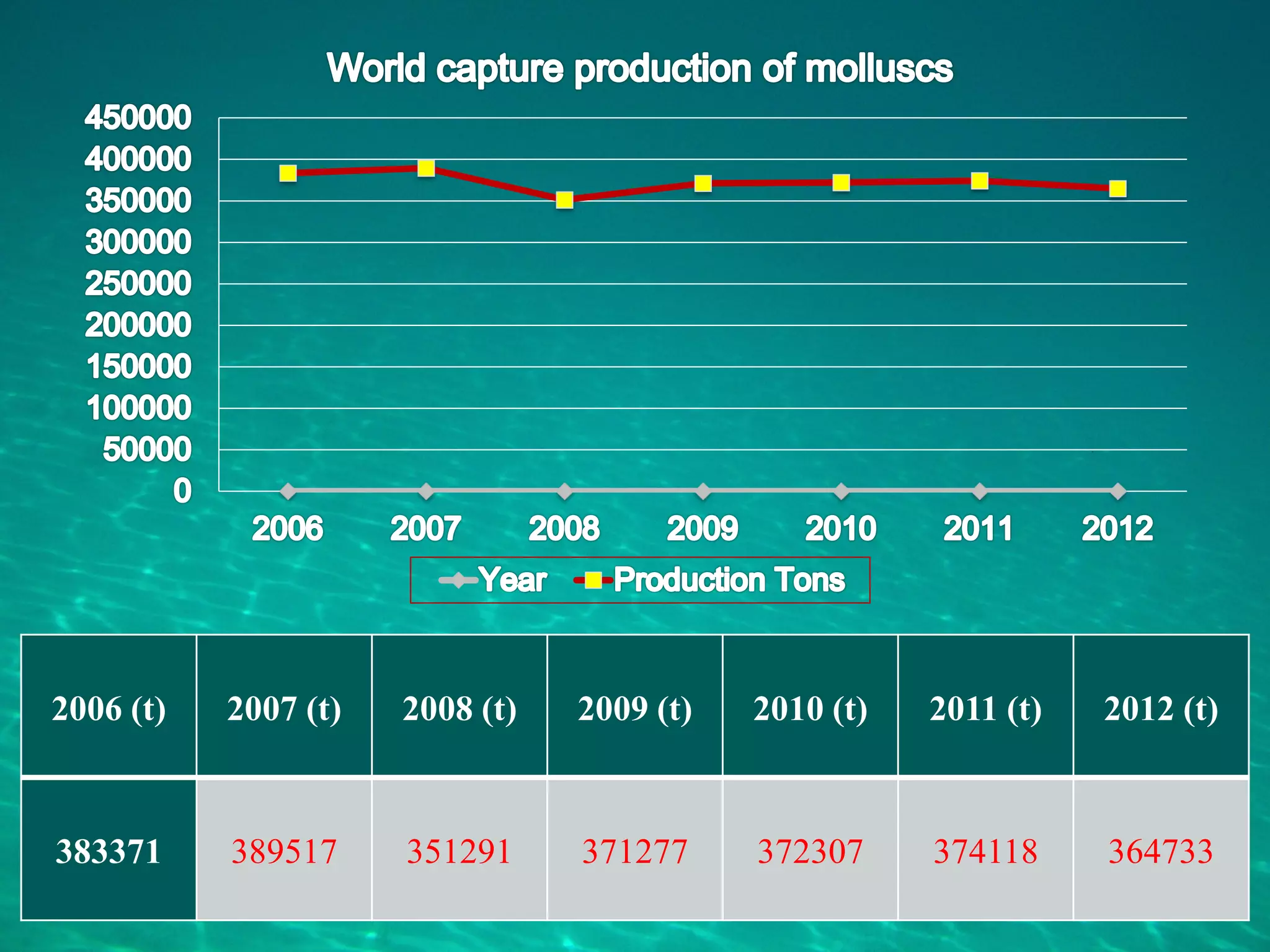
2006 (t) 2007 (t) 2008 (t) 2009 (t) 2010 (t) 2011 (t) 2012 (t)
383371 389517 351291 371277 372307 374118 364733
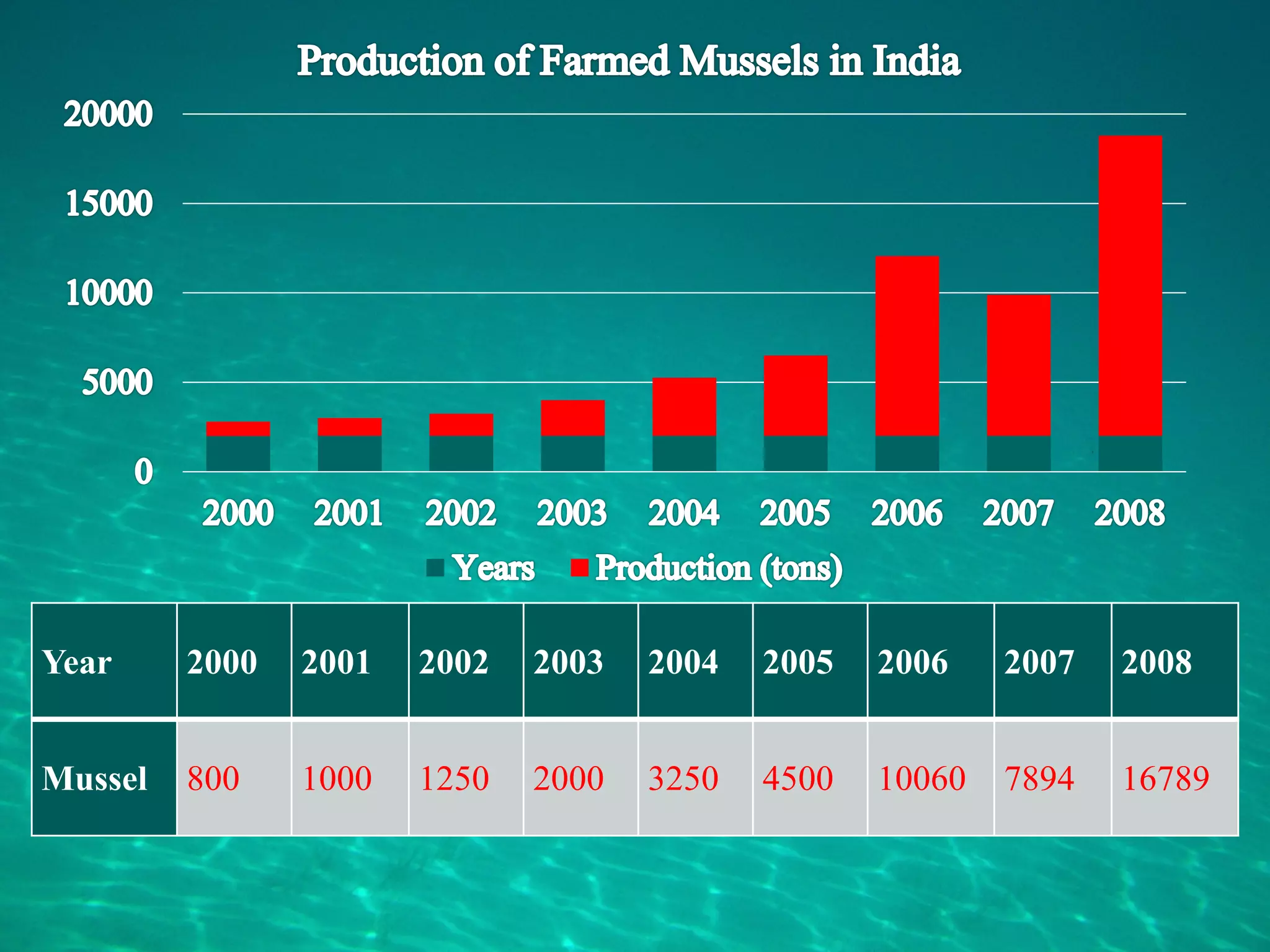
Year 2000 2001 2002 2003 2004 2005 2006 2007 2008
Mussel 800 1000 1250 2000 3250 4500 10060 7894 16789
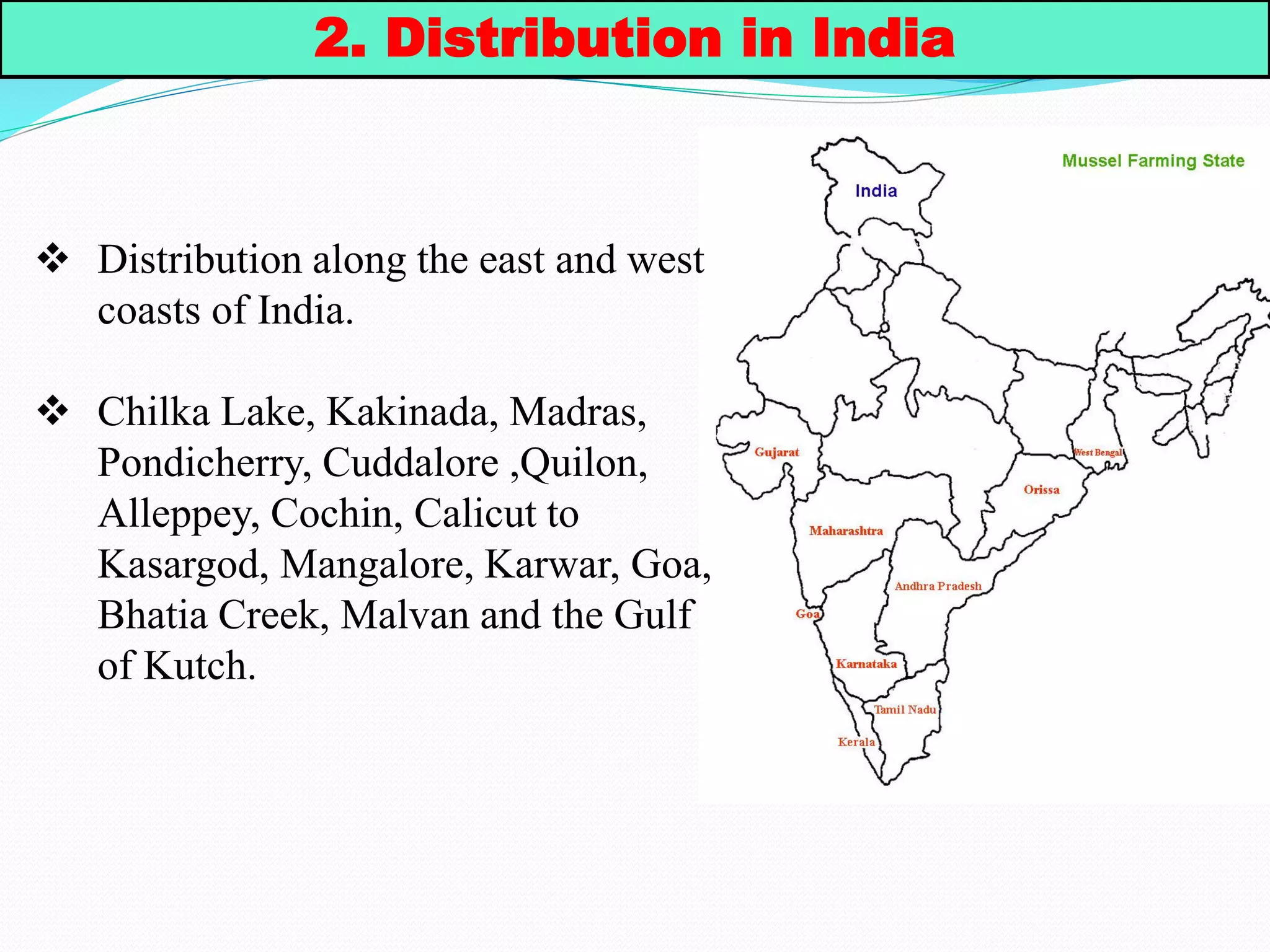
 Distribution along the east and west
coasts of India.
 Chilka Lake, Kakinada, Madras,
Pondicherry, Cuddalore ,Quilon,
Alleppey, Cochin, Calicut to
Kasargod, Mangalore, Karwar, Goa,
Bhatia Creek, Malvan and the Gulf
of Kutch.
2. Distribution in India
 Regular fishery for the green mussel exists in the region from Calicut
to Kasargod.
 Brown mussel from Quilon to Kanyakumari along the Kerala Coast.
Scientific classification
Perna indica, Perna viridis
Kingdom: Animalia
Phylum: Mollusca
Class: Bivalvia
Subclass: Pteriomorphia
Order: Mytiloida
Family: Mytilidae
Genus: Perna
Species indica, viridis
3. Taxonomic Classification:-
Character P. indica P. viridis
External Colour Dark brown Green
Mantle margin colour Brown Yellowish-green
Ventral shell margin Almost straight Highly concave
Middle dorsal margin A distinct dorsal angle or lump
present
Arcuate
Anterior end of shell Pointed and straight Pointed, beak down turned
Number and size of
hinge teeth
One large tooth on the left
valve and a corresponding
depression on the right valve
Two small teeth on the left
valve and one on the right
valve.
4. Identifying Characters:-
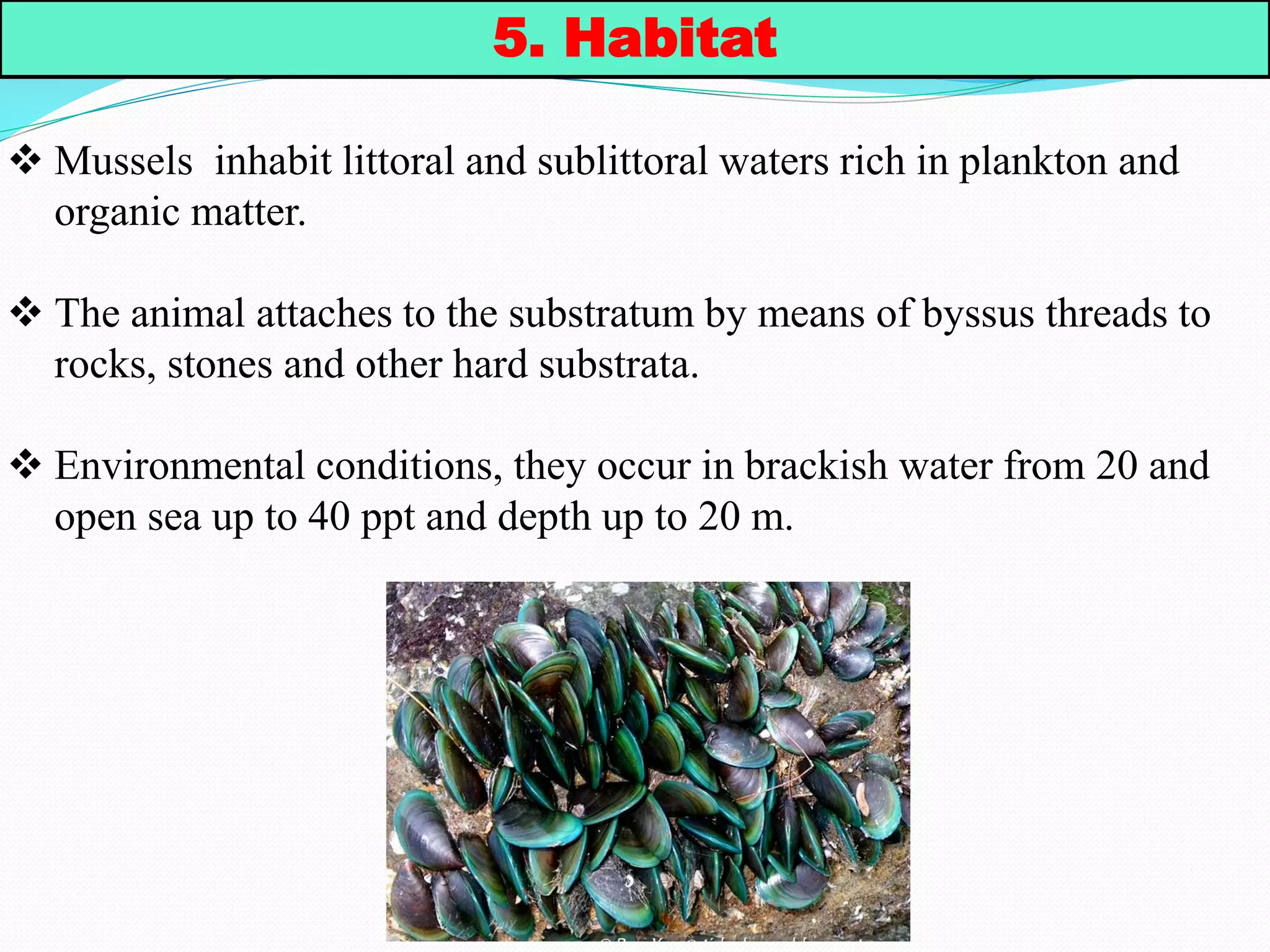
 Mussels inhabit littoral and sublittoral waters rich in plankton and
organic matter.
 The animal attaches to the substratum by means of byssus threads to
rocks, stones and other hard substrata.
 Environmental conditions, they occur in brackish water from 20 and
open sea up to 40 ppt and depth up to 20 m.
5. Habitat
 Mussels are ciliary-mucoid filter feeders, which
feed on phytoplankton, zooplankton, and detritus.
 It has four rows of gills which serve as both respiratory
organ and filter feeding apparatus.
6. Feeding
7. Growth
 In natural bed, mussels have grown to 96 mm, 132 mm and 156
mm in 1-3 years respectively.
 P. viridis grows to at Kakinada.
 At Ermore Backwater, green mussels have grown to 64 mm in 8
months
 P. indica of 20 mm have reached 55 mm in one year when grown in
ropes suspended from rafts in Vizhinjam Bay. It is grows slow as
compared to the green mussel.
Length Periods
63 mm 6 Months
91.5 mm 1 Year
117 mm 2 Years
129 mm 3 years
135 mm 4 Years
 Cultured mussels reached marketable size of 60-64 mm within 5
months and in 11 months they reached 85 mm.
 In mussels sexes are separate and reproduction and larval
development are similar to that of edible oysters.
 The male gonad is creamy white and in females it is pink or
reddish.
 The mussels attain maturity at very small lengths. The green mussel
attains maturity at 15.5 to 28.0 mm.
 The peak spawning period of the green mussel :-
Kakinada is from January to May,
Madras and Goa year round,
Calicut August-October &
Ratnagiri June-September and February-March.
 At Vizhinjam brown mussel spawns from the end of May till
September with peak in July-August.
:-
8. Reproduction
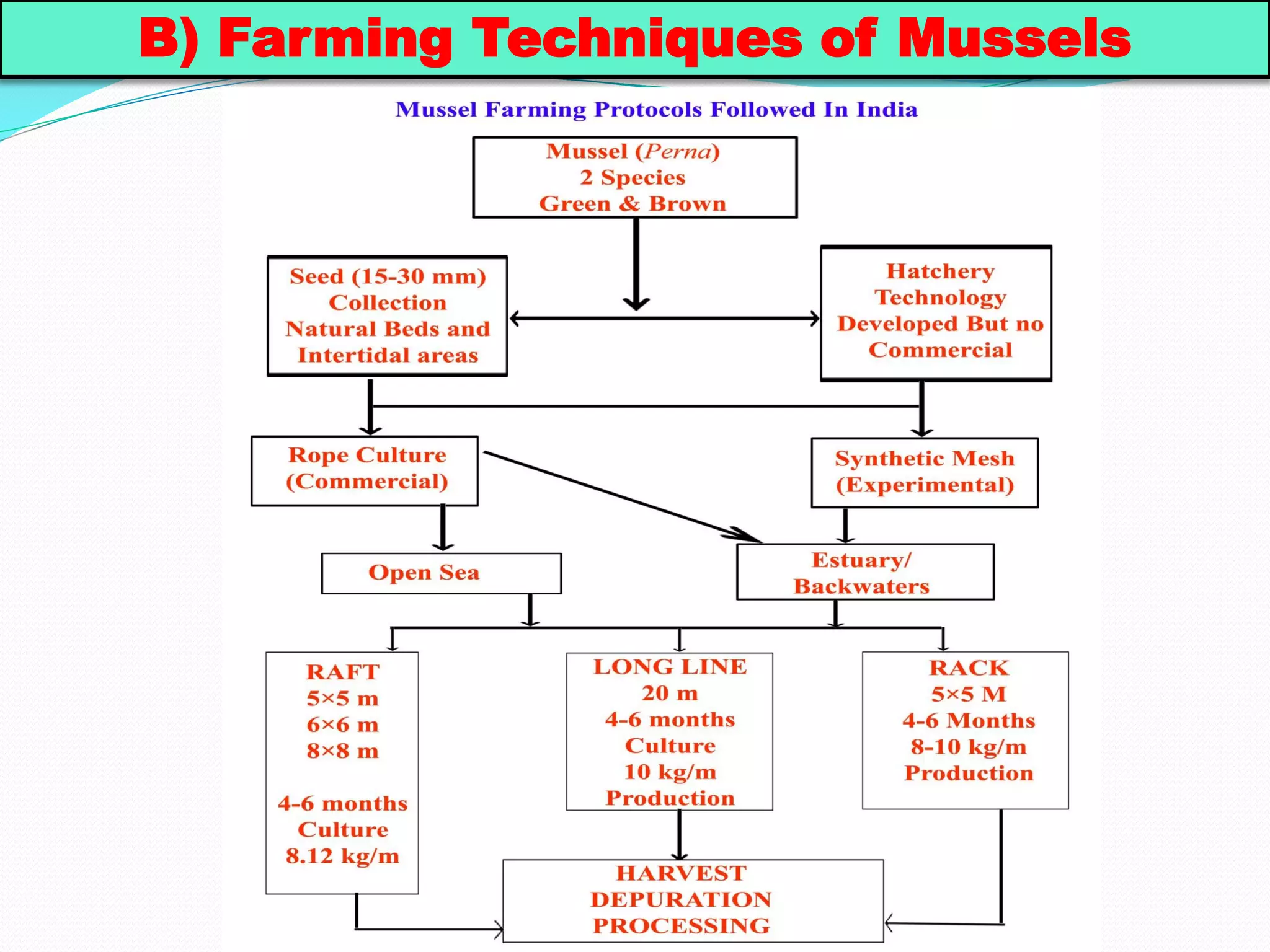
B) Farming Techniques of Mussels
1. Site selection for Mussels Culture
 Open sea and estuarine areas free from strong waves action may be
selected.
 Clear seawater with high plankton production is ideal for mussels.
 Moderate water current will bring the required planktonic food and
will carry away the waste materials.
 Site selected should be free from industrial pollution.
 Favourable water depth for culture is 2 m and above Salinity range of
30 - 35 ppt is ideal for both green and brown mussel farming.
 water temperature ranging from 27–30 °C
2. Seed collection
 Healthy seeds from the natural beds are to be collected for seeding.
 The site selected for collection of seed should be free from pollutants.
 Seed collected from the submerged (sub tidal) areas will be healthier.
 After removing other organisms and weeds, the seeds may be washed
thoroughly in seawater.
 Ideal size of seed is 20 -25 mm.
 About 500 to 750 g of seed will be required for seeding on one-meter
length of rope. The length of rope is decided by considering the depth
where the raft/rack is positioned.
 Nylon rope of 12-14 mm or 15-20 mm coir rope can be used for
seeding.
 Old cotton net, cotton mosquito net or cheap cotton cloth etc. is used
for covering the seeds around the rope.
 Cotton netting of required width and length is spread over it.
 After placing the rope over the seed, the net is tightly stitched in
such a way that the seeds spread uniformly around the rope.
 The basic technology for production of spat of P. viridis has been
developed by CMFRI at Madras and for P. indica at Vizhinjam.
 At Goa, the National Institute of Oceanography also has achieved
spat production in the case of green mussel.
 So far large scale production of mussel spat in hatchery has not been
tried in our country.
Hatchery production of spat
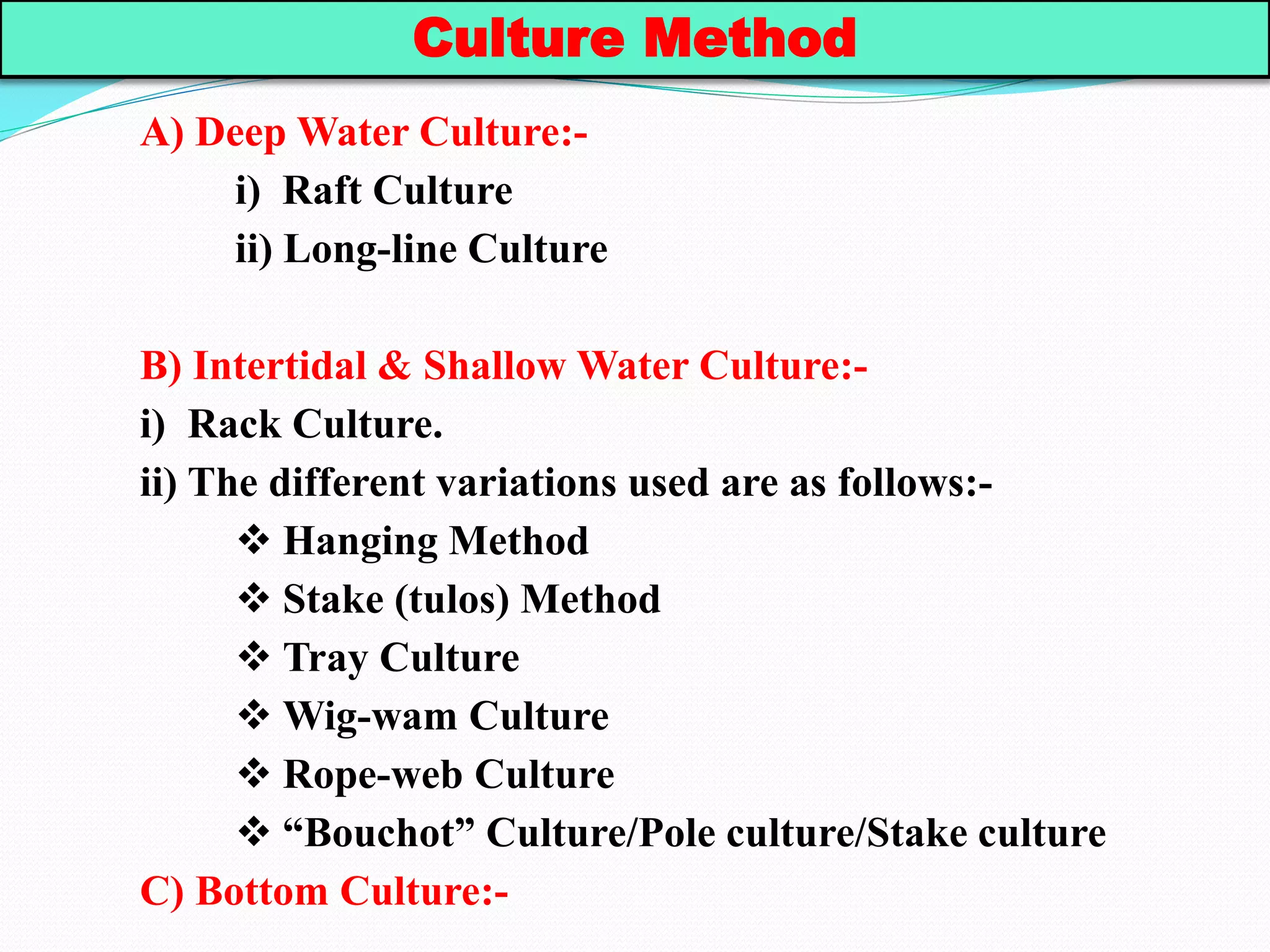
Culture Method
A) Deep Water Culture:-
i) Raft Culture
ii) Long-line Culture
B) Intertidal & Shallow Water Culture:-
i) Rack Culture.
ii) The different variations used are as follows:-
 Hanging Method
 Stake (tulos) Method
 Tray Culture
 Wig-wam Culture
 Rope-web Culture
 “Bouchot” Culture/Pole culture/Stake culture
C) Bottom Culture:-
A) Deep Water Culture
i) Raft Culture:-
 In the states of Andhra Pradesh, Tamil Nadu, Kerala, Karnataka,
Goa and Maharashtra, culture of green mussel from rafts, moored
mostly in open coastal waters.
 The depth at the culture sites varied from 5-10 m and the rafts
measured 5×5 to 8×8 m.
 Teakwood, casuarina and bamboo poles are used in raft
construction.
 Empty oil drums are used for floatation with proper anchorage.
 Natural green mussel seed of 3-26.7 mm in length are seeded on
coir or nylon ropes at the rate of 0.4 to 1.0 kg/m rope
 Depending upon water depth, the length of the seeded rope varied
from 2.5 to 8.0 m.
 It is ensured that the seeded part of the rope suspended from the
raft, is always submerged and the lower end is about one meter
above the bottom.
The ropes are spaced 0.6 to 1.0 m apart.
Seeding is carried in November-January and harvesting is
in April-May, before the onset of the monsoon.
The mussels are usually harvested after 5-6 months culture
when they reach 52-89.2 mm in length (total weight 12.3-
41.0g).
 The mussels are marketable from 60mm length onwards.
 The harvest size depends upon the initial length of seed, duration of
culture and the environmental condition of the farm site.
 Growth in shell length of raft grown mussels showed significant
positive correlation with chlorophyll a and dissolved oxygen.
 The average growth rate is 9-13 mm/month
 The production rate varied from 2.3 kg/m rope/6 months at Ratnagiri
to 12.3kg/m rope/5 months.
 Production of mussels from this type of culture is high. From a
catamaran-type raft with 1,000 rope, 6–9 m in length, about 4,666–
5,333 MT of marketable mussel can be produced.
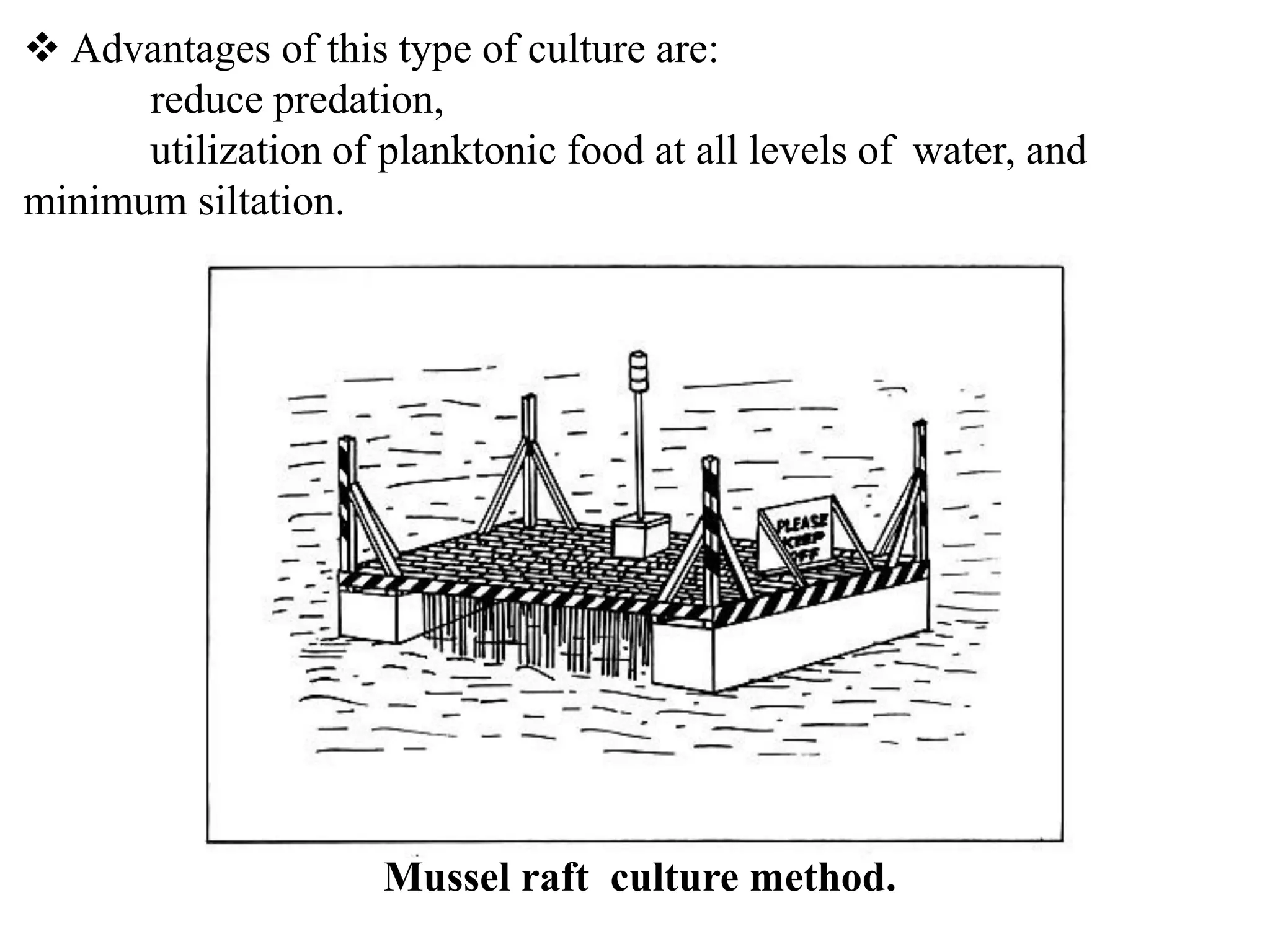
 Advantages of this type of culture are:
reduce predation,
utilization of planktonic food at all levels of water, and
minimum siltation.
Mussel raft culture method.
ii) Long-line Culture:-
 The long lines are long ropes, anchored at each end, and supported by
plastic barrels, which act as floats, at regular intervals.
 Longline culture of mussel is practiced in shallow waters of 10-15 m
depth.
 This method of culture can withstand the severe monsoon conditions
in the west coast.
 A single long line consists of 60 m long horizontal HPD rope of 20 -
24 mm thickness, anchored at both the ends with 150 kg concrete
blocks and a series of 100 It capacity barrels as floats fixed at 3 m
intervals.
 Vertical lines of 6 m length seeded with mussel spat are hung at a
distance of 75 cm between two floats in the main line.
A long line unit of 60 x 60 m can accommodate 12 horizontal ropes
and 920 to 1,000 vertical seeded ropes.
The horizontal lines are interconnected using additional lines.
At Ennore, near Chennai mussel seed of 45.9 mm average length,
stocked in 40×30 cm size synthetic net bags, and suspended from
long lines have grown to 94.4 mm average length in 5 months.
The production rate was 15.32 kg/net bag/5 months.
Intertidal & Shallow Water Culture
i) Rack Culture
 Racks are fixed structure and are constructed in shallow waters,
usually in areas up to 3 m depth.
 Bamboo or casuarina poles, spaced 1-2 m apart are driven into the
bottom.
 They are connected by horizontally placed poles and across them
rows of poles are placed and tied.
 This wooden frame built on poles is used for suspending seeded
ropes or bags.
 Earlier nylon or coir ropes were used but now many commercial
farms use a combination of these two.
 The upper 1 meter or so is nylon rope to which seeded coir ropes is
tied; the latter is replaced for the following crop.
 Generally, 15-30 mm P.viridis seed are used
 Cotton mosquito netting cloth of required length (dependent on water
depth) and 25 cm wide piece is laid on the ground and the rope to be
seeded is kept on this netting.
 Wooden pegs may be inserted at regular intervals (about 50 cm apart)
in the rope so as to minimize slipping of the mussels from the rope.
 The mussel seed are placed on the rope, the netting is wrapped around
the rope and both the ends of the netting are stitched with cotton
twine.
 The seeded rope is tied to the lower end of the nylon rope and
suspended from the rack.
 While major part of the nylon rope is exposed, the seeded rope is
immersed in the water, taking care that it is at least 50 cm above the
bottom.
 In the about 10 days the mosquito cloth netting disintegrates, and the
mussel seed are attached to the ropes with byssus.
 In India, racks are used in Tamil Nadu, Kerala, and Karnataka states.
 P. viridis seed usually of 15-30 mm length, collected from natural
beds are used.
 Nylon or core ropes are seeded at the rate of 0.75 to 2.0 kg/m rope.
 In about 6 months the mussels reached 65-77 mm length and the
monthly growth rate varied from 7.3 to 9.5 mm.
 The production rate was 4 to 9.9kg/m rope except at Ennore where
high production of 33.5kg/m rope/5 months was obtained due to
the use of large mussels (average length 45.9 mm) for seeding.
Rack Culture
 Hanging Method:-
 The process starts with the preparation of the spat collectors or
clutches.
 Nylon ropes or strings, No. 4, are threaded with coco fibre supported
by bamboo pegs or empty oyster shells at 10 cm intervals.
 These collectors are hung on horizontal bamboo poles at 0.5 m apart.
 A piece of steel or stone is attached at the end of the rope to prevent
the collector to float to the surface.
Hanging Method:-
Hanging Mussel Culture Method on bamboo plots as practiced in the
Philippines
 The stake method is midway between the rack and bottom
methods.
 Bamboo poles, 4–6 m in length are staked firmly at the bottom in
rows, 0.5–1 m apart during low tide in areas about 3.0 m deep and
above.
 In areas where water current is strong, bamboo poles are kept in
place by nailing long horizontal bamboo supports between rows.
 Collected spats are allowed to grow in-situ until marketable size,
5–10 cm after 6–10 months.
 Stake (tulos) Method:-
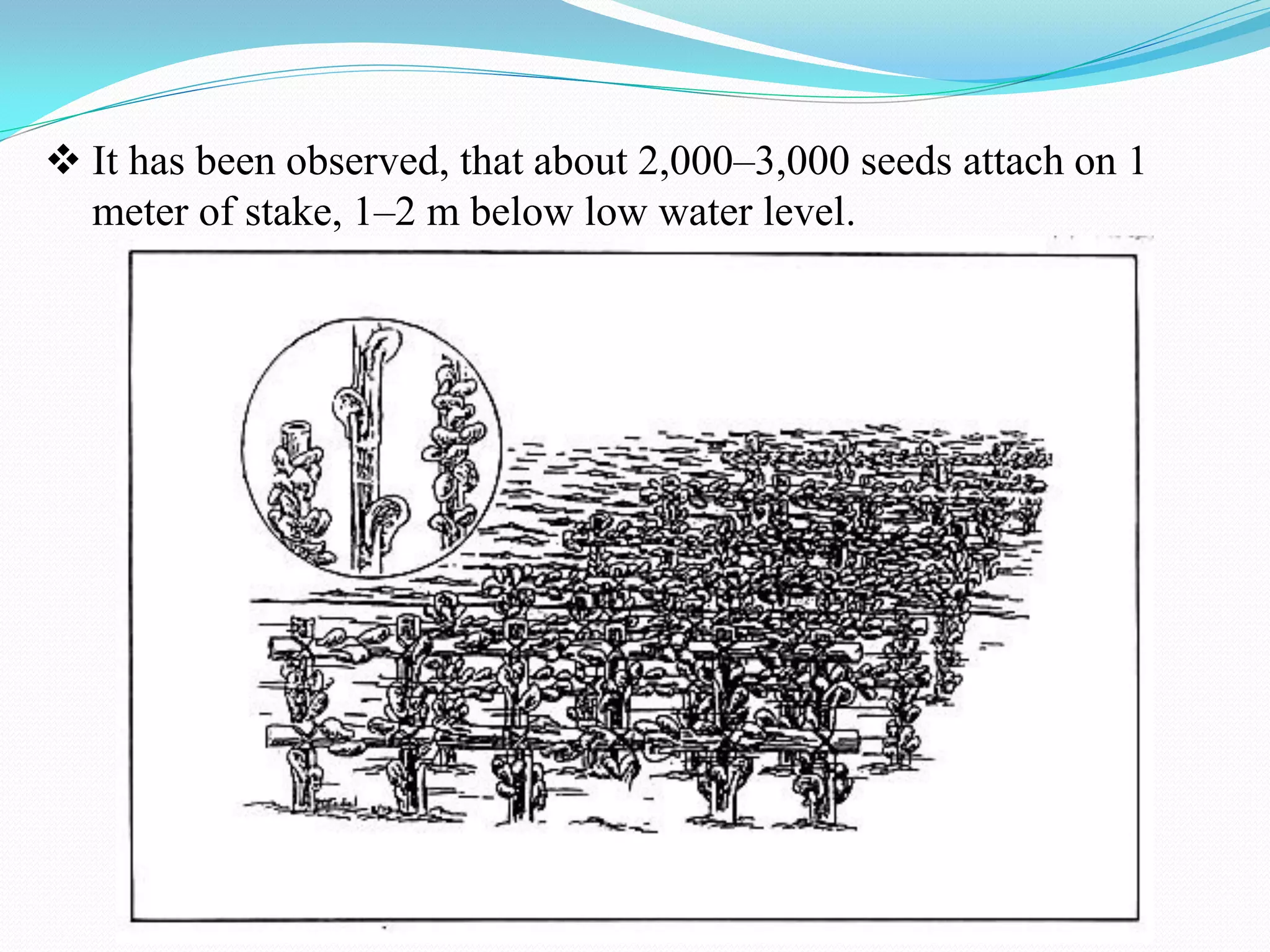
 It has been observed, that about 2,000–3,000 seeds attach on 1
meter of stake, 1–2 m below low water level.
 Tray culture of mussels is limited to detached clusters of
mussels.
 Bamboo or metal trays, 1.5 m × 1 m × 15 cm sidings are
used.
 The tray is either hang between poles of the hanging or
stake methods or suspended on four bamboo posts
 Tray Culture:-
Tray Culture:-
 This method requires a central bamboo pole serving as the pivot
from which 8 full-length bamboo poles are made to radiate by firmly
staking the butt ends into the bottom and nailing the ends to the
central pole, in a wigwam fashion.
 The stakes are driven 1.5 m apart and 2 m away from the pivot.
 To further support the structure, horizontal bamboo braces are nailed
to the outside frame above the low tide mark.
 Spats settle on the bamboos and are allowed to grow to the
marketable size in 8–10 months.
 Wig-wam Culture:-
Wig-wam Culture:-
 The rope-web method of mussel culture was first tried in Sapian Bay,
Capiz, in 1975 by a private company.
 It is an expensive type of culture utilizing synthetic nylon ropes, 12
mm in diameter.
 The ropes are made into webs tied vertically to bamboo poles.
 A web consists of two parallel ropes with a length of 5 m each and
positioned 2 m apart.
 They are connected to each other by a 40 m long rope tied or fastened
in a zigzag fashion at an interval of 40 cm between knots along each
of the parallel ropes.
Rope-web Culture:-
 Bamboo pegs, 20 cm in length and 1 cm width are inserted into the
rope at 40 cm interval to prevent sliding of the crop as it grows bigger.
“Bouchot” Culture/Pole culture/Stake
culture:-
 “Bouchot” culture is mainly undertaken in France.
 This is also called the “pole culture” or stake culture.
 The poles, used are big branches or trunks of oak tree, 4–6 m in
length, which are staked in rows, 0.7 m apart on soft and muddy
bottoms of the intertidal zone during low tide.
 Mussel seeds are collected on coco-fibre ropes which are stretched
out horizontally on poles.
 Young adults, 3–5 mm in size are placed in long netlon tubes (10
m in length) and attached around the oak poles in a spiral fashion,
until marketable size.
 In the Muttukadu mariculture farm of the CMFRI, teak wood poles
were laid in 1.5 to 2.0 m deep water and natural seed of P. viridis of
26.6 mm average length were experimentally grown on these pole for
6 month.
 The seed mussels weighed 4kg/pole and at harvest the production
was 14 kg/pole of 51.4 mm average length mussels.
 This method is widely practiced in Holland, Netherlands,
Denmark and Germany.
 Bottom culture as the name implies is growing mussels directly
on the bottom.
 In this culture system a firm bottom is required with adequate
tidal flow to prevent silt deposition, removal of excreta, and to
provide sufficient oxygen for the cultured animals.
 Mussel bottom culture is extensively practiced in The
Netherlands, where the production of seeds is completely left to
nature.
D) Bottom Culture
 If the natural spatfall grounds are unsatisfactory for growing, the
seedlings are transferred by the farmer to safer and richer ground
or to his private growing plots, until the marketable size is attained.
 Natural conditions control the quality and quantity of food in the
water flowing over the farming plots.
 Marketable mussels are fished from the plots and undergo
cleansing before being sold.
 This method requires a minimum investment.
 Disadvantages, however, of this type of culture is the heavy
predation by oyster drills, starfish, crabs, etc. Also, siltation, poor
growth and relatively low yields per unit culture area.
Bottom Culture
Harvesting
Mussel farming by Rack and Ren method in estuary
Economics
Area of rack : 5 x 5 m (0.0025 ha)
No. of seeded ropes : 100 Nos
Length of seeding in each rope : 1 m
Culture period : Upto 7 months (Nov - May)
Expenditure:
Item Quantity Rate (Rs.) Amount (Rs.)
Capital cost:
Bamboo poles 16 nos 125 2000
Rope for rack construction 0.5 kg 110 55
Seeding rope 13 kg 110 1430
Total 3485
Recurring Cost:
Cotton netting material 25 m 12 300
Nylon rope for attaching sinkers and mussel 2 kg 110 220
Needles 10 nos 2 20
Nylon rope for stitching 0.5 g 110 55
Cost of mussel seeds 200 kg 6 1200
Canoe Hiring Charges 15 trips 100 1500
Labour for seeding 8 man-days 150 1200
Marketing expenses 500
Transportation of poles 350
Transportation of seeds 200
Total 5545
Total financial outlay 9030
RS. 2700 will go back to the farmer, hence actual recurring cost will be Rs.2845
INCOME GENERATED:
Total yield (l00m x 8.4 Kg) 840 10.50 8820
Income realized 8820
Net income (Rs.8820 - 5545) 3375 3375
Reference:-
1. Aypa, S.M. 1980. Factors affecting recovery and growth rate of transplanted mussels, Perna viridis
(Linneus). Master Thesis submitted to U.P.
2. Appukuttan, K.K., Kripa, V., Velayudhan, T.S., Mohamed, K.S., Victor, A.C.C., Kuriakose, P.S.,
Laxmilatha, P., Muthiah, P., (2000). Bivalve Mariculture in India: A success story in coastal
ecosystem development. Editor: Pillai, V.N. Asia – Pacifi c association of Agricultural Research
Institutions, FAO regional Offi ce for Asia and the Pacifi c, New Delhi.
3. Korringa, P. 1976. Economic aspects of mussel farming. Proc. FAO Tech. Conf. on Aquaculture
4. Narasimharm K. A. 1980. Fishery and biology of the green mussel Perna viridis (Linnaeus). Mussel
Farming : Progress and prospects : CMFRI Bulletin,29 :10-17.
5. Pathansali, D. (1963). On the effects of salinity changes on the activity of the cockle, Anadara
granosa L. Malay. Agric. J. 44: 18–25.
6. PCARR. 1977. Philippine Recommends for oysters and mussels. PCARR, Los Banos, Laguna
7. Rangarajan, K, and K. A. Narasimharm 1980. Mussel farming in the east coast of India. Mussel Far
ming - Progress and Prospects). Bull. Cent. Mar. Fish. Res. Inst., 29: 39 - 41.
Mussels Farming in India

Mussels Farming in India

  • 1.
    Click here todownload this powerpoint template : Green Floral Free Powerpoint Template For more : Powerpoint Template Presentations Page 1 CREDIT SEMINAR ON Presented By:- Jadhav Kiran Ashokrao M.F.Sc (Aquaculture)
  • 2.
     Mussel farminghas a long history that dates back to the thirteenth century.  The main producers of mussels are countries such as China, Korea, Spain, Netherlands, Denmark, Philippines, France and New Zealand.  Approximately 17 species of edible mussels are cultured and harvested worldwide. A) 1. Introduction
  • 3.
     China ranksfirst in the production of cultured mussels in the world.  In India, mussel culture is becoming popular in the Malabar area  In India, two species of marine mussels coming under the genus Perna, namely, P. viridis & P. indica are regularly fished.  The technology of farming has been developed for both the species.
  • 4.
    2006 (t) 2007(t) 2008 (t) 2009 (t) 2010 (t) 2011 (t) 2012 (t) 383371 389517 351291 371277 372307 374118 364733
  • 5.
    Year 2000 20012002 2003 2004 2005 2006 2007 2008 Mussel 800 1000 1250 2000 3250 4500 10060 7894 16789
  • 7.
     Distribution alongthe east and west coasts of India.  Chilka Lake, Kakinada, Madras, Pondicherry, Cuddalore ,Quilon, Alleppey, Cochin, Calicut to Kasargod, Mangalore, Karwar, Goa, Bhatia Creek, Malvan and the Gulf of Kutch. 2. Distribution in India
  • 8.
     Regular fisheryfor the green mussel exists in the region from Calicut to Kasargod.  Brown mussel from Quilon to Kanyakumari along the Kerala Coast.
  • 9.
    Scientific classification Perna indica,Perna viridis Kingdom: Animalia Phylum: Mollusca Class: Bivalvia Subclass: Pteriomorphia Order: Mytiloida Family: Mytilidae Genus: Perna Species indica, viridis 3. Taxonomic Classification:-
  • 10.
    Character P. indicaP. viridis External Colour Dark brown Green Mantle margin colour Brown Yellowish-green Ventral shell margin Almost straight Highly concave Middle dorsal margin A distinct dorsal angle or lump present Arcuate Anterior end of shell Pointed and straight Pointed, beak down turned Number and size of hinge teeth One large tooth on the left valve and a corresponding depression on the right valve Two small teeth on the left valve and one on the right valve. 4. Identifying Characters:-
  • 11.
     Mussels inhabitlittoral and sublittoral waters rich in plankton and organic matter.  The animal attaches to the substratum by means of byssus threads to rocks, stones and other hard substrata.  Environmental conditions, they occur in brackish water from 20 and open sea up to 40 ppt and depth up to 20 m. 5. Habitat
  • 12.
     Mussels areciliary-mucoid filter feeders, which feed on phytoplankton, zooplankton, and detritus.  It has four rows of gills which serve as both respiratory organ and filter feeding apparatus. 6. Feeding
  • 13.
    7. Growth  Innatural bed, mussels have grown to 96 mm, 132 mm and 156 mm in 1-3 years respectively.  P. viridis grows to at Kakinada.  At Ermore Backwater, green mussels have grown to 64 mm in 8 months  P. indica of 20 mm have reached 55 mm in one year when grown in ropes suspended from rafts in Vizhinjam Bay. It is grows slow as compared to the green mussel. Length Periods 63 mm 6 Months 91.5 mm 1 Year 117 mm 2 Years 129 mm 3 years 135 mm 4 Years
  • 14.
     Cultured musselsreached marketable size of 60-64 mm within 5 months and in 11 months they reached 85 mm.
  • 15.
     In musselssexes are separate and reproduction and larval development are similar to that of edible oysters.  The male gonad is creamy white and in females it is pink or reddish.  The mussels attain maturity at very small lengths. The green mussel attains maturity at 15.5 to 28.0 mm.  The peak spawning period of the green mussel :- Kakinada is from January to May, Madras and Goa year round, Calicut August-October & Ratnagiri June-September and February-March.  At Vizhinjam brown mussel spawns from the end of May till September with peak in July-August. :- 8. Reproduction
  • 17.
  • 18.
    1. Site selectionfor Mussels Culture
  • 19.
     Open seaand estuarine areas free from strong waves action may be selected.  Clear seawater with high plankton production is ideal for mussels.  Moderate water current will bring the required planktonic food and will carry away the waste materials.  Site selected should be free from industrial pollution.  Favourable water depth for culture is 2 m and above Salinity range of 30 - 35 ppt is ideal for both green and brown mussel farming.  water temperature ranging from 27–30 °C
  • 20.
    2. Seed collection Healthy seeds from the natural beds are to be collected for seeding.  The site selected for collection of seed should be free from pollutants.  Seed collected from the submerged (sub tidal) areas will be healthier.  After removing other organisms and weeds, the seeds may be washed thoroughly in seawater.  Ideal size of seed is 20 -25 mm.  About 500 to 750 g of seed will be required for seeding on one-meter length of rope. The length of rope is decided by considering the depth where the raft/rack is positioned.
  • 21.
     Nylon ropeof 12-14 mm or 15-20 mm coir rope can be used for seeding.  Old cotton net, cotton mosquito net or cheap cotton cloth etc. is used for covering the seeds around the rope.  Cotton netting of required width and length is spread over it.  After placing the rope over the seed, the net is tightly stitched in such a way that the seeds spread uniformly around the rope.
  • 24.
     The basictechnology for production of spat of P. viridis has been developed by CMFRI at Madras and for P. indica at Vizhinjam.  At Goa, the National Institute of Oceanography also has achieved spat production in the case of green mussel.  So far large scale production of mussel spat in hatchery has not been tried in our country. Hatchery production of spat
  • 25.
    Culture Method A) DeepWater Culture:- i) Raft Culture ii) Long-line Culture B) Intertidal & Shallow Water Culture:- i) Rack Culture. ii) The different variations used are as follows:-  Hanging Method  Stake (tulos) Method  Tray Culture  Wig-wam Culture  Rope-web Culture  “Bouchot” Culture/Pole culture/Stake culture C) Bottom Culture:-
  • 27.
    A) Deep WaterCulture i) Raft Culture:-  In the states of Andhra Pradesh, Tamil Nadu, Kerala, Karnataka, Goa and Maharashtra, culture of green mussel from rafts, moored mostly in open coastal waters.  The depth at the culture sites varied from 5-10 m and the rafts measured 5×5 to 8×8 m.  Teakwood, casuarina and bamboo poles are used in raft construction.  Empty oil drums are used for floatation with proper anchorage.  Natural green mussel seed of 3-26.7 mm in length are seeded on coir or nylon ropes at the rate of 0.4 to 1.0 kg/m rope
  • 28.
     Depending uponwater depth, the length of the seeded rope varied from 2.5 to 8.0 m.  It is ensured that the seeded part of the rope suspended from the raft, is always submerged and the lower end is about one meter above the bottom. The ropes are spaced 0.6 to 1.0 m apart. Seeding is carried in November-January and harvesting is in April-May, before the onset of the monsoon. The mussels are usually harvested after 5-6 months culture when they reach 52-89.2 mm in length (total weight 12.3- 41.0g).
  • 29.
     The musselsare marketable from 60mm length onwards.  The harvest size depends upon the initial length of seed, duration of culture and the environmental condition of the farm site.  Growth in shell length of raft grown mussels showed significant positive correlation with chlorophyll a and dissolved oxygen.  The average growth rate is 9-13 mm/month  The production rate varied from 2.3 kg/m rope/6 months at Ratnagiri to 12.3kg/m rope/5 months.  Production of mussels from this type of culture is high. From a catamaran-type raft with 1,000 rope, 6–9 m in length, about 4,666– 5,333 MT of marketable mussel can be produced.
  • 30.
     Advantages ofthis type of culture are: reduce predation, utilization of planktonic food at all levels of water, and minimum siltation. Mussel raft culture method.
  • 32.
    ii) Long-line Culture:- The long lines are long ropes, anchored at each end, and supported by plastic barrels, which act as floats, at regular intervals.  Longline culture of mussel is practiced in shallow waters of 10-15 m depth.  This method of culture can withstand the severe monsoon conditions in the west coast.  A single long line consists of 60 m long horizontal HPD rope of 20 - 24 mm thickness, anchored at both the ends with 150 kg concrete blocks and a series of 100 It capacity barrels as floats fixed at 3 m intervals.  Vertical lines of 6 m length seeded with mussel spat are hung at a distance of 75 cm between two floats in the main line.
  • 33.
    A long lineunit of 60 x 60 m can accommodate 12 horizontal ropes and 920 to 1,000 vertical seeded ropes. The horizontal lines are interconnected using additional lines. At Ennore, near Chennai mussel seed of 45.9 mm average length, stocked in 40×30 cm size synthetic net bags, and suspended from long lines have grown to 94.4 mm average length in 5 months. The production rate was 15.32 kg/net bag/5 months.
  • 35.
    Intertidal & ShallowWater Culture i) Rack Culture  Racks are fixed structure and are constructed in shallow waters, usually in areas up to 3 m depth.  Bamboo or casuarina poles, spaced 1-2 m apart are driven into the bottom.  They are connected by horizontally placed poles and across them rows of poles are placed and tied.  This wooden frame built on poles is used for suspending seeded ropes or bags.  Earlier nylon or coir ropes were used but now many commercial farms use a combination of these two.
  • 36.
     The upper1 meter or so is nylon rope to which seeded coir ropes is tied; the latter is replaced for the following crop.  Generally, 15-30 mm P.viridis seed are used  Cotton mosquito netting cloth of required length (dependent on water depth) and 25 cm wide piece is laid on the ground and the rope to be seeded is kept on this netting.  Wooden pegs may be inserted at regular intervals (about 50 cm apart) in the rope so as to minimize slipping of the mussels from the rope.  The mussel seed are placed on the rope, the netting is wrapped around the rope and both the ends of the netting are stitched with cotton twine.
  • 37.
     The seededrope is tied to the lower end of the nylon rope and suspended from the rack.  While major part of the nylon rope is exposed, the seeded rope is immersed in the water, taking care that it is at least 50 cm above the bottom.  In the about 10 days the mosquito cloth netting disintegrates, and the mussel seed are attached to the ropes with byssus.  In India, racks are used in Tamil Nadu, Kerala, and Karnataka states.
  • 38.
     P. viridisseed usually of 15-30 mm length, collected from natural beds are used.  Nylon or core ropes are seeded at the rate of 0.75 to 2.0 kg/m rope.  In about 6 months the mussels reached 65-77 mm length and the monthly growth rate varied from 7.3 to 9.5 mm.  The production rate was 4 to 9.9kg/m rope except at Ennore where high production of 33.5kg/m rope/5 months was obtained due to the use of large mussels (average length 45.9 mm) for seeding.
  • 39.
  • 40.
     Hanging Method:- The process starts with the preparation of the spat collectors or clutches.  Nylon ropes or strings, No. 4, are threaded with coco fibre supported by bamboo pegs or empty oyster shells at 10 cm intervals.  These collectors are hung on horizontal bamboo poles at 0.5 m apart.  A piece of steel or stone is attached at the end of the rope to prevent the collector to float to the surface.
  • 41.
  • 42.
    Hanging Mussel CultureMethod on bamboo plots as practiced in the Philippines
  • 43.
     The stakemethod is midway between the rack and bottom methods.  Bamboo poles, 4–6 m in length are staked firmly at the bottom in rows, 0.5–1 m apart during low tide in areas about 3.0 m deep and above.  In areas where water current is strong, bamboo poles are kept in place by nailing long horizontal bamboo supports between rows.  Collected spats are allowed to grow in-situ until marketable size, 5–10 cm after 6–10 months.  Stake (tulos) Method:-
  • 44.
     It hasbeen observed, that about 2,000–3,000 seeds attach on 1 meter of stake, 1–2 m below low water level.
  • 45.
     Tray cultureof mussels is limited to detached clusters of mussels.  Bamboo or metal trays, 1.5 m × 1 m × 15 cm sidings are used.  The tray is either hang between poles of the hanging or stake methods or suspended on four bamboo posts  Tray Culture:-
  • 46.
  • 47.
     This methodrequires a central bamboo pole serving as the pivot from which 8 full-length bamboo poles are made to radiate by firmly staking the butt ends into the bottom and nailing the ends to the central pole, in a wigwam fashion.  The stakes are driven 1.5 m apart and 2 m away from the pivot.  To further support the structure, horizontal bamboo braces are nailed to the outside frame above the low tide mark.  Spats settle on the bamboos and are allowed to grow to the marketable size in 8–10 months.  Wig-wam Culture:-
  • 48.
  • 49.
     The rope-webmethod of mussel culture was first tried in Sapian Bay, Capiz, in 1975 by a private company.  It is an expensive type of culture utilizing synthetic nylon ropes, 12 mm in diameter.  The ropes are made into webs tied vertically to bamboo poles.  A web consists of two parallel ropes with a length of 5 m each and positioned 2 m apart.  They are connected to each other by a 40 m long rope tied or fastened in a zigzag fashion at an interval of 40 cm between knots along each of the parallel ropes. Rope-web Culture:-
  • 50.
     Bamboo pegs,20 cm in length and 1 cm width are inserted into the rope at 40 cm interval to prevent sliding of the crop as it grows bigger.
  • 51.
    “Bouchot” Culture/Pole culture/Stake culture:- “Bouchot” culture is mainly undertaken in France.  This is also called the “pole culture” or stake culture.  The poles, used are big branches or trunks of oak tree, 4–6 m in length, which are staked in rows, 0.7 m apart on soft and muddy bottoms of the intertidal zone during low tide.  Mussel seeds are collected on coco-fibre ropes which are stretched out horizontally on poles.  Young adults, 3–5 mm in size are placed in long netlon tubes (10 m in length) and attached around the oak poles in a spiral fashion, until marketable size.
  • 52.
     In theMuttukadu mariculture farm of the CMFRI, teak wood poles were laid in 1.5 to 2.0 m deep water and natural seed of P. viridis of 26.6 mm average length were experimentally grown on these pole for 6 month.  The seed mussels weighed 4kg/pole and at harvest the production was 14 kg/pole of 51.4 mm average length mussels.
  • 54.
     This methodis widely practiced in Holland, Netherlands, Denmark and Germany.  Bottom culture as the name implies is growing mussels directly on the bottom.  In this culture system a firm bottom is required with adequate tidal flow to prevent silt deposition, removal of excreta, and to provide sufficient oxygen for the cultured animals.  Mussel bottom culture is extensively practiced in The Netherlands, where the production of seeds is completely left to nature. D) Bottom Culture
  • 55.
     If thenatural spatfall grounds are unsatisfactory for growing, the seedlings are transferred by the farmer to safer and richer ground or to his private growing plots, until the marketable size is attained.  Natural conditions control the quality and quantity of food in the water flowing over the farming plots.  Marketable mussels are fished from the plots and undergo cleansing before being sold.  This method requires a minimum investment.  Disadvantages, however, of this type of culture is the heavy predation by oyster drills, starfish, crabs, etc. Also, siltation, poor growth and relatively low yields per unit culture area.
  • 56.
  • 57.
  • 58.
    Mussel farming byRack and Ren method in estuary Economics Area of rack : 5 x 5 m (0.0025 ha) No. of seeded ropes : 100 Nos Length of seeding in each rope : 1 m Culture period : Upto 7 months (Nov - May) Expenditure: Item Quantity Rate (Rs.) Amount (Rs.) Capital cost: Bamboo poles 16 nos 125 2000 Rope for rack construction 0.5 kg 110 55 Seeding rope 13 kg 110 1430 Total 3485 Recurring Cost: Cotton netting material 25 m 12 300 Nylon rope for attaching sinkers and mussel 2 kg 110 220 Needles 10 nos 2 20 Nylon rope for stitching 0.5 g 110 55 Cost of mussel seeds 200 kg 6 1200 Canoe Hiring Charges 15 trips 100 1500 Labour for seeding 8 man-days 150 1200
  • 59.
    Marketing expenses 500 Transportationof poles 350 Transportation of seeds 200 Total 5545 Total financial outlay 9030 RS. 2700 will go back to the farmer, hence actual recurring cost will be Rs.2845 INCOME GENERATED: Total yield (l00m x 8.4 Kg) 840 10.50 8820 Income realized 8820 Net income (Rs.8820 - 5545) 3375 3375
  • 61.
    Reference:- 1. Aypa, S.M.1980. Factors affecting recovery and growth rate of transplanted mussels, Perna viridis (Linneus). Master Thesis submitted to U.P. 2. Appukuttan, K.K., Kripa, V., Velayudhan, T.S., Mohamed, K.S., Victor, A.C.C., Kuriakose, P.S., Laxmilatha, P., Muthiah, P., (2000). Bivalve Mariculture in India: A success story in coastal ecosystem development. Editor: Pillai, V.N. Asia – Pacifi c association of Agricultural Research Institutions, FAO regional Offi ce for Asia and the Pacifi c, New Delhi. 3. Korringa, P. 1976. Economic aspects of mussel farming. Proc. FAO Tech. Conf. on Aquaculture 4. Narasimharm K. A. 1980. Fishery and biology of the green mussel Perna viridis (Linnaeus). Mussel Farming : Progress and prospects : CMFRI Bulletin,29 :10-17. 5. Pathansali, D. (1963). On the effects of salinity changes on the activity of the cockle, Anadara granosa L. Malay. Agric. J. 44: 18–25. 6. PCARR. 1977. Philippine Recommends for oysters and mussels. PCARR, Los Banos, Laguna 7. Rangarajan, K, and K. A. Narasimharm 1980. Mussel farming in the east coast of India. Mussel Far ming - Progress and Prospects). Bull. Cent. Mar. Fish. Res. Inst., 29: 39 - 41.