AQUACULTURE (AQU 220)
BOBY BASNET
ASSISTANT PROF. (ANIMAL SCIENCE)
ILAM COMMUNITY AGRICULTURE CAMPUS
PURBANCHAL UNIVERSITY
bobybasnet666@gmail.com
Biology of cultivated fish species: morphological characters, feeding habits, growth
rate and reproductive behavior of common carp, Chinese carp, indigenous major
carp, Tilapia, Trout, Catfishes, Sahar, Silver carp and Freshwater prawns.
BIOLOGY OF CULTIVATED INDIGENOUS FISH
Important indigenous cultured fishes of Nepal
A native fish species that is indigenous to a specific place or regions.
Favorable and suitable to that environment.
Exist from a long period of time is known as indigenous fish species.
a. Rohu (Labeo rohita)
b. Catla/Bhakur (Catla catla)
c. Mrigal/Naini (Cirrhinus mrigala)
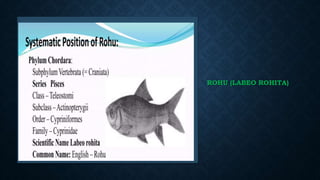
ROHU (LABEO ROHITA)
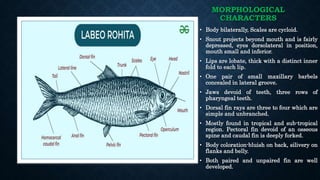
MORPHOLOGICAL
CHARACTERS
• Body bilaterally, Scales are cycloid.
• Snout projects beyond mouth and is fairly
depressed, eyes dorsolateral in position,
mouth small and inferior.
• Lips are lobate, thick with a distinct inner
fold to each lip.
• One pair of small maxillary barbels
concealed in lateral groove.
• Jaws devoid of teeth, three rows of
pharyngeal teeth.
• Dorsal fin rays are three to four which are
simple and unbranched.
• Mostly found in tropical and sub-tropical
region. Pectoral fin devoid of an osseous
spine and caudal fin is deeply forked.
• Body coloration-bluish on back, silivery on
flanks and belly.
• Both paired and unpaired fin are well
developed.
FEEDING HABITS
• In its early stage of life rohu prefer zooplankton, mainly rotifers and cladocerans
and phytoplankton comprise to form its emergency food.
• In the fingerling stage, it prefer to feed on all the zooplanktonic organism and few
smaller phytoplankters like desmids, phyflagellates and algal spores.
• On the other hand, adults show strong positive selection for the most of the
phytoplankton.
• In juvenile and adult stages rohu is essential an herbivores column feeder and
prefer algae and submerged vegetation.
• However the gut analysis, indicates its bottom feeding habits due to occu rrence
of decayed organic matter, mud and sand in its gut.
GROWTH RATE
• Rohu is eurythermal species and does not survive below 14°C.
• It is fast growing species.
• It attains about 35-45 cm total length and 700-800g in one year under
normal culture condition.
• It is observed that in polyculture, its growth rate is higher than that
of mrigal but lower than catla.
• Rohu is cultured along with Catla catla and Cirrhinus mrigala
REPRODUCTIVE BEHAVIOR
• It attains first maturity at the age of two years in both the sexes, whereas complete
maturity is attained after four years in males and five years in females.
• The spawning season of rohu generally from April to September.
• In natural conditions, spawning occurs in the shallow and marginal areas of flooded rivers.
• The optimum temperature for spawning is 22-31°C.
• However breeding does not take place in such lentic pond environments; thus induced
breeding becomes necessary.
• Rohu is seasonal breeder and artificial breeding is done by hypophysation.
• The fecundity is 271 egg/gms body weight
• Rohu is a polygamous fish and also seems to be promiscuous.
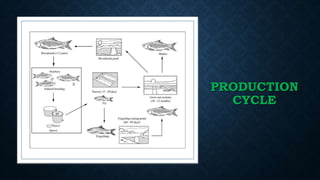
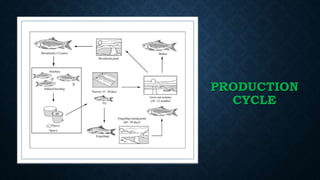
PRODUCTION
CYCLE
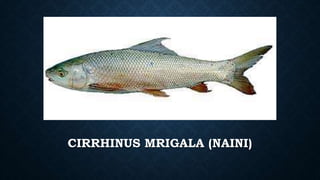
CIRRHINUS MRIGALA (NAINI)
MORPHOLOGICAL CHARACTERS
• Body bilaterally symmetrical and streamlined, its depth about equal to length of head.
• Scales are cycloid and present on whole body except head region.
• Snout is blunt, often with pores.
• Broad mouth, transverse, upper lip is entire and not continuous with lower lip, lower lip most
indistinct.
• One pair of short barbel.
• Pharyngeal teeth in three rows
• Dorsal fin as high as body with 12 or 13 branched rays.
• Pectoral fins shorter than dorsal and caudal fin deeply forked/divided.
• Body coloration-usually dark grey above, slivery beneath.
• Dorsal fin greyish and pectoral, pelvic and anal fins orange-tipped during breeding season.
FEEDING HABITS
• Hatchlings of mrigal normally confine themselves to the surface or sub-
surface waters.
• The fry and fingerling tend to move to deeper water.
• Adult are bottom dwellers
• It is stenophagus ( feeding insect) and illiophage (typically feed on
mud) fish in its feeding habit.
• The principal food components of its diet are detritus and decayed
vegetation, at the same time phytoplankton and zooplankton comprises
the rest
• Phytoplankton, Zooplankton
GROWTH RATE
• Eurythermal in nature and is reported to tolerate a minimum temperature of 14 ºC
• It attains 700-800g in one year under normal culture condition.
• Among the three Indian major carps, mrigal is normally considered as a slow
grower then catla and rohu.
• As the growth rate reduces after two years the rearing period is usually confined to
maximum of two years, only.
• However, mrigala is reported to survive for about twelve years in natural waters.
• It is observed that in polyculture, its growth rate is lower than that of rohu and
catla.
• Cirrhinus mrigala is cultured along with Catla catla and Rohu.
REPRODUCTIVE BEHAVIOR
• Maturity is attained in two years in captivity.
• Mrigal does not breed in ponds as it needs a fluviatile environment for it.
• Induced breeding by hypophysation and the use of synthetic hormones.
• Mrigal is a highly fecund fish i.e. 147 eggs/gms body weight.
• Fecundity increases with age and normally ranges from 100000-150000 eggs/kg
body weight.
• The spawning season is May to September.
• Mrigal usually breeds at a temperature of 24-31 ºC
• As mrigal does not breed in confined waters, injections of pituitary extract and
other synthetic commercial formulations: ovaparim.
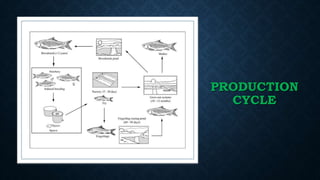
PRODUCTION
CYCLE
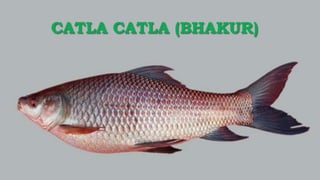
CATLA CATLA (BHAKUR)
MORPHOLOGICAL CHARACTERS
• Lips prominent and thick.
• Barbels absent.
• Body coloration: grayish on dorsal and silivery on the lateral and ventral side.
• Fins colour: blackish overall but pectoral, ventral and anal fins have orange tings
at the base.
• Scales: cycloid except on mouth and head.
• Lips: thick, fringed
• Head: Large and broad. Length of head ranges from 4 cm to 7 cm.
• Size: It reaches upto 182 cm length.
FEEDING HABIT
• Catle catle is a planktivorous carp. A planktivore is an aquatic organism that feeds on
planktonic food, including zooplankton and phytoplankton.
• Preferably feeding on zooplankton.
• It is freshwater surface feeder.
• Feeding preferences and nutritional requirements change according to the development
stage.
• Maximum feeding activity is seen during the morning hours (6 to 9 am).
• Larvae of Catla start feeding after 4 days of hatching on Brachionus and napuli.
• Feeds on large sized prey once the mouth gap increases.
• Fingerlings feeds on planktonic algae, vegetable debris along with larger size zooplankton.
• Adults predominantly feeds on surface and mid-water.
GROWTH RATE
• The average size of freshly hatched catla larvae is 4.7 mm.
• After 5 days- average size 9 mm
• After 10 days- average size 15.6 mm
• After 15 days- average size 27 mm respectively.
• Growth dependents on the density of the fishes stalked.
• Fast growing species.
• 300-400g in the first year, over 2 kg at the end of the second year, and
5-6 kg after 3 years.
REPRODUCTIVE BEHAVIOR
• Catla attains sexual maturity at an average age of two years and an average weight of 2 kg.
• Catla breed during the monsoon season in rivers.
• Induced breeding by hypophysation and the use of synthetic hormones.
• Fecundity increases with age and normally ranges from 80000-120000 eggs/kg body
weight.
• The spawning season is May to September.
• Catla usually breeds at a temperature of 25-32 ºC
• As Catla catla does not breed in confined waters, injections of pituitary extract and
other synthetic commercial formulations: ovaparim.
PRODUCTION
CYCLE
HORMONES USED FOR ARTIFICIAL
BREEDING
• Ova prim
• Pituitary gland
• Luteinizing releasing hormone-analogue
• Human chorionic gonadotropin
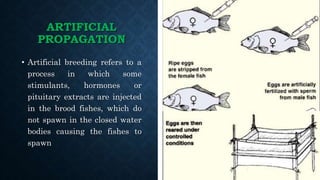
ARTIFICIAL
PROPAGATION
• Artificial breeding refers to a
process in which some
stimulants, hormones or
pituitary extracts are injected
in the brood fishes, which do
not spawn in the closed water
bodies causing the fishes to
spawn
THANK YOU

Indigeneous major carp.pptx by Boby Basnet

  • 1.
    AQUACULTURE (AQU 220) BOBYBASNET ASSISTANT PROF. (ANIMAL SCIENCE) ILAM COMMUNITY AGRICULTURE CAMPUS PURBANCHAL UNIVERSITY bobybasnet666@gmail.com
  • 2.
    Biology of cultivatedfish species: morphological characters, feeding habits, growth rate and reproductive behavior of common carp, Chinese carp, indigenous major carp, Tilapia, Trout, Catfishes, Sahar, Silver carp and Freshwater prawns.
  • 3.
    BIOLOGY OF CULTIVATEDINDIGENOUS FISH Important indigenous cultured fishes of Nepal A native fish species that is indigenous to a specific place or regions. Favorable and suitable to that environment. Exist from a long period of time is known as indigenous fish species. a. Rohu (Labeo rohita) b. Catla/Bhakur (Catla catla) c. Mrigal/Naini (Cirrhinus mrigala)
  • 4.
  • 5.
    MORPHOLOGICAL CHARACTERS • Body bilaterally,Scales are cycloid. • Snout projects beyond mouth and is fairly depressed, eyes dorsolateral in position, mouth small and inferior. • Lips are lobate, thick with a distinct inner fold to each lip. • One pair of small maxillary barbels concealed in lateral groove. • Jaws devoid of teeth, three rows of pharyngeal teeth. • Dorsal fin rays are three to four which are simple and unbranched. • Mostly found in tropical and sub-tropical region. Pectoral fin devoid of an osseous spine and caudal fin is deeply forked. • Body coloration-bluish on back, silivery on flanks and belly. • Both paired and unpaired fin are well developed.
  • 6.
    FEEDING HABITS • Inits early stage of life rohu prefer zooplankton, mainly rotifers and cladocerans and phytoplankton comprise to form its emergency food. • In the fingerling stage, it prefer to feed on all the zooplanktonic organism and few smaller phytoplankters like desmids, phyflagellates and algal spores. • On the other hand, adults show strong positive selection for the most of the phytoplankton. • In juvenile and adult stages rohu is essential an herbivores column feeder and prefer algae and submerged vegetation. • However the gut analysis, indicates its bottom feeding habits due to occu rrence of decayed organic matter, mud and sand in its gut.
  • 7.
    GROWTH RATE • Rohuis eurythermal species and does not survive below 14°C. • It is fast growing species. • It attains about 35-45 cm total length and 700-800g in one year under normal culture condition. • It is observed that in polyculture, its growth rate is higher than that of mrigal but lower than catla. • Rohu is cultured along with Catla catla and Cirrhinus mrigala
  • 8.
    REPRODUCTIVE BEHAVIOR • Itattains first maturity at the age of two years in both the sexes, whereas complete maturity is attained after four years in males and five years in females. • The spawning season of rohu generally from April to September. • In natural conditions, spawning occurs in the shallow and marginal areas of flooded rivers. • The optimum temperature for spawning is 22-31°C. • However breeding does not take place in such lentic pond environments; thus induced breeding becomes necessary. • Rohu is seasonal breeder and artificial breeding is done by hypophysation. • The fecundity is 271 egg/gms body weight • Rohu is a polygamous fish and also seems to be promiscuous.
  • 9.
  • 10.
  • 11.
    MORPHOLOGICAL CHARACTERS • Bodybilaterally symmetrical and streamlined, its depth about equal to length of head. • Scales are cycloid and present on whole body except head region. • Snout is blunt, often with pores. • Broad mouth, transverse, upper lip is entire and not continuous with lower lip, lower lip most indistinct. • One pair of short barbel. • Pharyngeal teeth in three rows • Dorsal fin as high as body with 12 or 13 branched rays. • Pectoral fins shorter than dorsal and caudal fin deeply forked/divided. • Body coloration-usually dark grey above, slivery beneath. • Dorsal fin greyish and pectoral, pelvic and anal fins orange-tipped during breeding season.
  • 12.
    FEEDING HABITS • Hatchlingsof mrigal normally confine themselves to the surface or sub- surface waters. • The fry and fingerling tend to move to deeper water. • Adult are bottom dwellers • It is stenophagus ( feeding insect) and illiophage (typically feed on mud) fish in its feeding habit. • The principal food components of its diet are detritus and decayed vegetation, at the same time phytoplankton and zooplankton comprises the rest • Phytoplankton, Zooplankton
  • 13.
    GROWTH RATE • Eurythermalin nature and is reported to tolerate a minimum temperature of 14 ºC • It attains 700-800g in one year under normal culture condition. • Among the three Indian major carps, mrigal is normally considered as a slow grower then catla and rohu. • As the growth rate reduces after two years the rearing period is usually confined to maximum of two years, only. • However, mrigala is reported to survive for about twelve years in natural waters. • It is observed that in polyculture, its growth rate is lower than that of rohu and catla. • Cirrhinus mrigala is cultured along with Catla catla and Rohu.
  • 14.
    REPRODUCTIVE BEHAVIOR • Maturityis attained in two years in captivity. • Mrigal does not breed in ponds as it needs a fluviatile environment for it. • Induced breeding by hypophysation and the use of synthetic hormones. • Mrigal is a highly fecund fish i.e. 147 eggs/gms body weight. • Fecundity increases with age and normally ranges from 100000-150000 eggs/kg body weight. • The spawning season is May to September. • Mrigal usually breeds at a temperature of 24-31 ºC • As mrigal does not breed in confined waters, injections of pituitary extract and other synthetic commercial formulations: ovaparim.
  • 15.
  • 16.
  • 17.
    MORPHOLOGICAL CHARACTERS • Lipsprominent and thick. • Barbels absent. • Body coloration: grayish on dorsal and silivery on the lateral and ventral side. • Fins colour: blackish overall but pectoral, ventral and anal fins have orange tings at the base. • Scales: cycloid except on mouth and head. • Lips: thick, fringed • Head: Large and broad. Length of head ranges from 4 cm to 7 cm. • Size: It reaches upto 182 cm length.
  • 18.
    FEEDING HABIT • Catlecatle is a planktivorous carp. A planktivore is an aquatic organism that feeds on planktonic food, including zooplankton and phytoplankton. • Preferably feeding on zooplankton. • It is freshwater surface feeder. • Feeding preferences and nutritional requirements change according to the development stage. • Maximum feeding activity is seen during the morning hours (6 to 9 am). • Larvae of Catla start feeding after 4 days of hatching on Brachionus and napuli. • Feeds on large sized prey once the mouth gap increases. • Fingerlings feeds on planktonic algae, vegetable debris along with larger size zooplankton. • Adults predominantly feeds on surface and mid-water.
  • 19.
    GROWTH RATE • Theaverage size of freshly hatched catla larvae is 4.7 mm. • After 5 days- average size 9 mm • After 10 days- average size 15.6 mm • After 15 days- average size 27 mm respectively. • Growth dependents on the density of the fishes stalked. • Fast growing species. • 300-400g in the first year, over 2 kg at the end of the second year, and 5-6 kg after 3 years.
  • 20.
    REPRODUCTIVE BEHAVIOR • Catlaattains sexual maturity at an average age of two years and an average weight of 2 kg. • Catla breed during the monsoon season in rivers. • Induced breeding by hypophysation and the use of synthetic hormones. • Fecundity increases with age and normally ranges from 80000-120000 eggs/kg body weight. • The spawning season is May to September. • Catla usually breeds at a temperature of 25-32 ºC • As Catla catla does not breed in confined waters, injections of pituitary extract and other synthetic commercial formulations: ovaparim.
  • 21.
  • 22.
    HORMONES USED FORARTIFICIAL BREEDING • Ova prim • Pituitary gland • Luteinizing releasing hormone-analogue • Human chorionic gonadotropin
  • 23.
    ARTIFICIAL PROPAGATION • Artificial breedingrefers to a process in which some stimulants, hormones or pituitary extracts are injected in the brood fishes, which do not spawn in the closed water bodies causing the fishes to spawn
  • 24.