MAGUR BREEDING
(Clarias batrachus)
Vishal solanki
Scientific classification
Kingdom : Animalia
Phylum : Chordata
Class : Actinopterygii
Order : Siluriformes
Family : Clariidae
Genus : Clarias
Species : Clarias batrachus
Scientific name : (Clarias batrachus)
Introduction
Magur (Clarias batrachus) is a species of
freshwater airbreathing catfish native to Southeast
Asia.
This fish know as walking catfishe because of its
ability to walk on land by using pactoral fin
movement.
This fish normaly lives in slow moving water body
or in stagnant water like pond, swamps, sreams,
rivers and rice paddies.
Geographic distribution
Magur is a very distributed fish species from India
(east India), Pakistan, Bangladesh, Myanmar, Sri
Lanka, Thailand, Singapore, Indonesia, and the
Philippines.
 Its current range includes the United States, where
it was first introduced to Florida from Thailand for
cultivation purposes.
Biological distribution
This is airbreathing fish. Here accessory breathing
organ is branched and present near the gill.
Can be cultured in oxygen-poor water as it is an
air-breathing fish important.
The head is large and the mouth is present on the
ventral side.
Of the eighth barbels two are much stouter and
larger while others are similar.
Cont..
This catfish has long-based dorsal and anal fins, as
well as several pairs of sensory barbels, and also
lacks an adipose fin.
Magur has Pectoral and pelvic fins in paired and
dorsal, anal, and caudal fins in unpaired fins.
The skin is scaleless, but covered with mucus,
which protects the fish when it is out of water.
Habits and habitats
This species can be found in freshwater, brackish water,
and terrestrial environments.
It has been recorded at a depth of one meter but the
species’ maximum depth is unknown.
Clarias batrachus burrows into the mud during cold
and dry months to survive poor weather conditions.
Clarias batrachus can survive outside of the water and
travel on land as long as its gills stay moist. It is most
common to see C. batrachus outside of the water after
heavy rains.
Feeding habits
The walking catfish is omnivorous
As larvae, C. batrachus feeds entirely on plankton. In the
later developmental stage of fry, it begins to prey on larger
organisms
 When it progresses into a juvenile, it predominantly eats
insects
As an adult, a walking catfish preys on plants (benthic
algae), insects (eggs, pupae, or nymphs [e.g., dragonfly
nymphs, chironomid larvae]), aquatic worms, mollusks,
and smaller fish (finfish)
The walking catfish is also a detritivore and eats organic
waste. Clarias batrachus has a broad diet and is known to be
an opportunistic feeder
Economic Importance for
Humans: Positive
Clarias batrachus is used in commercial fisheries,
aquaculture, and aquariums
The walking catfish is widely consumed in its
native range (Asia) but not in its introduced range
Further, Ohio and other U.S. states have limited or
prohibited the possession of the walking catfish to
prevent its expansion
Economic Importance for
Humans: Negative
The walking catfish poses a threat as an invasive
species
Clarias batrachus, once introduced, is hard to
contain and control due to its mass spawning that
produces several thousands of eggs, its voracious
diet, and its ability to survive in muddy and low-
oxygenated conditions
Costly containment methods, such as the use of
barrier fences, have been utilized to prevent walking
catfish from invading fish stocks
Natural breeding of magur
Breeding season:-June-August
Breeding interval :- Walking catfish breed via
multiple spawning cycles during the summer.
Range number of offspring:- 7,000 to 9,000
Average age at sexual or reproductive maturity
(female)1 year, (male)1 year.
Range time to hatching:- 20 to 24 hours
Average time to independence:- 72 hours
Cont..
The walking catfish fry becomes independent after
three days
The male guards the nest from predators,
immediately following spawning
The female will return once the eggs have hatched
and the male and female take part in protecting
the fry until they are independent
The parental investment only extends to 24 hours
following the hatching
Captive breeding of magur
Breeding techniques : the standard breeding
technique developed by the Central Indian
FisheriesResearch Institute.
Selections of brooder : use Magur one year old
and weighing about 100 g. each.
Identifying brooder : Gravid females are easy to
identify as they are comparatively heavier, have a
round and bulging abdomen and their vent is more
red than that of the males.
Cont..
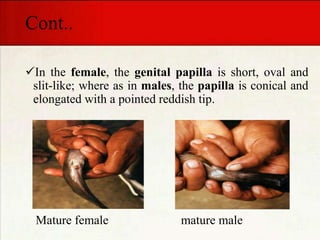
In the female, the genital papilla is short, oval and
slit-like; where as in males, the papilla is conical and
elongated with a pointed reddish tip.
Mature female mature male
Cont..
Brood - stock development: brood fish is maintain in
cement tanks with soil and running water.
Stock brooder in well prepared pond in month of April.
Stocking density is 8000 no/ha.
The fishes where fed with trash fishes and rice brand at
9:1 proportions at about 10% of body weight.
Fish meal, wheat flour and soya cack can be also used
in the diet.
Cont..
Cont…
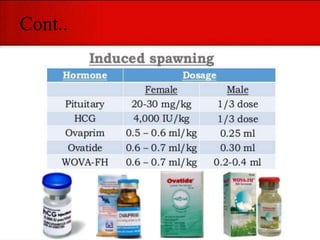
For Induced breeding given singel dose of ovaprim
at same time for both male and female.
 Hypodermic syringes with a small size of needle
use to ingect hormones into the muscle of brooder.
Kept the treated male and female fishe sapratly In
two tank.
Cont..
Stripping and fertilization: Earlier, the injected males
were sacrificed to prepare sperm suspension in clean
water.
The testes were dissected out and cut into small pieces
with the help of small scissors and a clean blade. A small
amount of water to activate the sperm.
This sperm suspension can remain dormant and fertile for
up to 24 hr.
 examined the fish for ovulation by hand stripping.
Cont..
 Fish that yielded a good stream of transparent green-
brown eggs were rated as ovulated.
released the eggs by gently pressing the abdomen towards
the vent, collecting them on a stainless steel plate.
The sperm suspension was sprinkled evenly over the eggs
and clean water was added.
The milt is then added and mixed well with the help of a
feather.
Cont..
Eggs and sperm were allowed to mix by gently moving
the tray for 4-5 minutes.
wash the fertilized eggs thoroughly and transferred them
to the hatchery before the eggs began to adhere. Removed
unfertilized or dead (opaque/white) eggs immediately to
prevent
The developing eggs are small, adhesive, and are
incubated in plastic basins with running water.
 fertilized the hand-stripped eggs artificially using the dry
and wet methods.
Reference
https://www.researchgate.net/publication/22851021
6_Seed_production_of_Magur_Clarias_batrachus_u
sing_a_rural_model_portable_hatchery_in_Assam_
India-A_farmer_proven_technology.
https://www2.slideshare.net/mobile/CREATIVEAvr
o/magur-fishclarias-batrachus?qid=d40574e3-b0b2-
41a1-aa99-51cef937c82c&v=&b=&from_search=1.
Reference
https://animaldiversity.org/accounts/Clarias_batrach
us/.
https://www2.slideshare.net/mobile/SaiprasadBhusa
re/breeding-of-magur?qid=d40574e3-b0b2-41a1-
aa99-51cef937c82c&v=&b=&from_search=6.
https://en.m.wikipedia.org/wiki/Walking_catfish.
Thank you..

Magur (Clarias batrachus) breeding

  • 1.
  • 2.
    Scientific classification Kingdom :Animalia Phylum : Chordata Class : Actinopterygii Order : Siluriformes Family : Clariidae Genus : Clarias Species : Clarias batrachus Scientific name : (Clarias batrachus)
  • 3.
    Introduction Magur (Clarias batrachus)is a species of freshwater airbreathing catfish native to Southeast Asia. This fish know as walking catfishe because of its ability to walk on land by using pactoral fin movement. This fish normaly lives in slow moving water body or in stagnant water like pond, swamps, sreams, rivers and rice paddies.
  • 4.
    Geographic distribution Magur isa very distributed fish species from India (east India), Pakistan, Bangladesh, Myanmar, Sri Lanka, Thailand, Singapore, Indonesia, and the Philippines.  Its current range includes the United States, where it was first introduced to Florida from Thailand for cultivation purposes.
  • 5.
    Biological distribution This isairbreathing fish. Here accessory breathing organ is branched and present near the gill. Can be cultured in oxygen-poor water as it is an air-breathing fish important. The head is large and the mouth is present on the ventral side. Of the eighth barbels two are much stouter and larger while others are similar.
  • 6.
    Cont.. This catfish haslong-based dorsal and anal fins, as well as several pairs of sensory barbels, and also lacks an adipose fin. Magur has Pectoral and pelvic fins in paired and dorsal, anal, and caudal fins in unpaired fins. The skin is scaleless, but covered with mucus, which protects the fish when it is out of water.
  • 7.
    Habits and habitats Thisspecies can be found in freshwater, brackish water, and terrestrial environments. It has been recorded at a depth of one meter but the species’ maximum depth is unknown. Clarias batrachus burrows into the mud during cold and dry months to survive poor weather conditions. Clarias batrachus can survive outside of the water and travel on land as long as its gills stay moist. It is most common to see C. batrachus outside of the water after heavy rains.
  • 8.
    Feeding habits The walkingcatfish is omnivorous As larvae, C. batrachus feeds entirely on plankton. In the later developmental stage of fry, it begins to prey on larger organisms  When it progresses into a juvenile, it predominantly eats insects As an adult, a walking catfish preys on plants (benthic algae), insects (eggs, pupae, or nymphs [e.g., dragonfly nymphs, chironomid larvae]), aquatic worms, mollusks, and smaller fish (finfish) The walking catfish is also a detritivore and eats organic waste. Clarias batrachus has a broad diet and is known to be an opportunistic feeder
  • 9.
    Economic Importance for Humans:Positive Clarias batrachus is used in commercial fisheries, aquaculture, and aquariums The walking catfish is widely consumed in its native range (Asia) but not in its introduced range Further, Ohio and other U.S. states have limited or prohibited the possession of the walking catfish to prevent its expansion
  • 10.
    Economic Importance for Humans:Negative The walking catfish poses a threat as an invasive species Clarias batrachus, once introduced, is hard to contain and control due to its mass spawning that produces several thousands of eggs, its voracious diet, and its ability to survive in muddy and low- oxygenated conditions Costly containment methods, such as the use of barrier fences, have been utilized to prevent walking catfish from invading fish stocks
  • 11.
    Natural breeding ofmagur Breeding season:-June-August Breeding interval :- Walking catfish breed via multiple spawning cycles during the summer. Range number of offspring:- 7,000 to 9,000 Average age at sexual or reproductive maturity (female)1 year, (male)1 year. Range time to hatching:- 20 to 24 hours Average time to independence:- 72 hours
  • 12.
    Cont.. The walking catfishfry becomes independent after three days The male guards the nest from predators, immediately following spawning The female will return once the eggs have hatched and the male and female take part in protecting the fry until they are independent The parental investment only extends to 24 hours following the hatching
  • 13.
    Captive breeding ofmagur Breeding techniques : the standard breeding technique developed by the Central Indian FisheriesResearch Institute. Selections of brooder : use Magur one year old and weighing about 100 g. each. Identifying brooder : Gravid females are easy to identify as they are comparatively heavier, have a round and bulging abdomen and their vent is more red than that of the males.
  • 14.
    Cont.. In the female,the genital papilla is short, oval and slit-like; where as in males, the papilla is conical and elongated with a pointed reddish tip. Mature female mature male
  • 15.
    Cont.. Brood - stockdevelopment: brood fish is maintain in cement tanks with soil and running water. Stock brooder in well prepared pond in month of April. Stocking density is 8000 no/ha. The fishes where fed with trash fishes and rice brand at 9:1 proportions at about 10% of body weight. Fish meal, wheat flour and soya cack can be also used in the diet.
  • 16.
  • 17.
    Cont… For Induced breedinggiven singel dose of ovaprim at same time for both male and female.  Hypodermic syringes with a small size of needle use to ingect hormones into the muscle of brooder. Kept the treated male and female fishe sapratly In two tank.
  • 18.
    Cont.. Stripping and fertilization:Earlier, the injected males were sacrificed to prepare sperm suspension in clean water. The testes were dissected out and cut into small pieces with the help of small scissors and a clean blade. A small amount of water to activate the sperm. This sperm suspension can remain dormant and fertile for up to 24 hr.  examined the fish for ovulation by hand stripping.
  • 19.
    Cont..  Fish thatyielded a good stream of transparent green- brown eggs were rated as ovulated. released the eggs by gently pressing the abdomen towards the vent, collecting them on a stainless steel plate. The sperm suspension was sprinkled evenly over the eggs and clean water was added. The milt is then added and mixed well with the help of a feather.
  • 20.
    Cont.. Eggs and spermwere allowed to mix by gently moving the tray for 4-5 minutes. wash the fertilized eggs thoroughly and transferred them to the hatchery before the eggs began to adhere. Removed unfertilized or dead (opaque/white) eggs immediately to prevent The developing eggs are small, adhesive, and are incubated in plastic basins with running water.  fertilized the hand-stripped eggs artificially using the dry and wet methods.
  • 23.
  • 24.
  • 25.