BBBByyyy:::: EEEErrrr.... RRRRaaaahhhhuuuullll SSSShhhhaaaarrrrmmmmaaaa 
EE DEPARMENT SEMINAR April 23, 2012
Introduction: 
 In a generating station the generator and transformer 
are the most expensive equipments and hence it is 
desirable to employ a protective system to isolate the 
faulty equipment as quickly as possible to keep the 
healthy section in normal operation aanndd ttoo eennssuurree 
uninterruptable power supply. 
 The basic electrical quantities those are likely to 
change during abnormal fault conditions are current, 
voltage, phase angle and frequency . Protective relays 
utilizes one or more of these quantities to detect 
abnormal conditions in a power system.
Generator protection: 
 Stator protection 
Differential 
Restricted eeaarrtthh ffaauulltt 
Negative sequence current 
 Loss of load
Cont.. 
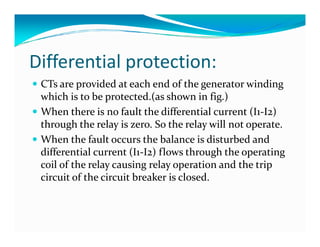
Rotor earth fault 
Over speed 
OOvveerr vvoollttaaggee 
 Loss of field 
Back –up over current
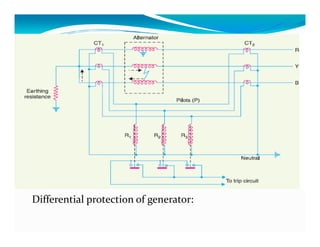
Differential protection: 
 CTs are provided at each end of the generator winding 
which is to be protected.(as shown in fig.) 
 When there is no fault the differential current (I1-I2) 
through the relay is zero. So the relay wwiillll nnoott ooppeerraattee.. 
 When the fault occurs the balance is disturbed and 
differential current (I1-I2) flows through the operating 
coil of the relay causing relay operation and the trip 
circuit of the circuit breaker is closed.
Differential protection of generator:
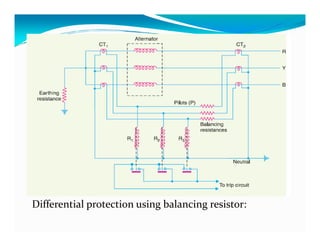
Differential protection using balancing resistor:
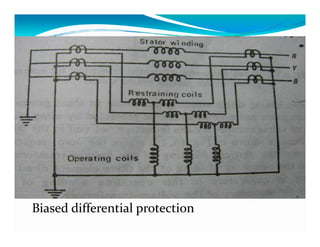
Biased differential protection
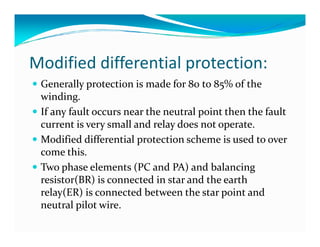
Modified differential protection: 
 Generally protection is made for 80 to 85% of the 
winding. 
 If any fault occurs near the neutral point then the fault 
current is very small and relay ddooeess nnoott ooppeerraattee.. 
 Modified differential protection scheme is used to over 
come this. 
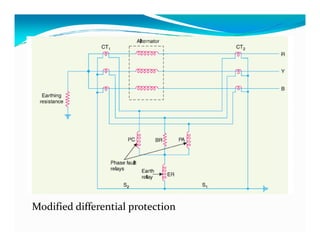
 Two phase elements (PC and PA) and balancing 
resistor(BR) is connected in star and the earth 
relay(ER) is connected between the star point and 
neutral pilot wire.
Modified differential protection
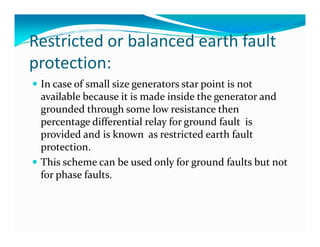
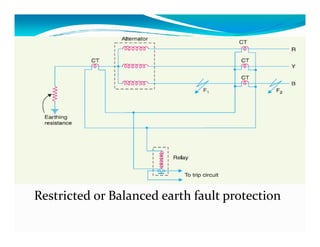
Restricted or balanced earth fault 
protection: 
 In case of small size generators star point is not 
available because it is made inside the generator and 
grounded through some low resistance then 
percentage differential relay for ggrroouunndd ffaauulltt iiss 
provided and is known as restricted earth fault 
protection. 
 This scheme can be used only for ground faults but not 
for phase faults.
Restricted or Balanced earth fault protection
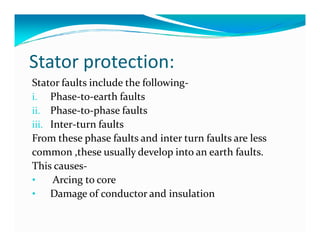
Stator protection: 
Stator faults include the following-i. 
Phase-to-earth faults 
ii. Phase-to-phase faults 
iii. IInntteerr-ttuurrnn ffaauullttss 
From these phase faults and inter turn faults are less 
common ,these usually develop into an earth faults. 
This causes- 
• Arcing to core 
• Damage of conductor and insulation
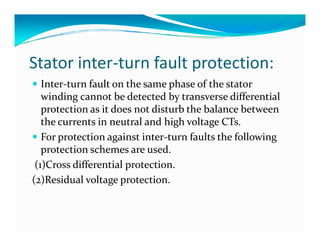
Stator inter-turn fault protection: 
 Inter-turn fault on the same phase of the stator 
winding cannot be detected by transverse differential 
protection as it does not disturb the balance between 
the currents in neutral and hhiigghh vvoollttaaggee CCTTss.. 
 For protection against inter-turn faults the following 
protection schemes are used. 
(1)Cross differential protection. 
(2)Residual voltage protection.
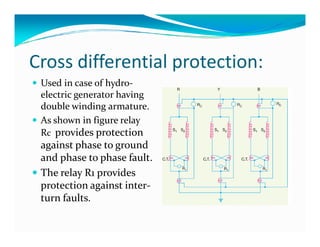
Cross differential protection: 
 Used in case of hydro-electric 
generator having 
double winding armature. 
 As shown iinn ffiigguurree rreellaayy 
Rc provides protection 
against phase to ground 
and phase to phase fault. 
 The relay R1 provides 
protection against inter-turn 
faults.
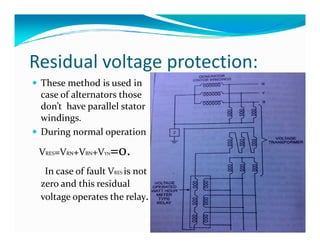
Residual voltage protection: 
 These method is used in 
case of alternators those 
don’t have parallel stator 
windings. 
 During normal operation 
VRES=VRN+VBN+VYN=0. 
In case of fault VRES is not 
zero and this residual 
voltage operates the relay.
Rotor faults: 
 Faults in the rotor circuit may be either earth faults or 
between the turns of the field winding . 
 Field circuits are normally operated un-earthed. So a 
single earth fault will not affect iittss ooppeerraattiioonn.. 
 But when a second fault arises then field winding is 
short circuited and produce unsymmetrical field 
system which leads to unbalanced forces on rotor and 
results in excess pressure and bearing and shaft 
distortion.
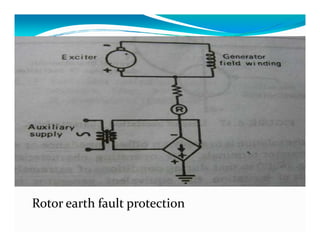
Rotor earth fault protection: 
 The rotor earth fault protection is done by “dc 
injection method or ac injection method”. 
 The dc or ac voltage is impressed between the field 
circuit and ground through a sensitive oovveerrvvoollttaaggee 
relay and current limiting resistor or capacitor(in case 
of ac). 
 But dc source is generally used as over-current relay in 
case of dc is more sensitive than ac. 
 A single earth fault in rotor circuit will complete the 
path and the fault is sensed by the relay.
Rotor earth fault protection
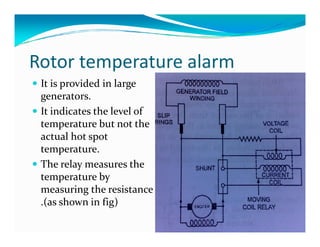
Rotor temperature alarm 
 It is provided in large 
generators. 
 It indicates the level of 
temperature bbuutt nnoott tthhee 
actual hot spot 
temperature. 
 The relay measures the 
temperature by 
measuring the resistance 
.(as shown in fig)
Loss of excitation protection: 
When the excitation of generator is lost it operate as a 
Induction generator. It derives excitation from the 
system and supply power at leading power factor. 
WWhhiicchh mmaayy ccaauussee- 
 A fall in voltage  so loss of synchronism  system 
instability. 
 Over heating of rotor due to induction current on it. 
A protection having MHO characteristic 
is used to detect loss of field.
Over voltage protection: 
 Overvoltage protection is required in case of hydro-electric 
or gas turbine generators but not in case of 
turbo generators. 
Over voltage may be caused due to- 
 Transient over voltage in the transmission lliinnee dduuee ttoo 
lightening. 
 Defective operation of the voltage regulator. 
 Sudden loss of load due to line tripping. 
The protection is provided with an over voltage relay. 
It is usually of induction pattern with an IDMT 
Characteristic
Overload protection: 
 Overloading of the machine causes overheating in the 
stator winding. 
 This can be prevented by using over-current relay with 
time ddeellaayy aaddjjuussttmmeenntt.. 
 But overheating not only depends on over-current but 
also the failure of the cooling system in the generator. 
 So temperature detector coils such as thermistors or 
thermocouples are used at various points in stator 
winding for indication of the temperature.
Reverse power protection: 
 When prime-mover fails machine starts motoring and 
draws electrical power from the system and this is 
known as inverted operation . 
 The generator can be protected ffrroomm iinnvveerrtteedd 
operation by using single-element directional power 
relay(reverse power relay) which senses the direction 
of power flow.
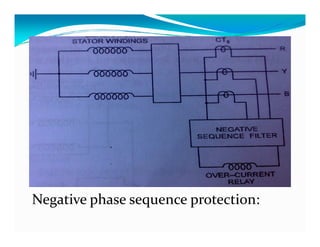
Negative phase sequence 
protection: 
 Unbalance may cause due to single phase fault or 
unbalanced loading and it gives rise to negative 
sequence current . 
 This current in rotor causes rotor oovveerrhheeaattiinngg aanndd 
damage to the rotor. 
 This can be protected by negative sequence current 
filter with over current relay.
Negative phase sequence protection:
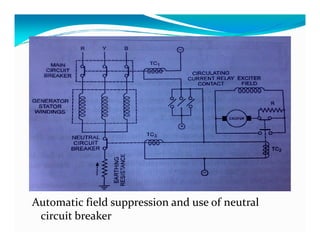
Automatic field suppression and 
use of neutral circuit breaker: 
 In case of a fault in the generator and though the 
circuit breaker is tripped ,the fault continues to fed as 
long as excitation will exist because emf is induced in 
the ggeenneerraattoorr iittsseellff.. 
 Hence all protection system not only trip the generator 
circuit breaker but also trip the “automatic field 
discharge switch “.
Automatic field suppression and use of neutral 
circuit breaker
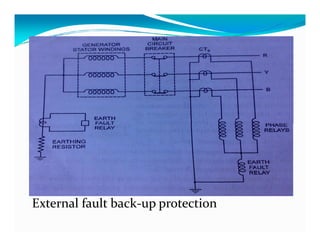
External fault back up protection: 
Over-current and earth-fault protection is 
provided for back-up protection of large 
sized generators protected bbyy ddiiffffeerreennttiiaall 
protection. 
 Induction type IDMT relay is used for this 
purpose.
External fault back-up protection
Conclusion: 
 Protective relays are used to detect electrical faults and 
to alarm, disconnects or shutdown the faulted 
apparatus to provide personnel safety and equipment 
pprrootteeccttiioonn.. 
 A protective relay does not prevent the appearance of 
faults rather takes action only after a fault has occurred 
in the system.
References: 
 Electrical power system 
by C.L.Wadhwa 
 Electrical power 
bbyy JJ..BB..GGuuppttaa 
 www.wikipedia.com
Thank 
yyoouu
Any Queries 
??????

Generator Protection By - Er Rahul Sharma

  • 1.
    BBBByyyy:::: EEEErrrr.... RRRRaaaahhhhuuuullllSSSShhhhaaaarrrrmmmmaaaa EE DEPARMENT SEMINAR April 23, 2012
  • 2.
    Introduction: Ina generating station the generator and transformer are the most expensive equipments and hence it is desirable to employ a protective system to isolate the faulty equipment as quickly as possible to keep the healthy section in normal operation aanndd ttoo eennssuurree uninterruptable power supply. The basic electrical quantities those are likely to change during abnormal fault conditions are current, voltage, phase angle and frequency . Protective relays utilizes one or more of these quantities to detect abnormal conditions in a power system.
  • 3.
    Generator protection: Stator protection Differential Restricted eeaarrtthh ffaauulltt Negative sequence current Loss of load
  • 4.
    Cont.. Rotor earthfault Over speed OOvveerr vvoollttaaggee Loss of field Back –up over current
  • 5.
    Differential protection: CTs are provided at each end of the generator winding which is to be protected.(as shown in fig.) When there is no fault the differential current (I1-I2) through the relay is zero. So the relay wwiillll nnoott ooppeerraattee.. When the fault occurs the balance is disturbed and differential current (I1-I2) flows through the operating coil of the relay causing relay operation and the trip circuit of the circuit breaker is closed.
  • 6.
  • 7.
    Differential protection usingbalancing resistor:
  • 8.
  • 9.
    Modified differential protection: Generally protection is made for 80 to 85% of the winding. If any fault occurs near the neutral point then the fault current is very small and relay ddooeess nnoott ooppeerraattee.. Modified differential protection scheme is used to over come this. Two phase elements (PC and PA) and balancing resistor(BR) is connected in star and the earth relay(ER) is connected between the star point and neutral pilot wire.
  • 10.
  • 11.
    Restricted or balancedearth fault protection: In case of small size generators star point is not available because it is made inside the generator and grounded through some low resistance then percentage differential relay for ggrroouunndd ffaauulltt iiss provided and is known as restricted earth fault protection. This scheme can be used only for ground faults but not for phase faults.
  • 12.
    Restricted or Balancedearth fault protection
  • 13.
    Stator protection: Statorfaults include the following-i. Phase-to-earth faults ii. Phase-to-phase faults iii. IInntteerr-ttuurrnn ffaauullttss From these phase faults and inter turn faults are less common ,these usually develop into an earth faults. This causes- • Arcing to core • Damage of conductor and insulation
  • 14.
    Stator inter-turn faultprotection: Inter-turn fault on the same phase of the stator winding cannot be detected by transverse differential protection as it does not disturb the balance between the currents in neutral and hhiigghh vvoollttaaggee CCTTss.. For protection against inter-turn faults the following protection schemes are used. (1)Cross differential protection. (2)Residual voltage protection.
  • 15.
    Cross differential protection: Used in case of hydro-electric generator having double winding armature. As shown iinn ffiigguurree rreellaayy Rc provides protection against phase to ground and phase to phase fault. The relay R1 provides protection against inter-turn faults.
  • 16.
    Residual voltage protection: These method is used in case of alternators those don’t have parallel stator windings. During normal operation VRES=VRN+VBN+VYN=0. In case of fault VRES is not zero and this residual voltage operates the relay.
  • 17.
    Rotor faults: Faults in the rotor circuit may be either earth faults or between the turns of the field winding . Field circuits are normally operated un-earthed. So a single earth fault will not affect iittss ooppeerraattiioonn.. But when a second fault arises then field winding is short circuited and produce unsymmetrical field system which leads to unbalanced forces on rotor and results in excess pressure and bearing and shaft distortion.
  • 18.
    Rotor earth faultprotection: The rotor earth fault protection is done by “dc injection method or ac injection method”. The dc or ac voltage is impressed between the field circuit and ground through a sensitive oovveerrvvoollttaaggee relay and current limiting resistor or capacitor(in case of ac). But dc source is generally used as over-current relay in case of dc is more sensitive than ac. A single earth fault in rotor circuit will complete the path and the fault is sensed by the relay.
  • 19.
  • 20.
    Rotor temperature alarm It is provided in large generators. It indicates the level of temperature bbuutt nnoott tthhee actual hot spot temperature. The relay measures the temperature by measuring the resistance .(as shown in fig)
  • 21.
    Loss of excitationprotection: When the excitation of generator is lost it operate as a Induction generator. It derives excitation from the system and supply power at leading power factor. WWhhiicchh mmaayy ccaauussee- A fall in voltage so loss of synchronism system instability. Over heating of rotor due to induction current on it. A protection having MHO characteristic is used to detect loss of field.
  • 22.
    Over voltage protection: Overvoltage protection is required in case of hydro-electric or gas turbine generators but not in case of turbo generators. Over voltage may be caused due to- Transient over voltage in the transmission lliinnee dduuee ttoo lightening. Defective operation of the voltage regulator. Sudden loss of load due to line tripping. The protection is provided with an over voltage relay. It is usually of induction pattern with an IDMT Characteristic
  • 23.
    Overload protection: Overloading of the machine causes overheating in the stator winding. This can be prevented by using over-current relay with time ddeellaayy aaddjjuussttmmeenntt.. But overheating not only depends on over-current but also the failure of the cooling system in the generator. So temperature detector coils such as thermistors or thermocouples are used at various points in stator winding for indication of the temperature.
  • 24.
    Reverse power protection: When prime-mover fails machine starts motoring and draws electrical power from the system and this is known as inverted operation . The generator can be protected ffrroomm iinnvveerrtteedd operation by using single-element directional power relay(reverse power relay) which senses the direction of power flow.
  • 25.
    Negative phase sequence protection: Unbalance may cause due to single phase fault or unbalanced loading and it gives rise to negative sequence current . This current in rotor causes rotor oovveerrhheeaattiinngg aanndd damage to the rotor. This can be protected by negative sequence current filter with over current relay.
  • 26.
  • 27.
    Automatic field suppressionand use of neutral circuit breaker: In case of a fault in the generator and though the circuit breaker is tripped ,the fault continues to fed as long as excitation will exist because emf is induced in the ggeenneerraattoorr iittsseellff.. Hence all protection system not only trip the generator circuit breaker but also trip the “automatic field discharge switch “.
  • 28.
    Automatic field suppressionand use of neutral circuit breaker
  • 29.
    External fault backup protection: Over-current and earth-fault protection is provided for back-up protection of large sized generators protected bbyy ddiiffffeerreennttiiaall protection. Induction type IDMT relay is used for this purpose.
  • 30.
  • 31.
    Conclusion: Protectiverelays are used to detect electrical faults and to alarm, disconnects or shutdown the faulted apparatus to provide personnel safety and equipment pprrootteeccttiioonn.. A protective relay does not prevent the appearance of faults rather takes action only after a fault has occurred in the system.
  • 32.
    References: Electricalpower system by C.L.Wadhwa Electrical power bbyy JJ..BB..GGuuppttaa www.wikipedia.com
  • 33.
  • 34.