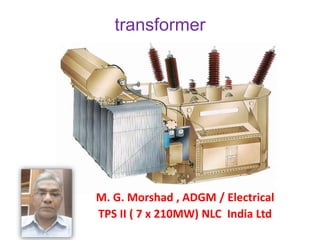
transformer
M. G. Morshad , ADGM / Electrical
TPS II ( 7 x 210MW) NLC India Ltd
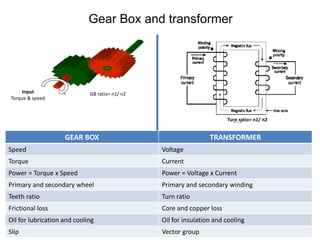
Gear Box and transformer
Input
Torque & speed
GB ratio= n1/ n2
Turn ratio= n1/ n2
GEAR BOX TRANSFORMER
Speed Voltage
Torque Current
Power = Torque x Speed Power = Voltage x Current
Primary and secondary wheel Primary and secondary winding
Teeth ratio Turn ratio
Frictional loss Core and copper loss
Oil for lubrication and cooling Oil for insulation and cooling
Slip Vector group
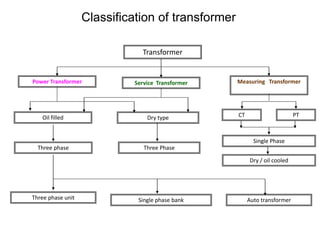
Classification of transformer
Transformer
Power Transformer Service Transformer Measuring Transformer
Dry type
Auto transformer
Three Phase
Oil filled CT PT
Single Phase
Dry / oil cooled
Three phase
Three phase unit Single phase bank
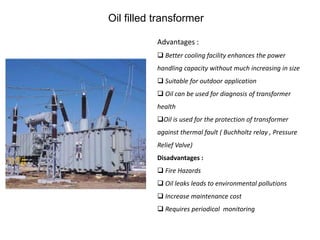
Oil filled transformer
Advantages :
 Better cooling facility enhances the power
handling capacity without much increasing in size
 Suitable for outdoor application
 Oil can be used for diagnosis of transformer
health
Oil is used for the protection of transformer
against thermal fault ( Buchholtz relay , Pressure
Relief Valve)
Disadvantages :
 Fire Hazards
 Oil leaks leads to environmental pollutions
 Increase maintenance cost
 Requires periodical monitoring
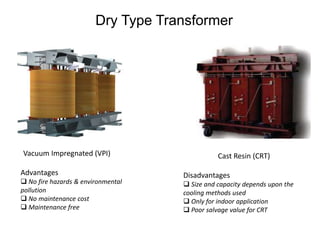
Dry Type Transformer
Vacuum Impregnated (VPI) Cast Resin (CRT)
Advantages
 No fire hazards & environmental
pollution
 No maintenance cost
 Maintenance free
Disadvantages
 Size and capacity depends upon the
cooling methods used
 Only for indoor application
 Poor salvage value for CRT
Purpose of Transformer in thermal power plant
1. To step up the voltage for long distance transmission of
electric power with high voltage & low current ( GT)
2. To interconnect two grid of different system voltage (ICT)
3. To step down the voltage for providing supply source to load
capacity >175KW through 6.6 KV HT bus (UAT)
4. To step down the voltage for providing supply source to load
capacity <175KW through 415 V KV LT bus (UST)
5. Providing supply source nearest to the load centre to avoid
voltage buckling during start of load.
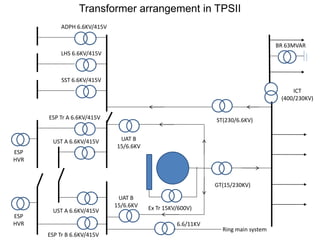
Transformer arrangement in TPSII
GT(15/230KV)
ST(230/6.6KV)
ICT
(400/230KV)
Ex Tr 15KV/600V)
UAT B
15/6.6KV
BR 63MVAR
UAT B
15/6.6KV
ESP Tr A 6.6KV/415V
ESP Tr B 6.6KV/415V
UST A 6.6KV/415V
UST A 6.6KV/415V
6.6/11KV
Ring main system
SST 6.6KV/415V
LHS 6.6KV/415V
ADPH 6.6KV/415V
ESP
HVR
ESP
HVR
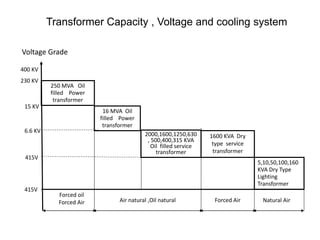
Transformer Capacity , Voltage and cooling system
5,10,50,100,160
KVA Dry Type
Lighting
Transformer
2000,1600,1250,630
, 500,400,315 KVA
Oil filled service
transformer
16 MVA Oil
filled Power
transformer
415V
415V
6.6 KV
250 MVA Oil
filled Power
transformer
15 KV
400 KV
230 KV
1600 KVA Dry
type service
transformer
Forced oil
Forced Air Air natural ,Oil natural Forced Air Natural Air
Voltage Grade
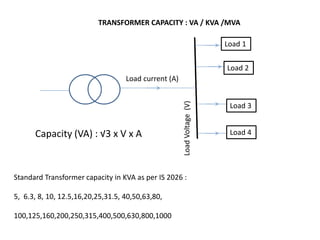
TRANSFORMER CAPACITY : VA / KVA /MVA
Load 1
Load 2
Load 3
Load 4
Load current (A)
LoadVoltage(V)
Capacity (VA) : √3 x V x A
Standard Transformer capacity in KVA as per IS 2026 :
5, 6.3, 8, 10, 12.5,16,20,25,31.5, 40,50,63,80,
100,125,160,200,250,315,400,500,630,800,1000
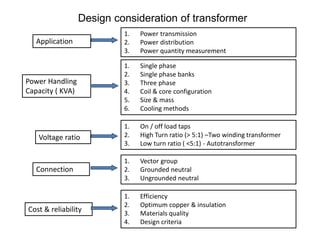
Design consideration of transformer
Application
Power Handling
Capacity ( KVA)
Voltage ratio
1. Single phase
2. Single phase banks
3. Three phase
4. Coil & core configuration
5. Size & mass
6. Cooling methods
1. Power transmission
2. Power distribution
3. Power quantity measurement
1. On / off load taps
2. High Turn ratio (> 5:1) –Two winding transformer
3. Low turn ratio ( <5:1) - Autotransformer
Connection
1. Vector group
2. Grounded neutral
3. Ungrounded neutral
Cost & reliability
1. Efficiency
2. Optimum copper & insulation
3. Materials quality
4. Design criteria
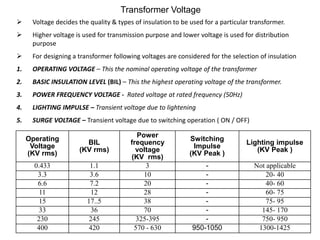
 Voltage decides the quality & types of insulation to be used for a particular transformer.
 Higher voltage is used for transmission purpose and lower voltage is used for distribution
purpose
 For designing a transformer following voltages are considered for the selection of insulation
1. OPERATING VOLTAGE – This the nominal operating voltage of the transformer
2. BASIC INSULATION LEVEL (BIL) – This the highest operating voltage of the transformer.
3. POWER FREQUENCY VOLTAGE - Rated voltage at rated frequency (50Hz)
4. LIGHTING IMPULSE – Transient voltage due to lightening
5. SURGE VOLTAGE – Transient voltage due to switching operation ( ON / OFF)
Operating
Voltage
(KV rms)
BIL
(KV rms)
Power
frequency
voltage
(KV rms)
Switching
Impulse
(KV Peak )
Lighting impulse
(KV Peak )
0.433 1.1 3 - Not applicable
3.3 3.6 10 - 20- 40
6.6 7.2 20 - 40- 60
11 12 28 - 60- 75
15 17..5 38 - 75- 95
33 36 70 - 145- 170
230 245 325-395 - 750- 950
400 420 570 - 630 950-1050 1300-1425
Transformer Voltage
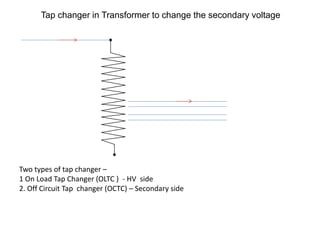
Tap changer in Transformer to change the secondary voltage
Two types of tap changer –
1 On Load Tap Changer (OLTC ) - HV side
2. Off Circuit Tap changer (OCTC) – Secondary side
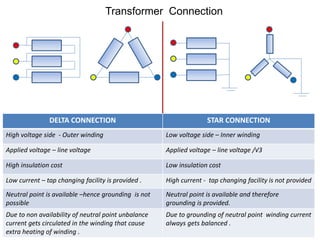
Transformer Connection
DELTA CONNECTION STAR CONNECTION
High voltage side - Outer winding Low voltage side – Inner winding
Applied voltage – line voltage Applied voltage – line voltage /√3
High insulation cost Low insulation cost
Low current – tap changing facility is provided . High current - tap changing facility is not provided
Neutral point is available –hence grounding is not
possible
Neutral point is available and therefore
grounding is provided.
Due to non availability of neutral point unbalance
current gets circulated in the winding that cause
extra heating of winding .
Due to grounding of neutral point winding current
always gets balanced .
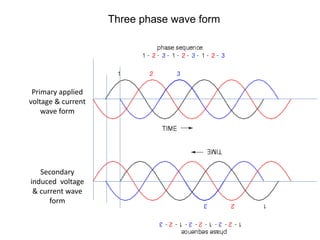
Three phase wave form
Primary applied
voltage & current
wave form
Secondary
induced voltage
& current wave
form
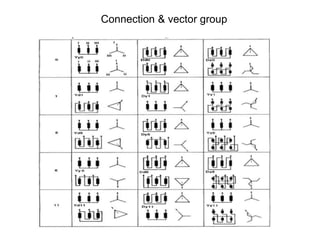
Connection & vector group
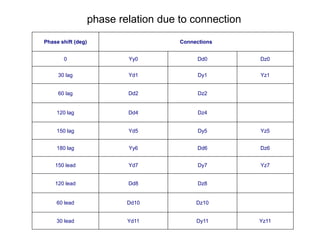
Phase shift (deg) Connections
0 Yy0 Dd0 Dz0
30 lag Yd1 Dy1 Yz1
60 lag Dd2 Dz2
120 lag Dd4 Dz4
150 lag Yd5 Dy5 Yz5
180 lag Yy6 Dd6 Dz6
150 lead Yd7 Dy7 Yz7
120 lead Dd8 Dz8
60 lead Dd10 Dz10
30 lead Yd11 Dy11 Yz11
phase relation due to connection
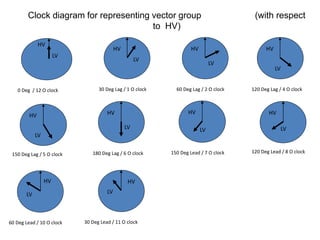
LV
HV
0 Deg / 12 O clock
LV
HV
30 Deg Lag / 1 O clock
LV
HV
60 Deg Lag / 2 O clock
LV
HV
150 Deg Lag / 5 O clock
LV
HV
180 Deg Lag / 6 O clock
LV
HV
150 Deg Lead / 7 O clock
LV
HV
120 Deg Lead / 8 O clock
LV
HV
60 Deg Lead / 10 O clock
LV
HV
30 Deg Lead / 11 O clock
LV
HV
120 Deg Lag / 4 O clock
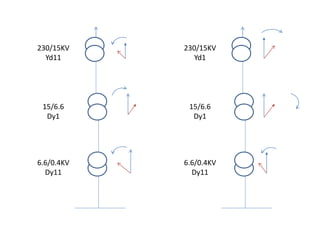
Clock diagram for representing vector group (with respect
to HV)
230/15KV
Yd11
15/6.6
Dy1
6.6/0.4KV
Dy11
230/15KV
Yd1
15/6.6
Dy1
6.6/0.4KV
Dy11
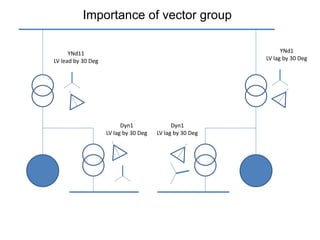
YNd11
LV lead by 30 Deg
Dyn1
LV lag by 30 Deg
YNd1
LV lag by 30 Deg
Dyn1
LV lag by 30 Deg
Importance of vector group
Application of transformers in thermal power
plant
1. Transmission of power : (Power Transformer) –
a. Generator Transformer (GT), 250 MVA
b. Interconnecting transformer (ICT)
c. Unit Auxiliary Transformer (UAT)
d. Station Transformer(ST)
2. Distribution of power : ( service Transformer) –
a. Unit Service transformer
b. Station Service transformers
c. Unit Auxiliary Transformer (UAT)
d. Station Transformer(ST)
2. Direct Loading Transformer
a. Lighting Transformer
b. ESP Rectifier Transformer
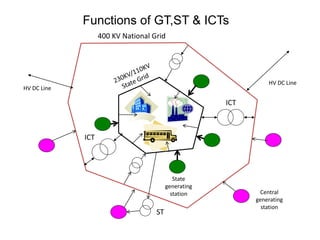
Functions of GT,ST & ICTs
400 KV National Grid
ICT
ICT
ST
State
generating
station Central
generating
station
HV DC Line
HV DC Line
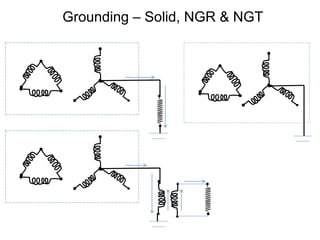
Grounding – Solid, NGR & NGT
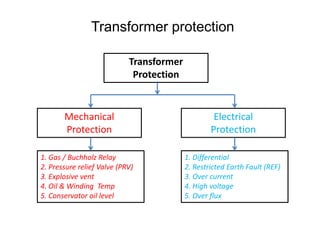
Transformer protection
Transformer
Protection
Mechanical
Protection
Electrical
Protection
1. Gas / Buchholz Relay
2. Pressure relief Valve (PRV)
3. Explosive vent
4. Oil & Winding Temp
5. Conservator oil level
1. Differential
2. Restricted Earth Fault (REF)
3. Over current
4. High voltage
5. Over flux
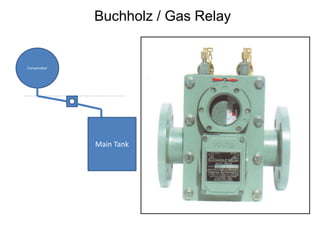
Conservator
Main Tank
Buchholz / Gas Relay
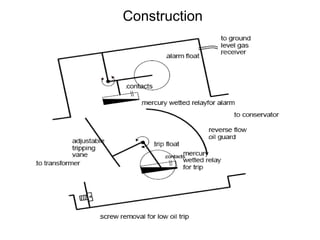
Construction
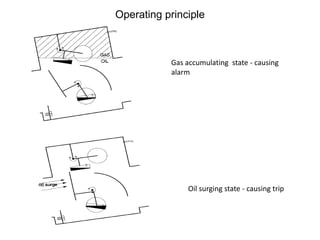
Operating principle
Gas accumulating state - causing
alarm
Oil surging state - causing trip
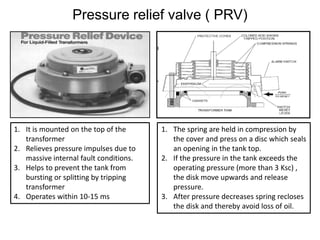
Pressure relief valve ( PRV)
1. It is mounted on the top of the
transformer
2. Relieves pressure impulses due to
massive internal fault conditions.
3. Helps to prevent the tank from
bursting or splitting by tripping
transformer
4. Operates within 10-15 ms
1. The spring are held in compression by
the cover and press on a disc which seals
an opening in the tank top.
2. If the pressure in the tank exceeds the
operating pressure (more than 3 Ksc) ,
the disk move upwards and release
pressure.
3. After pressure decreases spring recloses
the disk and thereby avoid loss of oil.
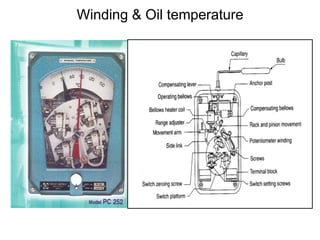
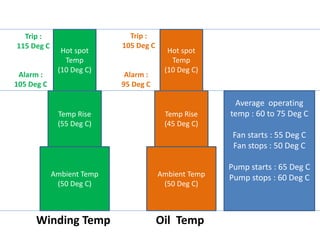
Winding & Oil temperature
Ambient Temp
(50 Deg C)
Temp Rise
(55 Deg C)
Hot spot
Temp
(10 Deg C)
Ambient Temp
(50 Deg C)
Temp Rise
(45 Deg C)
Hot spot
Temp
(10 Deg C)
Alarm :
105 Deg C
Trip :
115 Deg C
Alarm :
95 Deg C
Trip :
105 Deg C
Winding Temp Oil Temp
Average operating
temp : 60 to 75 Deg C
Fan starts : 55 Deg C
Fan stops : 50 Deg C
Pump starts : 65 Deg C
Pump stops : 60 Deg C
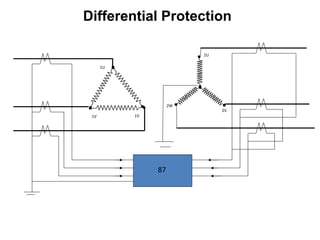
Differential Protection
2U
2V
2W
1U
1V1V
87
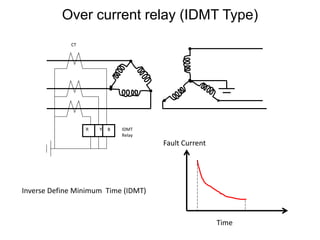
R Y B IDMT
Relay
CT
Over current relay (IDMT Type)
Inverse Define Minimum Time (IDMT)
Time
Fault Current
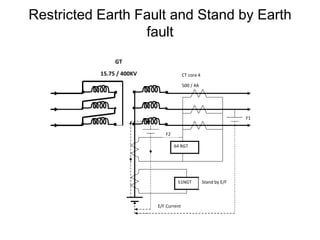
64 RGT
51NGT Stand by E/F
F2
E/F Current
F1
CT core 4
500 / 4A
GT
15.75 / 400KV
Restricted Earth Fault and Stand by Earth
fault
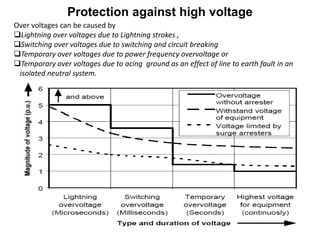
Protection against high voltage
Over voltages can be caused by
Lightning over voltages due to Lightning strokes ,
Switching over voltages due to switching and circuit breaking
Temporary over voltages due to power frequency overvoltage or
Temporary over voltages due to acing ground as an effect of line to earth fault in an
isolated neutral system.
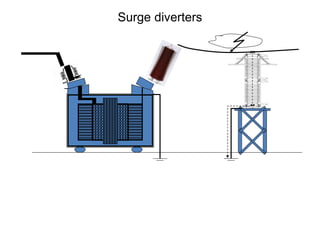
Surge diverters

Transformer maintenance

  • 1.
    transformer M. G. Morshad, ADGM / Electrical TPS II ( 7 x 210MW) NLC India Ltd
  • 2.
    Gear Box andtransformer Input Torque & speed GB ratio= n1/ n2 Turn ratio= n1/ n2 GEAR BOX TRANSFORMER Speed Voltage Torque Current Power = Torque x Speed Power = Voltage x Current Primary and secondary wheel Primary and secondary winding Teeth ratio Turn ratio Frictional loss Core and copper loss Oil for lubrication and cooling Oil for insulation and cooling Slip Vector group
  • 3.
    Classification of transformer Transformer PowerTransformer Service Transformer Measuring Transformer Dry type Auto transformer Three Phase Oil filled CT PT Single Phase Dry / oil cooled Three phase Three phase unit Single phase bank
  • 4.
    Oil filled transformer Advantages:  Better cooling facility enhances the power handling capacity without much increasing in size  Suitable for outdoor application  Oil can be used for diagnosis of transformer health Oil is used for the protection of transformer against thermal fault ( Buchholtz relay , Pressure Relief Valve) Disadvantages :  Fire Hazards  Oil leaks leads to environmental pollutions  Increase maintenance cost  Requires periodical monitoring
  • 5.
    Dry Type Transformer VacuumImpregnated (VPI) Cast Resin (CRT) Advantages  No fire hazards & environmental pollution  No maintenance cost  Maintenance free Disadvantages  Size and capacity depends upon the cooling methods used  Only for indoor application  Poor salvage value for CRT
  • 6.
    Purpose of Transformerin thermal power plant 1. To step up the voltage for long distance transmission of electric power with high voltage & low current ( GT) 2. To interconnect two grid of different system voltage (ICT) 3. To step down the voltage for providing supply source to load capacity >175KW through 6.6 KV HT bus (UAT) 4. To step down the voltage for providing supply source to load capacity <175KW through 415 V KV LT bus (UST) 5. Providing supply source nearest to the load centre to avoid voltage buckling during start of load.
  • 7.
    Transformer arrangement inTPSII GT(15/230KV) ST(230/6.6KV) ICT (400/230KV) Ex Tr 15KV/600V) UAT B 15/6.6KV BR 63MVAR UAT B 15/6.6KV ESP Tr A 6.6KV/415V ESP Tr B 6.6KV/415V UST A 6.6KV/415V UST A 6.6KV/415V 6.6/11KV Ring main system SST 6.6KV/415V LHS 6.6KV/415V ADPH 6.6KV/415V ESP HVR ESP HVR
  • 8.
    Transformer Capacity ,Voltage and cooling system 5,10,50,100,160 KVA Dry Type Lighting Transformer 2000,1600,1250,630 , 500,400,315 KVA Oil filled service transformer 16 MVA Oil filled Power transformer 415V 415V 6.6 KV 250 MVA Oil filled Power transformer 15 KV 400 KV 230 KV 1600 KVA Dry type service transformer Forced oil Forced Air Air natural ,Oil natural Forced Air Natural Air Voltage Grade
  • 9.
    TRANSFORMER CAPACITY :VA / KVA /MVA Load 1 Load 2 Load 3 Load 4 Load current (A) LoadVoltage(V) Capacity (VA) : √3 x V x A Standard Transformer capacity in KVA as per IS 2026 : 5, 6.3, 8, 10, 12.5,16,20,25,31.5, 40,50,63,80, 100,125,160,200,250,315,400,500,630,800,1000
  • 10.
    Design consideration oftransformer Application Power Handling Capacity ( KVA) Voltage ratio 1. Single phase 2. Single phase banks 3. Three phase 4. Coil & core configuration 5. Size & mass 6. Cooling methods 1. Power transmission 2. Power distribution 3. Power quantity measurement 1. On / off load taps 2. High Turn ratio (> 5:1) –Two winding transformer 3. Low turn ratio ( <5:1) - Autotransformer Connection 1. Vector group 2. Grounded neutral 3. Ungrounded neutral Cost & reliability 1. Efficiency 2. Optimum copper & insulation 3. Materials quality 4. Design criteria
  • 14.
     Voltage decidesthe quality & types of insulation to be used for a particular transformer.  Higher voltage is used for transmission purpose and lower voltage is used for distribution purpose  For designing a transformer following voltages are considered for the selection of insulation 1. OPERATING VOLTAGE – This the nominal operating voltage of the transformer 2. BASIC INSULATION LEVEL (BIL) – This the highest operating voltage of the transformer. 3. POWER FREQUENCY VOLTAGE - Rated voltage at rated frequency (50Hz) 4. LIGHTING IMPULSE – Transient voltage due to lightening 5. SURGE VOLTAGE – Transient voltage due to switching operation ( ON / OFF) Operating Voltage (KV rms) BIL (KV rms) Power frequency voltage (KV rms) Switching Impulse (KV Peak ) Lighting impulse (KV Peak ) 0.433 1.1 3 - Not applicable 3.3 3.6 10 - 20- 40 6.6 7.2 20 - 40- 60 11 12 28 - 60- 75 15 17..5 38 - 75- 95 33 36 70 - 145- 170 230 245 325-395 - 750- 950 400 420 570 - 630 950-1050 1300-1425 Transformer Voltage
  • 15.
    Tap changer inTransformer to change the secondary voltage Two types of tap changer – 1 On Load Tap Changer (OLTC ) - HV side 2. Off Circuit Tap changer (OCTC) – Secondary side
  • 16.
    Transformer Connection DELTA CONNECTIONSTAR CONNECTION High voltage side - Outer winding Low voltage side – Inner winding Applied voltage – line voltage Applied voltage – line voltage /√3 High insulation cost Low insulation cost Low current – tap changing facility is provided . High current - tap changing facility is not provided Neutral point is available –hence grounding is not possible Neutral point is available and therefore grounding is provided. Due to non availability of neutral point unbalance current gets circulated in the winding that cause extra heating of winding . Due to grounding of neutral point winding current always gets balanced .
  • 17.
    Three phase waveform Primary applied voltage & current wave form Secondary induced voltage & current wave form
  • 18.
  • 19.
    Phase shift (deg)Connections 0 Yy0 Dd0 Dz0 30 lag Yd1 Dy1 Yz1 60 lag Dd2 Dz2 120 lag Dd4 Dz4 150 lag Yd5 Dy5 Yz5 180 lag Yy6 Dd6 Dz6 150 lead Yd7 Dy7 Yz7 120 lead Dd8 Dz8 60 lead Dd10 Dz10 30 lead Yd11 Dy11 Yz11 phase relation due to connection
  • 20.
    LV HV 0 Deg /12 O clock LV HV 30 Deg Lag / 1 O clock LV HV 60 Deg Lag / 2 O clock LV HV 150 Deg Lag / 5 O clock LV HV 180 Deg Lag / 6 O clock LV HV 150 Deg Lead / 7 O clock LV HV 120 Deg Lead / 8 O clock LV HV 60 Deg Lead / 10 O clock LV HV 30 Deg Lead / 11 O clock LV HV 120 Deg Lag / 4 O clock Clock diagram for representing vector group (with respect to HV)
  • 21.
  • 22.
    YNd11 LV lead by30 Deg Dyn1 LV lag by 30 Deg YNd1 LV lag by 30 Deg Dyn1 LV lag by 30 Deg Importance of vector group
  • 23.
    Application of transformersin thermal power plant 1. Transmission of power : (Power Transformer) – a. Generator Transformer (GT), 250 MVA b. Interconnecting transformer (ICT) c. Unit Auxiliary Transformer (UAT) d. Station Transformer(ST) 2. Distribution of power : ( service Transformer) – a. Unit Service transformer b. Station Service transformers c. Unit Auxiliary Transformer (UAT) d. Station Transformer(ST) 2. Direct Loading Transformer a. Lighting Transformer b. ESP Rectifier Transformer
  • 24.
    Functions of GT,ST& ICTs 400 KV National Grid ICT ICT ST State generating station Central generating station HV DC Line HV DC Line
  • 25.
  • 26.
    Transformer protection Transformer Protection Mechanical Protection Electrical Protection 1. Gas/ Buchholz Relay 2. Pressure relief Valve (PRV) 3. Explosive vent 4. Oil & Winding Temp 5. Conservator oil level 1. Differential 2. Restricted Earth Fault (REF) 3. Over current 4. High voltage 5. Over flux
  • 28.
  • 29.
  • 30.
    Operating principle Gas accumulatingstate - causing alarm Oil surging state - causing trip
  • 31.
    Pressure relief valve( PRV) 1. It is mounted on the top of the transformer 2. Relieves pressure impulses due to massive internal fault conditions. 3. Helps to prevent the tank from bursting or splitting by tripping transformer 4. Operates within 10-15 ms 1. The spring are held in compression by the cover and press on a disc which seals an opening in the tank top. 2. If the pressure in the tank exceeds the operating pressure (more than 3 Ksc) , the disk move upwards and release pressure. 3. After pressure decreases spring recloses the disk and thereby avoid loss of oil.
  • 32.
    Winding & Oiltemperature
  • 33.
    Ambient Temp (50 DegC) Temp Rise (55 Deg C) Hot spot Temp (10 Deg C) Ambient Temp (50 Deg C) Temp Rise (45 Deg C) Hot spot Temp (10 Deg C) Alarm : 105 Deg C Trip : 115 Deg C Alarm : 95 Deg C Trip : 105 Deg C Winding Temp Oil Temp Average operating temp : 60 to 75 Deg C Fan starts : 55 Deg C Fan stops : 50 Deg C Pump starts : 65 Deg C Pump stops : 60 Deg C
  • 34.
  • 35.
    R Y BIDMT Relay CT Over current relay (IDMT Type) Inverse Define Minimum Time (IDMT) Time Fault Current
  • 36.
    64 RGT 51NGT Standby E/F F2 E/F Current F1 CT core 4 500 / 4A GT 15.75 / 400KV Restricted Earth Fault and Stand by Earth fault
  • 37.
    Protection against highvoltage Over voltages can be caused by Lightning over voltages due to Lightning strokes , Switching over voltages due to switching and circuit breaking Temporary over voltages due to power frequency overvoltage or Temporary over voltages due to acing ground as an effect of line to earth fault in an isolated neutral system.
  • 38.