A
Summer training
Presentation
on
“Transformer”
Presented By:
Name: Rakesh Gurjar
Roll no: 039
Department of Electrical Engineering
Poornima Institute of Engineering and Technology
ISI-6 RIICO Institutional Area,
Jaipur -302022
Submitted To:
Rajendra Singh
(Ass. Professor )
EE, PIET, Jaipur
2018-2019
CONTENTS
 Company Introduction
 Introduction
 Principle
 Classification of transformer
 Construction
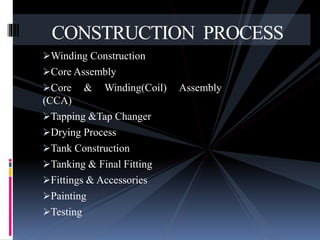
 Construction Process
 Winding Construction
 Core Construction
 Core Coil Assembly (CCA)
 Tank Fabrication
 Paint
 Testing
COMPANY INTRODUCTION
 “Danish Private Limited” is established in 1985 and is today
India’s leading quality manufacturer
 Company Works in the field of Manufacturing and Exporting
of Transformers and Relay Panels.
 Product Generated by Company:
o Distribution Transformer
o Dry type Transformer
o Power Transformer
o CRP and Substation Automation
o Substations Projects
INTRODUCTION
 A transformer is a device that changes ac electric power at one
voltage level to ac electric power at another voltage level
through the action of a magnetic field.
 It can be either to step-up or step down the voltage.
 A transformer is a static device.
 The word ‘transformer’ comes form the word ‘transform’.
PRINCIPLE
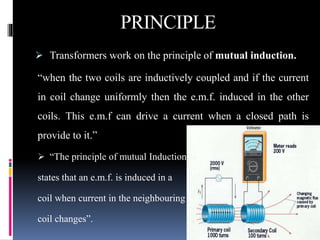
 Transformers work on the principle of mutual induction.
“when the two coils are inductively coupled and if the current
in coil change uniformly then the e.m.f. induced in the other
coils. This e.m.f can drive a current when a closed path is
provide to it.”
 “The principle of mutual Induction
states that an e.m.f. is induced in a
coil when current in the neighbouring
coil changes”.
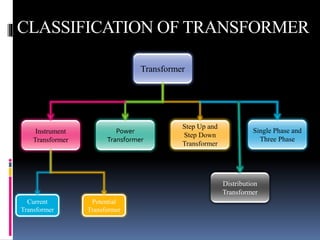
CLASSIFICATION OF TRANSFORMER
Instrument
Transformer
Power
Transformer
Step Up and
Step Down
Transformer
Single Phase and
Three Phase
Distribution
Transformer
Transformer
Current
Transformer
Potential
Transformer
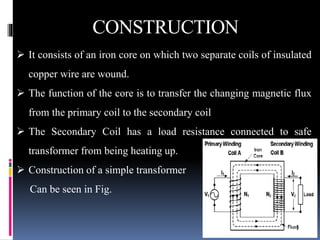
 It consists of an iron core on which two separate coils of insulated
copper wire are wound.
 The function of the core is to transfer the changing magnetic flux
from the primary coil to the secondary coil
 The Secondary Coil has a load resistance connected to safe
transformer from being heating up.
 Construction of a simple transformer
Can be seen in Fig.
CONSTRUCTION
Winding Construction
Core Assembly
Core & Winding(Coil) Assembly
(CCA)
Tapping &Tap Changer
Drying Process
Tank Construction
Tanking & Final Fitting
Fittings & Accessories
Painting
Testing
CONSTRUCTION PROCESS
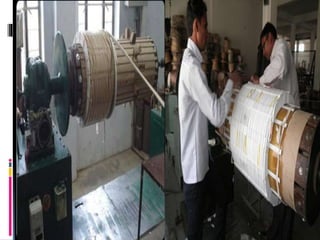
CONSTRUCTION OF WINDING
 Conducting material is used for construction of winding.
 The coils are used are wound on the limbs and insulated from
each other.
 The two different windings are wounds on two different limbs.
 The leakage flux increases which affects the performance and
efficiency of transformer.
 To reduce the leakage flux it is necessary that the windings
should be very close to each other to have high mutual
induction.
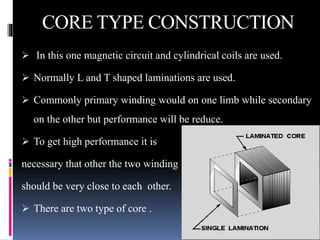
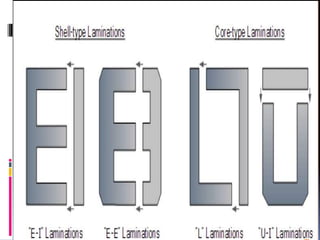
CORE TYPE CONSTRUCTION
 In this one magnetic circuit and cylindrical coils are used.
 Normally L and T shaped laminations are used.
 Commonly primary winding would on one limb while secondary
on the other but performance will be reduce.
 To get high performance it is
necessary that other the two winding
should be very close to each other.
 There are two type of core .
CORE COILASSEMBLY
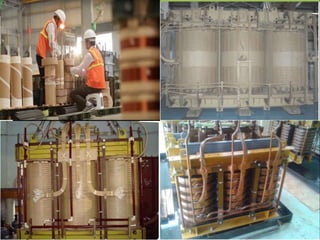
 In this Process the Winding Coil and Core is Assembled
together .
 Core Coil Assembly defines the insulation scheme, cooling,
dynamic withstand capability, handling.
 Cooling is essential to prevent the thermal degradation of
insulation which enhances a transformer’s life.
 The core assembly is vertically placed with the foot plate
touching the ground. The top yoke of the core is removed.
Tapping & Tap Changer
 Generally Taps are provided on HV Windings for HV Variation
or LV Variation.
 To achieve proper voltage regulation on load tap changer is used
instead of OCTC.
 As it is mainly used for higher capacity transformers i.e. above
5000 KVA ratings, voltage can be supplied with On Load Tap
Changer along with necessary controls.
 After this the CCA is placed in Vacuum Auto Enclave to remove
moisture content at 90°c.
TANK FABRICATION
 Transformer tanks commonly used are of the following types;
1. Plain sheet steel tank.
2. Sheet steel tank with external cooling tubes.
3. Radiator tanks.
4. Tanks with corrugated wall panels.
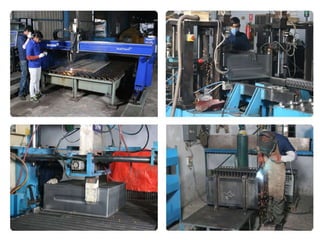
 The tank is manufactured by forming and welding steel plate
which is used as a container for holding the core and coil
assembly together with insulating oil.
TANK UP PROCESS
 The core-coil assembly is taken out of the oven and the
"Muggers test" is carried out. If the merger value is as per the
specification then it is taken to Tank-up Dept.
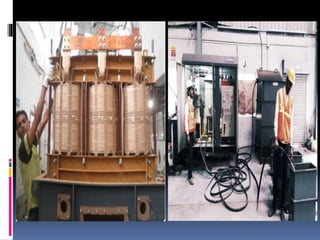
 After this test the Core-Coil Assembly is placed into the tank
and locked up, this process is known as “Tank-Up Process”.
 Accessories are Fitted like drain valves, HV & LV Bushings,
conservator, oil level indicator and explosion vent are fitted in
the tanks.
 Pure filtered transformer oil is filled in the tank to immerse the
assembly only.
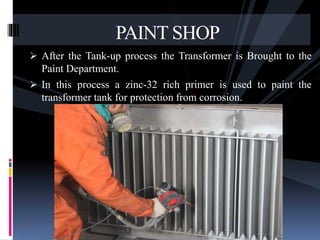
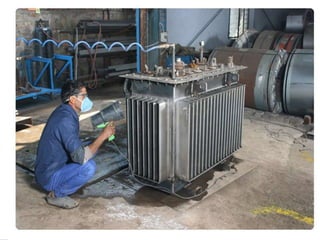
 After the Tank-up process the Transformer is Brought to the
Paint Department.
 In this process a zinc-32 rich primer is used to paint the
transformer tank for protection from corrosion.
PAINT SHOP
TESTING OF TRANSFORMER
Following test used for the various purposes:-
1. Megger Insulation Test
2. Ratio And Polarity Test
3. High Voltage Test
4. Low Voltage Test
5. D.V.D.F Test
6. Open Circuit Test
7. Short Circuit Test
8. Winding Resistance Test
9. Oil Dielectric Strength Test
10. Vector Group Test
11. Magnetic Balance Test
APPLICATIONAND USES
 The transformer used in television and photocopy Machines.
 The transmission and distribution of alternating power is possible
by transformer.
 Simple camera flash uses fly back transformer.
 Signal and audio transformer are used couple in amplifier.
ADVANTAGES
 Less cost
 Less Weight
 less size
 Less time require to assembling
 Require less space
 Deliver more power
 Higher efficiency
 Easier to install
 Easy transportation and installation
 Easy to repair
 Easy assembling
DISADVANTAGES
 Greater cost of standby Units
 Increased cost and inconvenience of repairs.
 In Single Phase transformer (Three Single Phase
Transformer) failure of one transformer, the other two,
Single Phase Transformer still supply the power, while it is
not possible in case of failing a Transformer.
Transformer ppt

Transformer ppt

  • 1.
    A Summer training Presentation on “Transformer” Presented By: Name:Rakesh Gurjar Roll no: 039 Department of Electrical Engineering Poornima Institute of Engineering and Technology ISI-6 RIICO Institutional Area, Jaipur -302022 Submitted To: Rajendra Singh (Ass. Professor ) EE, PIET, Jaipur 2018-2019
  • 2.
    CONTENTS  Company Introduction Introduction  Principle  Classification of transformer  Construction  Construction Process  Winding Construction  Core Construction  Core Coil Assembly (CCA)  Tank Fabrication  Paint  Testing
  • 3.
    COMPANY INTRODUCTION  “DanishPrivate Limited” is established in 1985 and is today India’s leading quality manufacturer  Company Works in the field of Manufacturing and Exporting of Transformers and Relay Panels.  Product Generated by Company: o Distribution Transformer o Dry type Transformer o Power Transformer o CRP and Substation Automation o Substations Projects
  • 4.
    INTRODUCTION  A transformeris a device that changes ac electric power at one voltage level to ac electric power at another voltage level through the action of a magnetic field.  It can be either to step-up or step down the voltage.  A transformer is a static device.  The word ‘transformer’ comes form the word ‘transform’.
  • 5.
    PRINCIPLE  Transformers workon the principle of mutual induction. “when the two coils are inductively coupled and if the current in coil change uniformly then the e.m.f. induced in the other coils. This e.m.f can drive a current when a closed path is provide to it.”  “The principle of mutual Induction states that an e.m.f. is induced in a coil when current in the neighbouring coil changes”.
  • 6.
    CLASSIFICATION OF TRANSFORMER Instrument Transformer Power Transformer StepUp and Step Down Transformer Single Phase and Three Phase Distribution Transformer Transformer Current Transformer Potential Transformer
  • 7.
     It consistsof an iron core on which two separate coils of insulated copper wire are wound.  The function of the core is to transfer the changing magnetic flux from the primary coil to the secondary coil  The Secondary Coil has a load resistance connected to safe transformer from being heating up.  Construction of a simple transformer Can be seen in Fig. CONSTRUCTION
  • 8.
    Winding Construction Core Assembly Core& Winding(Coil) Assembly (CCA) Tapping &Tap Changer Drying Process Tank Construction Tanking & Final Fitting Fittings & Accessories Painting Testing CONSTRUCTION PROCESS
  • 9.
    CONSTRUCTION OF WINDING Conducting material is used for construction of winding.  The coils are used are wound on the limbs and insulated from each other.  The two different windings are wounds on two different limbs.  The leakage flux increases which affects the performance and efficiency of transformer.  To reduce the leakage flux it is necessary that the windings should be very close to each other to have high mutual induction.
  • 11.
    CORE TYPE CONSTRUCTION In this one magnetic circuit and cylindrical coils are used.  Normally L and T shaped laminations are used.  Commonly primary winding would on one limb while secondary on the other but performance will be reduce.  To get high performance it is necessary that other the two winding should be very close to each other.  There are two type of core .
  • 13.
    CORE COILASSEMBLY  Inthis Process the Winding Coil and Core is Assembled together .  Core Coil Assembly defines the insulation scheme, cooling, dynamic withstand capability, handling.  Cooling is essential to prevent the thermal degradation of insulation which enhances a transformer’s life.  The core assembly is vertically placed with the foot plate touching the ground. The top yoke of the core is removed.
  • 15.
    Tapping & TapChanger  Generally Taps are provided on HV Windings for HV Variation or LV Variation.  To achieve proper voltage regulation on load tap changer is used instead of OCTC.  As it is mainly used for higher capacity transformers i.e. above 5000 KVA ratings, voltage can be supplied with On Load Tap Changer along with necessary controls.  After this the CCA is placed in Vacuum Auto Enclave to remove moisture content at 90°c.
  • 16.
    TANK FABRICATION  Transformertanks commonly used are of the following types; 1. Plain sheet steel tank. 2. Sheet steel tank with external cooling tubes. 3. Radiator tanks. 4. Tanks with corrugated wall panels.  The tank is manufactured by forming and welding steel plate which is used as a container for holding the core and coil assembly together with insulating oil.
  • 18.
    TANK UP PROCESS The core-coil assembly is taken out of the oven and the "Muggers test" is carried out. If the merger value is as per the specification then it is taken to Tank-up Dept.  After this test the Core-Coil Assembly is placed into the tank and locked up, this process is known as “Tank-Up Process”.  Accessories are Fitted like drain valves, HV & LV Bushings, conservator, oil level indicator and explosion vent are fitted in the tanks.  Pure filtered transformer oil is filled in the tank to immerse the assembly only.
  • 20.
     After theTank-up process the Transformer is Brought to the Paint Department.  In this process a zinc-32 rich primer is used to paint the transformer tank for protection from corrosion. PAINT SHOP
  • 21.
    TESTING OF TRANSFORMER Followingtest used for the various purposes:- 1. Megger Insulation Test 2. Ratio And Polarity Test 3. High Voltage Test 4. Low Voltage Test 5. D.V.D.F Test 6. Open Circuit Test 7. Short Circuit Test 8. Winding Resistance Test 9. Oil Dielectric Strength Test 10. Vector Group Test 11. Magnetic Balance Test
  • 23.
    APPLICATIONAND USES  Thetransformer used in television and photocopy Machines.  The transmission and distribution of alternating power is possible by transformer.  Simple camera flash uses fly back transformer.  Signal and audio transformer are used couple in amplifier.
  • 24.
    ADVANTAGES  Less cost Less Weight  less size  Less time require to assembling  Require less space  Deliver more power  Higher efficiency  Easier to install  Easy transportation and installation  Easy to repair  Easy assembling
  • 25.
    DISADVANTAGES  Greater costof standby Units  Increased cost and inconvenience of repairs.  In Single Phase transformer (Three Single Phase Transformer) failure of one transformer, the other two, Single Phase Transformer still supply the power, while it is not possible in case of failing a Transformer.