BEEPRESENTATION
FARHANUR RAHMAN
21BTCS030HY
CONTENT
o DEFINATION
o FEATURES OF AUTO-TRANSFORMER
o THEORY OF AUTO-TRANSFORMER
o OUTPUT POWER
o SAVING OF CU IN AUTO-TRANSFORMER
o Advantages and disadvantages of auto transformer
o THREE-PHASE TRANSFORMER
o Three-phase transformer conecction
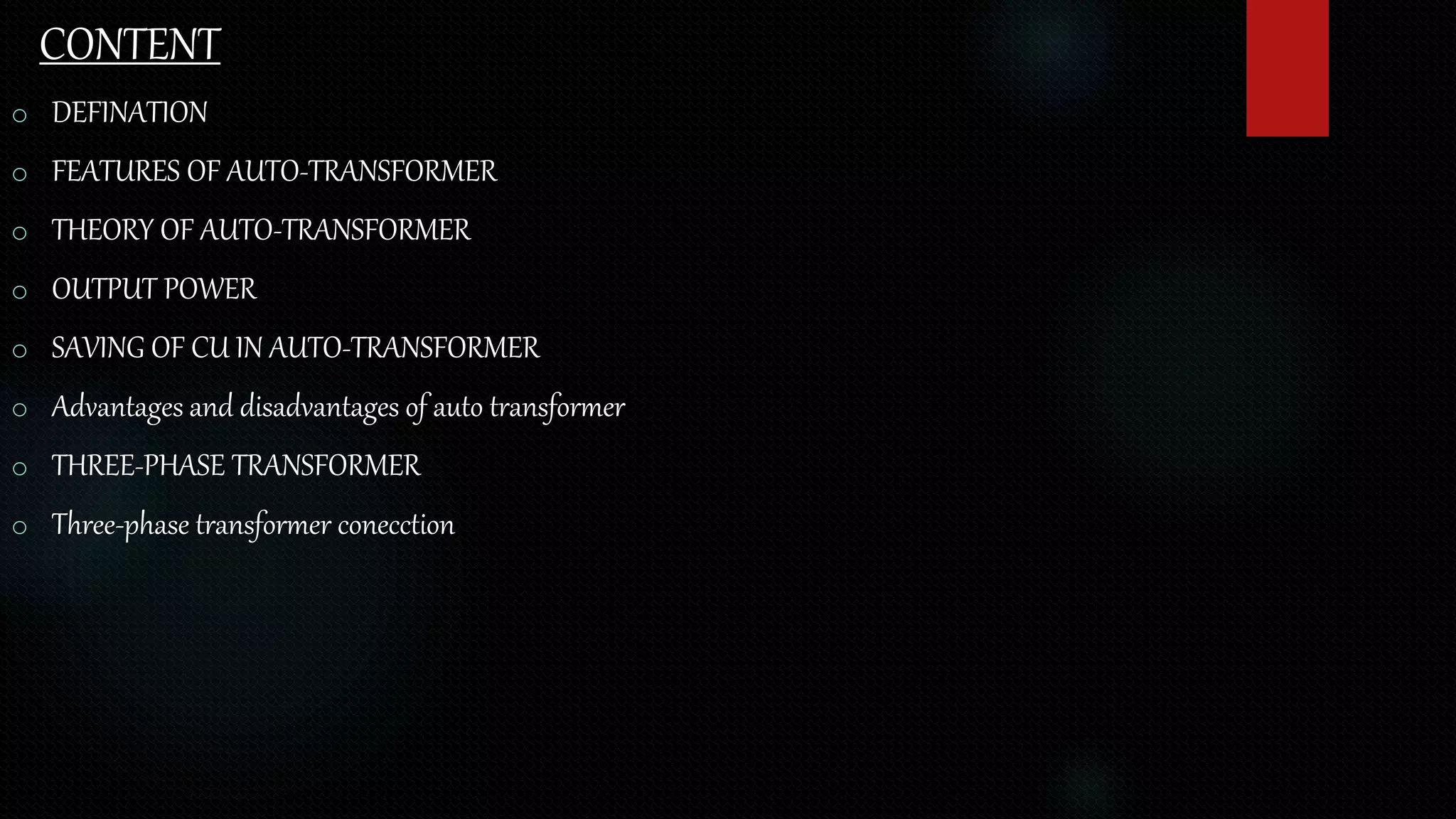
Auto transf ormer and working principle
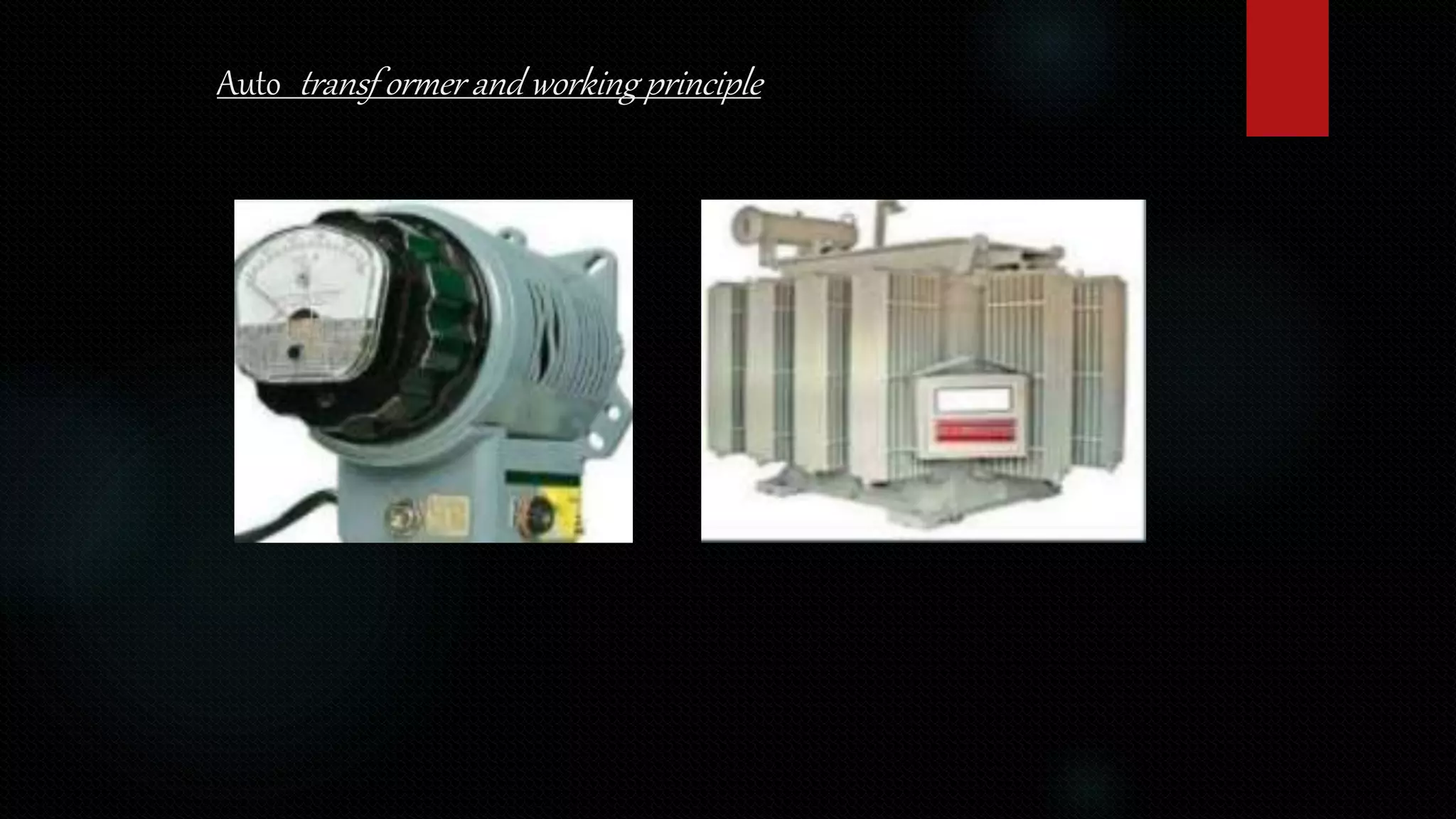
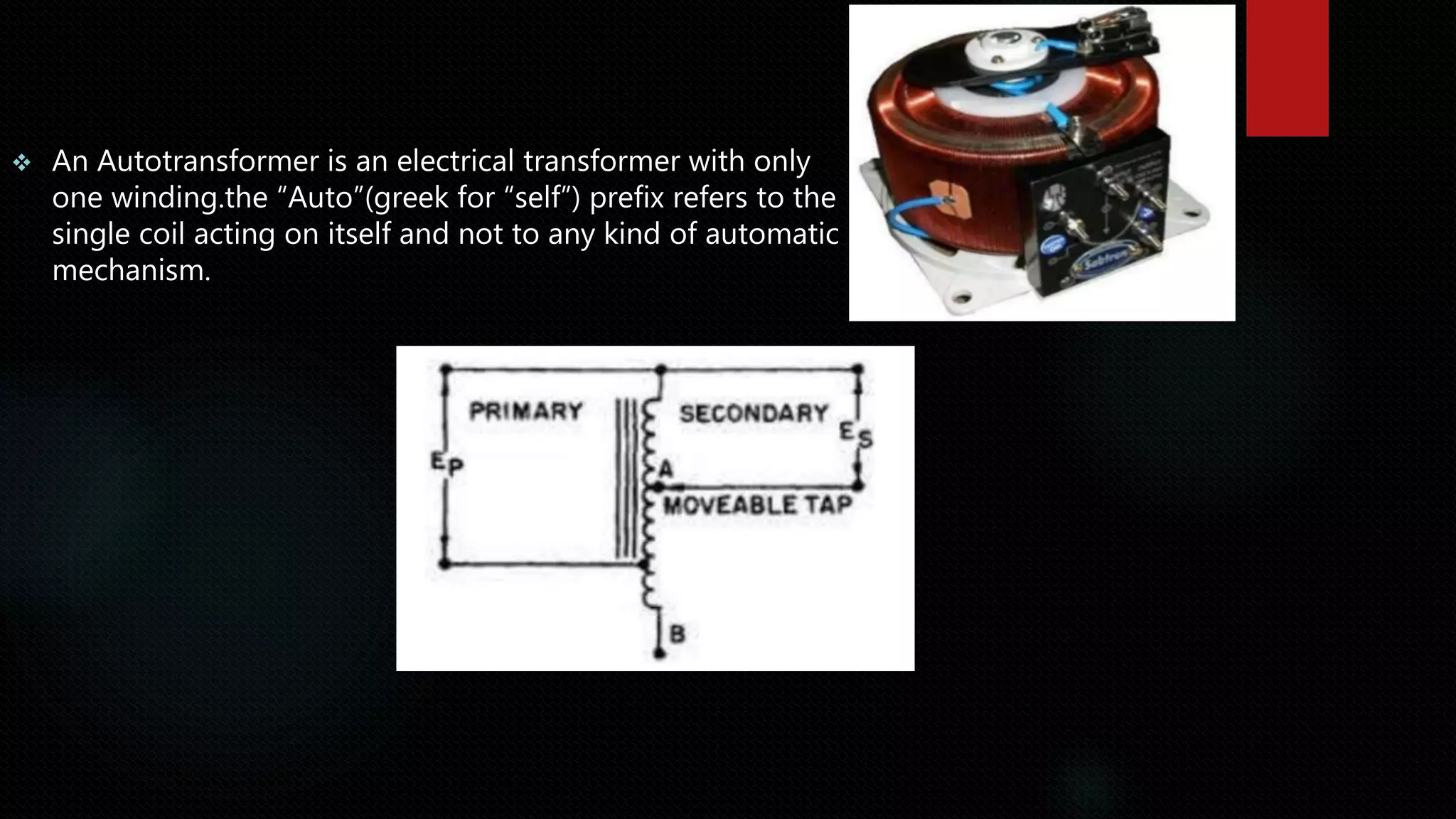
 An Autotransformer is an electrical transformer with only
one winding.the “Auto”(greek for “self”) prefix refers to the
single coil acting on itself and not to any kind of automatic
mechanism.
 Features of Auto-Transformer
 Primary and secondary windings are not electrically isolated
 Uses less copper and hence is cheaper
 Transformation ratio differs from unity
 Higher efficiency but smaller in size
 Voltage regulation is superior
 Lower leakage
 Lower losses
 Lower magnetizing current
 Increase kVA rating
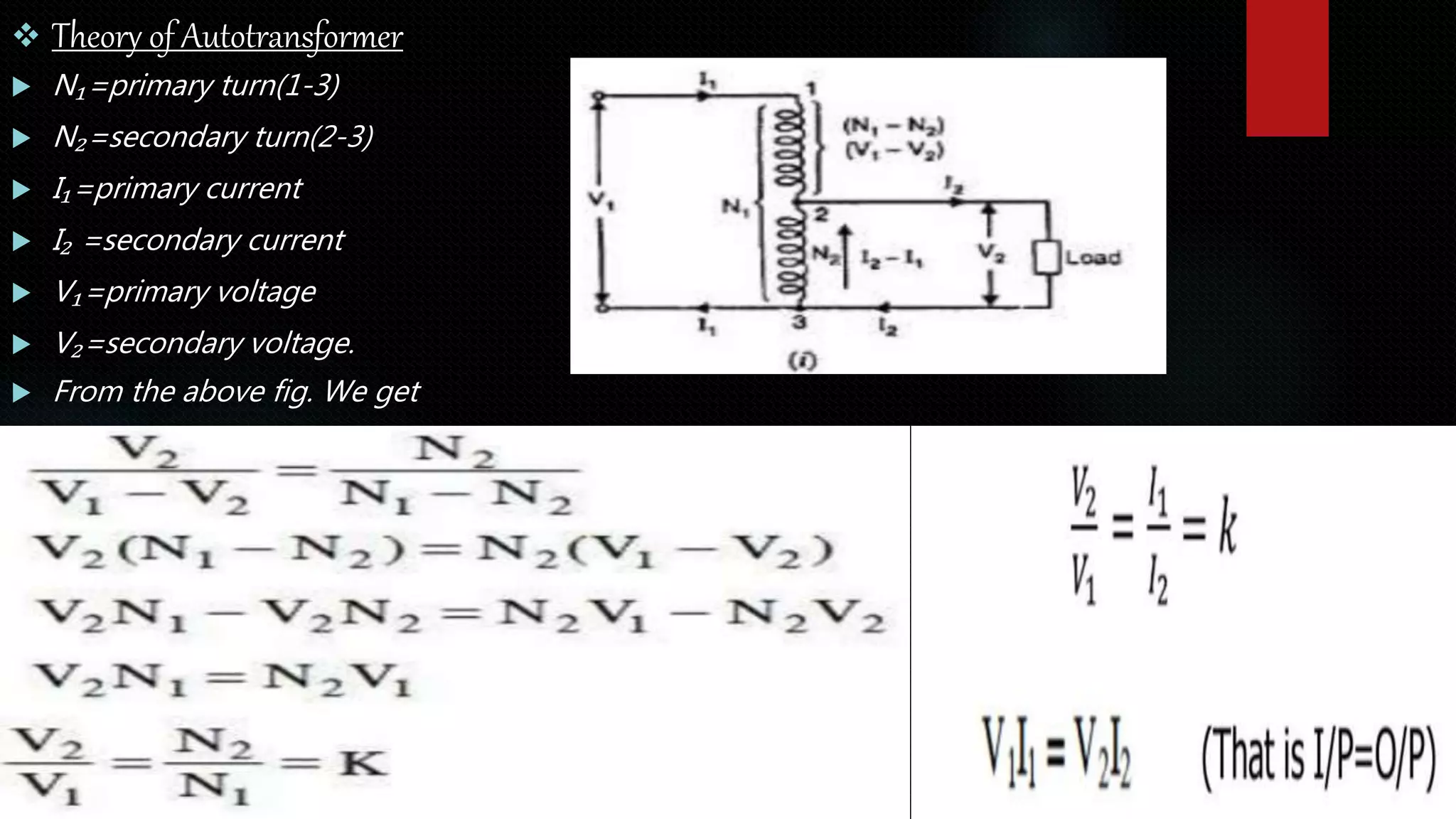
 Theory of Autotransformer
 N₁=primary turn(1-3)
 N₂=secondary turn(2-3)
 I₁=primary current
 I₂ =secondary current
 V₁=primary voltage
 V₂=secondary voltage.
 From the above fig. We get
 Output power
 The primary and secondary windings of an auto-transformer are connected
magnetically as well as electrically. So the power transferred from primary to secondary
is inductively as well as conductively.
 Output apparent power = V₂I₂
 Apparent power transferred inductively = V₂(I₂-I₁) = V₂(I₂-KI₂)
 = V₂l₂(1-K)= V₁I₁(1-K)
 Power transferred inductively = Input x (1-K)
 Power transferred conductively = Input - Input (1-K)
 = Input [1-(1-K)]
 = K x Input
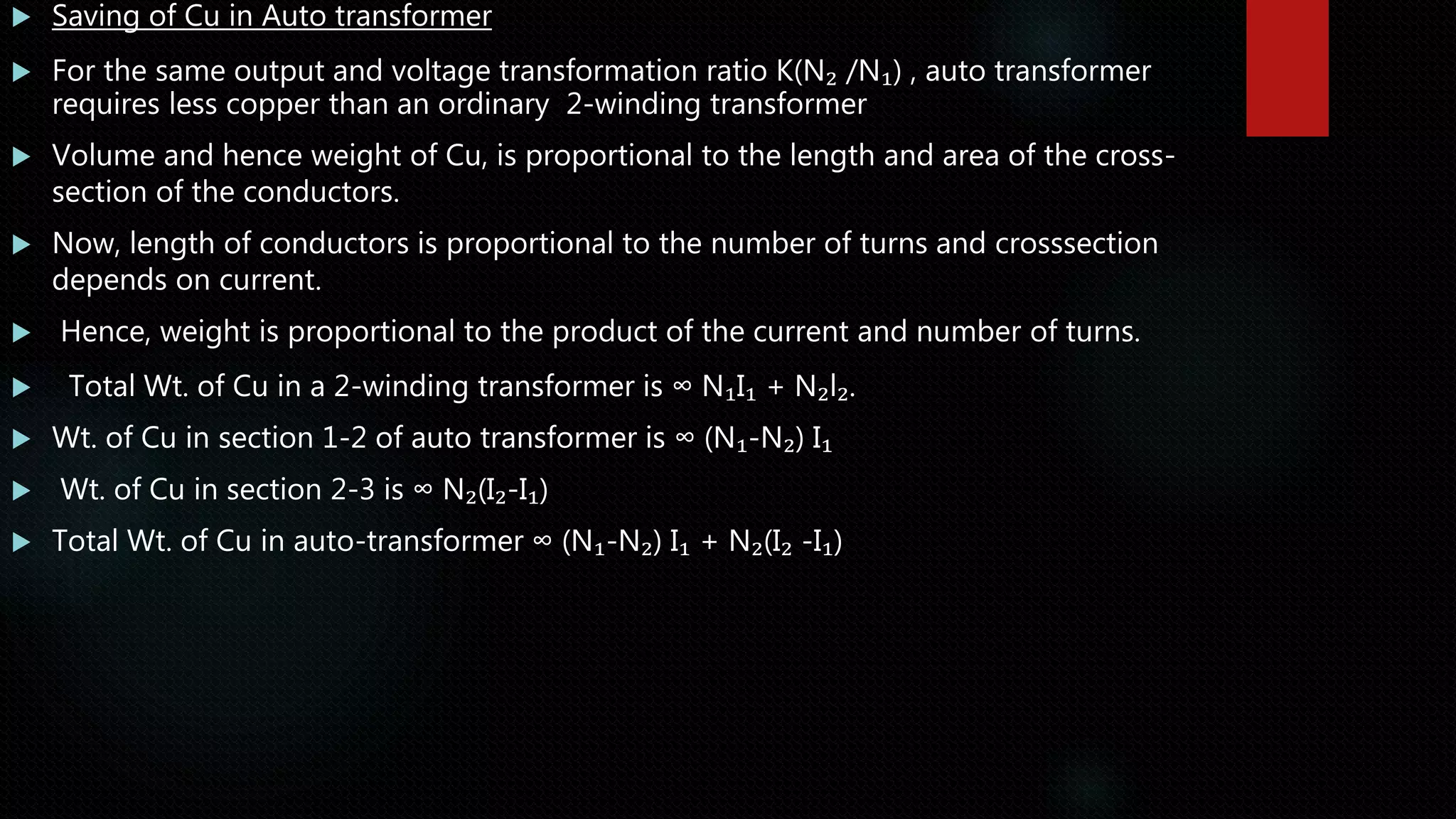
 Saving of Cu in Auto transformer
 For the same output and voltage transformation ratio K(N₂ /N₁) , auto transformer
requires less copper than an ordinary 2-winding transformer
 Volume and hence weight of Cu, is proportional to the length and area of the cross-
section of the conductors.
 Now, length of conductors is proportional to the number of turns and crosssection
depends on current.
 Hence, weight is proportional to the product of the current and number of turns.
 Total Wt. of Cu in a 2-winding transformer is ∞ N₁I₁ + N₂l₂.
 Wt. of Cu in section 1-2 of auto transformer is ∞ (N₁-N₂) I₁
 Wt. of Cu in section 2-3 is ∞ N₂(I₂-I₁)
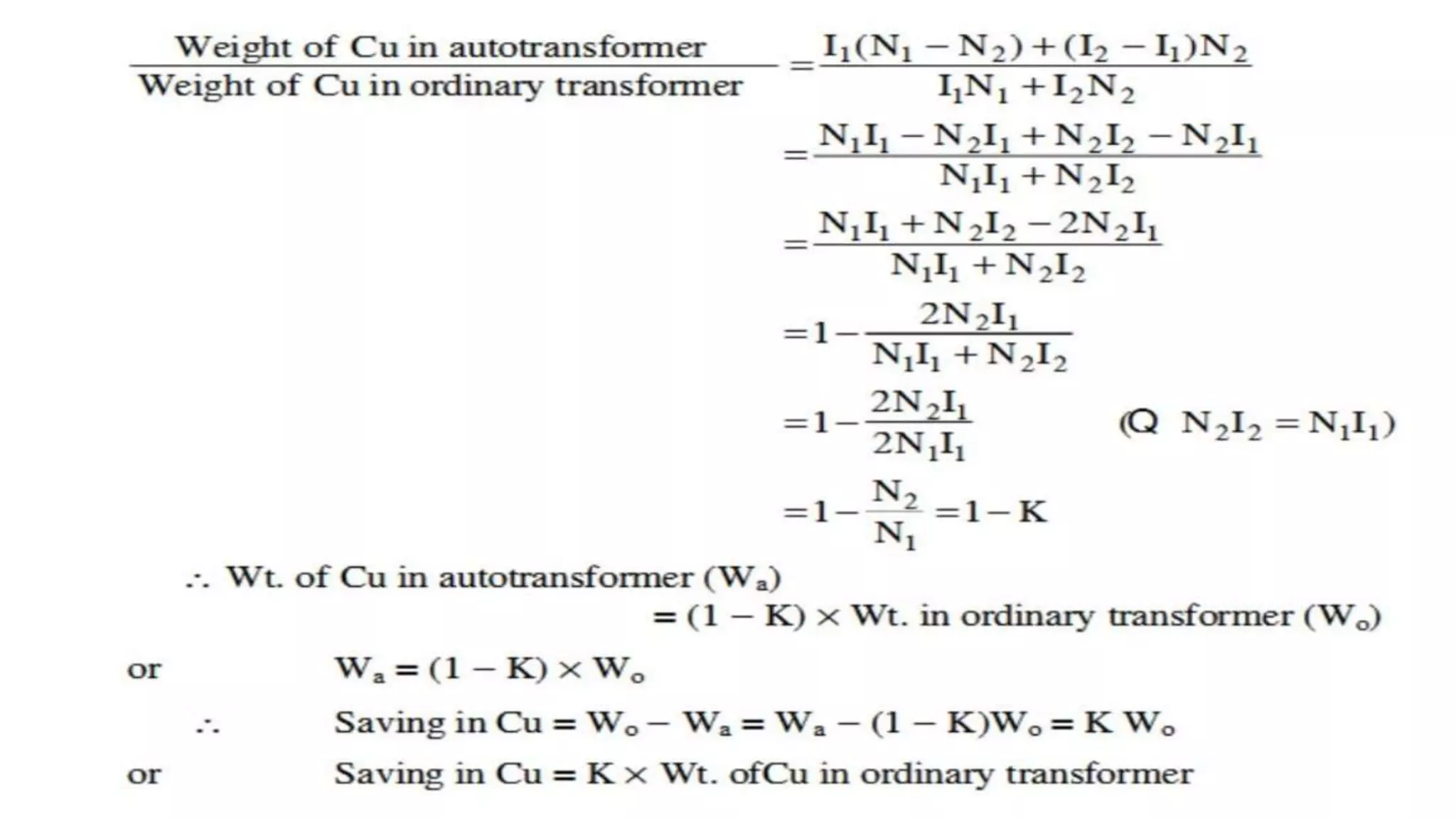
 Total Wt. of Cu in auto-transformer ∞ (N₁-N₂) I₁ + N₂(I₂ -I₁)
 Thus if K =0.1, the saving of Cu is only 10% but if K = 0 .9 , saving of Cu is 90%. Therefore,
the value of K of autotransformer is to 1, the greater is the saving of Cu.
 ADVANTAGES AND DISADVANTAGES OF AUTOTRANSFORMERS
o Advantages
o An autotransformer requires less Cu than a two-winding transformer of similar
rating.
o An autotransformer operates at a higher efficiency than a two-winding
transformer of similar rating.
o An autotransformer has better voltage regulation than a two-winding
transformer of the samr rating.
o An autotransformer has smaller size than'a two-winding transformer of the
same rating.
o An autotransformer requires smaller exciting current than a two-winding
transformer of the same rating.
 Disadvantages
o There is a direct connection between the primary and secondary. Th The
short-circuit current is much larger than for the two-winding transformer
of the same rating. It can be seen that a short-circuited secondary
causes part of the primary also to be short-circuited. This reduces the
effective resistance and reactance.
o erefore, the output is no longer d.c. isolated from the input.
 THREE-PHASE TRANSFORMERS
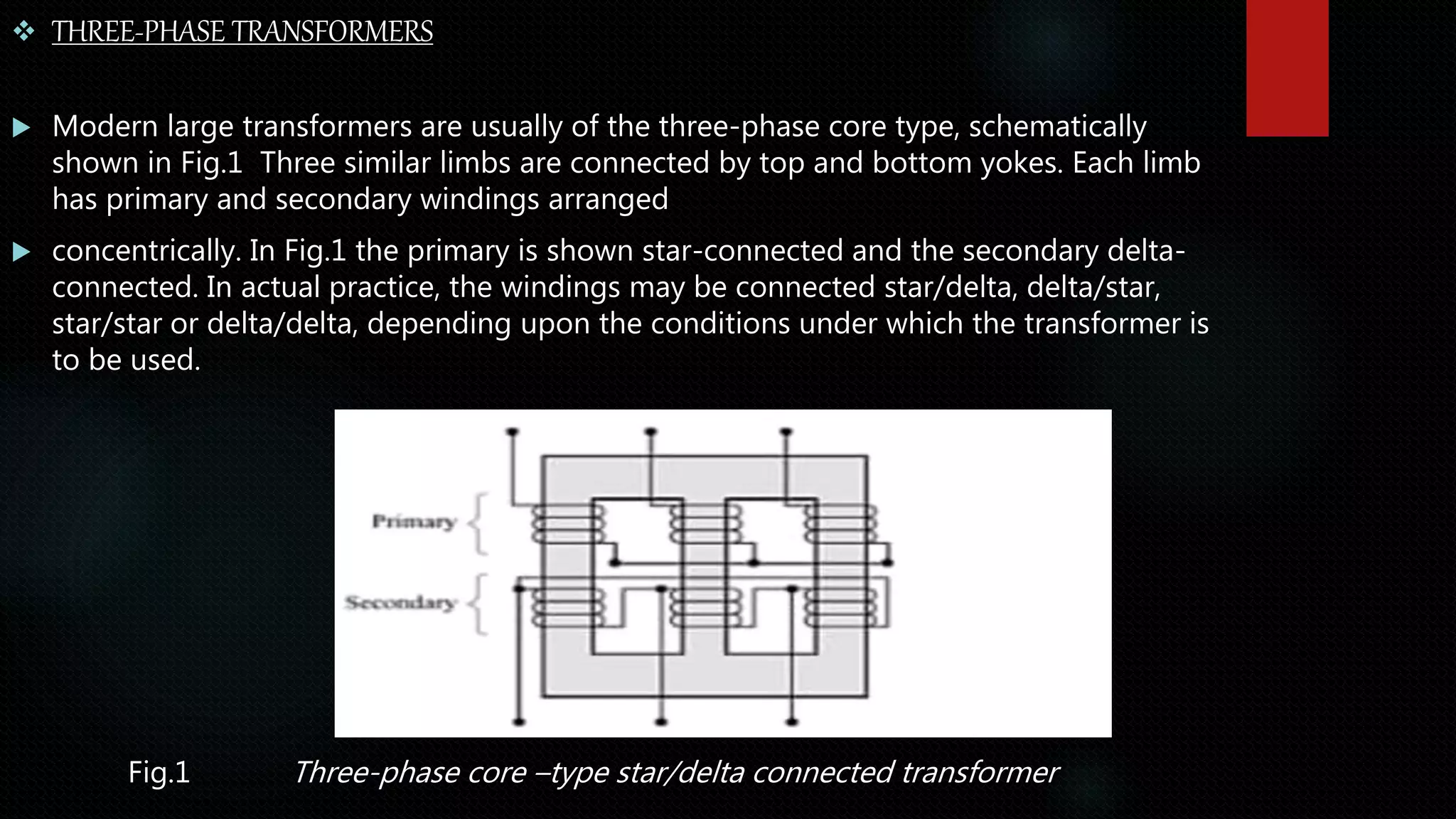
 Modern large transformers are usually of the three-phase core type, schematically
shown in Fig.1 Three similar limbs are connected by top and bottom yokes. Each limb
has primary and secondary windings arranged
 concentrically. In Fig.1 the primary is shown star-connected and the secondary delta-
connected. In actual practice, the windings may be connected star/delta, delta/star,
star/star or delta/delta, depending upon the conditions under which the transformer is
to be used.
Fig.1 Three-phase core –type star/delta connected transformer
 THREE-PHASE TRANSFORMER CONNECTIONS
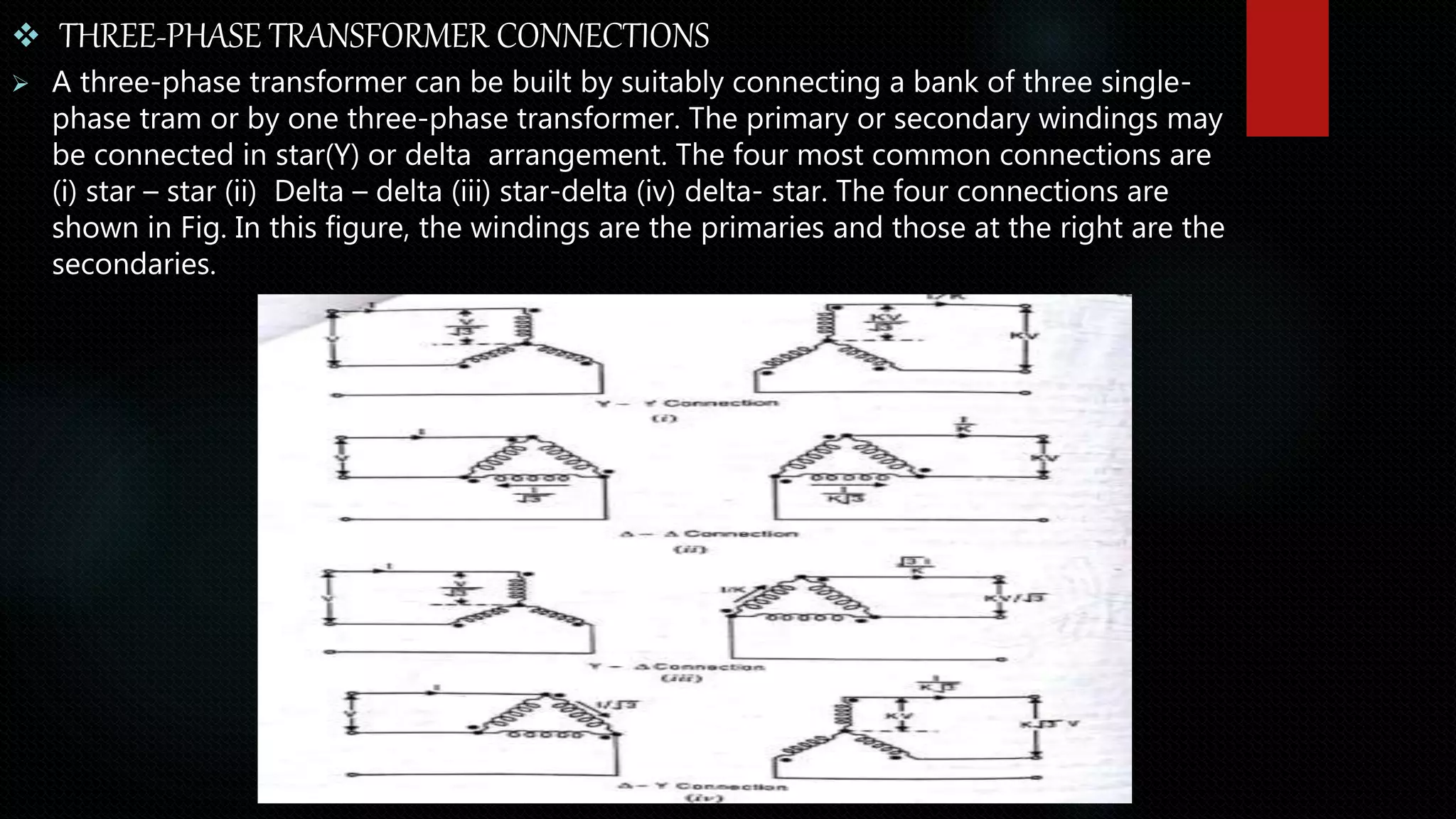
 A three-phase transformer can be built by suitably connecting a bank of three single-
phase tram or by one three-phase transformer. The primary or secondary windings may
be connected in star(Y) or delta arrangement. The four most common connections are
(i) star – star (ii) Delta – delta (iii) star-delta (iv) delta- star. The four connections are
shown in Fig. In this figure, the windings are the primaries and those at the right are the
secondaries.
 Star-star Connection: In the Y-Y connection shown in above fig (i) 57.7% of the line voltage is
impressed upon each winding but full line current flows in each winding.
 Delta-delta Connection: The Delta-Delta connection shown in above fig. is often used for
moderate voltages. An advantage of this connection is that if one transformer gets
damaged or is removed from service, the remaining two can be operated in what is
known as the open-delta or V-V connection.
 star-Delta Connection: star-delta connection shown in the above Fig. is suitable for stepping
down a high voltage. In this case, the primaries are designed for 57.7% of the high-
tension line voltages.
 Delta-star Connection: The A-Y connection shown in the above fig. is commonly used for
stepping up to a high voltage.

AUTO TRANSFORMER AND THREE PHASE TRANSFORMER

  • 1.
  • 2.
    CONTENT o DEFINATION o FEATURESOF AUTO-TRANSFORMER o THEORY OF AUTO-TRANSFORMER o OUTPUT POWER o SAVING OF CU IN AUTO-TRANSFORMER o Advantages and disadvantages of auto transformer o THREE-PHASE TRANSFORMER o Three-phase transformer conecction
  • 3.
    Auto transf ormerand working principle
  • 4.
     An Autotransformeris an electrical transformer with only one winding.the “Auto”(greek for “self”) prefix refers to the single coil acting on itself and not to any kind of automatic mechanism.
  • 5.
     Features ofAuto-Transformer  Primary and secondary windings are not electrically isolated  Uses less copper and hence is cheaper  Transformation ratio differs from unity  Higher efficiency but smaller in size  Voltage regulation is superior  Lower leakage  Lower losses  Lower magnetizing current  Increase kVA rating
  • 6.
     Theory ofAutotransformer  N₁=primary turn(1-3)  N₂=secondary turn(2-3)  I₁=primary current  I₂ =secondary current  V₁=primary voltage  V₂=secondary voltage.  From the above fig. We get
  • 7.
     Output power The primary and secondary windings of an auto-transformer are connected magnetically as well as electrically. So the power transferred from primary to secondary is inductively as well as conductively.  Output apparent power = V₂I₂  Apparent power transferred inductively = V₂(I₂-I₁) = V₂(I₂-KI₂)  = V₂l₂(1-K)= V₁I₁(1-K)  Power transferred inductively = Input x (1-K)  Power transferred conductively = Input - Input (1-K)  = Input [1-(1-K)]  = K x Input
  • 8.
     Saving ofCu in Auto transformer  For the same output and voltage transformation ratio K(N₂ /N₁) , auto transformer requires less copper than an ordinary 2-winding transformer  Volume and hence weight of Cu, is proportional to the length and area of the cross- section of the conductors.  Now, length of conductors is proportional to the number of turns and crosssection depends on current.  Hence, weight is proportional to the product of the current and number of turns.  Total Wt. of Cu in a 2-winding transformer is ∞ N₁I₁ + N₂l₂.  Wt. of Cu in section 1-2 of auto transformer is ∞ (N₁-N₂) I₁  Wt. of Cu in section 2-3 is ∞ N₂(I₂-I₁)  Total Wt. of Cu in auto-transformer ∞ (N₁-N₂) I₁ + N₂(I₂ -I₁)
  • 10.
     Thus ifK =0.1, the saving of Cu is only 10% but if K = 0 .9 , saving of Cu is 90%. Therefore, the value of K of autotransformer is to 1, the greater is the saving of Cu.  ADVANTAGES AND DISADVANTAGES OF AUTOTRANSFORMERS o Advantages o An autotransformer requires less Cu than a two-winding transformer of similar rating. o An autotransformer operates at a higher efficiency than a two-winding transformer of similar rating. o An autotransformer has better voltage regulation than a two-winding transformer of the samr rating. o An autotransformer has smaller size than'a two-winding transformer of the same rating. o An autotransformer requires smaller exciting current than a two-winding transformer of the same rating.
  • 11.
     Disadvantages o Thereis a direct connection between the primary and secondary. Th The short-circuit current is much larger than for the two-winding transformer of the same rating. It can be seen that a short-circuited secondary causes part of the primary also to be short-circuited. This reduces the effective resistance and reactance. o erefore, the output is no longer d.c. isolated from the input.
  • 12.
     THREE-PHASE TRANSFORMERS Modern large transformers are usually of the three-phase core type, schematically shown in Fig.1 Three similar limbs are connected by top and bottom yokes. Each limb has primary and secondary windings arranged  concentrically. In Fig.1 the primary is shown star-connected and the secondary delta- connected. In actual practice, the windings may be connected star/delta, delta/star, star/star or delta/delta, depending upon the conditions under which the transformer is to be used. Fig.1 Three-phase core –type star/delta connected transformer
  • 13.
     THREE-PHASE TRANSFORMERCONNECTIONS  A three-phase transformer can be built by suitably connecting a bank of three single- phase tram or by one three-phase transformer. The primary or secondary windings may be connected in star(Y) or delta arrangement. The four most common connections are (i) star – star (ii) Delta – delta (iii) star-delta (iv) delta- star. The four connections are shown in Fig. In this figure, the windings are the primaries and those at the right are the secondaries.
  • 14.
     Star-star Connection:In the Y-Y connection shown in above fig (i) 57.7% of the line voltage is impressed upon each winding but full line current flows in each winding.  Delta-delta Connection: The Delta-Delta connection shown in above fig. is often used for moderate voltages. An advantage of this connection is that if one transformer gets damaged or is removed from service, the remaining two can be operated in what is known as the open-delta or V-V connection.  star-Delta Connection: star-delta connection shown in the above Fig. is suitable for stepping down a high voltage. In this case, the primaries are designed for 57.7% of the high- tension line voltages.  Delta-star Connection: The A-Y connection shown in the above fig. is commonly used for stepping up to a high voltage.