Case Study- Research
Methodology
Dr. D. Heena Cowsar
Assistant Professor of Commerce
Bon Secours College for Women
Thanjavur
heen@bonsecourscollege.in / heena.raffi@gmail.com
Case Study -Introduction
The case study method is a very popular form of
qualitative analysis and involves a careful and complete
observation of a social unit (be that unit a person, a
family, an institution, a cultural group or even the entire
community). It is a method of study in depth rather than
breadth.
The case study places more emphasis on the full
analysis of a limited number of events or conditions and
their interrelations. The case study deals with the
processes that take place and their interrelationship.
Thus, case study is essentially an intensive
investigation of the particular unit under consideration.
The object of the case study method is to locate the
factors that account for the behaviour-patterns of the
given unit as an integrated totality.
Case Study - Definition
According to H. Odum, “The case study method of data
collection is a technique by which individual factor whether it be
an institution or just an episode in the life of an individual or a
group is analysed in its relationship to any other in the group.”
Thus, a fairly exhaustive study of a person (as to what he does and
has done, what he thinks he does and had done and what he
expects to do and says he ought to do) or group is called a life or
case history.
Burgess has used the words “the social microscope” for the
case study method.”
Pauline V. Young describes case study as “a comprehensive
study of a social unit be that unit a person, a group, a social
institution, a district or a community.”
Case Study - Meaning
In brief, we can say that case study method is
1. a form of qualitative analysis
2. where in careful and complete observation of an individual or a
situation or an institution is done;
3. efforts are made to study each and every aspect of the concerning
unit in minute details
4. and then from case data generalisations and inferences are drawn.
Characteristics of Case Study
1. Under this method the researcher can take one single social unit or more of such units for his study
purpose; he may even take a situation to study the same comprehensively.
2. Here the selected unit is studied intensively i.e., it is studied in minute details. Generally, the study
extends over a long period of time to ascertain the natural history of the unit so as to obtain enough
information for drawing correct inferences.
3. In the context of this method we make complete study of the social unit covering all facets. Through
this method we try to understand the complex of factors that are operative within a social unit as an
integrated totality.
4. Under this method the approach happens to be qualitative and not quantitative. Mere quantitative
information is not collected. Every possible effort is made to collect information concerning all aspects
of life. As such, case study deepens our perception and gives us a clear insight into life.
For instance, under this method we not only study how many crimes a man has done but
shall peep into the factors that forced him to commit crimes when we are making a case study of a
man as a criminal. The objective of the study may be to suggest ways to reform the criminal.
Contd..
5. In respect of the case study method an effort is made to know the
mutual inter-relationship of causal factors.
6. Under case study method the behaviour pattern of the
concerning unit is studied directly and not by an indirect and
abstract approach.
7. Case study method results in fruitful hypotheses along with the
data which may be helpful in testing them, and thus it enables the
generalised knowledge to get richer and richer. In its absence,
generalised social science may get handicapped.
Evolution and scope
The case study method is a widely used systematic field research technique in
sociology these days. The credit for introducing this method to the field of social
investigation goes to
1. Frederic Le Play who used it as a hand-maiden to statistics in his studies of
family budgets.
2. Herbert Spencer was the first to use case material in his comparative study of
different cultures.
3. Dr. William Healy resorted to this method in his study of juvenile
delinquency, and considered it as a better method over and above the mere use
of statistical data.
4. Similarly, anthropologists, historians, novelists and dramatists have used this
method concerning problems pertaining to their areas of interests.
5. Even management experts use case study methods for getting clues to several
management problems.
In brief, case study method is being used in several disciplines. Not only this, its
use is increasing day by day.
Assumptions in Case Study
The case study method is based on several assumptions. The important
assumptions may be listed as follows:
1. The assumption of uniformity in the basic human nature in spite of the fact
that human behaviour may vary according to situations.
2. he assumption of studying the natural history of the unit concerned.
3. The assumption of comprehensive study of the unit concerned.
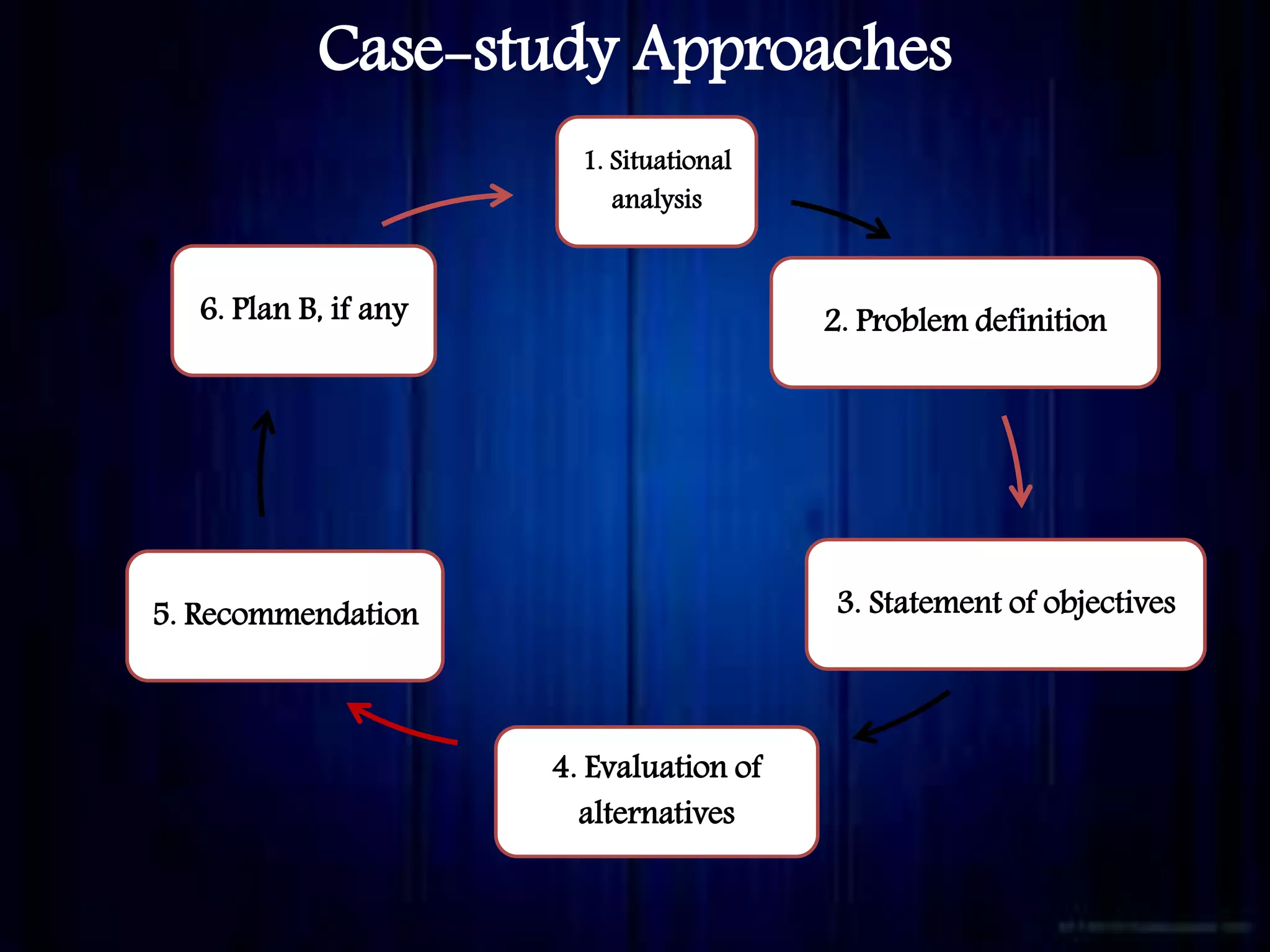
Case-study Approaches
1. Situational
analysis
2. Problem definition
3. Statement of objectives
4. Evaluation of
alternatives
5. Recommendation
6. Plan B, if any
Steps in Case Study
Major phases involved in case study are as follows:
1. Recognition and determination of the status of the phenomenon to be
investigated or the unit of attention.
2. Collection of data, examination and history of the given phenomenon.
3. Diagnosis and identification of causal factors as a basis for remedial or
developmental treatment.
4. Application of remedial measures i.e., treatment and therapy (this phase is
often characterized as case work).
5. Follow-up programme to determine effectiveness of the treatment applied.
Advantages
1. Being an exhaustive study of a social unit, the case study method enables us
to understand fully the behaviour pattern of the concerned unit.
2. Through case study a researcher can obtain a real and enlightened record of
personal experiences which would reveal man’s inner strivings, tensions and
motivations that drive him to action along with the forces that direct him to
adopt a certain pattern of behaviour.
3. This method enables the researcher to trace out the natural history of the
social unit and its relationship with the social factors and the forces involved in
its surrounding environment.
4. It helps in formulating relevant hypotheses along with the data which may
be helpful in testing them. Case studies, thus, enable the generalised knowledge
to get richer and richer.
Advantages
5. The method facilitates intensive study of social units which is generally not
possible if we use either the observation method or the method of collecting
information through schedules.
6. Information collected under the case study method helps a lot to the
researcher in the task of constructing the appropriate questionnaire or schedule
for the said task requires thorough knowledge of the concerning universe.
7. The researcher can use one or more of the several research methods under
the case study method depending upon the prevalent circumstances. In other
words, the use of different methods such as depth interviews, questionnaires,
documents, study reports of individuals, letters, and the like is possible under
case study method.
8. This method is a means to well understand the past of a social unit because
of its emphasis of historical analysis. Besides, it is also a technique to suggest
measures for improvement in the context of the present environment of the
concerned social units.
Advantages
9. Case studies constitute the perfect type of sociological material as they represent a
real record of personal experiences which very often escape the attention of most of the
skilled researchers using other techniques.
10. Case study method enhances the experience of the researcher and this in turn
increases his analysing ability and skill.
11. This method makes possible the study of social changes. On account of the minute
study of the different facets of a social unit, the researcher can well understand the
social change then and now. This also facilitates the drawing of inferences and helps in
maintaining the continuity of the research process.
12. Case study techniques are indispensable for therapeutic and administrative
purposes. They are also of immense value in taking decisions regarding several
management problems. Case data are quite useful for diagnosis, therapy and other
practical case problems.
Advantages
7. The researcher can use one or more of the several research methods under the case
study method depending upon the prevalent circumstances. In other words, the use of
different methods such as depth interviews, questionnaires, documents, study reports of
individuals, letters, and the like is possible under case study method.
8. This method is a means to well understand the past of a social unit because of its
emphasis of historical analysis. Besides, it is also a technique to suggest measures for
improvement in the context of the present environment of the concerned social units.
9. Case studies constitute the perfect type of sociological material as they represent a
real record of personal experiences which very often escape the attention of most of the
skilled researchers using other techniques.
10. Case study method enhances the experience of the researcher and this in turn
increases his analysing ability and skill.
11. This method makes possible the study of social changes. On account of the minute
study of the different facets of a social unit, the researcher can well understand the
social change then and now. This also facilitates the drawing of inferences and helps in
maintaining the continuity of the research process.
12. Case study techniques are indispensable for therapeutic and administrative
purposes. They are also of immense value in taking decisions regarding several
management problems. Case data are quite useful for diagnosis, therapy and other
practical case problems.
Limitations
1. Case situations are seldom comparable and as such the information gathered
in case studies is often not comparable.
2.Real information is often not collected because the subjectivity of the
researcher does enter in the collection of information in a case study.
3.The danger of false generalization is always there in view of the fact that no
set rules are followed in collection of the information and only few units are
studied.
4.It consumes more time and requires lot of expenditure. More time is needed
under case study method since one studies the natural history cycles of social
units and that too minutely.
Limitations
5. The case data are often vitiated because the subject, according to Read Bain, may
write what he thinks the investigator wants; and the greater the rapport, the more
subjective the whole process is.
6. Case study method is based on several assumptions which may not be very realistic at
times, and as such the usefulness of case data is always subject to doubt
7. Case study method can be used only in a limited sphere., it is not possible to use it in
case of a big society. Sampling is also not possible under a case study method.
8. Response of the investigator is an important limitation of the case study method. He
often thinks that he has full knowledge of the unit and can himself answer about it. In
case the same is not true, then consequences follow. In fact, this is more the fault of the
researcher rather than that of the case method.
Home Assignments
1. Shut down of UBER home services
2. Lebanon – Beirut explosion
3. Insurance agents marketing techniques
4. Class monitor role with arguing person
5. Edmodo unsuitable services
6. Newly appointed Sales Manager role for promoting sale during corona lockdown
7. Junior staff strategy to admire the Head
8. Corona Vaccine release
Today’s Case
“A software engineer is hired as a trainee by a company that specialises in hardware. As
the end of his mandatory training period approaches, his job performance is found
below par, and he is informed that he must leave the company at the end of his training
period. His immediate superior, out of kindness, writes him a recommendation letter,
which may help him in getting the next job. However, this engineer uses the letter to
take the company to court and challenges his dismissal.
How should the company resolve this situation?”
Today’s Case
“Mr. Secret Keeper is a Corporate Head (HR) in a company. He is very nice and gets
along well with all people. People often consult him for help and advice. One person
(named “Mr. A”) approaches him for a job because he is right now jobless. Mr. Secret
Keeper takes the guy's qualifications and asks him to come after a week however, since
no job available. He keeps frequently postponing the job offer. Mr. A keeps visiting the
HR head, Mr. Secret Keeper, often and becomes his close friend.
Then, one day, Mr. A confides with the HR Head “I was in prison for 18 years for a
crime that I had not committed. With two years remaining of the sentence, I ran away
from jail. Even now, police is in look out for me.” Mr. Secret Keeper tells the person to
go home and that he would give him a job. However as soon as he leaves, Mr. Secret
Keeper calls up the police and gives the details of Mr. A and asks them to arrest Mr. A.
Because of this betrayal of trust by the HR head, people in the organisation have
started losing faith in him. A senior person in the office complains to the VP that the
Mr. Secret Keeper has “broken faith”, so others could not come to him.”
Mr. Secret Keeper is a Corporate Head (HR) in a company. He is very nice and gets
along well with all people. People often consult him for help and advice. One person
(named “Mr. A”) approaches him for a job because he is right now jobless. Mr. Secret
Keeper takes the guy's qualifications and asks him to come after a week however, since
no job available. He keeps frequently postponing the job offer. Mr. A keeps visiting the
HR head, Mr. Secret Keeper, often and becomes his close friend.
Then, one day, Mr. A confides with the HR Head “I was in prison for 18 years for a
crime that I had not committed. With two years remaining of the sentence, I ran away
from jail. Even now, police is in look out for me.” Mr. Secret Keeper tells the person to
go home and that he would give him a job. However as soon as he leaves, Mr. Secret
Keeper calls up the police and gives the details of Mr. A and asks them to arrest Mr. A.
Because of this betrayal of trust by the HR head, people in the organisation have
started losing faith in him. A senior person in the office complains to the VP that the
Mr. Secret Keeper has “broken faith”, so others could not come to him.
Assume that you are the VP of the company. What would you do about the situation?

Case Study- Research Methodology.pptx

  • 1.
    Case Study- Research Methodology Dr.D. Heena Cowsar Assistant Professor of Commerce Bon Secours College for Women Thanjavur heen@bonsecourscollege.in / heena.raffi@gmail.com
  • 2.
    Case Study -Introduction Thecase study method is a very popular form of qualitative analysis and involves a careful and complete observation of a social unit (be that unit a person, a family, an institution, a cultural group or even the entire community). It is a method of study in depth rather than breadth. The case study places more emphasis on the full analysis of a limited number of events or conditions and their interrelations. The case study deals with the processes that take place and their interrelationship. Thus, case study is essentially an intensive investigation of the particular unit under consideration. The object of the case study method is to locate the factors that account for the behaviour-patterns of the given unit as an integrated totality.
  • 3.
    Case Study -Definition According to H. Odum, “The case study method of data collection is a technique by which individual factor whether it be an institution or just an episode in the life of an individual or a group is analysed in its relationship to any other in the group.” Thus, a fairly exhaustive study of a person (as to what he does and has done, what he thinks he does and had done and what he expects to do and says he ought to do) or group is called a life or case history. Burgess has used the words “the social microscope” for the case study method.” Pauline V. Young describes case study as “a comprehensive study of a social unit be that unit a person, a group, a social institution, a district or a community.”
  • 4.
    Case Study -Meaning In brief, we can say that case study method is 1. a form of qualitative analysis 2. where in careful and complete observation of an individual or a situation or an institution is done; 3. efforts are made to study each and every aspect of the concerning unit in minute details 4. and then from case data generalisations and inferences are drawn.
  • 5.
    Characteristics of CaseStudy 1. Under this method the researcher can take one single social unit or more of such units for his study purpose; he may even take a situation to study the same comprehensively. 2. Here the selected unit is studied intensively i.e., it is studied in minute details. Generally, the study extends over a long period of time to ascertain the natural history of the unit so as to obtain enough information for drawing correct inferences. 3. In the context of this method we make complete study of the social unit covering all facets. Through this method we try to understand the complex of factors that are operative within a social unit as an integrated totality. 4. Under this method the approach happens to be qualitative and not quantitative. Mere quantitative information is not collected. Every possible effort is made to collect information concerning all aspects of life. As such, case study deepens our perception and gives us a clear insight into life. For instance, under this method we not only study how many crimes a man has done but shall peep into the factors that forced him to commit crimes when we are making a case study of a man as a criminal. The objective of the study may be to suggest ways to reform the criminal.
  • 6.
    Contd.. 5. In respectof the case study method an effort is made to know the mutual inter-relationship of causal factors. 6. Under case study method the behaviour pattern of the concerning unit is studied directly and not by an indirect and abstract approach. 7. Case study method results in fruitful hypotheses along with the data which may be helpful in testing them, and thus it enables the generalised knowledge to get richer and richer. In its absence, generalised social science may get handicapped.
  • 7.
    Evolution and scope Thecase study method is a widely used systematic field research technique in sociology these days. The credit for introducing this method to the field of social investigation goes to 1. Frederic Le Play who used it as a hand-maiden to statistics in his studies of family budgets. 2. Herbert Spencer was the first to use case material in his comparative study of different cultures. 3. Dr. William Healy resorted to this method in his study of juvenile delinquency, and considered it as a better method over and above the mere use of statistical data. 4. Similarly, anthropologists, historians, novelists and dramatists have used this method concerning problems pertaining to their areas of interests. 5. Even management experts use case study methods for getting clues to several management problems. In brief, case study method is being used in several disciplines. Not only this, its use is increasing day by day.
  • 8.
    Assumptions in CaseStudy The case study method is based on several assumptions. The important assumptions may be listed as follows: 1. The assumption of uniformity in the basic human nature in spite of the fact that human behaviour may vary according to situations. 2. he assumption of studying the natural history of the unit concerned. 3. The assumption of comprehensive study of the unit concerned.
  • 9.
    Case-study Approaches 1. Situational analysis 2.Problem definition 3. Statement of objectives 4. Evaluation of alternatives 5. Recommendation 6. Plan B, if any
  • 10.
    Steps in CaseStudy Major phases involved in case study are as follows: 1. Recognition and determination of the status of the phenomenon to be investigated or the unit of attention. 2. Collection of data, examination and history of the given phenomenon. 3. Diagnosis and identification of causal factors as a basis for remedial or developmental treatment. 4. Application of remedial measures i.e., treatment and therapy (this phase is often characterized as case work). 5. Follow-up programme to determine effectiveness of the treatment applied.
  • 11.
    Advantages 1. Being anexhaustive study of a social unit, the case study method enables us to understand fully the behaviour pattern of the concerned unit. 2. Through case study a researcher can obtain a real and enlightened record of personal experiences which would reveal man’s inner strivings, tensions and motivations that drive him to action along with the forces that direct him to adopt a certain pattern of behaviour. 3. This method enables the researcher to trace out the natural history of the social unit and its relationship with the social factors and the forces involved in its surrounding environment. 4. It helps in formulating relevant hypotheses along with the data which may be helpful in testing them. Case studies, thus, enable the generalised knowledge to get richer and richer.
  • 12.
    Advantages 5. The methodfacilitates intensive study of social units which is generally not possible if we use either the observation method or the method of collecting information through schedules. 6. Information collected under the case study method helps a lot to the researcher in the task of constructing the appropriate questionnaire or schedule for the said task requires thorough knowledge of the concerning universe. 7. The researcher can use one or more of the several research methods under the case study method depending upon the prevalent circumstances. In other words, the use of different methods such as depth interviews, questionnaires, documents, study reports of individuals, letters, and the like is possible under case study method. 8. This method is a means to well understand the past of a social unit because of its emphasis of historical analysis. Besides, it is also a technique to suggest measures for improvement in the context of the present environment of the concerned social units.
  • 13.
    Advantages 9. Case studiesconstitute the perfect type of sociological material as they represent a real record of personal experiences which very often escape the attention of most of the skilled researchers using other techniques. 10. Case study method enhances the experience of the researcher and this in turn increases his analysing ability and skill. 11. This method makes possible the study of social changes. On account of the minute study of the different facets of a social unit, the researcher can well understand the social change then and now. This also facilitates the drawing of inferences and helps in maintaining the continuity of the research process. 12. Case study techniques are indispensable for therapeutic and administrative purposes. They are also of immense value in taking decisions regarding several management problems. Case data are quite useful for diagnosis, therapy and other practical case problems.
  • 14.
    Advantages 7. The researchercan use one or more of the several research methods under the case study method depending upon the prevalent circumstances. In other words, the use of different methods such as depth interviews, questionnaires, documents, study reports of individuals, letters, and the like is possible under case study method. 8. This method is a means to well understand the past of a social unit because of its emphasis of historical analysis. Besides, it is also a technique to suggest measures for improvement in the context of the present environment of the concerned social units. 9. Case studies constitute the perfect type of sociological material as they represent a real record of personal experiences which very often escape the attention of most of the skilled researchers using other techniques. 10. Case study method enhances the experience of the researcher and this in turn increases his analysing ability and skill. 11. This method makes possible the study of social changes. On account of the minute study of the different facets of a social unit, the researcher can well understand the social change then and now. This also facilitates the drawing of inferences and helps in maintaining the continuity of the research process. 12. Case study techniques are indispensable for therapeutic and administrative purposes. They are also of immense value in taking decisions regarding several management problems. Case data are quite useful for diagnosis, therapy and other practical case problems.
  • 15.
    Limitations 1. Case situationsare seldom comparable and as such the information gathered in case studies is often not comparable. 2.Real information is often not collected because the subjectivity of the researcher does enter in the collection of information in a case study. 3.The danger of false generalization is always there in view of the fact that no set rules are followed in collection of the information and only few units are studied. 4.It consumes more time and requires lot of expenditure. More time is needed under case study method since one studies the natural history cycles of social units and that too minutely.
  • 16.
    Limitations 5. The casedata are often vitiated because the subject, according to Read Bain, may write what he thinks the investigator wants; and the greater the rapport, the more subjective the whole process is. 6. Case study method is based on several assumptions which may not be very realistic at times, and as such the usefulness of case data is always subject to doubt 7. Case study method can be used only in a limited sphere., it is not possible to use it in case of a big society. Sampling is also not possible under a case study method. 8. Response of the investigator is an important limitation of the case study method. He often thinks that he has full knowledge of the unit and can himself answer about it. In case the same is not true, then consequences follow. In fact, this is more the fault of the researcher rather than that of the case method.
  • 17.
    Home Assignments 1. Shutdown of UBER home services 2. Lebanon – Beirut explosion 3. Insurance agents marketing techniques 4. Class monitor role with arguing person 5. Edmodo unsuitable services 6. Newly appointed Sales Manager role for promoting sale during corona lockdown 7. Junior staff strategy to admire the Head 8. Corona Vaccine release
  • 18.
    Today’s Case “A softwareengineer is hired as a trainee by a company that specialises in hardware. As the end of his mandatory training period approaches, his job performance is found below par, and he is informed that he must leave the company at the end of his training period. His immediate superior, out of kindness, writes him a recommendation letter, which may help him in getting the next job. However, this engineer uses the letter to take the company to court and challenges his dismissal. How should the company resolve this situation?”
  • 19.
    Today’s Case “Mr. SecretKeeper is a Corporate Head (HR) in a company. He is very nice and gets along well with all people. People often consult him for help and advice. One person (named “Mr. A”) approaches him for a job because he is right now jobless. Mr. Secret Keeper takes the guy's qualifications and asks him to come after a week however, since no job available. He keeps frequently postponing the job offer. Mr. A keeps visiting the HR head, Mr. Secret Keeper, often and becomes his close friend. Then, one day, Mr. A confides with the HR Head “I was in prison for 18 years for a crime that I had not committed. With two years remaining of the sentence, I ran away from jail. Even now, police is in look out for me.” Mr. Secret Keeper tells the person to go home and that he would give him a job. However as soon as he leaves, Mr. Secret Keeper calls up the police and gives the details of Mr. A and asks them to arrest Mr. A. Because of this betrayal of trust by the HR head, people in the organisation have started losing faith in him. A senior person in the office complains to the VP that the Mr. Secret Keeper has “broken faith”, so others could not come to him.”
  • 20.
    Mr. Secret Keeperis a Corporate Head (HR) in a company. He is very nice and gets along well with all people. People often consult him for help and advice. One person (named “Mr. A”) approaches him for a job because he is right now jobless. Mr. Secret Keeper takes the guy's qualifications and asks him to come after a week however, since no job available. He keeps frequently postponing the job offer. Mr. A keeps visiting the HR head, Mr. Secret Keeper, often and becomes his close friend. Then, one day, Mr. A confides with the HR Head “I was in prison for 18 years for a crime that I had not committed. With two years remaining of the sentence, I ran away from jail. Even now, police is in look out for me.” Mr. Secret Keeper tells the person to go home and that he would give him a job. However as soon as he leaves, Mr. Secret Keeper calls up the police and gives the details of Mr. A and asks them to arrest Mr. A. Because of this betrayal of trust by the HR head, people in the organisation have started losing faith in him. A senior person in the office complains to the VP that the Mr. Secret Keeper has “broken faith”, so others could not come to him. Assume that you are the VP of the company. What would you do about the situation?