Dr. D. Heena Cowsar
Assistant Professor of Commerce
Bon Secours College for Women
Thanjavur
heena.raffi@gmail.com / heen@bonsecourscollege.in
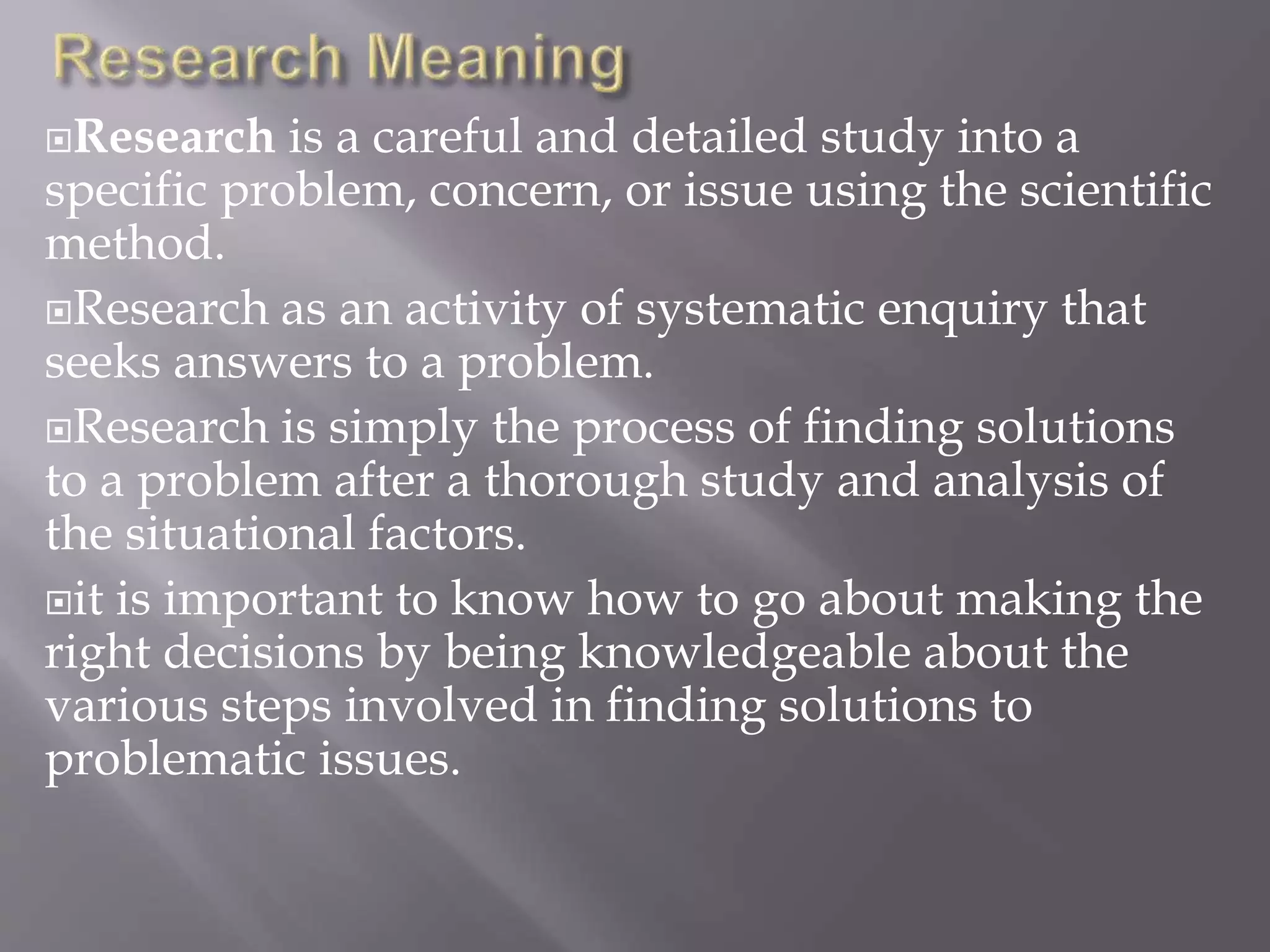
Research is a careful and detailed study into a
specific problem, concern, or issue using the scientific
method.
Research as an activity of systematic enquiry that
seeks answers to a problem.
Research is simply the process of finding solutions
to a problem after a thorough study and analysis of
the situational factors.
it is important to know how to go about making the
right decisions by being knowledgeable about the
various steps involved in finding solutions to
problematic issues.
 It is an investigation of finding solutions to scientific
and social problems through objective and systematic
analysis.
 It is a search for knowledge, that is, a discovery of
hidden truths. Here knowledge means information
about matters. The information might be collected
from different sources like experience, human beings,
books, journals, nature, etc.
 A research can lead to new contributions to the
existing knowledge. Only through research is it
possible to make progress in a field.
 Research is indeed civilization and determines the
economic, social and political development of a
nation.
 Research is not confined to science and
technology only. There are vast areas of research
in other disciplines such as languages, literature,
history and sociology. Whatever might be the
subject, research has to be an active, diligent and
systematic process of inquiry in order to discover,
interpret or revise facts, events, behaviours and
theories. Applying the outcome of research for
the refinement of knowledge in other subjects, or
in enhancing the quality of human life also
becomes a kind of research and development.
 Research is done with the help of study,
experiment, observation, analysis, comparison and
reasoning. Research is in fact ubiquitous. For
example, we know that cigarette smoking is
injurious to health; heroine is addictive; cow dung
is a useful source of biogas; malaria is due to the
virus protozoan plasmodium; AIDS (Acquired
Immuno Deficiency Syndrome) is due to the virus
HIV (Human Immuno Deficiency Virus). How did
we know all these? We became aware of all these
information only through research. More precisely,
it seeks predictions of events, explanations,
relationships and theories for them.
The prime objectives of research are
(1) to discover new facts
(2) to verify and test important facts
(3) to analyse an event or process or phenomenon to
identify the cause and effect relationship
(4) to develop new scientific tools, concepts and
theories to solve and understand scientific and
nonscientific problems
(5) to find solutions to scientific, nonscientific and
social problems and (6) to overcome or solve the
problems occurring in our every day life.
It refers to
 A Systematic Study
 Defining a problem
 Formulating a hypothesis
 Collecting & Analysing a data
 Deductions and conclusion

1 Research Methodology.pptx

  • 1.
    Dr. D. HeenaCowsar Assistant Professor of Commerce Bon Secours College for Women Thanjavur heena.raffi@gmail.com / heen@bonsecourscollege.in
  • 3.
    Research is acareful and detailed study into a specific problem, concern, or issue using the scientific method. Research as an activity of systematic enquiry that seeks answers to a problem. Research is simply the process of finding solutions to a problem after a thorough study and analysis of the situational factors. it is important to know how to go about making the right decisions by being knowledgeable about the various steps involved in finding solutions to problematic issues.
  • 4.
     It isan investigation of finding solutions to scientific and social problems through objective and systematic analysis.  It is a search for knowledge, that is, a discovery of hidden truths. Here knowledge means information about matters. The information might be collected from different sources like experience, human beings, books, journals, nature, etc.  A research can lead to new contributions to the existing knowledge. Only through research is it possible to make progress in a field.  Research is indeed civilization and determines the economic, social and political development of a nation.
  • 5.
     Research isnot confined to science and technology only. There are vast areas of research in other disciplines such as languages, literature, history and sociology. Whatever might be the subject, research has to be an active, diligent and systematic process of inquiry in order to discover, interpret or revise facts, events, behaviours and theories. Applying the outcome of research for the refinement of knowledge in other subjects, or in enhancing the quality of human life also becomes a kind of research and development.
  • 6.
     Research isdone with the help of study, experiment, observation, analysis, comparison and reasoning. Research is in fact ubiquitous. For example, we know that cigarette smoking is injurious to health; heroine is addictive; cow dung is a useful source of biogas; malaria is due to the virus protozoan plasmodium; AIDS (Acquired Immuno Deficiency Syndrome) is due to the virus HIV (Human Immuno Deficiency Virus). How did we know all these? We became aware of all these information only through research. More precisely, it seeks predictions of events, explanations, relationships and theories for them.
  • 7.
    The prime objectivesof research are (1) to discover new facts (2) to verify and test important facts (3) to analyse an event or process or phenomenon to identify the cause and effect relationship (4) to develop new scientific tools, concepts and theories to solve and understand scientific and nonscientific problems (5) to find solutions to scientific, nonscientific and social problems and (6) to overcome or solve the problems occurring in our every day life.
  • 8.
    It refers to A Systematic Study  Defining a problem  Formulating a hypothesis  Collecting & Analysing a data  Deductions and conclusion