




CASE STUDY
A.J.JENIFER DIVYA
I YR M.ED
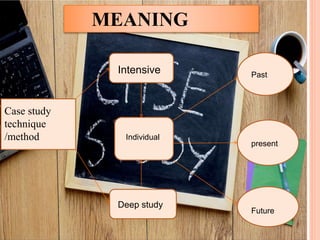
MEANING
Case study
technique
/method
Intensive
Individual
Deep study
Past
present
Future
DEFINITION:
“A fairly exhaustive study of a person or group is
called a life of case history”
-P.V.YOUNG
“Case study is a method of exploring and analyzing
the life of a social unit –be that unit a person ,a
family,institution,culture, group or even an entire
community or nation”
-P.V.YOUNG
Case study method is a form of
qualitative analysis involving the very
careful and complete observation of a
person ,a situation or an institution.
-BEISANZ & BEISANZ
EXAMPLES OF CASE STUDIES
• Single organization – School : What is
happening with a particular tool/ stratergy
• A particular community – rural village ongoing
issue
• An individual – career criminal
• An event – Election Campaign
• On a particular group- issue to a group
CHARACTERISTICS:
Study of a unit
Holistic
Scientific
Reliable
It is the best method to use for diognostics and
further remedial measures
Its provide complete information about individuals
behavior
SOURCES OF CASE STUDY
• Personal documents
• Life history records
• Related persons
• Official records
• The subject himself through interview
OBJECTIVES OF CASE STUDY:
 Clinical purpose
 Diagnostic purpose
 Fact-finding about psychological and
educational problems.
 Supplementing other information's.
STEPS INVOLVED IN CASE STUDY:
Identifying
the specific
problem
Collection of
data
Analysis of
problem
Application of
Remedial
measures
Evaluating
Follow up
ADVANTAGES:
 Intensive in nature
 Data collection is flexible
 Less expensive than other methods
 Useful in guidance and counseling
 Helps to generalize knowledge
 Researcher can use more than one method
 To study historical background
 Exploring New areas of research
DISADVANTAGES:
 Develops over confidence
 Unsystematic and Unscientific
 Difficult to apply
 Scope of errors
 Consummes more time and money
 Not useful for quantitative studies
REFERENCES:
a) Prof .Dr.A. Mustafa ,Research Methodology, A.I.T.B Publishers
b) Dr.K .Nagarajan ,Dr.R.Srinivasan, Dr.Mrs.Mary Vijayakumar,
Research Methodology in Education,Ram Publishers
c) P.Saravanavel ,Research Methodology ,Kitab Mahal publishers
d) N.R.Saxena,B.K .Mishra,R.K.Mohanty ,Fundamentals of
Educational Research,
GENETIC METHOD
TYPES
Longitudinal
Cross sectional

Case study

  • 1.
  • 2.
  • 3.
    DEFINITION: “A fairly exhaustivestudy of a person or group is called a life of case history” -P.V.YOUNG “Case study is a method of exploring and analyzing the life of a social unit –be that unit a person ,a family,institution,culture, group or even an entire community or nation” -P.V.YOUNG
  • 4.
    Case study methodis a form of qualitative analysis involving the very careful and complete observation of a person ,a situation or an institution. -BEISANZ & BEISANZ
  • 5.
    EXAMPLES OF CASESTUDIES • Single organization – School : What is happening with a particular tool/ stratergy • A particular community – rural village ongoing issue • An individual – career criminal • An event – Election Campaign • On a particular group- issue to a group
  • 6.
    CHARACTERISTICS: Study of aunit Holistic Scientific Reliable It is the best method to use for diognostics and further remedial measures Its provide complete information about individuals behavior
  • 7.
    SOURCES OF CASESTUDY • Personal documents • Life history records • Related persons • Official records • The subject himself through interview
  • 8.
    OBJECTIVES OF CASESTUDY:  Clinical purpose  Diagnostic purpose  Fact-finding about psychological and educational problems.  Supplementing other information's.
  • 9.
    STEPS INVOLVED INCASE STUDY: Identifying the specific problem Collection of data Analysis of problem Application of Remedial measures Evaluating Follow up
  • 10.
    ADVANTAGES:  Intensive innature  Data collection is flexible  Less expensive than other methods  Useful in guidance and counseling  Helps to generalize knowledge  Researcher can use more than one method  To study historical background  Exploring New areas of research
  • 11.
    DISADVANTAGES:  Develops overconfidence  Unsystematic and Unscientific  Difficult to apply  Scope of errors  Consummes more time and money  Not useful for quantitative studies
  • 12.
    REFERENCES: a) Prof .Dr.A.Mustafa ,Research Methodology, A.I.T.B Publishers b) Dr.K .Nagarajan ,Dr.R.Srinivasan, Dr.Mrs.Mary Vijayakumar, Research Methodology in Education,Ram Publishers c) P.Saravanavel ,Research Methodology ,Kitab Mahal publishers d) N.R.Saxena,B.K .Mishra,R.K.Mohanty ,Fundamentals of Educational Research,
  • 14.
  • 17.