Presentation for the Course Research Methodology
(TEFL-523)
Case Study Research Method
By: Dawit Dibekulu
April, 2018
In this presentation I am going to present:
Definition and background of case study
Research
Purpose of case study research
Characteristics of case study research
Types of case study research
Advantages and Dis-advantages of case
study research
Implications of case study research
Criticism of case study research and,
Finally, summary
 Case study Research method originated in clinical
medicine (the case history, i.e. the patient’s personal
history (idiographic method).
 Description of the symptoms, the diagnosis, the treatment
and eventual outcome (descriptive method) but also in
newer research explanatory case studies.
 In-depth investigation of experiences that allow to
identify interactions and influences on psychological
processes.
 Opens up and explore aspects of human experience that
can be investigated using research methods (qualitative
study)
 Yin (1984) case study is a comprehensive study of a social
unit , be it person, a group of person, an institute, a
community or a family.
 A case study is an exploration of a “bounded system” or
a case (or multiple cases) over time through detailed, in-
depth data collection involving multiple sources of
information rich in context. (Creswell, 1998, p. 61)
 Groode and Hatt (1953) CS is a method of exploring and
analyzing the life of a social unit.
 So, critical analysis reveal that case study detail study of a
situation concerning a social unit in an intensive and
comprehensives manner.
Case study research has different purposes:
 To identify the key points or issues
 To weigh up the situation
 To consider the information you do and don’t have
 Define the problem /issues to be addressed precisely
 Outline the objectives: the desirable outcome
 Identify resources/techniques helpful to opening up the
case study sustainability and ethics in design generate
ideas or alternative solution
 Descriptive study
 Narrowly focused
 Combines objective and subjective data
 Process oriented
 A Descriptive study
It is more of qualitative method rather than
quantitative method.
High level of detail are provided
Behavior pattern of the concerned unit is
studied directly where in efforts are made to
know the mutual inter-relationship of casual
factor.
Cont……
 Narrowly Focused
Typically a case study offers a complete and
comprehensive description of all facets of a
social unit, be a single individual or may be a
social group.
Often the case study focused on limited
aspect of a person, such as their
psychopathology symptoms.
Cont…..
 Combines objective and subjective data
Researchers may combine objective and
subjective data in both the data are regarded
as valid data for analysis.
It enables case study to achieved in-depth
understanding of the behavior and experience
of a single individual.
 Process-oriented: It enables the researcher to
explore and describe the nature of process,
which occur over time.
When to use case study
 The first stage is to decide whether case studies
can be useful for a specific kind of investigation.
 There are three factors that determine the best
research methodology:
The types of questions to be answered
The extent of control over behavioral events, and
The degree of focus on contemporary as opposed to
historical events.
Techniques
Observations
Interview
Secondary Data
Documents Records
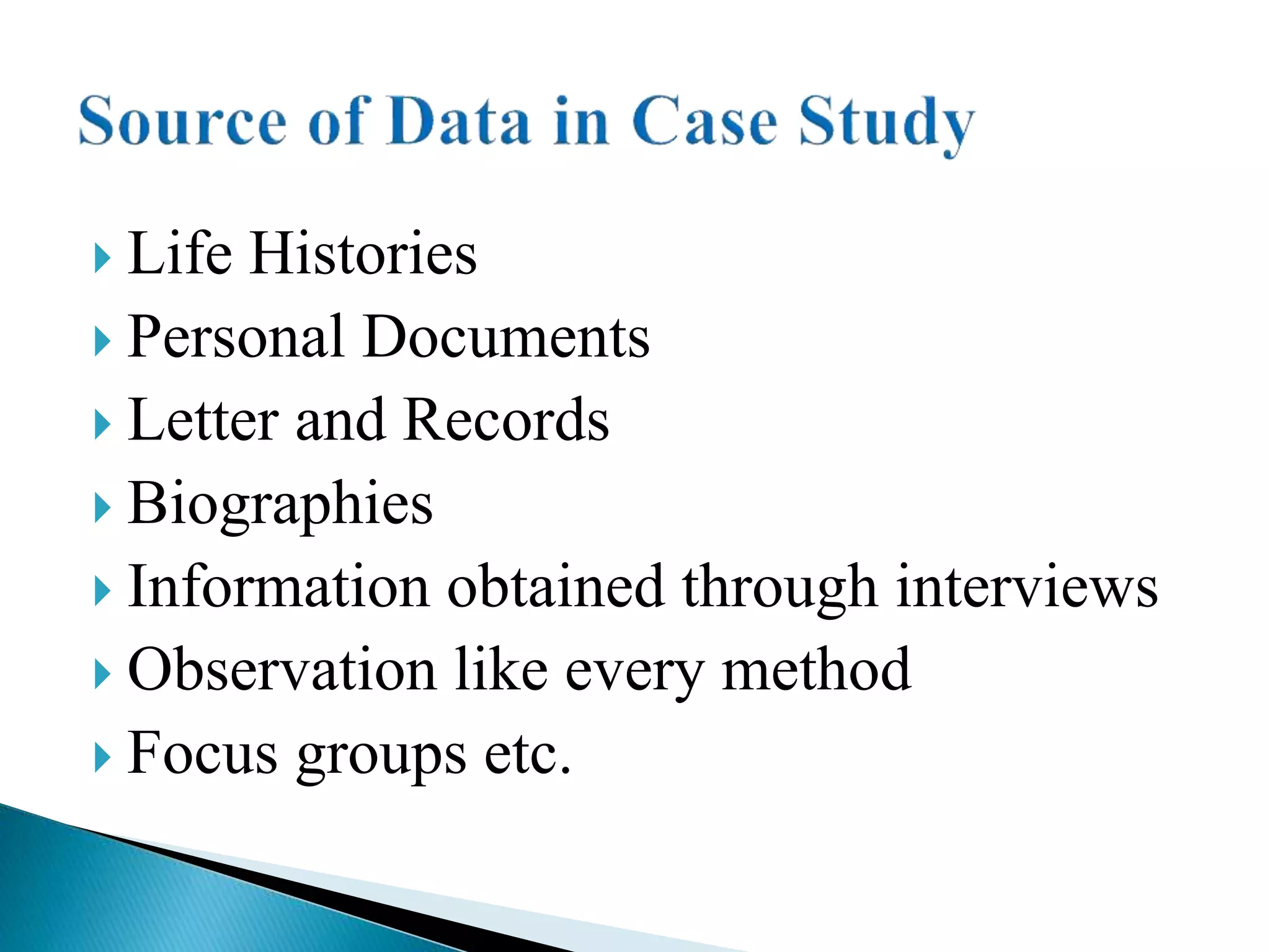
 Life Histories
 Personal Documents
 Letter and Records
 Biographies
 Information obtained through interviews
 Observation like every method
 Focus groups etc.
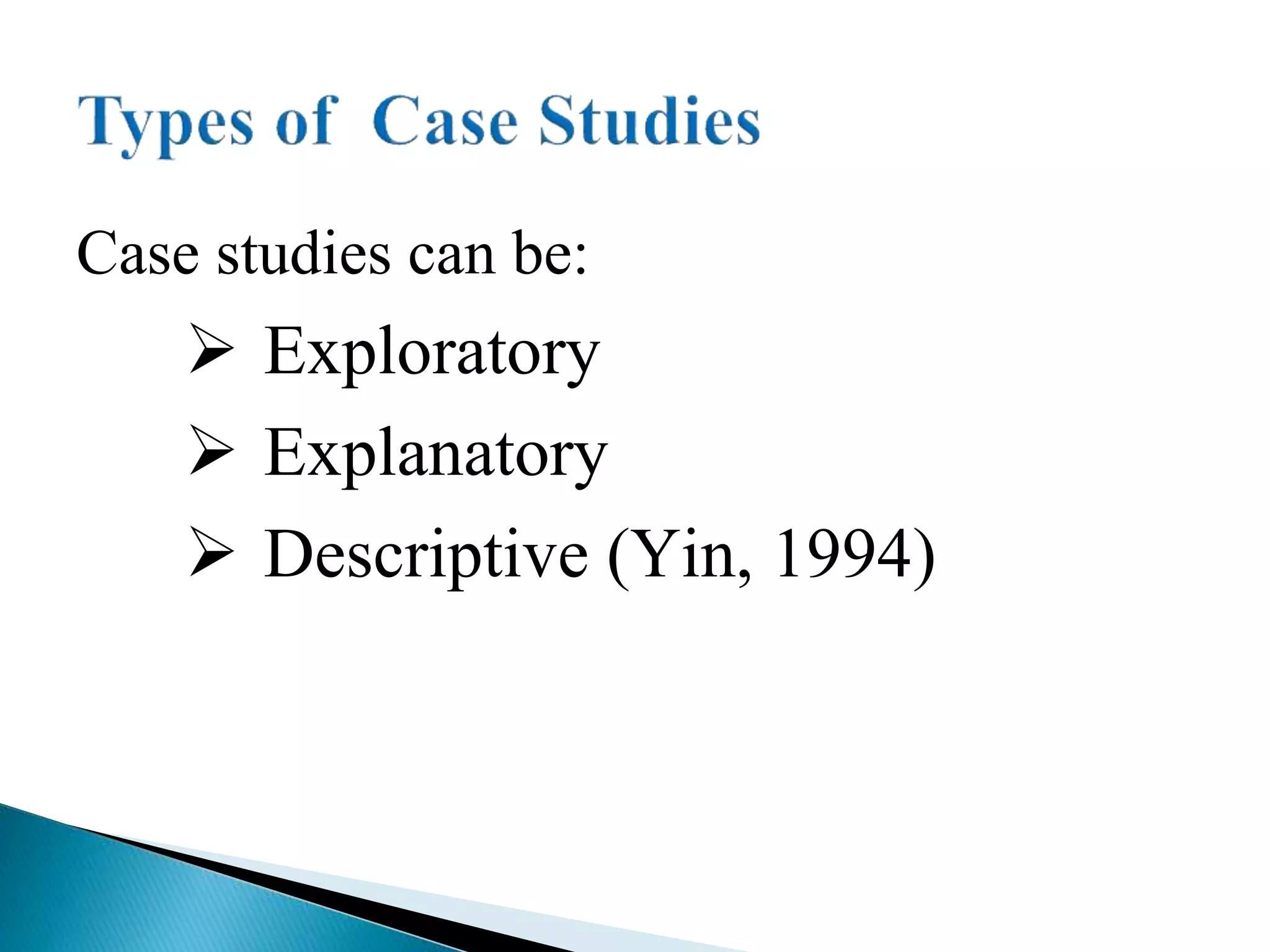
Case studies can be:
 Exploratory
 Explanatory
 Descriptive (Yin, 1994)
 Explanatory case studies: examine the data closely both at a
surface and deep level in order to explain the phenomena in
the data.
 Descriptive case studies:
which provides a thorough, contextualized description of a
phenomenon;
aim to analyze the sequence of interpersonal events after a certain
amount of time has passed.
The goal set by the researcher is to describe the data as they occur.
 Exploratory case studies:
intended to shed light on causal factors leading to particular
events.
prior fieldwork and small-scale data collection may be
conducted before the research questions and hypotheses are
proposed.
A pilot study is considered an example of an exploratory case
study
Stake (1995) suggests three types of case study based on
case selection:
 The intrinsic case study: where the case is given, rather
than chosen, as commonly occurs in program evaluation;
 The instrumental case study: where the case is
selected for its ability to contribute to a general
understanding of a phenomenon; and
 The collective case study: an extension of the
instrumental case study, where two or more
representative cases are selected.
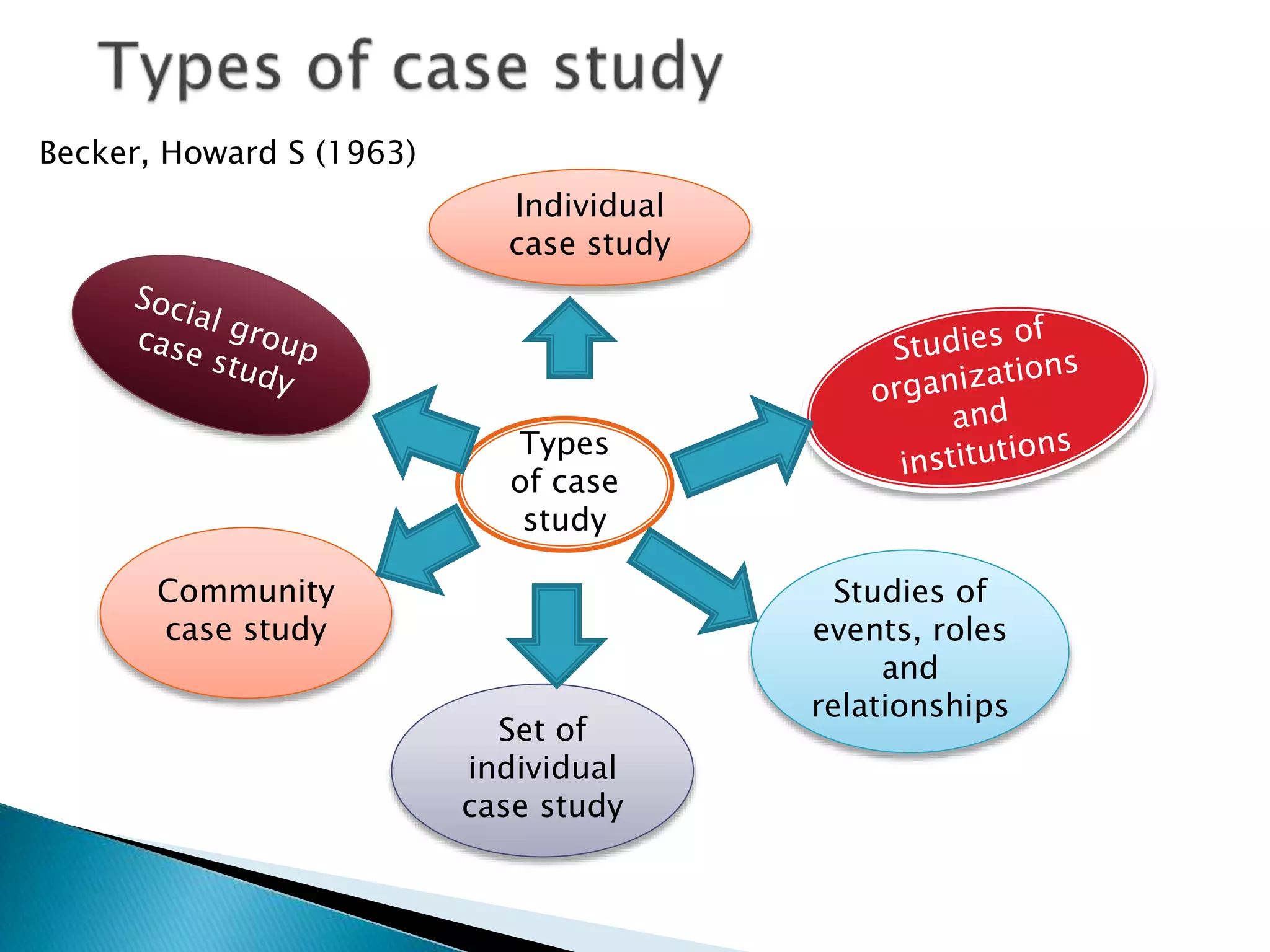
Becker, Howard S (1963) t
Individual
case study
Types
of case
study
Studies of
events, roles
and
relationships
Community
case study
Set of
individual
case study
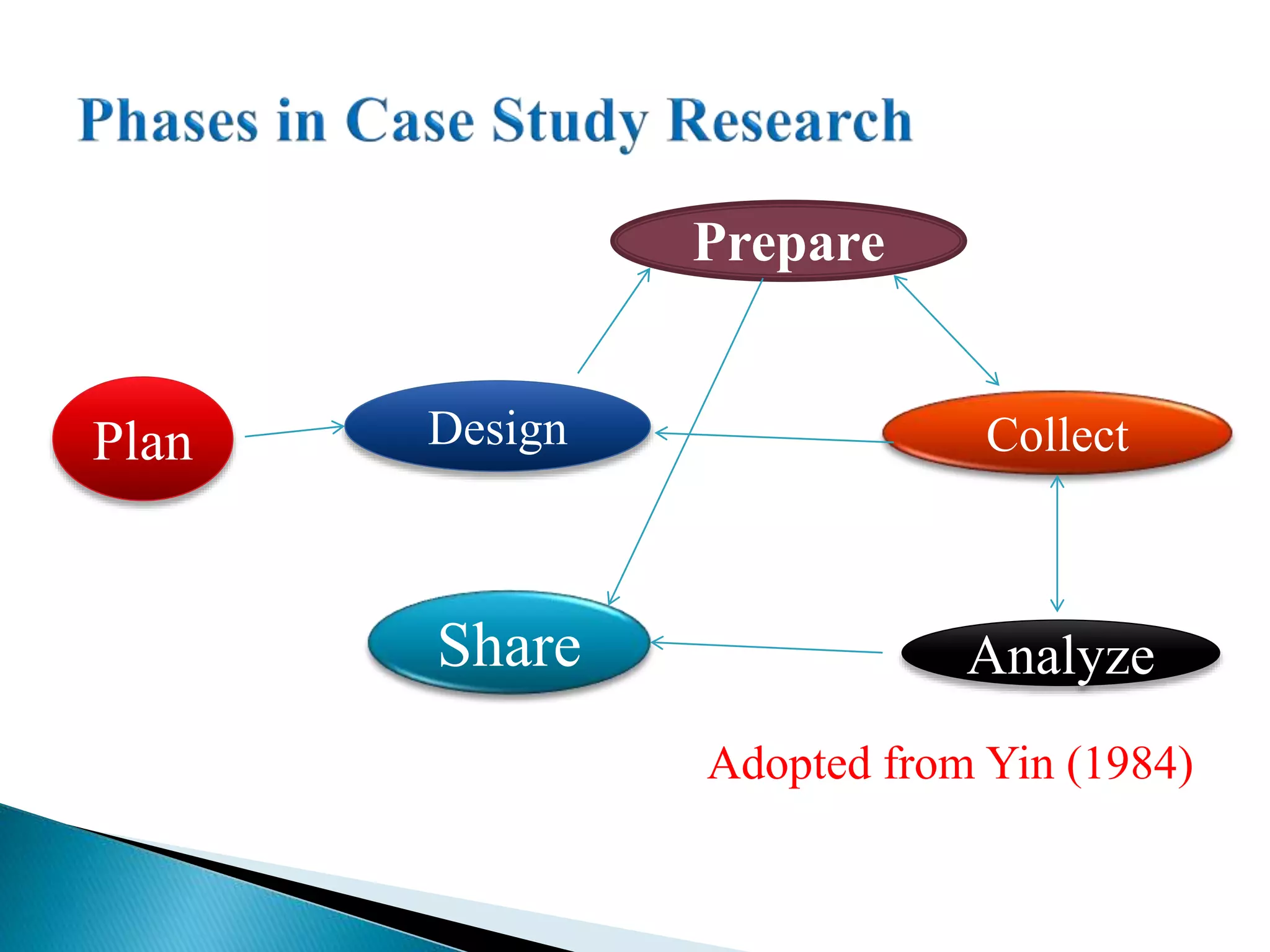
Adopted from Yin (1984)
Prepare
Design
Plan
Share Analyze
Collect
Think about ..
Conceptual Framework
Research questions
Research design
Sampling/ replication strategies
Methods and instruments
Analysis of data
Identifying your case
Establish rationale for the case define social
phenomenon
Developed research questions
 The case study method is appropriate to:
Answer why and how? Questions;
Gain an in depth understanding of a particular
phenomenon;
Develop an initial hypothesis;
Develop new theories;
Extend and testing existing theories;
Capture complexity;
It improves analytical thinking;
Helps to Stimulating new research.
 It could be open to errors due to faulty selection
of case and inaccurate observation
 There chances of inaccuracy of the data as
uniform and standardized system of recording
case histories as been developed
 Data collected from case study usually based on
several assumptions which may not be very
realistic at times.
 Problem of generalization: idiosyncratic subject
 Problem of generalization: experimenter biases
and subjective impressions
 Entangled relationships among variables.
 It is very difficult to draw generalizations on the
basis of few cases.
 Sampling is not possible in case study as this
method can be used only in limited unit.
 The information collected from case study is
incomparable since each informant gives his/her
own opinion. Therefore , replication is not
possible.
 The use of case studies can therefore be a very effective
classroom technique.
 An excellent means for the integration of subject specific
aspects into language teaching.
 Instructors may choose to use several cases so that
students can identify both the similarities and differences
among the cases.
 It help to Engage readers in active learning , Can involve
participant-led presentations, exercises, role plays, debates,
guest speakers, and informational lecture.
 For educators and teachers,
Teachers are investigating problems of intense personal
interest,
They often are able to apply instruction more
specifically,
 They gain deeper insight through their research of the
overall problem and often have success in problem
resolution,
 They are able to generate and evaluate numerous
possible solutions,
 They feel that it gives legitimacy and support to their
ideas they become more reflective in their practice.
 The Research participants need to be free
 Confidentiality
 Transparency and safety ( physical and psychological
harm) , including the potential harm associated with
the invasion of privacy and confidentiality.
 case-centered research where researchers often work
closely with research participants etc.
 Lack of rigor of case study research.
 Confusing case study research with case study
teaching.
 Provide little basis for scientific generalization.
 Case Studies take too long.
 Wieviorka (1992) sated that the method has
been criticized as being unreliable, too general,
and open to bias.
 Stake (2005) who claimed that “generalizations
can lead one to see phenomenon more
simplistically than one should (p.23).”
Critics of the case study method often claim:
 Studying a small number of cases is insufficient
for establishing reliability or generality of
findings;
 The intense involvement of the researcher in the
study of the case could bias the findings;
 Some critics suggest case study research is
useful only as an exploratory tool or for
establishing a hypothesis;
 Some would claim it is unscientific.
Generally,
Case study is categorized under qualitative research.
 It is a systematic inquiry into an event or a set of
related events which aims to describe and explain the
phenomenon of interest. (Bromley, (1990)
 The essence of case study methodology is
triangulation, the combination on different levels of
techniques, methods, strategies, or theories.
 A good case study investigator should be able to ask
good questions and interpret the answers, a good
listener, adaptive and flexible, should have a firm
grasp of the issues being studied, and unbiased by
preconceived notions.
Case Study Research Method

Case Study Research Method

  • 1.
    Presentation for theCourse Research Methodology (TEFL-523) Case Study Research Method By: Dawit Dibekulu April, 2018
  • 2.
    In this presentationI am going to present: Definition and background of case study Research Purpose of case study research Characteristics of case study research Types of case study research Advantages and Dis-advantages of case study research Implications of case study research Criticism of case study research and, Finally, summary
  • 3.
     Case studyResearch method originated in clinical medicine (the case history, i.e. the patient’s personal history (idiographic method).  Description of the symptoms, the diagnosis, the treatment and eventual outcome (descriptive method) but also in newer research explanatory case studies.  In-depth investigation of experiences that allow to identify interactions and influences on psychological processes.  Opens up and explore aspects of human experience that can be investigated using research methods (qualitative study)
  • 4.
     Yin (1984)case study is a comprehensive study of a social unit , be it person, a group of person, an institute, a community or a family.  A case study is an exploration of a “bounded system” or a case (or multiple cases) over time through detailed, in- depth data collection involving multiple sources of information rich in context. (Creswell, 1998, p. 61)  Groode and Hatt (1953) CS is a method of exploring and analyzing the life of a social unit.  So, critical analysis reveal that case study detail study of a situation concerning a social unit in an intensive and comprehensives manner.
  • 5.
    Case study researchhas different purposes:  To identify the key points or issues  To weigh up the situation  To consider the information you do and don’t have  Define the problem /issues to be addressed precisely  Outline the objectives: the desirable outcome  Identify resources/techniques helpful to opening up the case study sustainability and ethics in design generate ideas or alternative solution
  • 6.
     Descriptive study Narrowly focused  Combines objective and subjective data  Process oriented
  • 7.
     A Descriptivestudy It is more of qualitative method rather than quantitative method. High level of detail are provided Behavior pattern of the concerned unit is studied directly where in efforts are made to know the mutual inter-relationship of casual factor. Cont……
  • 8.
     Narrowly Focused Typicallya case study offers a complete and comprehensive description of all facets of a social unit, be a single individual or may be a social group. Often the case study focused on limited aspect of a person, such as their psychopathology symptoms. Cont…..
  • 9.
     Combines objectiveand subjective data Researchers may combine objective and subjective data in both the data are regarded as valid data for analysis. It enables case study to achieved in-depth understanding of the behavior and experience of a single individual.  Process-oriented: It enables the researcher to explore and describe the nature of process, which occur over time.
  • 10.
    When to usecase study  The first stage is to decide whether case studies can be useful for a specific kind of investigation.  There are three factors that determine the best research methodology: The types of questions to be answered The extent of control over behavioral events, and The degree of focus on contemporary as opposed to historical events.
  • 11.
  • 12.
     Life Histories Personal Documents  Letter and Records  Biographies  Information obtained through interviews  Observation like every method  Focus groups etc.
  • 13.
    Case studies canbe:  Exploratory  Explanatory  Descriptive (Yin, 1994)
  • 14.
     Explanatory casestudies: examine the data closely both at a surface and deep level in order to explain the phenomena in the data.  Descriptive case studies: which provides a thorough, contextualized description of a phenomenon; aim to analyze the sequence of interpersonal events after a certain amount of time has passed. The goal set by the researcher is to describe the data as they occur.  Exploratory case studies: intended to shed light on causal factors leading to particular events. prior fieldwork and small-scale data collection may be conducted before the research questions and hypotheses are proposed. A pilot study is considered an example of an exploratory case study
  • 15.
    Stake (1995) suggeststhree types of case study based on case selection:  The intrinsic case study: where the case is given, rather than chosen, as commonly occurs in program evaluation;  The instrumental case study: where the case is selected for its ability to contribute to a general understanding of a phenomenon; and  The collective case study: an extension of the instrumental case study, where two or more representative cases are selected.
  • 16.
    Becker, Howard S(1963) t Individual case study Types of case study Studies of events, roles and relationships Community case study Set of individual case study
  • 17.
    Adopted from Yin(1984) Prepare Design Plan Share Analyze Collect
  • 18.
    Think about .. ConceptualFramework Research questions Research design Sampling/ replication strategies Methods and instruments Analysis of data Identifying your case Establish rationale for the case define social phenomenon Developed research questions
  • 19.
     The casestudy method is appropriate to: Answer why and how? Questions; Gain an in depth understanding of a particular phenomenon; Develop an initial hypothesis; Develop new theories; Extend and testing existing theories; Capture complexity; It improves analytical thinking; Helps to Stimulating new research.
  • 20.
     It couldbe open to errors due to faulty selection of case and inaccurate observation  There chances of inaccuracy of the data as uniform and standardized system of recording case histories as been developed  Data collected from case study usually based on several assumptions which may not be very realistic at times.  Problem of generalization: idiosyncratic subject
  • 21.
     Problem ofgeneralization: experimenter biases and subjective impressions  Entangled relationships among variables.  It is very difficult to draw generalizations on the basis of few cases.  Sampling is not possible in case study as this method can be used only in limited unit.  The information collected from case study is incomparable since each informant gives his/her own opinion. Therefore , replication is not possible.
  • 22.
     The useof case studies can therefore be a very effective classroom technique.  An excellent means for the integration of subject specific aspects into language teaching.  Instructors may choose to use several cases so that students can identify both the similarities and differences among the cases.  It help to Engage readers in active learning , Can involve participant-led presentations, exercises, role plays, debates, guest speakers, and informational lecture.
  • 23.
     For educatorsand teachers, Teachers are investigating problems of intense personal interest, They often are able to apply instruction more specifically,  They gain deeper insight through their research of the overall problem and often have success in problem resolution,  They are able to generate and evaluate numerous possible solutions,  They feel that it gives legitimacy and support to their ideas they become more reflective in their practice.
  • 24.
     The Researchparticipants need to be free  Confidentiality  Transparency and safety ( physical and psychological harm) , including the potential harm associated with the invasion of privacy and confidentiality.  case-centered research where researchers often work closely with research participants etc.
  • 25.
     Lack ofrigor of case study research.  Confusing case study research with case study teaching.  Provide little basis for scientific generalization.  Case Studies take too long.  Wieviorka (1992) sated that the method has been criticized as being unreliable, too general, and open to bias.  Stake (2005) who claimed that “generalizations can lead one to see phenomenon more simplistically than one should (p.23).”
  • 26.
    Critics of thecase study method often claim:  Studying a small number of cases is insufficient for establishing reliability or generality of findings;  The intense involvement of the researcher in the study of the case could bias the findings;  Some critics suggest case study research is useful only as an exploratory tool or for establishing a hypothesis;  Some would claim it is unscientific.
  • 27.
    Generally, Case study iscategorized under qualitative research.  It is a systematic inquiry into an event or a set of related events which aims to describe and explain the phenomenon of interest. (Bromley, (1990)  The essence of case study methodology is triangulation, the combination on different levels of techniques, methods, strategies, or theories.  A good case study investigator should be able to ask good questions and interpret the answers, a good listener, adaptive and flexible, should have a firm grasp of the issues being studied, and unbiased by preconceived notions.

Editor's Notes