RESEARCH METHODOLOGY
PRESENTATION BY:
S. HARITHAA
III B.COM (CA)-B
DR.N.G.P. ARTS AND SCIENCE
COLLEGE,COIMBATORE-48.
RESEARCH - MEANING:
 The word research is derived from the middle of French ‘recherche’
which means to go about seeking.
 Research is a systematic and an organized method to finding answers
to questions.
 A research is a frame work or blueprint for conducting the a
research project. It details the procedures necessary for obtaining
the information needed to structure or solve research problem.
 Research consist of the prefix Re which means to search, examine
or try.
 Research can be explained as the process of collecting data and
information for the purpose of making decisions.
DEFINTION - RESEARCH
 According to Neuman “ A collection of
methods and methodologies that researchers
apply systematically to produce scientifically
based knowledge about the social world.”
 According to Mouly, “actually research is
simply the process of arriving at dependable
solutions to problems through the planned
and systematic collections , analysis and
interpretation of data.”
RESEARCH PROCESS:
1) Topic/ research title: Title plays a major role in
research.
2) Literature review: Review of literature will help in
strong content.
3) Study design: predesign of the content will make
research clear.
4) Measurement: Taking effective measurements will
help in effective research.
5) Data collection: Clear data collection.
6) Data analysis: Analysing the collected data clearly.
7) Interpretation: Interpreting the data’s properly.
8) Conclusion: Should precise the content and show in
conclusion.
OBJECTIVES OF
RESEARCH:
 To explore a phenomena in order to achieve insights.
 To produce some new knowledge. Research remains the most
efficient and reliable source of knowledge.
 To discover new inventions/design.
 To discover some solutions to solve a particular problem.
 To produce some new policies.
 To test certain hypothesis.
 Research enables predictions to be made. Predictions in
research fulfills one of the basic desire of humanity, to discern
the future and know what fate holds.
MOTIVES OF RESEARCH:
 To get a degree or promotion .
 To solve problem or find a deter solution.
 To get more knowledge.
 To contribute to the existing knowledge or society.
 To be respected as an expert.
 Directives of government, employment conditions, curiosity,
etc.,
 To get attached to the topic.
 To be more source full.
 To keep us updated.
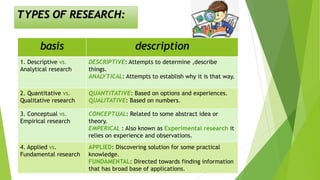
TYPES OF RESEARCH:
 Four main types of research :
basis description
1. Descriptive vs.
Analytical research
DESCRIPTIVE: Attempts to determine ,describe
things.
ANALYTICAL: Attempts to establish why it is that way.
2. Quantitative vs.
Qualitative research
QUANTITATIVE: Based on options and experiences.
QUALITATIVE: Based on numbers.
3. Conceptual vs.
Empirical research
CONCEPTUAL: Related to some abstract idea or
theory.
EMPERICAL : Also known as Experimental research it
relies on experience and observations.
4. Applied vs.
Fundamental research
APPLIED: Discovering solution for some practical
knowledge.
FUNDAMENTAL: Directed towards finding information
that has broad base of applications.
Research Meaning, Definition, Research Process, Types and Motives

Research Meaning, Definition, Research Process, Types and Motives

  • 1.
    RESEARCH METHODOLOGY PRESENTATION BY: S.HARITHAA III B.COM (CA)-B DR.N.G.P. ARTS AND SCIENCE COLLEGE,COIMBATORE-48.
  • 2.
    RESEARCH - MEANING: The word research is derived from the middle of French ‘recherche’ which means to go about seeking.  Research is a systematic and an organized method to finding answers to questions.  A research is a frame work or blueprint for conducting the a research project. It details the procedures necessary for obtaining the information needed to structure or solve research problem.  Research consist of the prefix Re which means to search, examine or try.  Research can be explained as the process of collecting data and information for the purpose of making decisions.
  • 3.
    DEFINTION - RESEARCH According to Neuman “ A collection of methods and methodologies that researchers apply systematically to produce scientifically based knowledge about the social world.”  According to Mouly, “actually research is simply the process of arriving at dependable solutions to problems through the planned and systematic collections , analysis and interpretation of data.”
  • 4.
    RESEARCH PROCESS: 1) Topic/research title: Title plays a major role in research. 2) Literature review: Review of literature will help in strong content. 3) Study design: predesign of the content will make research clear. 4) Measurement: Taking effective measurements will help in effective research. 5) Data collection: Clear data collection. 6) Data analysis: Analysing the collected data clearly. 7) Interpretation: Interpreting the data’s properly. 8) Conclusion: Should precise the content and show in conclusion.
  • 5.
    OBJECTIVES OF RESEARCH:  Toexplore a phenomena in order to achieve insights.  To produce some new knowledge. Research remains the most efficient and reliable source of knowledge.  To discover new inventions/design.  To discover some solutions to solve a particular problem.  To produce some new policies.  To test certain hypothesis.  Research enables predictions to be made. Predictions in research fulfills one of the basic desire of humanity, to discern the future and know what fate holds.
  • 6.
    MOTIVES OF RESEARCH: To get a degree or promotion .  To solve problem or find a deter solution.  To get more knowledge.  To contribute to the existing knowledge or society.  To be respected as an expert.  Directives of government, employment conditions, curiosity, etc.,  To get attached to the topic.  To be more source full.  To keep us updated.
  • 7.
    TYPES OF RESEARCH: Four main types of research : basis description 1. Descriptive vs. Analytical research DESCRIPTIVE: Attempts to determine ,describe things. ANALYTICAL: Attempts to establish why it is that way. 2. Quantitative vs. Qualitative research QUANTITATIVE: Based on options and experiences. QUALITATIVE: Based on numbers. 3. Conceptual vs. Empirical research CONCEPTUAL: Related to some abstract idea or theory. EMPERICAL : Also known as Experimental research it relies on experience and observations. 4. Applied vs. Fundamental research APPLIED: Discovering solution for some practical knowledge. FUNDAMENTAL: Directed towards finding information that has broad base of applications.