BBA Vth Sem.
MARKETING RESEARCH
TOPIC: RESEARCH DESIGN
Presented by: Ms. Pooja Luniya
RESEARCH DESIGN: OUTLINE
 Introduction
 Classification
 Exploratory Research Design
 Descriptive Research Designs
 Causal Research Designs
 Comparison of various research designs
 Causal Methods of Data Collection
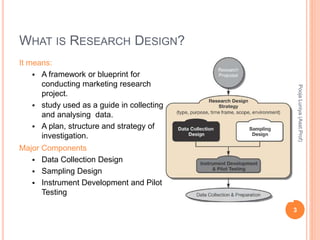
WHAT IS RESEARCH DESIGN?
It means:
 A framework or blueprint for
conducting marketing research
project.
 study used as a guide in collecting
and analysing data.
 A plan, structure and strategy of
investigation.
Major Components
 Data Collection Design
 Sampling Design
 Instrument Development and Pilot
Testing
3
PoojaLuniya(Asst.Prof)
RESEARCH DESIGN
Features / Components of a Research Design
 Define the information needed
 Design the exploratory, descriptive and / or causal phases of the
research
 Specify the measurement and scaling procedures
 Construct and pretest a questionnaire or an appropriate form of data
collection
 Specify the sampling process and sample size
 Develop a plan of data analysis
PoojaLuniya(Asst.Prof)
4
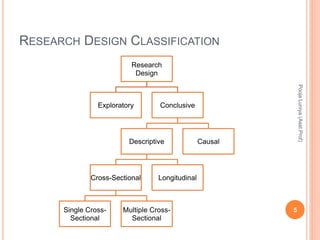
RESEARCH DESIGN CLASSIFICATION
Research
Design
Exploratory Conclusive
Descriptive
Cross-Sectional
Single Cross-
Sectional
Multiple Cross-
Sectional
Longitudinal
Causal
PoojaLuniya(Asst.Prof)
5
Exploratory Research Design
PoojaLuniya(Asst.Prof)
6
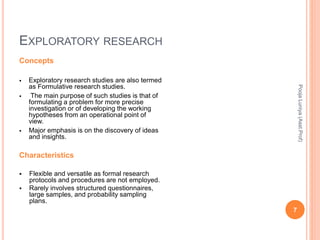
EXPLORATORY RESEARCH
Concepts
 Exploratory research studies are also termed
as Formulative research studies.
 The main purpose of such studies is that of
formulating a problem for more precise
investigation or of developing the working
hypotheses from an operational point of
view.
 Major emphasis is on the discovery of ideas
and insights.
Characteristics
 Flexible and versatile as formal research
protocols and procedures are not employed.
 Rarely involves structured questionnaires,
large samples, and probability sampling
plans.
PoojaLuniya(Asst.Prof)
7
EXPLORATORY RESEARCH DESIGNS
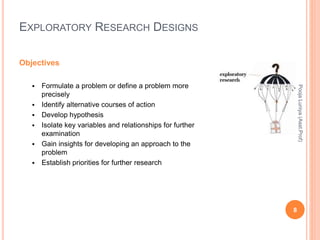
Objectives
 Formulate a problem or define a problem more
precisely
 Identify alternative courses of action
 Develop hypothesis
 Isolate key variables and relationships for further
examination
 Gain insights for developing an approach to the
problem
 Establish priorities for further research
PoojaLuniya(Asst.Prof)
8
EXPLORATORY RESEARCH DESIGN
METHODS
 Survey of concerning literature
 Studies of previous research, work already done, hypotheses already
tested
 Experience surveys
 Survey of people who have had practical experience with the problem to
be studied
 Idea is to obtain insight into the relationship between variables and new
ideas relating to the research problem
 Analysis of ‘insight-stimulating’ examples
 Particularly suitable in areas where there is little experience to serve as a
guide
 Intensive study of selected instances of the phenomenon of interest
 Examination of existing records and unstructured interviewing
PoojaLuniya(Asst.Prof)
9
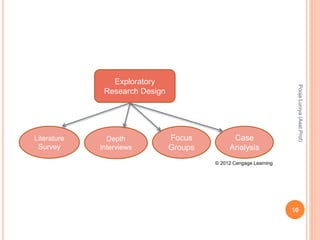
© 2012 Cengage Learning
Literature
Survey
Depth
Interviews
Focus
Groups
Case
Analysis
Exploratory
Research Design
PoojaLuniya(Asst.Prof)
10
Descriptive Research Design
PoojaLuniya(Asst.Prof)
11
DESCRIPTIVE RESEARCH DESIGN
 Objectives
 Describing the characteristics of relevant groups
 Estimating percentage of units in a specified population exhibiting a
certain behavior
 Determine the perceptions of product characteristics
 Determine the degree of association among marketing variables
 Making specific predictions
 Characteristics
 Assumes that the researcher has much prior knowledge about the
problem situation
 Hypothesis is formed prior to research
 Preplanned and structured
 Findings are conclusive
PoojaLuniya(Asst.Prof)
12
 Information needed
 Clearly defined
 Data Collection
 Through well defined surveys; Panels; Observational study; Examination
of records; Interviewing etc.
 Sampling
 Sample must be able to yield accurate information with a minimum
amount of research effort.
 Probability sampling is used
 Data Processing and Analysis
 Data must be examined for completeness, comprehensibility, consistency
and reliability
 Statistical operations on the data must be carried out
PoojaLuniya(Asst.Prof)
13
DESCRIPTIVE RESEARCH
CLASSIFICATION
 Cross-sectional
 Single: Information is collected from a given sample of population only
once
 Multiple: Information is drawn only once from two or more samples of
respondents
 Cohort: Series of surveys conducted at appropriate time intervals
 Longitudinal / Panel design
 A fixed population is measured repeatedly on the same variable
 The sample remains the same over time
PoojaLuniya(Asst.Prof)
14
Causal Research Design
PoojaLuniya(Asst.Prof)
15
CAUSAL RESEARCH DESIGNS
OBJECTIVES
 Objective
 To obtain evidence of cause-and-effect relationships
 To understand which variables are the cause and which variables are the
effect of a phenomena
 To determine the nature of the relationship between the causal variables
and the effect to be predicted
 Characteristics
 Requires procedure to reduce bias and increase reliability such as
manipulation of an independent variables in a relatively controlled
environment (An environment where other variables that may effect the
dependent variable are controlled or checked as much as possible).
 Main method is experimentation.
PoojaLuniya(Asst.Prof)
16
CAUSAL RESEARCH DESIGNS
METHOD
 Information needed
 Clearly defined in the form of a hypothesis
 Data Collection
 Through experimentation, causal surveys.
 Sampling
 Sample must be able to yield accurate information with a minimum
amount of research effort
 Statistical controls are used
 Probability sampling is used
 Data Processing and Analysis
 Using advanced statistical analysis tools
PoojaLuniya(Asst.Prof)
17
COMPARISON OF VARIOUS RESEARCH DESIGNS
 Exploratory vs Conclusive
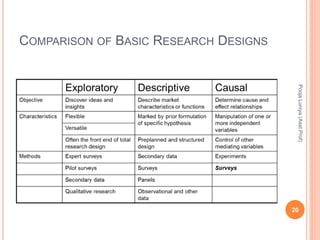
 Exploratory, Descriptive and Causal Research Designs
PoojaLuniya(Asst.Prof)
18
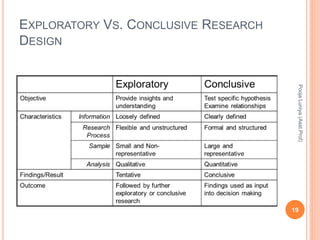
EXPLORATORY VS. CONCLUSIVE RESEARCH
DESIGN
PoojaLuniya(Asst.Prof)
19
COMPARISON OF BASIC RESEARCH DESIGNS
PoojaLuniya(Asst.Prof)
20
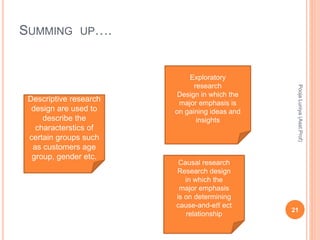
Causal research
Research design
in which the
major emphasis
is on determining
cause-and-eff ect
relationship
Exploratory
research
Design in which the
major emphasis is
on gaining ideas and
insights
Descriptive research
design are used to
describe the
characterstics of
certain groups such
as customers age
group, gender etc.
SUMMING UP….
PoojaLuniya(Asst.Prof)
21
Questions or Doubts…????
PoojaLuniya(Asst.Prof)
22

Research design

  • 1.
    BBA Vth Sem. MARKETINGRESEARCH TOPIC: RESEARCH DESIGN Presented by: Ms. Pooja Luniya
  • 2.
    RESEARCH DESIGN: OUTLINE Introduction  Classification  Exploratory Research Design  Descriptive Research Designs  Causal Research Designs  Comparison of various research designs  Causal Methods of Data Collection
  • 3.
    WHAT IS RESEARCHDESIGN? It means:  A framework or blueprint for conducting marketing research project.  study used as a guide in collecting and analysing data.  A plan, structure and strategy of investigation. Major Components  Data Collection Design  Sampling Design  Instrument Development and Pilot Testing 3 PoojaLuniya(Asst.Prof)
  • 4.
    RESEARCH DESIGN Features /Components of a Research Design  Define the information needed  Design the exploratory, descriptive and / or causal phases of the research  Specify the measurement and scaling procedures  Construct and pretest a questionnaire or an appropriate form of data collection  Specify the sampling process and sample size  Develop a plan of data analysis PoojaLuniya(Asst.Prof) 4
  • 5.
    RESEARCH DESIGN CLASSIFICATION Research Design ExploratoryConclusive Descriptive Cross-Sectional Single Cross- Sectional Multiple Cross- Sectional Longitudinal Causal PoojaLuniya(Asst.Prof) 5
  • 6.
  • 7.
    EXPLORATORY RESEARCH Concepts  Exploratoryresearch studies are also termed as Formulative research studies.  The main purpose of such studies is that of formulating a problem for more precise investigation or of developing the working hypotheses from an operational point of view.  Major emphasis is on the discovery of ideas and insights. Characteristics  Flexible and versatile as formal research protocols and procedures are not employed.  Rarely involves structured questionnaires, large samples, and probability sampling plans. PoojaLuniya(Asst.Prof) 7
  • 8.
    EXPLORATORY RESEARCH DESIGNS Objectives Formulate a problem or define a problem more precisely  Identify alternative courses of action  Develop hypothesis  Isolate key variables and relationships for further examination  Gain insights for developing an approach to the problem  Establish priorities for further research PoojaLuniya(Asst.Prof) 8
  • 9.
    EXPLORATORY RESEARCH DESIGN METHODS Survey of concerning literature  Studies of previous research, work already done, hypotheses already tested  Experience surveys  Survey of people who have had practical experience with the problem to be studied  Idea is to obtain insight into the relationship between variables and new ideas relating to the research problem  Analysis of ‘insight-stimulating’ examples  Particularly suitable in areas where there is little experience to serve as a guide  Intensive study of selected instances of the phenomenon of interest  Examination of existing records and unstructured interviewing PoojaLuniya(Asst.Prof) 9
  • 10.
    © 2012 CengageLearning Literature Survey Depth Interviews Focus Groups Case Analysis Exploratory Research Design PoojaLuniya(Asst.Prof) 10
  • 11.
  • 12.
    DESCRIPTIVE RESEARCH DESIGN Objectives  Describing the characteristics of relevant groups  Estimating percentage of units in a specified population exhibiting a certain behavior  Determine the perceptions of product characteristics  Determine the degree of association among marketing variables  Making specific predictions  Characteristics  Assumes that the researcher has much prior knowledge about the problem situation  Hypothesis is formed prior to research  Preplanned and structured  Findings are conclusive PoojaLuniya(Asst.Prof) 12
  • 13.
     Information needed Clearly defined  Data Collection  Through well defined surveys; Panels; Observational study; Examination of records; Interviewing etc.  Sampling  Sample must be able to yield accurate information with a minimum amount of research effort.  Probability sampling is used  Data Processing and Analysis  Data must be examined for completeness, comprehensibility, consistency and reliability  Statistical operations on the data must be carried out PoojaLuniya(Asst.Prof) 13
  • 14.
    DESCRIPTIVE RESEARCH CLASSIFICATION  Cross-sectional Single: Information is collected from a given sample of population only once  Multiple: Information is drawn only once from two or more samples of respondents  Cohort: Series of surveys conducted at appropriate time intervals  Longitudinal / Panel design  A fixed population is measured repeatedly on the same variable  The sample remains the same over time PoojaLuniya(Asst.Prof) 14
  • 15.
  • 16.
    CAUSAL RESEARCH DESIGNS OBJECTIVES Objective  To obtain evidence of cause-and-effect relationships  To understand which variables are the cause and which variables are the effect of a phenomena  To determine the nature of the relationship between the causal variables and the effect to be predicted  Characteristics  Requires procedure to reduce bias and increase reliability such as manipulation of an independent variables in a relatively controlled environment (An environment where other variables that may effect the dependent variable are controlled or checked as much as possible).  Main method is experimentation. PoojaLuniya(Asst.Prof) 16
  • 17.
    CAUSAL RESEARCH DESIGNS METHOD Information needed  Clearly defined in the form of a hypothesis  Data Collection  Through experimentation, causal surveys.  Sampling  Sample must be able to yield accurate information with a minimum amount of research effort  Statistical controls are used  Probability sampling is used  Data Processing and Analysis  Using advanced statistical analysis tools PoojaLuniya(Asst.Prof) 17
  • 18.
    COMPARISON OF VARIOUSRESEARCH DESIGNS  Exploratory vs Conclusive  Exploratory, Descriptive and Causal Research Designs PoojaLuniya(Asst.Prof) 18
  • 19.
    EXPLORATORY VS. CONCLUSIVERESEARCH DESIGN PoojaLuniya(Asst.Prof) 19
  • 20.
    COMPARISON OF BASICRESEARCH DESIGNS PoojaLuniya(Asst.Prof) 20
  • 21.
    Causal research Research design inwhich the major emphasis is on determining cause-and-eff ect relationship Exploratory research Design in which the major emphasis is on gaining ideas and insights Descriptive research design are used to describe the characterstics of certain groups such as customers age group, gender etc. SUMMING UP…. PoojaLuniya(Asst.Prof) 21
  • 22.