
Dr. Sarita Anand
Assistant Professor
Department of Education
Vinaya Bhavana, Visva-Bharati
Santiniketan
sarita.anand@visva-bharati.ac.in
CASE STUDY
RESEARCH METHOD
Case studies have been used for various purposes-
• Deep & Intensive study
• Descriptive
• Exploratory
• Explanatory
• Also generates theory (Yin, 1989)
PURPOSES
•Preferred Strategy when “how, who, why, and what”
questions are being asked or when the locus is on a
contemporary Phenomenon within a real life context.
•Case Study is not a method of data collection; rather it is a
research strategy or an empirical inquiry that investigates a
contemporary phenomenon by using multiple sources of
evidence.
CLARIFICATION
•Qualitative research & qualitative analysis
•Studies whole units in their totality
•Single individual or example
•Extensive data collection employs several methods in data collection
to prevent errors and distortions
•Perceives the respondent as knowledgeable person, not just as a
source of data
• Data collection till the ‘saturation point’
•Studies a typical case not general
CHARACTERISTICS
Merriam (1988) originally viewed it as “an intensive, holistic description
and analysis of a single instance, phenomenon, or social unit.”
Frederick Le Play (1829) was the first to introduce case study method
into the field of social scientific investigation as a handmaiden to
statistics in his studies of family budgets. (Les Ouvriers Europeens; 2nd
edition, 1879).
The use of case studies for the creation of new theory in social sciences
has been further developed by the sociologists Glaser and Strauss who
presented their research method, Grounded theory (1967).
HISTORY
Case study research evolved as a distinctive approach to
scientific inquiry, partly as a reaction to perceived limitations of
quantitative research (Gall, Borg, and Gall, 1996).
Yin (1994) defines case study in terms of the research process
as “. . . an empirical inquiry that investigates a contemporary
phenomenon within its real-life context, especially when the
boundaries between phenomenon and context are not clearly
evident.”
DEFINITION
• an individual (Not
necessarily a disabled or
Special child)
• a family
• a system
• a social unit
• a social group
• a social situation
CASE
• an incident
• an accident
• an event
• an institution
• an organization
• a community (e.g., a school
drop-out, a village school, a, a
tribal village, delinquent group
etc.).
A case may be-
1. Intrinsic Case Study
2. Instrumental Case Study
3. Multiple or Collective Case Study
TYPES OF CASE STUDIES
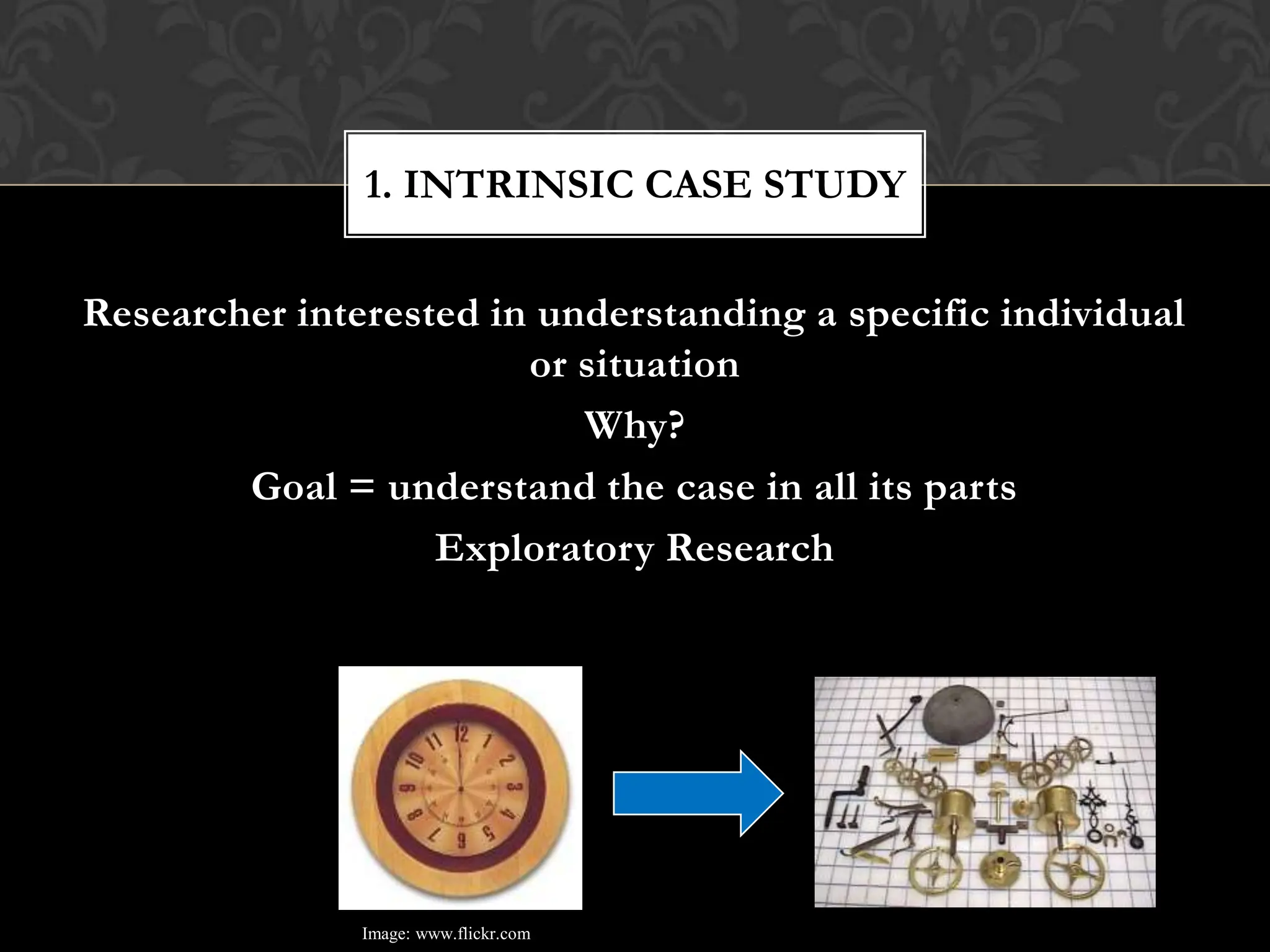
Researcher interested in understanding a specific individual
or situation
Why?
Goal = understand the case in all its parts
Exploratory Research
1. INTRINSIC CASE STUDY
Image: www.flickr.com
Researcher interested in understanding something more
than just a particular case
Studies the case only as a means to some larger goal
Goal = global
Draws conclusions that apply beyond a particular case
2. INSTRUMENTAL CASE STUDY
Researcher studies multiple cases at the same time
Overall study
3. MULTIPLE OR COLLECTIVE
CASE STUDY
1. Historical case studies
2. Observational case studies
3. Oral history case studies
4. Situational case studies
5. Clinical case studies
6. Multi-case studies
TYPES BY BURNS (2000)
Primary: Interview (through questionnaire and schedule)
and
Observation (Participant and Non-Participant)
Secondary: Variety of sources like-
• Reports
• Records
• Books
• Files
• Diaries
• News papers
• Magazines
SOURCES OF DATA COLLECTION
The researcher is the interviewer/ observer and the analyzer.
Conclusion is generally used to develop a further more intense
study.
ANALYSIS & CONCLUSION
• One researcher
• Personal or subjective bias
• Little evidence for scientific or valid generalizations
• Not all environments are identical
• Time consuming
• Doubtful reliability
• Missing Validity
• Require extensive/deep research
LIMITATIONS
REFERENCES
Ahuja, Ram (2011).Research Methods, 261-272. Rawat, New Delhi.
Burns, Robert B. (2000). Introduction to research Methods (4th ed.). Sage, London.
Frederick Le Play (1829). Les Ouvriers Europeens (2nd ed.), Paris.
Gall, M., Borg, W. and Gall, J. (1996). Educational Research. Longman, NewYork.
Glaser, B. G., & Strauss, A. L. (1967). The Discovery of Grounded Theory: Strategies for
Qualitative Research. Aldine. https://doi.org/10.1097/00006199-196807000-00014
Merriam, S. B. (1988). Case study research in education: A qualitative approach. Jossey-Bass,
San Francisco.
Yin, R.K. (1989). Case study Research: Design and Method (revised ed.), Sage, Newbury Park.
Yin, R.K.(1994). Case study research: Design and methods. Sage, Beverly Hills.
Case Study: A Research Method in Education

Case Study: A Research Method in Education

  • 1.
    Dr. Sarita Anand AssistantProfessor Department of Education Vinaya Bhavana, Visva-Bharati Santiniketan sarita.anand@visva-bharati.ac.in CASE STUDY RESEARCH METHOD
  • 2.
    Case studies havebeen used for various purposes- • Deep & Intensive study • Descriptive • Exploratory • Explanatory • Also generates theory (Yin, 1989) PURPOSES
  • 3.
    •Preferred Strategy when“how, who, why, and what” questions are being asked or when the locus is on a contemporary Phenomenon within a real life context. •Case Study is not a method of data collection; rather it is a research strategy or an empirical inquiry that investigates a contemporary phenomenon by using multiple sources of evidence. CLARIFICATION
  • 4.
    •Qualitative research &qualitative analysis •Studies whole units in their totality •Single individual or example •Extensive data collection employs several methods in data collection to prevent errors and distortions •Perceives the respondent as knowledgeable person, not just as a source of data • Data collection till the ‘saturation point’ •Studies a typical case not general CHARACTERISTICS
  • 5.
    Merriam (1988) originallyviewed it as “an intensive, holistic description and analysis of a single instance, phenomenon, or social unit.” Frederick Le Play (1829) was the first to introduce case study method into the field of social scientific investigation as a handmaiden to statistics in his studies of family budgets. (Les Ouvriers Europeens; 2nd edition, 1879). The use of case studies for the creation of new theory in social sciences has been further developed by the sociologists Glaser and Strauss who presented their research method, Grounded theory (1967). HISTORY
  • 6.
    Case study researchevolved as a distinctive approach to scientific inquiry, partly as a reaction to perceived limitations of quantitative research (Gall, Borg, and Gall, 1996). Yin (1994) defines case study in terms of the research process as “. . . an empirical inquiry that investigates a contemporary phenomenon within its real-life context, especially when the boundaries between phenomenon and context are not clearly evident.” DEFINITION
  • 7.
    • an individual(Not necessarily a disabled or Special child) • a family • a system • a social unit • a social group • a social situation CASE • an incident • an accident • an event • an institution • an organization • a community (e.g., a school drop-out, a village school, a, a tribal village, delinquent group etc.). A case may be-
  • 8.
    1. Intrinsic CaseStudy 2. Instrumental Case Study 3. Multiple or Collective Case Study TYPES OF CASE STUDIES
  • 9.
    Researcher interested inunderstanding a specific individual or situation Why? Goal = understand the case in all its parts Exploratory Research 1. INTRINSIC CASE STUDY Image: www.flickr.com
  • 10.
    Researcher interested inunderstanding something more than just a particular case Studies the case only as a means to some larger goal Goal = global Draws conclusions that apply beyond a particular case 2. INSTRUMENTAL CASE STUDY
  • 11.
    Researcher studies multiplecases at the same time Overall study 3. MULTIPLE OR COLLECTIVE CASE STUDY
  • 12.
    1. Historical casestudies 2. Observational case studies 3. Oral history case studies 4. Situational case studies 5. Clinical case studies 6. Multi-case studies TYPES BY BURNS (2000)
  • 13.
    Primary: Interview (throughquestionnaire and schedule) and Observation (Participant and Non-Participant) Secondary: Variety of sources like- • Reports • Records • Books • Files • Diaries • News papers • Magazines SOURCES OF DATA COLLECTION
  • 14.
    The researcher isthe interviewer/ observer and the analyzer. Conclusion is generally used to develop a further more intense study. ANALYSIS & CONCLUSION
  • 15.
    • One researcher •Personal or subjective bias • Little evidence for scientific or valid generalizations • Not all environments are identical • Time consuming • Doubtful reliability • Missing Validity • Require extensive/deep research LIMITATIONS
  • 16.
    REFERENCES Ahuja, Ram (2011).ResearchMethods, 261-272. Rawat, New Delhi. Burns, Robert B. (2000). Introduction to research Methods (4th ed.). Sage, London. Frederick Le Play (1829). Les Ouvriers Europeens (2nd ed.), Paris. Gall, M., Borg, W. and Gall, J. (1996). Educational Research. Longman, NewYork. Glaser, B. G., & Strauss, A. L. (1967). The Discovery of Grounded Theory: Strategies for Qualitative Research. Aldine. https://doi.org/10.1097/00006199-196807000-00014 Merriam, S. B. (1988). Case study research in education: A qualitative approach. Jossey-Bass, San Francisco. Yin, R.K. (1989). Case study Research: Design and Method (revised ed.), Sage, Newbury Park. Yin, R.K.(1994). Case study research: Design and methods. Sage, Beverly Hills.