Pretesting in Research
Dr. D. Heena Cowsar
Assistant Professor of Commerce
Bon Secours College for Women
Thanjavur
heen@bonsecourscollege.in
Introduction
Designing the perfect survey questionnaire is
impossible. However, researchers can still
create effective surveys. To determine the
effectiveness of your survey questionnaire, it
is necessary to pretest it before actually using
it. Pretesting can help you determine the
strengths and weaknesses of your survey
concerning question format, wording and
order.
Pretesting is also termed as Pilot study.
Meaning & Definition
Pretesting is the stage in survey research
when survey questions and questionnaires are
tested on members of target population/study
population, to evaluate the reliability and validity
of the survey instruments prior to their final
distribution.
Pretesting is widely regarded as
indispensable in survey questionnaire
development and is also crucial to improve data
collection for quality-of-life research. It
incorporates a variety of methods or
combinations of methods.
Two types of survey pretests
• Participating pretests dictate that you tell respondents that the
pretest is a practice run; rather than asking the respondents
to simply fill out the questionnaire, participating pretests
usually involve an interview setting where respondents are
asked to explain reactions to question form, wording and
order. This kind of pretest will help you determine whether
the questionnaire is understandable.
• When conducting an undeclared pretest, you do not tell
respondents that it is a pretest. The survey is given just as you
intend to conduct it for real. This type of pretest allows you to
check your choice of analysis and the standardization of your
survey. According to Converse and Presser (1986), if
researchers have the resources to do more than one pretest, it
might be best to use a participatory pretest first, then an
General Applications of
Pretesting
Whether or not you use a participating or
undeclared pretest, pretesting should ideally also
test specifically for question variation, meaning,
task difficulty, and respondent interest and
attention. Your pretests should also include any
questions you borrowed from other similar
surveys, even if they have already been pretested,
because meaning can be affected by the
particular context of your survey. Researchers
can also pretest the following: flow, order, skip
patterns, timing, and overall respondent well-
being.
Pretesting for reliability and validity
Researchers might also want to pretest the
reliability and validity of the survey questions.
To be reliable, a survey question must be
answered by respondents the same way each time.
According to Weisberg et. al (1989), researchers
can assess reliability by comparing the answers
respondents give in one pretest with answers in another
pretest. Then, a survey question's validity is determined
by how well it measures the concept(s) it is intended to
measure. Both convergent validity and divergent
validity can be determined by first comparing answers
to another question measuring the same concept, then
by measuring this answer to the participant's response
to a question that asks for the exact opposite answer.
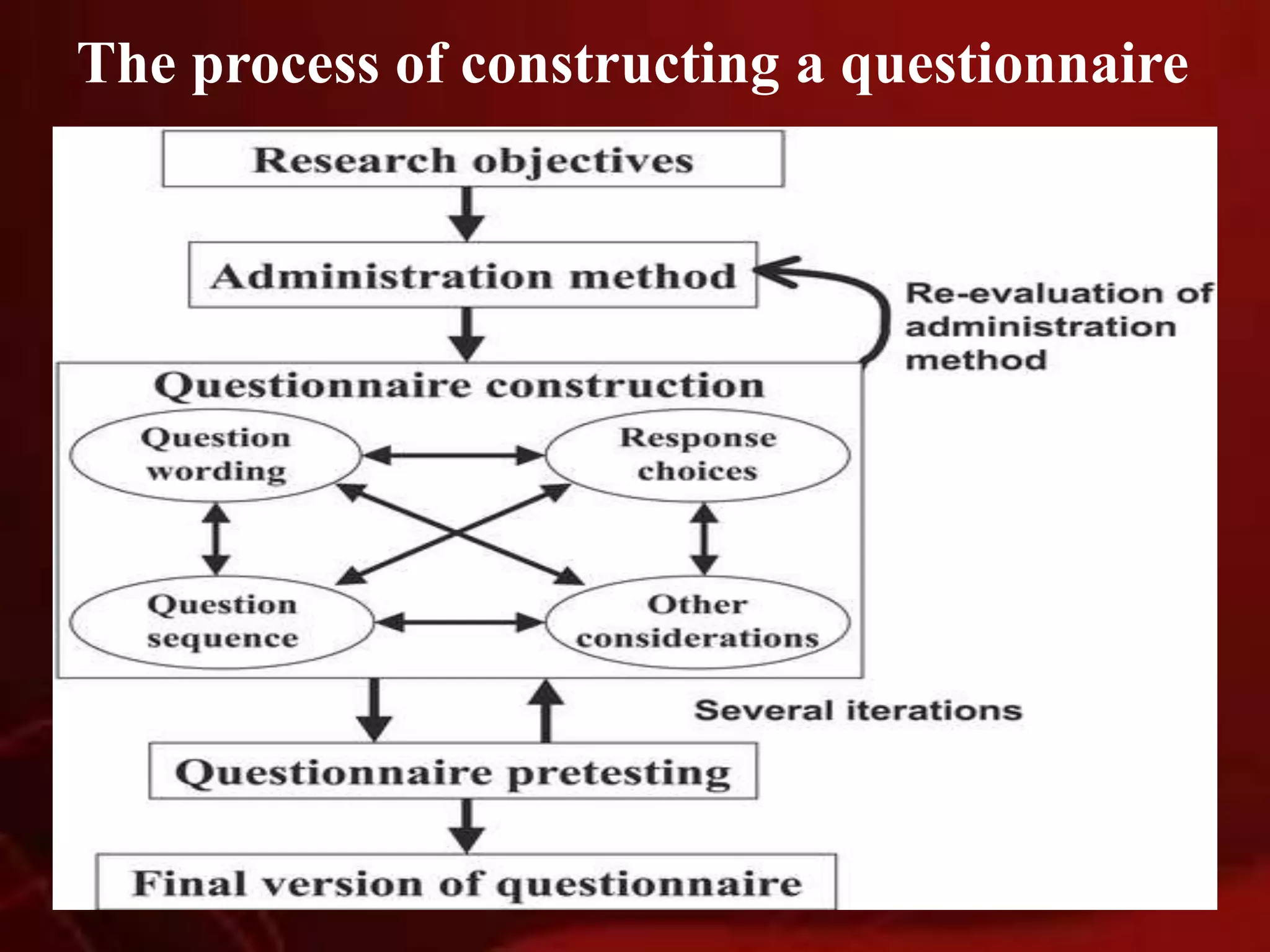
The process of constructing a questionnaire
Case Study
The Nakamura Lacquer Company (NLC) of Kyoto, Japan, employed several thousand men
and produced 500,000 pieces of lacquer tableware annually, with its Chrysanthmum brand
becoming Japan's best known and bestselling brand. The annual profit from operations was
$250,000.
The market for lacquerware in Japan seemed to have matured, with the production
steady at 500,000 pieces a year. NLC did practically no business outside Japan.
In May 2000, (much to your chagrin!) the ambitious and dynamic, Mr. Nakamura (Chairman,
NLC) received two offers from American companies wishing to sell lacquer ware in America.
The first offer was from the National China Company. It was the largest
manufacturer of good quality dinnerware in the U.S., with their “Rose and Crown” brand
accounting for almost 30% of total sales. They were willing to give a firm order for three
years for annual purchases of 400,000 sets of lacquer dinnerware, delivered in Japan and at
5% more than what the Japanese jobbers paid. However, Nakamura would have to forego the
Chrysanthemum trademark to “Rose and Crown” and also undertake not to sell lacquer ware
to anyone else in the U.S.
The second offer was from Sammelback, Sammelback and Whittacker (henceforth
SSW), Chicago, the largest supplier of hotel and restaurant supplies in the U.S. They
perceived a U.S. market of 600,000 sets a year, expecting it to go up to 2 million in around 5
years. Since the Japanese government did not allow overseas investment, SSW was willing to
budget $1.5 million for the next two years towards introduction and promotion. Nakamura
would sell his “Chrysanthemum” brand but would have to give exclusive representation to
SSW for five years at standard commission rates and also forego his profit margin toward
paying back of the $ 1.5 million.
What should Mr. Nakamura do?

Pretesting.pptx

  • 1.
    Pretesting in Research Dr.D. Heena Cowsar Assistant Professor of Commerce Bon Secours College for Women Thanjavur heen@bonsecourscollege.in
  • 2.
    Introduction Designing the perfectsurvey questionnaire is impossible. However, researchers can still create effective surveys. To determine the effectiveness of your survey questionnaire, it is necessary to pretest it before actually using it. Pretesting can help you determine the strengths and weaknesses of your survey concerning question format, wording and order. Pretesting is also termed as Pilot study.
  • 3.
    Meaning & Definition Pretestingis the stage in survey research when survey questions and questionnaires are tested on members of target population/study population, to evaluate the reliability and validity of the survey instruments prior to their final distribution. Pretesting is widely regarded as indispensable in survey questionnaire development and is also crucial to improve data collection for quality-of-life research. It incorporates a variety of methods or combinations of methods.
  • 4.
    Two types ofsurvey pretests • Participating pretests dictate that you tell respondents that the pretest is a practice run; rather than asking the respondents to simply fill out the questionnaire, participating pretests usually involve an interview setting where respondents are asked to explain reactions to question form, wording and order. This kind of pretest will help you determine whether the questionnaire is understandable. • When conducting an undeclared pretest, you do not tell respondents that it is a pretest. The survey is given just as you intend to conduct it for real. This type of pretest allows you to check your choice of analysis and the standardization of your survey. According to Converse and Presser (1986), if researchers have the resources to do more than one pretest, it might be best to use a participatory pretest first, then an
  • 5.
    General Applications of Pretesting Whetheror not you use a participating or undeclared pretest, pretesting should ideally also test specifically for question variation, meaning, task difficulty, and respondent interest and attention. Your pretests should also include any questions you borrowed from other similar surveys, even if they have already been pretested, because meaning can be affected by the particular context of your survey. Researchers can also pretest the following: flow, order, skip patterns, timing, and overall respondent well- being.
  • 6.
    Pretesting for reliabilityand validity Researchers might also want to pretest the reliability and validity of the survey questions. To be reliable, a survey question must be answered by respondents the same way each time. According to Weisberg et. al (1989), researchers can assess reliability by comparing the answers respondents give in one pretest with answers in another pretest. Then, a survey question's validity is determined by how well it measures the concept(s) it is intended to measure. Both convergent validity and divergent validity can be determined by first comparing answers to another question measuring the same concept, then by measuring this answer to the participant's response to a question that asks for the exact opposite answer.
  • 7.
    The process ofconstructing a questionnaire
  • 8.
    Case Study The NakamuraLacquer Company (NLC) of Kyoto, Japan, employed several thousand men and produced 500,000 pieces of lacquer tableware annually, with its Chrysanthmum brand becoming Japan's best known and bestselling brand. The annual profit from operations was $250,000. The market for lacquerware in Japan seemed to have matured, with the production steady at 500,000 pieces a year. NLC did practically no business outside Japan. In May 2000, (much to your chagrin!) the ambitious and dynamic, Mr. Nakamura (Chairman, NLC) received two offers from American companies wishing to sell lacquer ware in America. The first offer was from the National China Company. It was the largest manufacturer of good quality dinnerware in the U.S., with their “Rose and Crown” brand accounting for almost 30% of total sales. They were willing to give a firm order for three years for annual purchases of 400,000 sets of lacquer dinnerware, delivered in Japan and at 5% more than what the Japanese jobbers paid. However, Nakamura would have to forego the Chrysanthemum trademark to “Rose and Crown” and also undertake not to sell lacquer ware to anyone else in the U.S. The second offer was from Sammelback, Sammelback and Whittacker (henceforth SSW), Chicago, the largest supplier of hotel and restaurant supplies in the U.S. They perceived a U.S. market of 600,000 sets a year, expecting it to go up to 2 million in around 5 years. Since the Japanese government did not allow overseas investment, SSW was willing to budget $1.5 million for the next two years towards introduction and promotion. Nakamura would sell his “Chrysanthemum” brand but would have to give exclusive representation to SSW for five years at standard commission rates and also forego his profit margin toward paying back of the $ 1.5 million. What should Mr. Nakamura do?