Factors Determining Sample
size & Steps in Sampling
Dr. D. Heena Cowsar
Assistant Professor of Commerce
Bon Secours College for Women,
Thanjavur
heena.raffi@gmail.com
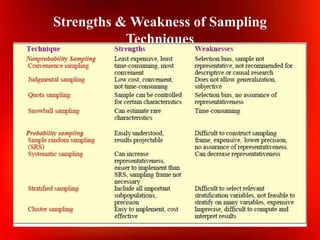
Strengths & Weakness of Sampling
Techniques
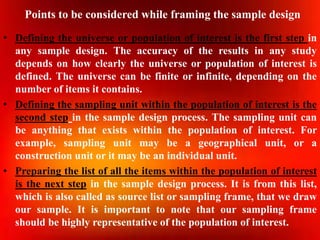
Points to be considered while framing the sample design
• Defining the universe or population of interest is the first step in
any sample design. The accuracy of the results in any study
depends on how clearly the universe or population of interest is
defined. The universe can be finite or infinite, depending on the
number of items it contains.
• Defining the sampling unit within the population of interest is the
second step in the sample design process. The sampling unit can
be anything that exists within the population of interest. For
example, sampling unit may be a geographical unit, or a
construction unit or it may be an individual unit.
• Preparing the list of all the items within the population of interest
is the next step in the sample design process. It is from this list,
which is also called as source list or sampling frame, that we draw
our sample. It is important to note that our sampling frame
should be highly representative of the population of interest.
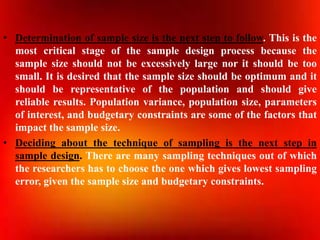
• Determination of sample size is the next step to follow. This is the
most critical stage of the sample design process because the
sample size should not be excessively large nor it should be too
small. It is desired that the sample size should be optimum and it
should be representative of the population and should give
reliable results. Population variance, population size, parameters
of interest, and budgetary constraints are some of the factors that
impact the sample size.
• Deciding about the technique of sampling is the next step in
sample design. There are many sampling techniques out of which
the researchers has to choose the one which gives lowest sampling
error, given the sample size and budgetary constraints.
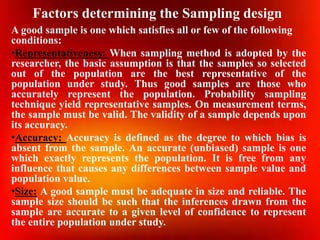
Factors determining the Sampling design
A good sample is one which satisfies all or few of the following
conditions:
•Representativeness: When sampling method is adopted by the
researcher, the basic assumption is that the samples so selected
out of the population are the best representative of the
population under study. Thus good samples are those who
accurately represent the population. Probability sampling
technique yield representative samples. On measurement terms,
the sample must be valid. The validity of a sample depends upon
its accuracy.
•Accuracy: Accuracy is defined as the degree to which bias is
absent from the sample. An accurate (unbiased) sample is one
which exactly represents the population. It is free from any
influence that causes any differences between sample value and
population value.
•Size: A good sample must be adequate in size and reliable. The
sample size should be such that the inferences drawn from the
sample are accurate to a given level of confidence to represent
the entire population under study.
Factors determining the size of Sample
The size of sample depends on number of factors. Some important
among them are:
•Homogeneity or Heterogeneity of the universe: Selection of
sample depends on the nature of the universe. It says that if the
nature of universe is homogeneous then a small sample will
represent the behavior of entire universe. This will lead to
selection of small sample size rather than a large one. On the
other hand, if the universe is heterogeneous in nature then
samples are to be chosen as from each heterogeneous unit.
•Number of classes proposed: If a large number of class intervals
to be made then the size of sample should be more because it has
to represent the entire universe. In case of small samples there is
the possibility that some samples may not be included.
•Nature of study: The size of sample also depends on the nature of
study. For an intensive study which may be for a long time, large
samples are to be chosen. Similarly, in case of general studies
large number of respondents may be appropriate one but if the
study is of technical in nature then the selection of large number
of respondents may cause difficulty while gathering information.
Steps in Sampling Process
• Defining the target population.
• Specifying the sampling frame.
• Specifying the sampling unit.
• Selection of the sampling method.
• Determination of sample size.
• Specifying the sampling plan.
• Selecting the sample.
1. Defining the Target Population:
•Defining the population of interest, for business research, is the first step in
sampling process. In general, target population is defined in terms of element,
sampling unit, extent, and time frame. The definition should be in line with the
objectives of the research study.
•For ex, if a kitchen appliances firm wants to conduct a survey to ascertain
the demand for its micro ovens, it may define the population as ‘all women
above the age of 20 who cook (assuming that very few men cook)’.
However this definition is too broad and will include every household in
the country, in the population that is to be covered by the survey.
Therefore the definition can be further refined and defined at the sampling
unit level, that, all women above the age 20, who cook and whose monthly
household income exceeds Rs.20,000. This reduces the target population
size and makes the research more focused. The population definition can
be refined further by specifying the area from where the researcher has to
draw his sample, that is, households located in Hyderabad.
•A well defined population reduces the probability of including the
respondents who do not fit the research objective of the company. For ex, if
the population is defined as all women above the age of 20, the researcher
may end up taking the opinions of a large number of women who cannot
afford to buy a micro oven.
2. Specifying the Sampling Frame:
•Once the definition of the population is clear a researcher should
decide on the sampling frame. A sampling frame is the list of
elements from which the sample may be drawn. Continuing with the
micro oven ex, an ideal sampling frame would be a database that
contains all the households that have a monthly income above
Rs.20,000. However, in practice it is difficult to get an exhaustive
sampling frame that exactly fits the requirements of a particular
research. In general, researchers use easily available sampling
frames like telephone directories and lists of credit card and mobile
phone users. Various private players provide databases developed
along various demographic and economic variables. Sometimes,
maps and aerial pictures are also used as sampling frames.
Whatever may be the case, an ideal sampling frame is one that entire
population and lists the names of its elements only once.
3. Specifying the Sampling Unit:
•A sampling unit is a basic unit that contains a
single element or a group of elements of the
population to be sampled. In this case, a household
becomes a sampling unit and all women above the
age of 20 years living in that particular house
become the sampling elements. If it is possible to
identify the exact target audience of the business
research, every individual element would be a
sampling unit. This would present a case of primary
sampling unit. However, a convenient and better
means of sampling would be to select households as
the sampling unit and interview all females above
20 years, who cook. This would present a case of
secondary sampling unit.
4. Selection of the Sampling Method:
•The sampling method outlines the way in
which the sample units are to be selected. The
choice of the sampling method is influenced
by the objectives of the business research,
availability of financial resources, time
constraints, and the nature of the problem to
be investigated. All sampling methods can be
grouped under two distinct heads, that is,
probability and non-probability sampling.
5. Determination of Sample Size:
•The sample size plays a crucial role in the sampling process.
There are various ways of classifying the techniques used in
determining the sample size. A couple those hold primary
importance and are worth mentioning are whether the
technique deals with fixed or sequential sampling and
whether its logic is based on traditional or Bayesian methods.
In non-probability sampling procedures, the allocation of
budget, thumb rules and number of sub groups to be
analyzed, importance of the decision, number of variables,
nature of analysis, incidence rates, and completion rates play
a major role in sample size determination. In the case of
probability sampling, however, formulas are used to calculate
the sample size after the levels of acceptable error and level
of confidence are specified. The details of the various
techniques used to determine the sample size will be
explained at the end of the chapter.
6. Specifying the Sampling Plan:
•In this step, the specifications and decisions regarding
the implementation of the research process are outlined.
Suppose, blocks in a city are the sampling units and the
households are the sampling elements. This step outlines
the modus operandi of the sampling plan in identifying
houses based on specified characteristics. It includes
issues like how is the interviewer going to take a
systematic sample of the houses. What should the
interviewer do when a house is vacant? What is the
recontact procedure for respondents who were
unavailable? All these and many other questions need to
be answered for the smooth functioning of the research
process. These are guide lines that would help the
researcher in every step of the process. As the
interviewers and their co-workers will be on field duty of
most of the time, a proper specification of the sampling
plans would make their work easy and they would not
have to revert to their seniors when faced with
7. Selecting the Sample:
• This is the final step in the sampling process,
where the actual selection of the sample
elements is carried out. At this stage, it is
necessary that the interviewers stick to the
rules outlined for the smooth implementation
of the business research. This step involves
implementing the sampling plan to select the
sampling plan to select a sample required for
the survey.

Sampling merits & Demerits.pptx

  • 1.
    Factors Determining Sample size& Steps in Sampling Dr. D. Heena Cowsar Assistant Professor of Commerce Bon Secours College for Women, Thanjavur heena.raffi@gmail.com
  • 2.
    Strengths & Weaknessof Sampling Techniques
  • 3.
    Points to beconsidered while framing the sample design • Defining the universe or population of interest is the first step in any sample design. The accuracy of the results in any study depends on how clearly the universe or population of interest is defined. The universe can be finite or infinite, depending on the number of items it contains. • Defining the sampling unit within the population of interest is the second step in the sample design process. The sampling unit can be anything that exists within the population of interest. For example, sampling unit may be a geographical unit, or a construction unit or it may be an individual unit. • Preparing the list of all the items within the population of interest is the next step in the sample design process. It is from this list, which is also called as source list or sampling frame, that we draw our sample. It is important to note that our sampling frame should be highly representative of the population of interest.
  • 4.
    • Determination ofsample size is the next step to follow. This is the most critical stage of the sample design process because the sample size should not be excessively large nor it should be too small. It is desired that the sample size should be optimum and it should be representative of the population and should give reliable results. Population variance, population size, parameters of interest, and budgetary constraints are some of the factors that impact the sample size. • Deciding about the technique of sampling is the next step in sample design. There are many sampling techniques out of which the researchers has to choose the one which gives lowest sampling error, given the sample size and budgetary constraints.
  • 5.
    Factors determining theSampling design A good sample is one which satisfies all or few of the following conditions: •Representativeness: When sampling method is adopted by the researcher, the basic assumption is that the samples so selected out of the population are the best representative of the population under study. Thus good samples are those who accurately represent the population. Probability sampling technique yield representative samples. On measurement terms, the sample must be valid. The validity of a sample depends upon its accuracy. •Accuracy: Accuracy is defined as the degree to which bias is absent from the sample. An accurate (unbiased) sample is one which exactly represents the population. It is free from any influence that causes any differences between sample value and population value. •Size: A good sample must be adequate in size and reliable. The sample size should be such that the inferences drawn from the sample are accurate to a given level of confidence to represent the entire population under study.
  • 6.
    Factors determining thesize of Sample The size of sample depends on number of factors. Some important among them are: •Homogeneity or Heterogeneity of the universe: Selection of sample depends on the nature of the universe. It says that if the nature of universe is homogeneous then a small sample will represent the behavior of entire universe. This will lead to selection of small sample size rather than a large one. On the other hand, if the universe is heterogeneous in nature then samples are to be chosen as from each heterogeneous unit. •Number of classes proposed: If a large number of class intervals to be made then the size of sample should be more because it has to represent the entire universe. In case of small samples there is the possibility that some samples may not be included. •Nature of study: The size of sample also depends on the nature of study. For an intensive study which may be for a long time, large samples are to be chosen. Similarly, in case of general studies large number of respondents may be appropriate one but if the study is of technical in nature then the selection of large number of respondents may cause difficulty while gathering information.
  • 7.
    Steps in SamplingProcess • Defining the target population. • Specifying the sampling frame. • Specifying the sampling unit. • Selection of the sampling method. • Determination of sample size. • Specifying the sampling plan. • Selecting the sample.
  • 8.
    1. Defining theTarget Population: •Defining the population of interest, for business research, is the first step in sampling process. In general, target population is defined in terms of element, sampling unit, extent, and time frame. The definition should be in line with the objectives of the research study. •For ex, if a kitchen appliances firm wants to conduct a survey to ascertain the demand for its micro ovens, it may define the population as ‘all women above the age of 20 who cook (assuming that very few men cook)’. However this definition is too broad and will include every household in the country, in the population that is to be covered by the survey. Therefore the definition can be further refined and defined at the sampling unit level, that, all women above the age 20, who cook and whose monthly household income exceeds Rs.20,000. This reduces the target population size and makes the research more focused. The population definition can be refined further by specifying the area from where the researcher has to draw his sample, that is, households located in Hyderabad. •A well defined population reduces the probability of including the respondents who do not fit the research objective of the company. For ex, if the population is defined as all women above the age of 20, the researcher may end up taking the opinions of a large number of women who cannot afford to buy a micro oven.
  • 9.
    2. Specifying theSampling Frame: •Once the definition of the population is clear a researcher should decide on the sampling frame. A sampling frame is the list of elements from which the sample may be drawn. Continuing with the micro oven ex, an ideal sampling frame would be a database that contains all the households that have a monthly income above Rs.20,000. However, in practice it is difficult to get an exhaustive sampling frame that exactly fits the requirements of a particular research. In general, researchers use easily available sampling frames like telephone directories and lists of credit card and mobile phone users. Various private players provide databases developed along various demographic and economic variables. Sometimes, maps and aerial pictures are also used as sampling frames. Whatever may be the case, an ideal sampling frame is one that entire population and lists the names of its elements only once.
  • 10.
    3. Specifying theSampling Unit: •A sampling unit is a basic unit that contains a single element or a group of elements of the population to be sampled. In this case, a household becomes a sampling unit and all women above the age of 20 years living in that particular house become the sampling elements. If it is possible to identify the exact target audience of the business research, every individual element would be a sampling unit. This would present a case of primary sampling unit. However, a convenient and better means of sampling would be to select households as the sampling unit and interview all females above 20 years, who cook. This would present a case of secondary sampling unit.
  • 11.
    4. Selection ofthe Sampling Method: •The sampling method outlines the way in which the sample units are to be selected. The choice of the sampling method is influenced by the objectives of the business research, availability of financial resources, time constraints, and the nature of the problem to be investigated. All sampling methods can be grouped under two distinct heads, that is, probability and non-probability sampling.
  • 12.
    5. Determination ofSample Size: •The sample size plays a crucial role in the sampling process. There are various ways of classifying the techniques used in determining the sample size. A couple those hold primary importance and are worth mentioning are whether the technique deals with fixed or sequential sampling and whether its logic is based on traditional or Bayesian methods. In non-probability sampling procedures, the allocation of budget, thumb rules and number of sub groups to be analyzed, importance of the decision, number of variables, nature of analysis, incidence rates, and completion rates play a major role in sample size determination. In the case of probability sampling, however, formulas are used to calculate the sample size after the levels of acceptable error and level of confidence are specified. The details of the various techniques used to determine the sample size will be explained at the end of the chapter.
  • 13.
    6. Specifying theSampling Plan: •In this step, the specifications and decisions regarding the implementation of the research process are outlined. Suppose, blocks in a city are the sampling units and the households are the sampling elements. This step outlines the modus operandi of the sampling plan in identifying houses based on specified characteristics. It includes issues like how is the interviewer going to take a systematic sample of the houses. What should the interviewer do when a house is vacant? What is the recontact procedure for respondents who were unavailable? All these and many other questions need to be answered for the smooth functioning of the research process. These are guide lines that would help the researcher in every step of the process. As the interviewers and their co-workers will be on field duty of most of the time, a proper specification of the sampling plans would make their work easy and they would not have to revert to their seniors when faced with
  • 14.
    7. Selecting theSample: • This is the final step in the sampling process, where the actual selection of the sample elements is carried out. At this stage, it is necessary that the interviewers stick to the rules outlined for the smooth implementation of the business research. This step involves implementing the sampling plan to select the sampling plan to select a sample required for the survey.