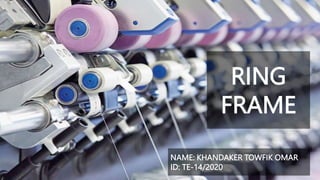
RING
FRAME
NAME: KHANDAKER TOWFIK OMAR
ID: TE-14/2020
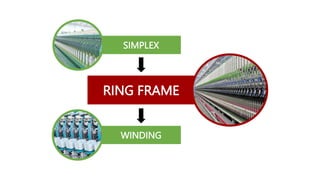
SIMPLEX
RING FRAME
WINDING
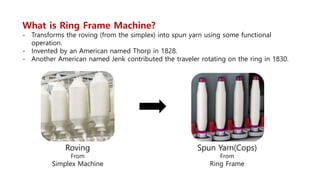
What is Ring Frame Machine?
- Transforms the roving (from the simplex) into spun yarn using some functional
operation.
- Invented by an American named Thorp in 1828.
- Another American named Jenk contributed the traveler rotating on the ring in 1830.
Roving
From
Simplex Machine
Spun Yarn(Cops)
From
Ring Frame
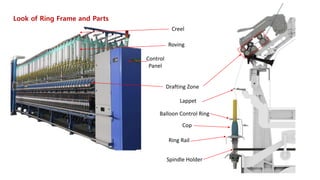
Control
Panel
Roving
Creel
Drafting Zone
Look of Ring Frame and Parts
Lappet
Balloon Control Ring
Ring Rail
Cop
Spindle Holder
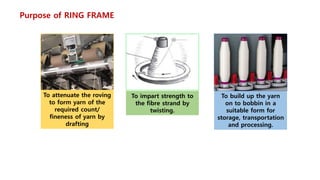
Purpose of RING FRAME
To attenuate the roving
to form yarn of the
required count/
fineness of yarn by
drafting
To impart strength to
the fibre strand by
twisting.
To build up the yarn
on to bobbin in a
suitable form for
storage, transportation
and processing.
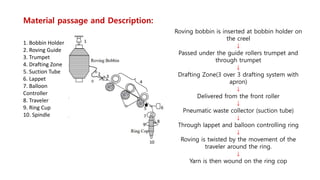
Material passage and Description:
1. Bobbin Holder
2. Roving Guide
3. Trumpet
4. Drafting Zone
5. Suction Tube
6. Lappet
7. Balloon
Controller
8. Traveler
9. Ring Cup
10. Spindle
Roving bobbin is inserted at bobbin holder on
the creel
↓
Passed under the guide rollers trumpet and
through trumpet
↓
Drafting Zone(3 over 3 drafting system with
apron)
↓
Delivered from the front roller
↓
Pneumatic waste collector (suction tube)
↓
Through lappet and balloon controlling ring
↓
Roving is twisted by the movement of the
traveler around the ring.
↓
Yarn is then wound on the ring cop
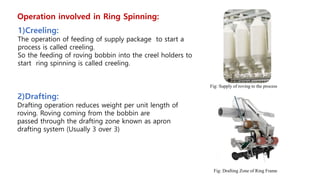
Operation involved in Ring Spinning:
1)Creeling:
The operation of feeding of supply package to start a
process is called creeling.
So the feeding of roving bobbin into the creel holders to
start ring spinning is called creeling.
Fig: Supply of roving to the process
2)Drafting:
Drafting operation reduces weight per unit length of
roving. Roving coming from the bobbin are
passed through the drafting zone known as apron
drafting system (Usually 3 over 3)
Fig: Drafting Zone of Ring Frame
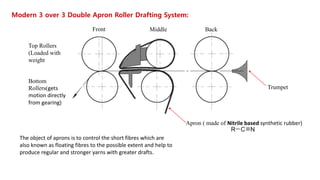
Modern 3 over 3 Double Apron Roller Drafting System:
Top Rollers
(Loaded with
weight
Bottom
Rollers(gets
motion directly
from gearing)
Front Middle Back
Apron ( made of Nitrile based synthetic rubber)
Trumpet
The object of aprons is to control the short fibres which are
also known as floating fibres to the possible extent and help to
produce regular and stronger yarns with greater drafts.
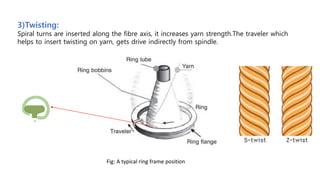
3)Twisting:
Spiral turns are inserted along the fibre axis, it increases yarn strength.The traveler which
helps to insert twisting on yarn, gets drive indirectly from spindle.
Fig: A typical ring frame position
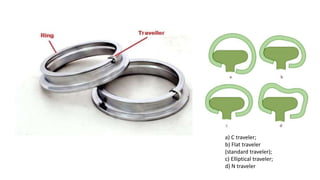
a) C traveler;
b) Flat traveler
(standard traveler);
c) Elliptical traveler;
d) N traveler
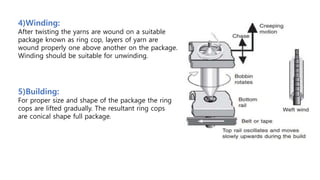
4)Winding:
After twisting the yarns are wound on a suitable
package known as ring cop, layers of yarn are
wound properly one above another on the package.
Winding should be suitable for unwinding.
5)Building:
For proper size and shape of the package the ring
cops are lifted gradually. The resultant ring cops
are conical shape full package.
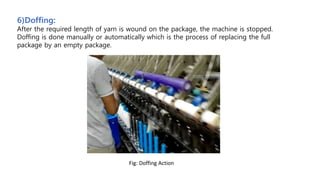
6)Doffing:
After the required length of yarn is wound on the package, the machine is stopped.
Doffing is done manually or automatically which is the process of replacing the full
package by an empty package.
Fig: Doffing Action
Faults in Ring Frame:
Uneven Yarn
Either travelers are too heavy or for spinning fine counts from inferior cotton.
Soft Yarn
Generally caused by slack spindle bundles, twist change wheel too large, empty bobbins not
properly pushed down during doffing.
Badly Wound Yarn
Caused by the defective traveler motion and also by bobbin being loose on the spindle.
Hard And Inelastic Yarn
Too much twisting and drafting in the draw frame and also for insufficient doubling later.
Slub
This occur when the twist in the yarn is not uniform. It appears as thick place, which has received
insufficient twist. This is caused by what is called thick roving. Two rovings over lapping each other,
which thus passing through the rollers without receiving the amount of twist required.
Nepped Yarns
So called because it contains small piece of hard cotton called neps.
Limitation of Ring Frame:
•Traveler Speed: Maximum attainable speed 50 m/s.
• Delivery Speed: For high delivery speed problem arise for piecing. So production is low.
• Yarn Tension: For higher machine speed, size of balloons increase as machine speed have positive
influence on balloon size. Due to increase in tension and end breakage rate increase.
• Power Consumption: After a certain speed power consumption of the machine in such a way which does
not fit commercially. About 60% power is consumed in Ring Frame of the total power supplying in Ring
Spinning Mills.
• Limitation of Drafting System: For higher speed of machine, drafting zone cannot control the fiber
perfectly due to high roller speed. As a result, irregular yarn will be produced.
• Winding Speed: Though less RPM is required for winding but both spindle and traveler rotated at high
speed for twist insertion.
RING FRAME Machine

RING FRAME Machine

  • 1.
  • 2.
  • 3.
    What is RingFrame Machine? - Transforms the roving (from the simplex) into spun yarn using some functional operation. - Invented by an American named Thorp in 1828. - Another American named Jenk contributed the traveler rotating on the ring in 1830. Roving From Simplex Machine Spun Yarn(Cops) From Ring Frame
  • 4.
    Control Panel Roving Creel Drafting Zone Look ofRing Frame and Parts Lappet Balloon Control Ring Ring Rail Cop Spindle Holder
  • 5.
    Purpose of RINGFRAME To attenuate the roving to form yarn of the required count/ fineness of yarn by drafting To impart strength to the fibre strand by twisting. To build up the yarn on to bobbin in a suitable form for storage, transportation and processing.
  • 6.
    Material passage andDescription: 1. Bobbin Holder 2. Roving Guide 3. Trumpet 4. Drafting Zone 5. Suction Tube 6. Lappet 7. Balloon Controller 8. Traveler 9. Ring Cup 10. Spindle Roving bobbin is inserted at bobbin holder on the creel ↓ Passed under the guide rollers trumpet and through trumpet ↓ Drafting Zone(3 over 3 drafting system with apron) ↓ Delivered from the front roller ↓ Pneumatic waste collector (suction tube) ↓ Through lappet and balloon controlling ring ↓ Roving is twisted by the movement of the traveler around the ring. ↓ Yarn is then wound on the ring cop
  • 7.
    Operation involved inRing Spinning: 1)Creeling: The operation of feeding of supply package to start a process is called creeling. So the feeding of roving bobbin into the creel holders to start ring spinning is called creeling. Fig: Supply of roving to the process 2)Drafting: Drafting operation reduces weight per unit length of roving. Roving coming from the bobbin are passed through the drafting zone known as apron drafting system (Usually 3 over 3) Fig: Drafting Zone of Ring Frame
  • 8.
    Modern 3 over3 Double Apron Roller Drafting System: Top Rollers (Loaded with weight Bottom Rollers(gets motion directly from gearing) Front Middle Back Apron ( made of Nitrile based synthetic rubber) Trumpet The object of aprons is to control the short fibres which are also known as floating fibres to the possible extent and help to produce regular and stronger yarns with greater drafts.
  • 9.
    3)Twisting: Spiral turns areinserted along the fibre axis, it increases yarn strength.The traveler which helps to insert twisting on yarn, gets drive indirectly from spindle. Fig: A typical ring frame position
  • 10.
    a) C traveler; b)Flat traveler (standard traveler); c) Elliptical traveler; d) N traveler
  • 11.
    4)Winding: After twisting theyarns are wound on a suitable package known as ring cop, layers of yarn are wound properly one above another on the package. Winding should be suitable for unwinding. 5)Building: For proper size and shape of the package the ring cops are lifted gradually. The resultant ring cops are conical shape full package.
  • 12.
    6)Doffing: After the requiredlength of yarn is wound on the package, the machine is stopped. Doffing is done manually or automatically which is the process of replacing the full package by an empty package. Fig: Doffing Action
  • 13.
    Faults in RingFrame: Uneven Yarn Either travelers are too heavy or for spinning fine counts from inferior cotton. Soft Yarn Generally caused by slack spindle bundles, twist change wheel too large, empty bobbins not properly pushed down during doffing. Badly Wound Yarn Caused by the defective traveler motion and also by bobbin being loose on the spindle. Hard And Inelastic Yarn Too much twisting and drafting in the draw frame and also for insufficient doubling later. Slub This occur when the twist in the yarn is not uniform. It appears as thick place, which has received insufficient twist. This is caused by what is called thick roving. Two rovings over lapping each other, which thus passing through the rollers without receiving the amount of twist required. Nepped Yarns So called because it contains small piece of hard cotton called neps.
  • 14.
    Limitation of RingFrame: •Traveler Speed: Maximum attainable speed 50 m/s. • Delivery Speed: For high delivery speed problem arise for piecing. So production is low. • Yarn Tension: For higher machine speed, size of balloons increase as machine speed have positive influence on balloon size. Due to increase in tension and end breakage rate increase. • Power Consumption: After a certain speed power consumption of the machine in such a way which does not fit commercially. About 60% power is consumed in Ring Frame of the total power supplying in Ring Spinning Mills. • Limitation of Drafting System: For higher speed of machine, drafting zone cannot control the fiber perfectly due to high roller speed. As a result, irregular yarn will be produced. • Winding Speed: Though less RPM is required for winding but both spindle and traveler rotated at high speed for twist insertion.