MEHRAN UNIVERSITY OF ENGINEERING
AND TECHNOLOGY JAMSHORO
PRESENTED TO:
SIR FAROOQ
PRESENTED BY:
SORATH ANSARI (11TE106)
ASWAD SOOMRO (11TE93)
KIRAN MEMON (11TE53)
HAMMAMA SOHAIL (11TE47)
WAJID ALI CHANA (11TE45)
 Winding is one of the most important operation,
which is mainly occurred in spinning section.
 The creation of large yarn packages that can be
easily unwound, is called winding.
 This makes using the yarn on subsequent
machines both easier and more economical.
 Three zones of winding:
1. Unwinding zone
2. Tension and clearing zone
3. Winding zone
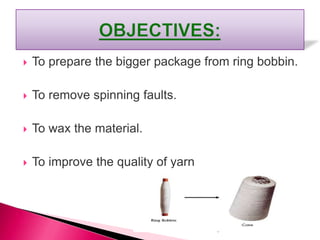
 To prepare the bigger package from ring bobbin.
 To remove spinning faults.
 To wax the material.
 To improve the quality of yarn
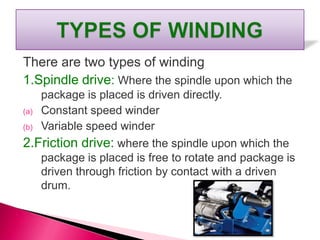
There are two types of winding
1.Spindle drive: Where the spindle upon which the
package is placed is driven directly.
(a) Constant speed winder
(b) Variable speed winder
2.Friction drive: where the spindle upon which the
package is placed is free to rotate and package is
driven through friction by contact with a driven
drum.
 CRADLE:
Its function to provide setting to cone having
package holders, it lies on upper part of
machine on drum.
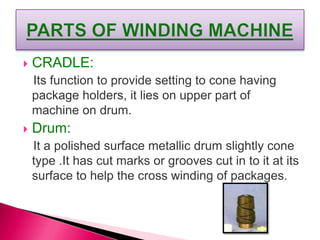
 Drum:
It a polished surface metallic drum slightly cone
type .It has cut marks or grooves cut in to it at its
surface to help the cross winding of packages.
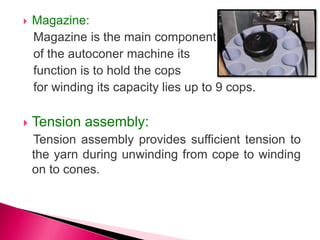
 Magazine:
Magazine is the main component
of the autoconer machine its
function is to hold the cops
for winding its capacity lies up to 9 cops.
 Tension assembly:
Tension assembly provides sufficient tension to
the yarn during unwinding from cope to winding
on to cones.
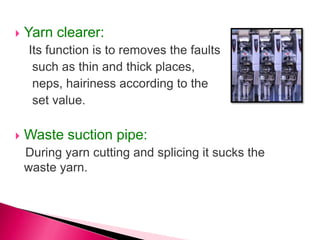
 Yarn clearer:
Its function is to removes the faults
such as thin and thick places,
neps, hairiness according to the
set value.
 Waste suction pipe:
During yarn cutting and splicing it sucks the
waste yarn.
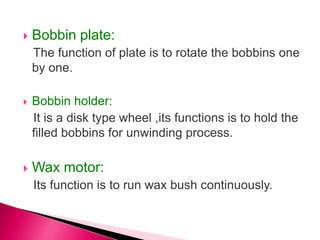
 Bobbin plate:
The function of plate is to rotate the bobbins one
by one.
 Bobbin holder:
It is a disk type wheel ,its functions is to hold the
filled bobbins for unwinding process.
 Wax motor:
Its function is to run wax bush continuously.
 Wax bush:
To provide smooth surface to yarn wax is applied
especially to the yarn intended for knitting, the
function of wax bush is to apply wax to yarn to
make its hairs sticky.
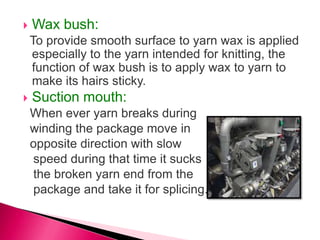
 Suction mouth:
When ever yarn breaks during
winding the package move in
opposite direction with slow
speed during that time it sucks
the broken yarn end from the
package and take it for splicing.
 Retie pipe:
It take the yarn end from bobbin toward splicing
mechanism.
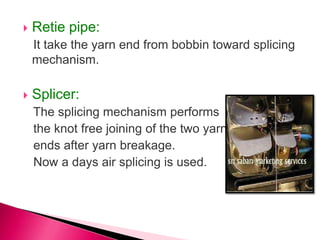
 Splicer:
The splicing mechanism performs
the knot free joining of the two yarn
ends after yarn breakage.
Now a days air splicing is used.
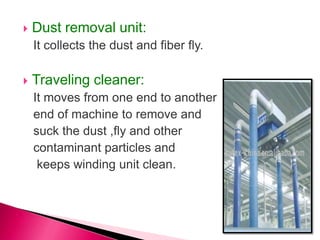
 Dust removal unit:
It collects the dust and fiber fly.
 Traveling cleaner:
It moves from one end to another
end of machine to remove and
suck the dust ,fly and other
contaminant particles and
keeps winding unit clean.
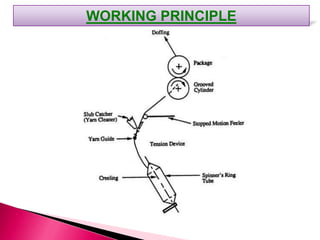
WORKING PRINCIPLE
Winding process should be accurate for
accelerate the next fabric manufacturing
process. winding process should fulfill the
following requirements……..
 Winding process should be easy.
 Characteristics of the yarn should not be change
 Winding process should be economical.
 winding faults should be minimize.
 Yarn package size and shape should be
suitable.
•Yarn package should be cheap in cost .
•Avoid excess in looseness or tightness.
•Exact package hardness.
•In winding, yarn knots should be smaller in size and
amount of knots should be minimum.
In auto cone department the humidity and
temperature are maintained according to the
requirements throughout the year.
Normally ranges are:
humidity% 55~80%
temperature 22~39.5℃
If winding tension is selected properly, the
following tensile properties are not affected
 tenacity
 elongation
 work- to- break
But excessive tension in winding will deteriorate
the above said tensile properties.
The aim of the modern automatic winder is to
make the wound package as uniform as
possible along with achieving higher production,
better quality, and lower power consumption per
kg of product and flexibility.
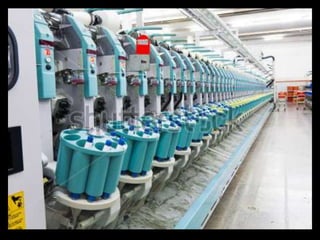
Auto cone winding machine

Auto cone winding machine

  • 1.
    MEHRAN UNIVERSITY OFENGINEERING AND TECHNOLOGY JAMSHORO
  • 3.
    PRESENTED TO: SIR FAROOQ PRESENTEDBY: SORATH ANSARI (11TE106) ASWAD SOOMRO (11TE93) KIRAN MEMON (11TE53) HAMMAMA SOHAIL (11TE47) WAJID ALI CHANA (11TE45)
  • 5.
     Winding isone of the most important operation, which is mainly occurred in spinning section.  The creation of large yarn packages that can be easily unwound, is called winding.  This makes using the yarn on subsequent machines both easier and more economical.  Three zones of winding: 1. Unwinding zone 2. Tension and clearing zone 3. Winding zone
  • 7.
     To preparethe bigger package from ring bobbin.  To remove spinning faults.  To wax the material.  To improve the quality of yarn
  • 8.
    There are twotypes of winding 1.Spindle drive: Where the spindle upon which the package is placed is driven directly. (a) Constant speed winder (b) Variable speed winder 2.Friction drive: where the spindle upon which the package is placed is free to rotate and package is driven through friction by contact with a driven drum.
  • 9.
     CRADLE: Its functionto provide setting to cone having package holders, it lies on upper part of machine on drum.  Drum: It a polished surface metallic drum slightly cone type .It has cut marks or grooves cut in to it at its surface to help the cross winding of packages.
  • 10.
     Magazine: Magazine isthe main component of the autoconer machine its function is to hold the cops for winding its capacity lies up to 9 cops.  Tension assembly: Tension assembly provides sufficient tension to the yarn during unwinding from cope to winding on to cones.
  • 11.
     Yarn clearer: Itsfunction is to removes the faults such as thin and thick places, neps, hairiness according to the set value.  Waste suction pipe: During yarn cutting and splicing it sucks the waste yarn.
  • 12.
     Bobbin plate: Thefunction of plate is to rotate the bobbins one by one.  Bobbin holder: It is a disk type wheel ,its functions is to hold the filled bobbins for unwinding process.  Wax motor: Its function is to run wax bush continuously.
  • 13.
     Wax bush: Toprovide smooth surface to yarn wax is applied especially to the yarn intended for knitting, the function of wax bush is to apply wax to yarn to make its hairs sticky.  Suction mouth: When ever yarn breaks during winding the package move in opposite direction with slow speed during that time it sucks the broken yarn end from the package and take it for splicing.
  • 14.
     Retie pipe: Ittake the yarn end from bobbin toward splicing mechanism.  Splicer: The splicing mechanism performs the knot free joining of the two yarn ends after yarn breakage. Now a days air splicing is used.
  • 15.
     Dust removalunit: It collects the dust and fiber fly.  Traveling cleaner: It moves from one end to another end of machine to remove and suck the dust ,fly and other contaminant particles and keeps winding unit clean.
  • 16.
  • 17.
    Winding process shouldbe accurate for accelerate the next fabric manufacturing process. winding process should fulfill the following requirements……..  Winding process should be easy.  Characteristics of the yarn should not be change  Winding process should be economical.  winding faults should be minimize.  Yarn package size and shape should be suitable.
  • 18.
    •Yarn package shouldbe cheap in cost . •Avoid excess in looseness or tightness. •Exact package hardness. •In winding, yarn knots should be smaller in size and amount of knots should be minimum.
  • 19.
    In auto conedepartment the humidity and temperature are maintained according to the requirements throughout the year. Normally ranges are: humidity% 55~80% temperature 22~39.5℃
  • 20.
    If winding tensionis selected properly, the following tensile properties are not affected  tenacity  elongation  work- to- break But excessive tension in winding will deteriorate the above said tensile properties.
  • 21.
    The aim ofthe modern automatic winder is to make the wound package as uniform as possible along with achieving higher production, better quality, and lower power consumption per kg of product and flexibility.