Prepared By :

Prepared By : Mazadul Hasan sheshir
ID: 2010000400008
13th Batch
Wet Processing Technology
Email: mazadulhasan@yahoo.com
Southeast University

Southeast University
Department Of Textile Engineering
I/A 251,252 Tejgaon Dhaka Bangladesh
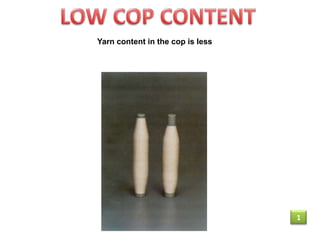
Yarn content in the cop is less

1
EFFECT
Efficiency loss in ring frame
•Drop in winding efficiency
•More knots for a given length of wound yarn
CAUSES
Under utilisation of bobbin height
Lower number of coils /inch
Higher chase length
Cop bottom bracket properly not set
Improper selection of ratchet
Ratchet pawl pushing number of teeths/movment in the ratchet wheel
Spinning empties wall thickness is high
RECTIFICATION
Optimum chase length, coil spacing and wall thickness of empy cops tobe ensured
1. Ratchet/pawl movement to be properly set
2. Free space of only 7.5mm to be maintained at the top and bottom of
the cop
3. Free space only 0.75mm only to be maintained between full cops and
the ring
An abnormally thick place or lump in yarn showing less twist at that
place.

2
EFFECT
More end breaks in the next process.
 Damaged fabric appearance.
 Shade variation in dyed fabrics.
CAUSES
Accumulation of fly and fluff on the machine parts.
Poor carding.
Defective ring frame drafting and bad piecing
Improperly clothed top roller clearers.

RECTIFICATION
1. Machine surfaces to be maintained clean.
2. Proper functioning of pnemafil/roller clearers to be ensured.
3. Broken teeth gear wheel to be avoided and proper meshing to be
ensured.
4. Better fiber individualisation at cards to be achieved.
5. Optimum top roller pressure &back zone
6. Setting at ring frame to be maintained.
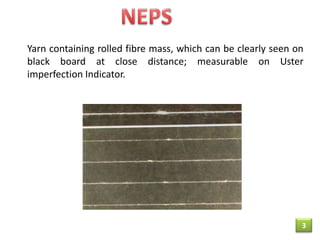
Yarn containing rolled fibre mass, which can be clearly seen on
black board at close distance; measurable on Uster
imperfection Indicator.

3
EFFECT
Damaged fabric appearance
•Shade variation in the dyed fabrics
•An abnormally thick place or lump in yarn showing less twist at that place
is called slubs
CAUSES
Accumalation of fly and fluff on the machine parts
Poor carding.
Defective ring frame drafting and bad piecing
Improperly clothed top roller clearers.
RECTIFICATION
Machine surfaces to be maintained clean.
1. Proper functioning of pnemafil/roller clearers to be ensured.
2. Broken teeth gear wheel to be avoided and proper meshing to be
ensured.
3. Better fiber individualisation at cards to be achieved.
Yarn with kinks(twisted onto itself)due to insufficient tension after
twisting

4
EFFECT
Entanglement with adjacent ends causing a break
•Damaged fabric appearance
•Shade variation in dyed fabrics
•Improper meshing of gear wheels
•Mixing of cottons varying widely in fiber lengths and use of immature
cottons
CAUSES Higher than normal twist in the yarn
Presence of too many long thin places in the yarn

RECTIFICATION
Optimum twist to be used for the type of cotton processed
1. Drafting parameters to minimise thin places in the yarn to be adopted
2. The yarn to be conditioned
3. Correct tension weights and slub catcher settings to be employed at
winding
Measurable by Uster Imperfection Indicator and observable on
appearance

5
EFFECT
Eccentric top and bottom rollers
•Insufficient pressure on top rollers
•Worn and old aprons and improper apron spacing
•Improper meshing of gear wheels
•Mixing of cottons varying widely in fiber lengths and use of immature cottons
CAUSES Eccentric top and bottom rollers
Insufficient pressure on top rollers
Worn and old aprons and improper apron spacing
Improper meshing of gear wheels
Mixing of cottons varying widely in fibre lengths and use of immature
cottons
RECTIFICATION
Eccentric top and bottom rollers to be avoided
1. Top arm pressure checking schedules to be Maintained strictly
2. Wide variation in the properties of cottons used in the mixing to be
avoided
3. Better fiber individualisation at cards to be achieved.
4. Correct spacers to be utilised
Yarn which is weak indicating lesser twist

6
EFFECT:
More end breaks in subsequent processes
•Shade variation in dyed fabrics

CAUSES:
Slack tapes dirty jockey pulleys
Improper bobbin feed on the spls
Less twist in the yarn
Bad clearing at the travellar

RECTIFICATION:
Vibration of bobbins on the spindles to be avoided
1. Proper yarn clearing to be ensured
2. Periodic replacement of worn rings and travellars to be effected
Yarn stained with oil

7
EFFECT
Damaged fabric appearance
•Occurrence of black spot in fabric

CAUSES
Careless oil in the moving parts,over head pulleys etc
Piecings made with oily or dirty fingers
Careless material handlings

RECTIFICATION
Appropriate material handling procedures to be followed
1. Oilers to trained in proper method of lubrication
2. Clean containers to be utilised for material transportation
Very small snarl-like places in the yarn which disappear when pulled with
enough tension or Yarn with spring –like shape

8
EFFECT
More breaks in winding
•More noticable in polyester and cotton blended yarns
CAUSES Mixing of cottons of widely differing staple length
Closer roller settings
Eccentric top and bottom rollers
Non optimum temperature and relative humidity in the spinning
shed
Over spinning of cottons
RECTIFICATION
Optimum top roller pressure to be maintained
1. Mixing of cottons varying widely in fibre length to be avoided
2. Use of optimum roller settings
3. Use of properly buffed rollers free from eccentricity to be
ensured
Unduly thick piecing in yarn caused by over End piecing

9
EFFECT
More end breaks in subsequent process
•Increase in hard waste

CAUSES Wrong method of piecing and over end piecing
Twisting the ends instead of knotting

RECTIFICATION
Tenters to be trained in proper methods of piecing
1. Separators to be provided
2. Excessive end breaks in spinning to be avoided
Slub in the yarn stained with oil

10
EFFECT
More end breaks in the ensuring process
•Damaged fabric appearance
•Shade variation in dyed fabrics
CAUSES Accumulation of oily fluff on machinery parts
Poor methods of lubrication in preparatory processes
Negligence in segregating the oily waste from process waste

RECTIFICATION
Yarn contact surfaces to be kept clean
1. Oilers to be trained in correct procedures of lubrication
2. Proper segregation of oily waste from process waste
Presence of black specks of broken seeds, leaf bits and trash in yarn

11
EFFECT
Damaged fabric appearance
•Production of specks during dyeing
•Needle breaks during knitting

•Poor performance during winding

CAUSES Ineffective cleaning in Blow room and cards
Use of cottons with high trash and too many seed coat fragments

RECTIFICATION
Cleaning efficiency of blow room and cards to be improved
1.

Optimum humidity in the departments to be ensured
Protrusion of fibre ends from the main yarn structure

12
EFFECT
More end breaks in winding
•Uneven fabric surface
•Beads formation in the fabric in the case of polyester/cotton blends
CAUSES Use of cottons differing widely in the properties in the same mixing
Use of worn rings and lighter travellars
Maintaining low relative humidity, closer roller settings and very high
spindle speeds
RECTIFICATION
Use of travellars of correct size and shape and rings in good condition to be
ensured
1. Periodic replacement of travellars and suitable
2. Roller settings to be maintained

3. Optimum relative humidity to be maintained in the spinning room
4. Wide variation in the properties of cottons used in the mixing to be
avoided
Metallic parts, jute flannel and other similar foreign matters spun along
with yarn

13
EFFECT
Breaks during winding
•Formation of holes and stains in cloth
•Damaged fabric appearance

CAUSES Improper handling of travellers
Improper preparation of mixings
RECTIFICATION
Removal of foreign matters(such as jute fibres,colour cloth bits) to be
ensured during preparation of mixing
1. Installation of permanent magnets at proper
2. Places in blow room lines to be ensured
Fly or fluff either spun along with the yarn or loosely embedded on the yarn

14
EFFECT
More breaks in winding

CAUSES Accumulation of fluff over machine parts

Fanning by workers
Failure of over head cleaners
Malfunctioning of humidification plant

RECTIFICATION
Machinery surfaces to be kept clean by using roller pickers
1. Fanning by workers to be avoided
2. Performance of over head cleaners and humidification plants to
be closely monitored
It is a double yarn which one yarn is straight and other is coiled over it

15
EFFECT
Breaks during winding
•Causes streaks in the fabric

CAUSES

Feeding of two ends (instead of one ) in ring frame
Lashing -in ends in ring frame

RECTIFICATION
Tenters are to be trained in piecing methods(or) practices
1. Pneumafil ducts to be kept clean and properly set
Coils of yarn coming out of the ring cops in bunches at the time of unwinding

16
EFFECT
Increase in end breaks
•Higher yarn waste
CAUSES Improper ring rail movement
Worn builder cam
Loose package and excessive coils in the package
Soft build of cops
Improper empties fit on the spindles and slack tapes
RECTIFICATION
Ring rail movement to be set right
•Optimum ratio of winding: bindings coils and optimum chase
length to be maintained
Damaged layers on the surface of the ring cops

17
EFFECT
Excessive breaks during winding
• More hard waste at winding

CAUSES Spindle or empty cops wobbling
 Use of lighter travellers snd incorrect ratchet wheel
 Movement of spindles to the rings not concentric

RECTIFICATION
Worn spindles to be replaced
1. Improper fit of empty cops with spindles to be avoided
2. Gauging of spindles with rings to be properly carried out
3. Use of right type travellar and ratchet wheel to be ensured
Step-like appearance of the cop

18
EFFECT
Slough-off during doffing/winding
• More breaks during unwinding(due to slough off)
• Higher hard waste in winding

CAUSES

Improper combination of ratchet and pawl
 Jerky ring rail movement(pocker rod movement to check)

RECTIFICATION
Ratchet and Ratchet/pawl movement to be accurately arrived at taking into
consideration
1. Count of yarn, ring dia and chase length

2. Lubrication of pocker rods at appropriate interavels to be carried
out
Ends not laid properly on the cone at reversal of yarn path

19
EFFECT
More end breaks in the subsequent process
• Excessive yarn waste

CAUSES Vibrating and wrongly set cone holder
 Yarn coils wrapped round the base of cone holder
 Traverse restrictors fixed at incorrect position
 Improper alignment of tension brackets with the drum

RECTIFICATION
Maintenance cone winders to be good

1. Cone holder settings and alignment of tension
2. Brackets with drum to be carried out as frequently as possible
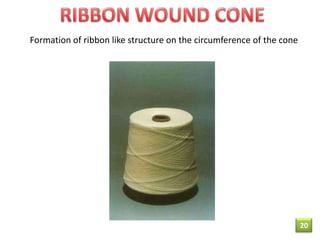
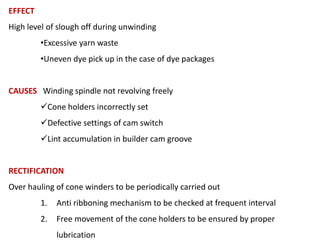
Formation of ribbon like structure on the circumference of the cone

20
EFFECT
High level of slough off during unwinding
•Excessive yarn waste
•Uneven dye pick up in the case of dye packages

CAUSES Winding spindle not revolving freely
Cone holders incorrectly set
Defective settings of cam switch

Lint accumulation in builder cam groove

RECTIFICATION
Over hauling of cone winders to be periodically carried out
1.

Anti ribboning mechanism to be checked at frequent interval

2.

Free movement of the cone holders to be ensured by proper
lubrication
Unduly soft structure of cone

21
EFFECT
Overall density of package is lower
•Soft packing either at the base or at the nose of cones

CAUSES Improper alignment of winding spindle to the winding drum
Insufficient unwinding tension
Inadequate cradle loading

RECTIFICATION
Unwinding tension to be maintained at 6 to 8% of single yarn strength
1. Cradle pressure to be maintained to the optimum level
Cones which are tightly built at centre, presents a shape of bell

22
EFFECT
Excessive breaks during subsequent processes

CAUSES High yarn tension during winding
Cone holders incorrectly set to the winding drum
Damages in paper cone centre

RECTIFICATION
Quality of cones to be checked at that time of procurement
1. Optimum unwinding tension to be maintained
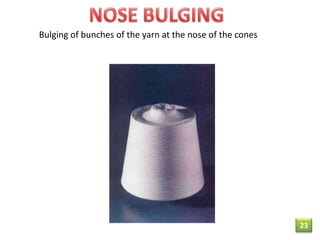
Bulging of bunches of the yarn at the nose of the cones

23
EFFECT
Slough during warping/unwinding
•Excessive yarn waste in next process

CAUSES Improper setting of cone holders to the winding drum
Damaged nose of the paper cones

RECTIFICATION
Periodical inspection of settings in winding machines
1. Tenters to be instructed to adopt correct work practices
2. Avoiding usage of damaged paper cones
Collapse of the structure of the cone(paper cone)itself

24
EFFECT
Use of poor quality /damaged paper cones
•Poor system of material handling
•Maintaining non optimum unwinding tension

CAUSES Use of poor quality/damaged cones

RECTIFICATION
Using of poor quality/damaged paper cones should be avoided
1. Winding tenters should be trained by proper work methods
2. Proper material handling devices such as cone transport trolleys
to be used
3. Cone inserts to be used for paper cones
Faults: miss-shaped laps.
Remedy:
•If the censity of cotton across the width of the laps is constant ,wedge
shaped laps can still occur due to unequal pressure on side of the

calendar r/r.
•Pressure should be equal on both sides.

Faults: split laps.
Remedy:
•If lap licking at the card persists, it can be prevented by feeding roving
into the lap sheet as it is formed at the lap end or by use of lap r/r.
Faults: Poor cleaning efficiency.
Remedy:
•In the m/c cleaning efficiency is affected by grid bar to beater settings,
better speeds, condition of beater blade edges and beater bars, fan speed
and m/c cleanliness.
•Appropriate stapes have to be taken.

Faults: Neps Formation
Remedy:
•The paddle regulator mechanism and cone drum drive should be kept in
good working order.
Faults: neppy web.
Remedy:
• The m/c made neps may be due to an excessive number of immature
fibres in the cotton or to poor settings and maintenance. Which should be
properly maintained.
Raw materials:
•Checking that the belts are correctly mixed according to micronaire value
and fibre bundle strength.
•Percentage of wastage should be maintained accordingly.

Faults: cloudy web.
Remedy:
•Correct settings of back sheet.
•Poor condition of wire with patches missing, damaged or rubbed will have
the same results which should be maintained.
Faults: Irregular sliver.
Remedy:
•Any eccentric r/r, incorrect undergrid settings, rubber wire across the
eccentric r/r settings should be on the points.
Faults: fine sliver.
Remedy:

•All drawframe stop mechanism should be regularly tested.

Faults: irregular sliver.
Remedy:
•Checking top and bottom r/r, top spinning pressure and r/r
settings and taking suitable action.
•Also checking that sliver is not being reserved.
Faults: Neppy waste.
Remedy:
•Top combs and cylinders should be examined daily because damaged
cylinder wire/needles and top com needles can cause flocking.

Faults: Long fibers in waste.
Remedy:
There are a number of comber settings and timings which will cause long
fibre to be found in the wastage. They include insufficient of the nippers
during feeding, late closing of the nippers, wide detaching r/r settings
detaching r/r turning back too late which should be properly observed.
Faults: Irregular sliver.
Remedy:
•R/R, r/r settings and drafts should be checked.

Faults: Curls.
Remedy:
•Correct timing of nippers and detaching r/r, correct penetration
of the top combs and r/r covering.
Faults: Slippings coils.
Remedy:
•Attention to finding the correct taper wheel, resetting poker bar
and the builder will cure this faults.

Faults: Soft bobbins.
Remedy:
•This faults can be prevented by using suitable change wheels. If an
odd bobbin is affected this could be due to fine a fine roving or
incorrect tensioning.

Faults : Irregular roving.
Remedy:
•Simplex m/c are susceptible to this faults and source of the
vibration is usually in the gearing or grafting r/r.
Faults: Count and hank variation
Variation in hank and count should be monitored and controlled as previously
specified by:
•Regular daily inspection and maintained strict control lap weights,
weekly meter/metre wrappings of scutcher laps, calculating variation
and graphing results.
•Wrapping finisher drawframe sliver every 4 hours and taking immediate

action if results exceed tolerance quality control graphs to be used.
•Daily wrappings of yarn for count, regularity of count, strength and
twist. Assessment of yarn on blackboards.

•Faults have adequately death with earlier in this section under
regularity.
Faults: Foreign fibers:
Remedy:
•Operatives working in the mixing chamber must be instructed to
take out any foreign fibers, string, cloth contaminated with dye or
oil.
•Care have to be taken when taking the tare from the bale.

Faults: Twist variation:
Remedy:
•Too much twist reduces yarn strength and also makes the yarn
brittle and liable to from snarls. Spindle to spindle variation also
occurs due to differences in spindle speed as a result of driving tape
slippage, misalignment of tapes and spindle bearings or inadequate
lubrication which should be maintained properly.
The quality control in spinning has a vital consequences on the

production. In the aspect of textile it is a must to make sure to fulfill
the general requirement of the quality in different stages in spinning.
vijayakumhark.tripod.com

SPINNING & YARN FAULT

  • 2.
    Prepared By : PreparedBy : Mazadul Hasan sheshir ID: 2010000400008 13th Batch Wet Processing Technology Email: mazadulhasan@yahoo.com Southeast University Southeast University Department Of Textile Engineering I/A 251,252 Tejgaon Dhaka Bangladesh
  • 4.
    Yarn content inthe cop is less 1
  • 5.
    EFFECT Efficiency loss inring frame •Drop in winding efficiency •More knots for a given length of wound yarn CAUSES Under utilisation of bobbin height Lower number of coils /inch Higher chase length Cop bottom bracket properly not set Improper selection of ratchet Ratchet pawl pushing number of teeths/movment in the ratchet wheel Spinning empties wall thickness is high RECTIFICATION Optimum chase length, coil spacing and wall thickness of empy cops tobe ensured 1. Ratchet/pawl movement to be properly set 2. Free space of only 7.5mm to be maintained at the top and bottom of the cop 3. Free space only 0.75mm only to be maintained between full cops and the ring
  • 6.
    An abnormally thickplace or lump in yarn showing less twist at that place. 2
  • 7.
    EFFECT More end breaksin the next process.  Damaged fabric appearance.  Shade variation in dyed fabrics. CAUSES Accumulation of fly and fluff on the machine parts. Poor carding. Defective ring frame drafting and bad piecing Improperly clothed top roller clearers. RECTIFICATION 1. Machine surfaces to be maintained clean. 2. Proper functioning of pnemafil/roller clearers to be ensured. 3. Broken teeth gear wheel to be avoided and proper meshing to be ensured. 4. Better fiber individualisation at cards to be achieved. 5. Optimum top roller pressure &back zone 6. Setting at ring frame to be maintained.
  • 8.
    Yarn containing rolledfibre mass, which can be clearly seen on black board at close distance; measurable on Uster imperfection Indicator. 3
  • 9.
    EFFECT Damaged fabric appearance •Shadevariation in the dyed fabrics •An abnormally thick place or lump in yarn showing less twist at that place is called slubs CAUSES Accumalation of fly and fluff on the machine parts Poor carding. Defective ring frame drafting and bad piecing Improperly clothed top roller clearers. RECTIFICATION Machine surfaces to be maintained clean. 1. Proper functioning of pnemafil/roller clearers to be ensured. 2. Broken teeth gear wheel to be avoided and proper meshing to be ensured. 3. Better fiber individualisation at cards to be achieved.
  • 10.
    Yarn with kinks(twistedonto itself)due to insufficient tension after twisting 4
  • 11.
    EFFECT Entanglement with adjacentends causing a break •Damaged fabric appearance •Shade variation in dyed fabrics •Improper meshing of gear wheels •Mixing of cottons varying widely in fiber lengths and use of immature cottons CAUSES Higher than normal twist in the yarn Presence of too many long thin places in the yarn RECTIFICATION Optimum twist to be used for the type of cotton processed 1. Drafting parameters to minimise thin places in the yarn to be adopted 2. The yarn to be conditioned 3. Correct tension weights and slub catcher settings to be employed at winding
  • 12.
    Measurable by UsterImperfection Indicator and observable on appearance 5
  • 13.
    EFFECT Eccentric top andbottom rollers •Insufficient pressure on top rollers •Worn and old aprons and improper apron spacing •Improper meshing of gear wheels •Mixing of cottons varying widely in fiber lengths and use of immature cottons CAUSES Eccentric top and bottom rollers Insufficient pressure on top rollers Worn and old aprons and improper apron spacing Improper meshing of gear wheels Mixing of cottons varying widely in fibre lengths and use of immature cottons RECTIFICATION Eccentric top and bottom rollers to be avoided 1. Top arm pressure checking schedules to be Maintained strictly 2. Wide variation in the properties of cottons used in the mixing to be avoided 3. Better fiber individualisation at cards to be achieved. 4. Correct spacers to be utilised
  • 14.
    Yarn which isweak indicating lesser twist 6
  • 15.
    EFFECT: More end breaksin subsequent processes •Shade variation in dyed fabrics CAUSES: Slack tapes dirty jockey pulleys Improper bobbin feed on the spls Less twist in the yarn Bad clearing at the travellar RECTIFICATION: Vibration of bobbins on the spindles to be avoided 1. Proper yarn clearing to be ensured 2. Periodic replacement of worn rings and travellars to be effected
  • 16.
  • 17.
    EFFECT Damaged fabric appearance •Occurrenceof black spot in fabric CAUSES Careless oil in the moving parts,over head pulleys etc Piecings made with oily or dirty fingers Careless material handlings RECTIFICATION Appropriate material handling procedures to be followed 1. Oilers to trained in proper method of lubrication 2. Clean containers to be utilised for material transportation
  • 18.
    Very small snarl-likeplaces in the yarn which disappear when pulled with enough tension or Yarn with spring –like shape 8
  • 19.
    EFFECT More breaks inwinding •More noticable in polyester and cotton blended yarns CAUSES Mixing of cottons of widely differing staple length Closer roller settings Eccentric top and bottom rollers Non optimum temperature and relative humidity in the spinning shed Over spinning of cottons RECTIFICATION Optimum top roller pressure to be maintained 1. Mixing of cottons varying widely in fibre length to be avoided 2. Use of optimum roller settings 3. Use of properly buffed rollers free from eccentricity to be ensured
  • 20.
    Unduly thick piecingin yarn caused by over End piecing 9
  • 21.
    EFFECT More end breaksin subsequent process •Increase in hard waste CAUSES Wrong method of piecing and over end piecing Twisting the ends instead of knotting RECTIFICATION Tenters to be trained in proper methods of piecing 1. Separators to be provided 2. Excessive end breaks in spinning to be avoided
  • 22.
    Slub in theyarn stained with oil 10
  • 23.
    EFFECT More end breaksin the ensuring process •Damaged fabric appearance •Shade variation in dyed fabrics CAUSES Accumulation of oily fluff on machinery parts Poor methods of lubrication in preparatory processes Negligence in segregating the oily waste from process waste RECTIFICATION Yarn contact surfaces to be kept clean 1. Oilers to be trained in correct procedures of lubrication 2. Proper segregation of oily waste from process waste
  • 24.
    Presence of blackspecks of broken seeds, leaf bits and trash in yarn 11
  • 25.
    EFFECT Damaged fabric appearance •Productionof specks during dyeing •Needle breaks during knitting •Poor performance during winding CAUSES Ineffective cleaning in Blow room and cards Use of cottons with high trash and too many seed coat fragments RECTIFICATION Cleaning efficiency of blow room and cards to be improved 1. Optimum humidity in the departments to be ensured
  • 26.
    Protrusion of fibreends from the main yarn structure 12
  • 27.
    EFFECT More end breaksin winding •Uneven fabric surface •Beads formation in the fabric in the case of polyester/cotton blends CAUSES Use of cottons differing widely in the properties in the same mixing Use of worn rings and lighter travellars Maintaining low relative humidity, closer roller settings and very high spindle speeds RECTIFICATION Use of travellars of correct size and shape and rings in good condition to be ensured 1. Periodic replacement of travellars and suitable 2. Roller settings to be maintained 3. Optimum relative humidity to be maintained in the spinning room 4. Wide variation in the properties of cottons used in the mixing to be avoided
  • 28.
    Metallic parts, juteflannel and other similar foreign matters spun along with yarn 13
  • 29.
    EFFECT Breaks during winding •Formationof holes and stains in cloth •Damaged fabric appearance CAUSES Improper handling of travellers Improper preparation of mixings RECTIFICATION Removal of foreign matters(such as jute fibres,colour cloth bits) to be ensured during preparation of mixing 1. Installation of permanent magnets at proper 2. Places in blow room lines to be ensured
  • 30.
    Fly or fluffeither spun along with the yarn or loosely embedded on the yarn 14
  • 31.
    EFFECT More breaks inwinding CAUSES Accumulation of fluff over machine parts Fanning by workers Failure of over head cleaners Malfunctioning of humidification plant RECTIFICATION Machinery surfaces to be kept clean by using roller pickers 1. Fanning by workers to be avoided 2. Performance of over head cleaners and humidification plants to be closely monitored
  • 32.
    It is adouble yarn which one yarn is straight and other is coiled over it 15
  • 33.
    EFFECT Breaks during winding •Causesstreaks in the fabric CAUSES Feeding of two ends (instead of one ) in ring frame Lashing -in ends in ring frame RECTIFICATION Tenters are to be trained in piecing methods(or) practices 1. Pneumafil ducts to be kept clean and properly set
  • 34.
    Coils of yarncoming out of the ring cops in bunches at the time of unwinding 16
  • 35.
    EFFECT Increase in endbreaks •Higher yarn waste CAUSES Improper ring rail movement Worn builder cam Loose package and excessive coils in the package Soft build of cops Improper empties fit on the spindles and slack tapes RECTIFICATION Ring rail movement to be set right •Optimum ratio of winding: bindings coils and optimum chase length to be maintained
  • 36.
    Damaged layers onthe surface of the ring cops 17
  • 37.
    EFFECT Excessive breaks duringwinding • More hard waste at winding CAUSES Spindle or empty cops wobbling  Use of lighter travellers snd incorrect ratchet wheel  Movement of spindles to the rings not concentric RECTIFICATION Worn spindles to be replaced 1. Improper fit of empty cops with spindles to be avoided 2. Gauging of spindles with rings to be properly carried out 3. Use of right type travellar and ratchet wheel to be ensured
  • 38.
  • 39.
    EFFECT Slough-off during doffing/winding •More breaks during unwinding(due to slough off) • Higher hard waste in winding CAUSES Improper combination of ratchet and pawl  Jerky ring rail movement(pocker rod movement to check) RECTIFICATION Ratchet and Ratchet/pawl movement to be accurately arrived at taking into consideration 1. Count of yarn, ring dia and chase length 2. Lubrication of pocker rods at appropriate interavels to be carried out
  • 40.
    Ends not laidproperly on the cone at reversal of yarn path 19
  • 41.
    EFFECT More end breaksin the subsequent process • Excessive yarn waste CAUSES Vibrating and wrongly set cone holder  Yarn coils wrapped round the base of cone holder  Traverse restrictors fixed at incorrect position  Improper alignment of tension brackets with the drum RECTIFICATION Maintenance cone winders to be good 1. Cone holder settings and alignment of tension 2. Brackets with drum to be carried out as frequently as possible
  • 42.
    Formation of ribbonlike structure on the circumference of the cone 20
  • 43.
    EFFECT High level ofslough off during unwinding •Excessive yarn waste •Uneven dye pick up in the case of dye packages CAUSES Winding spindle not revolving freely Cone holders incorrectly set Defective settings of cam switch Lint accumulation in builder cam groove RECTIFICATION Over hauling of cone winders to be periodically carried out 1. Anti ribboning mechanism to be checked at frequent interval 2. Free movement of the cone holders to be ensured by proper lubrication
  • 44.
  • 45.
    EFFECT Overall density ofpackage is lower •Soft packing either at the base or at the nose of cones CAUSES Improper alignment of winding spindle to the winding drum Insufficient unwinding tension Inadequate cradle loading RECTIFICATION Unwinding tension to be maintained at 6 to 8% of single yarn strength 1. Cradle pressure to be maintained to the optimum level
  • 46.
    Cones which aretightly built at centre, presents a shape of bell 22
  • 47.
    EFFECT Excessive breaks duringsubsequent processes CAUSES High yarn tension during winding Cone holders incorrectly set to the winding drum Damages in paper cone centre RECTIFICATION Quality of cones to be checked at that time of procurement 1. Optimum unwinding tension to be maintained
  • 48.
    Bulging of bunchesof the yarn at the nose of the cones 23
  • 49.
    EFFECT Slough during warping/unwinding •Excessiveyarn waste in next process CAUSES Improper setting of cone holders to the winding drum Damaged nose of the paper cones RECTIFICATION Periodical inspection of settings in winding machines 1. Tenters to be instructed to adopt correct work practices 2. Avoiding usage of damaged paper cones
  • 50.
    Collapse of thestructure of the cone(paper cone)itself 24
  • 51.
    EFFECT Use of poorquality /damaged paper cones •Poor system of material handling •Maintaining non optimum unwinding tension CAUSES Use of poor quality/damaged cones RECTIFICATION Using of poor quality/damaged paper cones should be avoided 1. Winding tenters should be trained by proper work methods 2. Proper material handling devices such as cone transport trolleys to be used 3. Cone inserts to be used for paper cones
  • 53.
    Faults: miss-shaped laps. Remedy: •Ifthe censity of cotton across the width of the laps is constant ,wedge shaped laps can still occur due to unequal pressure on side of the calendar r/r. •Pressure should be equal on both sides. Faults: split laps. Remedy: •If lap licking at the card persists, it can be prevented by feeding roving into the lap sheet as it is formed at the lap end or by use of lap r/r.
  • 54.
    Faults: Poor cleaningefficiency. Remedy: •In the m/c cleaning efficiency is affected by grid bar to beater settings, better speeds, condition of beater blade edges and beater bars, fan speed and m/c cleanliness. •Appropriate stapes have to be taken. Faults: Neps Formation Remedy: •The paddle regulator mechanism and cone drum drive should be kept in good working order.
  • 56.
    Faults: neppy web. Remedy: •The m/c made neps may be due to an excessive number of immature fibres in the cotton or to poor settings and maintenance. Which should be properly maintained. Raw materials: •Checking that the belts are correctly mixed according to micronaire value and fibre bundle strength. •Percentage of wastage should be maintained accordingly. Faults: cloudy web. Remedy: •Correct settings of back sheet. •Poor condition of wire with patches missing, damaged or rubbed will have the same results which should be maintained.
  • 57.
    Faults: Irregular sliver. Remedy: •Anyeccentric r/r, incorrect undergrid settings, rubber wire across the eccentric r/r settings should be on the points.
  • 59.
    Faults: fine sliver. Remedy: •Alldrawframe stop mechanism should be regularly tested. Faults: irregular sliver. Remedy: •Checking top and bottom r/r, top spinning pressure and r/r settings and taking suitable action. •Also checking that sliver is not being reserved.
  • 61.
    Faults: Neppy waste. Remedy: •Topcombs and cylinders should be examined daily because damaged cylinder wire/needles and top com needles can cause flocking. Faults: Long fibers in waste. Remedy: There are a number of comber settings and timings which will cause long fibre to be found in the wastage. They include insufficient of the nippers during feeding, late closing of the nippers, wide detaching r/r settings detaching r/r turning back too late which should be properly observed.
  • 62.
    Faults: Irregular sliver. Remedy: •R/R,r/r settings and drafts should be checked. Faults: Curls. Remedy: •Correct timing of nippers and detaching r/r, correct penetration of the top combs and r/r covering.
  • 64.
    Faults: Slippings coils. Remedy: •Attentionto finding the correct taper wheel, resetting poker bar and the builder will cure this faults. Faults: Soft bobbins. Remedy: •This faults can be prevented by using suitable change wheels. If an odd bobbin is affected this could be due to fine a fine roving or incorrect tensioning. Faults : Irregular roving. Remedy: •Simplex m/c are susceptible to this faults and source of the vibration is usually in the gearing or grafting r/r.
  • 65.
    Faults: Count andhank variation Variation in hank and count should be monitored and controlled as previously specified by: •Regular daily inspection and maintained strict control lap weights, weekly meter/metre wrappings of scutcher laps, calculating variation and graphing results. •Wrapping finisher drawframe sliver every 4 hours and taking immediate action if results exceed tolerance quality control graphs to be used. •Daily wrappings of yarn for count, regularity of count, strength and twist. Assessment of yarn on blackboards. •Faults have adequately death with earlier in this section under regularity.
  • 67.
    Faults: Foreign fibers: Remedy: •Operativesworking in the mixing chamber must be instructed to take out any foreign fibers, string, cloth contaminated with dye or oil. •Care have to be taken when taking the tare from the bale. Faults: Twist variation: Remedy: •Too much twist reduces yarn strength and also makes the yarn brittle and liable to from snarls. Spindle to spindle variation also occurs due to differences in spindle speed as a result of driving tape slippage, misalignment of tapes and spindle bearings or inadequate lubrication which should be maintained properly.
  • 68.
    The quality controlin spinning has a vital consequences on the production. In the aspect of textile it is a must to make sure to fulfill the general requirement of the quality in different stages in spinning.
  • 69.