CARBOHYDRATES
Dr. Otsyula Munyekenye
Introduction
• Carbohydrates are organic compounds with the
general formula (CH2O)n.
• They consist of carbon, hydrogen and oxygen, with
hydrogen being twice of carbon and oxygen atom
ratio.
• Carbohydrates can be termed as hydrates of
carbon, hence they are known as carbohydrates.
• Carbohydrates are simply defined as polyhydroxy
aldehydes or ketones or compounds which yield
these on hydrolysis.
Carbohydrate Functions
• Carbohydrates such as sugar and starch have a
dietary function the oxidation of carbohydrates is
the central energy-yielding pathway in most
nonphotosynthetic cells.
• Some carbohydrate polymers have structural
functions in cell wall and connective tissues
• Some have protective function
• Other carbohydrate polymers lubricate skeletal
joints and participate in cell-cell recognition and
adhesion.
• Some serve as signal molecules that target other
molecules to their destinations
Introduction
• There are three major size classes of
carbohydrates:
• 1. Monosaccharides
• 2. Oligosaccharides
• 3. Polysaccharides
• The word “saccharide” is derived from the Greek
sakcharon, meaning “sugar”.
• Monosaccharides are simple sugars consist of a
single polyhydroxy aldehyde or ketone unit.
• The most abundant monosaccharide in nature is
the six-carbon sugar D-glucose.
Introduction
• Oligosaccharides consist of short chains of
monosaccharide units, or residues, joined by
characteristic linkages called glycosidic bonds.
• The most abundant are the disaccharides, with two
monosaccharide units.
• Sucrose (cane sugar) consists of the six-carbon sugars
D-glucose and D-fructose.
• All common monosaccharides and disaccharides have
names ending with the suffix “-ose.”
• The polysaccharides are sugar polymers containing
more than 20 monosaccharide units
• Some polysaccharides, such as cellulose, are linear
chains; others, such as glycogen, are branched.
Monosaccharides and Disaccharides
• The simplest of the carbohydrates, the
monosaccharides, are either aldehydes or ketones
with two or more hydroxyl groups.
• The six-carbon monosaccharides glucose and
fructose have five hydroxyl groups.
• Many of the carbon atoms to which the hydroxyl
groups are attached are chiral centers, which give
rise to the many sugar stereoisomers found in
nature.
• There are two families of monosaccharides: Aldose
and Ketose
Aldose and Ketose
• The backbones of common monosaccharides are
unbranched carbon chains in which all the carbon atoms
are linked by single bonds.
• In this open-chain form, one of the carbon atoms is
double-bonded to an oxygen atom to form a carbonyl
group; each of the other carbon atoms has a hydroxyl
group.
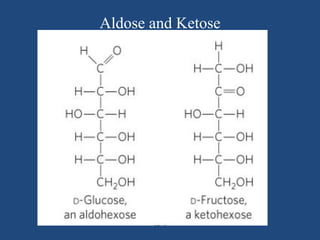
• If the carbonyl group is at an end of the carbon chain
(that is, in an aldehyde group), the monosaccharide is
an aldose
• If the carbonyl group is at any other position (in a
ketone group), the monosaccharide is a ketose.
• The carbons of a sugar are numbered beginning at the
end of the chain nearest the carbonyl group.
Aldose and Ketose
Aldose and Ketose
Monosaccharides
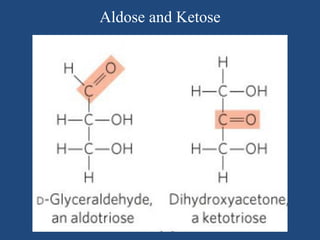
• The simplest monosaccharides are the two three-
carbon trioses: glyceraldehyde, an aldotriose, and
dihydroxyacetone, a ketotriose.
• Monosaccharides with four, five, six, and seven
carbon atoms in their backbones are called tetroses,
pentoses, hexoses, and heptoses.
• There are aldoses and ketoses of each of these chain
lengths
• All the monosaccharides except dihydroxyacetone
contain one or more asymmetric (chiral) carbon
atoms and thus occur in optically active isomeric
forms.
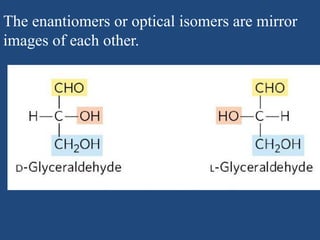
• The simplest aldose, glyceraldehyde, contains one
chiral center and therefore has two different optical
isomers, or enantiomers
The enantiomers or optical isomers are mirror
images of each other.
D and L isomer / Enantiomers
• A molecule with n chiral centers can have 2n
stereoisomers.
• Glyceraldehyde has 21 = 2; the aldohexoses, with
four chiral centers, have 24 = 16.
• The stereoisomers of monosaccharides can be
divided into two groups that differ in the
configuration about the chiral center which is most
distant carbon from the carbonyl carbon.
• Those in which the configuration at this reference
carbon is the same as that of D-glyceraldehyde are
designated D isomers, and those with the same
configuration as L-glyceraldehyde are L isomers.
Monosaccharides
• Thus when the hydroxyl group on the reference
carbon is on the right (dextro) in a projection
formula the sugar is the D isomer; when on the left
(levo), it is the L isomer.
• Most of the hexoses of living organisms are D
isomers with exception of L-arabinose
Epimers
• Two sugars that differ only in the configuration
around one carbon atom are called epimers; D-
glucose and D-mannose, which differ only in the
stereochemistry at C-2, are epimers, as are D-
glucose and D-galactose (which differ at C-4)
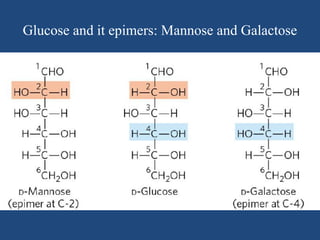
• D-Glucose and two of its epimers are shown as
projection formulas in Fig below.
• Each epimer differs from D-glucose in the
configuration at one chiral center
Glucose and it epimers: Mannose and Galactose
Anomers
• Monosaccharides can exist both as open-chain
form or in cyclic form.
• In aqueous solution monosaccharides with four or
more carbons in their backbone tend to form
cyclic structures in which the carbonyl group form
a covalent bond with the oxygen of a hydroxyl
group along the chain.
• The formation of these ring structures is the result
of a general reaction between alcohols and
aldehydes or ketones to form derivatives called
hemiacetals or hemiketals.
Anomers
• If the -OH and carbonyl groups are on the same
molecule, a five or six-membered ring results.
• The reaction creates an additional chiral center (the
carbonyl carbon).
• Because the alcohol can add in either of two ways,
attacking either the “front” or the “back” of the
carbonyl carbon, the reaction can produce either of
two stereoisomeric configurations, denoted α and β.
• Isomeric forms of monosaccharides that differ only
in their configuration about the hemiacetal or
hemiketal carbon atom are called anomers, and the
carbonyl carbon atom is called the anomeric
carbon.
Anomer
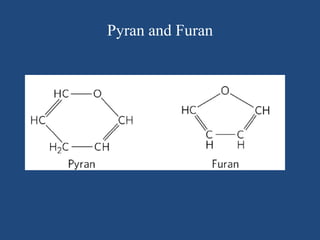
• Six-membered ring compounds are called
pyranoses because they resemble the six-
membered ring compound pyran.
• Five-membered ring compounds are called
furanoses because they resemble furan.
• The systematic names for the two ring forms of
D-glucose are therefore α-D-glucopyranose and
β-D-glucopyranose.
• Ketohexoses (such as fructose) also occur as
cyclic compounds with α and β anomeric forms.
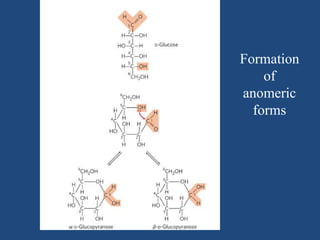
Formation
of
anomeric
forms
Formation of anomeric forms
• Reaction between the aldehyde group at C-1 and
the hydroxyl group at C-5 forms a hemiacetal
linkage, producing either of two stereoisomers, the
α and β anomers, which differ only in the
stereochemistry around the hemiacetal carbon.
• The interconversion of α and β anomers is called
mutarotation.
• The α and β anomers of D-glucose interconvert in
aqueous solution by a process called mutarotation,
in which one ring form e.g α opens briefly into the
linear form, then closes again to produce the β
anomer
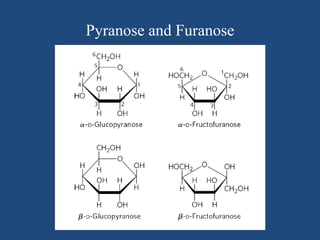
Pyranose and Furanose
Pyran and Furan
Other monosaccharide derivatives
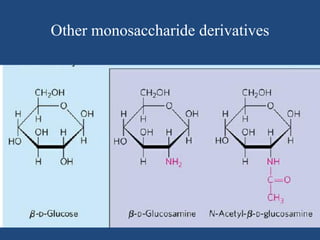
• In addition to simple hexoses such as glucose,
galactose, and mannose, there are many sugar
derivatives in which a hydroxyl group in the
parent compound is replaced with another
substituent, or a carbon atom is oxidized to a
carboxyl group.
• Where hydroxyl at C-2 is replaced with an amino
group it results to glucosamine from glucose,
galactosamine from galactose, and Mannosamine
from mannose
Other monosaccharide derivatives
• In most cases the amino group is commonly
condensed with acetic acid, to give rise to N-
acetylglucosamine.
• This glucosamine derivative is part of many
structural polymers, including those of the
bacterial cell wall.
• Recall one function of carbohydrates is structural
and that is an example molecule
Other monosaccharide derivatives
Monosaccharides are reducing agents
• Because the α and β isomers of glucose are in an
equilibrium that passes through the open-chain form,
glucose has some of the chemical properties of free
aldehydes, such as the ability to react with oxidizing
agents.
• For example, glucose can react with cupric ion (Cu2+),
reducing it to cuprous ion (Cu+), while being oxidized
to gluconic acid.
• Solutions of cupric ion (known as Fehling’s solution)
provide a simple test for the presence of sugars such as
glucose.
• Sugars that react are called reducing sugars; those that
do not are called nonreducing sugars.
Disaccharides
• Disaccharides such as maltose, lactose, and sucrose
consist of two monosaccharides joined covalently
by an O-glycosidic bond.
• The bond is formed when a hydroxyl group of one
sugar molecule, typically in its cyclic form, reacts
with the anomeric carbon of the other sugar
molecule.
• This reaction represents the formation of an acetal
from a hemiacetal and the resulting compound is
called a glycoside
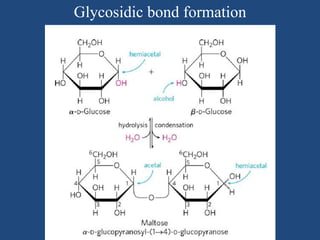
Glycosidic bond formation
Formation of maltose
• Maltose is formed from two glucose residues
when an OH (alcohol) of one glucose (right)
condenses with the intramolecular hemiacetal of
the other (left), with elimination of H2O and
formation of a glycosidic bond.
• The reversal of this reaction is hydrolysis attack
by H2O on the glycosidic bond.
• The maltose molecule, shown above retains a
reducing hemiacetal at the C-1 not involved in
the glycosidic bond.
Disaccharides
• Maltose contains two glucose residues joined by a
glycosidic linkage between C-1 (the anomeric
carbon) of one glucose residue and C-4 of the
other.
• Because the disaccharide retains a free anomeric
carbon (C-1 of the glucose residue on the right
see Fig above), maltose is a reducing sugar.
• In describing disaccharides or polysaccharides,
the end of a chain with a free anomeric carbon
(one not involved in a glycosidic bond) is
commonly called the reducing end.
Disaccharides
• The oxidation of a sugar by cupric ion (the
reaction that defines a reducing sugar) occurs
only with the linear form, which exists in
equilibrium with the cyclic form(s).
• When the anomeric carbon is involved in a
glycosidic bond (that is, when the compound is a
full acetal or ketal), the easy interconversion of
linear and cyclic forms is prevented.
• Because the carbonyl carbon can be oxidized only
when the sugar is in its linear form, formation of a
glycosidic bond renders a sugar nonreducing.
Disaccharides
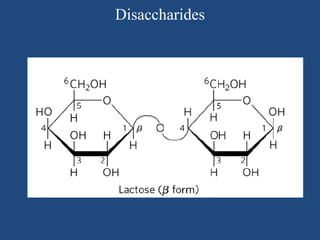
• The disaccharide lactose formed by D-
galactose and D-glucose occurs naturally in
milk.
• The anomeric carbon of the glucose residue is
available for oxidation, and thus lactose is a
reducing disaccharide.
Disaccharides
Disaccharises
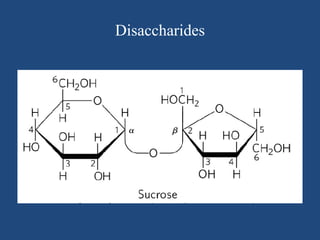
• Sucrose is a disaccharide of glucose and
fructose.
• It is formed by plants but not by animals.
• In contrast to maltose and lactose, sucrose
contains no free anomeric carbon atom; the
anomeric carbons of both monosaccharide units
are involved in the glycosidic bond
• Sucrose is therefore a nonreducing sugar
Disaccharides
Disaccharides
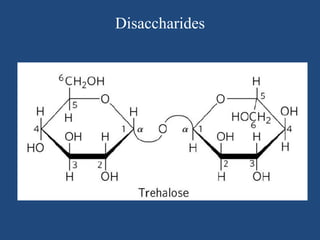
• Trehalose, a disaccharide of D-glucose that, like
sucrose, is a nonreducing sugar
• It is a major constituent of the circulating fluid
(hemolymph) of insects.
• It serves as an energy-storage compound.
Disaccharides
Polysaccharides
• Most carbohydrates found in nature occur as
polysaccharides
• Polysaccharides, also called glycans, differ
from each other in the identity of their
recurring monosaccharide units,
• In the length of their chains
• In the types of bonds linking the units
• In the degree of branching.
Polysaccharides
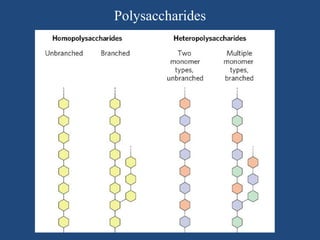
• Homopolysaccharides contain only a single
monomeric species.
• Heteropolysaccharides contain two or more
different kinds.
Polysaccharides
Polysaccharides
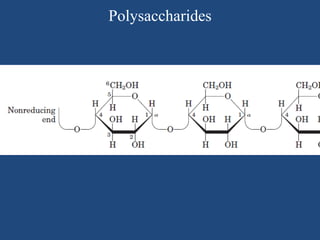
• Starch is a polysaccharide
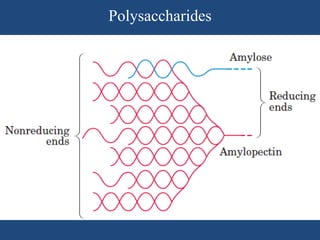
• It contains two types of glucose polymer, amylose
and amylopectin.
• Amylose consists of long, unbranched chains of D-
glucose residues connected by (α1→4) linkages.
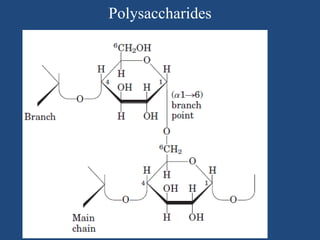
• Amylopectin is highly branched.
• The glycosidic linkages joining successive glucose
residues in amylopectin chains are (α1→4)
• The branch points occurring every 24 to 30 residues
have (α1→6) linkages.
Polysaccharides
Polysaccharides
Polysaccharides
Polysaccharides
• Glycogen is the main storage polysaccharide of
animal cells.
• Like amylopectin, glycogen is a polymer of
(α1→4)-linked glucose subunits, with (α1→6)-
linked branches, but glycogen is more extensively
branched (on average, a branch every 8 to 12
residues) and more compact than starch.
Polysaccharides
• Because each branch in glycogen ends with a
nonreducing sugar unit, a glycogen molecule with
n branches has n + 1 nonreducing ends, but only
one reducing end. (EXPLAIN)
• When glycogen is used as an energy source,
glucose units are removed one at a time from the
nonreducing ends.
Polysaccharides
• Dextrans are bacterial and yeast
polysaccharides made up of (α16)-linked poly-
D-glucose; all have (α1→3) branches, and some
also have (α1 → 2) or (α1 → 4) branches.
• Dental plaque, formed by bacteria growing on
the surface of teeth, is rich in dextrans.
• Synthetic dextrans are used in several
commercial products E.g Sephadex that serve in
the fractionation of proteins by size-exclusion
chromatography
Polysaccharides
• Cellulose is a fibrous, tough, water-insoluble
polysaccharide is found in the cell walls of
plants.
• Cellulose molecule is a linear, unbranched
homopolysaccharide, consisting of 10,000 to
15,000 D-glucose units.
• In cellulose the glucose residues have the β
configuration.
Polysaccharides
• Glycogen and starch ingested in the diet are
hydrolyzed by α-amylases and glycosidases,
enzymes in saliva and the intestine that break
(α1 → 4) glycosidic bonds between glucose
units.
• Most animals cannot use cellulose as a fuel
source, because they lack an enzyme to
hydrolyze the (β1 → 4) linkages.
Polysaccharides
• Chitin is a linear homopolysaccharide composed
• of N-acetylglucosamine residues in (β1→4)
linkage
• The only chemical difference from cellulose is the
replacement of the hydroxyl group at C-2 with an
acetylated amino group.
• Chitin is the principal component of the hard
exoskeletons of arthropods
Assignment
• Describe the unambigous or conventional
naming of disaccharides and oligosaccharides
(10 marks)
• List the names, symbols and abbreviations for
common monosaccharides and their
derivatives (20 marks)

Medical Biochemistry LECTURE NOTES ON CARBOHYDRATE

  • 1.
  • 2.
    Introduction • Carbohydrates areorganic compounds with the general formula (CH2O)n. • They consist of carbon, hydrogen and oxygen, with hydrogen being twice of carbon and oxygen atom ratio. • Carbohydrates can be termed as hydrates of carbon, hence they are known as carbohydrates. • Carbohydrates are simply defined as polyhydroxy aldehydes or ketones or compounds which yield these on hydrolysis.
  • 3.
    Carbohydrate Functions • Carbohydratessuch as sugar and starch have a dietary function the oxidation of carbohydrates is the central energy-yielding pathway in most nonphotosynthetic cells. • Some carbohydrate polymers have structural functions in cell wall and connective tissues • Some have protective function • Other carbohydrate polymers lubricate skeletal joints and participate in cell-cell recognition and adhesion. • Some serve as signal molecules that target other molecules to their destinations
  • 4.
    Introduction • There arethree major size classes of carbohydrates: • 1. Monosaccharides • 2. Oligosaccharides • 3. Polysaccharides • The word “saccharide” is derived from the Greek sakcharon, meaning “sugar”. • Monosaccharides are simple sugars consist of a single polyhydroxy aldehyde or ketone unit. • The most abundant monosaccharide in nature is the six-carbon sugar D-glucose.
  • 5.
    Introduction • Oligosaccharides consistof short chains of monosaccharide units, or residues, joined by characteristic linkages called glycosidic bonds. • The most abundant are the disaccharides, with two monosaccharide units. • Sucrose (cane sugar) consists of the six-carbon sugars D-glucose and D-fructose. • All common monosaccharides and disaccharides have names ending with the suffix “-ose.” • The polysaccharides are sugar polymers containing more than 20 monosaccharide units • Some polysaccharides, such as cellulose, are linear chains; others, such as glycogen, are branched.
  • 6.
    Monosaccharides and Disaccharides •The simplest of the carbohydrates, the monosaccharides, are either aldehydes or ketones with two or more hydroxyl groups. • The six-carbon monosaccharides glucose and fructose have five hydroxyl groups. • Many of the carbon atoms to which the hydroxyl groups are attached are chiral centers, which give rise to the many sugar stereoisomers found in nature. • There are two families of monosaccharides: Aldose and Ketose
  • 7.
    Aldose and Ketose •The backbones of common monosaccharides are unbranched carbon chains in which all the carbon atoms are linked by single bonds. • In this open-chain form, one of the carbon atoms is double-bonded to an oxygen atom to form a carbonyl group; each of the other carbon atoms has a hydroxyl group. • If the carbonyl group is at an end of the carbon chain (that is, in an aldehyde group), the monosaccharide is an aldose • If the carbonyl group is at any other position (in a ketone group), the monosaccharide is a ketose. • The carbons of a sugar are numbered beginning at the end of the chain nearest the carbonyl group.
  • 8.
  • 9.
  • 10.
    Monosaccharides • The simplestmonosaccharides are the two three- carbon trioses: glyceraldehyde, an aldotriose, and dihydroxyacetone, a ketotriose. • Monosaccharides with four, five, six, and seven carbon atoms in their backbones are called tetroses, pentoses, hexoses, and heptoses. • There are aldoses and ketoses of each of these chain lengths • All the monosaccharides except dihydroxyacetone contain one or more asymmetric (chiral) carbon atoms and thus occur in optically active isomeric forms. • The simplest aldose, glyceraldehyde, contains one chiral center and therefore has two different optical isomers, or enantiomers
  • 11.
    The enantiomers oroptical isomers are mirror images of each other.
  • 12.
    D and Lisomer / Enantiomers • A molecule with n chiral centers can have 2n stereoisomers. • Glyceraldehyde has 21 = 2; the aldohexoses, with four chiral centers, have 24 = 16. • The stereoisomers of monosaccharides can be divided into two groups that differ in the configuration about the chiral center which is most distant carbon from the carbonyl carbon. • Those in which the configuration at this reference carbon is the same as that of D-glyceraldehyde are designated D isomers, and those with the same configuration as L-glyceraldehyde are L isomers.
  • 13.
    Monosaccharides • Thus whenthe hydroxyl group on the reference carbon is on the right (dextro) in a projection formula the sugar is the D isomer; when on the left (levo), it is the L isomer. • Most of the hexoses of living organisms are D isomers with exception of L-arabinose
  • 14.
    Epimers • Two sugarsthat differ only in the configuration around one carbon atom are called epimers; D- glucose and D-mannose, which differ only in the stereochemistry at C-2, are epimers, as are D- glucose and D-galactose (which differ at C-4) • D-Glucose and two of its epimers are shown as projection formulas in Fig below. • Each epimer differs from D-glucose in the configuration at one chiral center
  • 15.
    Glucose and itepimers: Mannose and Galactose
  • 16.
    Anomers • Monosaccharides canexist both as open-chain form or in cyclic form. • In aqueous solution monosaccharides with four or more carbons in their backbone tend to form cyclic structures in which the carbonyl group form a covalent bond with the oxygen of a hydroxyl group along the chain. • The formation of these ring structures is the result of a general reaction between alcohols and aldehydes or ketones to form derivatives called hemiacetals or hemiketals.
  • 17.
    Anomers • If the-OH and carbonyl groups are on the same molecule, a five or six-membered ring results. • The reaction creates an additional chiral center (the carbonyl carbon). • Because the alcohol can add in either of two ways, attacking either the “front” or the “back” of the carbonyl carbon, the reaction can produce either of two stereoisomeric configurations, denoted α and β. • Isomeric forms of monosaccharides that differ only in their configuration about the hemiacetal or hemiketal carbon atom are called anomers, and the carbonyl carbon atom is called the anomeric carbon.
  • 18.
    Anomer • Six-membered ringcompounds are called pyranoses because they resemble the six- membered ring compound pyran. • Five-membered ring compounds are called furanoses because they resemble furan. • The systematic names for the two ring forms of D-glucose are therefore α-D-glucopyranose and β-D-glucopyranose. • Ketohexoses (such as fructose) also occur as cyclic compounds with α and β anomeric forms.
  • 19.
  • 20.
    Formation of anomericforms • Reaction between the aldehyde group at C-1 and the hydroxyl group at C-5 forms a hemiacetal linkage, producing either of two stereoisomers, the α and β anomers, which differ only in the stereochemistry around the hemiacetal carbon. • The interconversion of α and β anomers is called mutarotation. • The α and β anomers of D-glucose interconvert in aqueous solution by a process called mutarotation, in which one ring form e.g α opens briefly into the linear form, then closes again to produce the β anomer
  • 21.
  • 22.
  • 23.
    Other monosaccharide derivatives •In addition to simple hexoses such as glucose, galactose, and mannose, there are many sugar derivatives in which a hydroxyl group in the parent compound is replaced with another substituent, or a carbon atom is oxidized to a carboxyl group. • Where hydroxyl at C-2 is replaced with an amino group it results to glucosamine from glucose, galactosamine from galactose, and Mannosamine from mannose
  • 24.
    Other monosaccharide derivatives •In most cases the amino group is commonly condensed with acetic acid, to give rise to N- acetylglucosamine. • This glucosamine derivative is part of many structural polymers, including those of the bacterial cell wall. • Recall one function of carbohydrates is structural and that is an example molecule
  • 25.
  • 26.
    Monosaccharides are reducingagents • Because the α and β isomers of glucose are in an equilibrium that passes through the open-chain form, glucose has some of the chemical properties of free aldehydes, such as the ability to react with oxidizing agents. • For example, glucose can react with cupric ion (Cu2+), reducing it to cuprous ion (Cu+), while being oxidized to gluconic acid. • Solutions of cupric ion (known as Fehling’s solution) provide a simple test for the presence of sugars such as glucose. • Sugars that react are called reducing sugars; those that do not are called nonreducing sugars.
  • 27.
    Disaccharides • Disaccharides suchas maltose, lactose, and sucrose consist of two monosaccharides joined covalently by an O-glycosidic bond. • The bond is formed when a hydroxyl group of one sugar molecule, typically in its cyclic form, reacts with the anomeric carbon of the other sugar molecule. • This reaction represents the formation of an acetal from a hemiacetal and the resulting compound is called a glycoside
  • 28.
  • 29.
    Formation of maltose •Maltose is formed from two glucose residues when an OH (alcohol) of one glucose (right) condenses with the intramolecular hemiacetal of the other (left), with elimination of H2O and formation of a glycosidic bond. • The reversal of this reaction is hydrolysis attack by H2O on the glycosidic bond. • The maltose molecule, shown above retains a reducing hemiacetal at the C-1 not involved in the glycosidic bond.
  • 30.
    Disaccharides • Maltose containstwo glucose residues joined by a glycosidic linkage between C-1 (the anomeric carbon) of one glucose residue and C-4 of the other. • Because the disaccharide retains a free anomeric carbon (C-1 of the glucose residue on the right see Fig above), maltose is a reducing sugar. • In describing disaccharides or polysaccharides, the end of a chain with a free anomeric carbon (one not involved in a glycosidic bond) is commonly called the reducing end.
  • 31.
    Disaccharides • The oxidationof a sugar by cupric ion (the reaction that defines a reducing sugar) occurs only with the linear form, which exists in equilibrium with the cyclic form(s). • When the anomeric carbon is involved in a glycosidic bond (that is, when the compound is a full acetal or ketal), the easy interconversion of linear and cyclic forms is prevented. • Because the carbonyl carbon can be oxidized only when the sugar is in its linear form, formation of a glycosidic bond renders a sugar nonreducing.
  • 32.
    Disaccharides • The disaccharidelactose formed by D- galactose and D-glucose occurs naturally in milk. • The anomeric carbon of the glucose residue is available for oxidation, and thus lactose is a reducing disaccharide.
  • 33.
  • 34.
    Disaccharises • Sucrose isa disaccharide of glucose and fructose. • It is formed by plants but not by animals. • In contrast to maltose and lactose, sucrose contains no free anomeric carbon atom; the anomeric carbons of both monosaccharide units are involved in the glycosidic bond • Sucrose is therefore a nonreducing sugar
  • 35.
  • 36.
    Disaccharides • Trehalose, adisaccharide of D-glucose that, like sucrose, is a nonreducing sugar • It is a major constituent of the circulating fluid (hemolymph) of insects. • It serves as an energy-storage compound.
  • 37.
  • 38.
    Polysaccharides • Most carbohydratesfound in nature occur as polysaccharides • Polysaccharides, also called glycans, differ from each other in the identity of their recurring monosaccharide units, • In the length of their chains • In the types of bonds linking the units • In the degree of branching.
  • 39.
    Polysaccharides • Homopolysaccharides containonly a single monomeric species. • Heteropolysaccharides contain two or more different kinds.
  • 40.
  • 41.
    Polysaccharides • Starch isa polysaccharide • It contains two types of glucose polymer, amylose and amylopectin. • Amylose consists of long, unbranched chains of D- glucose residues connected by (α1→4) linkages. • Amylopectin is highly branched. • The glycosidic linkages joining successive glucose residues in amylopectin chains are (α1→4) • The branch points occurring every 24 to 30 residues have (α1→6) linkages.
  • 42.
  • 43.
  • 44.
  • 45.
    Polysaccharides • Glycogen isthe main storage polysaccharide of animal cells. • Like amylopectin, glycogen is a polymer of (α1→4)-linked glucose subunits, with (α1→6)- linked branches, but glycogen is more extensively branched (on average, a branch every 8 to 12 residues) and more compact than starch.
  • 46.
    Polysaccharides • Because eachbranch in glycogen ends with a nonreducing sugar unit, a glycogen molecule with n branches has n + 1 nonreducing ends, but only one reducing end. (EXPLAIN) • When glycogen is used as an energy source, glucose units are removed one at a time from the nonreducing ends.
  • 47.
    Polysaccharides • Dextrans arebacterial and yeast polysaccharides made up of (α16)-linked poly- D-glucose; all have (α1→3) branches, and some also have (α1 → 2) or (α1 → 4) branches. • Dental plaque, formed by bacteria growing on the surface of teeth, is rich in dextrans. • Synthetic dextrans are used in several commercial products E.g Sephadex that serve in the fractionation of proteins by size-exclusion chromatography
  • 48.
    Polysaccharides • Cellulose isa fibrous, tough, water-insoluble polysaccharide is found in the cell walls of plants. • Cellulose molecule is a linear, unbranched homopolysaccharide, consisting of 10,000 to 15,000 D-glucose units. • In cellulose the glucose residues have the β configuration.
  • 49.
    Polysaccharides • Glycogen andstarch ingested in the diet are hydrolyzed by α-amylases and glycosidases, enzymes in saliva and the intestine that break (α1 → 4) glycosidic bonds between glucose units. • Most animals cannot use cellulose as a fuel source, because they lack an enzyme to hydrolyze the (β1 → 4) linkages.
  • 50.
    Polysaccharides • Chitin isa linear homopolysaccharide composed • of N-acetylglucosamine residues in (β1→4) linkage • The only chemical difference from cellulose is the replacement of the hydroxyl group at C-2 with an acetylated amino group. • Chitin is the principal component of the hard exoskeletons of arthropods
  • 51.
    Assignment • Describe theunambigous or conventional naming of disaccharides and oligosaccharides (10 marks) • List the names, symbols and abbreviations for common monosaccharides and their derivatives (20 marks)