Carbohydrates
Assistant professor
Dr. Mustafa Taha Mohammed
Carbohydrates
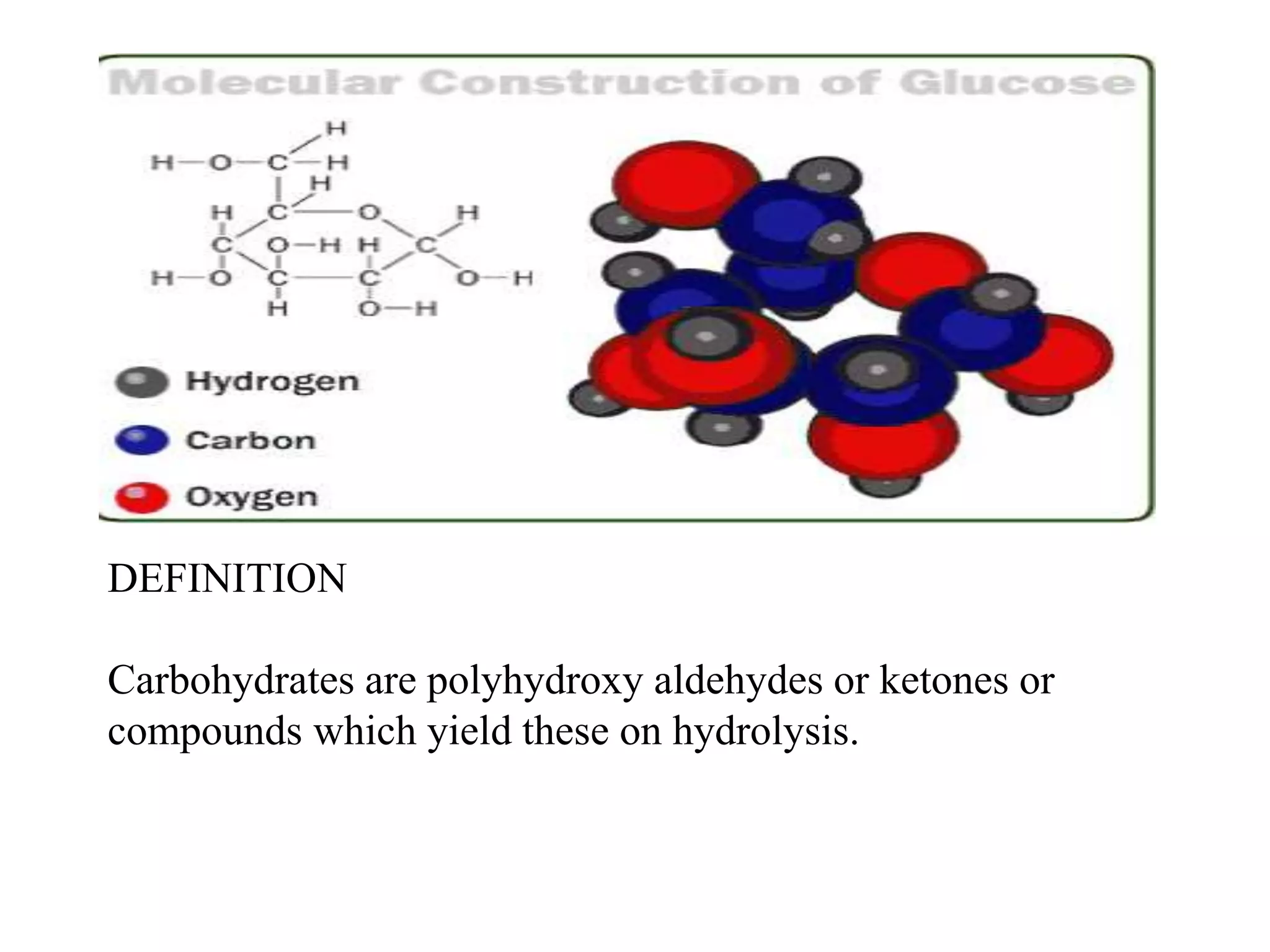
DEFINITION
Carbohydrates are polyhydroxy aldehydes or ketones or
compounds which yield these on hydrolysis.
Functions
• sources of energy
• intermediates in the biosynthesis of other basic
biochemical entities (fats and proteins)
• associated with other entities such as glycosides,
vitamins and antibiotics)
• form structural tissues in plants and in
microorganisms (cellulose, lignin, murein)
• participate in biological transport, cell-cell
recognition, activation of growth factors,
modulation of the immune system
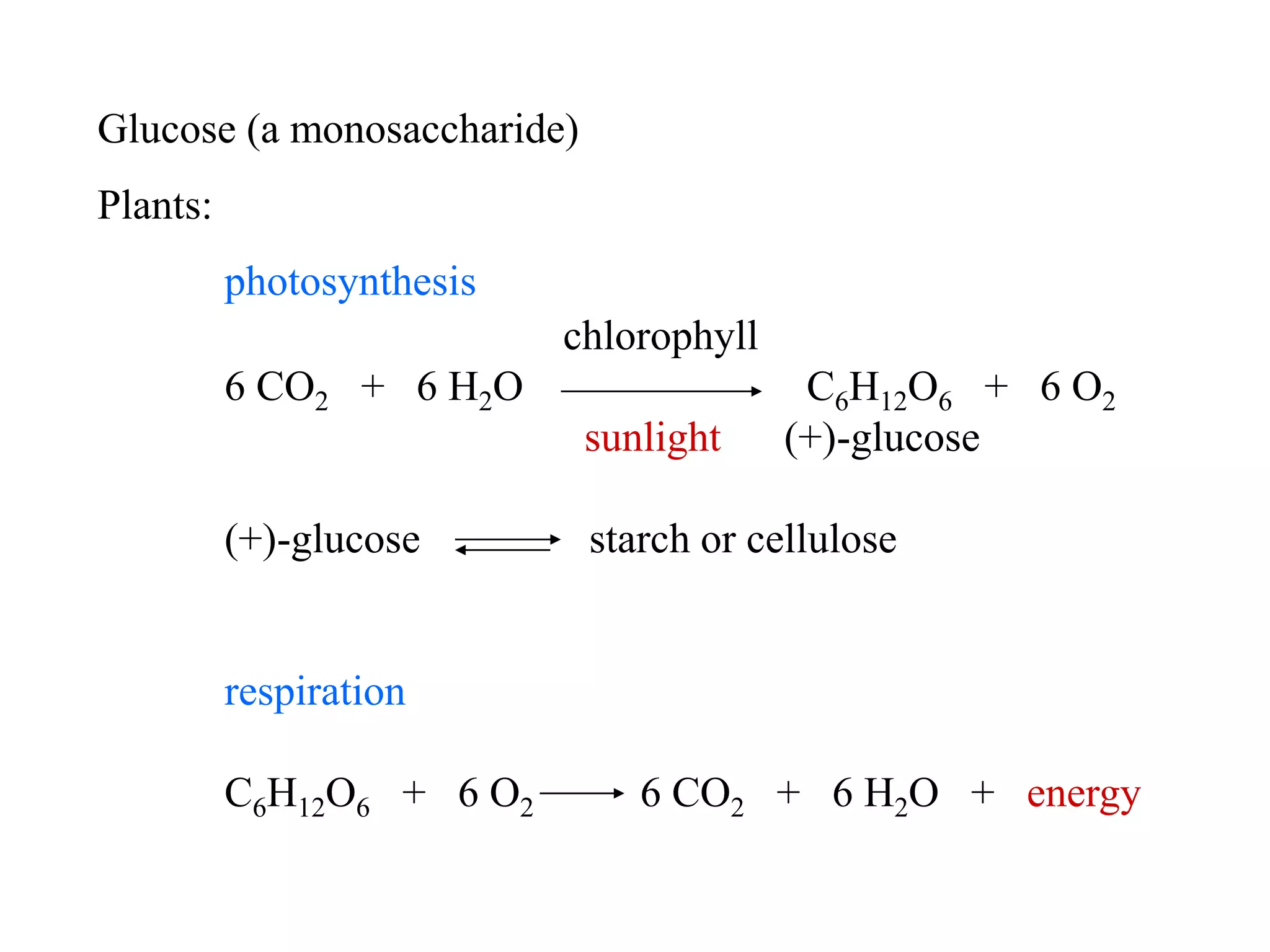
Glucose (a monosaccharide)
Plants:
photosynthesis
chlorophyll
6 CO2 + 6 H2O C6H12O6 + 6 O2
sunlight (+)-glucose
(+)-glucose starch or cellulose
respiration
C6H12O6 + 6 O2 6 CO2 + 6 H2O + energy
Carbohydrates
• glucose provides energy for the brain and ½
of energy for muscles and tissues
• glycogen is stored glucose
• glucose is immediate energy
• glycogen is reserve energy
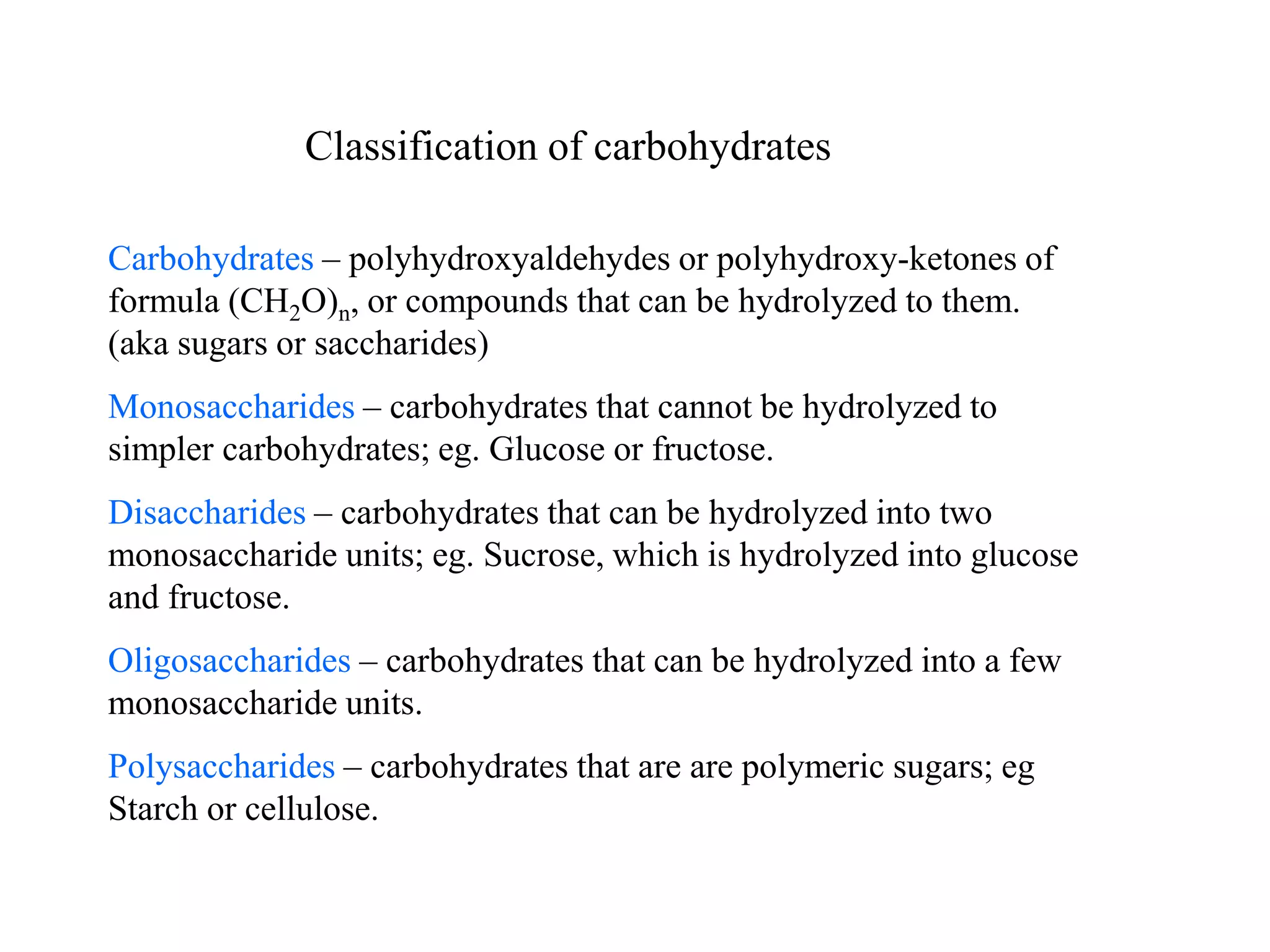
Carbohydrates – polyhydroxyaldehydes or polyhydroxy-ketones of
formula (CH2O)n, or compounds that can be hydrolyzed to them.
(aka sugars or saccharides)
Monosaccharides – carbohydrates that cannot be hydrolyzed to
simpler carbohydrates; eg. Glucose or fructose.
Disaccharides – carbohydrates that can be hydrolyzed into two
monosaccharide units; eg. Sucrose, which is hydrolyzed into glucose
and fructose.
Oligosaccharides – carbohydrates that can be hydrolyzed into a few
monosaccharide units.
Polysaccharides – carbohydrates that are are polymeric sugars; eg
Starch or cellulose.
Classification of carbohydrates
Monosaccharides
• also known as simple sugars
• classified by 1. the number of carbons and 2.
whether aldoses or ketoses
• most (99%) are straight chain compounds
• D-glyceraldehyde is the simplest of the aldoses
(aldotriose)
• all other sugars have the ending ose (glucose,
galactose, ribose, lactose, etc…)
Glucose
The chemical formula
for glucose is C6H12O6.
It is a six sided ring.
The structure on the
left is a simplified
structure of glucose
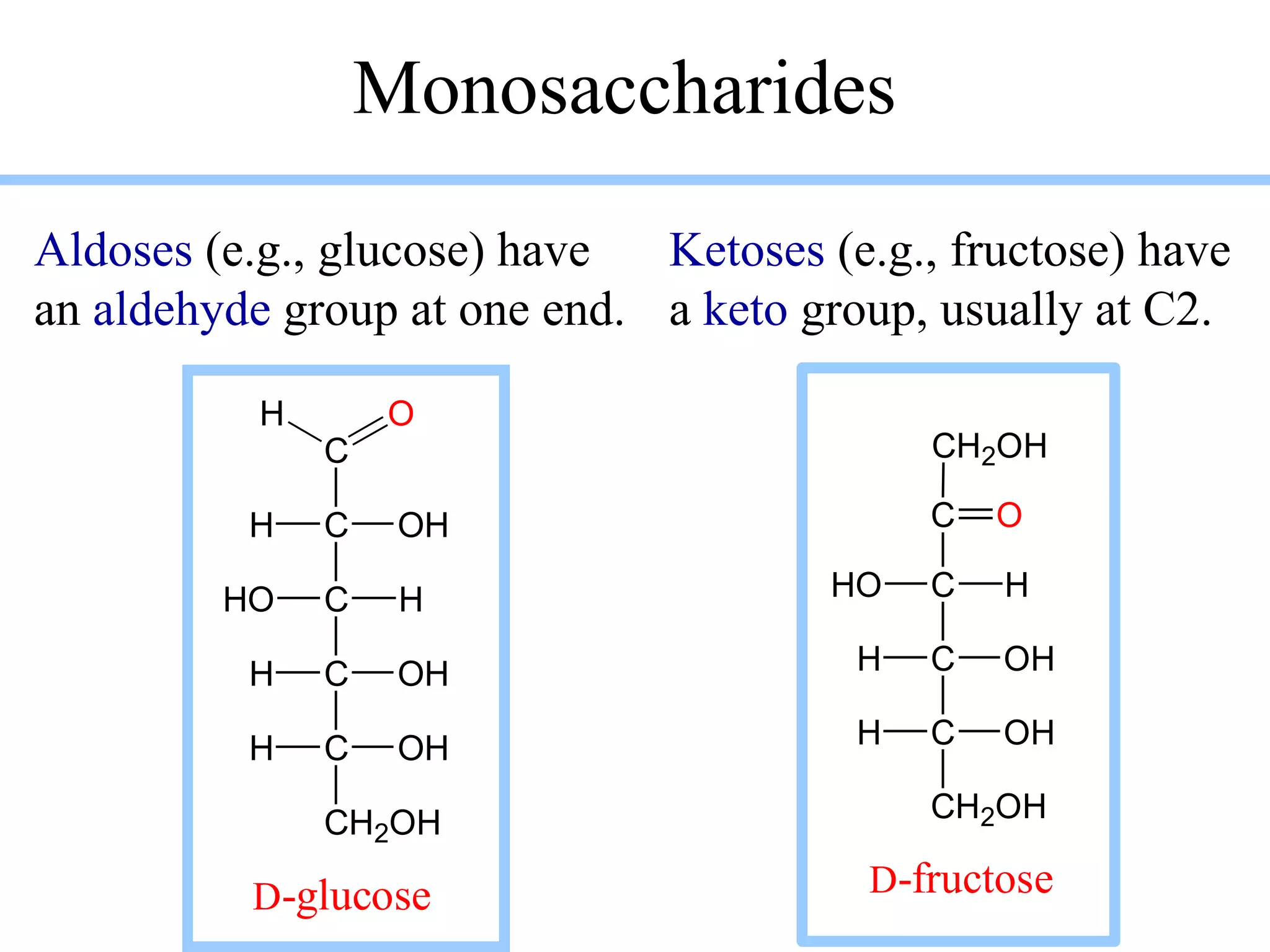
Monosaccharides
Aldoses (e.g., glucose) have
an aldehyde group at one end.
Ketoses (e.g., fructose) have
a keto group, usually at C2.
C
C OHH
C HHO
C OHH
C OHH
CH2OH
D-glucose
OH
C HHO
C OHH
C OHH
CH2OH
CH2OH
C O
D-fructose
• Compounds having same structural formula, but differ
in spatial configuration.
• Asymmetric Carbon atom:Attached to four different
atoms or groups.
• Vant Hoff’s rule: The possible isomers (2n) of a given
compound is determined by the number of asymmetric
carbon atoms (n).
• Reference C atom: Penultimate C atom, around which
mirror images are formed.
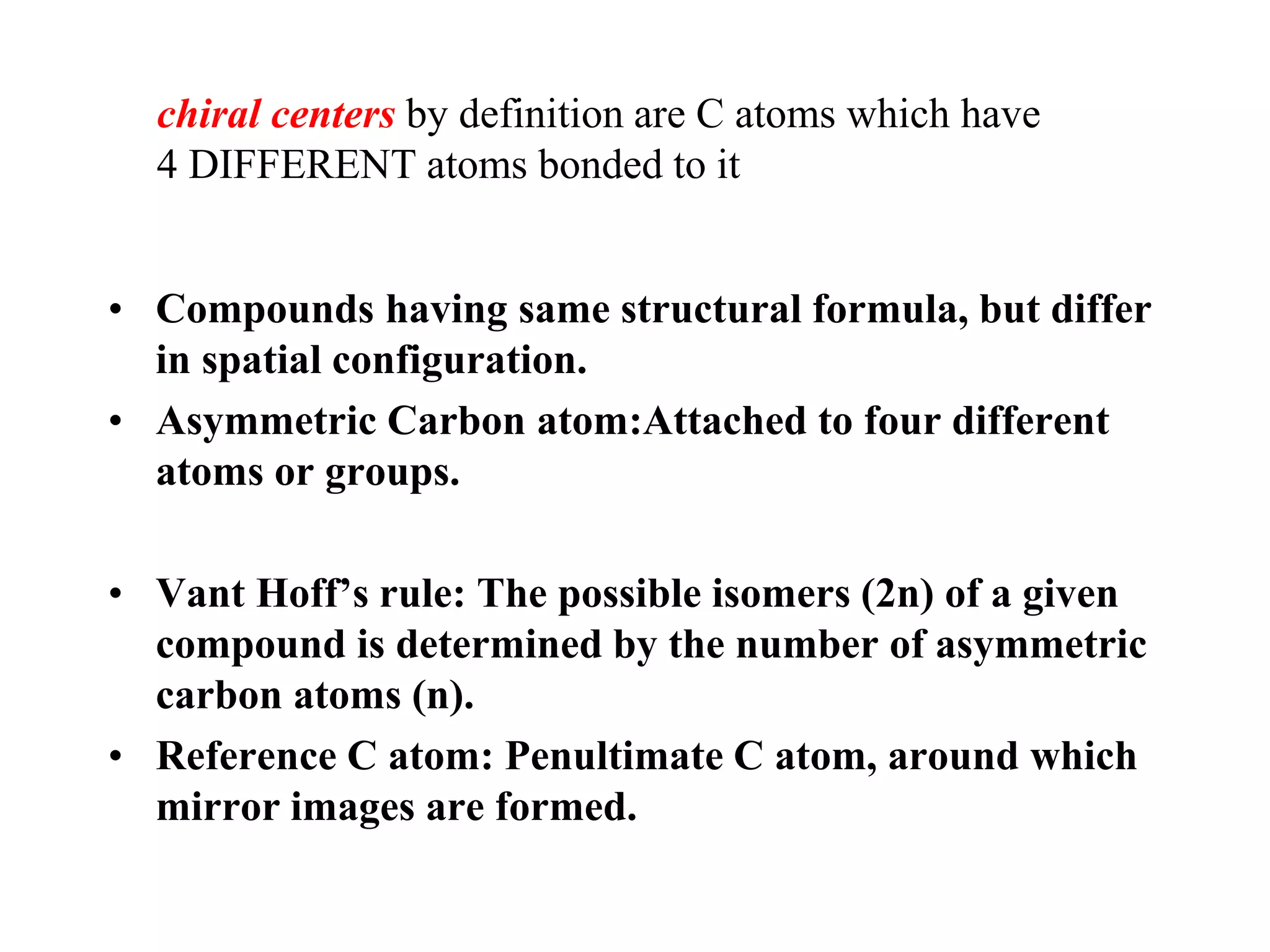
chiral centers by definition are C atoms which have
4 DIFFERENT atoms bonded to it
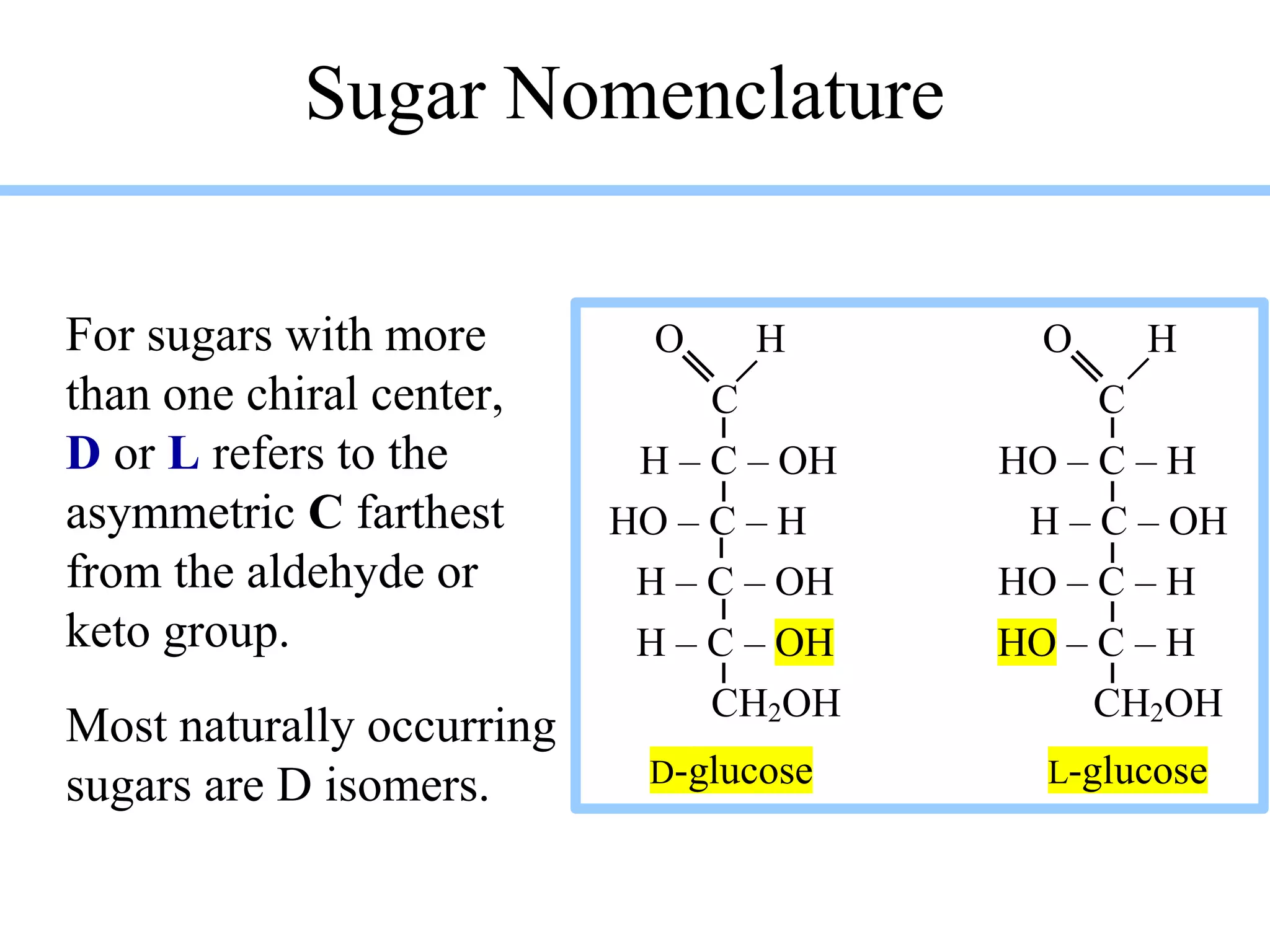
Sugar Nomenclature
For sugars with more
than one chiral center,
D or L refers to the
asymmetric C farthest
from the aldehyde or
keto group.
Most naturally occurring
sugars are D isomers.
O H O H
C C
H – C – OH HO – C – H
HO – C – H H – C – OH
H – C – OH HO – C – H
CH2OH CH2OH
D-glucose L-glucose
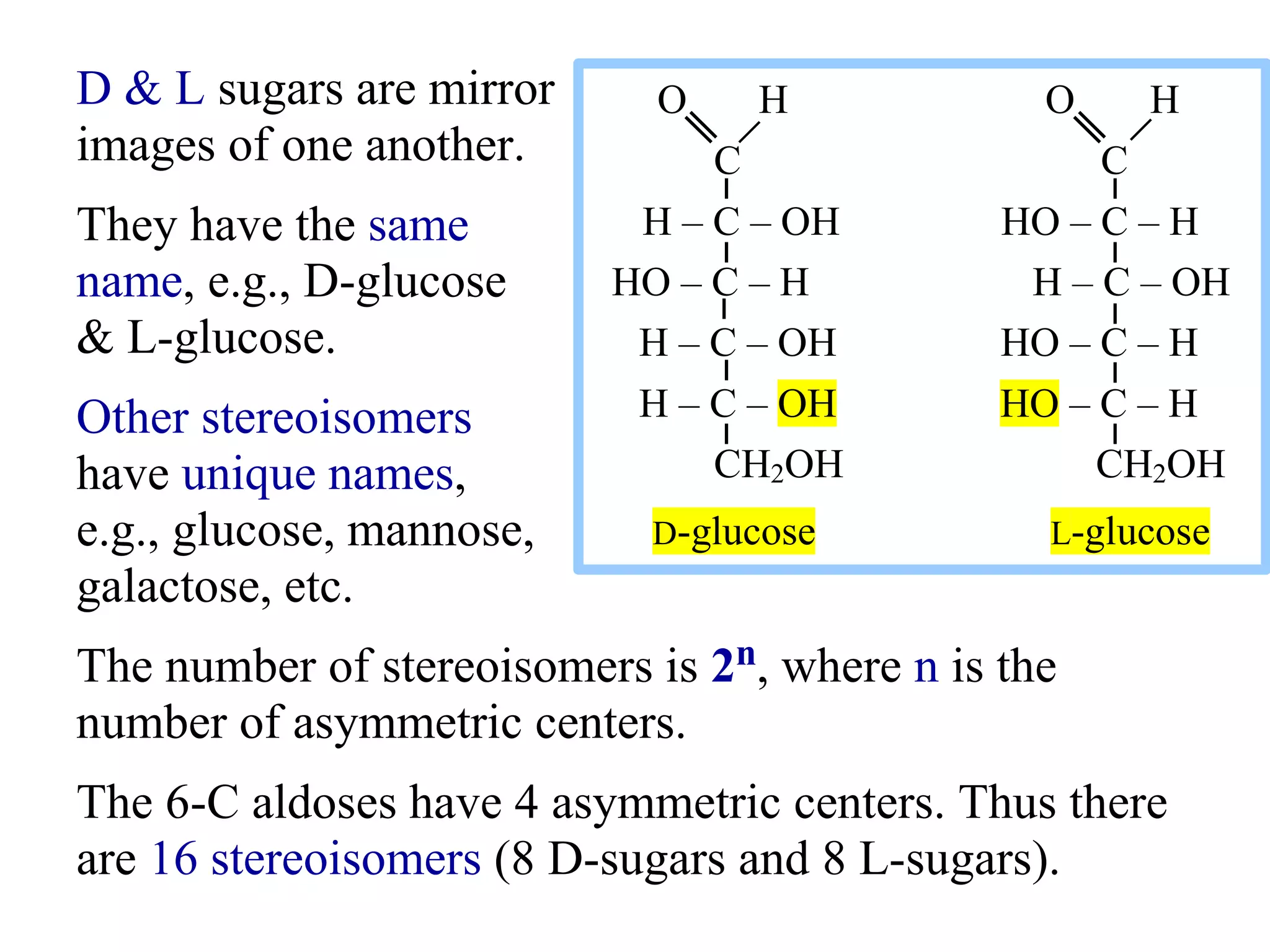
D & L sugars are mirror
images of one another.
They have the same
name, e.g., D-glucose
& L-glucose.
Other stereoisomers
have unique names,
e.g., glucose, mannose,
galactose, etc.
The number of stereoisomers is 2n, where n is the
number of asymmetric centers.
The 6-C aldoses have 4 asymmetric centers. Thus there
are 16 stereoisomers (8 D-sugars and 8 L-sugars).
O H O H
C C
H – C – OH HO – C – H
HO – C – H H – C – OH
H – C – OH HO – C – H
CH2OH CH2OH
D-glucose L-glucose
D vs L Designation
D & L designations
are based on the
configuration about
the single asymmetric
C in glyceraldehyde.
The lower
representations are
Fischer Projections.
CHO
C
CH2OH
HO H
CHO
C
CH2OH
H OH
CHO
C
CH2OH
HO H
CHO
C
CH2OH
H OH
L-glyceraldehydeD-glyceraldehyde
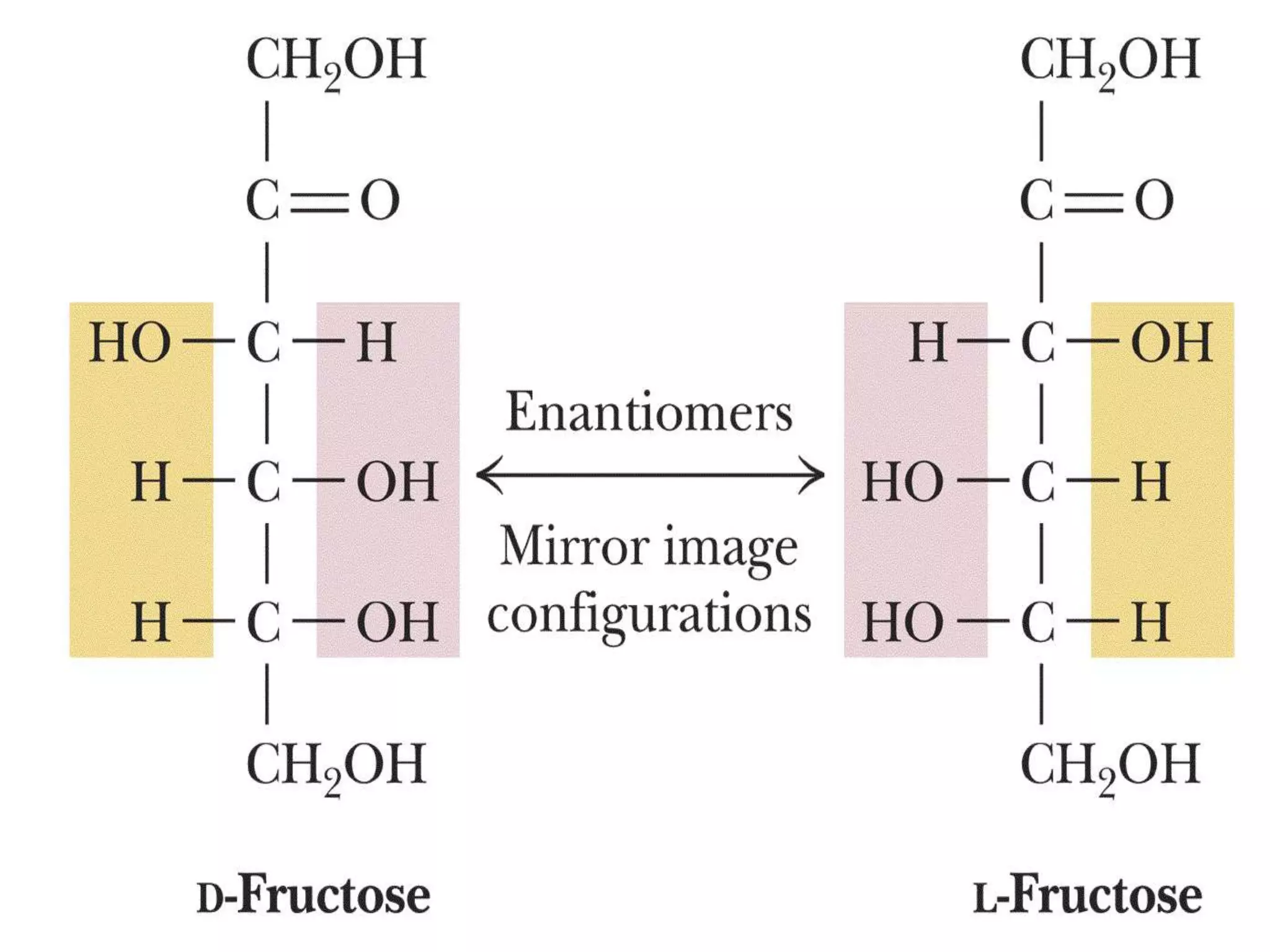
Enantiomres
A special type of isomerism is found in the pairs of structures that
are mirror images of each other. These mirror images are called
enantiomers, and the two members of the pair are designated as
a D- and an L-sugar
two monosaccharides differ in configuration around only one
specific carbon atom (with the exception of the carbonyl carbon,
see below), they are defined as epimers of each other.
(+)-glucose? An aldohexose
Emil Fischer (1902)
Four chiral centers, 24 = 16 stereoisomers
CHO
CH2OH
OH?
CH2CHCHCHCHCH O
OH OHOHOHOH
* * * *
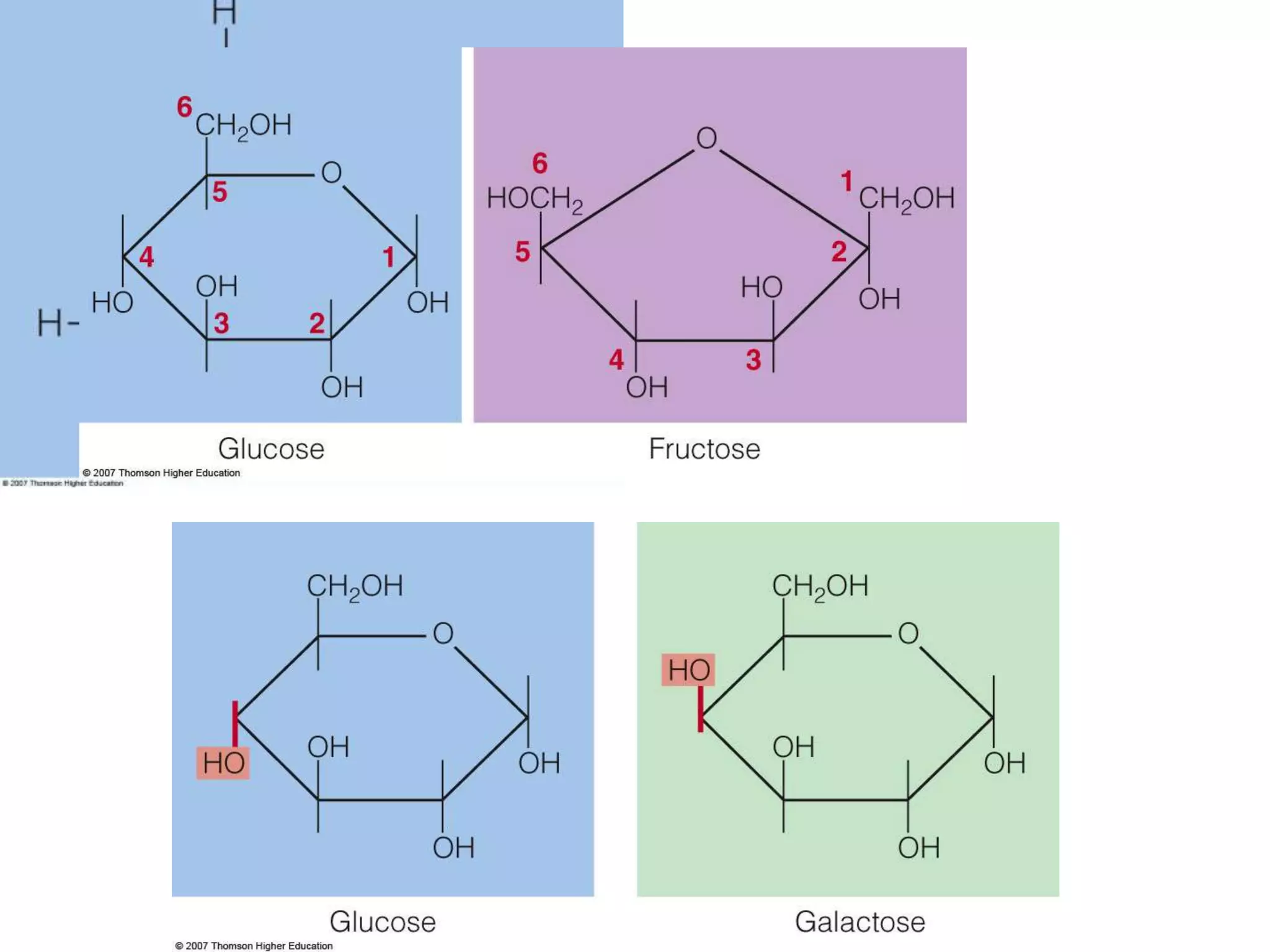
Fructose forms either
 a 6-member pyranose ring, by reaction of the C2 keto
group with the OH on C6, or
 a 5-member furanose ring, by reaction of the C2 keto
group with the OH on C5.
CH2OH
C O
C HHO
C OHH
C OHH
CH2OH
HOH2C
OH
CH2OH
H
OH H
H HO
O
1
6
5
4
3
2
6
5
4 3
2
1
D-fructose (linear) -D-fructofuranose
Epimers – stereoisomers that differ only in configuration about
one chiral center.
CHO
OHH
HHO
OHH
OHH
CH2OH
D-glucose
CHO
HHO
HHO
OHH
OHH
CH2OH
D-mannose
epimers
Sugars are different from one
another, only in configuration
with regard to a single C atom
(other than the reference C
atom).
C
CH2OH
OHH
C O
H
C OHH
C
CH2OH
HOH
C O
H
C HOH
these two aldotetroses are enantiomers.
They are stereoisomers that are mirror
images of each other
C O
H
C HHO
C HHO
CH OH
C
CH2OH
OHH
C O
H
C HHO
C HHO
CHO H
C
CH2OH
OHH
these two aldohexoses are C-4 epimers.
they differ only in the position of the
hydroxyl group on one asymmetric carb
(carbon 4)
Enantiomers and epimers
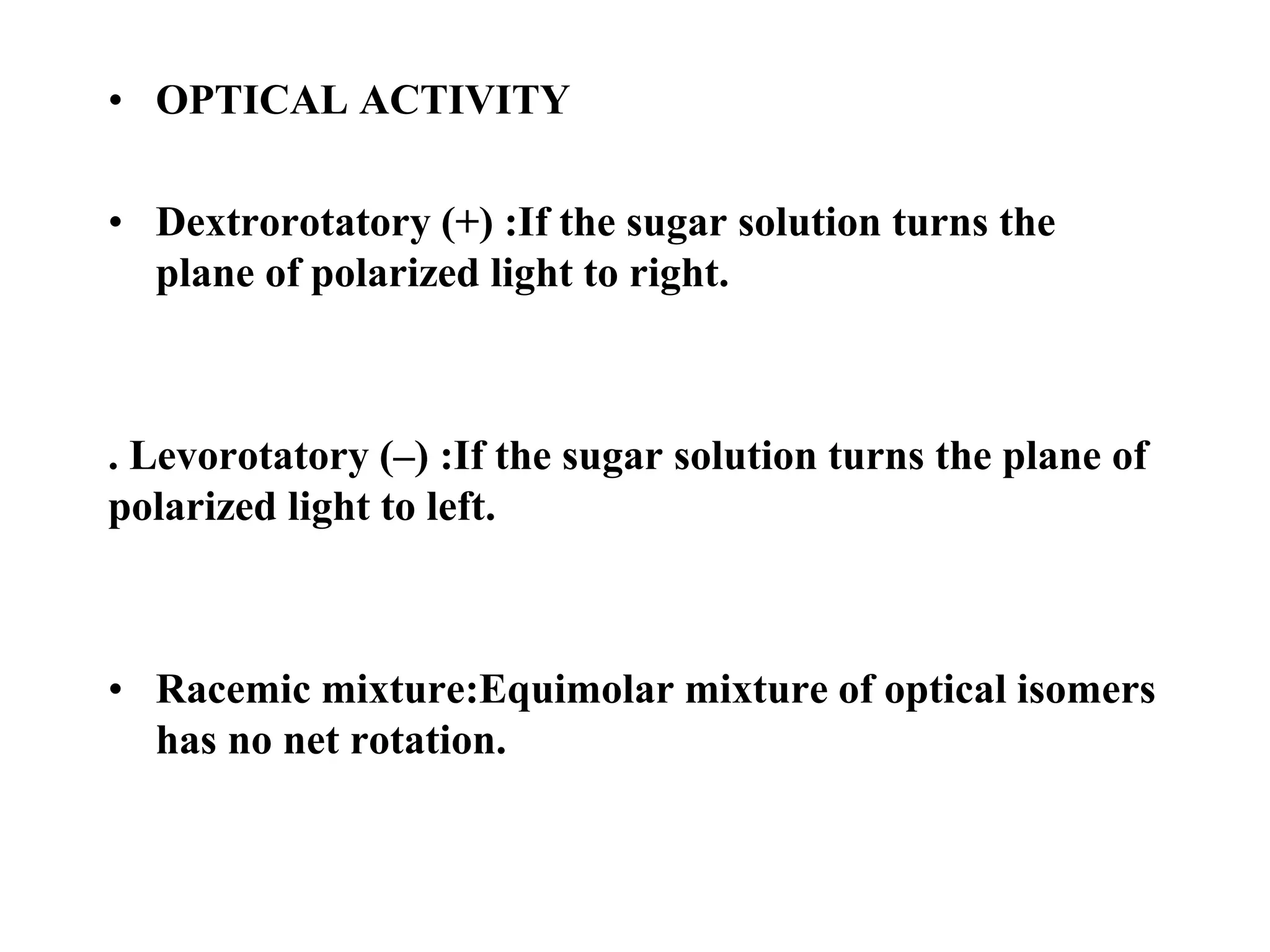
• OPTICAL ACTIVITY
• Dextrorotatory (+) :If the sugar solution turns the
plane of polarized light to right.
. Levorotatory (–) :If the sugar solution turns the plane of
polarized light to left.
• Racemic mixture:Equimolar mixture of optical isomers
has no net rotation.
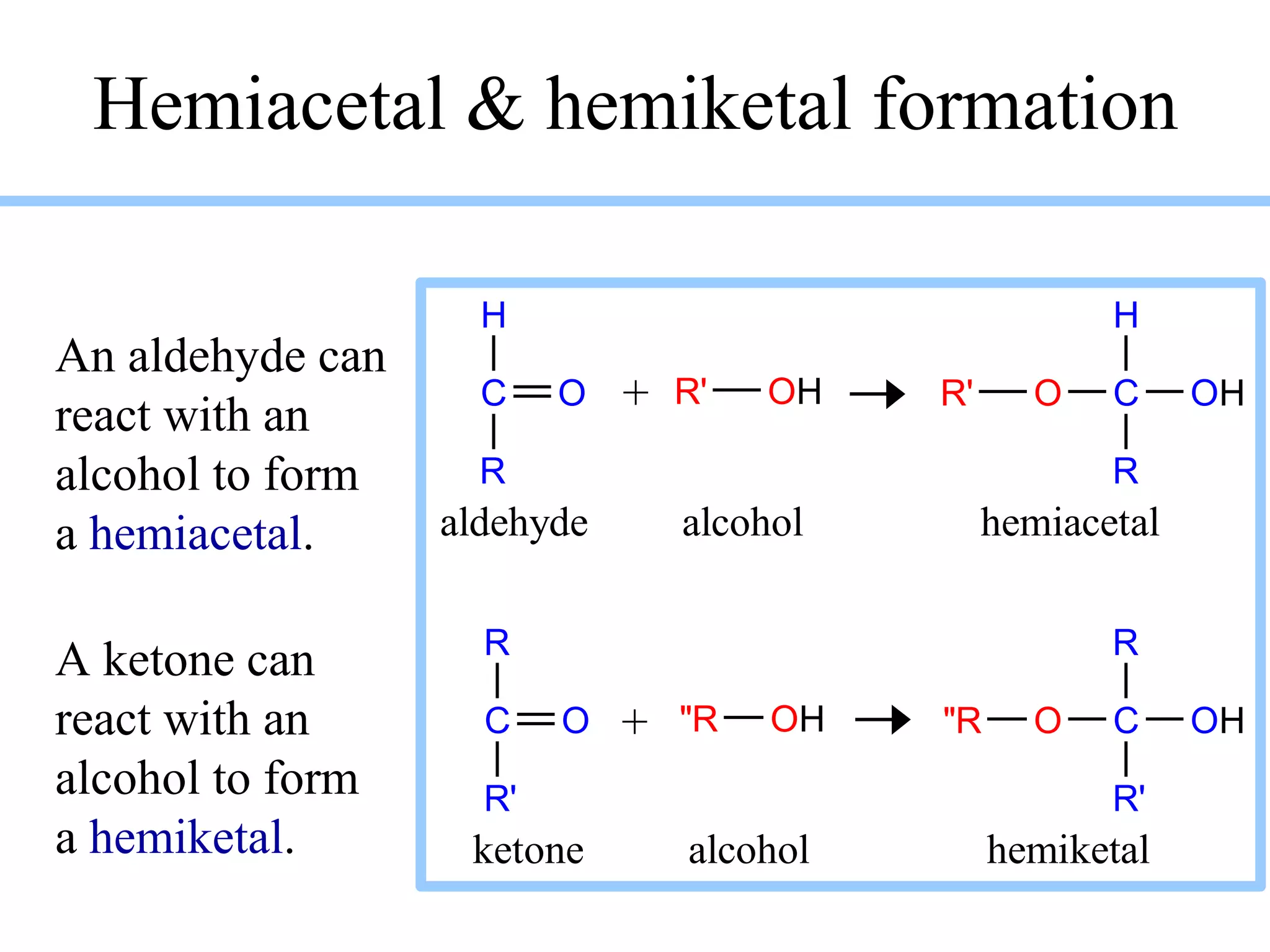
Hemiacetal & hemiketal formation
An aldehyde can
react with an
alcohol to form
a hemiacetal.
A ketone can
react with an
alcohol to form
a hemiketal.
O C
H
R
OH
O C
R
R'
OHC
R
R'
O
aldehyde alcohol hemiacetal
ketone alcohol hemiketal
C
H
R
O R'R' OH
"R OH "R
+
+
3. Fructose (levulsoe) --- Rotation in polarimeter is left
D-Fructose b-D-Fructose -D-Fructose
CH2OH
O
CH2OH
C
HO HC
OHCH
H C
OH
O
CH2OH
C
HO HC
OHCH
H C
CH2OHCH2OH
CH
HO
H C OH
C HHO
C
OH
CH2OH
O
or
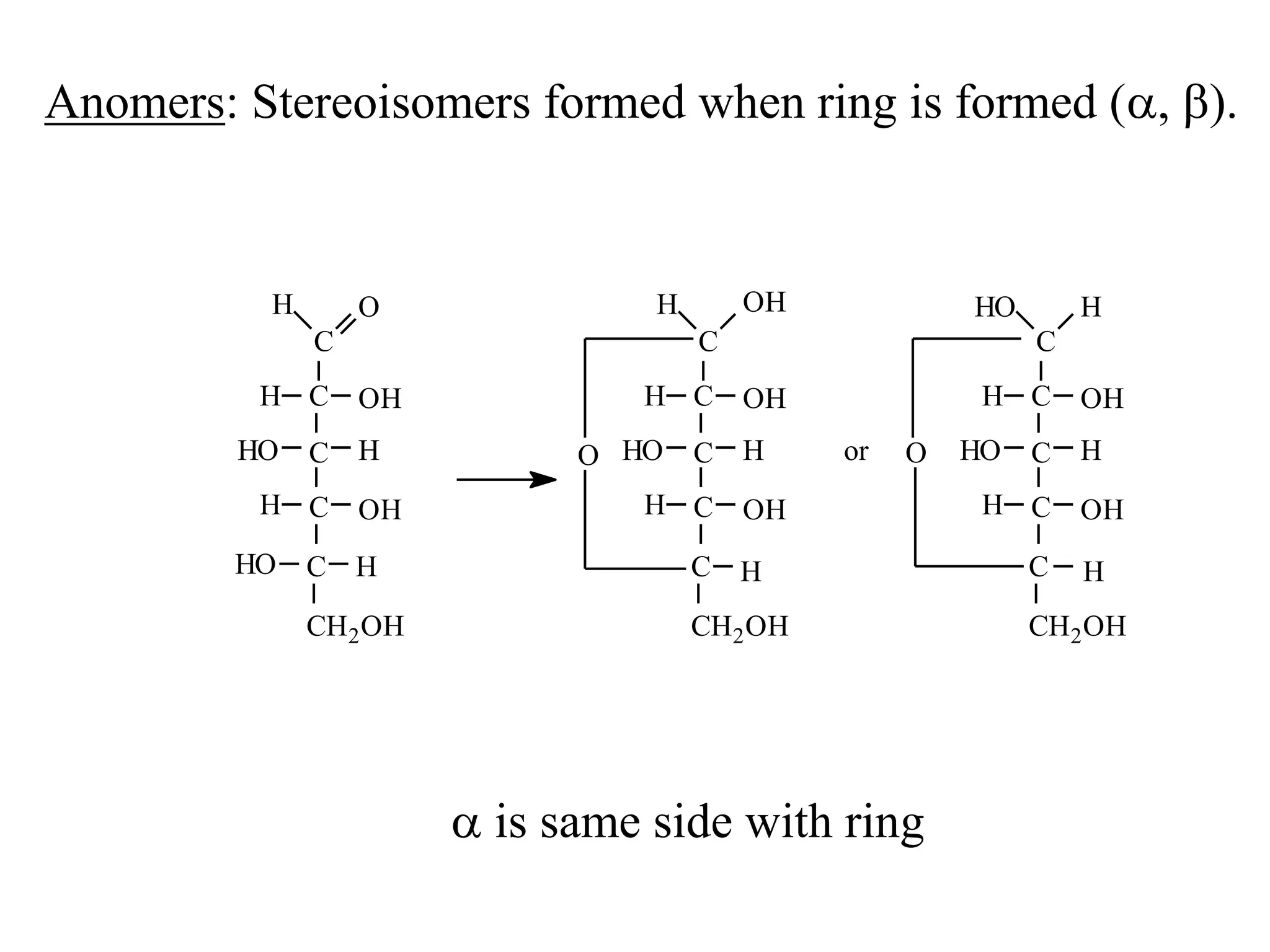
Anomers: Stereoisomers formed when ring is formed (, b).
C
O
CH2OH
OHCH
HO
H
HC
OH
OH
CH
HO
HO HC
OH
C H
H C OH
C H
H
HO
H C
CH2OH
O
C C
O
CH2OH
CH
HO
H
HC
OHCH
HC
OH
or
 is same side with ring
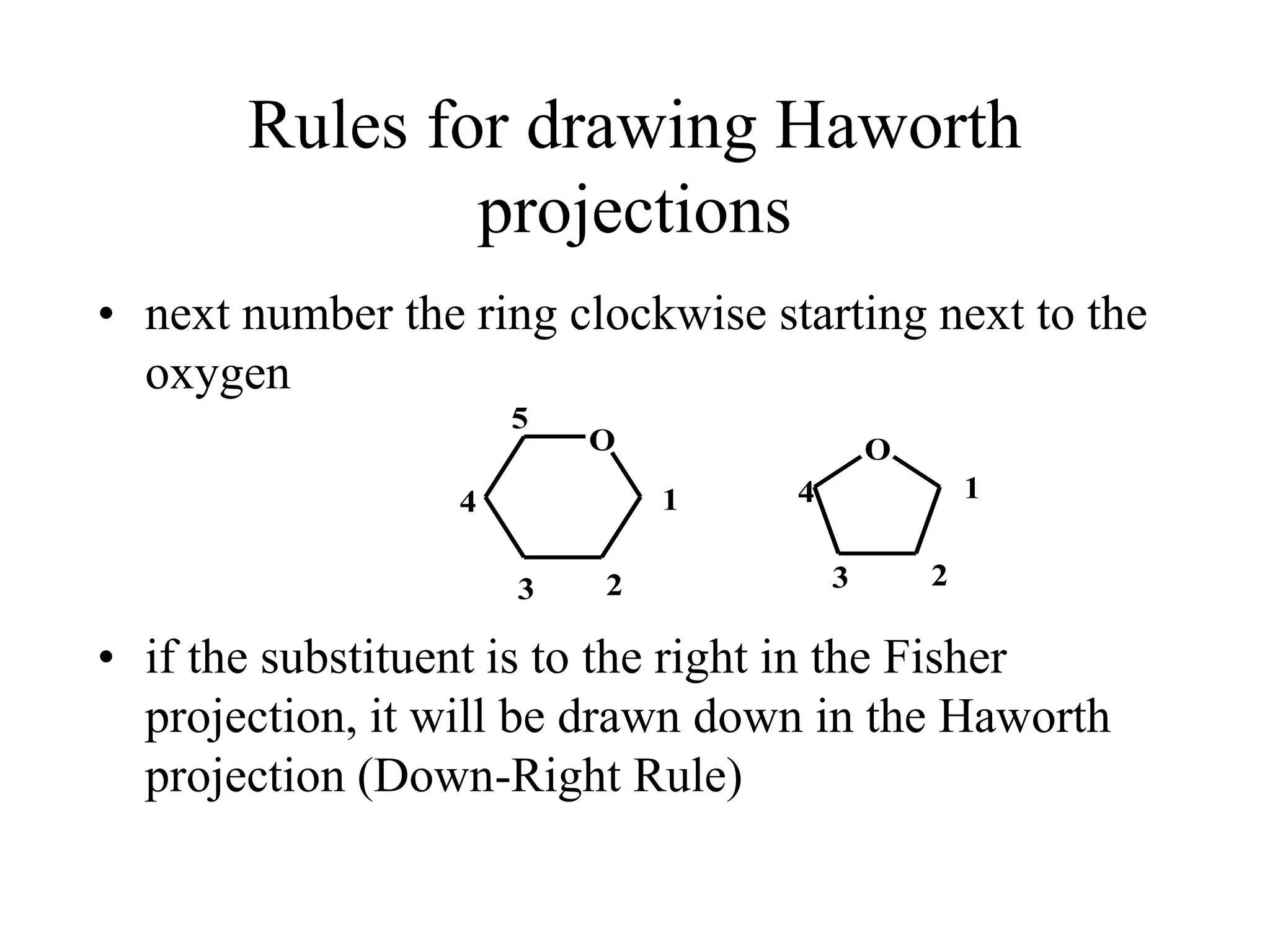
Rules for drawing Haworth
projections
• next number the ring clockwise starting next to the
oxygen
• if the substituent is to the right in the Fisher
projection, it will be drawn down in the Haworth
projection (Down-Right Rule)
O O
1
23
4
5
1
23
4
Rules for drawing Haworth
projections
• draw either a six or 5-membered ring
including oxygen as one atom
• most aldohexoses are six-membered
• aldotetroses, aldopentoses, ketohexoses are
5-membered
O O
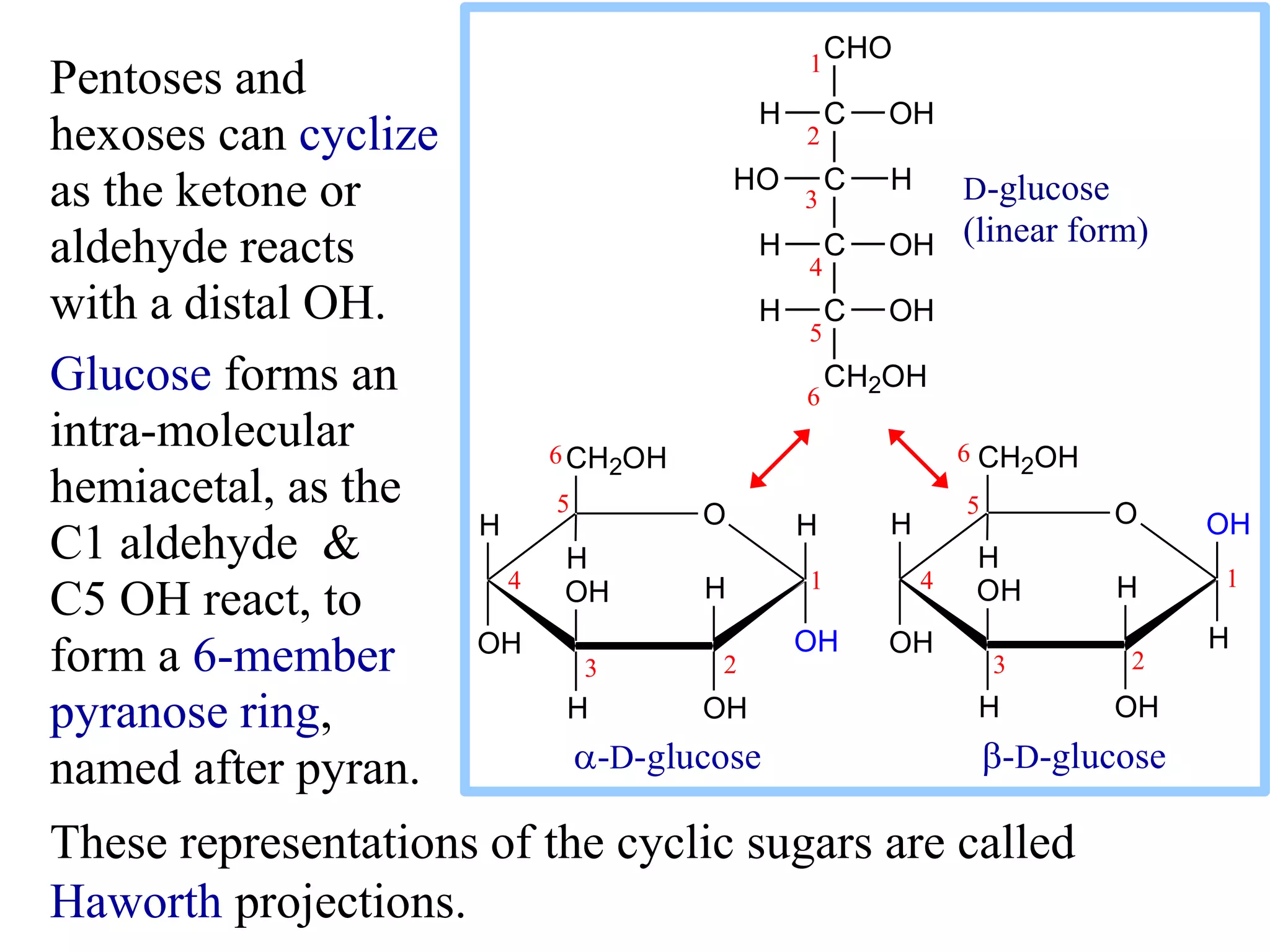
Pentoses and
hexoses can cyclize
as the ketone or
aldehyde reacts
with a distal OH.
Glucose forms an
intra-molecular
hemiacetal, as the
C1 aldehyde &
C5 OH react, to
form a 6-member
pyranose ring,
named after pyran.
These representations of the cyclic sugars are called
Haworth projections.
H O
OH
H
OHH
OH
CH2OH
H
OH
H H O
OH
H
OHH
OH
CH2OH
H
H
OH
-D-glucose b-D-glucose
23
4
5
6
1 1
6
5
4
3 2
H
CHO
C OH
C HHO
C OHH
C OHH
CH2OH
1
5
2
3
4
6
D-glucose
(linear form)
D-glucose can cyclize in two
ways forming either furanose or
pyranose structures
D-ribose and other five-carbon
saccharides can form either
furanose or pyranose structures
Cyclization of glucose produces a new asymmetric center
at C1. The 2 stereoisomers are called anomers,  & b.
Haworth projections represent the cyclic sugars as having
essentially planar rings, with the OH at the anomeric C1:
  (OH below the ring)
 b (OH above the ring).
H O
OH
H
OHH
OH
CH2OH
H
-D-glucose
OH
H H O
OH
H
OHH
OH
CH2OH
H
H
OH
b-D-glucose
23
4
5
6
1 1
6
5
4
3 2
Structural representation of sugars
• Fisher projection: straight chain
representation
• Haworth projection: simple ring in
perspective
• Conformational representation: chair and
boat configurations
Different Forms of Glucose
copyright cmassengale
Oxygen of the hydroxyl group is
removed to form deoxy sugars.
􀁺
Non reducing and non osazone
forming.
􀁺
Important part of nucleic acids.
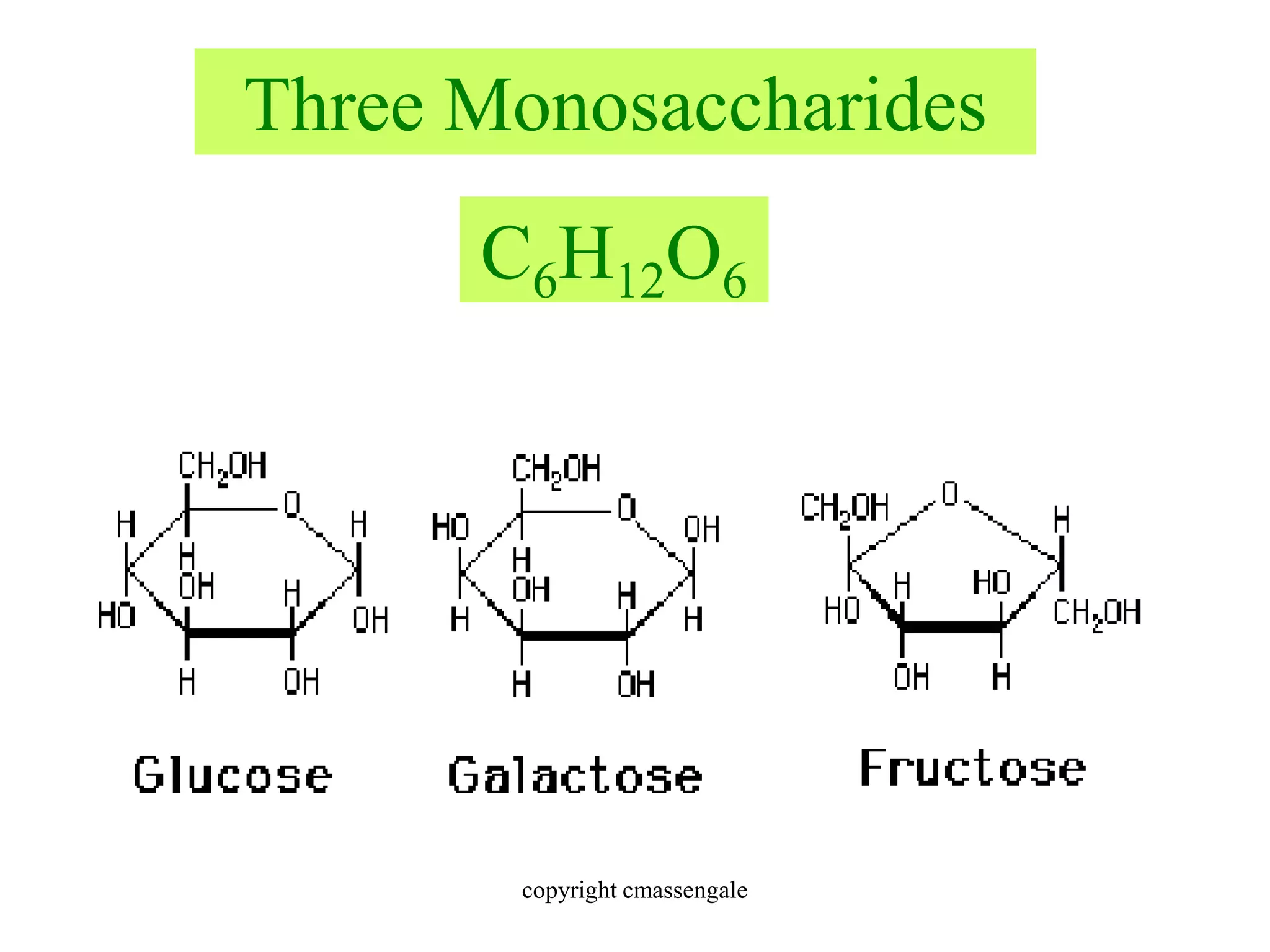
Three Monosaccharides
C6H12O6
copyright cmassengale
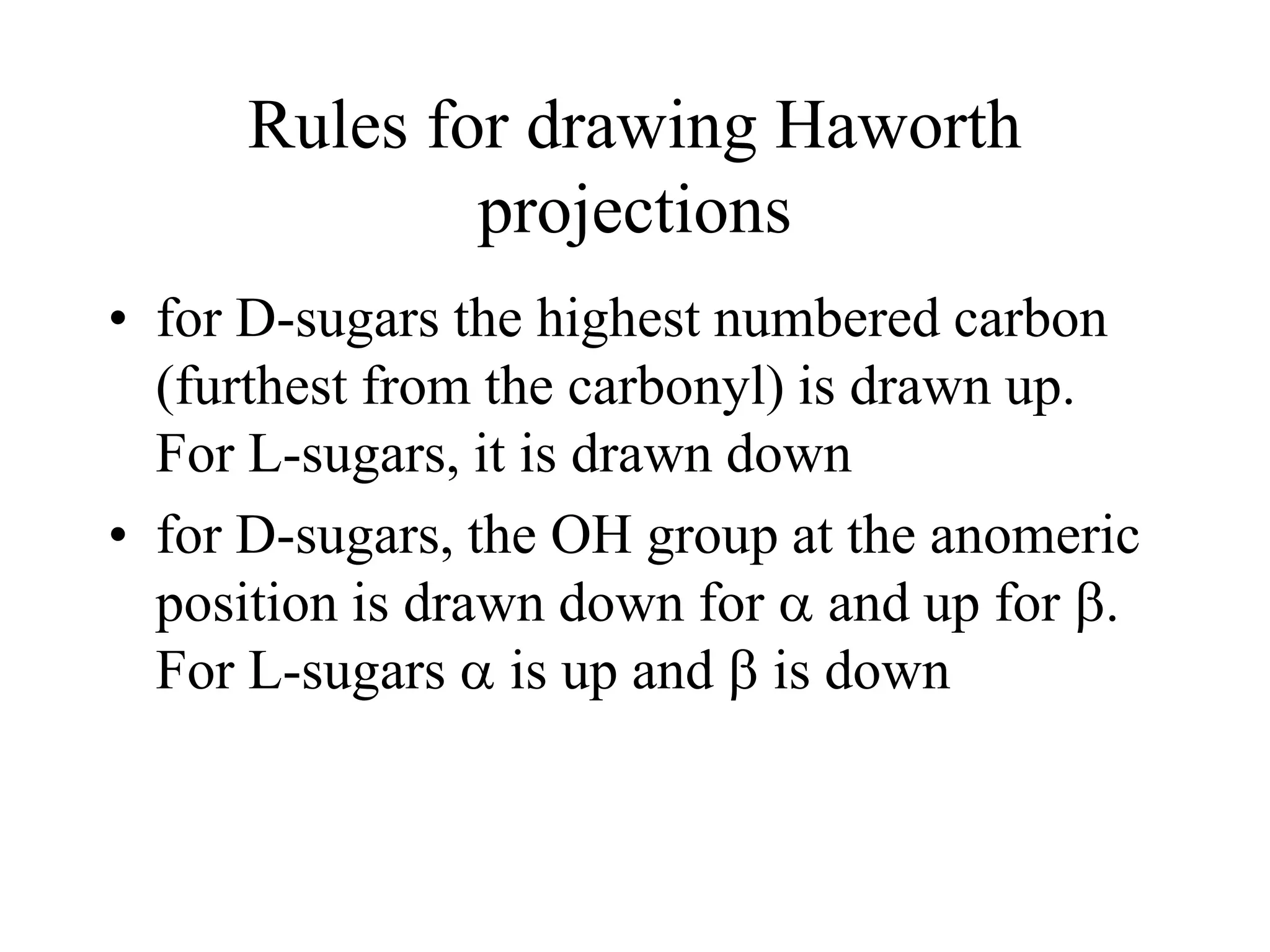
Rules for drawing Haworth
projections
• for D-sugars the highest numbered carbon
(furthest from the carbonyl) is drawn up.
For L-sugars, it is drawn down
• for D-sugars, the OH group at the anomeric
position is drawn down for  and up for b.
For L-sugars  is up and b is down
Glucose oxidase
• glucose oxidase converts glucose to gluconic acid
and hydrogen peroxide
• when the reaction is performed in the presence of
peroxidase and o-dianisidine a yellow color is
formed
• this forms the basis for the measurement of
urinary and blood glucose
• Testape, Clinistix, Diastix (urinary glucose)
• Dextrostix (venous glucose)
Reduction
• either done catalytically (hydrogen and a catalyst)
or enzymatically
• the resultant product is a polyol or sugar alcohol
(alditol)
• glucose form sorbitol (glucitol)
• mannose forms mannitol
• fructose forms a mixture of mannitol and sorbitol
• glyceraldehyde gives glycerol
Glycosidic Bonds
The anomeric hydroxyl and a hydroxyl of another sugar
or some other compound can join together, splitting out
water to form a glycosidic bond:
R-OH + HO-R'  R-O-R' + H2O
E.g., methanol reacts with the anomeric OH on glucose
to form methyl glucoside (methyl-glucopyranose).
O
H
HO
H
HO
H
OH
OHH
H
OH
-D-glucopyranose
O
H
HO
H
HO
H
OCH3
OHH
H
OH
methyl--D-glucopyranose
CH3-OH+
methanol
H2O
CH2OH
O
HHO
OHH
OHH
CH2OH
D-fructose
CH2OH
OH
H
CH2OH
OH H
H OH
O
beta-D-fructofuranose
OH
CH2OH
H
CH2OH
OH H
H OH
O
alpha-D-fructofuranose
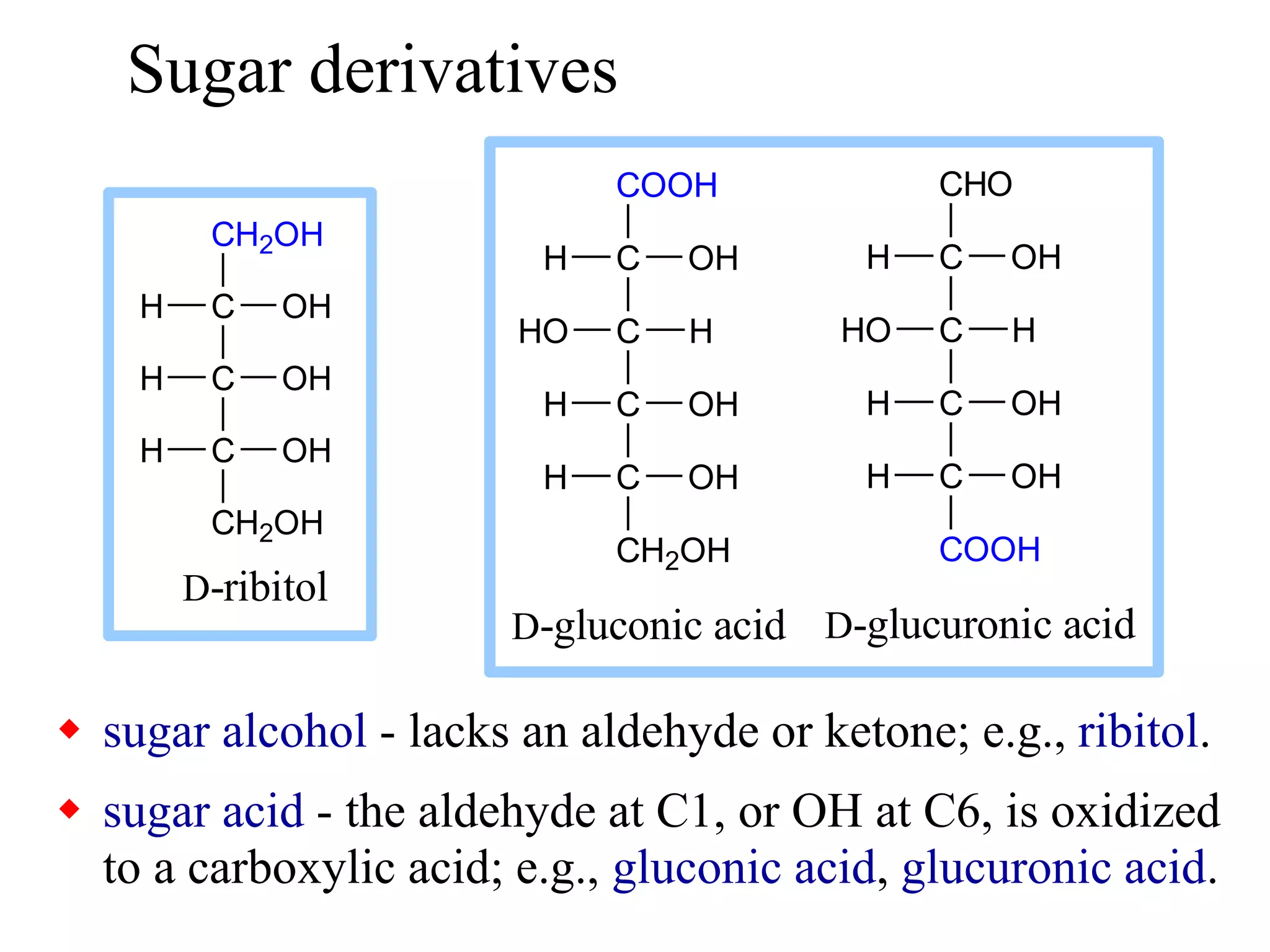
Sugar derivatives
 sugar alcohol - lacks an aldehyde or ketone; e.g., ribitol.
 sugar acid - the aldehyde at C1, or OH at C6, is oxidized
to a carboxylic acid; e.g., gluconic acid, glucuronic acid.
CH2OH
C
C
C
CH2OH
H OH
H OH
H OH
D-ribitol
COOH
C
C
C
C
H OH
HO H
H OH
D-gluconic acid D-glucuronic acid
CH2OH
OHH
CHO
C
C
C
C
H OH
HO H
H OH
COOH
OHH
Sugar derivatives
amino sugar - an amino group substitutes for a hydroxyl.
An example is glucosamine.
The amino group may be acetylated, as in
N-acetylglucosamine.
H O
OH
H
OH
H
NH2H
OH
CH2OH
H
-D-glucosamine
H O
OH
H
OH
H
NH
OH
CH2OH
H
-D-N-acetylglucosamine
C CH3
O
H
The anomeric forms of
methyl-D-glucoside
Cellobiose, a product of cellulose breakdown, is the
otherwise equivalent b anomer (O on C1 points up).
The b(1 4) glycosidic linkage is represented as a zig-zag,
but one glucose is actually flipped over relative to the other.
H O
OH
H
OHH
OH
CH2OH
H
O H
OH
H
OHH
OH
CH2OH
H
O
HH
1
23
5
4
6
1
23
4
5
6
maltose
H O
OH
H
OHH
OH
CH2OH
H
O OH
H
H
OHH
OH
CH2OH
H
H
H
O1
23
4
5
6
1
23
4
5
6
cellobiose
Disaccharides:
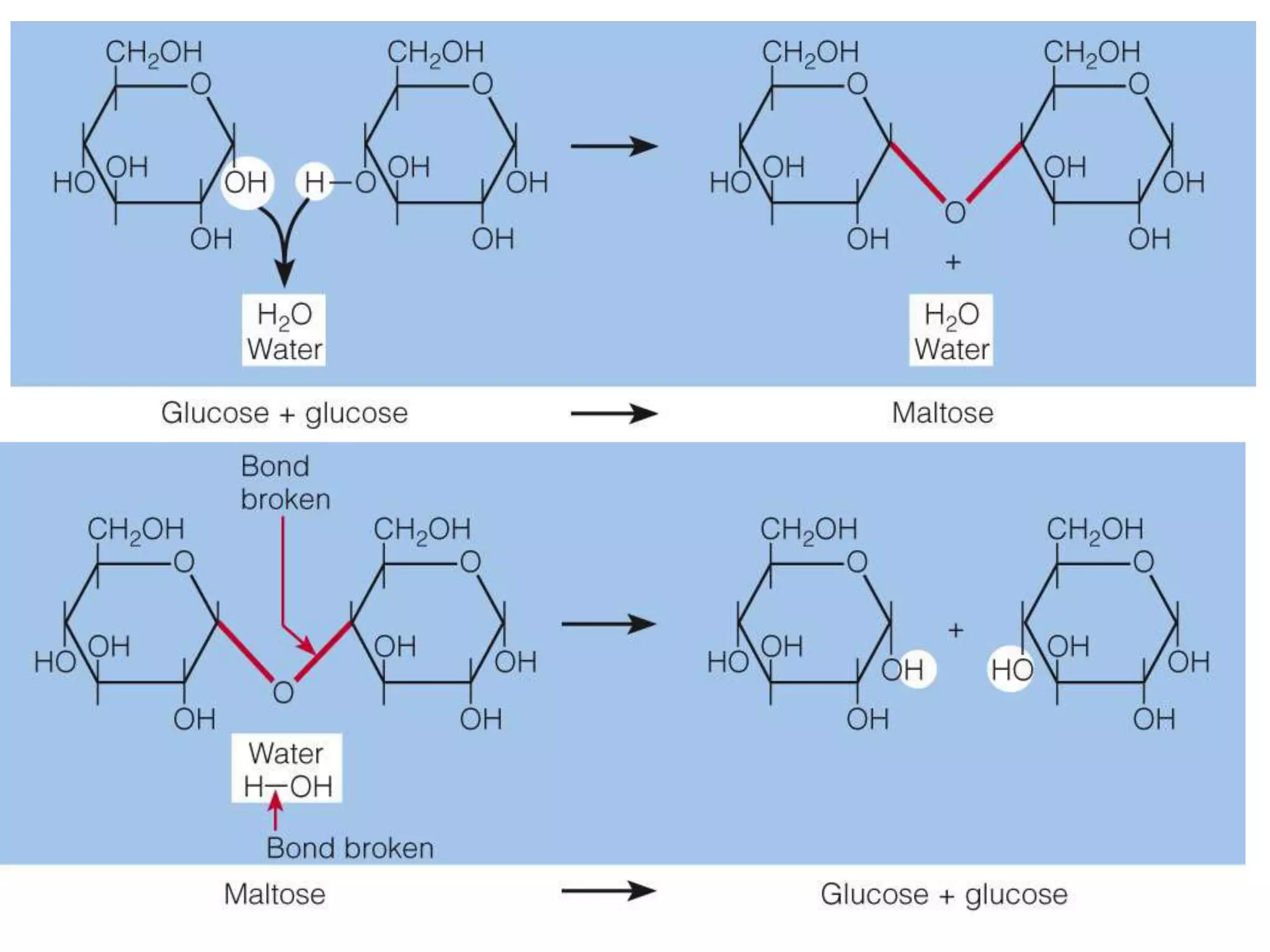
Maltose, a cleavage
product of starch
(e.g., amylose), is a
disaccharide with an
(1 4) glycosidic
link between C1 - C4
OH of 2 glucoses.
It is the  anomer
(C1 O points down).
Other disaccharides include:
 Sucrose, common table sugar, has a glycosidic bond
linking the anomeric hydroxyls of glucose & fructose.
Because the configuration at the anomeric C of glucose
is  (O points down from ring), the linkage is (12).
The full name of sucrose is -D-glucopyranosyl-(12)-
b-D-fructopyranose.)
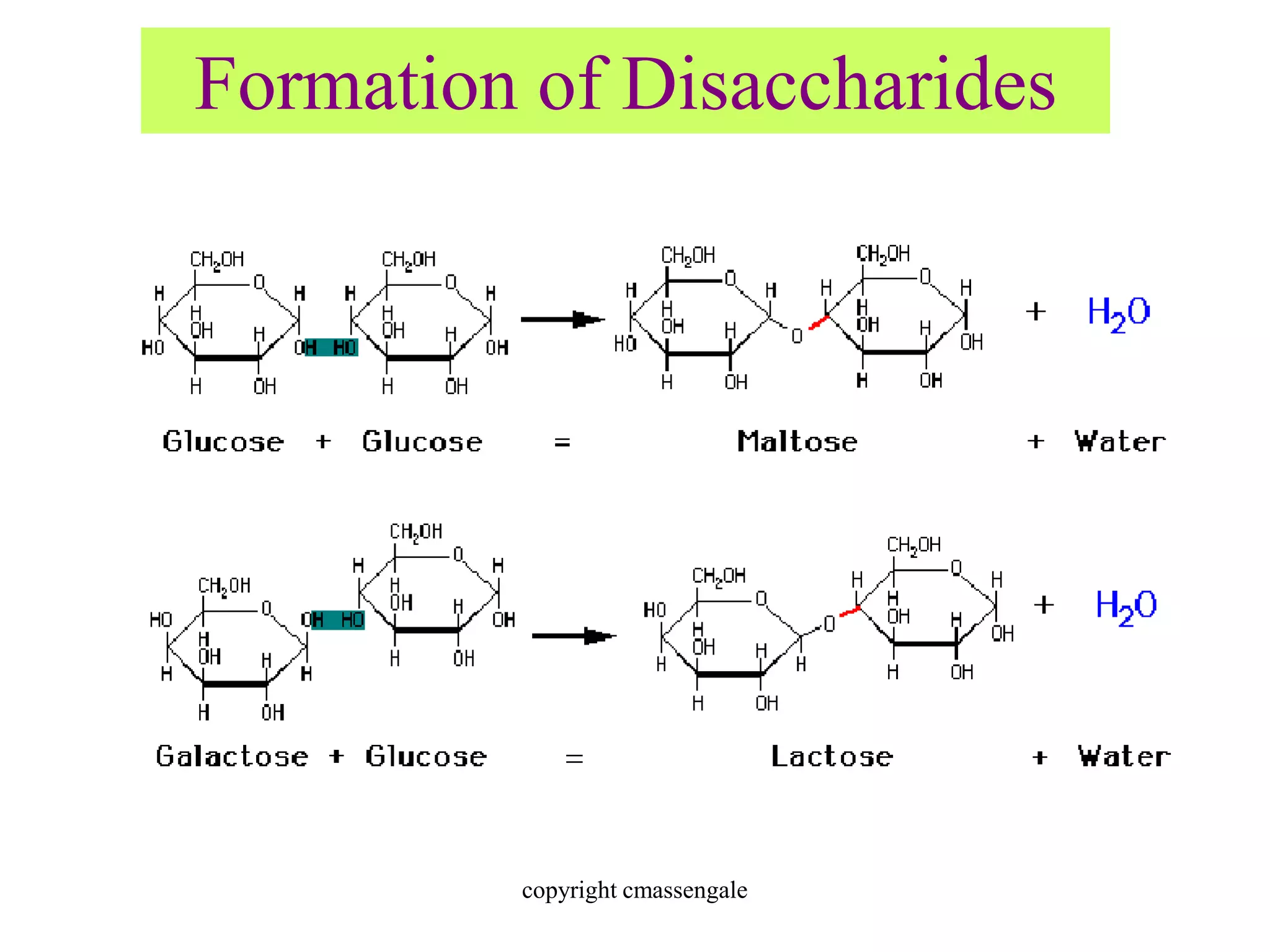
 Lactose, milk sugar, is composed of galactose &
glucose, with b(14) linkage from the anomeric OH of
galactose. Its full name is b-D-galactopyranosyl-(1 4)-
-D-glucopyranose
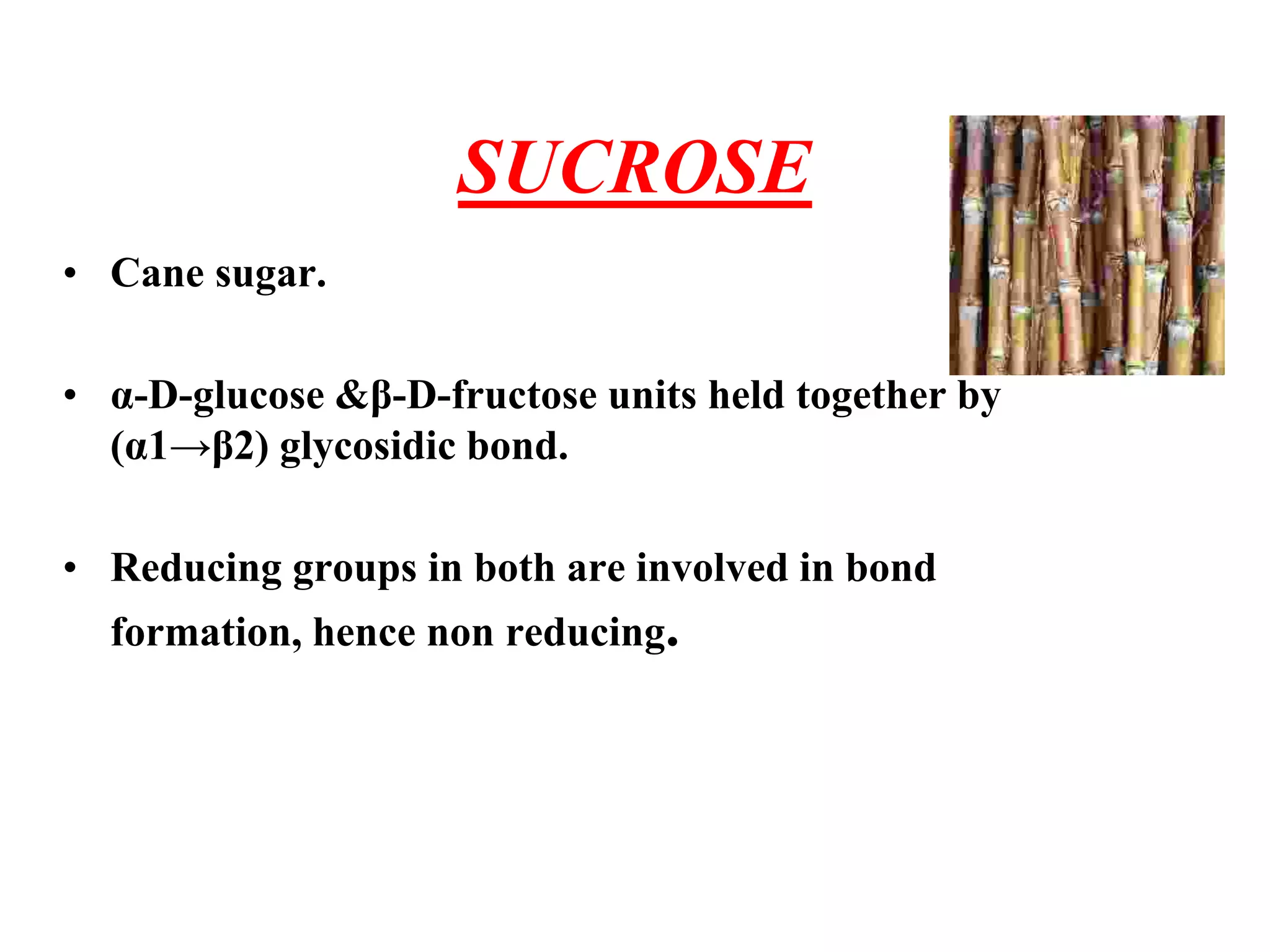
SUCROSE
• Cane sugar.
• α-D-glucose &β-D-fructose units held together by
(α1→β2) glycosidic bond.
• Reducing groups in both are involved in bond
formation, hence non reducing.
LACTOSE
Principal sugar in milk
O
OH
OH
CH2 OH
O
OH
OH
CH2 OH
O
OH
OH
β-D-galactose & β-D-glucose units held
together by β(1→4) glycosidic bond.
• Reducing:Maltose, Lactose –with free
aldehyde or keto group.
• Non-reducing:Sucrose, Trehalose –no
free aldehyde or keto group.
Sucrose
2-0--D-Glucopyranosyl b-D-Fructofuranoside
O
OH
OH
HO
CH2 OH
CH2OH
O
CH2OH
O
HO
OH
H
1
2
3 4
5
6
Invert Sugar --- when sucrose in solution, the rotation changes
from detrorotatory (+66.5) to levorotatory (-19.8). So, sucrose is
called “Invert Sugar”. Sucrose has been hydrolyzed into glucose
and fructose.
Oligosaccharides
• Most common are the disaccharides
• Sucrose, lactose, and maltose
• Maltose hydrolyzes to 2 molecules of D-glucose
• Lactose hydrolyzes to a molecule of glucose and a
molecule of galactose
• Sucrose hydrolyzes to a moledule of glucose and a
molecule of fructose
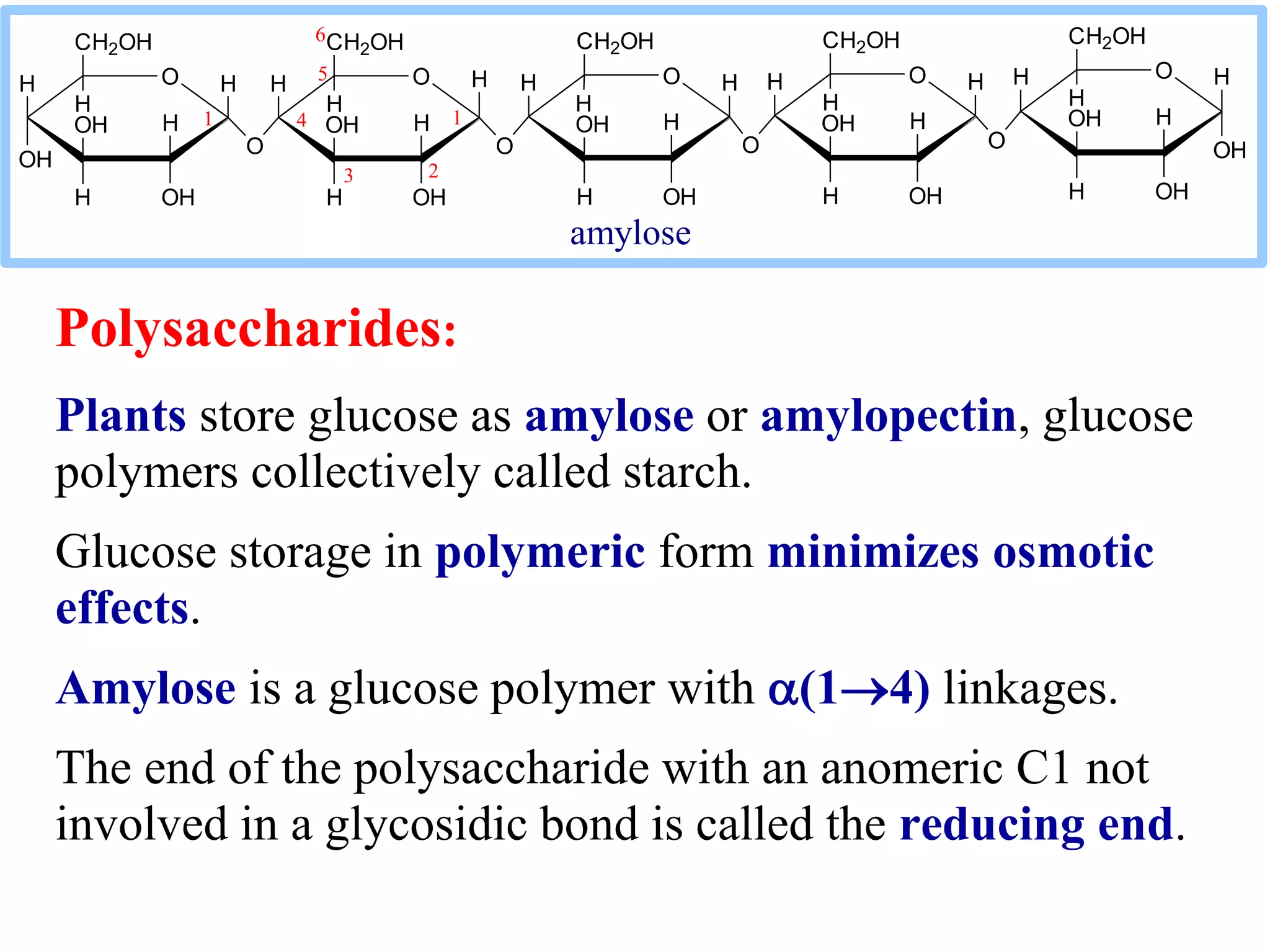
Polysaccharides:
Plants store glucose as amylose or amylopectin, glucose
polymers collectively called starch.
Glucose storage in polymeric form minimizes osmotic
effects.
Amylose is a glucose polymer with (14) linkages.
The end of the polysaccharide with an anomeric C1 not
involved in a glycosidic bond is called the reducing end.
H O
OH
H
OHH
OH
CH2OH
H
O H
H
OHH
OH
CH2OH
H
O
HH H O
O
H
OHH
OH
CH2OH
H
H H O
H
OHH
OH
CH2OH
H
OH
HH O
O
H
OHH
OH
CH2OH
H
O
H
1
6
5
4
3
1
2
amylose
Dehydration Synthesis
of a Disaccharide
copyright cmassengale
Formation of Disaccharides
copyright cmassengale
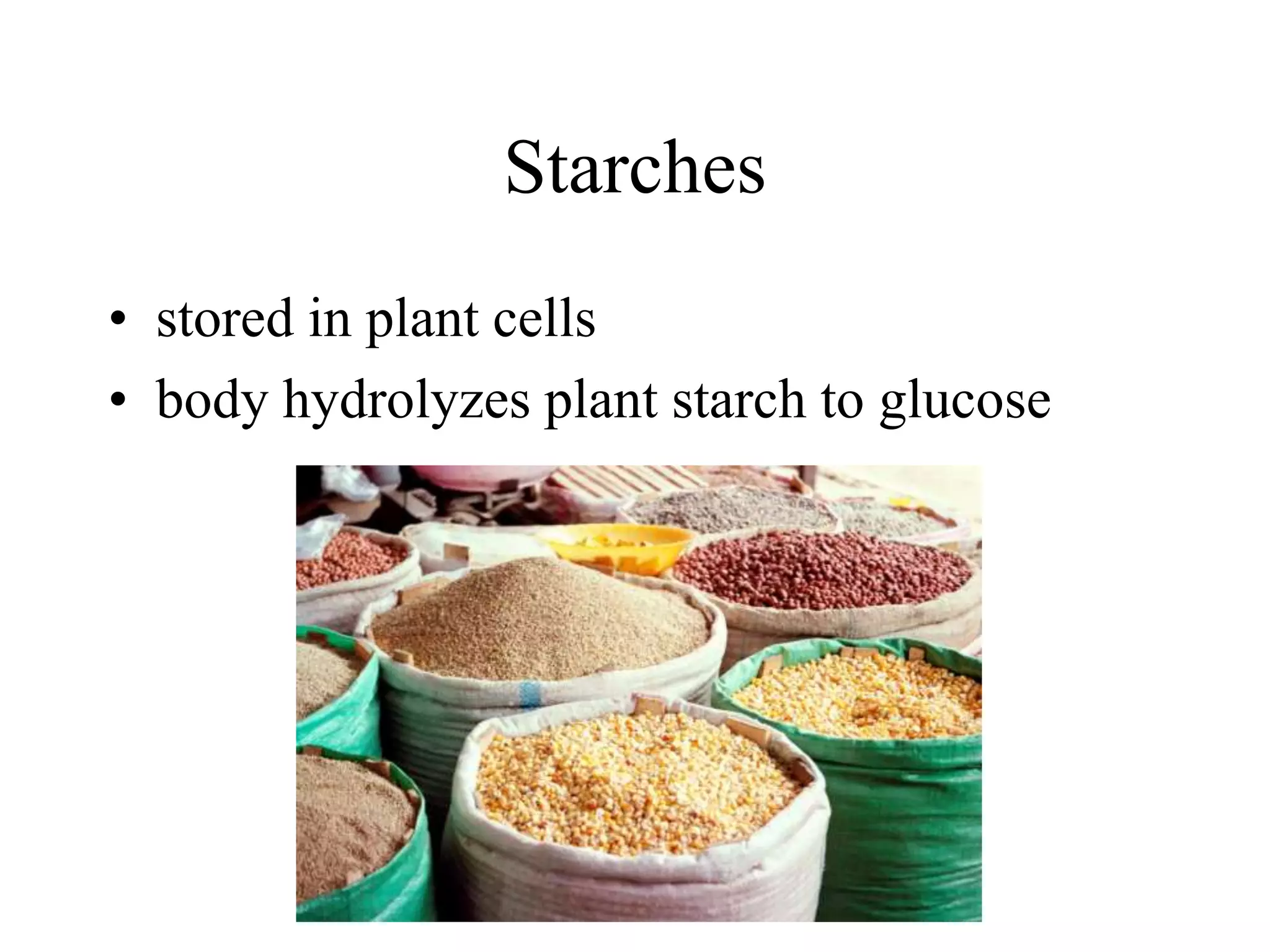
Starches
• stored in plant cells
• body hydrolyzes plant starch to glucose
Starch
• most common storage polysaccharide in
plants
• composed of 10 – 30% -amylose and 70-
90% amylopectin depending on the source
• the chains are of varying length, having
molecular weights from several thousands
to half a million
Polysaccharides
starch
cellulose
Starch 20% amylose (water soluble)
80% amylopectin (water insoluble)
amylose + H2O  (+)-maltose
(+)-maltose + H2O  (+)-glucose
starch is a poly glucose (alpha-glucoside to C-4)
O
O
O
O
O
O
O
O
O
O
O
O
O
O
O
O
Amylose and amylopectin are the 2 forms of starch. Amylopectin
is a highly branched structure, with branches occurring every 12
to 30 residues
Amylopectin is a glucose polymer with mainly (14)
linkages, but it also has branches formed by (16)
linkages. Branches are generally longer than shown above.
The branches produce a compact structure & provide
multiple chain ends at which enzymatic cleavage can occur.
H O
OH
H
OHH
OH
CH2OH
H
O H
H
OHH
OH
CH2OH
H
O
HH H O
O
H
OHH
OH
CH2
H
H H O
H
OHH
OH
CH2OH
H
OH
HH O
O
H
OHH
OH
CH2OH
H
O
H
O
1 4
6
H O
H
OHH
OH
CH2OH
H
H H O
H
OHH
OH
CH2OH
H
H
O
1
OH
3
4
5
2
amylopectin
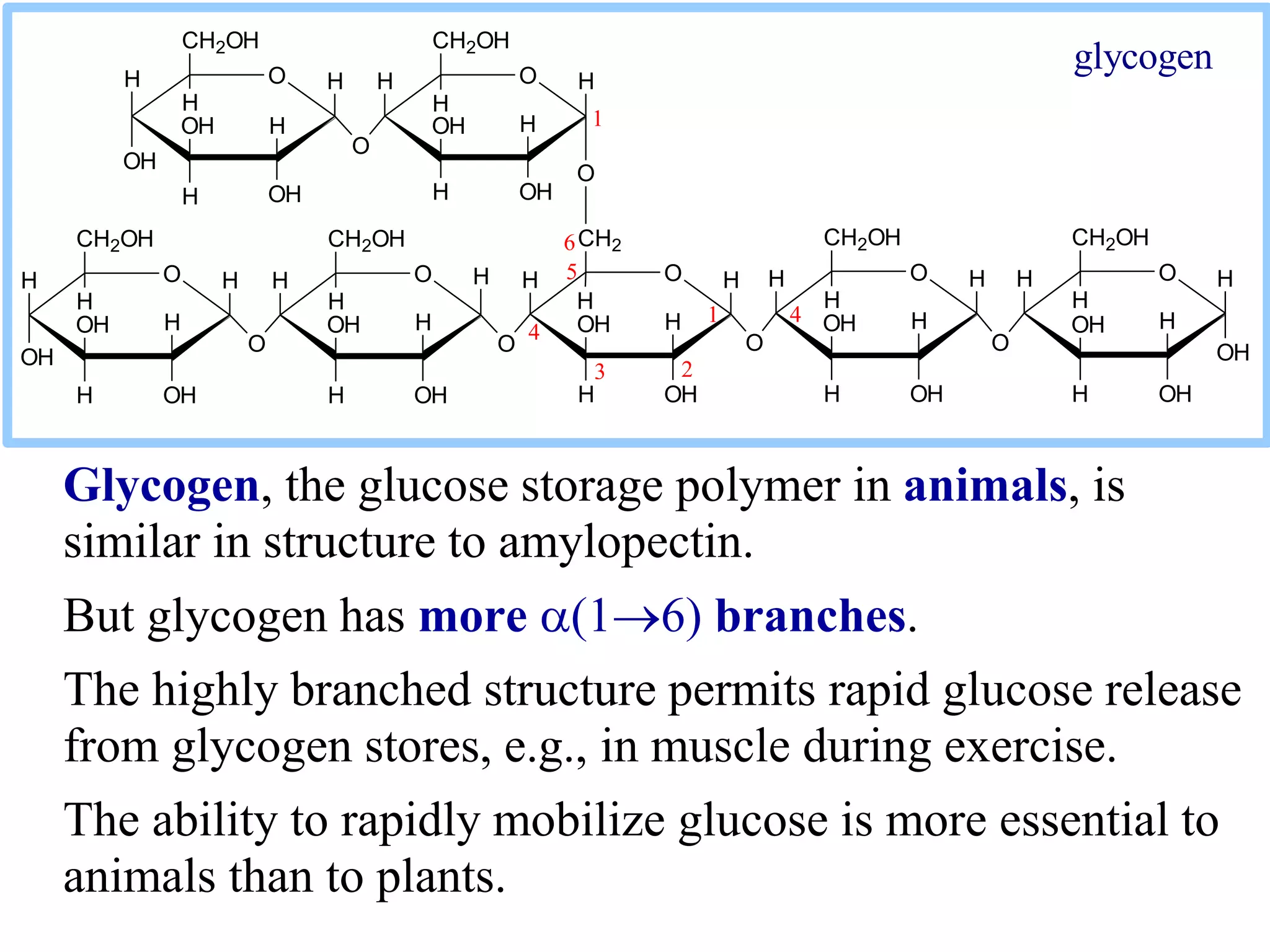
Glycogen, the glucose storage polymer in animals, is
similar in structure to amylopectin.
But glycogen has more (16) branches.
The highly branched structure permits rapid glucose release
from glycogen stores, e.g., in muscle during exercise.
The ability to rapidly mobilize glucose is more essential to
animals than to plants.
H O
OH
H
OHH
OH
CH2OH
H
O H
H
OHH
OH
CH2OH
H
O
HH H O
O
H
OHH
OH
CH2
H
H H O
H
OHH
OH
CH2OH
H
OH
HH O
O
H
OHH
OH
CH2OH
H
O
H
O
1 4
6
H O
H
OHH
OH
CH2OH
H
H H O
H
OHH
OH
CH2OH
H
H
O
1
OH
3
4
5
2
glycogen
Cellulose
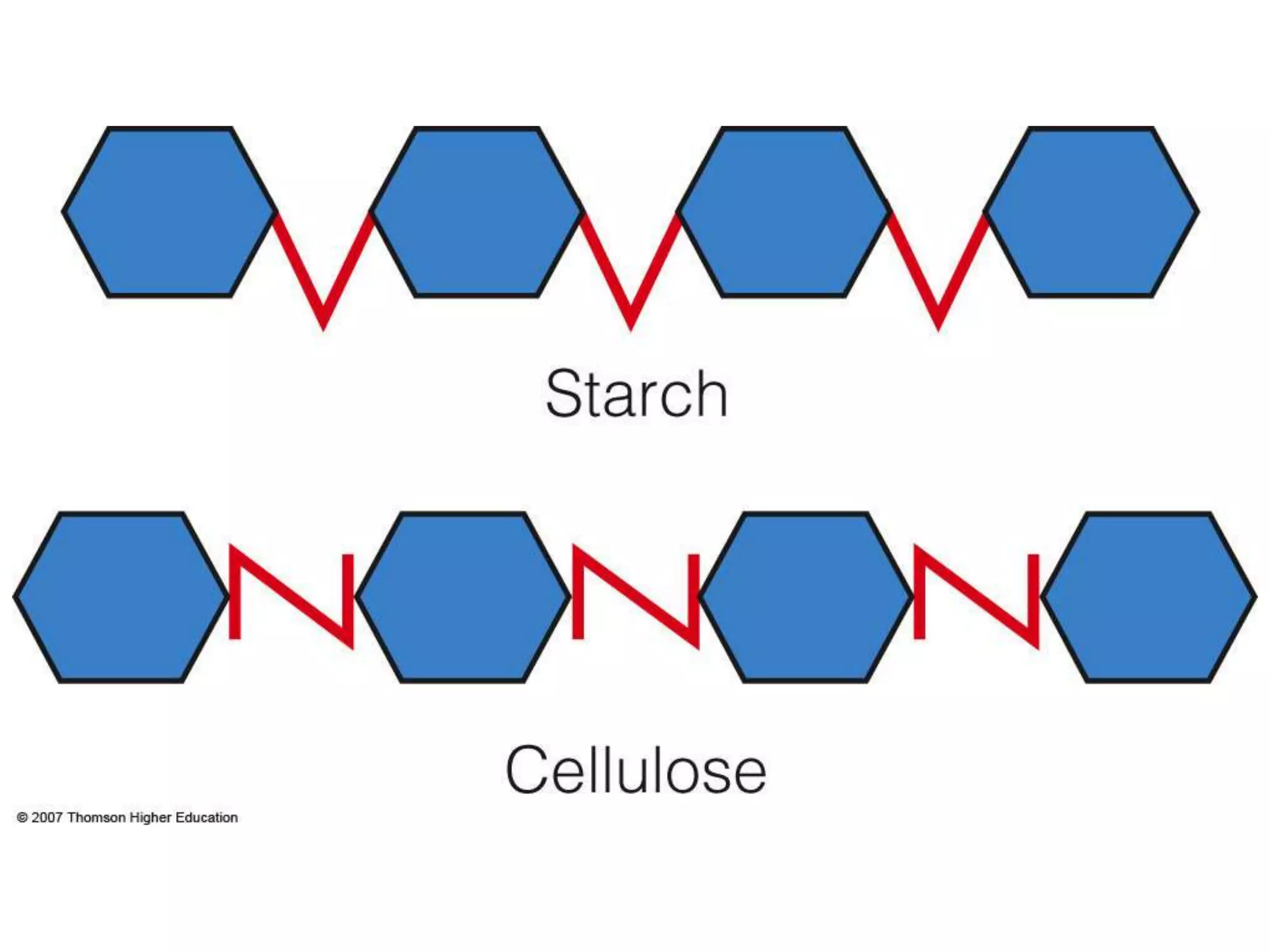
• Polymer of b-D-glucose attached by b(1,4) linkages
• Only digested and utilized by ruminants (cows, deers,
giraffes, camels)
• A structural polysaccharide
• Yields glucose upon complete hydrolysis
• Partial hydrolysis yields cellobiose
• Most abundant of all carbohydrates
• Cotton flax: 97-99% cellulose
• Wood: ~ 50% cellulose
• Gives no color with iodine
• Held together with lignin in woody plant tissues
Cellulose, a major constituent of plant cell walls, consists
of long linear chains of glucose with b(14) linkages.
Every other glucose is flipped over, due to b linkages.
This promotes intra-chain and inter-chain H-bonds and
cellulose
H O
OH
H
OHH
OH
CH2OH
H
O
H
OHH
OH
CH2OH
H
O
H H O
O H
OHH
OH
CH2OH
H
H O
H
OHH
OH
CH2OH
H
H
OHH O
O H
OHH
OH
CH2OH
H
O
H H H H
1
6
5
4
3
1
2
van der Waals interactions,
that cause cellulose chains to
be straight & rigid, and pack
with a crystalline arrangement
in thick bundles - microfibrils.
See: Botany online website;
website at Georgia Tech.
Schematic of arrangement of
cellulose chains in a microfibril.
Glycogen
• also known as animal starch
• stored in muscle and liver (mostly)
• present in cells as granules (high MW)
• contains both (1,4) links and (1,6) branches at
every 8 to 12 glucose unit (more frequent than in
starch)
• complete hydrolysis yields glucose
• glycogen and iodine gives a red-violet color
• hydrolyzed by both  and b-amylases and by
glycogen phosphorylase
‫الصغائكم‬ ‫ا‬‫ر‬‫شك‬
‫بوك‬ ‫الفيس‬:‫د‬.‫محمد‬ ‫طه‬ ‫مصطفى‬
‫االلكتروني‬ ‫البريد‬:Tahabiochem@yahoo.com

2017-2018محاضرات الكاربوهيدرات

  • 1.
  • 2.
  • 3.
    DEFINITION Carbohydrates are polyhydroxyaldehydes or ketones or compounds which yield these on hydrolysis.
  • 4.
    Functions • sources ofenergy • intermediates in the biosynthesis of other basic biochemical entities (fats and proteins) • associated with other entities such as glycosides, vitamins and antibiotics) • form structural tissues in plants and in microorganisms (cellulose, lignin, murein) • participate in biological transport, cell-cell recognition, activation of growth factors, modulation of the immune system
  • 5.
    Glucose (a monosaccharide) Plants: photosynthesis chlorophyll 6CO2 + 6 H2O C6H12O6 + 6 O2 sunlight (+)-glucose (+)-glucose starch or cellulose respiration C6H12O6 + 6 O2 6 CO2 + 6 H2O + energy
  • 6.
    Carbohydrates • glucose providesenergy for the brain and ½ of energy for muscles and tissues • glycogen is stored glucose • glucose is immediate energy • glycogen is reserve energy
  • 7.
    Carbohydrates – polyhydroxyaldehydesor polyhydroxy-ketones of formula (CH2O)n, or compounds that can be hydrolyzed to them. (aka sugars or saccharides) Monosaccharides – carbohydrates that cannot be hydrolyzed to simpler carbohydrates; eg. Glucose or fructose. Disaccharides – carbohydrates that can be hydrolyzed into two monosaccharide units; eg. Sucrose, which is hydrolyzed into glucose and fructose. Oligosaccharides – carbohydrates that can be hydrolyzed into a few monosaccharide units. Polysaccharides – carbohydrates that are are polymeric sugars; eg Starch or cellulose. Classification of carbohydrates
  • 8.
    Monosaccharides • also knownas simple sugars • classified by 1. the number of carbons and 2. whether aldoses or ketoses • most (99%) are straight chain compounds • D-glyceraldehyde is the simplest of the aldoses (aldotriose) • all other sugars have the ending ose (glucose, galactose, ribose, lactose, etc…)
  • 10.
    Glucose The chemical formula forglucose is C6H12O6. It is a six sided ring. The structure on the left is a simplified structure of glucose
  • 11.
    Monosaccharides Aldoses (e.g., glucose)have an aldehyde group at one end. Ketoses (e.g., fructose) have a keto group, usually at C2. C C OHH C HHO C OHH C OHH CH2OH D-glucose OH C HHO C OHH C OHH CH2OH CH2OH C O D-fructose
  • 12.
    • Compounds havingsame structural formula, but differ in spatial configuration. • Asymmetric Carbon atom:Attached to four different atoms or groups. • Vant Hoff’s rule: The possible isomers (2n) of a given compound is determined by the number of asymmetric carbon atoms (n). • Reference C atom: Penultimate C atom, around which mirror images are formed. chiral centers by definition are C atoms which have 4 DIFFERENT atoms bonded to it
  • 13.
    Sugar Nomenclature For sugarswith more than one chiral center, D or L refers to the asymmetric C farthest from the aldehyde or keto group. Most naturally occurring sugars are D isomers. O H O H C C H – C – OH HO – C – H HO – C – H H – C – OH H – C – OH HO – C – H H – C – OH HO – C – H CH2OH CH2OH D-glucose L-glucose
  • 14.
    D & Lsugars are mirror images of one another. They have the same name, e.g., D-glucose & L-glucose. Other stereoisomers have unique names, e.g., glucose, mannose, galactose, etc. The number of stereoisomers is 2n, where n is the number of asymmetric centers. The 6-C aldoses have 4 asymmetric centers. Thus there are 16 stereoisomers (8 D-sugars and 8 L-sugars). O H O H C C H – C – OH HO – C – H HO – C – H H – C – OH H – C – OH HO – C – H H – C – OH HO – C – H CH2OH CH2OH D-glucose L-glucose
  • 15.
    D vs LDesignation D & L designations are based on the configuration about the single asymmetric C in glyceraldehyde. The lower representations are Fischer Projections. CHO C CH2OH HO H CHO C CH2OH H OH CHO C CH2OH HO H CHO C CH2OH H OH L-glyceraldehydeD-glyceraldehyde L-glyceraldehydeD-glyceraldehyde
  • 17.
    Enantiomres A special typeof isomerism is found in the pairs of structures that are mirror images of each other. These mirror images are called enantiomers, and the two members of the pair are designated as a D- and an L-sugar two monosaccharides differ in configuration around only one specific carbon atom (with the exception of the carbonyl carbon, see below), they are defined as epimers of each other.
  • 18.
    (+)-glucose? An aldohexose EmilFischer (1902) Four chiral centers, 24 = 16 stereoisomers CHO CH2OH OH? CH2CHCHCHCHCH O OH OHOHOHOH * * * *
  • 19.
    Fructose forms either a 6-member pyranose ring, by reaction of the C2 keto group with the OH on C6, or  a 5-member furanose ring, by reaction of the C2 keto group with the OH on C5. CH2OH C O C HHO C OHH C OHH CH2OH HOH2C OH CH2OH H OH H H HO O 1 6 5 4 3 2 6 5 4 3 2 1 D-fructose (linear) -D-fructofuranose
  • 20.
    Epimers – stereoisomersthat differ only in configuration about one chiral center. CHO OHH HHO OHH OHH CH2OH D-glucose CHO HHO HHO OHH OHH CH2OH D-mannose epimers Sugars are different from one another, only in configuration with regard to a single C atom (other than the reference C atom).
  • 21.
    C CH2OH OHH C O H C OHH C CH2OH HOH CO H C HOH these two aldotetroses are enantiomers. They are stereoisomers that are mirror images of each other C O H C HHO C HHO CH OH C CH2OH OHH C O H C HHO C HHO CHO H C CH2OH OHH these two aldohexoses are C-4 epimers. they differ only in the position of the hydroxyl group on one asymmetric carb (carbon 4) Enantiomers and epimers
  • 22.
    • OPTICAL ACTIVITY •Dextrorotatory (+) :If the sugar solution turns the plane of polarized light to right. . Levorotatory (–) :If the sugar solution turns the plane of polarized light to left. • Racemic mixture:Equimolar mixture of optical isomers has no net rotation.
  • 23.
    Hemiacetal & hemiketalformation An aldehyde can react with an alcohol to form a hemiacetal. A ketone can react with an alcohol to form a hemiketal. O C H R OH O C R R' OHC R R' O aldehyde alcohol hemiacetal ketone alcohol hemiketal C H R O R'R' OH "R OH "R + +
  • 24.
    3. Fructose (levulsoe)--- Rotation in polarimeter is left D-Fructose b-D-Fructose -D-Fructose CH2OH O CH2OH C HO HC OHCH H C OH O CH2OH C HO HC OHCH H C CH2OHCH2OH CH HO H C OH C HHO C OH CH2OH O or
  • 25.
    Anomers: Stereoisomers formedwhen ring is formed (, b). C O CH2OH OHCH HO H HC OH OH CH HO HO HC OH C H H C OH C H H HO H C CH2OH O C C O CH2OH CH HO H HC OHCH HC OH or  is same side with ring
  • 26.
    Rules for drawingHaworth projections • next number the ring clockwise starting next to the oxygen • if the substituent is to the right in the Fisher projection, it will be drawn down in the Haworth projection (Down-Right Rule) O O 1 23 4 5 1 23 4
  • 27.
    Rules for drawingHaworth projections • draw either a six or 5-membered ring including oxygen as one atom • most aldohexoses are six-membered • aldotetroses, aldopentoses, ketohexoses are 5-membered O O
  • 28.
    Pentoses and hexoses cancyclize as the ketone or aldehyde reacts with a distal OH. Glucose forms an intra-molecular hemiacetal, as the C1 aldehyde & C5 OH react, to form a 6-member pyranose ring, named after pyran. These representations of the cyclic sugars are called Haworth projections. H O OH H OHH OH CH2OH H OH H H O OH H OHH OH CH2OH H H OH -D-glucose b-D-glucose 23 4 5 6 1 1 6 5 4 3 2 H CHO C OH C HHO C OHH C OHH CH2OH 1 5 2 3 4 6 D-glucose (linear form)
  • 29.
    D-glucose can cyclizein two ways forming either furanose or pyranose structures
  • 30.
    D-ribose and otherfive-carbon saccharides can form either furanose or pyranose structures
  • 31.
    Cyclization of glucoseproduces a new asymmetric center at C1. The 2 stereoisomers are called anomers,  & b. Haworth projections represent the cyclic sugars as having essentially planar rings, with the OH at the anomeric C1:   (OH below the ring)  b (OH above the ring). H O OH H OHH OH CH2OH H -D-glucose OH H H O OH H OHH OH CH2OH H H OH b-D-glucose 23 4 5 6 1 1 6 5 4 3 2
  • 32.
    Structural representation ofsugars • Fisher projection: straight chain representation • Haworth projection: simple ring in perspective • Conformational representation: chair and boat configurations
  • 33.
    Different Forms ofGlucose copyright cmassengale
  • 34.
    Oxygen of thehydroxyl group is removed to form deoxy sugars. 􀁺 Non reducing and non osazone forming. 􀁺 Important part of nucleic acids.
  • 35.
  • 36.
    Rules for drawingHaworth projections • for D-sugars the highest numbered carbon (furthest from the carbonyl) is drawn up. For L-sugars, it is drawn down • for D-sugars, the OH group at the anomeric position is drawn down for  and up for b. For L-sugars  is up and b is down
  • 37.
    Glucose oxidase • glucoseoxidase converts glucose to gluconic acid and hydrogen peroxide • when the reaction is performed in the presence of peroxidase and o-dianisidine a yellow color is formed • this forms the basis for the measurement of urinary and blood glucose • Testape, Clinistix, Diastix (urinary glucose) • Dextrostix (venous glucose)
  • 38.
    Reduction • either donecatalytically (hydrogen and a catalyst) or enzymatically • the resultant product is a polyol or sugar alcohol (alditol) • glucose form sorbitol (glucitol) • mannose forms mannitol • fructose forms a mixture of mannitol and sorbitol • glyceraldehyde gives glycerol
  • 40.
    Glycosidic Bonds The anomerichydroxyl and a hydroxyl of another sugar or some other compound can join together, splitting out water to form a glycosidic bond: R-OH + HO-R'  R-O-R' + H2O E.g., methanol reacts with the anomeric OH on glucose to form methyl glucoside (methyl-glucopyranose). O H HO H HO H OH OHH H OH -D-glucopyranose O H HO H HO H OCH3 OHH H OH methyl--D-glucopyranose CH3-OH+ methanol H2O
  • 42.
  • 43.
    Sugar derivatives  sugaralcohol - lacks an aldehyde or ketone; e.g., ribitol.  sugar acid - the aldehyde at C1, or OH at C6, is oxidized to a carboxylic acid; e.g., gluconic acid, glucuronic acid. CH2OH C C C CH2OH H OH H OH H OH D-ribitol COOH C C C C H OH HO H H OH D-gluconic acid D-glucuronic acid CH2OH OHH CHO C C C C H OH HO H H OH COOH OHH
  • 44.
    Sugar derivatives amino sugar- an amino group substitutes for a hydroxyl. An example is glucosamine. The amino group may be acetylated, as in N-acetylglucosamine. H O OH H OH H NH2H OH CH2OH H -D-glucosamine H O OH H OH H NH OH CH2OH H -D-N-acetylglucosamine C CH3 O H
  • 45.
    The anomeric formsof methyl-D-glucoside
  • 46.
    Cellobiose, a productof cellulose breakdown, is the otherwise equivalent b anomer (O on C1 points up). The b(1 4) glycosidic linkage is represented as a zig-zag, but one glucose is actually flipped over relative to the other. H O OH H OHH OH CH2OH H O H OH H OHH OH CH2OH H O HH 1 23 5 4 6 1 23 4 5 6 maltose H O OH H OHH OH CH2OH H O OH H H OHH OH CH2OH H H H O1 23 4 5 6 1 23 4 5 6 cellobiose Disaccharides: Maltose, a cleavage product of starch (e.g., amylose), is a disaccharide with an (1 4) glycosidic link between C1 - C4 OH of 2 glucoses. It is the  anomer (C1 O points down).
  • 48.
    Other disaccharides include: Sucrose, common table sugar, has a glycosidic bond linking the anomeric hydroxyls of glucose & fructose. Because the configuration at the anomeric C of glucose is  (O points down from ring), the linkage is (12). The full name of sucrose is -D-glucopyranosyl-(12)- b-D-fructopyranose.)  Lactose, milk sugar, is composed of galactose & glucose, with b(14) linkage from the anomeric OH of galactose. Its full name is b-D-galactopyranosyl-(1 4)- -D-glucopyranose
  • 49.
    SUCROSE • Cane sugar. •α-D-glucose &β-D-fructose units held together by (α1→β2) glycosidic bond. • Reducing groups in both are involved in bond formation, hence non reducing.
  • 50.
    LACTOSE Principal sugar inmilk O OH OH CH2 OH O OH OH CH2 OH O OH OH β-D-galactose & β-D-glucose units held together by β(1→4) glycosidic bond.
  • 51.
    • Reducing:Maltose, Lactose–with free aldehyde or keto group. • Non-reducing:Sucrose, Trehalose –no free aldehyde or keto group.
  • 52.
    Sucrose 2-0--D-Glucopyranosyl b-D-Fructofuranoside O OH OH HO CH2 OH CH2OH O CH2OH O HO OH H 1 2 34 5 6 Invert Sugar --- when sucrose in solution, the rotation changes from detrorotatory (+66.5) to levorotatory (-19.8). So, sucrose is called “Invert Sugar”. Sucrose has been hydrolyzed into glucose and fructose.
  • 53.
    Oligosaccharides • Most commonare the disaccharides • Sucrose, lactose, and maltose • Maltose hydrolyzes to 2 molecules of D-glucose • Lactose hydrolyzes to a molecule of glucose and a molecule of galactose • Sucrose hydrolyzes to a moledule of glucose and a molecule of fructose
  • 54.
    Polysaccharides: Plants store glucoseas amylose or amylopectin, glucose polymers collectively called starch. Glucose storage in polymeric form minimizes osmotic effects. Amylose is a glucose polymer with (14) linkages. The end of the polysaccharide with an anomeric C1 not involved in a glycosidic bond is called the reducing end. H O OH H OHH OH CH2OH H O H H OHH OH CH2OH H O HH H O O H OHH OH CH2OH H H H O H OHH OH CH2OH H OH HH O O H OHH OH CH2OH H O H 1 6 5 4 3 1 2 amylose
  • 55.
    Dehydration Synthesis of aDisaccharide copyright cmassengale
  • 56.
  • 57.
    Starches • stored inplant cells • body hydrolyzes plant starch to glucose
  • 58.
    Starch • most commonstorage polysaccharide in plants • composed of 10 – 30% -amylose and 70- 90% amylopectin depending on the source • the chains are of varying length, having molecular weights from several thousands to half a million
  • 59.
    Polysaccharides starch cellulose Starch 20% amylose(water soluble) 80% amylopectin (water insoluble) amylose + H2O  (+)-maltose (+)-maltose + H2O  (+)-glucose starch is a poly glucose (alpha-glucoside to C-4) O O O O O O O O O O O O O O O O
  • 60.
    Amylose and amylopectinare the 2 forms of starch. Amylopectin is a highly branched structure, with branches occurring every 12 to 30 residues
  • 61.
    Amylopectin is aglucose polymer with mainly (14) linkages, but it also has branches formed by (16) linkages. Branches are generally longer than shown above. The branches produce a compact structure & provide multiple chain ends at which enzymatic cleavage can occur. H O OH H OHH OH CH2OH H O H H OHH OH CH2OH H O HH H O O H OHH OH CH2 H H H O H OHH OH CH2OH H OH HH O O H OHH OH CH2OH H O H O 1 4 6 H O H OHH OH CH2OH H H H O H OHH OH CH2OH H H O 1 OH 3 4 5 2 amylopectin
  • 62.
    Glycogen, the glucosestorage polymer in animals, is similar in structure to amylopectin. But glycogen has more (16) branches. The highly branched structure permits rapid glucose release from glycogen stores, e.g., in muscle during exercise. The ability to rapidly mobilize glucose is more essential to animals than to plants. H O OH H OHH OH CH2OH H O H H OHH OH CH2OH H O HH H O O H OHH OH CH2 H H H O H OHH OH CH2OH H OH HH O O H OHH OH CH2OH H O H O 1 4 6 H O H OHH OH CH2OH H H H O H OHH OH CH2OH H H O 1 OH 3 4 5 2 glycogen
  • 63.
    Cellulose • Polymer ofb-D-glucose attached by b(1,4) linkages • Only digested and utilized by ruminants (cows, deers, giraffes, camels) • A structural polysaccharide • Yields glucose upon complete hydrolysis • Partial hydrolysis yields cellobiose • Most abundant of all carbohydrates • Cotton flax: 97-99% cellulose • Wood: ~ 50% cellulose • Gives no color with iodine • Held together with lignin in woody plant tissues
  • 64.
    Cellulose, a majorconstituent of plant cell walls, consists of long linear chains of glucose with b(14) linkages. Every other glucose is flipped over, due to b linkages. This promotes intra-chain and inter-chain H-bonds and cellulose H O OH H OHH OH CH2OH H O H OHH OH CH2OH H O H H O O H OHH OH CH2OH H H O H OHH OH CH2OH H H OHH O O H OHH OH CH2OH H O H H H H 1 6 5 4 3 1 2 van der Waals interactions, that cause cellulose chains to be straight & rigid, and pack with a crystalline arrangement in thick bundles - microfibrils. See: Botany online website; website at Georgia Tech. Schematic of arrangement of cellulose chains in a microfibril.
  • 66.
    Glycogen • also knownas animal starch • stored in muscle and liver (mostly) • present in cells as granules (high MW) • contains both (1,4) links and (1,6) branches at every 8 to 12 glucose unit (more frequent than in starch) • complete hydrolysis yields glucose • glycogen and iodine gives a red-violet color • hydrolyzed by both  and b-amylases and by glycogen phosphorylase
  • 67.
    ‫الصغائكم‬ ‫ا‬‫ر‬‫شك‬ ‫بوك‬ ‫الفيس‬:‫د‬.‫محمد‬‫طه‬ ‫مصطفى‬ ‫االلكتروني‬ ‫البريد‬:Tahabiochem@yahoo.com