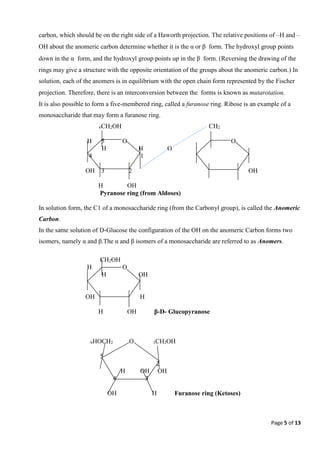
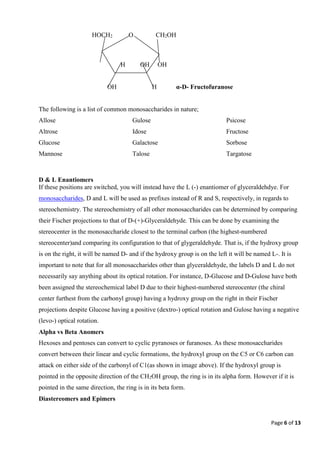
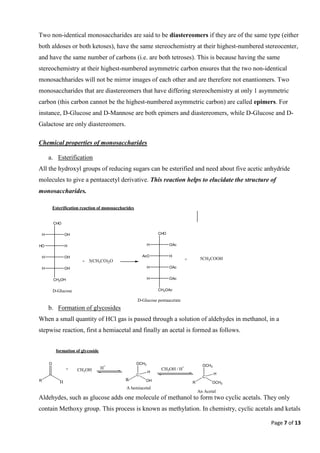
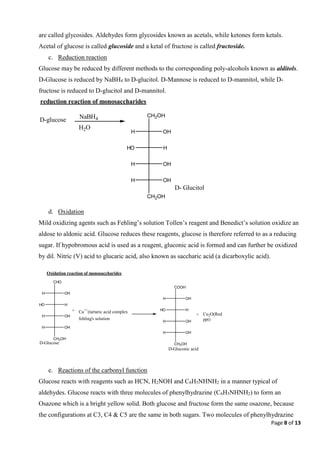
Page 1 of 13
CHAPTER 1: CHEMISTRY AND OCCURRENCE OF CARBOHYDRATES IN PLANTS
AND ANIMALS
Carbohydrates contain carbon and hydrogen & oxygen in then ratio 2:1, and therefore they are
referred to as hydrates of carbon.
The modern definition of carbohydrates is polyhydroxy ketones or aldehydes or substances that yield
such products on hydrolysis. They usually contain hydroxyl, ether or carbonyl functional groups. The
low molecular weight carbohydrates are called sugars or saccharides.
Classification of carbohydrates
Carbohydrate should contain at least three carbon atoms. Carbohydrates are divided in to four main
groups depending on their molecular structure, physical and chemical properties. The following are
the FOUR main classes of carbohydrates;
a) Monosaccharides
b) Disaccharides
c) Oligosaccharides
d) Polysaccharides
A. Monosaccharides:
Structure
Monosaccharides also referred to as simple sugars, because they cannot be hydrolyzed further. All
naturally occurring monosaccharides belong to the D-series.
They have the empirical formula (CH2O)n, where n= the number of Carbon atoms in the molecule.
They are un-branched. Each carbon has hydroxyl (OH) group.
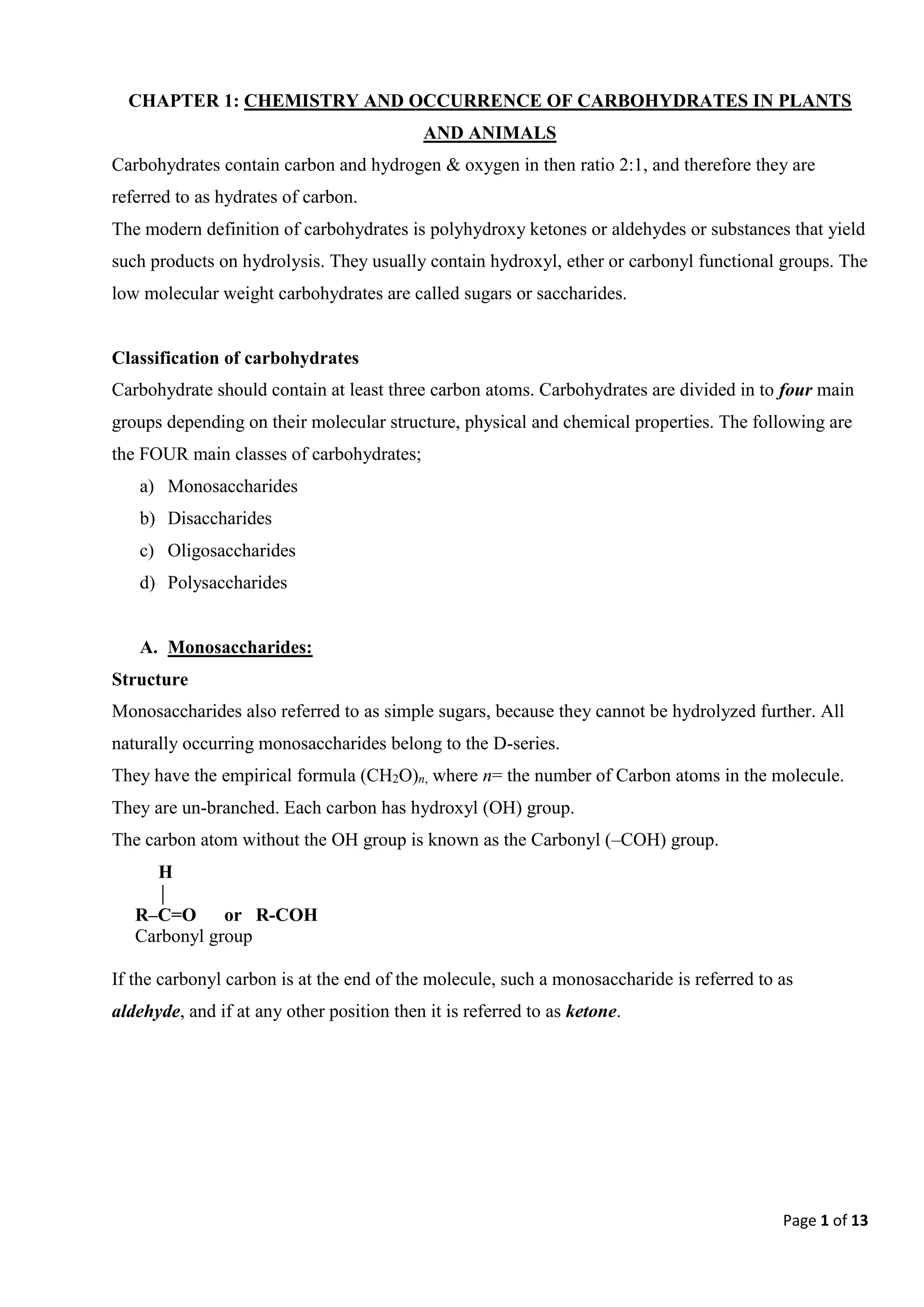
The carbon atom without the OH group is known as the Carbonyl (–COH) group.
H
R–C=O or R-COH
Carbonyl group
If the carbonyl carbon is at the end of the molecule, such a monosaccharide is referred to as
aldehyde, and if at any other position then it is referred to as ketone.
Page 2 of 13
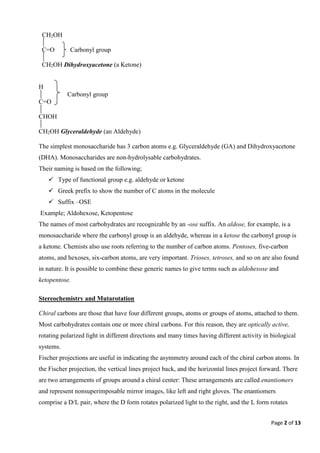
CH2OH
C=O Carbonyl group
CH2OH Dihydroxyacetone (a Ketone)
H
Carbonyl group
C=O
CHOH
CH2OH Glyceraldehyde (an Aldehyde)
The simplest monosaccharide has 3 carbon atoms e.g. Glyceraldehyde (GA) and Dihydroxyacetone
(DHA). Monosaccharides are non-hydrolysable carbohydrates.
Their naming is based on the following;
 Type of functional group e.g. aldehyde or ketone
 Greek prefix to show the number of C atoms in the molecule
 Suffix –OSE
Example; Aldohexose, Ketopentose
The names of most carbohydrates are recognizable by an -ose suffix. An aldose, for example, is a
monosaccharide where the carbonyl group is an aldehyde, whereas in a ketose the carbonyl group is
a ketone. Chemists also use roots referring to the number of carbon atoms. Pentoses, five-carbon
atoms, and hexoses, six-carbon atoms, are very important. Trioses, tetroses, and so on are also found
in nature. It is possible to combine these generic names to give terms such as aldohexose and
ketopentose.
Stereochemistry and Mutarotation
Chiral carbons are those that have four different groups, atoms or groups of atoms, attached to them.
Most carbohydrates contain one or more chiral carbons. For this reason, they are optically active,
rotating polarized light in different directions and many times having different activity in biological
systems.
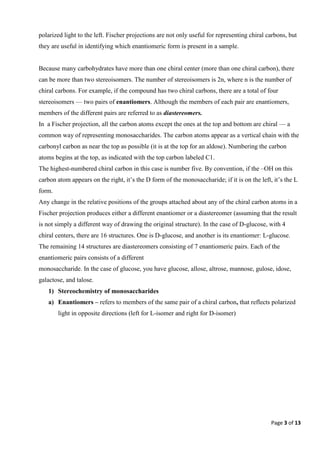
Fischer projections are useful in indicating the asymmetry around each of the chiral carbon atoms. In
the Fischer projection, the vertical lines project back, and the horizontal lines project forward. There
are two arrangements of groups around a chiral center: These arrangements are called enantiomers
and represent nonsuperimposable mirror images, like left and right gloves. The enantiomers
comprise a D/L pair, where the D form rotates polarized light to the right, and the L form rotates
Page 3 of 13
polarized light to the left. Fischer projections are not only useful for representing chiral carbons, but
they are useful in identifying which enantiomeric form is present in a sample.
Because many carbohydrates have more than one chiral center (more than one chiral carbon), there
can be more than two stereoisomers. The number of stereoisomers is 2n, where n is the number of
chiral carbons. For example, if the compound has two chiral carbons, there are a total of four
stereoisomers — two pairs of enantiomers. Although the members of each pair are enantiomers,
members of the different pairs are referred to as diastereomers.
In a Fischer projection, all the carbon atoms except the ones at the top and bottom are chiral — a
common way of representing monosaccharides. The carbon atoms appear as a vertical chain with the
carbonyl carbon as near the top as possible (it is at the top for an aldose). Numbering the carbon
atoms begins at the top, as indicated with the top carbon labeled C1.
The highest-numbered chiral carbon in this case is number five. By convention, if the –OH on this
carbon atom appears on the right, it’s the D form of the monosaccharide; if it is on the left, it’s the L
form.
Any change in the relative positions of the groups attached about any of the chiral carbon atoms in a
Fischer projection produces either a different enantiomer or a diastereomer (assuming that the result
is not simply a different way of drawing the original structure). In the case of D-glucose, with 4
chiral centers, there are 16 structures. One is D-glucose, and another is its enantiomer: L-glucose.
The remaining 14 structures are diastereomers consisting of 7 enantiomeric pairs. Each of the
enantiomeric pairs consists of a different
monosaccharide. In the case of glucose, you have glucose, allose, altrose, mannose, gulose, idose,
galactose, and talose.
1) Stereochemistry of monosaccharides
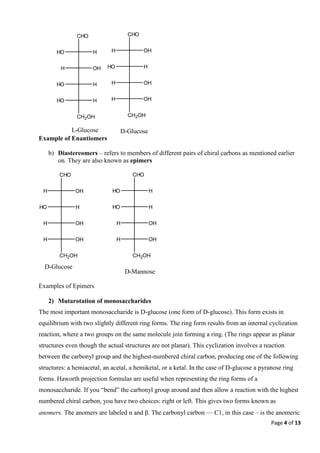
a) Enantiomers – refers to members of the same pair of a chiral carbon, that reflects polarized
light in opposite directions (left for L-isomer and right for D-isomer)
Page 4 of 13
Example of Enantiomers
b) Diastereomers – refers to members of different pairs of chiral carbons as mentioned earlier
on. They are also known as epimers
Examples of Epimers
2) Mutarotation of monosaccharides
The most important monosaccharide is D-glucose (one form of D-glucose). This form exists in
equilibrium with two slightly different ring forms. The ring form results from an internal cyclization
reaction, where a two groups on the same molecule join forming a ring. (The rings appear as planar
structures even though the actual structures are not planar). This cyclization involves a reaction
between the carbonyl group and the highest-numbered chiral carbon, producing one of the following
structures: a hemiacetal, an acetal, a hemiketal, or a ketal. In the case of D-glucose a pyranose ring
forms. Haworth projection formulas are useful when representing the ring forms of a
monosaccharide. If you “bend” the carbonyl group around and then allow a reaction with the highest
numbered chiral carbon, you have two choices: right or left. This gives two forms known as
anomers. The anomers are labeled αand β. The carbonyl carbon — C1, in this case – is the anomeric
CHO
OH
H
H
HO
OH
H
OH
H
CH2OH
D-Glucose
CHO
H
HO
H
HO
OH
H
OH
H
CH2OH
D-Mannose
CHO
OH
H
H
HO
OH
H
OH
H
CH2OH
D-Glucose
CHO
H
HO
OH
H
H
HO
H
HO
CH2OH
L-Glucose
Page 5 of 13
carbon, which should be on the right side of a Haworth projection. The relative positions of –H and –
OH about the anomeric carbon determine whether it is the αor βform. The hydroxyl group points
down in the αform, and the hydroxyl group points up in the βform. (Reversing the drawing of the
rings may give a structure with the opposite orientation of the groups about the anomeric carbon.) In
solution, each of the anomers is in equilibrium with the open chain form represented by the Fischer
projection. Therefore, there is an interconversion between the forms is known as mutarotation.
It is also possible to form a five-membered ring, called a furanose ring. Ribose is an example of a
monosaccharide that may form a furanose ring.
6CH2OH CH2
H 5 O O
H H O
4 1
OH 3 2 OH
H OH
Pyranose ring (from Aldoses)
In solution form, the C1 of a monosaccharide ring (from the Carbonyl group), is called the Anomeric
Carbon.
In the same solution of D-Glucose the configuration of the OH on the anomeric Carbon forms two
isomers, namely α and β.The α and β isomers of a monosaccharide are referred to as Anomers.
CH2OH
H O
H OH
OH H
H OH β-D- Glucopyranose
6HOCH2 O 1CH2OH
5
2
H OH OH
4 3
OH H Furanose ring (Ketoses)
Page 6 of 13
HOCH2 O CH2OH
H OH OH
OH H α-D- Fructofuranose
The following is a list of common monosaccharides in nature;
Allose
Altrose
Glucose
Mannose
Gulose
Idose
Galactose
Talose
Psicose
Fructose
Sorbose
Targatose
D & L Enantiomers
If these positions are switched, you will instead have the L (-) enantiomer of glyceraldehdye. For
monosaccharides, D and L will be used as prefixes instead of R and S, respectively, in regards to
stereochemistry. The stereochemistry of all other monosaccharides can be determined by comparing
their Fischer projections to that of D-(+)-Glyceraldehyde. This can be done by examining the
stereocenter in the monosaccharide closest to the terminal carbon (the highest-numbered
stereocenter)and comparing its configuration to that of glygeraldehyde. That is, if the hydroxy group
is on the right, it will be named D- and if the hydroxy group is on the left it will be named L-. It is
important to note that for all monosaccharides other than glyceraldehyde, the labels D and L do not
necessarily say anything about its optical rotation. For instance, D-Glucose and D-Gulose have both
been assigned the stereochemical label D due to their highest-numbered stereocenter (the chiral
center furthest from the carbonyl group) having a hydroxy group on the right in their Fischer
projections despite Glucose having a positive (dextro-) optical rotation and Gulose having a negative
(levo-) optical rotation.
Alpha vs Beta Anomers
Hexoses and pentoses can convert to cyclic pyranoses or furanoses. As these monosaccharides
convert between their linear and cyclic formations, the hydroxyl group on the C5 or C6 carbon can
attack on either side of the carbonyl of C1(as shown in image above). If the hydroxyl group is
pointed in the opposite direction of the CH2OH group, the ring is in its alpha form. However if it is
pointed in the same direction, the ring is in its beta form.
Diastereomers and Epimers
Page 7 of 13
Two non-identical monosaccharides are said to be diastereomers if they are of the same type (either
both aldoses or both ketoses), have the same stereochemistry at their highest-numbered stereocenter,
and have the same number of carbons (i.e. are both tetroses). This is because having the same
stereochemistry at their highest-numbered asymmetric carbon ensures that the two non-identical
monosachharides will not be mirror images of each other and are therefore not enantiomers. Two
monosaccharides that are diastereomers that have differing stereochemistry at only 1 asymmetric
carbon (this carbon cannot be the highest-numbered asymmetric carbon) are called epimers. For
instance, D-Glucose and D-Mannose are both epimers and diastereomers, while D-Glucose and D-
Galactose are only diastereomers.
Chemical properties of monosaccharides
a. Esterification
All the hydroxyl groups of reducing sugars can be esterified and need about five acetic anhydride
molecules to give a pentaacetyl derivative. This reaction helps to elucidate the structure of
monosaccharides.
b. Formation of glycosides
When a small quantity of HCl gas is passed through a solution of aldehydes in methanol, in a
stepwise reaction, first a hemiacetal and finally an acetal is formed as follows.
Aldehydes, such as glucose adds one molecule of methanol to form two cyclic acetals. They only
contain Methoxy group. This process is known as methylation. In chemistry, cyclic acetals and ketals
CHO
OH
H
H
HO
OH
H
OH
H
CH2OH
D-Glucose
+ 5(CH3CO)2O
CHO
OAc
H
H
AcO
OAc
H
OAc
H
CH2OAc
+ 5CH3COOH
D-Glucose pentaacetate
Esterification reaction of monosaccharides
R
O
H
+ CH3OH H+
C
OH
OCH3
H
R
CH3OH / H+
R
C
OCH3
OCH3
H
An Acetal
A hemiacetal
formation of glycoside
Page 8 of 13
are called glycosides. Aldehydes form glycosides known as acetals, while ketones form ketals.
Acetal of glucose is called glucoside and a ketal of fructose is called fructoside.
c. Reduction reaction
Glucose may be reduced by different methods to the corresponding poly-alcohols known as alditols.
D-Glucose is reduced by NaBH4 to D-glucitol. D-Mannose is reduced to D-mannitol, while D-
fructose is reduced to D-glucitol and D-mannitol.
d. Oxidation
Mild oxidizing agents such as Fehling’s solution Tollen’s reagent and Benedict’s solution oxidize an
aldose to aldonic acid. Glucose reduces these reagents, glucose is therefore referred to as a reducing
sugar. If hypobromous acid is used as a reagent, gluconic acid is formed and can further be oxidized
by dil. Nitric (V) acid to glucaric acid, also known as saccharic acid (a dicarboxylic acid).
e. Reactions of the carbonyl function
Glucose reacts with reagents such as HCN, H2NOH and C6H5NHNH2 in a manner typical of
aldehydes. Glucose reacts with three molecules of phenylhydrazine (C6H5NHNH2) to form an
Osazone which is a bright yellow solid. Both glucose and fructose form the same osazone, because
the configurations at C3, C4 & C5 are the same in both sugars. Two molecules of phenylhydrazine
reduction reaction of monosaccharides
D-glucose NaBH4
H2O
CH2OH
OH
H
H
HO
OH
H
OH
H
CH2OH
D- Glucitol
CHO
OH
H
H
HO
OH
H
OH
H
CH2OH
+ Cu++
(tartaric acid complex
fehling's solution
COOH
OH
H
H
HO
OH
H
OH
H
CH2OH
+ Cu2O(Red
ppt)
D-Gluconic acid
D-Glucose
Oxidation reaction of monosaccharides
Page 9 of 13
are used in two reaction steps, thus oxidizing the first two C atoms. The osazones are more easily
handled than the sugars themselves, since sugars tend to form syrups when not completely pure.
Both reducing and non-reducing monosaccharides form osazones.
B. Disaccharides
They are formed when two monosaccharide units, same or different react through condensation
polymerisation. They are crystalline solids, soluble in water and sweet in taste.
The monosaccharide units in the disaccharide molecule are linked by Glycosidic bond.
There are two types of disaccharides, namely;
i) Non-reducing sugars
ii) Reducing sugars
a) Non-reducing sugars
They are formed when a glycosidic bond is established between two anomeric (carbonyl) Carbon
atoms, the disaccharide formed is non-reducing e.g. sucrose and trehalose.
(Please draw the structures of the following compounds)
i. Trehalose [O-α-D-Glucopyranosyl-(1, 1)-α-D-Glucopyranose]
ii. Sucrose [O-β-D-Fructofuranosyl-(2, 1)-α-D-Glucopyranose]
b) Reducing sugars
Glucose H2NNHC6H5
CH2NNHC6H5
OH
H
H
HO
OH
H
OH
H
CH2OH
H2NNHC6H5
-C6H5NH2
-NH3
CH=NNHC6H5
O
H
HO
OH
H
OH
H
CH2OH
H2NNHC6H5
-H2O
CH2NNHC6H5
NNHC6H5
H
H
HO
OH
H
OH
H
CH2OH
Glucosazone
Carbonyl function
Page 10 of 13
They are formed when a glycosidic bond is established between anomeric and non-anomeric Carbon
atoms of the reacting monosaccharides; e.g. maltose, isomaltose, cellobiose and lactose.
(Please draw the structures of the following compounds)
i. Maltose [O-α-D-Glucopyranosyl-(1, 4)-β-D-Glucopyranose]
ii. Isomaltose [O-α-D-Glucopyranosyl-(1, 6)-α-D-Glucopyranose]
iii. Lactose [O-β-D-Galactopyranosyl-(1, 4)-β-D-Glucopyranose]
iv. Cellobiose [O-β-D-Glucopyranosyl-(1, 4)-α-D-Glucopyranose]
Nomenclature
The systematic names of these disaccharides are based on the monosaccharide units present, the
position of the glycosidic bond and the anomers of the monosaccharides. The general rules applied in
naming organic compounds apply.
Properties of disaccharides
a. Hydrolysis
In the lab, they hydrolyzed by hot dil. Mineral acids to constituent monosaccharides. In the living
cell, this reaction is carried out by enzymes generally known as hydrolases.
b. Oxidation
Disaccharide such as sucrose oxidized by hot conc nitric (V) acid to oxalic acid and water.
Hot Conc HNO3
C12H22O11 6{(HOOCCOOH)} + 5H2O
Sucrose Oxalic acid water
c. Dehydration
In the presence of hot conc sulphuric (VI) acid, sucrose loses water to form black carbon. This is a
dehydration reaction. This is the Molisch test for Carbohydrates.
Hot Conc H2SO4
C12H22O11 12C + 11H2O
Sucrose Carbon water
d. Decomposition reaction
With hot conc hydrochloric acid, sucrose decomposes to laevulinic acid.
hot ConcHCl
C12H22O11 CH3-CO-CH2-CH2-COOH
Sucrose Laevulinic acid
e. Fermentation
Sucrose ferments in the presence of yeast to yield alcohol ethanol
yeast
Page 11 of 13
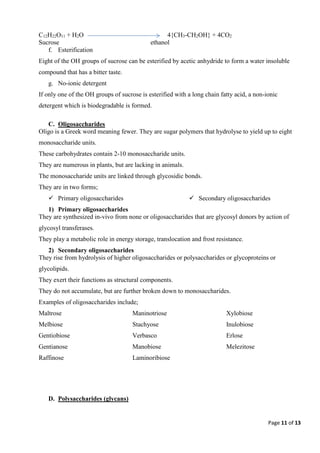
C12H22O11 + H2O 4{CH3-CH2OH} + 4CO2
Sucrose ethanol
f. Esterification
Eight of the OH groups of sucrose can be esterified by acetic anhydride to form a water insoluble
compound that has a bitter taste.
g. No-ionic detergent
If only one of the OH groups of sucrose is esterified with a long chain fatty acid, a non-ionic
detergent which is biodegradable is formed.
C. Oligosaccharides
Oligo is a Greek word meaning fewer. They are sugar polymers that hydrolyse to yield up to eight
monosaccharide units.
These carbohydrates contain 2-10 monosaccharide units.
They are numerous in plants, but are lacking in animals.
The monosaccharide units are linked through glycosidic bonds.
They are in two forms;
 Primary oligosaccharides  Secondary oligosaccharides
1) Primary oligosaccharides
They are synthesized in-vivo from none or oligosaccharides that are glycosyl donors by action of
glycosyl transferases.
They play a metabolic role in energy storage, translocation and frost resistance.
2) Secondary oligosaccharides
They rise from hydrolysis of higher oligosaccharides or polysaccharides or glycoproteins or
glycolipids.
They exert their functions as structural components.
They do not accumulate, but are further broken down to monosaccharides.
Examples of oligosaccharides include;
Maltrose
Melbiose
Gentiobiose
Gentianose
Raffinose
Maninotriose
Stachyose
Verbasco
Manobiose
Laminoribiose
Xylobiose
Inulobiose
Erlose
Melezitose
D. Polysaccharides (glycans)
Page 12 of 13
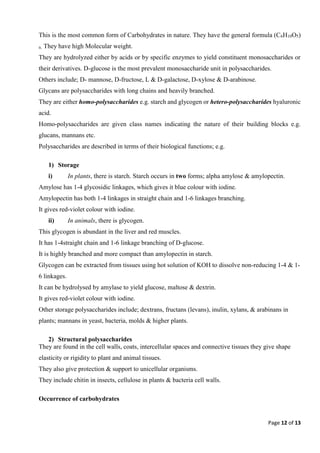
This is the most common form of Carbohydrates in nature. They have the general formula (C6H10O5)
n. They have high Molecular weight.
They are hydrolyzed either by acids or by specific enzymes to yield constituent monosaccharides or
their derivatives. D-glucose is the most prevalent monosaccharide unit in polysaccharides.
Others include; D- mannose, D-fructose, L & D-galactose, D-xylose & D-arabinose.
Glycans are polysaccharides with long chains and heavily branched.
They are either homo-polysaccharides e.g. starch and glycogen or hetero-polysaccharides hyaluronic
acid.
Homo-polysaccharides are given class names indicating the nature of their building blocks e.g.
glucans, mannans etc.
Polysaccharides are described in terms of their biological functions; e.g.
1) Storage
i) In plants, there is starch. Starch occurs in two forms; alpha amylose & amylopectin.
Amylose has 1-4 glycosidic linkages, which gives it blue colour with iodine.
Amylopectin has both 1-4 linkages in straight chain and 1-6 linkages branching.
It gives red-violet colour with iodine.
ii) In animals, there is glycogen.
This glycogen is abundant in the liver and red muscles.
It has 1-4straight chain and 1-6 linkage branching of D-glucose.
It is highly branched and more compact than amylopectin in starch.
Glycogen can be extracted from tissues using hot solution of KOH to dissolve non-reducing 1-4 & 1-
6 linkages.
It can be hydrolysed by amylase to yield glucose, maltose & dextrin.
It gives red-violet colour with iodine.
Other storage polysaccharides include; dextrans, fructans (levans), inulin, xylans, & arabinans in
plants; mannans in yeast, bacteria, molds & higher plants.
2) Structural polysaccharides
They are found in the cell walls, coats, intercellular spaces and connective tissues they give shape
elasticity or rigidity to plant and animal tissues.
They also give protection & support to unicellular organisms.
They include chitin in insects, cellulose in plants & bacteria cell walls.
Occurrence of carbohydrates
Page 13 of 13
They are synthesized by living plants by a process called photosynthesis. The chlorophyll converts
the CO2 and water with the aid of solar energy in to sugars. The chlorophyll absorbs solar energy and
acts as a catalyst to start the reaction.
Sunlight
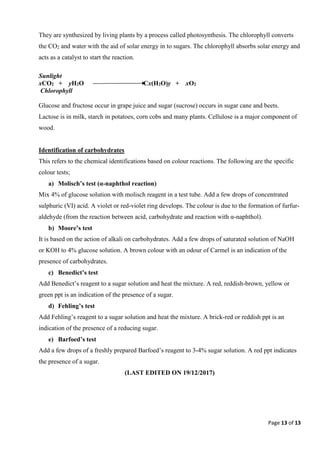
xCO2 + yH2O Cx(H2O)y + xO2
Chlorophyll
Glucose and fructose occur in grape juice and sugar (sucrose) occurs in sugar cane and beets.
Lactose is in milk, starch in potatoes, corn cobs and many plants. Cellulose is a major component of
wood.
Identification of carbohydrates
This refers to the chemical identifications based on colour reactions. The following are the specific
colour tests;
a) Molisch’s test (α-naphthol reaction)
Mix 4% of glucose solution with molisch reagent in a test tube. Add a few drops of concentrated
sulphuric (VI) acid. A violet or red-violet ring develops. The colour is due to the formation of furfur-
aldehyde (from the reaction between acid, carbohydrate and reaction with α-naphthol).
b) Moore’s test
It is based on the action of alkali on carbohydrates. Add a few drops of saturated solution of NaOH
or KOH to 4% glucose solution. A brown colour with an odour of Carmel is an indication of the
presence of carbohydrates.
c) Benedict’s test
Add Benedict’s reagent to a sugar solution and heat the mixture. A red, reddish-brown, yellow or
green ppt is an indication of the presence of a sugar.
d) Fehling’s test
Add Fehling’s reagent to a sugar solution and heat the mixture. A brick-red or reddish ppt is an
indication of the presence of a reducing sugar.
e) Barfoed’s test
Add a few drops of a freshly prepared Barfoed’s reagent to 3-4% sugar solution. A red ppt indicates
the presence of a sugar.
(LAST EDITED ON 19/12/2017)

CHAPTER 1 - CARBOHYDARTES.pdf

  • 1.
    Page 1 of13 CHAPTER 1: CHEMISTRY AND OCCURRENCE OF CARBOHYDRATES IN PLANTS AND ANIMALS Carbohydrates contain carbon and hydrogen & oxygen in then ratio 2:1, and therefore they are referred to as hydrates of carbon. The modern definition of carbohydrates is polyhydroxy ketones or aldehydes or substances that yield such products on hydrolysis. They usually contain hydroxyl, ether or carbonyl functional groups. The low molecular weight carbohydrates are called sugars or saccharides. Classification of carbohydrates Carbohydrate should contain at least three carbon atoms. Carbohydrates are divided in to four main groups depending on their molecular structure, physical and chemical properties. The following are the FOUR main classes of carbohydrates; a) Monosaccharides b) Disaccharides c) Oligosaccharides d) Polysaccharides A. Monosaccharides: Structure Monosaccharides also referred to as simple sugars, because they cannot be hydrolyzed further. All naturally occurring monosaccharides belong to the D-series. They have the empirical formula (CH2O)n, where n= the number of Carbon atoms in the molecule. They are un-branched. Each carbon has hydroxyl (OH) group. The carbon atom without the OH group is known as the Carbonyl (–COH) group. H R–C=O or R-COH Carbonyl group If the carbonyl carbon is at the end of the molecule, such a monosaccharide is referred to as aldehyde, and if at any other position then it is referred to as ketone.
  • 2.
    Page 2 of13 CH2OH C=O Carbonyl group CH2OH Dihydroxyacetone (a Ketone) H Carbonyl group C=O CHOH CH2OH Glyceraldehyde (an Aldehyde) The simplest monosaccharide has 3 carbon atoms e.g. Glyceraldehyde (GA) and Dihydroxyacetone (DHA). Monosaccharides are non-hydrolysable carbohydrates. Their naming is based on the following;  Type of functional group e.g. aldehyde or ketone  Greek prefix to show the number of C atoms in the molecule  Suffix –OSE Example; Aldohexose, Ketopentose The names of most carbohydrates are recognizable by an -ose suffix. An aldose, for example, is a monosaccharide where the carbonyl group is an aldehyde, whereas in a ketose the carbonyl group is a ketone. Chemists also use roots referring to the number of carbon atoms. Pentoses, five-carbon atoms, and hexoses, six-carbon atoms, are very important. Trioses, tetroses, and so on are also found in nature. It is possible to combine these generic names to give terms such as aldohexose and ketopentose. Stereochemistry and Mutarotation Chiral carbons are those that have four different groups, atoms or groups of atoms, attached to them. Most carbohydrates contain one or more chiral carbons. For this reason, they are optically active, rotating polarized light in different directions and many times having different activity in biological systems. Fischer projections are useful in indicating the asymmetry around each of the chiral carbon atoms. In the Fischer projection, the vertical lines project back, and the horizontal lines project forward. There are two arrangements of groups around a chiral center: These arrangements are called enantiomers and represent nonsuperimposable mirror images, like left and right gloves. The enantiomers comprise a D/L pair, where the D form rotates polarized light to the right, and the L form rotates
  • 3.
    Page 3 of13 polarized light to the left. Fischer projections are not only useful for representing chiral carbons, but they are useful in identifying which enantiomeric form is present in a sample. Because many carbohydrates have more than one chiral center (more than one chiral carbon), there can be more than two stereoisomers. The number of stereoisomers is 2n, where n is the number of chiral carbons. For example, if the compound has two chiral carbons, there are a total of four stereoisomers — two pairs of enantiomers. Although the members of each pair are enantiomers, members of the different pairs are referred to as diastereomers. In a Fischer projection, all the carbon atoms except the ones at the top and bottom are chiral — a common way of representing monosaccharides. The carbon atoms appear as a vertical chain with the carbonyl carbon as near the top as possible (it is at the top for an aldose). Numbering the carbon atoms begins at the top, as indicated with the top carbon labeled C1. The highest-numbered chiral carbon in this case is number five. By convention, if the –OH on this carbon atom appears on the right, it’s the D form of the monosaccharide; if it is on the left, it’s the L form. Any change in the relative positions of the groups attached about any of the chiral carbon atoms in a Fischer projection produces either a different enantiomer or a diastereomer (assuming that the result is not simply a different way of drawing the original structure). In the case of D-glucose, with 4 chiral centers, there are 16 structures. One is D-glucose, and another is its enantiomer: L-glucose. The remaining 14 structures are diastereomers consisting of 7 enantiomeric pairs. Each of the enantiomeric pairs consists of a different monosaccharide. In the case of glucose, you have glucose, allose, altrose, mannose, gulose, idose, galactose, and talose. 1) Stereochemistry of monosaccharides a) Enantiomers – refers to members of the same pair of a chiral carbon, that reflects polarized light in opposite directions (left for L-isomer and right for D-isomer)
  • 4.
    Page 4 of13 Example of Enantiomers b) Diastereomers – refers to members of different pairs of chiral carbons as mentioned earlier on. They are also known as epimers Examples of Epimers 2) Mutarotation of monosaccharides The most important monosaccharide is D-glucose (one form of D-glucose). This form exists in equilibrium with two slightly different ring forms. The ring form results from an internal cyclization reaction, where a two groups on the same molecule join forming a ring. (The rings appear as planar structures even though the actual structures are not planar). This cyclization involves a reaction between the carbonyl group and the highest-numbered chiral carbon, producing one of the following structures: a hemiacetal, an acetal, a hemiketal, or a ketal. In the case of D-glucose a pyranose ring forms. Haworth projection formulas are useful when representing the ring forms of a monosaccharide. If you “bend” the carbonyl group around and then allow a reaction with the highest numbered chiral carbon, you have two choices: right or left. This gives two forms known as anomers. The anomers are labeled αand β. The carbonyl carbon — C1, in this case – is the anomeric CHO OH H H HO OH H OH H CH2OH D-Glucose CHO H HO H HO OH H OH H CH2OH D-Mannose CHO OH H H HO OH H OH H CH2OH D-Glucose CHO H HO OH H H HO H HO CH2OH L-Glucose
  • 5.
    Page 5 of13 carbon, which should be on the right side of a Haworth projection. The relative positions of –H and – OH about the anomeric carbon determine whether it is the αor βform. The hydroxyl group points down in the αform, and the hydroxyl group points up in the βform. (Reversing the drawing of the rings may give a structure with the opposite orientation of the groups about the anomeric carbon.) In solution, each of the anomers is in equilibrium with the open chain form represented by the Fischer projection. Therefore, there is an interconversion between the forms is known as mutarotation. It is also possible to form a five-membered ring, called a furanose ring. Ribose is an example of a monosaccharide that may form a furanose ring. 6CH2OH CH2 H 5 O O H H O 4 1 OH 3 2 OH H OH Pyranose ring (from Aldoses) In solution form, the C1 of a monosaccharide ring (from the Carbonyl group), is called the Anomeric Carbon. In the same solution of D-Glucose the configuration of the OH on the anomeric Carbon forms two isomers, namely α and β.The α and β isomers of a monosaccharide are referred to as Anomers. CH2OH H O H OH OH H H OH β-D- Glucopyranose 6HOCH2 O 1CH2OH 5 2 H OH OH 4 3 OH H Furanose ring (Ketoses)
  • 6.
    Page 6 of13 HOCH2 O CH2OH H OH OH OH H α-D- Fructofuranose The following is a list of common monosaccharides in nature; Allose Altrose Glucose Mannose Gulose Idose Galactose Talose Psicose Fructose Sorbose Targatose D & L Enantiomers If these positions are switched, you will instead have the L (-) enantiomer of glyceraldehdye. For monosaccharides, D and L will be used as prefixes instead of R and S, respectively, in regards to stereochemistry. The stereochemistry of all other monosaccharides can be determined by comparing their Fischer projections to that of D-(+)-Glyceraldehyde. This can be done by examining the stereocenter in the monosaccharide closest to the terminal carbon (the highest-numbered stereocenter)and comparing its configuration to that of glygeraldehyde. That is, if the hydroxy group is on the right, it will be named D- and if the hydroxy group is on the left it will be named L-. It is important to note that for all monosaccharides other than glyceraldehyde, the labels D and L do not necessarily say anything about its optical rotation. For instance, D-Glucose and D-Gulose have both been assigned the stereochemical label D due to their highest-numbered stereocenter (the chiral center furthest from the carbonyl group) having a hydroxy group on the right in their Fischer projections despite Glucose having a positive (dextro-) optical rotation and Gulose having a negative (levo-) optical rotation. Alpha vs Beta Anomers Hexoses and pentoses can convert to cyclic pyranoses or furanoses. As these monosaccharides convert between their linear and cyclic formations, the hydroxyl group on the C5 or C6 carbon can attack on either side of the carbonyl of C1(as shown in image above). If the hydroxyl group is pointed in the opposite direction of the CH2OH group, the ring is in its alpha form. However if it is pointed in the same direction, the ring is in its beta form. Diastereomers and Epimers
  • 7.
    Page 7 of13 Two non-identical monosaccharides are said to be diastereomers if they are of the same type (either both aldoses or both ketoses), have the same stereochemistry at their highest-numbered stereocenter, and have the same number of carbons (i.e. are both tetroses). This is because having the same stereochemistry at their highest-numbered asymmetric carbon ensures that the two non-identical monosachharides will not be mirror images of each other and are therefore not enantiomers. Two monosaccharides that are diastereomers that have differing stereochemistry at only 1 asymmetric carbon (this carbon cannot be the highest-numbered asymmetric carbon) are called epimers. For instance, D-Glucose and D-Mannose are both epimers and diastereomers, while D-Glucose and D- Galactose are only diastereomers. Chemical properties of monosaccharides a. Esterification All the hydroxyl groups of reducing sugars can be esterified and need about five acetic anhydride molecules to give a pentaacetyl derivative. This reaction helps to elucidate the structure of monosaccharides. b. Formation of glycosides When a small quantity of HCl gas is passed through a solution of aldehydes in methanol, in a stepwise reaction, first a hemiacetal and finally an acetal is formed as follows. Aldehydes, such as glucose adds one molecule of methanol to form two cyclic acetals. They only contain Methoxy group. This process is known as methylation. In chemistry, cyclic acetals and ketals CHO OH H H HO OH H OH H CH2OH D-Glucose + 5(CH3CO)2O CHO OAc H H AcO OAc H OAc H CH2OAc + 5CH3COOH D-Glucose pentaacetate Esterification reaction of monosaccharides R O H + CH3OH H+ C OH OCH3 H R CH3OH / H+ R C OCH3 OCH3 H An Acetal A hemiacetal formation of glycoside
  • 8.
    Page 8 of13 are called glycosides. Aldehydes form glycosides known as acetals, while ketones form ketals. Acetal of glucose is called glucoside and a ketal of fructose is called fructoside. c. Reduction reaction Glucose may be reduced by different methods to the corresponding poly-alcohols known as alditols. D-Glucose is reduced by NaBH4 to D-glucitol. D-Mannose is reduced to D-mannitol, while D- fructose is reduced to D-glucitol and D-mannitol. d. Oxidation Mild oxidizing agents such as Fehling’s solution Tollen’s reagent and Benedict’s solution oxidize an aldose to aldonic acid. Glucose reduces these reagents, glucose is therefore referred to as a reducing sugar. If hypobromous acid is used as a reagent, gluconic acid is formed and can further be oxidized by dil. Nitric (V) acid to glucaric acid, also known as saccharic acid (a dicarboxylic acid). e. Reactions of the carbonyl function Glucose reacts with reagents such as HCN, H2NOH and C6H5NHNH2 in a manner typical of aldehydes. Glucose reacts with three molecules of phenylhydrazine (C6H5NHNH2) to form an Osazone which is a bright yellow solid. Both glucose and fructose form the same osazone, because the configurations at C3, C4 & C5 are the same in both sugars. Two molecules of phenylhydrazine reduction reaction of monosaccharides D-glucose NaBH4 H2O CH2OH OH H H HO OH H OH H CH2OH D- Glucitol CHO OH H H HO OH H OH H CH2OH + Cu++ (tartaric acid complex fehling's solution COOH OH H H HO OH H OH H CH2OH + Cu2O(Red ppt) D-Gluconic acid D-Glucose Oxidation reaction of monosaccharides
  • 9.
    Page 9 of13 are used in two reaction steps, thus oxidizing the first two C atoms. The osazones are more easily handled than the sugars themselves, since sugars tend to form syrups when not completely pure. Both reducing and non-reducing monosaccharides form osazones. B. Disaccharides They are formed when two monosaccharide units, same or different react through condensation polymerisation. They are crystalline solids, soluble in water and sweet in taste. The monosaccharide units in the disaccharide molecule are linked by Glycosidic bond. There are two types of disaccharides, namely; i) Non-reducing sugars ii) Reducing sugars a) Non-reducing sugars They are formed when a glycosidic bond is established between two anomeric (carbonyl) Carbon atoms, the disaccharide formed is non-reducing e.g. sucrose and trehalose. (Please draw the structures of the following compounds) i. Trehalose [O-α-D-Glucopyranosyl-(1, 1)-α-D-Glucopyranose] ii. Sucrose [O-β-D-Fructofuranosyl-(2, 1)-α-D-Glucopyranose] b) Reducing sugars Glucose H2NNHC6H5 CH2NNHC6H5 OH H H HO OH H OH H CH2OH H2NNHC6H5 -C6H5NH2 -NH3 CH=NNHC6H5 O H HO OH H OH H CH2OH H2NNHC6H5 -H2O CH2NNHC6H5 NNHC6H5 H H HO OH H OH H CH2OH Glucosazone Carbonyl function
  • 10.
    Page 10 of13 They are formed when a glycosidic bond is established between anomeric and non-anomeric Carbon atoms of the reacting monosaccharides; e.g. maltose, isomaltose, cellobiose and lactose. (Please draw the structures of the following compounds) i. Maltose [O-α-D-Glucopyranosyl-(1, 4)-β-D-Glucopyranose] ii. Isomaltose [O-α-D-Glucopyranosyl-(1, 6)-α-D-Glucopyranose] iii. Lactose [O-β-D-Galactopyranosyl-(1, 4)-β-D-Glucopyranose] iv. Cellobiose [O-β-D-Glucopyranosyl-(1, 4)-α-D-Glucopyranose] Nomenclature The systematic names of these disaccharides are based on the monosaccharide units present, the position of the glycosidic bond and the anomers of the monosaccharides. The general rules applied in naming organic compounds apply. Properties of disaccharides a. Hydrolysis In the lab, they hydrolyzed by hot dil. Mineral acids to constituent monosaccharides. In the living cell, this reaction is carried out by enzymes generally known as hydrolases. b. Oxidation Disaccharide such as sucrose oxidized by hot conc nitric (V) acid to oxalic acid and water. Hot Conc HNO3 C12H22O11 6{(HOOCCOOH)} + 5H2O Sucrose Oxalic acid water c. Dehydration In the presence of hot conc sulphuric (VI) acid, sucrose loses water to form black carbon. This is a dehydration reaction. This is the Molisch test for Carbohydrates. Hot Conc H2SO4 C12H22O11 12C + 11H2O Sucrose Carbon water d. Decomposition reaction With hot conc hydrochloric acid, sucrose decomposes to laevulinic acid. hot ConcHCl C12H22O11 CH3-CO-CH2-CH2-COOH Sucrose Laevulinic acid e. Fermentation Sucrose ferments in the presence of yeast to yield alcohol ethanol yeast
  • 11.
    Page 11 of13 C12H22O11 + H2O 4{CH3-CH2OH} + 4CO2 Sucrose ethanol f. Esterification Eight of the OH groups of sucrose can be esterified by acetic anhydride to form a water insoluble compound that has a bitter taste. g. No-ionic detergent If only one of the OH groups of sucrose is esterified with a long chain fatty acid, a non-ionic detergent which is biodegradable is formed. C. Oligosaccharides Oligo is a Greek word meaning fewer. They are sugar polymers that hydrolyse to yield up to eight monosaccharide units. These carbohydrates contain 2-10 monosaccharide units. They are numerous in plants, but are lacking in animals. The monosaccharide units are linked through glycosidic bonds. They are in two forms;  Primary oligosaccharides  Secondary oligosaccharides 1) Primary oligosaccharides They are synthesized in-vivo from none or oligosaccharides that are glycosyl donors by action of glycosyl transferases. They play a metabolic role in energy storage, translocation and frost resistance. 2) Secondary oligosaccharides They rise from hydrolysis of higher oligosaccharides or polysaccharides or glycoproteins or glycolipids. They exert their functions as structural components. They do not accumulate, but are further broken down to monosaccharides. Examples of oligosaccharides include; Maltrose Melbiose Gentiobiose Gentianose Raffinose Maninotriose Stachyose Verbasco Manobiose Laminoribiose Xylobiose Inulobiose Erlose Melezitose D. Polysaccharides (glycans)
  • 12.
    Page 12 of13 This is the most common form of Carbohydrates in nature. They have the general formula (C6H10O5) n. They have high Molecular weight. They are hydrolyzed either by acids or by specific enzymes to yield constituent monosaccharides or their derivatives. D-glucose is the most prevalent monosaccharide unit in polysaccharides. Others include; D- mannose, D-fructose, L & D-galactose, D-xylose & D-arabinose. Glycans are polysaccharides with long chains and heavily branched. They are either homo-polysaccharides e.g. starch and glycogen or hetero-polysaccharides hyaluronic acid. Homo-polysaccharides are given class names indicating the nature of their building blocks e.g. glucans, mannans etc. Polysaccharides are described in terms of their biological functions; e.g. 1) Storage i) In plants, there is starch. Starch occurs in two forms; alpha amylose & amylopectin. Amylose has 1-4 glycosidic linkages, which gives it blue colour with iodine. Amylopectin has both 1-4 linkages in straight chain and 1-6 linkages branching. It gives red-violet colour with iodine. ii) In animals, there is glycogen. This glycogen is abundant in the liver and red muscles. It has 1-4straight chain and 1-6 linkage branching of D-glucose. It is highly branched and more compact than amylopectin in starch. Glycogen can be extracted from tissues using hot solution of KOH to dissolve non-reducing 1-4 & 1- 6 linkages. It can be hydrolysed by amylase to yield glucose, maltose & dextrin. It gives red-violet colour with iodine. Other storage polysaccharides include; dextrans, fructans (levans), inulin, xylans, & arabinans in plants; mannans in yeast, bacteria, molds & higher plants. 2) Structural polysaccharides They are found in the cell walls, coats, intercellular spaces and connective tissues they give shape elasticity or rigidity to plant and animal tissues. They also give protection & support to unicellular organisms. They include chitin in insects, cellulose in plants & bacteria cell walls. Occurrence of carbohydrates
  • 13.
    Page 13 of13 They are synthesized by living plants by a process called photosynthesis. The chlorophyll converts the CO2 and water with the aid of solar energy in to sugars. The chlorophyll absorbs solar energy and acts as a catalyst to start the reaction. Sunlight xCO2 + yH2O Cx(H2O)y + xO2 Chlorophyll Glucose and fructose occur in grape juice and sugar (sucrose) occurs in sugar cane and beets. Lactose is in milk, starch in potatoes, corn cobs and many plants. Cellulose is a major component of wood. Identification of carbohydrates This refers to the chemical identifications based on colour reactions. The following are the specific colour tests; a) Molisch’s test (α-naphthol reaction) Mix 4% of glucose solution with molisch reagent in a test tube. Add a few drops of concentrated sulphuric (VI) acid. A violet or red-violet ring develops. The colour is due to the formation of furfur- aldehyde (from the reaction between acid, carbohydrate and reaction with α-naphthol). b) Moore’s test It is based on the action of alkali on carbohydrates. Add a few drops of saturated solution of NaOH or KOH to 4% glucose solution. A brown colour with an odour of Carmel is an indication of the presence of carbohydrates. c) Benedict’s test Add Benedict’s reagent to a sugar solution and heat the mixture. A red, reddish-brown, yellow or green ppt is an indication of the presence of a sugar. d) Fehling’s test Add Fehling’s reagent to a sugar solution and heat the mixture. A brick-red or reddish ppt is an indication of the presence of a reducing sugar. e) Barfoed’s test Add a few drops of a freshly prepared Barfoed’s reagent to 3-4% sugar solution. A red ppt indicates the presence of a sugar. (LAST EDITED ON 19/12/2017)