Prepared by
Mrs. Ashwini P. Shewale
M.Pharm
(PDEA’S Shankarrao Ursal College of
Pharmacy,Kharadi)
1
CAPSULES
Unit solid dosage form the drug is enclosed within water soluble shell or
an envelope either a hard or soft shell. Shell is typically made of gelatin
primarily intended for oral delivery provide a rapid release of contents.
2
Advantages :
1.The drug having unpleasant odour & taste can be
administered by enclosing them in a tasteless shell.
2.Smooth become very slippery when moist &can be easily
swallowed.
3.They are economical.
4.Easy to handle & carry.
5.Release the medicament as and when desired in GIT.
6.They are made up from gelatin hence they are
therapeutically inert.
7.They are attractive in appearance.
8.Available in various sizes .
9. Microencapsulation provides the sustained release
dosageform.
3
Disadvantages:
 1. The hygroscopic drugs cannot be filled in capsules.
They absorb water present in the capsule shell & make
it very brittle, which ultimately breaks into pieces.
 2.The concentrated preparation which need previous
dilution are unsuitable for capsules because it may
lead to irritation in stomach if administered as such.
4
GELATINE
protein, prepared from hydrolysis of collagen (animal bones and
skin)
type A : PH = 7-9, pig skin
type B : PH = 5, animal bones
TYPE A - Derived from acid treated precursor that exhibits an iso electric
point at pH-9. It is manufactured mainly from pork skin.
TYPE B - Derived from alkali treated precursor that exhibits an iso electric
point at pH-4.7. It is manufactured mainly from animal bones.
POSSESSES 4 ESSENTIAL PROPERTIES
•stable when dry
•subject to microbial degradation when moist
•digested
• absorbed
5
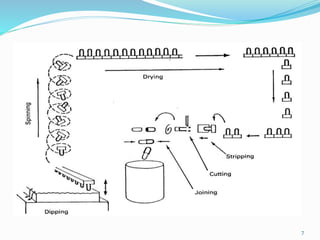
MANUFACTURE OF EMPTY GELATIN
CAPSULES:
Steps involved in making empty gelatin capsules…
 Dipping
 Spinning
 Drying
 Stripping
 Trimming
 Joining
 Polishing
6
7
• Once raw materials have been received and released by Quality
Control, the gelatin and hot demineralized water are mixed
under vacuum in Stainless Steel Gelatin Melting System.
• From receiving tanks, the gelatin solution is transferred to
stainless steel feed tanks.
• Dyes, opacifants, and any needed water are added to the gelatin
in the feed tanks to complete the gelatin preparation procedure.
• From the feed tank, the gelatin is gravity fed to Dipper section.
8
Dipping : Pairs of the stainless steel pins are dipped into the
dipping solution to simultaneously form the caps and bodies for
12sec. The dipping solution is maintained at a temperature of
about 50º C in a heated, jacketed dipping pan & pins are at 22ºc.
Spinning : The pins are rotated to distribute the gelatin over the
pins uniformly and to avoid the formation of a bead at the
capsule ends it is rotated 2½ times by moving upward.
Drying : The gelatin is dried by a blast of cool air to form a hard
shells. The pins are moved through a series of air drying kilns,
Here gently moving air which is precisely controlled for volume,
temperature, and humidity, removes the exact amount of
moisture from the capsule halves. 9
Stripping : A series of bronze jaws strip the cap and body portions of
the capsules from the pins.
Trimming and joining: The stripped cap and body portions are
trimmed to the required length by stationary knives. The cap and
body lengths are precisely trimmed to a ±0.15 mm tolerance.
After trimming to the right length, the cap and body portion are
joined.
 Finished capsules are pushed onto a conveyer belt which carries
them out to a container.
 Capsule quality is monitored throughout the production process
including size, moisture content, single wall thickness, and color.
 Capsules are sorted and visually inspected on specially designed
Inspection Stations.
 Perfect capsules are imprinted with the client logo on high-speed
10
3.modified-release capsules:
1.delayed-release capsules gastroresistant / enteric capsules)
2.sustained-release capsules (extended-/prolonged release
capsules).
Types of Capsules
1.Hard gelatin capsules
2.Soft gelatin capsules
11
Hard Gelatin Capsules
contain 12 - 16 % moisture
typically filled with dry solids
powders
granules
pellets
tablets
also contain gelatin, titanium dioxide
Colorant ,preservatives
SIZE Capacity in mg VOLUME
(cm3
)
000 950 1.37
00 650 0.95
0 450 0.68
1 300 0.50
2 250 0.37
3 200 0.30
4 150 0.21
5 100 0.13
12
13
Excipients used in the filling of capsules:
1. Diluents: e.g. Lactose, mannitol , sorbitol , starch
2.Absorbents: e.g. magnesium oxides, magnesium
carbonates, Calcium oxides, Calcium carbonates,
Kaolin
3.Glidants: Talc, magnesium stearate, calcium stearate
4. Antidusting agents: inert edible oil.
14
Hard Gelatin Capsules
 Advantages
 tasteless and odorless
 swallowing is easy
 flexibility in formulating
 uniquely suitable for blinded clinical trials
 useful for extemporaneous compounding by pharmacist
 Disadvantages
 tend to be more expensive to produce than tablets
 not suitable for highly soluble salts
Processing of capsules:
1.Filling of capsules
2. Cleaning & polishing
3. Sealing of capsules
15
16
Capsule filling machine (Hand operated) It consists of:—
1. A bed having 200-300 holes
2. A loading tray having 200-300 holes
3. A powder tray
4. A pin plate having 200-300 pins
5. A sealing plate having a rubber top
6. A lever
7. A cam handle
Polishing
Pan Polishing : Acela-cota pan is used to dust and polish.
Cloth Dusting : Capsule are rubbed with cloth.
Brushing : Capsule are feed under soft rotating brush.
17
Locking and Sealing of Capsules :
Banding – Placing gelatin color bands at the meeting point of caps and the bodies.
Moistening – Moistening the inner surface of caps with lukewarm gelatin solution.
Spot Welding – Spot welding the joints which leaves a ring like appearance at the
point of sealing
Thermal welding – Applying wetting sol. At the meeting points which causes
lowering of M.P at applied area. Finally they are sealed at a temp. 40-45ºc.
By using Coni-snap capsules – Grooves help to lock the caps with the bodies.
Storage: Finished capsules normally contain an equilibrium moisture content
of 13-16%. To maintain a relative humidity of 40-60% when handling and
storing capsules
18
Soft Gelatin Capsules (Softgels)
• consist of a continuous gelatin shell surrounding a liquid
core
• formed, filled, and sealed in one operation
• shells are softened platizised by addition of glycerin or
polyhydric alcohol (ex. sorbitol), May contain preservetive.
• oblong, spherical, elliptical in shape. Enclosed
oils,suspention,food concentarate,opthalmic products.
19
SHAPES OF SOFT GELATIN CAPSULES:
20
Soft Capsules
 ADVANTAGES
 may contain liquids, suspensions, pastes
 rapid release of contents
 useful for drugs prone to oxidation
 DISADVANTAGES
 have a greater tendency to adhere to each other
 more expensive
 increased possibility of interactions between drug and
shell
21
22
ROTARY DIE MACHINE:
23
24
25
Sr.No. Hard Gelatin Capsule Soft gelatin capsule
1. Hard Gelatin Capsule shell
consists of two parts 1. Body 2.
Cap
Soft gelatin capsule shell become a single
unit after sealing the two halves of the
capsules
2. They are cylindrical in shape They are available in round , oval & tube
like shapes
3. The contents of a hard gelatin
capsules usually consist of the
medicaments is the form of
powder, beads or granules
The contents of soft gelatin capsules
usually consists of liquids or solids
dissolved or dispersed in suitable
excipients to give a paste like consistency .
4. These are prepared from gelatin
,Titanium dioxide, coloring
agents and Plasticizer
These are prepared from gelatin plasticizer
(Glycerin or Sorbitol ) and a preservative
5. Capsules are sealed after they are
filled to ensure that the
medicaments may not come out
of the capsule due to rough
handling
Filing and sealing of soft gelatin capsules
are done in a combined operation on
machines
EVALUTION OF CAPSULES:
(1) Content uniformity
(2) Disintegration test .
(3) Weight variation test
(4)Dissolution test.
(5)Moisture permeation test:
26
Content uniformity:
The amount of active ingredient should be within the
range of 85% to 115% of the label amount for 9 of 10
capsules, with no unit outside the range of 70% to
125% of label amount.
27
Disintegration test for capsules:
 Place 1 capsule in each of the 6tubes of the basket &
suspend the assembly in water at 37℃ ± 2ºC,which is
repeatedly immersed 30 times per minute.
 The capsules pass the test if no residue of drug or
other than fragments of shell remains on No. 10 mesh
screen of the tubes.
28
 Weight variation test: 20 capsules are taken at random and
weighed. Their average weight is calculated, then each capsule is
weighed individually and their weight is noted. The capsule passes
the test if the weight of individual capsule falls with in 90-110% of
the average weight.
 Moisture permeation test:
 Acc. to U.S.P the unit dose container is packed along with
dehydrated pellets, which have the property of changing color in the
presence of moisture. The weight of test capsule is compared with
the under test capsules. Diff. in weights gives the amount of moisture
absorbed.
29
Dissolution test for capsules:
 Place 1000ml of water having a temp. of 36.5º to 37.5º into the
vessel. Place specified number of capsules in basket 7 adjust
the speed to 100 rpm.
 Withdraw req. volume for every 10min time interval. Filter and
determine the amount of active ingredient.
 The sample passes the test if the amount of active ingredients
in the solution is not less than 70% of the stated amount.
30
PACKING & STORAGE OF CAPSULES:
Capsules should be packed well closed glass & plastic container
& stored at temp. not exceeding 30ºc. Capsules are
individually protected by enclosing in strip & blister
packaging.
 In strip packing the capsule is hermetically sealed within the
strips of an aluminum or plastic film.
 In blister packs, a press on the blister forces the capsule
through the backing strip.
.
31
Special applications of capsules
1. Enteric Coated Capsules:- a Coating of cellacephate (cellulose
acetate phthalate) and mixture of waxes with fatty acids or their
esters is given.
2. Sustained release capsules :- Finely powdered drug first
converted to pellets .pellets are coated with protective coating
that delay the release of drug.30% uncoated pellets 30% coated
pellets that release drug at 4 hr & 8 hr interval & 10% neutral
pellets to fill the capsule.
3.Rectal Capsules:-soft gelatin capsules as substitute for rectal &
vaginal suppositories. Pear shaped
4. Capsule containing ophthalmic ointments:- Ophthalmic
ointments are sterile to keep that ointment sterile during their
storage & later use it is required to be filled in a single dose
container. Intended for single application to eye. The capsule is
puncture with sterile needle a& instilled into eye & shell is
discarded
32
Angle of repose
The maximum angle between the surface of pile of
powder and the horizontal surface is called as angle of
repose.
tan θ = 2h
D
tan θ = 25O
tan θ= 50Oh
D
33
34
35

Capsule

  • 1.
    Prepared by Mrs. AshwiniP. Shewale M.Pharm (PDEA’S Shankarrao Ursal College of Pharmacy,Kharadi) 1
  • 2.
    CAPSULES Unit solid dosageform the drug is enclosed within water soluble shell or an envelope either a hard or soft shell. Shell is typically made of gelatin primarily intended for oral delivery provide a rapid release of contents. 2
  • 3.
    Advantages : 1.The drughaving unpleasant odour & taste can be administered by enclosing them in a tasteless shell. 2.Smooth become very slippery when moist &can be easily swallowed. 3.They are economical. 4.Easy to handle & carry. 5.Release the medicament as and when desired in GIT. 6.They are made up from gelatin hence they are therapeutically inert. 7.They are attractive in appearance. 8.Available in various sizes . 9. Microencapsulation provides the sustained release dosageform. 3
  • 4.
    Disadvantages:  1. Thehygroscopic drugs cannot be filled in capsules. They absorb water present in the capsule shell & make it very brittle, which ultimately breaks into pieces.  2.The concentrated preparation which need previous dilution are unsuitable for capsules because it may lead to irritation in stomach if administered as such. 4
  • 5.
    GELATINE protein, prepared fromhydrolysis of collagen (animal bones and skin) type A : PH = 7-9, pig skin type B : PH = 5, animal bones TYPE A - Derived from acid treated precursor that exhibits an iso electric point at pH-9. It is manufactured mainly from pork skin. TYPE B - Derived from alkali treated precursor that exhibits an iso electric point at pH-4.7. It is manufactured mainly from animal bones. POSSESSES 4 ESSENTIAL PROPERTIES •stable when dry •subject to microbial degradation when moist •digested • absorbed 5
  • 6.
    MANUFACTURE OF EMPTYGELATIN CAPSULES: Steps involved in making empty gelatin capsules…  Dipping  Spinning  Drying  Stripping  Trimming  Joining  Polishing 6
  • 7.
  • 8.
    • Once rawmaterials have been received and released by Quality Control, the gelatin and hot demineralized water are mixed under vacuum in Stainless Steel Gelatin Melting System. • From receiving tanks, the gelatin solution is transferred to stainless steel feed tanks. • Dyes, opacifants, and any needed water are added to the gelatin in the feed tanks to complete the gelatin preparation procedure. • From the feed tank, the gelatin is gravity fed to Dipper section. 8
  • 9.
    Dipping : Pairsof the stainless steel pins are dipped into the dipping solution to simultaneously form the caps and bodies for 12sec. The dipping solution is maintained at a temperature of about 50º C in a heated, jacketed dipping pan & pins are at 22ºc. Spinning : The pins are rotated to distribute the gelatin over the pins uniformly and to avoid the formation of a bead at the capsule ends it is rotated 2½ times by moving upward. Drying : The gelatin is dried by a blast of cool air to form a hard shells. The pins are moved through a series of air drying kilns, Here gently moving air which is precisely controlled for volume, temperature, and humidity, removes the exact amount of moisture from the capsule halves. 9
  • 10.
    Stripping : Aseries of bronze jaws strip the cap and body portions of the capsules from the pins. Trimming and joining: The stripped cap and body portions are trimmed to the required length by stationary knives. The cap and body lengths are precisely trimmed to a ±0.15 mm tolerance. After trimming to the right length, the cap and body portion are joined.  Finished capsules are pushed onto a conveyer belt which carries them out to a container.  Capsule quality is monitored throughout the production process including size, moisture content, single wall thickness, and color.  Capsules are sorted and visually inspected on specially designed Inspection Stations.  Perfect capsules are imprinted with the client logo on high-speed 10
  • 11.
    3.modified-release capsules: 1.delayed-release capsulesgastroresistant / enteric capsules) 2.sustained-release capsules (extended-/prolonged release capsules). Types of Capsules 1.Hard gelatin capsules 2.Soft gelatin capsules 11
  • 12.
    Hard Gelatin Capsules contain12 - 16 % moisture typically filled with dry solids powders granules pellets tablets also contain gelatin, titanium dioxide Colorant ,preservatives SIZE Capacity in mg VOLUME (cm3 ) 000 950 1.37 00 650 0.95 0 450 0.68 1 300 0.50 2 250 0.37 3 200 0.30 4 150 0.21 5 100 0.13 12
  • 13.
  • 14.
    Excipients used inthe filling of capsules: 1. Diluents: e.g. Lactose, mannitol , sorbitol , starch 2.Absorbents: e.g. magnesium oxides, magnesium carbonates, Calcium oxides, Calcium carbonates, Kaolin 3.Glidants: Talc, magnesium stearate, calcium stearate 4. Antidusting agents: inert edible oil. 14
  • 15.
    Hard Gelatin Capsules Advantages  tasteless and odorless  swallowing is easy  flexibility in formulating  uniquely suitable for blinded clinical trials  useful for extemporaneous compounding by pharmacist  Disadvantages  tend to be more expensive to produce than tablets  not suitable for highly soluble salts Processing of capsules: 1.Filling of capsules 2. Cleaning & polishing 3. Sealing of capsules 15
  • 16.
  • 17.
    Capsule filling machine(Hand operated) It consists of:— 1. A bed having 200-300 holes 2. A loading tray having 200-300 holes 3. A powder tray 4. A pin plate having 200-300 pins 5. A sealing plate having a rubber top 6. A lever 7. A cam handle Polishing Pan Polishing : Acela-cota pan is used to dust and polish. Cloth Dusting : Capsule are rubbed with cloth. Brushing : Capsule are feed under soft rotating brush. 17
  • 18.
    Locking and Sealingof Capsules : Banding – Placing gelatin color bands at the meeting point of caps and the bodies. Moistening – Moistening the inner surface of caps with lukewarm gelatin solution. Spot Welding – Spot welding the joints which leaves a ring like appearance at the point of sealing Thermal welding – Applying wetting sol. At the meeting points which causes lowering of M.P at applied area. Finally they are sealed at a temp. 40-45ºc. By using Coni-snap capsules – Grooves help to lock the caps with the bodies. Storage: Finished capsules normally contain an equilibrium moisture content of 13-16%. To maintain a relative humidity of 40-60% when handling and storing capsules 18
  • 19.
    Soft Gelatin Capsules(Softgels) • consist of a continuous gelatin shell surrounding a liquid core • formed, filled, and sealed in one operation • shells are softened platizised by addition of glycerin or polyhydric alcohol (ex. sorbitol), May contain preservetive. • oblong, spherical, elliptical in shape. Enclosed oils,suspention,food concentarate,opthalmic products. 19
  • 20.
    SHAPES OF SOFTGELATIN CAPSULES: 20
  • 21.
    Soft Capsules  ADVANTAGES may contain liquids, suspensions, pastes  rapid release of contents  useful for drugs prone to oxidation  DISADVANTAGES  have a greater tendency to adhere to each other  more expensive  increased possibility of interactions between drug and shell 21
  • 22.
  • 23.
  • 24.
  • 25.
    25 Sr.No. Hard GelatinCapsule Soft gelatin capsule 1. Hard Gelatin Capsule shell consists of two parts 1. Body 2. Cap Soft gelatin capsule shell become a single unit after sealing the two halves of the capsules 2. They are cylindrical in shape They are available in round , oval & tube like shapes 3. The contents of a hard gelatin capsules usually consist of the medicaments is the form of powder, beads or granules The contents of soft gelatin capsules usually consists of liquids or solids dissolved or dispersed in suitable excipients to give a paste like consistency . 4. These are prepared from gelatin ,Titanium dioxide, coloring agents and Plasticizer These are prepared from gelatin plasticizer (Glycerin or Sorbitol ) and a preservative 5. Capsules are sealed after they are filled to ensure that the medicaments may not come out of the capsule due to rough handling Filing and sealing of soft gelatin capsules are done in a combined operation on machines
  • 26.
    EVALUTION OF CAPSULES: (1)Content uniformity (2) Disintegration test . (3) Weight variation test (4)Dissolution test. (5)Moisture permeation test: 26
  • 27.
    Content uniformity: The amountof active ingredient should be within the range of 85% to 115% of the label amount for 9 of 10 capsules, with no unit outside the range of 70% to 125% of label amount. 27
  • 28.
    Disintegration test forcapsules:  Place 1 capsule in each of the 6tubes of the basket & suspend the assembly in water at 37℃ ± 2ºC,which is repeatedly immersed 30 times per minute.  The capsules pass the test if no residue of drug or other than fragments of shell remains on No. 10 mesh screen of the tubes. 28
  • 29.
     Weight variationtest: 20 capsules are taken at random and weighed. Their average weight is calculated, then each capsule is weighed individually and their weight is noted. The capsule passes the test if the weight of individual capsule falls with in 90-110% of the average weight.  Moisture permeation test:  Acc. to U.S.P the unit dose container is packed along with dehydrated pellets, which have the property of changing color in the presence of moisture. The weight of test capsule is compared with the under test capsules. Diff. in weights gives the amount of moisture absorbed. 29
  • 30.
    Dissolution test forcapsules:  Place 1000ml of water having a temp. of 36.5º to 37.5º into the vessel. Place specified number of capsules in basket 7 adjust the speed to 100 rpm.  Withdraw req. volume for every 10min time interval. Filter and determine the amount of active ingredient.  The sample passes the test if the amount of active ingredients in the solution is not less than 70% of the stated amount. 30
  • 31.
    PACKING & STORAGEOF CAPSULES: Capsules should be packed well closed glass & plastic container & stored at temp. not exceeding 30ºc. Capsules are individually protected by enclosing in strip & blister packaging.  In strip packing the capsule is hermetically sealed within the strips of an aluminum or plastic film.  In blister packs, a press on the blister forces the capsule through the backing strip. . 31
  • 32.
    Special applications ofcapsules 1. Enteric Coated Capsules:- a Coating of cellacephate (cellulose acetate phthalate) and mixture of waxes with fatty acids or their esters is given. 2. Sustained release capsules :- Finely powdered drug first converted to pellets .pellets are coated with protective coating that delay the release of drug.30% uncoated pellets 30% coated pellets that release drug at 4 hr & 8 hr interval & 10% neutral pellets to fill the capsule. 3.Rectal Capsules:-soft gelatin capsules as substitute for rectal & vaginal suppositories. Pear shaped 4. Capsule containing ophthalmic ointments:- Ophthalmic ointments are sterile to keep that ointment sterile during their storage & later use it is required to be filled in a single dose container. Intended for single application to eye. The capsule is puncture with sterile needle a& instilled into eye & shell is discarded 32
  • 33.
    Angle of repose Themaximum angle between the surface of pile of powder and the horizontal surface is called as angle of repose. tan θ = 2h D tan θ = 25O tan θ= 50Oh D 33
  • 34.
  • 35.