Soft Gelatin Capsules
PRESENTED BY GROUP-A
(16PHR001, 16, 17, 26, 32, 39, 56)
BANGABANDHU SHEIKH MUJIBUR RAHMAN
SCIENCE & TECHNOLOGY UNIVERSITY, GOPALGANJ
WELCOME TO OUR PRESENTATION
ON
COURSE TITLE: PHARMACEUTICAL TECHNOLOGY-II
COURSE CODE: PHR361
Introduction
The first capsule prepared from gelatin was a one-piece capsule
patented in France by Mothes and Du Blance in 1834.
Capsules are solid dosage forms in which the drug
substances is enclosed within either a hard or soft soluble
shell, usually formed from gelatin.
Most capsules of are intended to shallowed whole ; however some soft
gelatin capsules are intended for rectal or vaginal insertion as
suppositions.
Types of Capsule :
Hard gelatin
capsules
Soft gelatin
capsules
There are two types of capsule:
Soft Gelatin Capsule
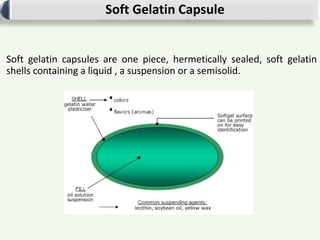
Soft gelatin capsules are one piece, hermetically sealed, soft gelatin
shells containing a liquid , a suspension or a semisolid.
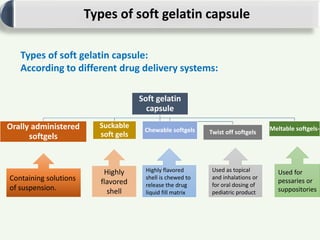
Soft gelatin
capsule
Orally administered
softgels
Suckable
soft gels
Chewable softgels Twist off softgels
Meltable softgels-
Types of soft gelatin capsule:
According to different drug delivery systems:
Types of soft gelatin capsule
Used for
pessaries or
suppositories
Used as topical
and inhalations or
for oral dosing of
pediatric product
Highly flavored
shell is chewed to
release the drug
liquid fill matrix
Containing solutions
of suspension.
Highly
flavored
shell
According to shape-
• Round - (1-7)types
• Oval - (1-110)types.
• Oblong - (3-360)types.
• Tube - (5-480)types.
• Miscellaneous - (6-80)types.
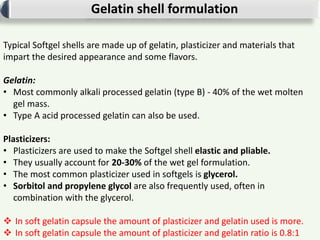
Typical Softgel shells are made up of gelatin, plasticizer and materials that
impart the desired appearance and some flavors.
Gelatin:
• Most commonly alkali processed gelatin (type B) - 40% of the wet molten
gel mass.
• Type A acid processed gelatin can also be used.
Plasticizers:
• Plasticizers are used to make the Softgel shell elastic and pliable.
• They usually account for 20-30% of the wet gel formulation.
• The most common plasticizer used in softgels is glycerol.
• Sorbitol and propylene glycol are also frequently used, often in
combination with the glycerol.
 In soft gelatin capsule the amount of plasticizer and gelatin used is more.
 In soft gelatin capsule the amount of plasticizer and gelatin ratio is 0.8:1
Gelatin shell formulation
Water
• Water usually accounts for 30-40% of the wet gel formulation.
• Its presence is important to ensure proper processing during gel
preparation and encapsulation.
Colorants/Opacifiers
• Colorants and Opacifiers are used in low concentrations in the
wet gel formulation. Colorants are used to impart desired shell
color for product identification
• Opacifiers are used to produce opaque shell.
• Oxygen permeability
The gelatin shell of a softgel provides a good barrier against the
diffusion of oxygen into the contents of the product. Gelatin should
be dry and formulated to contain about 30-40% glycerol.
• Residual water content
Softgels contain a little residual water and compounds which are
susceptible to hydrolysis are protected if dissolved or dispersed in
an oily liquid fill material.
• Presence of iron
Iron is always present in the raw gelatin. Soft gelatin capsules
should not contain more than 15 ppm of iron.
• Bloom or gel strength
bloom of softgels ranges from 150 to 250g.
Properties of soft gelatin shells
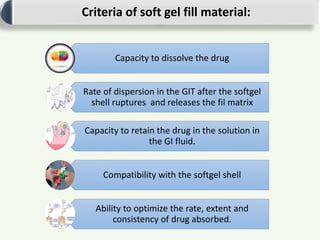
Capacity to dissolve the drug
Rate of dispersion in the GIT after the softgel
shell ruptures and releases the fil matrix
Capacity to retain the drug in the solution in
the GI fluid.
Compatibility with the softgel shell
Ability to optimize the rate, extent and
consistency of drug absorbed.
Criteria of soft gel fill material:
Types of softgel fill matrices
• Lipophilic liquids/oils:
Triglyceride oils, such as soya bean oil are commonly used in soft gels. Active ingredients
like hydroxycholecalciferol oestradiol can be formulated for softgel encapsulation.
• Hydrophilic liquids
Polar liquids with a sufficiently higher molecular weight are commonly used such as
Polyethylene glycol.
• Self-emulsifying oils:
A combination of a pharmaceutical oil and a non-ionic surfactant such as polyoxyethylene
sorbitan monooleate can provide an oily formulation which disperse readily in GI fluids.
• Microemulsion and nanoemulsion systems:
In a microemulsion, the droplet size is in the submicron range.
A nanoemulsion describes a similar system but droplet size is not in the 100 nm size. Both
of them have advantage of a capacity to solubilize drug compounds and to retain the drug
in the solution even after dilution in GI fluids.
• Suspensions:
Drugs that are insoluble in softgel fill matrices are formulated as suspension. With the
appropriate choice of excipients, softgel suspensions can have improved bioavailability.
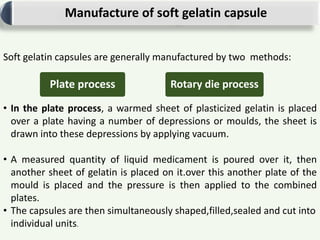
Manufacture of soft gelatin capsule
Soft gelatin capsules are generally manufactured by two methods:
• In the plate process, a warmed sheet of plasticized gelatin is placed
over a plate having a number of depressions or moulds, the sheet is
drawn into these depressions by applying vacuum.
• A measured quantity of liquid medicament is poured over it, then
another sheet of gelatin is placed on it.over this another plate of the
mould is placed and the pressure is then applied to the combined
plates.
• The capsules are then simultaneously shaped,filled,sealed and cut into
individual units.
Rotary die processPlate process
In the rotary die process, the ribbon and the unit dose of liquid fill
matrix are combined to form soft gel.
The process involves careful control of three parameters:
• Temperature- this controls the heat available for capsule seal
formation.
• Timing-The timing of the dosing of unit quantities of liquid fill matrix
into the softgel during its formation is critical.
• Pressure-the pressure exerted between the two rotary dies controls
the softgel shape and the final cut-out from the gel ribbon.
Manufacture of soft gelatin capsule (continued)
In short, these processes take place simultaneously, such that the machine
feeds the gelatin ribbon as the wedge injects fill material. At the same
time, the die system cuts and hermetically seals the two halves of the
gelatin ribbons together.
Manufacture of soft gelatin capsule (continued)
Product quality consideration
Ingredient specifications-
• All the ingredients of a Softgel dosage form are controlled and tested to
ensure compliance with pharmacopoeial specifications.
• Additional specification tests may be added for certain excipients in
order to ensure manufacture of a highly-quality soft gel product.
For example, it is important to limit certain trace impurities such as
aldehyde and peroxide that may be present in polyglycerol.
In process testing-
During this process four tests are carried out:
• The gel ribbon thickness.
• Softgel gel seal thickness at the time of encapsulation.
• Fill matrix weight and capsule shell weight.
• Softgel shell moisture level and Softgel hardness at the end of the
drying stage.
Finished product testing-
Finished softgels are subjected to a number of tests in accordance
with compendial requirements for unit dose capsule products.
These include capsule appearance, active ingredient assay, content
uniformity, weight, microbiological and dissolution testing.
Product quality consideration(continued)
Evaluation of capsule
Size and
shape
Color
Thickness
of cap
shell
Disintegrat
ion testing
Weight
variation
testing
Percent of
medicament
test
The hard and soft gelatin capsules are should be subjected to following
tests for standardization:
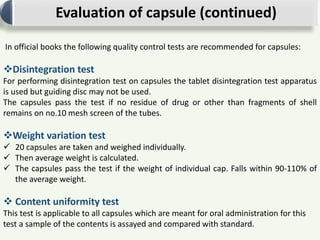
In official books the following quality control tests are recommended for capsules:
Disintegration test
For performing disintegration test on capsules the tablet disintegration test apparatus
is used but guiding disc may not be used.
The capsules pass the test if no residue of drug or other than fragments of shell
remains on no.10 mesh screen of the tubes.
Weight variation test
 20 capsules are taken and weighed individually.
 Then average weight is calculated.
 The capsules pass the test if the weight of individual cap. Falls within 90-110% of
the average weight.
 Content uniformity test
This test is applicable to all capsules which are meant for oral administration for this
test a sample of the contents is assayed and compared with standard.
Evaluation of capsule (continued)
Easy to Manufacture
Easy to administer
Liquids can be encapsulated ( non water soluble)
Small to large sizes possible
Elegance
Portability
Odour and taste masking
More production cost than tablets
Not possible to divide dose
Water soluble material are difficult to incorporate
Highly Moisture sensitive
Efflorescent material cannot be incorporated, they may cause softening /
leaching
Deliquescent materials cannot be incorporated, they may cause
hardening or brittle capsules.
Easy for adulteration.
The differences in between soft and hard gelatin capsules
Hard gelatin capsules Soft gelatin capsules
Cylindrical in shape Round, oval and tube-like shapes.
Hard gelatin capsules shell consists of two
parts namely a body and a cap.
Soft gelatin capsules consists of only 1
piece
Plasticizer and gelatin in hard gelatin
capsule (0.4: 1)
The ratio of plasticizer and gelatin in a soft
gelatin capsule (0.8 : 1)
Boundary wall firm and rigid Boundary wall soft and flexible
Volatile drug substance is not suitable for
filling.
Volatile drug substance is suitable for
filling.
Preservative less than soft gelatin capsule Preservative more than hard gelatin
capsule
Plasticizer less than soft gelatin capsule. Plasticizer more than hard gelatin capsule
Challenges in development of soft gelatin capsule
Although the formulation of drugs into softgel capsules has been reported to solve
many problem associated with tableting including
1. Lack of content or weight uniformity.
2. Powder flow or mixing problems.
3. Poor differentiation or mismatching of gel material added to cross-linking with
the drug
4. If gelatin is not suitable, alternative polymers for capsule production may be
exploited.
The major challenge in the development of the softgel dosage form is that the system
is very dynamic in terms of
1. The physical migration of components between the shell and the fill and the shell
and the external environment.
2. The occurrence of physical and chemical interactions within and between the shell
and fill component.
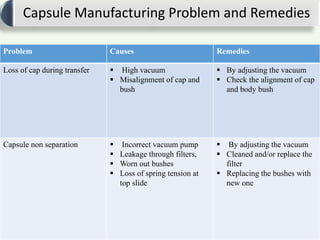
Capsule Manufacturing Problem and Remedies
Problem Causes Remedies
Loss of cap during transfer  High vacuum
 Misalignment of cap and
bush
 By adjusting the vacuum
 Check the alignment of cap
and body bush
Capsule non separation  Incorrect vacuum pump
 Leakage through filters,
 Worn out bushes
 Loss of spring tension at
top slide
 By adjusting the vacuum
 Cleaned and/or replace the
filter
 Replacing the bushes with
new one
Target weight not achieved  Wrong selection of capsule
size
 Incorrect slug formation
due to incorrect setting
parameter
 Insufficient binding
 Poor flow of product
 Formulation is stick
 Check the variation in
physical parameters
 Proper selection of dosing
disc
 Tamping block 1-5 are
placed along the direction
of rotation of dosing disc
 Improve the flow property
 Powder must be non-
hygroscopic
Length variation  Excess joined length
 Improper setting of closing
plate
 Damage rubber sheet of
closing plate
 Checking the standard
locking length
 The gap should be between
0.5-0.8 mm
 Replacing the rubber sheet
with one
Capsule Manufacturing Problem and Remedies (continued)
Problem Causes Remedies
Packaging
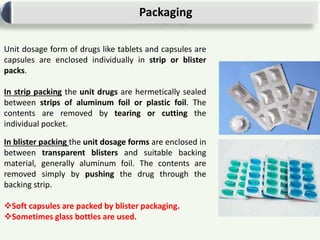
Unit dosage form of drugs like tablets and capsules are
capsules are enclosed individually in strip or blister
packs.
In strip packing the unit drugs are hermetically sealed
between strips of aluminum foil or plastic foil. The
contents are removed by tearing or cutting the
individual pocket.
In blister packing the unit dosage forms are enclosed in
between transparent blisters and suitable backing
material, generally aluminum foil. The contents are
removed simply by pushing the drug through the
backing strip.
Soft capsules are packed by blister packaging.
Sometimes glass bottles are used.
Uses of the soft gelatin capsules:
Here are some of the major uses of the soft gelatin capsules:
Depending on the combination you can use it to supplement or boost the
dietary requirements.
Boost the body energy requirements for gymnasts and treat certain
illnesses.
Improve oral bioavailability of compounds that are poorly soluble
Delivering ultra-low and low dosages of different compounds
Delivering low melting point compounds vii. Improving the ease of oral
medication due to the lack of taste and odor.
Conclusion
• More than 40% of new chemical entities (NCEs) coming out of
the current drug discovery process have poor biopharmaceutical
properties, such as low aqueous solubility and/or permeability.
Development of soft gelatin capsule (softgel) dosage form is of
growing interest for the oral delivery of poorly water soluble
compounds. For this reason the softgel dosage forms are
increasingly being preferred.
Soft Gelatin Capsule

Soft Gelatin Capsule

  • 1.
    Soft Gelatin Capsules PRESENTEDBY GROUP-A (16PHR001, 16, 17, 26, 32, 39, 56) BANGABANDHU SHEIKH MUJIBUR RAHMAN SCIENCE & TECHNOLOGY UNIVERSITY, GOPALGANJ WELCOME TO OUR PRESENTATION ON COURSE TITLE: PHARMACEUTICAL TECHNOLOGY-II COURSE CODE: PHR361
  • 2.
    Introduction The first capsuleprepared from gelatin was a one-piece capsule patented in France by Mothes and Du Blance in 1834. Capsules are solid dosage forms in which the drug substances is enclosed within either a hard or soft soluble shell, usually formed from gelatin. Most capsules of are intended to shallowed whole ; however some soft gelatin capsules are intended for rectal or vaginal insertion as suppositions.
  • 3.
    Types of Capsule: Hard gelatin capsules Soft gelatin capsules There are two types of capsule:
  • 4.
    Soft Gelatin Capsule Softgelatin capsules are one piece, hermetically sealed, soft gelatin shells containing a liquid , a suspension or a semisolid.
  • 5.
    Soft gelatin capsule Orally administered softgels Suckable softgels Chewable softgels Twist off softgels Meltable softgels- Types of soft gelatin capsule: According to different drug delivery systems: Types of soft gelatin capsule Used for pessaries or suppositories Used as topical and inhalations or for oral dosing of pediatric product Highly flavored shell is chewed to release the drug liquid fill matrix Containing solutions of suspension. Highly flavored shell
  • 6.
    According to shape- •Round - (1-7)types • Oval - (1-110)types. • Oblong - (3-360)types. • Tube - (5-480)types. • Miscellaneous - (6-80)types.
  • 7.
    Typical Softgel shellsare made up of gelatin, plasticizer and materials that impart the desired appearance and some flavors. Gelatin: • Most commonly alkali processed gelatin (type B) - 40% of the wet molten gel mass. • Type A acid processed gelatin can also be used. Plasticizers: • Plasticizers are used to make the Softgel shell elastic and pliable. • They usually account for 20-30% of the wet gel formulation. • The most common plasticizer used in softgels is glycerol. • Sorbitol and propylene glycol are also frequently used, often in combination with the glycerol.  In soft gelatin capsule the amount of plasticizer and gelatin used is more.  In soft gelatin capsule the amount of plasticizer and gelatin ratio is 0.8:1 Gelatin shell formulation
  • 8.
    Water • Water usuallyaccounts for 30-40% of the wet gel formulation. • Its presence is important to ensure proper processing during gel preparation and encapsulation. Colorants/Opacifiers • Colorants and Opacifiers are used in low concentrations in the wet gel formulation. Colorants are used to impart desired shell color for product identification • Opacifiers are used to produce opaque shell.
  • 9.
    • Oxygen permeability Thegelatin shell of a softgel provides a good barrier against the diffusion of oxygen into the contents of the product. Gelatin should be dry and formulated to contain about 30-40% glycerol. • Residual water content Softgels contain a little residual water and compounds which are susceptible to hydrolysis are protected if dissolved or dispersed in an oily liquid fill material. • Presence of iron Iron is always present in the raw gelatin. Soft gelatin capsules should not contain more than 15 ppm of iron. • Bloom or gel strength bloom of softgels ranges from 150 to 250g. Properties of soft gelatin shells
  • 10.
    Capacity to dissolvethe drug Rate of dispersion in the GIT after the softgel shell ruptures and releases the fil matrix Capacity to retain the drug in the solution in the GI fluid. Compatibility with the softgel shell Ability to optimize the rate, extent and consistency of drug absorbed. Criteria of soft gel fill material:
  • 11.
    Types of softgelfill matrices • Lipophilic liquids/oils: Triglyceride oils, such as soya bean oil are commonly used in soft gels. Active ingredients like hydroxycholecalciferol oestradiol can be formulated for softgel encapsulation. • Hydrophilic liquids Polar liquids with a sufficiently higher molecular weight are commonly used such as Polyethylene glycol. • Self-emulsifying oils: A combination of a pharmaceutical oil and a non-ionic surfactant such as polyoxyethylene sorbitan monooleate can provide an oily formulation which disperse readily in GI fluids. • Microemulsion and nanoemulsion systems: In a microemulsion, the droplet size is in the submicron range. A nanoemulsion describes a similar system but droplet size is not in the 100 nm size. Both of them have advantage of a capacity to solubilize drug compounds and to retain the drug in the solution even after dilution in GI fluids. • Suspensions: Drugs that are insoluble in softgel fill matrices are formulated as suspension. With the appropriate choice of excipients, softgel suspensions can have improved bioavailability.
  • 12.
    Manufacture of softgelatin capsule Soft gelatin capsules are generally manufactured by two methods: • In the plate process, a warmed sheet of plasticized gelatin is placed over a plate having a number of depressions or moulds, the sheet is drawn into these depressions by applying vacuum. • A measured quantity of liquid medicament is poured over it, then another sheet of gelatin is placed on it.over this another plate of the mould is placed and the pressure is then applied to the combined plates. • The capsules are then simultaneously shaped,filled,sealed and cut into individual units. Rotary die processPlate process
  • 13.
    In the rotarydie process, the ribbon and the unit dose of liquid fill matrix are combined to form soft gel. The process involves careful control of three parameters: • Temperature- this controls the heat available for capsule seal formation. • Timing-The timing of the dosing of unit quantities of liquid fill matrix into the softgel during its formation is critical. • Pressure-the pressure exerted between the two rotary dies controls the softgel shape and the final cut-out from the gel ribbon. Manufacture of soft gelatin capsule (continued)
  • 14.
    In short, theseprocesses take place simultaneously, such that the machine feeds the gelatin ribbon as the wedge injects fill material. At the same time, the die system cuts and hermetically seals the two halves of the gelatin ribbons together. Manufacture of soft gelatin capsule (continued)
  • 15.
    Product quality consideration Ingredientspecifications- • All the ingredients of a Softgel dosage form are controlled and tested to ensure compliance with pharmacopoeial specifications. • Additional specification tests may be added for certain excipients in order to ensure manufacture of a highly-quality soft gel product. For example, it is important to limit certain trace impurities such as aldehyde and peroxide that may be present in polyglycerol. In process testing- During this process four tests are carried out: • The gel ribbon thickness. • Softgel gel seal thickness at the time of encapsulation. • Fill matrix weight and capsule shell weight. • Softgel shell moisture level and Softgel hardness at the end of the drying stage.
  • 16.
    Finished product testing- Finishedsoftgels are subjected to a number of tests in accordance with compendial requirements for unit dose capsule products. These include capsule appearance, active ingredient assay, content uniformity, weight, microbiological and dissolution testing. Product quality consideration(continued)
  • 17.
    Evaluation of capsule Sizeand shape Color Thickness of cap shell Disintegrat ion testing Weight variation testing Percent of medicament test The hard and soft gelatin capsules are should be subjected to following tests for standardization:
  • 18.
    In official booksthe following quality control tests are recommended for capsules: Disintegration test For performing disintegration test on capsules the tablet disintegration test apparatus is used but guiding disc may not be used. The capsules pass the test if no residue of drug or other than fragments of shell remains on no.10 mesh screen of the tubes. Weight variation test  20 capsules are taken and weighed individually.  Then average weight is calculated.  The capsules pass the test if the weight of individual cap. Falls within 90-110% of the average weight.  Content uniformity test This test is applicable to all capsules which are meant for oral administration for this test a sample of the contents is assayed and compared with standard. Evaluation of capsule (continued)
  • 19.
    Easy to Manufacture Easyto administer Liquids can be encapsulated ( non water soluble) Small to large sizes possible Elegance Portability Odour and taste masking
  • 20.
    More production costthan tablets Not possible to divide dose Water soluble material are difficult to incorporate Highly Moisture sensitive Efflorescent material cannot be incorporated, they may cause softening / leaching Deliquescent materials cannot be incorporated, they may cause hardening or brittle capsules. Easy for adulteration.
  • 21.
    The differences inbetween soft and hard gelatin capsules Hard gelatin capsules Soft gelatin capsules Cylindrical in shape Round, oval and tube-like shapes. Hard gelatin capsules shell consists of two parts namely a body and a cap. Soft gelatin capsules consists of only 1 piece Plasticizer and gelatin in hard gelatin capsule (0.4: 1) The ratio of plasticizer and gelatin in a soft gelatin capsule (0.8 : 1) Boundary wall firm and rigid Boundary wall soft and flexible Volatile drug substance is not suitable for filling. Volatile drug substance is suitable for filling. Preservative less than soft gelatin capsule Preservative more than hard gelatin capsule Plasticizer less than soft gelatin capsule. Plasticizer more than hard gelatin capsule
  • 22.
    Challenges in developmentof soft gelatin capsule Although the formulation of drugs into softgel capsules has been reported to solve many problem associated with tableting including 1. Lack of content or weight uniformity. 2. Powder flow or mixing problems. 3. Poor differentiation or mismatching of gel material added to cross-linking with the drug 4. If gelatin is not suitable, alternative polymers for capsule production may be exploited. The major challenge in the development of the softgel dosage form is that the system is very dynamic in terms of 1. The physical migration of components between the shell and the fill and the shell and the external environment. 2. The occurrence of physical and chemical interactions within and between the shell and fill component.
  • 23.
    Capsule Manufacturing Problemand Remedies Problem Causes Remedies Loss of cap during transfer  High vacuum  Misalignment of cap and bush  By adjusting the vacuum  Check the alignment of cap and body bush Capsule non separation  Incorrect vacuum pump  Leakage through filters,  Worn out bushes  Loss of spring tension at top slide  By adjusting the vacuum  Cleaned and/or replace the filter  Replacing the bushes with new one
  • 24.
    Target weight notachieved  Wrong selection of capsule size  Incorrect slug formation due to incorrect setting parameter  Insufficient binding  Poor flow of product  Formulation is stick  Check the variation in physical parameters  Proper selection of dosing disc  Tamping block 1-5 are placed along the direction of rotation of dosing disc  Improve the flow property  Powder must be non- hygroscopic Length variation  Excess joined length  Improper setting of closing plate  Damage rubber sheet of closing plate  Checking the standard locking length  The gap should be between 0.5-0.8 mm  Replacing the rubber sheet with one Capsule Manufacturing Problem and Remedies (continued) Problem Causes Remedies
  • 25.
    Packaging Unit dosage formof drugs like tablets and capsules are capsules are enclosed individually in strip or blister packs. In strip packing the unit drugs are hermetically sealed between strips of aluminum foil or plastic foil. The contents are removed by tearing or cutting the individual pocket. In blister packing the unit dosage forms are enclosed in between transparent blisters and suitable backing material, generally aluminum foil. The contents are removed simply by pushing the drug through the backing strip. Soft capsules are packed by blister packaging. Sometimes glass bottles are used.
  • 26.
    Uses of thesoft gelatin capsules: Here are some of the major uses of the soft gelatin capsules: Depending on the combination you can use it to supplement or boost the dietary requirements. Boost the body energy requirements for gymnasts and treat certain illnesses. Improve oral bioavailability of compounds that are poorly soluble Delivering ultra-low and low dosages of different compounds Delivering low melting point compounds vii. Improving the ease of oral medication due to the lack of taste and odor.
  • 27.
    Conclusion • More than40% of new chemical entities (NCEs) coming out of the current drug discovery process have poor biopharmaceutical properties, such as low aqueous solubility and/or permeability. Development of soft gelatin capsule (softgel) dosage form is of growing interest for the oral delivery of poorly water soluble compounds. For this reason the softgel dosage forms are increasingly being preferred.