Absorption of Drugs
DRUG:
 • A      drug        is         injected
                                             • Thus, absorption is an important
  intravascularly          (iv   or    ia)    prerequisite step
  directly enters into systemic
  circulation.
 • Majority      of        drugs      are
  administered        extravascularly
  (generally orally).
 • Such   drugs can exert the
  pharmacological          action     only
  when they come into systemic
  circulation from their site of
  administration .
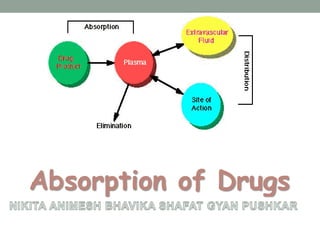
Definition of Absorption
• The process of movement of unchanged drug from the site
 of administration to systemic circulation
• The effectiveness of a drug can only be assessed by its
 concentration at the site of action.
• It is difficult to measure the drug concentration at such
 site.
• Instead, the concentration can be measured more correctly
 in plasma
• As     there   always   a   correlation   between   the   plasma
 concentration of a drug & therapeutic response
Cell Membrane
Structure & Physiology
CELL MEMBRANE
• Cell   membrane    separates      living   cell   from   nonliving
 surroundings

  • thin barrier = 8nm thick

• Controls traffic in & out of the cell

  • selectively permeable

  • allows some substances to cross more easily than others

     • hydrophobic vs hydrophilic

• Made of phospholipids, proteins & other macromolecules
• Proteins determine membrane’s specific
  functions
  – cell membrane & organelle membranes
    each have unique collections of proteins
• Membrane proteins:
  – peripheral proteins
     • loosely bound to surface of membrane
     • cell surface identity marker (antigens)


  – integral proteins
     • penetrate lipid bilayer, usually across whole
       membrane
     • transmembrane protein transport proteins
        – channels, permeases (pumps)
Physiological factors affecting oral
     absorption (outline)
• Passage of drugs           • Main factors
 across membranes              affecting oral
   1.Active transport          absorption
   2.Facilitated diffusion
                             • Physiological factors
   3.Passive diffusion
   4.Pinocytosis             • Physical-chemical
   5.Pore transport            factors
   6.Ion pair formation
                             • Formulation factors
MECHANISMS OF
DRUG ABSORPTION
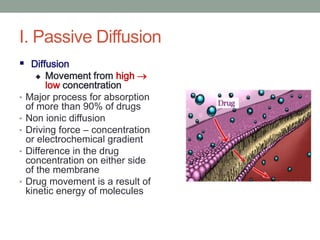
I. Passive Diffusion
 Diffusion
        Movement from high 
         low concentration
•   Major process for absorption
    of more than 90% of drugs
•   Non ionic diffusion
•   Driving force – concentration
    or electrochemical gradient
•   Difference in the drug
    concentration on either side
    of the membrane
•   Drug movement is a result of
    kinetic energy of molecules
Mathematically(Fick’s First law of
diffusion)

                                                 .................I
dQ/dt = rate of drug diffusion (amount/time)

D = diffusion coefficient of the drug

A= surface area of the absorbing membrane for drug diffusion

Km/w = partition coefficient of drug between the lipoidal membrane &
 the aqueous GI fluids
(CGIT – C) = difference in the concentration of drug in the GI fluids &
 the plasma (Concentration Gradient)
h = thickness of the membrane
Characteristics of Passive diffusion:
Energy independent
Greater the area & lesser the thickness of the membrane, faster
 the diffusion
The process rapid over for short distances
Concentration equal on both the sides of the membrane -
 Equilibrium is attained
Greater the PC of the drug faster the absorption
But this is not the case……
The passively absorbed drug enters blood, rapidly swept away

 & distributed into a larger volume of body fluids

Hence,

The concentration of drug at absorption site CGIT is maintained

 greater than the concentration in the plasma. Such a condition is
 called as sink condition for drug absorption.
Under usual absorption conditions,

D, A, Km/w & h are constants, the term DAKm/w /h can be replaced by

 a combined constant P called as permeability coefficient

Permeability -    ease with which a drug can permeate or diffuse
 through a membrane.

Due to sink conditions, the C is very small in comparison to CGIT.
……………..II

Equation II is an expression for a first order process.

Thus, passive diffusion follows first order kinetics.
II. PORE TRANSPORT

•   It is also called as convective transport, bulk flow or filtration.

•   Mechanism – through the protein channel present in the cell
    membrane.

•   Drug permeation through pore transport – renal excretion, removal
    of drug from CSF & entry of drug into the liver
The driving force – hydrostatic or osmotic pressure differences across
 the membrane. Thus, bulk flow of water along with the small solid
 molecules through aqueous channels. Water flux that promotes such a
 transport is called as solvent drag


The process is important in the absorption of low molecular weight
 (<100D), low molecular size (smaller than the diameter of the pore)
 & generally water soluble drugs through narrow, aqueous filled
 channels or pores e.g. urea, water & sugars.


Chain like or linear compounds (upto 400D)- filtration
III. ION-PAIR TRANSPORT
Responsible for absorption of compounds which ionizes at all

 pH values. e.g. quaternary ammonium, sulphonic acids

Ionized moieties forms neutral complexes with endogenous ions

 which have both the required lipophilicity & aqueous solubility
 for passive diffusion.

E.g. Propranolol, a basic drug that forms an ion pair with oleic

 acid & is absorbed by this mechanism
CARRIER MEDIATED Transport
• Involves a carrier      • The carrier then
  which reversibly          returns to the original
  binds to the solute       site to accept a new
  molecules and forms       molecule.
  a solute-carrier        • There are two type of
  complex.                  carrier mediated
• This molecule             transport system
  transverse across the    1) Facilitated
  membrane to the              diffusion
  other side and           2) Active transport
  dissociates, yielding
  the solute molecule.
FACILITATED DIFFUSION
               • Facilitated diffusion is a
                 form of carrier transport
                 that does not require
                 the expenditure of
                 cellular energy.
               • Carriers are numerous in
                 number & are found
                 dissolved in cell
                 membrane .
               • The driving force is
                 concentration
                 gradient, particles move
                 from a region of high
                 conc to low conc.
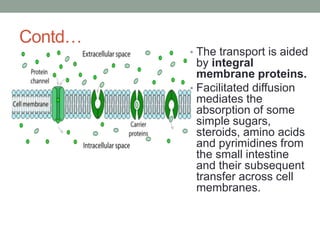
Contd…
         • The transport is aided
           by integral
           membrane proteins.
         • Facilitated diffusion
           mediates the
           absorption of some
           simple sugars,
           steroids, amino acids
           and pyrimidines from
           the small intestine
           and their subsequent
           transfer across cell
           membranes.
ACTIVE TRANSPORT
             • Requires energy, which
               is provided by hydrolysis
               of ATP for transportation.
             • More commonly,
               metabolic energy is
               provided by the active
               transport of Na+, or is
               dependent on the
               electrochemical gradient
               produced by the sodium
               pump, Na+/K+ ATPase
               (secondary active
               transport).
This transport requires energy in the form of ATP
PRIMARY ACTIVE TRANSPORT
• Direct ATP requirement
• The process transfers only one ion or molecule & only in
  one direction. Hence, called as UNIPORT
• E.g. absorption of glucose
• ABC (ATP binding Cassette) transporters
Secondary active transport

• No direct requirement of ATP
• The energy required in transporting an ion aids transport
  of another ion or molecule (co-transport or coupled
  transport) either in the same direction or opposite
  direction.
• 2 types:
• Symport (co-transport)
• Antiport (counter transport)
Antiport and Symport

ATP              ATP


      antiport         symport
ENDOCYTOSIS
              • It is a process in which
                cell absorbs molecules
                by engulfing them.
              • Also termed as
                vesicular transport.
              • It occurs by 3
                mechanisms:
              Phagocytosis
              Pinocytosis
              Transcytosis
PHAGOCYTOSIS
TRANSCYTOSIS
  • It is the process        • Generally used for the
    through which various     transfer of IgA and
    macromolecules are        insulin.
    transferred across the
    cell membrane.
  • They are captured in
    vesicles, on one side
    of the cell and the
    endocytic vesicle is
    transferred from one
    extracellular
    compartment to
    another.
PINOCYTOSIS
              • It is a form of endocytosis in
                  which small particles are
                  brought to the cell, forming
                  an invagination.
              •   These small particles are
                  suspended in small vesicles.
              •   It requires energy in the form
                  of ATP.
              •   It works as phagocytosis, the
                  only difference being, it is
                  non specific in the
                  substances it transports.
              •   This process is important in
                  the absorption of oil soluble
                  vitamins & in the uptake of
                  nutrients
FACTORS AFFECTING RATE OF
ABSORPTION
DRUG SOLUBILITY AND
DISSOLUTION RATE
• MAXIMUM ABSORBABLE DOSE (MAD)


•   Ka = intrinsic absorption rate constant

•   SGI = the solubility of the drug in the GI fluid

•   VGI = the volume of the GI fluid

•   tr = residence time of the drug in the GI
CLAS   SOLUBILIT   PERMIABILIT   ABSORPTION   RATE        EXAMPLE
S      Y           Y              PATTERN     LIMITING
                                              STEP
       HIGH        HIGH          WELL         GASTRIC     DILTIAZEM
1                                ABSORBED     EMPTYING
       LOW         HIGH          VARIABLE     DISSOLUTI   NIFEDEPINE
2                                             ON
       HIGH        LOW           VARIABLE     PERMIATIO   INSULIN
3                                             N
       LOW         LOW           POORLY       CASE BY     TAXOL
4                                ABSORBED     CASE
PARTICLE SIZE AND SURFACE AREA


• Particle size       1/surface area
•   Absolute surface area
•   Effective surface area
•   Larger the surface area higher the dissolution rate
•   Decrease in particle size can be accomplished by micronisation.
• hydrophobic drugs


   - The hydrophobic surface of the drug adsorbs air
     onto their surface which inhibits their wettability

    - The particles re-aggregate to form larger
      particles due to their high surface free energy.

    - Electrically induced agglomeration owing to
      surface charges prevents intimate contact of the
      drug with the dissolution medium.
REMEDIES
 • -Use of surfactant as wetting
      agent                               • Particle size reduction &
                                              subsequent increase in the
             Decreases             the       surface area & dissolution rate
                                              is not advisable for-
              interfacial tension         •       - When the drugs are
                                              unstable & degrade in the
             Displaces             the •           solution form e.g.
                                              penicillins, erythromycin.
              adsorbed air with the •             - When drugs produce
                                              undesirabe effects (gastric
              solvent                     •         irritation caused by
                                              nitrofurantoin).
 2.      Adding hydrophilic diluents
         which coat the surface        •          - When a sustained effect is
                                              desired.
       of hydrophobic drug particles &
         render them
       hydrophilic. E.g. PEG, PVP
Polymorphism and Amorphism
• A substance exists in more than one crystalline form, the
 different forms are designated as polymorphs & the
 phenomenon as polymorphism.

• Enantiotropic polymorph: sulphur


• Monotropic polymorph: glyceryl stearate
• Depending on their relative stability, one of the several
 polymorphic forms will be physically more stable than the others.

• Stable polymorphs
   - lowest energy state
   - highest MP
   - least aqueous solubility
• Metastable polymorphs
   - higher energy state
   - low MP
   - high aqueous solubility
• Chloramphenicol Palmitate - A, B & C.
• E.g. Riboflavin has 5 polymorphs- I, II, III, IV & V

•   Only 10% of the pharmaceuticals are present in metastable
    forms.

•   Aging of dosage forms containing metastable forms usually
    result in formation of less soluble, stable polymorph.

•   E.g. More soluble crystalline form II of cortisone acetate
    converts to less soluble form V in aqueous suspension
    resulting in caking of solid.
•   Amorphism:

•   Amorphous forms: having no internal crystal structure

•   The highest energy state

•   Have greater aqueous solubility than the crystalline forms
    because the energy required to transfer a molecule from
    crystal lattice is greater than that required for non-crystalline
    (amorphous) solid.

•   E.g. the amorphous form of novobiocin is 10 times more
    soluble than the crystalline form.
Salt form of drug

•   Most drugs are either weak acids or weak bases.

•   Solubilization technique – salt formation of drugs
• Weakly acidic drugs- strong base salt
• Weakly basic drugs- strong acidic salt
Drug pKa & GI pH
•    The pH partition theory – the process of drug absorption from the GIT & its
     distribution across GI membrane.

•    Many drugs are either Was or WBs

•    The drugs primarily transported across the biomembrane by passive
     diffusion, is governed by –

1.   The dissociation constant

2.   The lipid solubility of the unionised drugs

3.   The pH at absorption site

•    Drug pKa & GI pH

•    Unionised form of drug = Function of dissociation constant of the drug &

     pH of fluid at the absorption site
Drug Lipophilicity
    Lipophilicity & Drug Absorption:

    Ideally a drug should have

•     Sufficient aqueous solubility to dissolve in the fluids at
      absorption site

•     Sufficient lipid solubility to facilitate the partitioning of the drug
      in lipoidal membrane

•     A perfect hydrophilic-lipophilic balance should be there in the
      structure of the drug for optimum bioavailability.
Drug Permeability
•    Three major drug properties which affects drug permeability –

1.   Lipophilicity

2.   Polarity of the drug

3.   Molecular size of the drug
Drug Stability
•    A drug for oral use may destabilize either during its
     shelf life or in the GIT

•    Reasons:

•    Degradation of the drug into inactive form

•    Interaction with one or more different component either
     of the dosage form or present in the GIT to form
     complex which is poorly absorbable or is unabsorbable
FORMULATION
FACTORS
DISINTEGRATION TIME
• Is of particular importance in case of solid dosage forms
  like tablets and capsules
• Rapid disintegration-important in the therapeutic success
  of solid dosage form
• Sugar coated tablets have long DT


• DT is directly related to the amount of binder present and
 the compression force of a tablet

• After disintegration-granules deaggregate into tiny
 particles-dissolution faster
MANUFACTURING VARIABLES
Method of granulation:
• Wet granulation was thought to be the most conventional
  technique

• Direct compressed tablets dissolve faster


• Agglomerative phase of communition-superior product
Compression force:              • Intensity of packing of
• Higher compression force-       capsule contents:
  increased density and         • Tightly filled capsules-
  hardness-decreased              diffusion of GI fluids-high
  porosity and penetrability-     pressure-rapid bursting
  reduced wetability -inturn      and dissolution of contents
  decreased DR                  • Opposite also possible-
• Also causes                   •     poor drug release due
  deformation,crushing-           to decreased pore size
  increased effective surface     and poor penetrability of
  area-increased DR               GI fluids
DOSAGE FORMS
• Different Types
• Solution
• Suspension
• Tablets
• Capsules
• Coated Tablets
• Enteric Coated Tablet
• Powders
ORDER OF ABSORPTION
• Solutions>Emulsions>Suspensions>Capsules> Tablets>
 Coated Tablets>Enteric Coated Tablet>Sustain Release
 Tablet

• Mechanism


• Factors
Product age and storage conditions
Aging and alteration in storage condition change the physiochemical
 properties of a drug ---adversely affect Bioavailability

 During storage
• Metastable form          stable form
• Change in particle size
• Tablet    harden
            soften
Eg
   Prednisone tablet containing lactose as a filler ,high temp& high
  humidity resulted in harder tablet that disintegrated and dissolve
  slowly
PATIENT RELATED
FACTORS
GI pH
i) disintegration: some dosage forms is Ph sensitive , with
     enteric coating the coat dissolves only in in intestine.
ii) Dissolution: A large no. of drugs whose solubility is affected
     by pH are weak acidic and weak basic drugs.
       W.A drugs dissolve rapidly in the alkaline medium whereas
     W.B drugs dissolve in acidic medium.
iii) Absorption : Depending on drug pKa and whether it is acidic
     or basic , absorption depends on the amount of unionised
     form at site of absorption.
iv) Stability: GI pH affects chemical stability of drug.
    Eg. Acidic pH of stomach degrades Penicillin G and
     erythromycin. Hence they are administered as prodrugs
     namely carindacillin and erythromycin estolate.
Blood flow through GIT
-GIT extensively supplied by blood capillary network .
Therefore it helps in maintaining the sink condition for continued drug absorption.


            DRUG                                        BLOOD FLOW EFFECT
(A) For highly lipid soluble drug                          More
(B) For lipophilic drug                                  Intermediate
(C) For polar drugs                                        No effect
GASTROINTESTINAL CONTENTS
I) Food

                             Influence of food on drug absorption.
              Delayed           Decreased           Increased        Unaffected
            Aspirin             Penicillins        Griseofluvins Methyldopa
            Paracetamol        Erythromycin       Diazapam         Propylthiouracil
            Diclofenac         Tetracyclines

Delayed or decreased drug absorption could be due to
a)Delayed gastric emptying
b) Formation of poorly soluble , unabsorbable complex.
c) Increased viscosity due to food therby preventing drug dissolution.

Increased drug absorption could be due to:
a) Increased time for dissolution of a poorly soluble drug.
b) Enhanced solubility due to GI secretions.
c) Prolonged residence time Eg. Vitamins.
II Fluid volume
Large food volume results in better dissolution and enhanced drug absorption
Eg. Erythromycin is better absorbed when taken with a glass of water under fasting
condition.

III Interaction with normal GI constituents.
-mucin , a protective mucopolysaccharide that lines GI mucosa interacts with
streptomycin
 and certain quaternary ammonium copmpounds and retards their absoprtion
-Bile salts aid to solubilisation of drugs like Vitamin A,D,E and K
-Enzymes.

IV)Drug-drug interaction in the GIT:
They can be physicochemical.

V) Physicochemical D-D interaction can be due to :

a) Adsorption : Antidiarrhoeal preparation contain adsorbant like kaolin-pectin
    retard absorption of co-administerd drugs like promazine and lincomycin.
b) complexation: formation of unabsorpable complexes.Eg. Tetracyclines
c)pH change
•   In infants – incomplete development of biological system - the

    gastric pH is high & intestinal surface area & blood flow to GIT is

    less – results in altered absorption pattern

•   Elderly patients – impaired biological system like altered gastric

    emptying, decreased intestinal surface area, decreased blood

    flow to GIT, higher incidence of achlorhydria & bacterial

    overgrowth in small intestine.
INTESTINAL TRANSIT

  Defined as, the residence time of drug in small intestine.
  Delayed intestinal transit is desirable for:
1. Sustained release dosage forms.
2. Drug that only release in intestine ie ,enteric coated
   formulations,
3. Drugs absorbed from specific sites in intestine, eg;
   several B vitamins .
4. Drugs which penetrate intestinal mucosa very slowly
5. Drugs with minimal absorption from colon.
DISEASE STATE

Several disease state may influence the rate and extent
  of drug absorption.
Three major classes of disease may influence
  bioavailability of drug.
• GI diseases
• CVS diseases
• HEPATIC diseases
GI diseases

A. GI Infections
1. Celiac diseases:(characterized by destruction of villi
   and microvilli) abnormalities associated with this
   disease are increased gastric emptying rate and GI
   permeability, altered intestinal drug metabolism.
2. Crohn’s disease: altered gut transit time and decreased
   gut surface area and intestinal transit rate.
B. GI surgery: Gastrectomy may cause drug dumping in
   intestine, osmotic diarrhoea and reduce intestinal
   transit time.
CVS diseases:
In CVS diseases blood flow to GIT
decrease causing decreased drug absorption.


HEPATIC diseases:
Disorders like hepatic cirrhosis
influences bioavailability of drugs
which under goes first pass
metabolism.
Drug absorption

Drug absorption

  • 1.
  • 2.
    DRUG: • A drug is injected • Thus, absorption is an important intravascularly (iv or ia) prerequisite step directly enters into systemic circulation. • Majority of drugs are administered extravascularly (generally orally). • Such drugs can exert the pharmacological action only when they come into systemic circulation from their site of administration .
  • 3.
    Definition of Absorption •The process of movement of unchanged drug from the site of administration to systemic circulation • The effectiveness of a drug can only be assessed by its concentration at the site of action. • It is difficult to measure the drug concentration at such site. • Instead, the concentration can be measured more correctly in plasma • As there always a correlation between the plasma concentration of a drug & therapeutic response
  • 4.
  • 5.
    CELL MEMBRANE • Cell membrane separates living cell from nonliving surroundings • thin barrier = 8nm thick • Controls traffic in & out of the cell • selectively permeable • allows some substances to cross more easily than others • hydrophobic vs hydrophilic • Made of phospholipids, proteins & other macromolecules
  • 6.
    • Proteins determinemembrane’s specific functions – cell membrane & organelle membranes each have unique collections of proteins • Membrane proteins: – peripheral proteins • loosely bound to surface of membrane • cell surface identity marker (antigens) – integral proteins • penetrate lipid bilayer, usually across whole membrane • transmembrane protein transport proteins – channels, permeases (pumps)
  • 7.
    Physiological factors affectingoral absorption (outline) • Passage of drugs • Main factors across membranes affecting oral 1.Active transport absorption 2.Facilitated diffusion • Physiological factors 3.Passive diffusion 4.Pinocytosis • Physical-chemical 5.Pore transport factors 6.Ion pair formation • Formulation factors
  • 8.
  • 9.
    I. Passive Diffusion Diffusion  Movement from high  low concentration • Major process for absorption of more than 90% of drugs • Non ionic diffusion • Driving force – concentration or electrochemical gradient • Difference in the drug concentration on either side of the membrane • Drug movement is a result of kinetic energy of molecules
  • 11.
    Mathematically(Fick’s First lawof diffusion) .................I dQ/dt = rate of drug diffusion (amount/time) D = diffusion coefficient of the drug A= surface area of the absorbing membrane for drug diffusion Km/w = partition coefficient of drug between the lipoidal membrane & the aqueous GI fluids (CGIT – C) = difference in the concentration of drug in the GI fluids & the plasma (Concentration Gradient) h = thickness of the membrane
  • 12.
    Characteristics of Passivediffusion: Energy independent Greater the area & lesser the thickness of the membrane, faster the diffusion The process rapid over for short distances Concentration equal on both the sides of the membrane - Equilibrium is attained Greater the PC of the drug faster the absorption
  • 13.
    But this isnot the case…… The passively absorbed drug enters blood, rapidly swept away & distributed into a larger volume of body fluids Hence, The concentration of drug at absorption site CGIT is maintained greater than the concentration in the plasma. Such a condition is called as sink condition for drug absorption.
  • 14.
    Under usual absorptionconditions, D, A, Km/w & h are constants, the term DAKm/w /h can be replaced by a combined constant P called as permeability coefficient Permeability - ease with which a drug can permeate or diffuse through a membrane. Due to sink conditions, the C is very small in comparison to CGIT.
  • 15.
    ……………..II Equation II isan expression for a first order process. Thus, passive diffusion follows first order kinetics.
  • 16.
    II. PORE TRANSPORT • It is also called as convective transport, bulk flow or filtration. • Mechanism – through the protein channel present in the cell membrane. • Drug permeation through pore transport – renal excretion, removal of drug from CSF & entry of drug into the liver
  • 17.
    The driving force– hydrostatic or osmotic pressure differences across the membrane. Thus, bulk flow of water along with the small solid molecules through aqueous channels. Water flux that promotes such a transport is called as solvent drag The process is important in the absorption of low molecular weight (<100D), low molecular size (smaller than the diameter of the pore) & generally water soluble drugs through narrow, aqueous filled channels or pores e.g. urea, water & sugars. Chain like or linear compounds (upto 400D)- filtration
  • 18.
    III. ION-PAIR TRANSPORT Responsiblefor absorption of compounds which ionizes at all pH values. e.g. quaternary ammonium, sulphonic acids Ionized moieties forms neutral complexes with endogenous ions which have both the required lipophilicity & aqueous solubility for passive diffusion. E.g. Propranolol, a basic drug that forms an ion pair with oleic acid & is absorbed by this mechanism
  • 19.
    CARRIER MEDIATED Transport •Involves a carrier • The carrier then which reversibly returns to the original binds to the solute site to accept a new molecules and forms molecule. a solute-carrier • There are two type of complex. carrier mediated • This molecule transport system transverse across the 1) Facilitated membrane to the diffusion other side and 2) Active transport dissociates, yielding the solute molecule.
  • 20.
    FACILITATED DIFFUSION • Facilitated diffusion is a form of carrier transport that does not require the expenditure of cellular energy. • Carriers are numerous in number & are found dissolved in cell membrane . • The driving force is concentration gradient, particles move from a region of high conc to low conc.
  • 21.
    Contd… • The transport is aided by integral membrane proteins. • Facilitated diffusion mediates the absorption of some simple sugars, steroids, amino acids and pyrimidines from the small intestine and their subsequent transfer across cell membranes.
  • 22.
    ACTIVE TRANSPORT • Requires energy, which is provided by hydrolysis of ATP for transportation. • More commonly, metabolic energy is provided by the active transport of Na+, or is dependent on the electrochemical gradient produced by the sodium pump, Na+/K+ ATPase (secondary active transport).
  • 23.
    This transport requiresenergy in the form of ATP
  • 24.
    PRIMARY ACTIVE TRANSPORT •Direct ATP requirement • The process transfers only one ion or molecule & only in one direction. Hence, called as UNIPORT • E.g. absorption of glucose • ABC (ATP binding Cassette) transporters
  • 25.
    Secondary active transport •No direct requirement of ATP • The energy required in transporting an ion aids transport of another ion or molecule (co-transport or coupled transport) either in the same direction or opposite direction. • 2 types: • Symport (co-transport) • Antiport (counter transport)
  • 26.
    Antiport and Symport ATP ATP antiport symport
  • 27.
    ENDOCYTOSIS • It is a process in which cell absorbs molecules by engulfing them. • Also termed as vesicular transport. • It occurs by 3 mechanisms: Phagocytosis Pinocytosis Transcytosis
  • 28.
  • 29.
    TRANSCYTOSIS •It is the process • Generally used for the through which various transfer of IgA and macromolecules are insulin. transferred across the cell membrane. • They are captured in vesicles, on one side of the cell and the endocytic vesicle is transferred from one extracellular compartment to another.
  • 30.
    PINOCYTOSIS • It is a form of endocytosis in which small particles are brought to the cell, forming an invagination. • These small particles are suspended in small vesicles. • It requires energy in the form of ATP. • It works as phagocytosis, the only difference being, it is non specific in the substances it transports. • This process is important in the absorption of oil soluble vitamins & in the uptake of nutrients
  • 31.
  • 32.
    DRUG SOLUBILITY AND DISSOLUTIONRATE • MAXIMUM ABSORBABLE DOSE (MAD) • Ka = intrinsic absorption rate constant • SGI = the solubility of the drug in the GI fluid • VGI = the volume of the GI fluid • tr = residence time of the drug in the GI
  • 33.
    CLAS SOLUBILIT PERMIABILIT ABSORPTION RATE EXAMPLE S Y Y PATTERN LIMITING STEP HIGH HIGH WELL GASTRIC DILTIAZEM 1 ABSORBED EMPTYING LOW HIGH VARIABLE DISSOLUTI NIFEDEPINE 2 ON HIGH LOW VARIABLE PERMIATIO INSULIN 3 N LOW LOW POORLY CASE BY TAXOL 4 ABSORBED CASE
  • 34.
    PARTICLE SIZE ANDSURFACE AREA • Particle size 1/surface area • Absolute surface area • Effective surface area • Larger the surface area higher the dissolution rate • Decrease in particle size can be accomplished by micronisation.
  • 35.
    • hydrophobic drugs - The hydrophobic surface of the drug adsorbs air onto their surface which inhibits their wettability - The particles re-aggregate to form larger particles due to their high surface free energy. - Electrically induced agglomeration owing to surface charges prevents intimate contact of the drug with the dissolution medium.
  • 36.
    REMEDIES • -Useof surfactant as wetting agent • Particle size reduction & subsequent increase in the  Decreases the surface area & dissolution rate is not advisable for- interfacial tension • - When the drugs are unstable & degrade in the  Displaces the • solution form e.g. penicillins, erythromycin. adsorbed air with the • - When drugs produce undesirabe effects (gastric solvent • irritation caused by nitrofurantoin). 2. Adding hydrophilic diluents which coat the surface • - When a sustained effect is desired. of hydrophobic drug particles & render them hydrophilic. E.g. PEG, PVP
  • 37.
    Polymorphism and Amorphism •A substance exists in more than one crystalline form, the different forms are designated as polymorphs & the phenomenon as polymorphism. • Enantiotropic polymorph: sulphur • Monotropic polymorph: glyceryl stearate
  • 38.
    • Depending ontheir relative stability, one of the several polymorphic forms will be physically more stable than the others. • Stable polymorphs - lowest energy state - highest MP - least aqueous solubility • Metastable polymorphs - higher energy state - low MP - high aqueous solubility
  • 39.
    • Chloramphenicol Palmitate- A, B & C. • E.g. Riboflavin has 5 polymorphs- I, II, III, IV & V • Only 10% of the pharmaceuticals are present in metastable forms. • Aging of dosage forms containing metastable forms usually result in formation of less soluble, stable polymorph. • E.g. More soluble crystalline form II of cortisone acetate converts to less soluble form V in aqueous suspension resulting in caking of solid.
  • 40.
    Amorphism: • Amorphous forms: having no internal crystal structure • The highest energy state • Have greater aqueous solubility than the crystalline forms because the energy required to transfer a molecule from crystal lattice is greater than that required for non-crystalline (amorphous) solid. • E.g. the amorphous form of novobiocin is 10 times more soluble than the crystalline form.
  • 41.
    Salt form ofdrug • Most drugs are either weak acids or weak bases. • Solubilization technique – salt formation of drugs • Weakly acidic drugs- strong base salt • Weakly basic drugs- strong acidic salt
  • 43.
    Drug pKa &GI pH • The pH partition theory – the process of drug absorption from the GIT & its distribution across GI membrane. • Many drugs are either Was or WBs • The drugs primarily transported across the biomembrane by passive diffusion, is governed by – 1. The dissociation constant 2. The lipid solubility of the unionised drugs 3. The pH at absorption site • Drug pKa & GI pH • Unionised form of drug = Function of dissociation constant of the drug & pH of fluid at the absorption site
  • 44.
    Drug Lipophilicity Lipophilicity & Drug Absorption: Ideally a drug should have • Sufficient aqueous solubility to dissolve in the fluids at absorption site • Sufficient lipid solubility to facilitate the partitioning of the drug in lipoidal membrane • A perfect hydrophilic-lipophilic balance should be there in the structure of the drug for optimum bioavailability.
  • 45.
    Drug Permeability • Three major drug properties which affects drug permeability – 1. Lipophilicity 2. Polarity of the drug 3. Molecular size of the drug
  • 46.
    Drug Stability • A drug for oral use may destabilize either during its shelf life or in the GIT • Reasons: • Degradation of the drug into inactive form • Interaction with one or more different component either of the dosage form or present in the GIT to form complex which is poorly absorbable or is unabsorbable
  • 47.
  • 48.
    DISINTEGRATION TIME • Isof particular importance in case of solid dosage forms like tablets and capsules • Rapid disintegration-important in the therapeutic success of solid dosage form • Sugar coated tablets have long DT • DT is directly related to the amount of binder present and the compression force of a tablet • After disintegration-granules deaggregate into tiny particles-dissolution faster
  • 49.
    MANUFACTURING VARIABLES Method ofgranulation: • Wet granulation was thought to be the most conventional technique • Direct compressed tablets dissolve faster • Agglomerative phase of communition-superior product
  • 50.
    Compression force: • Intensity of packing of • Higher compression force- capsule contents: increased density and • Tightly filled capsules- hardness-decreased diffusion of GI fluids-high porosity and penetrability- pressure-rapid bursting reduced wetability -inturn and dissolution of contents decreased DR • Opposite also possible- • Also causes • poor drug release due deformation,crushing- to decreased pore size increased effective surface and poor penetrability of area-increased DR GI fluids
  • 51.
    DOSAGE FORMS • DifferentTypes • Solution • Suspension • Tablets • Capsules • Coated Tablets • Enteric Coated Tablet • Powders
  • 52.
    ORDER OF ABSORPTION •Solutions>Emulsions>Suspensions>Capsules> Tablets> Coated Tablets>Enteric Coated Tablet>Sustain Release Tablet • Mechanism • Factors
  • 53.
    Product age andstorage conditions Aging and alteration in storage condition change the physiochemical properties of a drug ---adversely affect Bioavailability During storage • Metastable form stable form • Change in particle size • Tablet harden soften Eg Prednisone tablet containing lactose as a filler ,high temp& high humidity resulted in harder tablet that disintegrated and dissolve slowly
  • 54.
  • 55.
    GI pH i) disintegration:some dosage forms is Ph sensitive , with enteric coating the coat dissolves only in in intestine. ii) Dissolution: A large no. of drugs whose solubility is affected by pH are weak acidic and weak basic drugs. W.A drugs dissolve rapidly in the alkaline medium whereas W.B drugs dissolve in acidic medium. iii) Absorption : Depending on drug pKa and whether it is acidic or basic , absorption depends on the amount of unionised form at site of absorption. iv) Stability: GI pH affects chemical stability of drug. Eg. Acidic pH of stomach degrades Penicillin G and erythromycin. Hence they are administered as prodrugs namely carindacillin and erythromycin estolate.
  • 56.
    Blood flow throughGIT -GIT extensively supplied by blood capillary network . Therefore it helps in maintaining the sink condition for continued drug absorption. DRUG BLOOD FLOW EFFECT (A) For highly lipid soluble drug More (B) For lipophilic drug Intermediate (C) For polar drugs No effect
  • 57.
    GASTROINTESTINAL CONTENTS I) Food Influence of food on drug absorption. Delayed Decreased Increased Unaffected Aspirin Penicillins Griseofluvins Methyldopa Paracetamol Erythromycin Diazapam Propylthiouracil Diclofenac Tetracyclines Delayed or decreased drug absorption could be due to a)Delayed gastric emptying b) Formation of poorly soluble , unabsorbable complex. c) Increased viscosity due to food therby preventing drug dissolution. Increased drug absorption could be due to: a) Increased time for dissolution of a poorly soluble drug. b) Enhanced solubility due to GI secretions. c) Prolonged residence time Eg. Vitamins.
  • 58.
    II Fluid volume Largefood volume results in better dissolution and enhanced drug absorption Eg. Erythromycin is better absorbed when taken with a glass of water under fasting condition. III Interaction with normal GI constituents. -mucin , a protective mucopolysaccharide that lines GI mucosa interacts with streptomycin and certain quaternary ammonium copmpounds and retards their absoprtion -Bile salts aid to solubilisation of drugs like Vitamin A,D,E and K -Enzymes. IV)Drug-drug interaction in the GIT: They can be physicochemical. V) Physicochemical D-D interaction can be due to : a) Adsorption : Antidiarrhoeal preparation contain adsorbant like kaolin-pectin retard absorption of co-administerd drugs like promazine and lincomycin. b) complexation: formation of unabsorpable complexes.Eg. Tetracyclines c)pH change
  • 59.
    In infants – incomplete development of biological system - the gastric pH is high & intestinal surface area & blood flow to GIT is less – results in altered absorption pattern • Elderly patients – impaired biological system like altered gastric emptying, decreased intestinal surface area, decreased blood flow to GIT, higher incidence of achlorhydria & bacterial overgrowth in small intestine.
  • 60.
    INTESTINAL TRANSIT Defined as, the residence time of drug in small intestine. Delayed intestinal transit is desirable for: 1. Sustained release dosage forms. 2. Drug that only release in intestine ie ,enteric coated formulations, 3. Drugs absorbed from specific sites in intestine, eg; several B vitamins . 4. Drugs which penetrate intestinal mucosa very slowly 5. Drugs with minimal absorption from colon.
  • 61.
    DISEASE STATE Several diseasestate may influence the rate and extent of drug absorption. Three major classes of disease may influence bioavailability of drug. • GI diseases • CVS diseases • HEPATIC diseases
  • 62.
    GI diseases A. GIInfections 1. Celiac diseases:(characterized by destruction of villi and microvilli) abnormalities associated with this disease are increased gastric emptying rate and GI permeability, altered intestinal drug metabolism. 2. Crohn’s disease: altered gut transit time and decreased gut surface area and intestinal transit rate. B. GI surgery: Gastrectomy may cause drug dumping in intestine, osmotic diarrhoea and reduce intestinal transit time.
  • 63.
    CVS diseases: In CVSdiseases blood flow to GIT decrease causing decreased drug absorption. HEPATIC diseases: Disorders like hepatic cirrhosis influences bioavailability of drugs which under goes first pass metabolism.