CAPSICUM
(Capsicum annuum L.)
INTRODUCTION
Belongs to family – Solanaceae
Originate from South and Central America
Popular countries- China, Turkey, Nigeria,
Mexico, Spain, U.S.A.
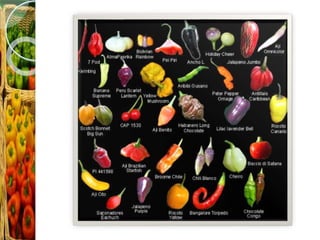
Fruits can widely vary in color, shape, and
size both between and within species
Therefore classification is difficult
Mainly consists of 5 domesticated
species and 26 wild species
5 domesticated species ;
 C. annuum
 C. baccatum
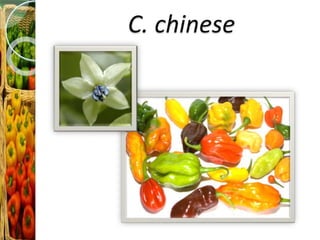
 C. chinese
 C. frutescens
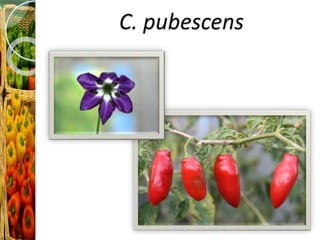
 C. pubescens
C. baccatum
C. chinese
C. frutescens
C. pubescens
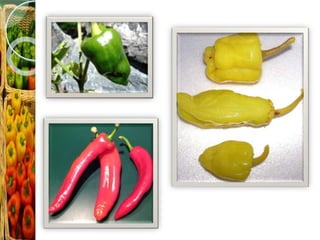
Capsicum annuum
The species includes a wide variety of
shapes and sizes of peppers ranging
from bell pepper to chili pepper
Some varieties;
 bell pepper
 Cascabel
 Anaheim
 Alma paprika
 Bird’s eye
 Italian sweet
pepper
 Cherry
 Fresno
 Hungarian wax
 Pablano
 Piquin
 Pepperoncicni
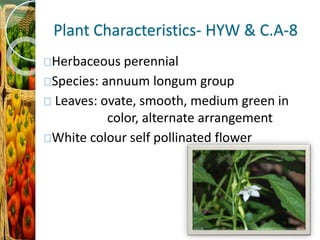
Plant Characteristics- HYW & C.A-8
Herbaceous perennial
Species: annuum longum group
Leaves: ovate, smooth, medium green in
color, alternate arrangement
White colour self pollinated flower
Recommended varieties in Srilanka
Hungarian Yellow Wax (HYW)
C.A. - 8
Hungarian Yellow Wax (HYW)
• Yellowish green in colour
• Smooth and shiny surface
• Conical shape fruits
• Thin walled & thick flesh
• Fruit length : 15-20cm
• Pungency varies from warm to moderately
hot
• Recommended for up country
• Not suitable for low and intermediate zones
due to high susceptibility to bacterial wilt
C.A. - 8
• Commonly referred as “banana pepper”
• Light green in colour
• Red or orange after ripening
• Uneven surface with shiny appearance
• Curved tip
• Fruit length : 15-20cm
• Mild, tangy taste
• Recommended for both up & low country
Environmental Requirements
Climatic Requirements
 can cultivate throughout the year
upto an elevation of 1500m
 supplementary irrigation is required
during the yala season.
Soil
 well-drained, loamy soils
 optimum pH range - 5.5 - 6.8
water logging conditions leads to
retarded growth
Nursery Management
• Select an area; without shade and well
drained soil
• Prepare nursery beds, 300x90x15cm in
size
• Apply compost 3-4kg into 1m² of the bed
and mix well
• Solarization should be done by burning
paddy husk and bran on the bed
• Then cover up the bed with a transparent
polythene sheet for 2 weeks
• Fungicides (Captan/Thiram) can also be
added
• Seeds saw in rows in 1cm depth, leaving
10-15cm space between each for easy
management practices
• Cover the seeds slightly with soil
• Apply mulch material to cover up the bed
• Mulches should remove after 5-6 days
• Seeds take 8-10 days to propagate
• Shade should be provided to protect
immature plants from heavy rainfall and
sunlight
• Plants should harden before establishing in
the field by increasing the irrigation
interval about 10 days
• Keep the plants about 1 months in the
nursery
Field Establishment
Land preparation
 Plough up to 10-15cm& harrow the land
 Make beds with 1m wide and convenient
length
Planting season
Any season
Yala : April - May
Maha : November - December
Spacing
 H.Y.W - 15cm X 30cm
 C.A 8 - 40cm X 40cm
Transplanting
 After 21 days of germination
Crop Management
Irrigation
 Early stage - 4-5 days interval
 Middle stage - once a week
 Irrigation requirement depends on the rain
fall intensity
 Irrigation before and after fertilizer
application is essential
 Water stress leads to the falling off of
flowers and pods, therefore moisture
conservation of soil is essential
Fertilizer Application
TIME UREA
Kg/ha
MOP
Kg/ha
TSP
Kg/ha
Basal Dressing 100 215 65
After 4 weeks 100 - 65
After 8 weeks 100 - 65
Weeding
Manual weeding after 2,4 & 8 weeks of
transplanting
Earthning up while weeding ensure the
proper establishment in the field
Chemical weeding;
After 2 days of transplanting, apply
“Alachlor” 45%, 1.4-2.4kg/ha
Pest & Disease Management
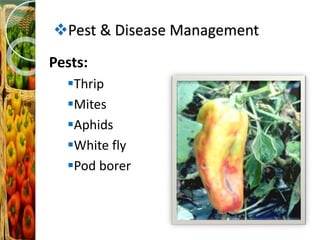
Pests:
Thrip
Mites
Aphids
White fly
Pod borer
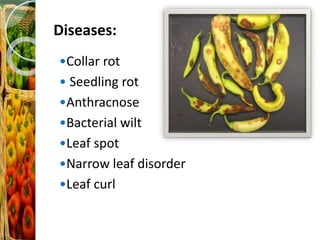
Diseases:
•Collar rot
• Seedling rot
•Anthracnose
•Bacterial wilt
•Leaf spot
•Narrow leaf disorder
•Leaf curl
Harvest
Harvest before maturity when it’s still yellow
green in colour
Can obtain yield after 75 days of planting
 Hungarian Yellow Wax :
 3-4 times harvesting ; 10-15 mt/ha
 C.A 8 :
In wet zone; 8-10 times of harvesting
6-8 mt/ha
In dry zone; 8-12 times of harvesting
10-15 mt/ha
Harvesting
On a sunny day
Avoid harvesting on rainy days or fruits
with water on it’s surface
Post Harvest Technology
•Transport soon after harvesting, packed in
plastic boxes or porous covering
•Aeration should be provided
•Can store In refrigerators
Uses
Salads
Baked dishes
Stuffed dishes
Stews
Salsa
Decorating agent in pizza
Pickles
For stuffing
Flavouring agent
Thank You!

Capsicum ( Capsicum annuum L. )

  • 1.
  • 2.
    INTRODUCTION Belongs to family– Solanaceae Originate from South and Central America Popular countries- China, Turkey, Nigeria, Mexico, Spain, U.S.A. Fruits can widely vary in color, shape, and size both between and within species Therefore classification is difficult
  • 4.
    Mainly consists of5 domesticated species and 26 wild species 5 domesticated species ;  C. annuum  C. baccatum  C. chinese  C. frutescens  C. pubescens
  • 5.
  • 6.
  • 7.
  • 8.
  • 9.
    Capsicum annuum The speciesincludes a wide variety of shapes and sizes of peppers ranging from bell pepper to chili pepper Some varieties;  bell pepper  Cascabel  Anaheim  Alma paprika  Bird’s eye  Italian sweet pepper  Cherry  Fresno  Hungarian wax  Pablano  Piquin  Pepperoncicni
  • 12.
    Plant Characteristics- HYW& C.A-8 Herbaceous perennial Species: annuum longum group Leaves: ovate, smooth, medium green in color, alternate arrangement White colour self pollinated flower
  • 13.
    Recommended varieties inSrilanka Hungarian Yellow Wax (HYW) C.A. - 8
  • 14.
    Hungarian Yellow Wax(HYW) • Yellowish green in colour • Smooth and shiny surface • Conical shape fruits • Thin walled & thick flesh • Fruit length : 15-20cm • Pungency varies from warm to moderately hot • Recommended for up country • Not suitable for low and intermediate zones due to high susceptibility to bacterial wilt
  • 15.
    C.A. - 8 •Commonly referred as “banana pepper” • Light green in colour • Red or orange after ripening • Uneven surface with shiny appearance • Curved tip • Fruit length : 15-20cm • Mild, tangy taste • Recommended for both up & low country
  • 16.
    Environmental Requirements Climatic Requirements can cultivate throughout the year upto an elevation of 1500m  supplementary irrigation is required during the yala season. Soil  well-drained, loamy soils  optimum pH range - 5.5 - 6.8 water logging conditions leads to retarded growth
  • 17.
    Nursery Management • Selectan area; without shade and well drained soil • Prepare nursery beds, 300x90x15cm in size • Apply compost 3-4kg into 1m² of the bed and mix well • Solarization should be done by burning paddy husk and bran on the bed
  • 18.
    • Then coverup the bed with a transparent polythene sheet for 2 weeks • Fungicides (Captan/Thiram) can also be added • Seeds saw in rows in 1cm depth, leaving 10-15cm space between each for easy management practices • Cover the seeds slightly with soil • Apply mulch material to cover up the bed • Mulches should remove after 5-6 days
  • 19.
    • Seeds take8-10 days to propagate • Shade should be provided to protect immature plants from heavy rainfall and sunlight • Plants should harden before establishing in the field by increasing the irrigation interval about 10 days • Keep the plants about 1 months in the nursery
  • 20.
    Field Establishment Land preparation Plough up to 10-15cm& harrow the land  Make beds with 1m wide and convenient length Planting season Any season Yala : April - May Maha : November - December
  • 21.
    Spacing  H.Y.W -15cm X 30cm  C.A 8 - 40cm X 40cm Transplanting  After 21 days of germination
  • 22.
    Crop Management Irrigation  Earlystage - 4-5 days interval  Middle stage - once a week  Irrigation requirement depends on the rain fall intensity  Irrigation before and after fertilizer application is essential  Water stress leads to the falling off of flowers and pods, therefore moisture conservation of soil is essential
  • 23.
    Fertilizer Application TIME UREA Kg/ha MOP Kg/ha TSP Kg/ha BasalDressing 100 215 65 After 4 weeks 100 - 65 After 8 weeks 100 - 65
  • 24.
    Weeding Manual weeding after2,4 & 8 weeks of transplanting Earthning up while weeding ensure the proper establishment in the field Chemical weeding; After 2 days of transplanting, apply “Alachlor” 45%, 1.4-2.4kg/ha
  • 25.
    Pest & DiseaseManagement Pests: Thrip Mites Aphids White fly Pod borer
  • 26.
    Diseases: •Collar rot • Seedlingrot •Anthracnose •Bacterial wilt •Leaf spot •Narrow leaf disorder •Leaf curl
  • 27.
    Harvest Harvest before maturitywhen it’s still yellow green in colour Can obtain yield after 75 days of planting  Hungarian Yellow Wax :  3-4 times harvesting ; 10-15 mt/ha  C.A 8 : In wet zone; 8-10 times of harvesting 6-8 mt/ha In dry zone; 8-12 times of harvesting 10-15 mt/ha
  • 28.
    Harvesting On a sunnyday Avoid harvesting on rainy days or fruits with water on it’s surface Post Harvest Technology •Transport soon after harvesting, packed in plastic boxes or porous covering •Aeration should be provided •Can store In refrigerators
  • 29.
    Uses Salads Baked dishes Stuffed dishes Stews Salsa Decoratingagent in pizza Pickles For stuffing Flavouring agent
  • 30.