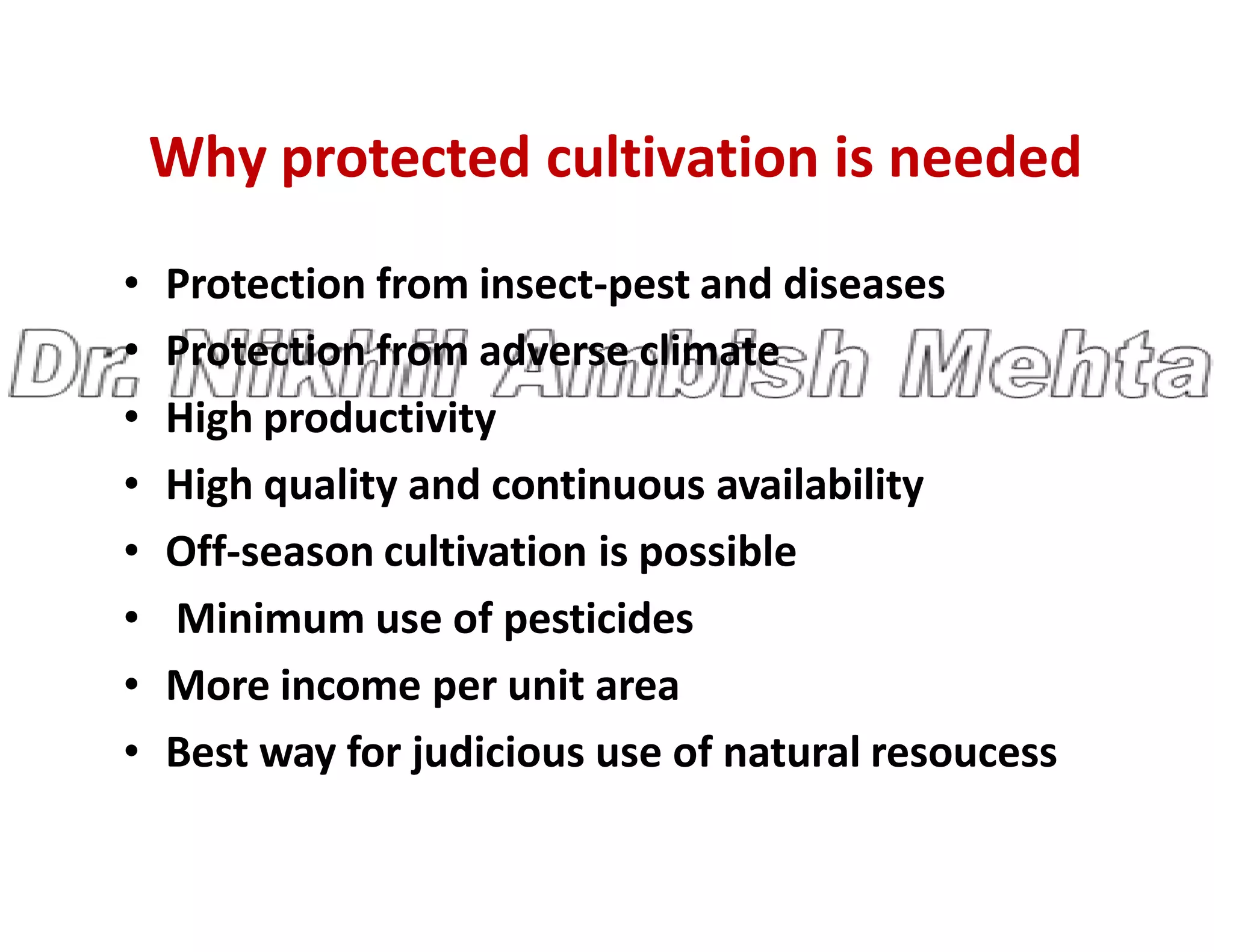

Cucumber Production in
Polyhouse
Dr. Nikhil Ambish Mehta
Research Officer /HDO
Why protected cultivation is needed
• Protection from insect-pest and diseases
• Protection from adverse climate
• High productivity
• High quality and continuous availability
• Off-season cultivation is possible
• Minimum use of pesticides
• More income per unit area
• Best way for judicious use of natural resoucess
Climate Requirement
• Although maximum growth occurs at a day and
night temperature of about 28°C.
• Maximum fruit production is achieved with a
night temperature of 19-20°C and a day
temperature of 20-22°C.
• The optimum daily average air temperature is
15- 24°C (65-75°F).
• Optimum temperatures for growth are at night,
about 18°C, and during the day, about 28°C
accompanied by high light intensity.
Planting Time
Growing season of Cucumbers is relatively short, lasting 90-
120 days for greenhouse varieties.
Summer Crop Season
Feb sowing with seedling
March sowing can be with Direct Seed sowing
Winter Crop Season – August September up to December
Direct Sowing is recommended genrally when temp is
Above 15 C.
Generally for polyhouse: Parthenocarpic cucumber i.e.
they produce fruit without the need of pollination.
Cucumber Hybrids for Polyhouse
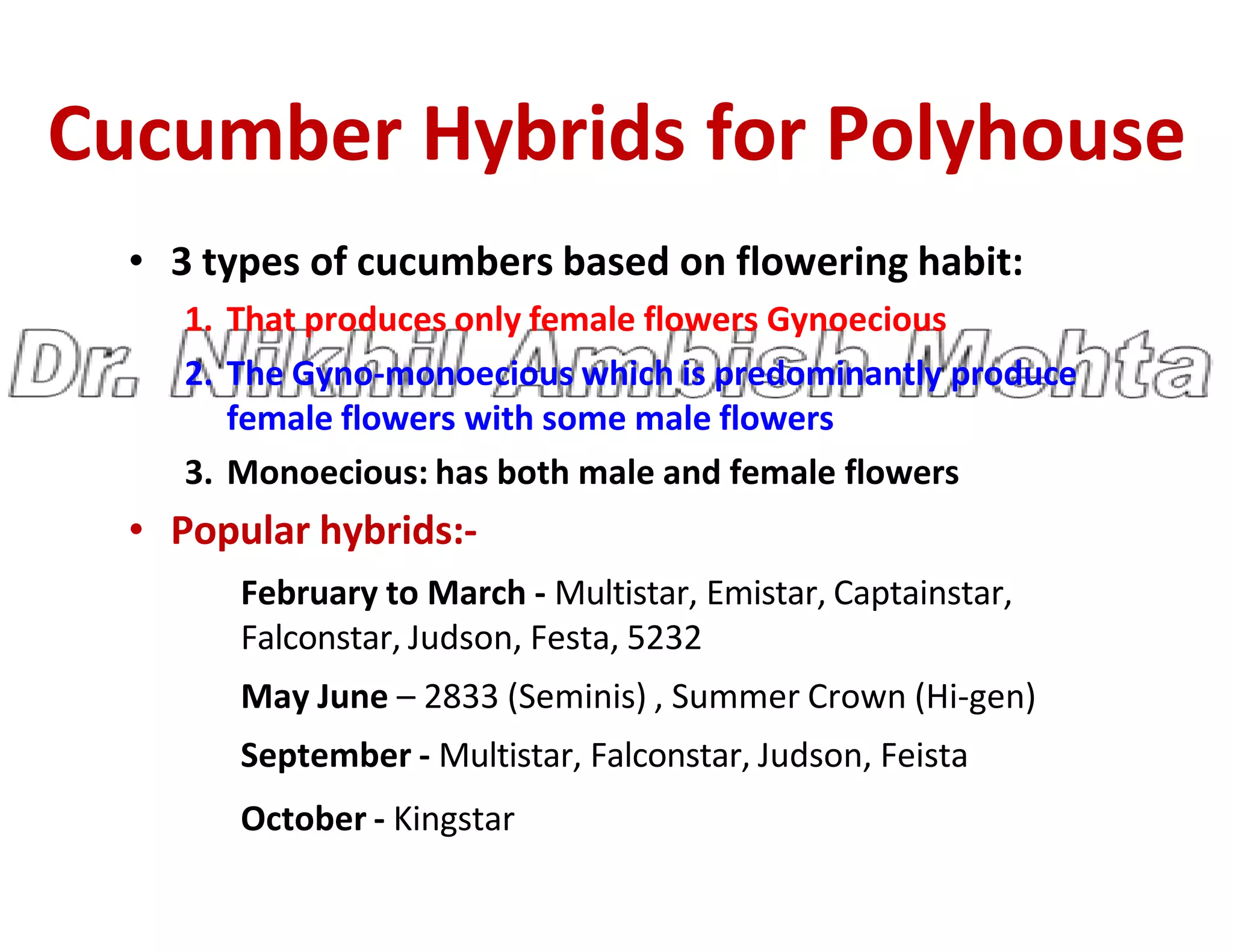
• 3 types of cucumbers based on flowering habit:
1. That produces only female flowers Gynoecious
2. The Gyno-monoecious which is predominantly produce
female flowers with some male flowers
3. Monoecious: has both male and female flowers
• Popular hybrids:-
February to March - Multistar, Emistar, Captainstar,
Falconstar, Judson, Festa, 5232
May June – 2833 (Seminis) , Summer Crown (Hi-gen)
September - Multistar, Falconstar, Judson, Feista
October - Kingstar
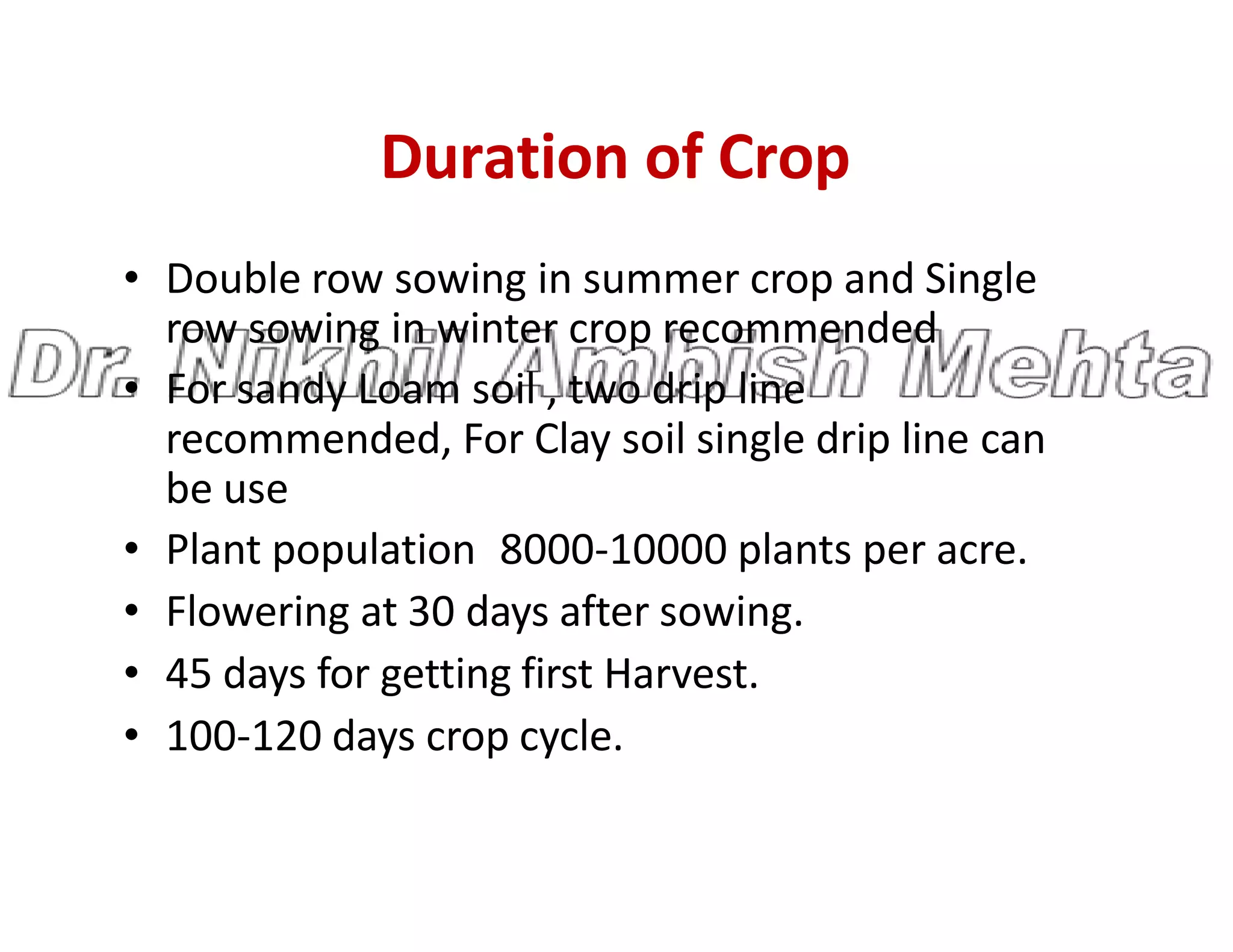
Duration of Crop
• Double row sowing in summer crop and Single
row sowing in winter crop recommended
• For sandy Loam soil , two drip line
recommended, For Clay soil single drip line can
be use
be use
• Plant population 8000-10000 plants per acre.
• Flowering at 30 days after sowing.
• 45 days for getting first Harvest.
• 100-120 days crop cycle.
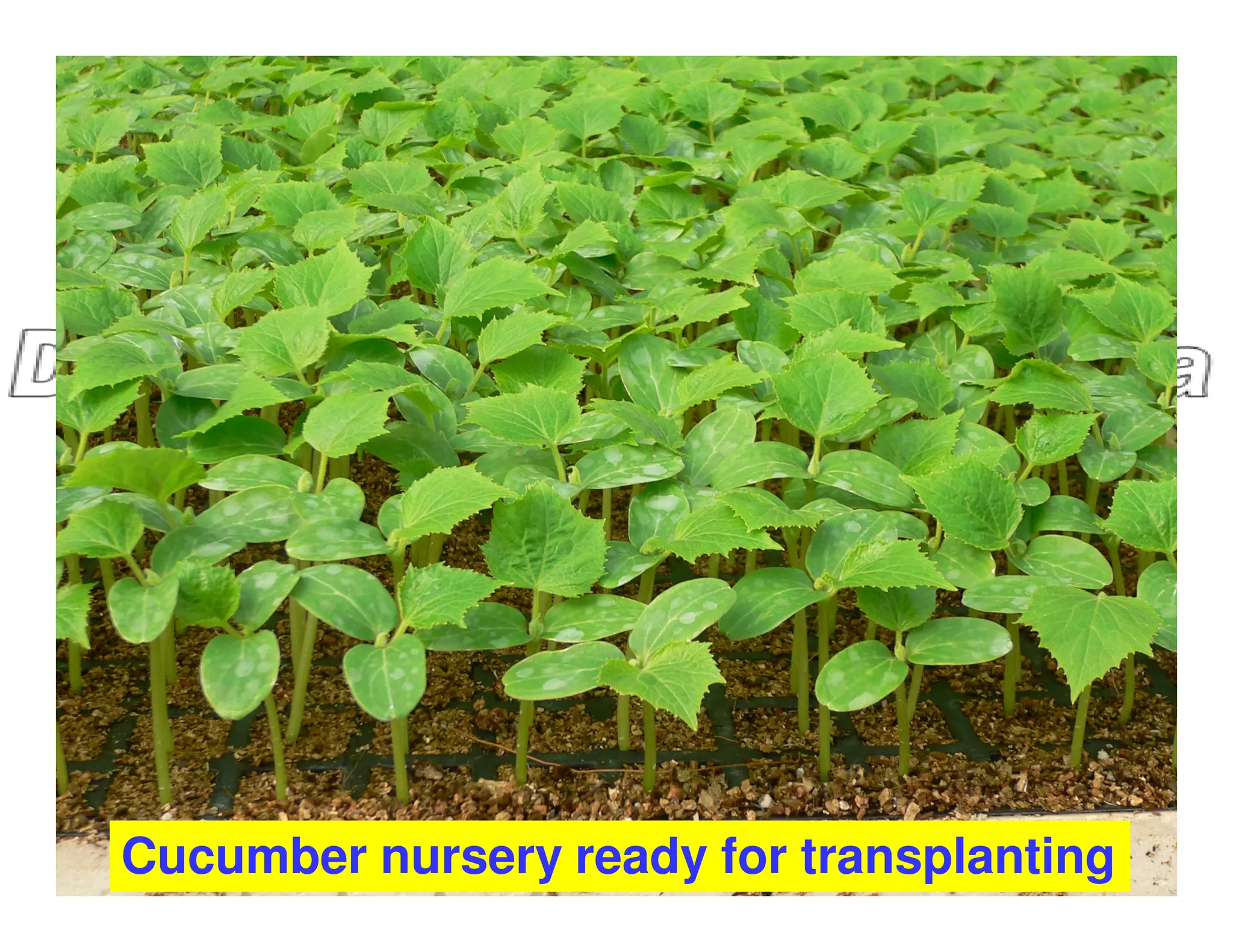
Cucumber nursery ready for transplanting
Cucumbers Cultivation process
1. Required conditions for the crop.
2. Soil preparation: Fertilizers, beds, Fumigation
3. Distances between plants
4. Vertical growth and pruning
5. Fertilization
5. Fertilization
6. Irrigation
7. Cultivation season & varieties
8. Plant protection: Up soil diseases, Soil born
diseases , Insects, Viruses
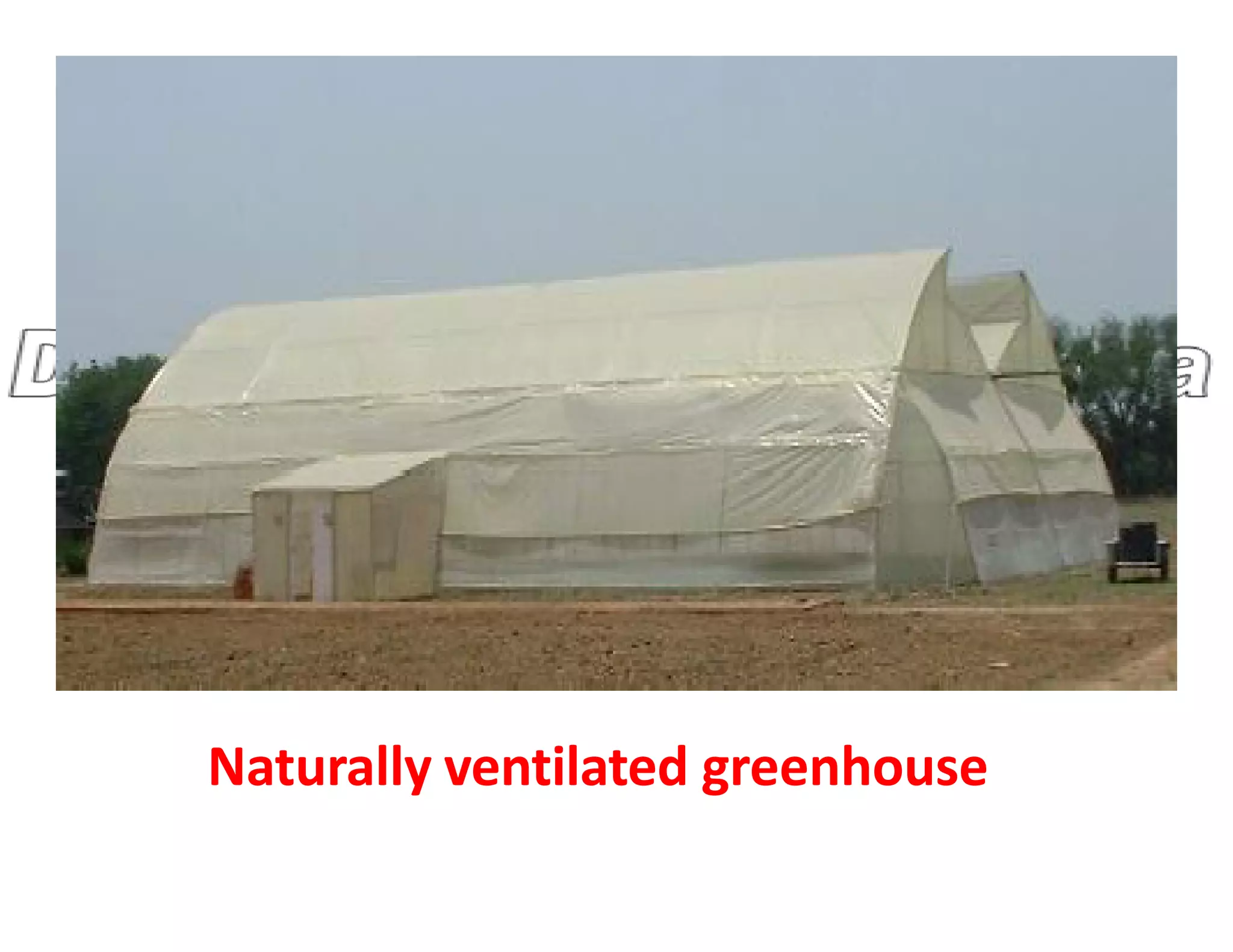
Naturally ventilated greenhouse
Soil Preparation
• Deep Ploughing of field
• Add FYM- Manure @ 10 Trolly per acre
• Add Chicken Manure @ 2 Trolly per acre
• Add Bi0-Char or Wood Aish @ 4 Trolly Per acre
• Add Vermicompost @ 2 MT per acre during bed
preperation with Microbs Culture
• Microbs like Trichoderma, Psedomonas,
Paecilomysis , PSB, KSB , Azotobactor should be
added @ 2 Liter per acre each before planting.
• Soil should be moist make Soil Alive (Living Soil)
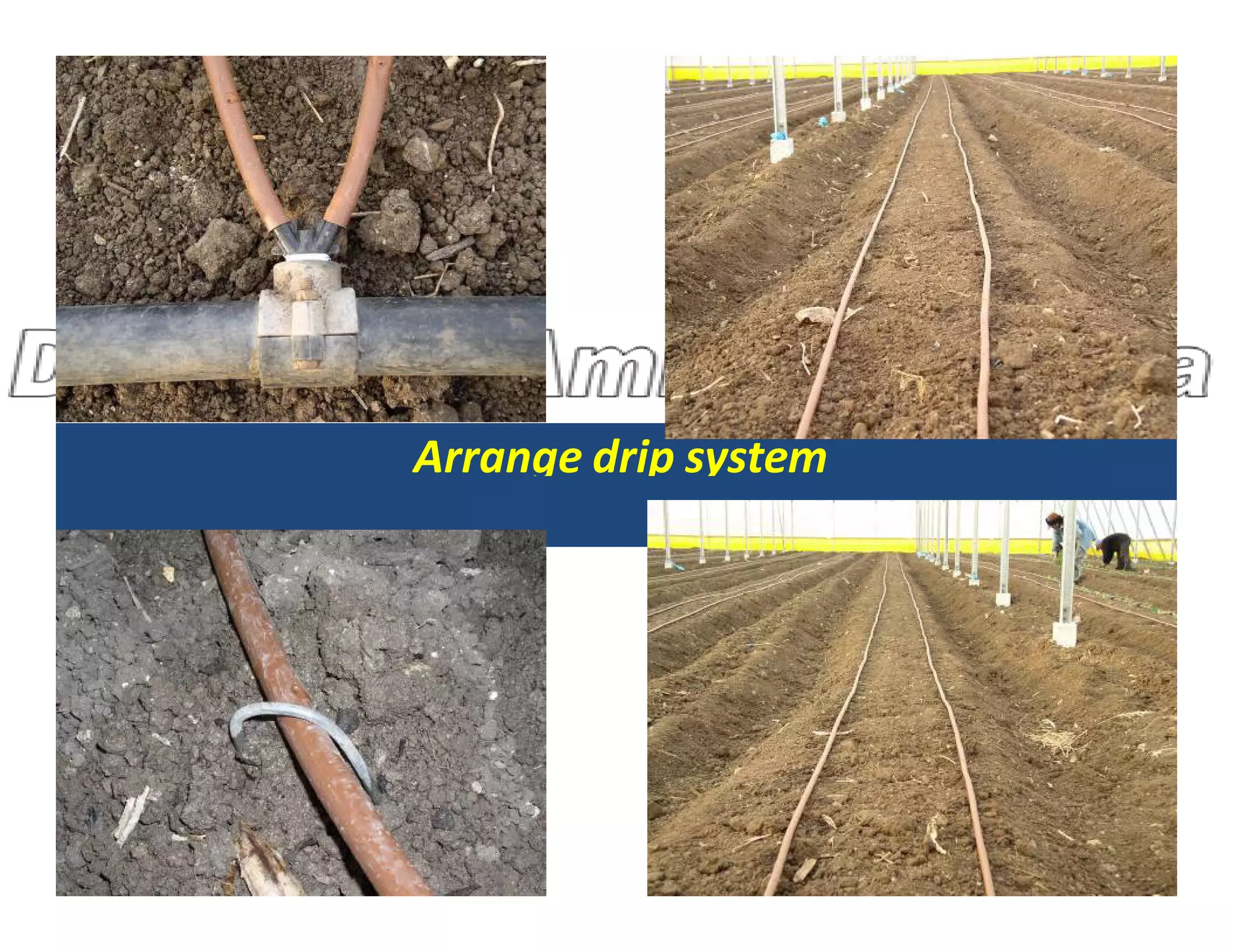
Arrange drip system
Arrange drip system
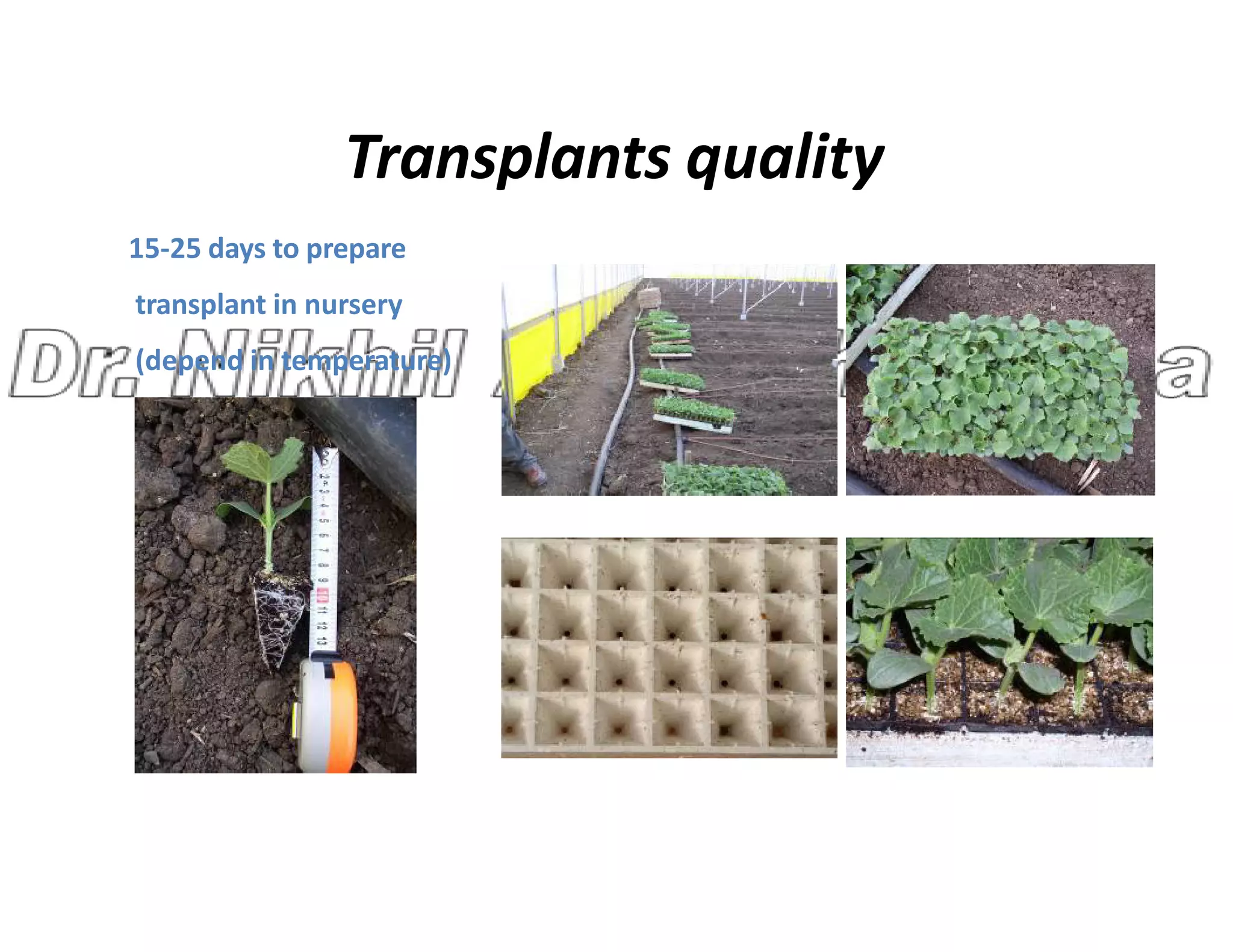
Transplants quality
15-25 days to prepare
transplant in nursery
(depend in temperature)
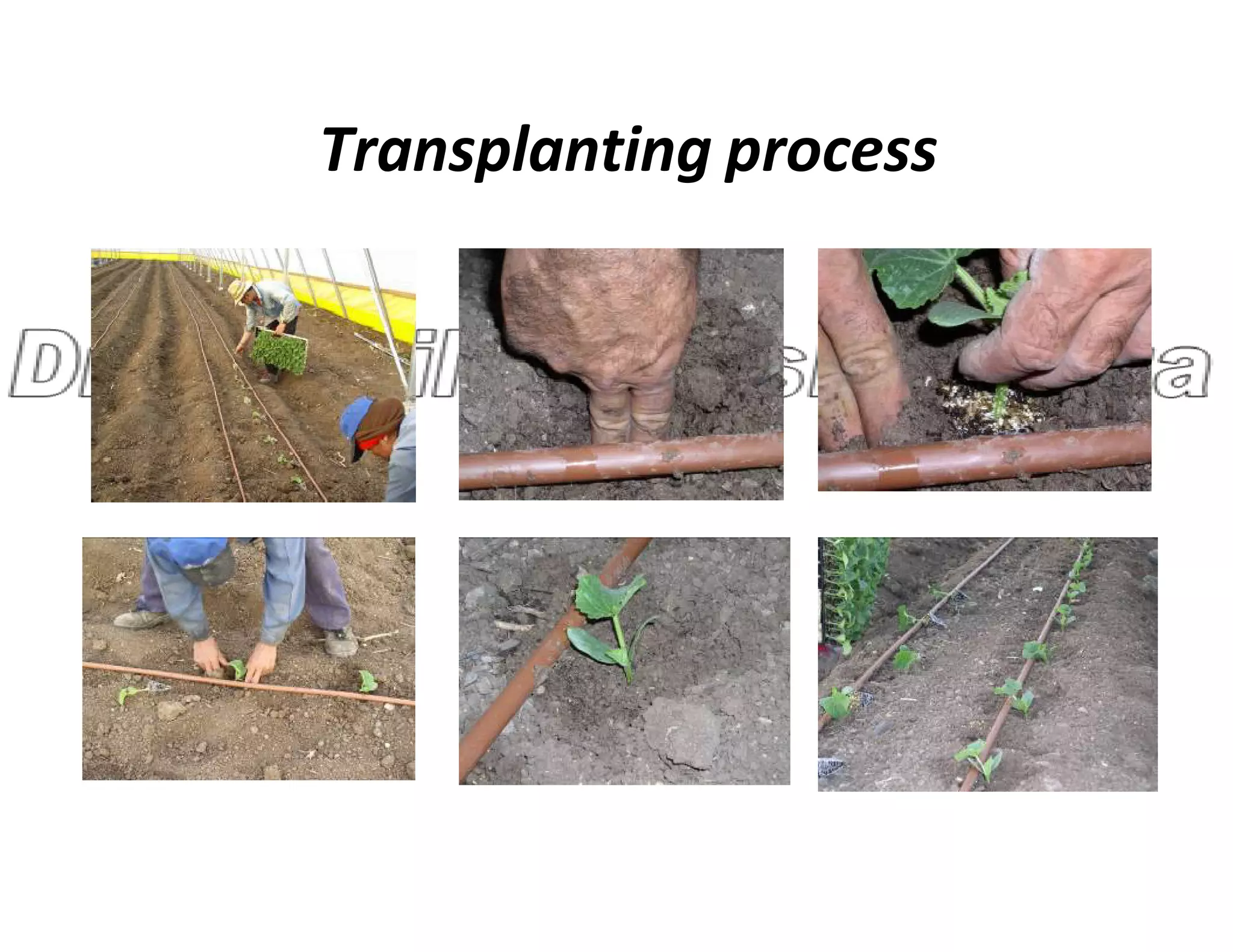
Transplanting process
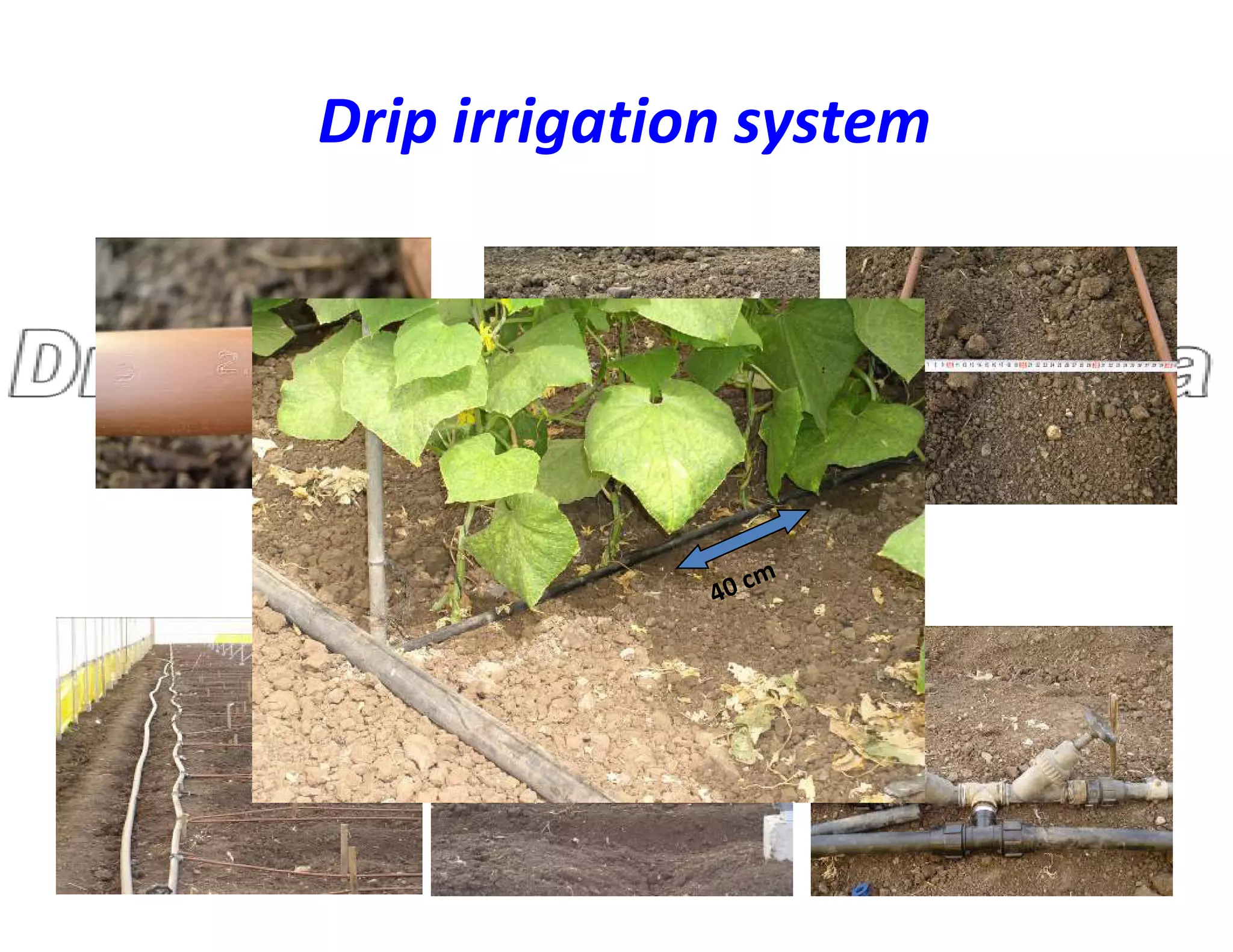
Drip irrigation system
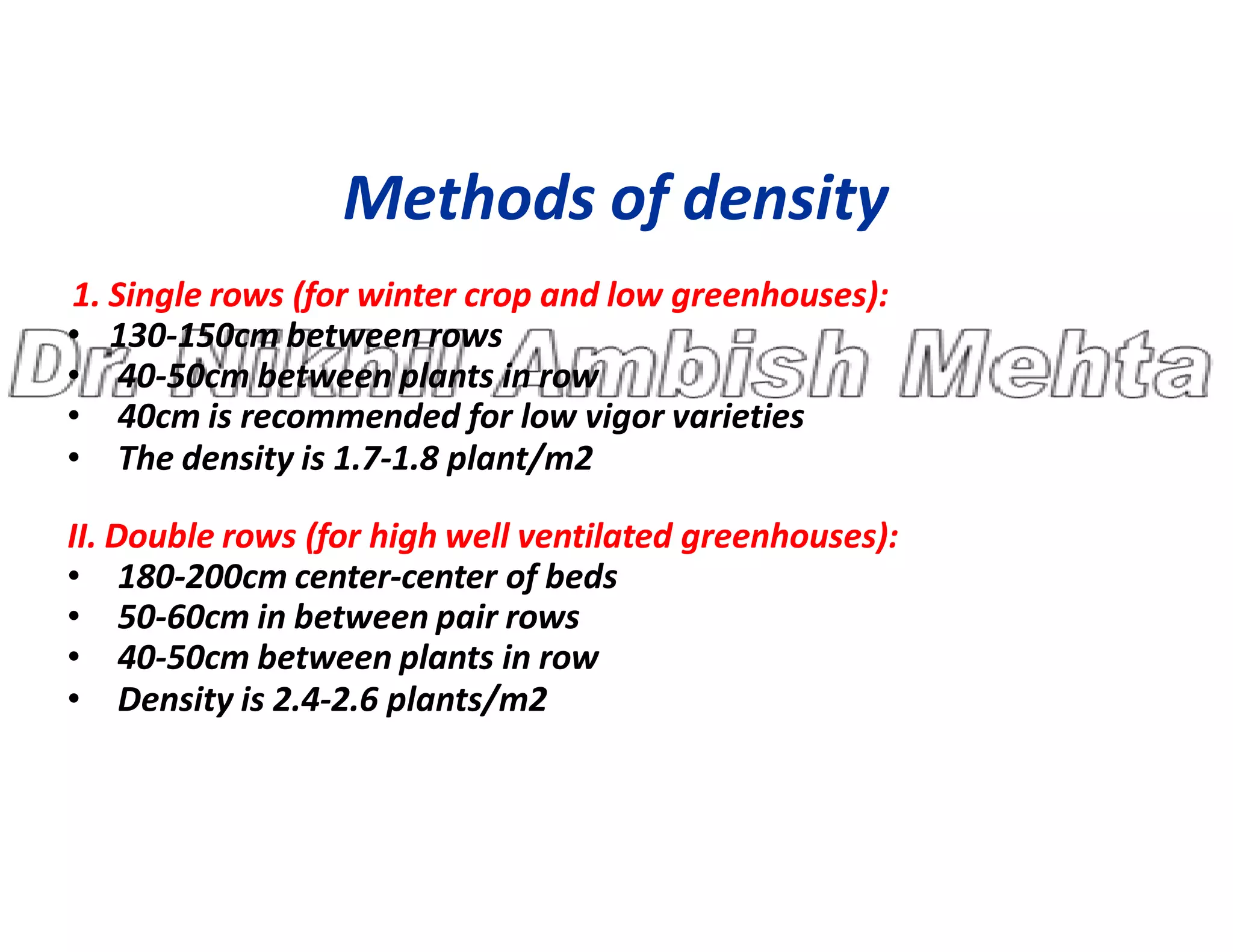
Methods of density
1. Single rows (for winter crop and low greenhouses):
• 130-150cm between rows
• 40-50cm between plants in row
• 40cm is recommended for low vigor varieties
• The density is 1.7-1.8 plant/m2
II. Double rows (for high well ventilated greenhouses):
• 180-200cm center-center of beds
• 50-60cm in between pair rows
• 40-50cm between plants in row
• Density is 2.4-2.6 plants/m2
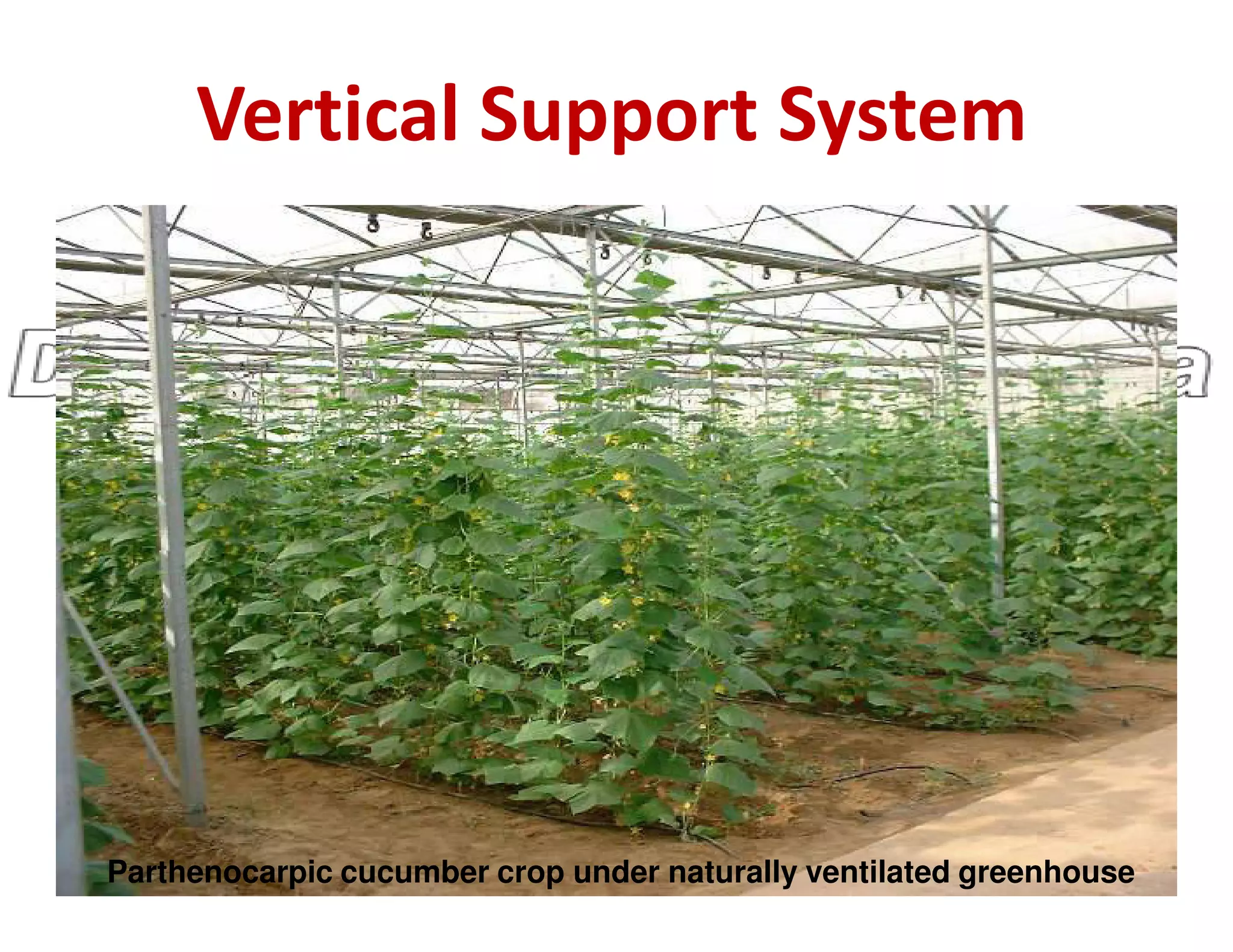
Vertical Support System
Parthenocarpic cucumber crop under naturally ventilated greenhouse
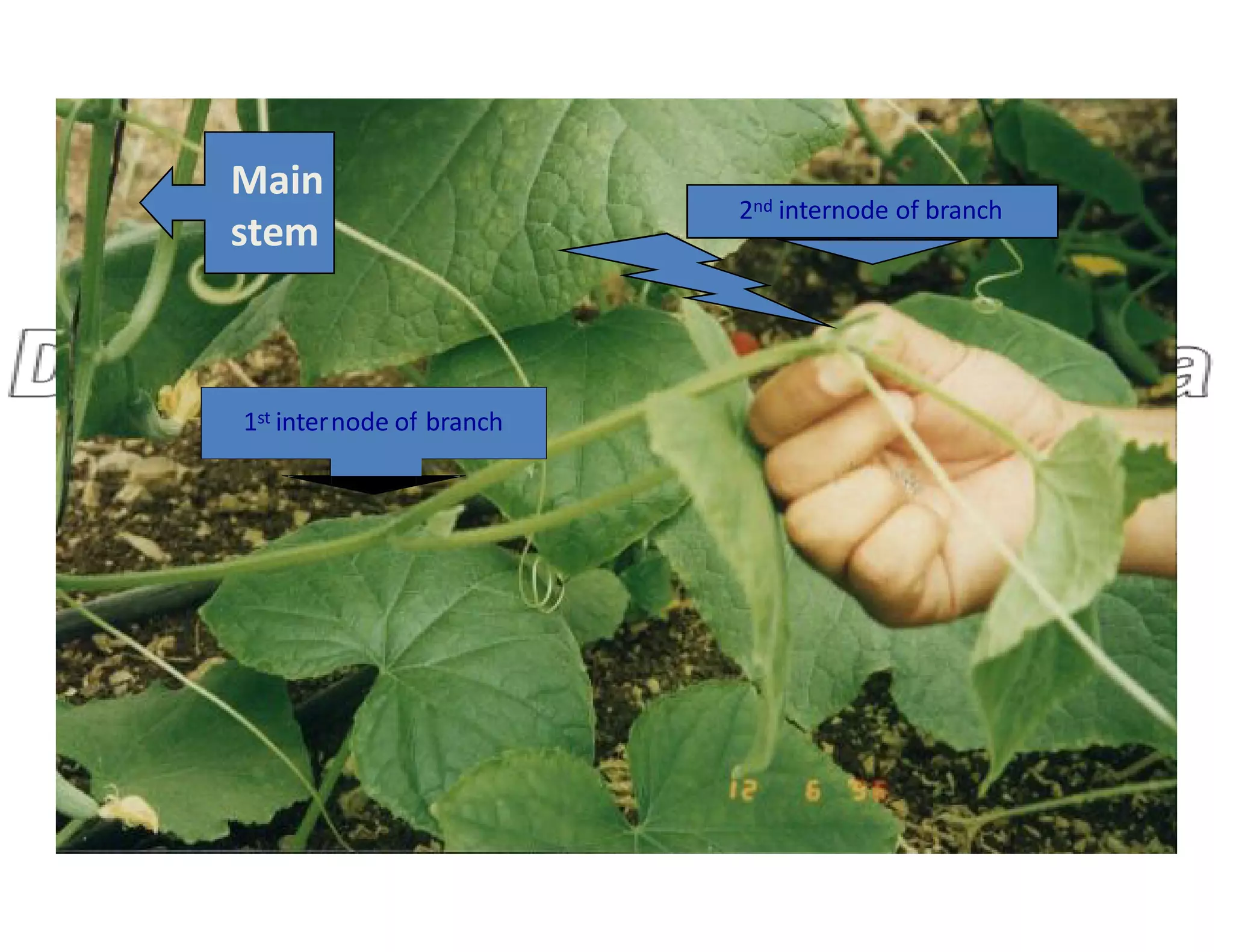
1st internode of branch
2nd internode of branch
Main
stem
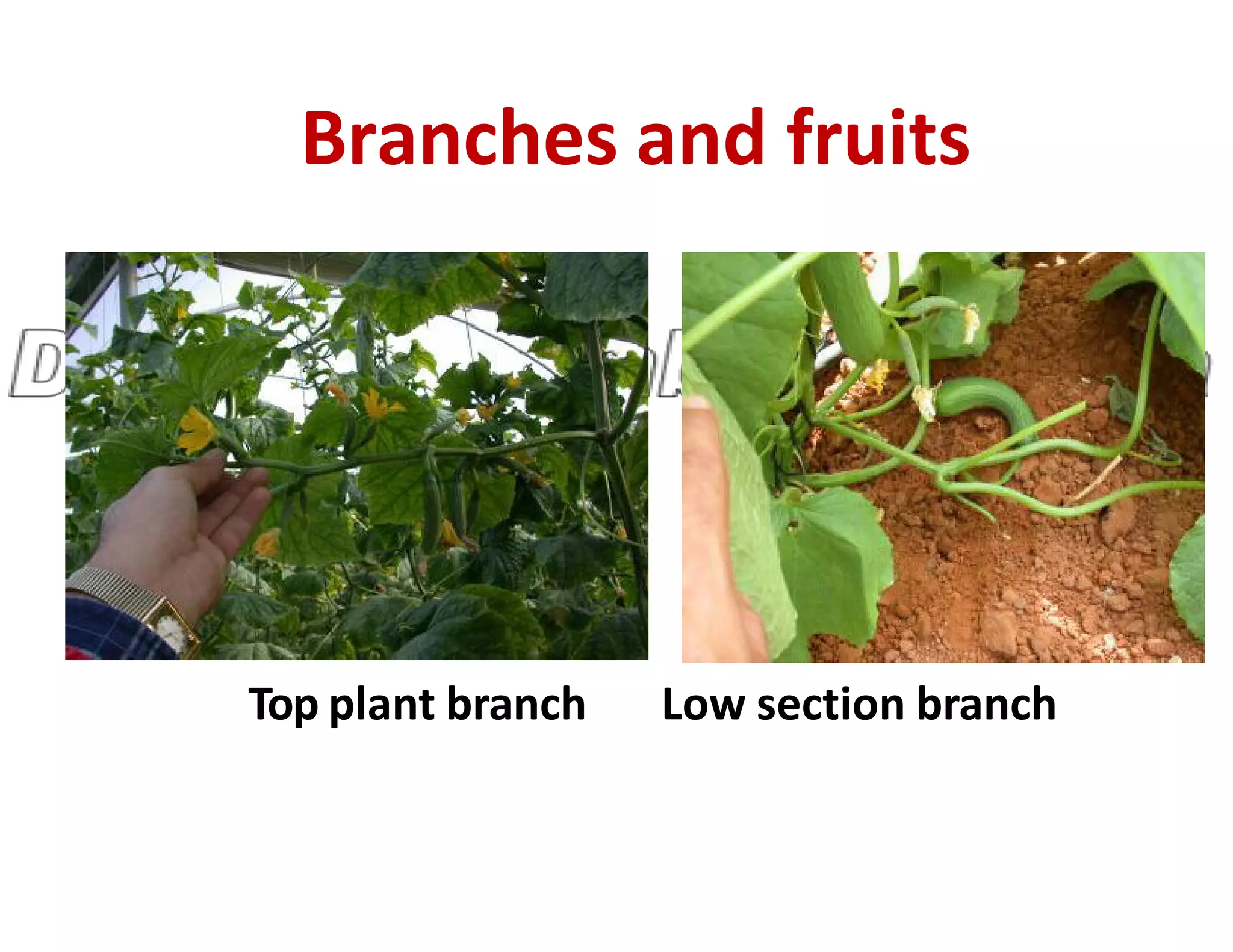
Branches and fruits
Top plant branch Low section branch
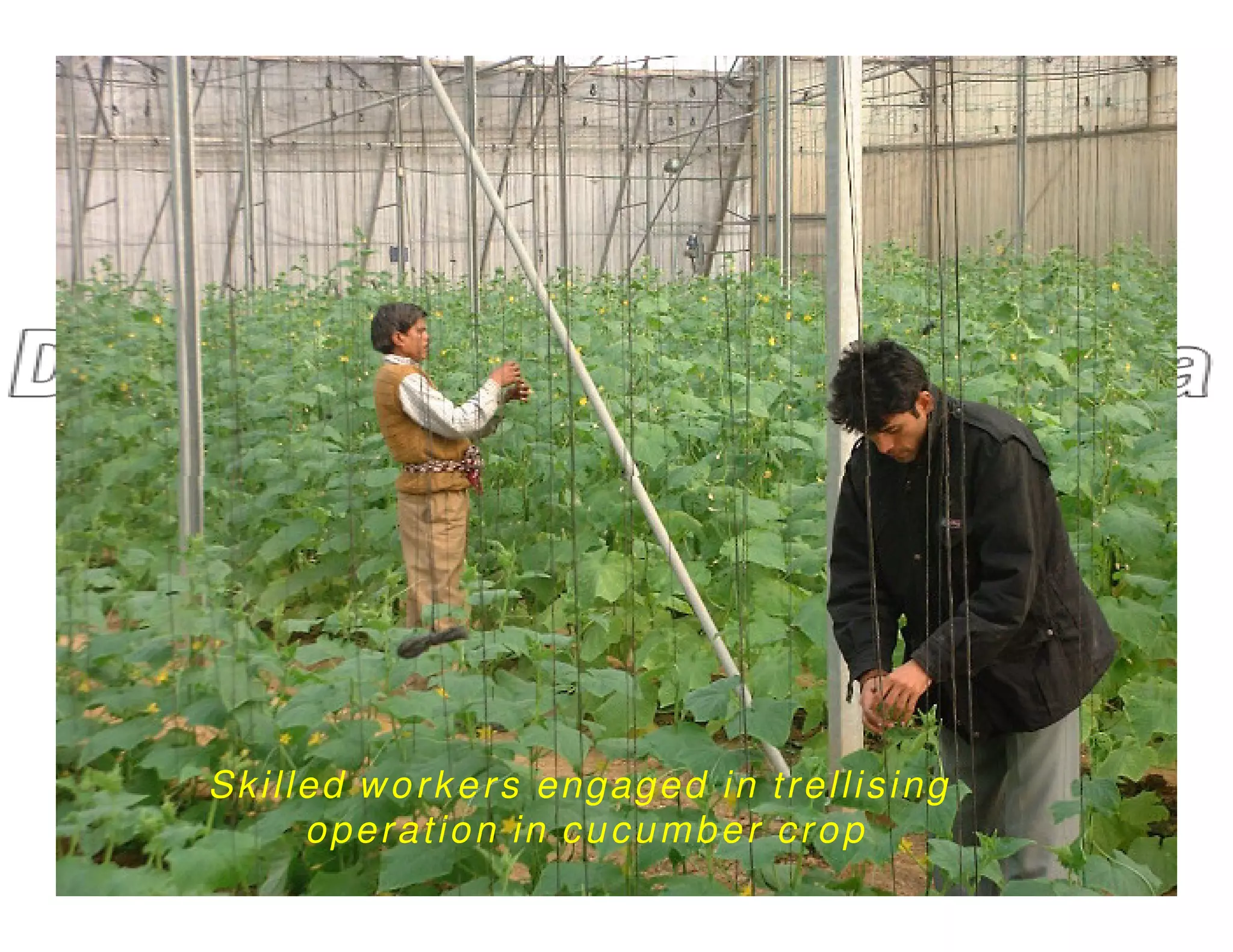
Skilled workers engaged in trellising
operation in cucumber crop
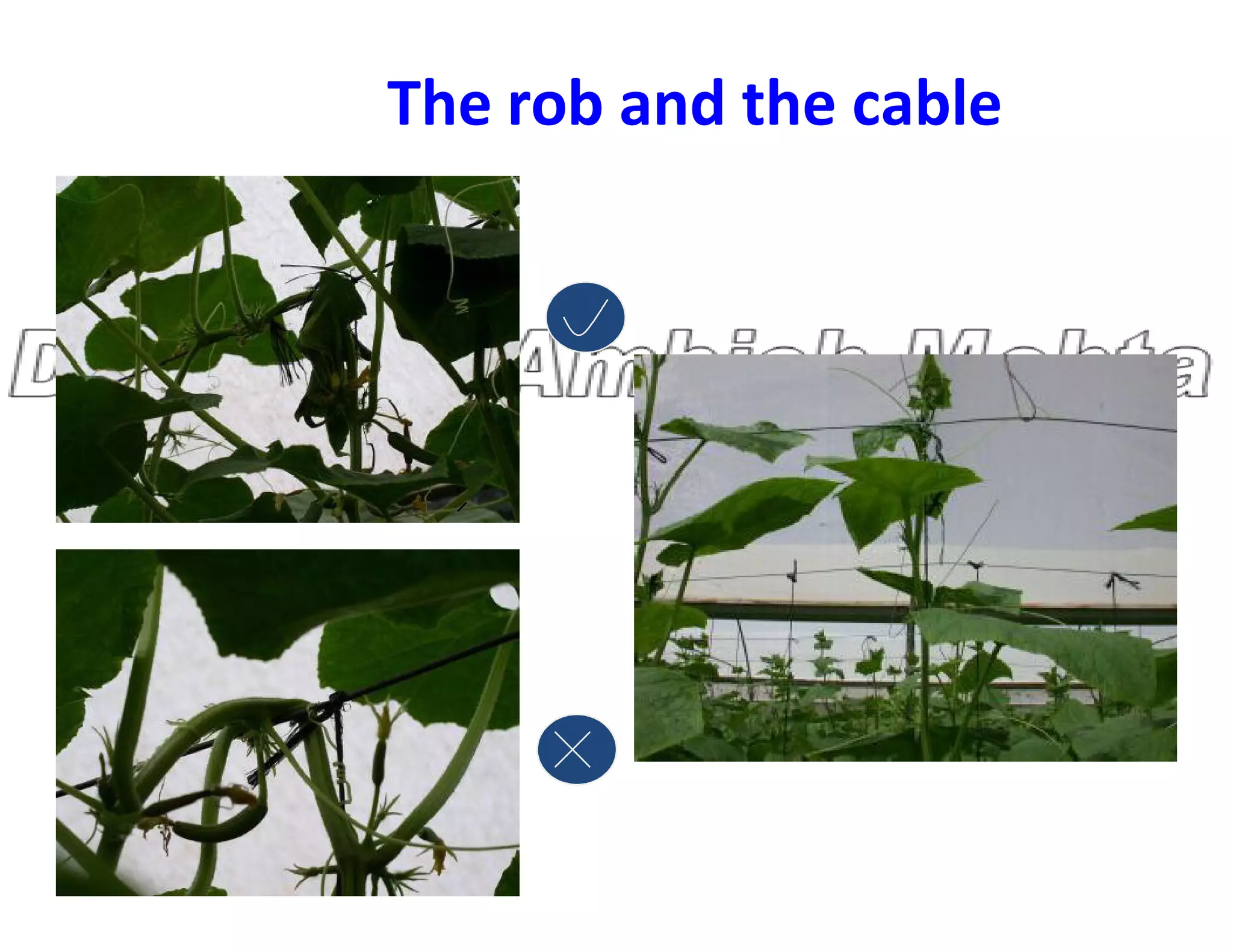
The rob and the cable
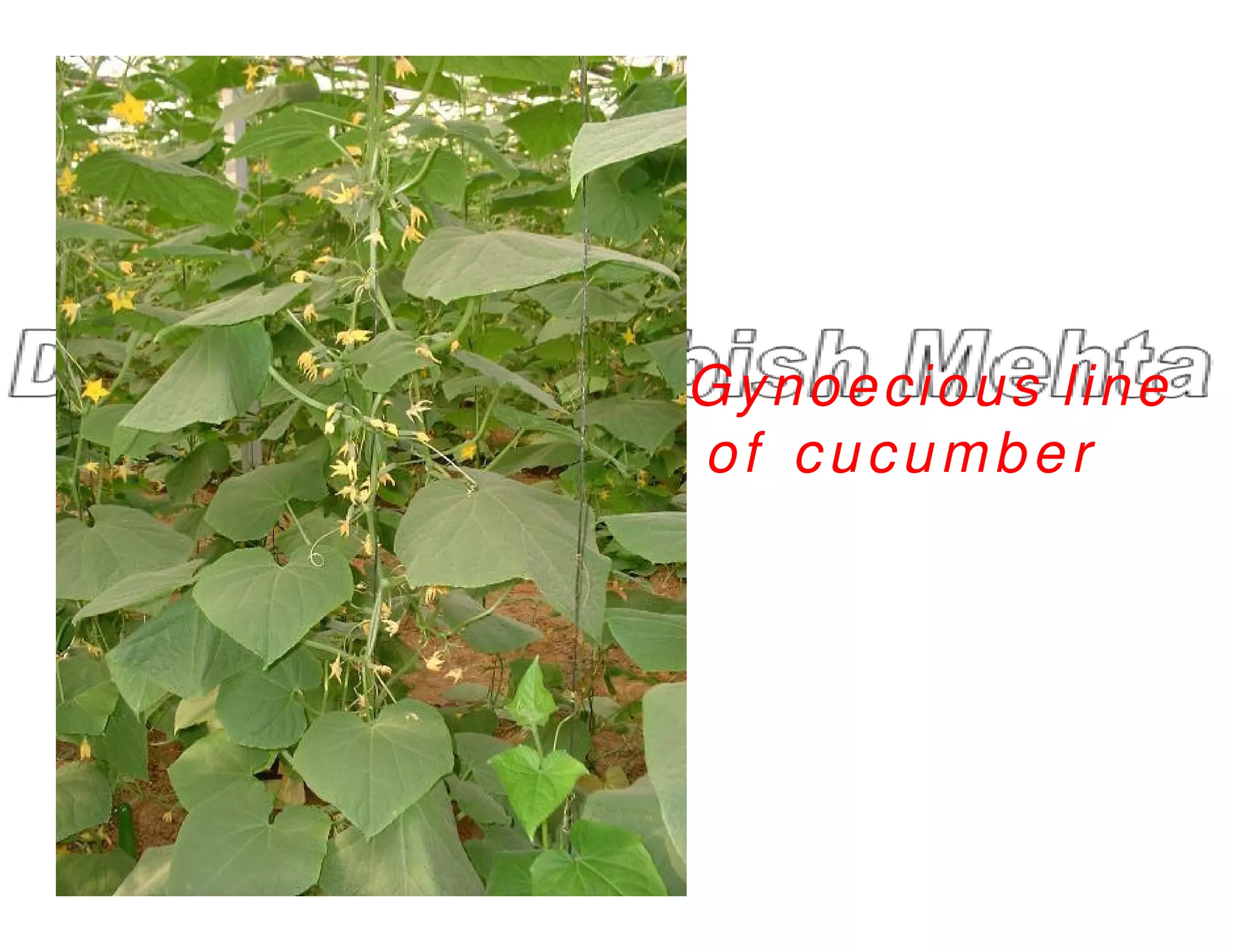
Gynoecious line
of cucumber
of cucumber
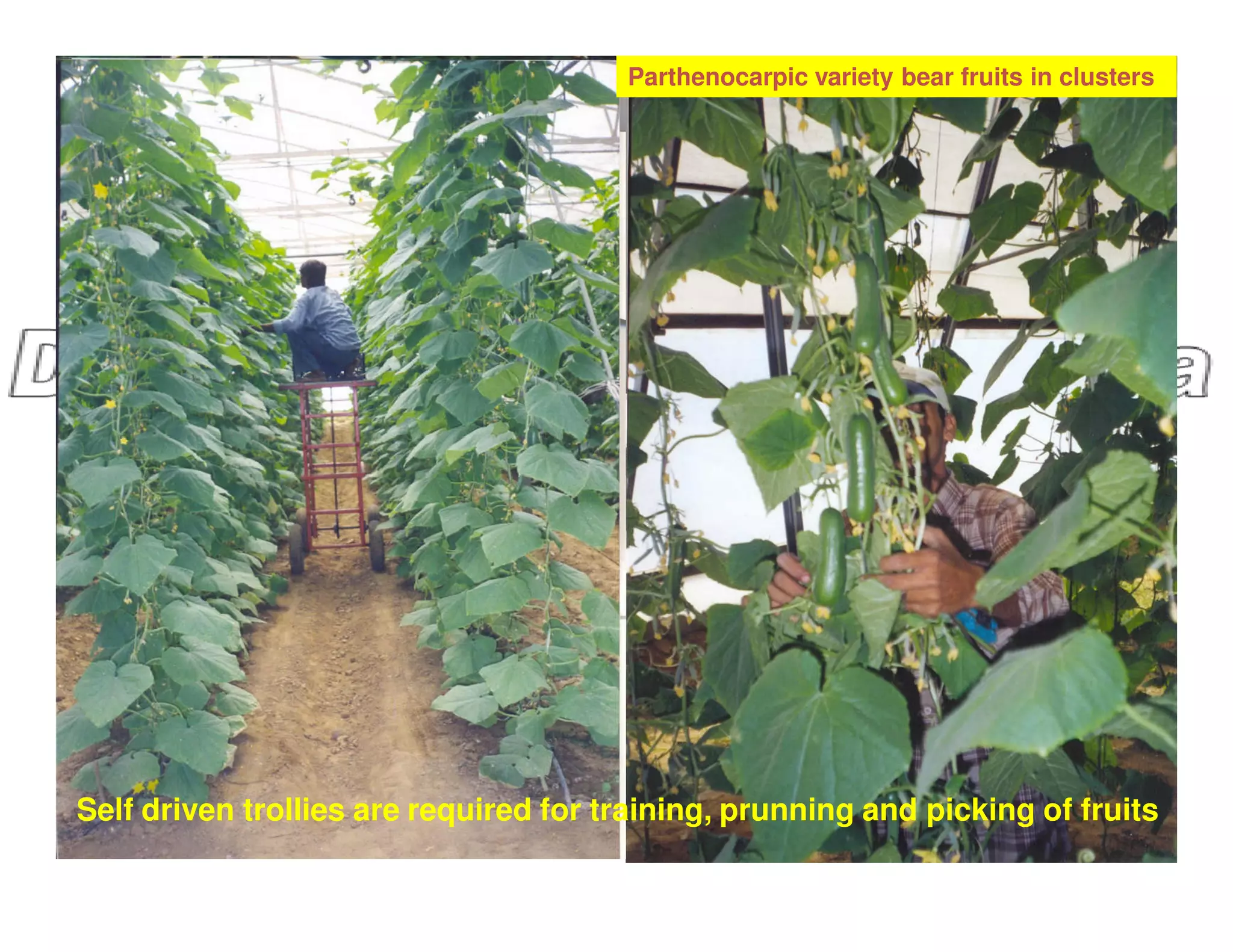
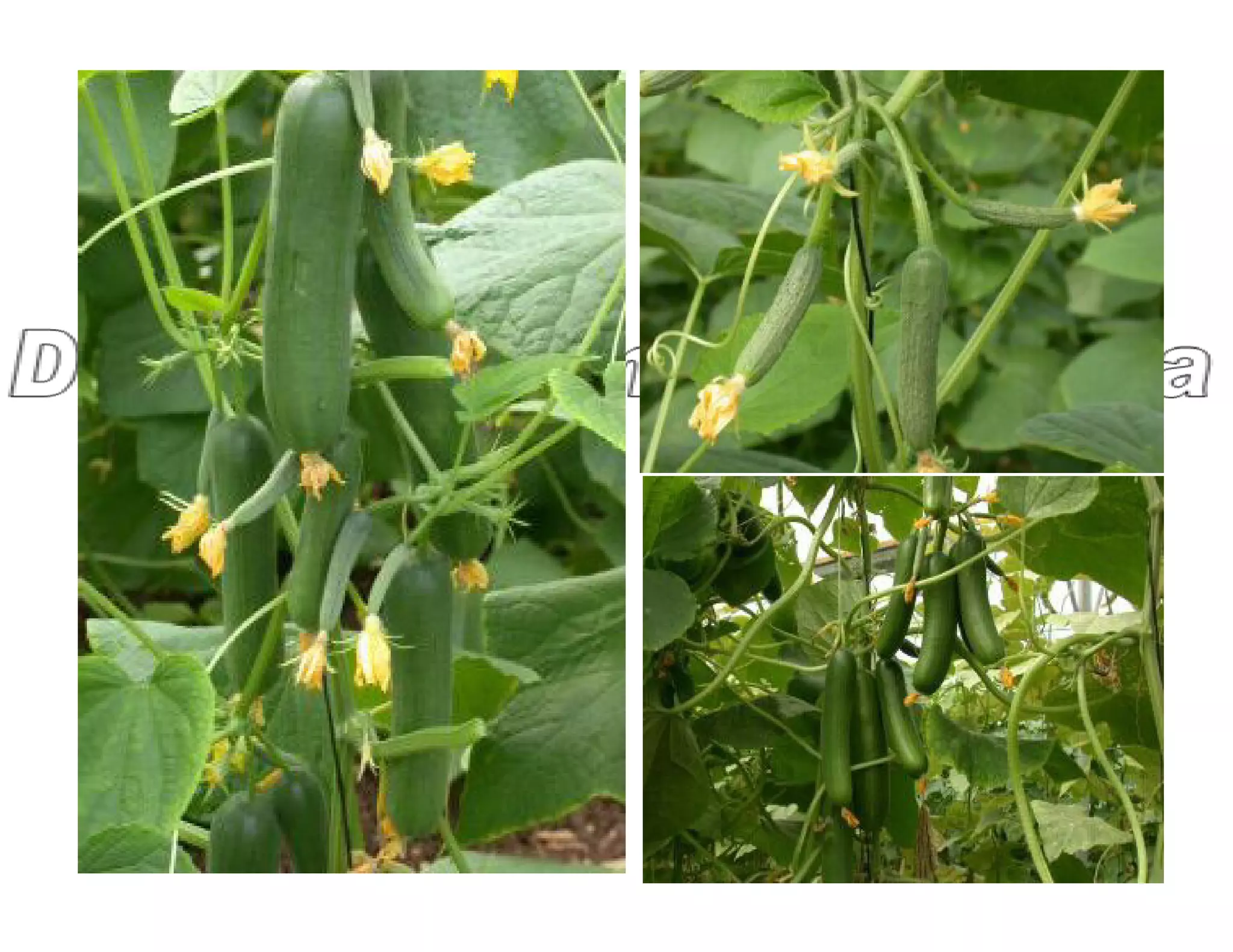
Parthenocarpic variety bear fruits in clusters
Self driven trollies are required for training, prunning and picking of fruits
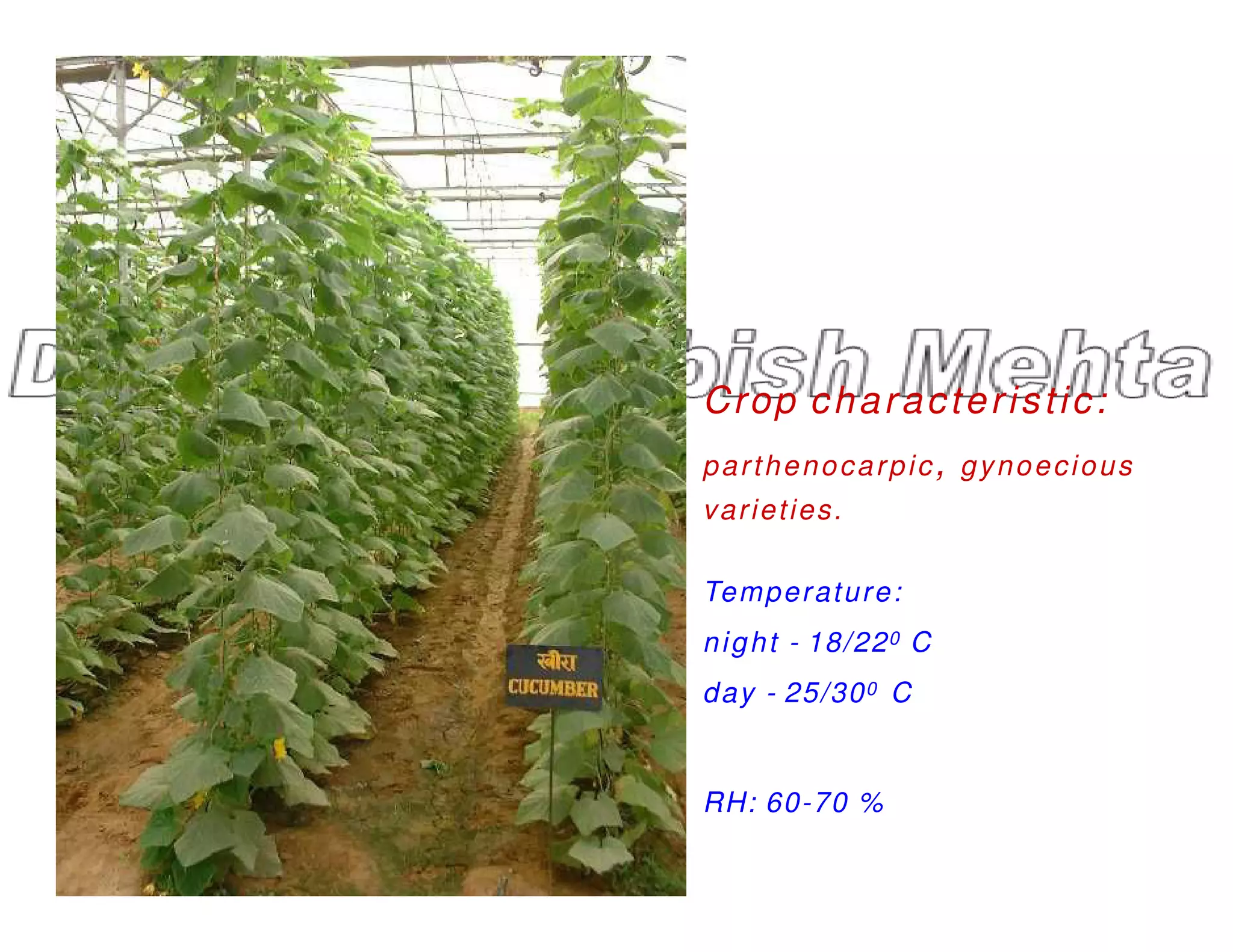
Crop characteristic:
parthenocarpic, gynoecious
varieties.
Temperature:
night - 18/220 C
day - 25/300 C
RH: 60-70 %
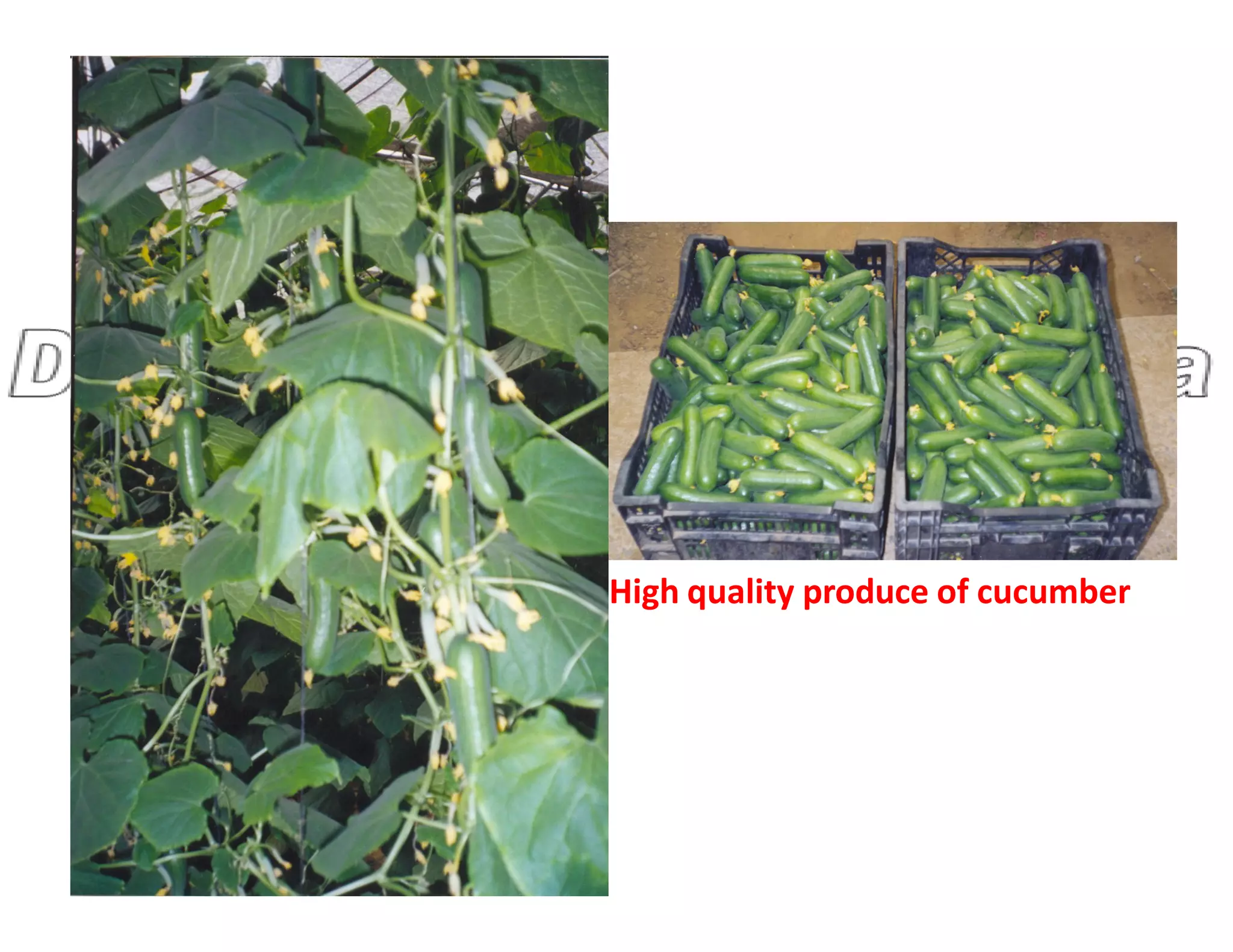
High quality produce of cucumber
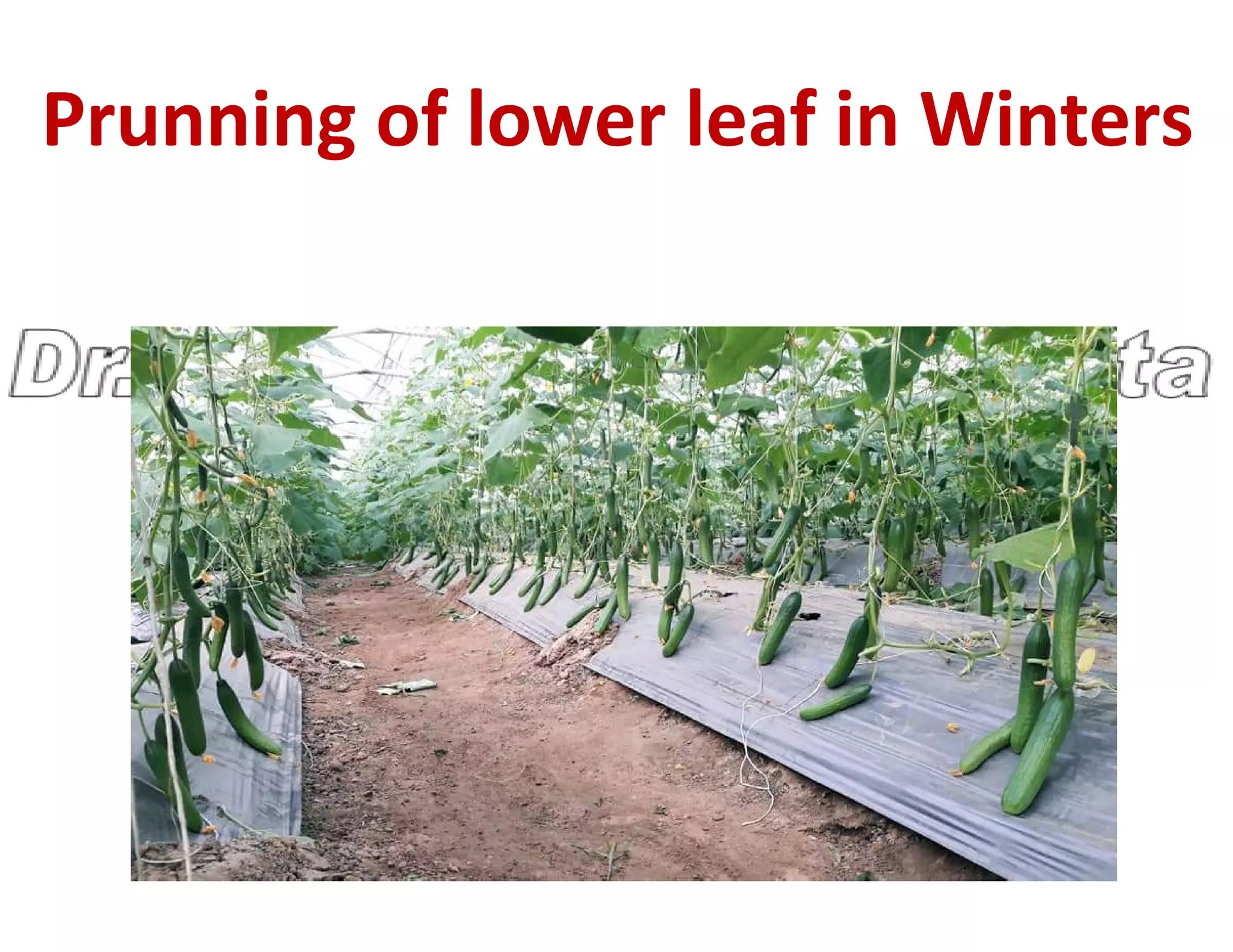
Prunning of lower leaf in Winters
Fertilizer and Water Requirement
Cucumber needs continuous water supply depends on soil
and climate
In general, green house cucumbers are irrigated through
drip system of irrigation and fertilizers are applied through
water: Fertigation
water: Fertigation
In addition to NPK, calcium is also required for fruit quality
and higher yields
Calcium should always applied through soil, not spraying
Boron Spray is require at the time of Flowering and Fruit
Setting.
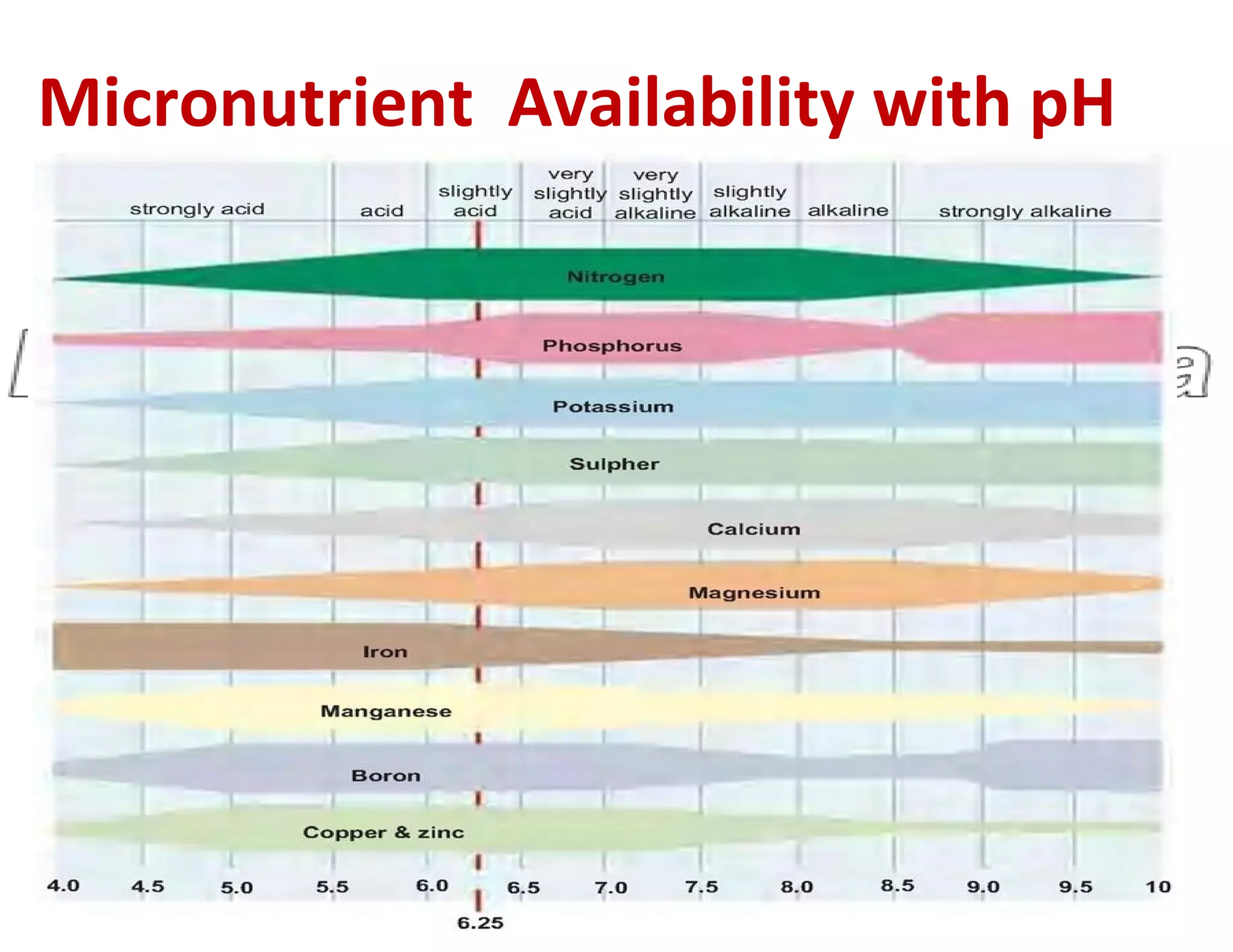
EC & pH Requirements
•Soil Testing and Water Testing is very
important.
•In soil testing, Check- EC, pH, Organic
matter, Major and Micro nutrients.
•Irrigation water should have EC <1 and pH
should be 6.5 to 7.0
•Fertigation water should have EC = 1.5
and pH should be 6.25.
•Soil EC should be <0.8 and pH should be
5.5 to 7.5.
Harvesting and Yield
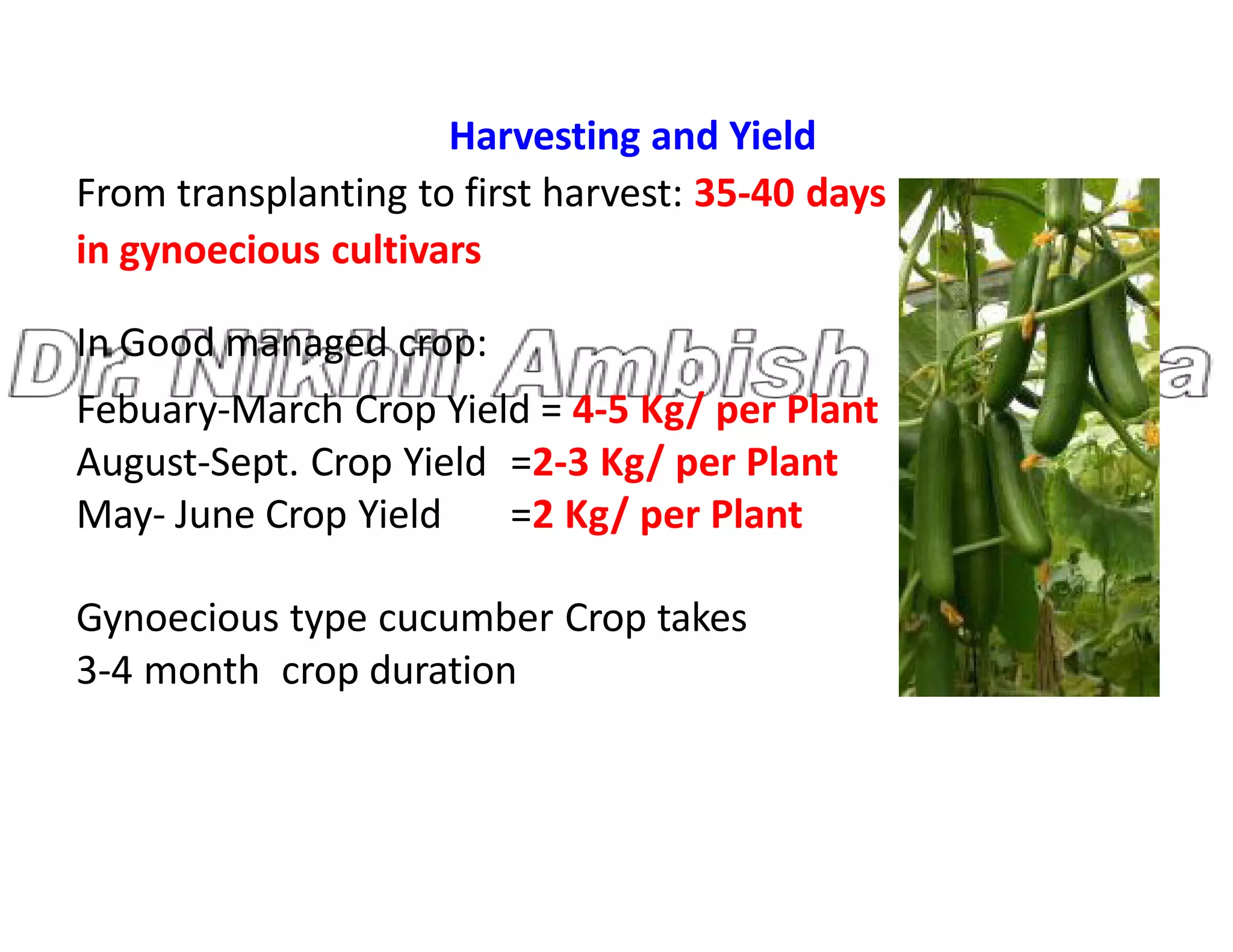
From transplanting to first harvest: 35-40 days
in gynoecious cultivars
In Good managed crop:
Febuary-March Crop Yield = 4-5 Kg/ per Plant
August-Sept. Crop Yield =2-3 Kg/ per Plant
May- June Crop Yield =2 Kg/ per Plant
Gynoecious type cucumber Crop takes
3-4 month crop duration
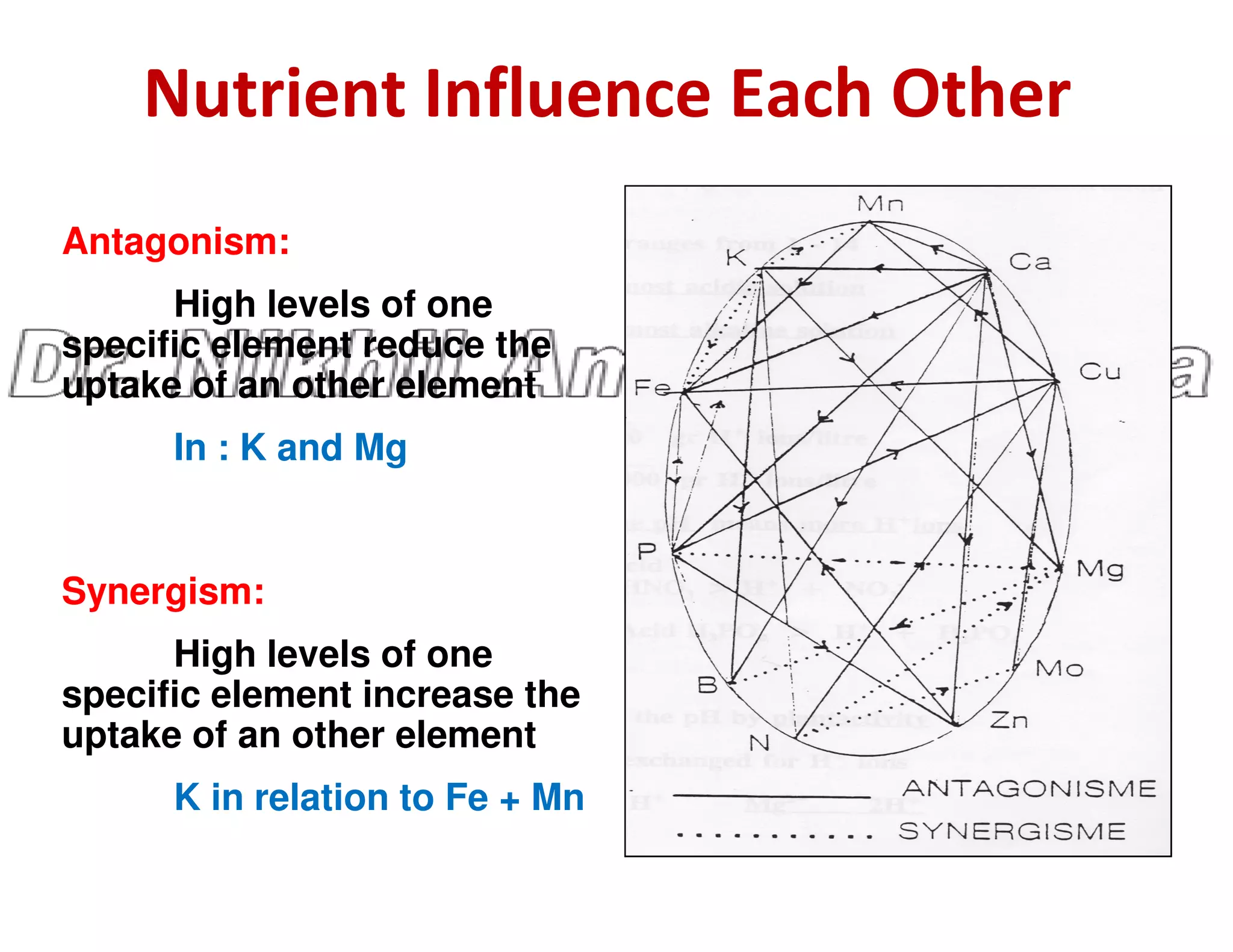
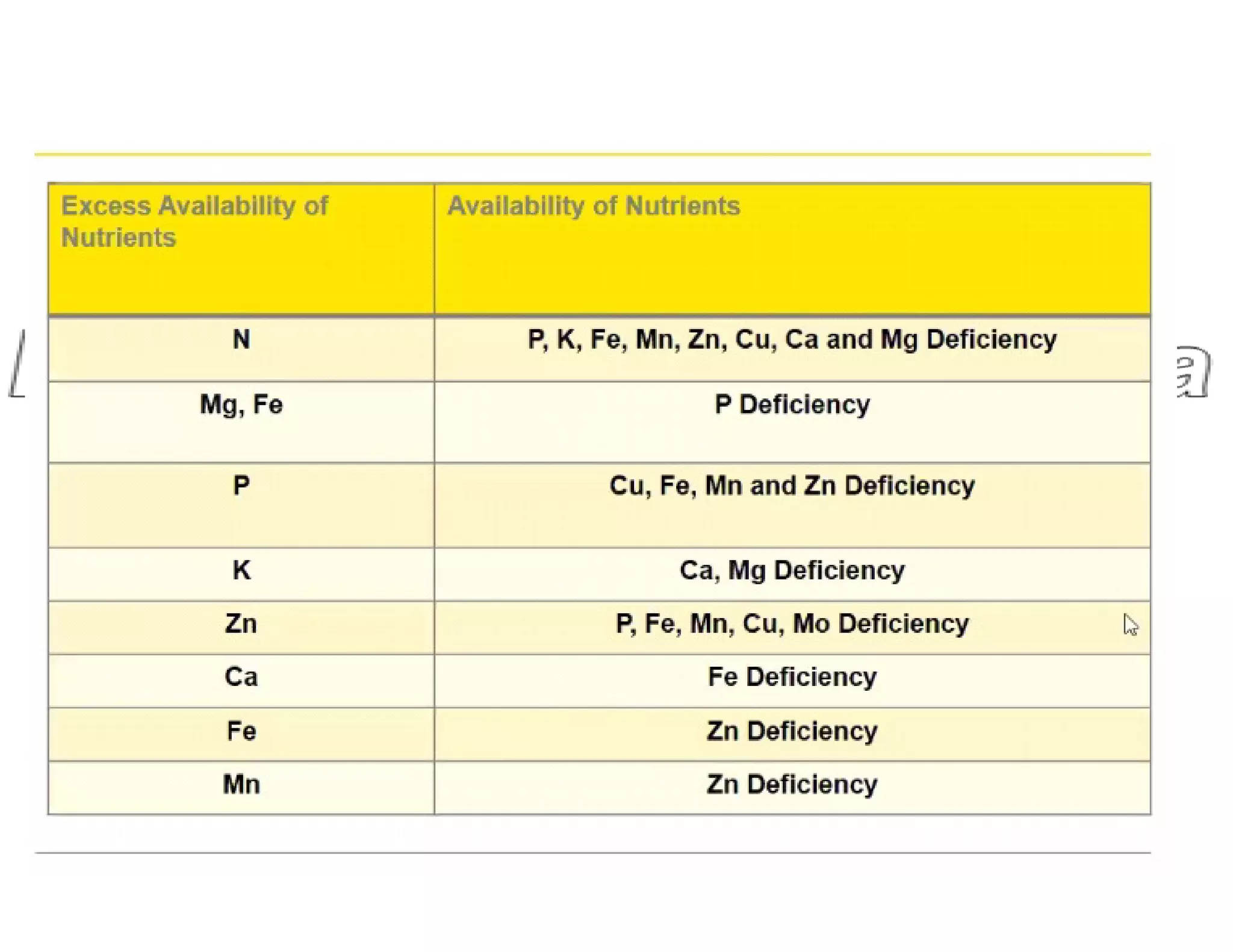
Nutrient Influence Each Other
Antagonism:
High levels of one
specific element reduce the
uptake of an other element
In : K and Mg
Synergism:
High levels of one
specific element increase the
uptake of an other element
K in relation to Fe + Mn
Micronutrient Availability with pH
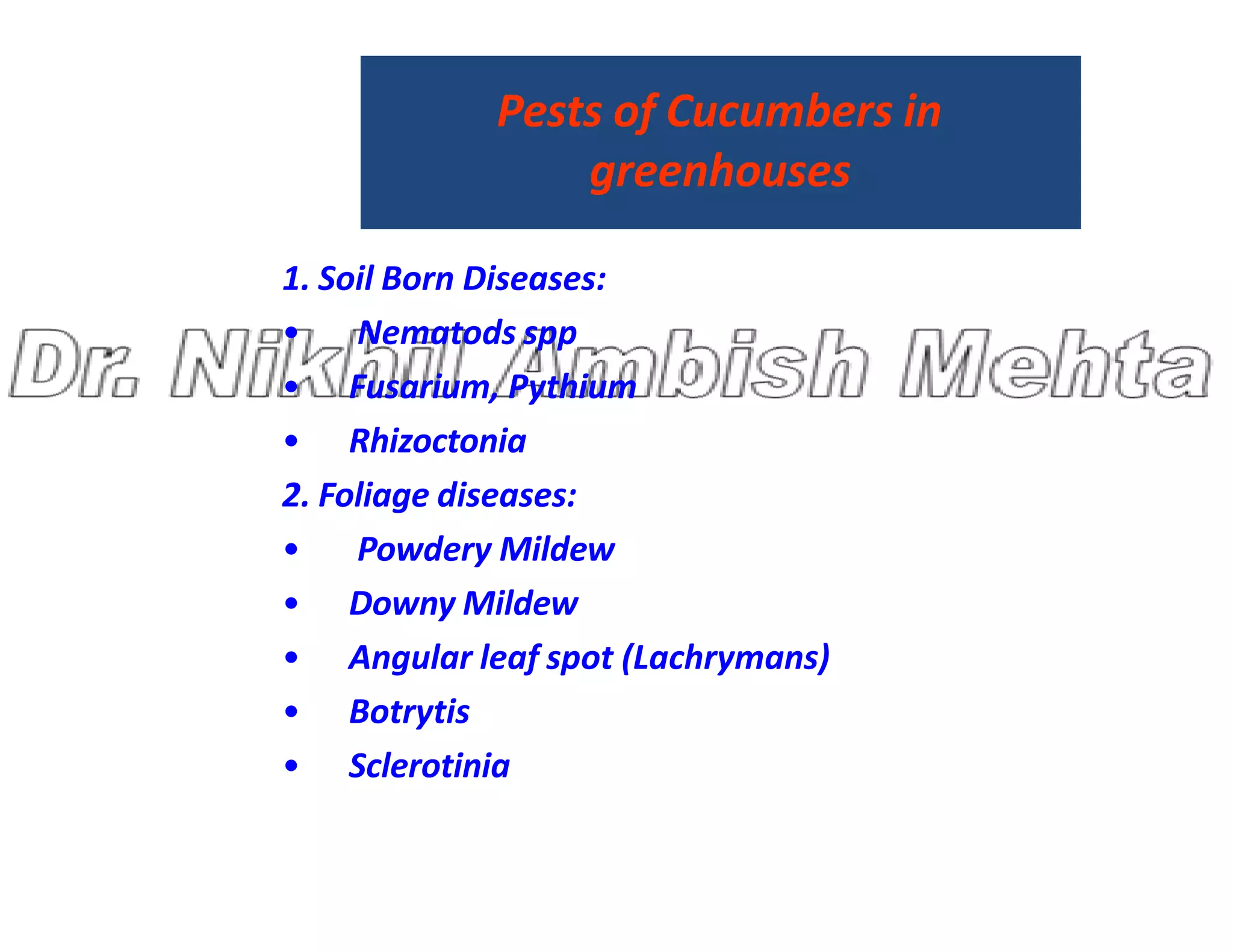
Pests of Cucumbers in
greenhouses
1. Soil Born Diseases:
• Nematods spp
• Fusarium, Pythium
• Rhizoctonia
2. Foliage diseases:
• Powdery Mildew
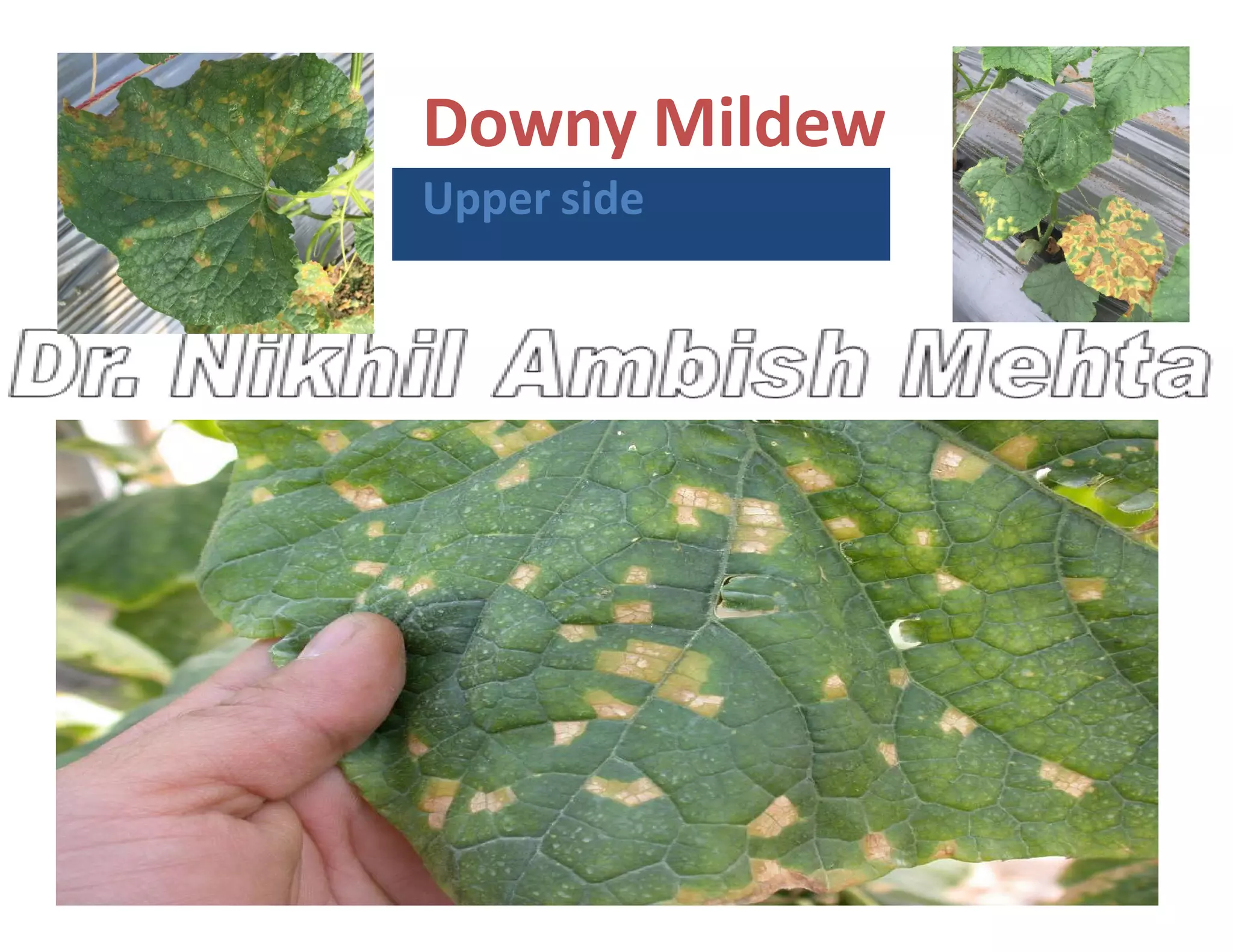
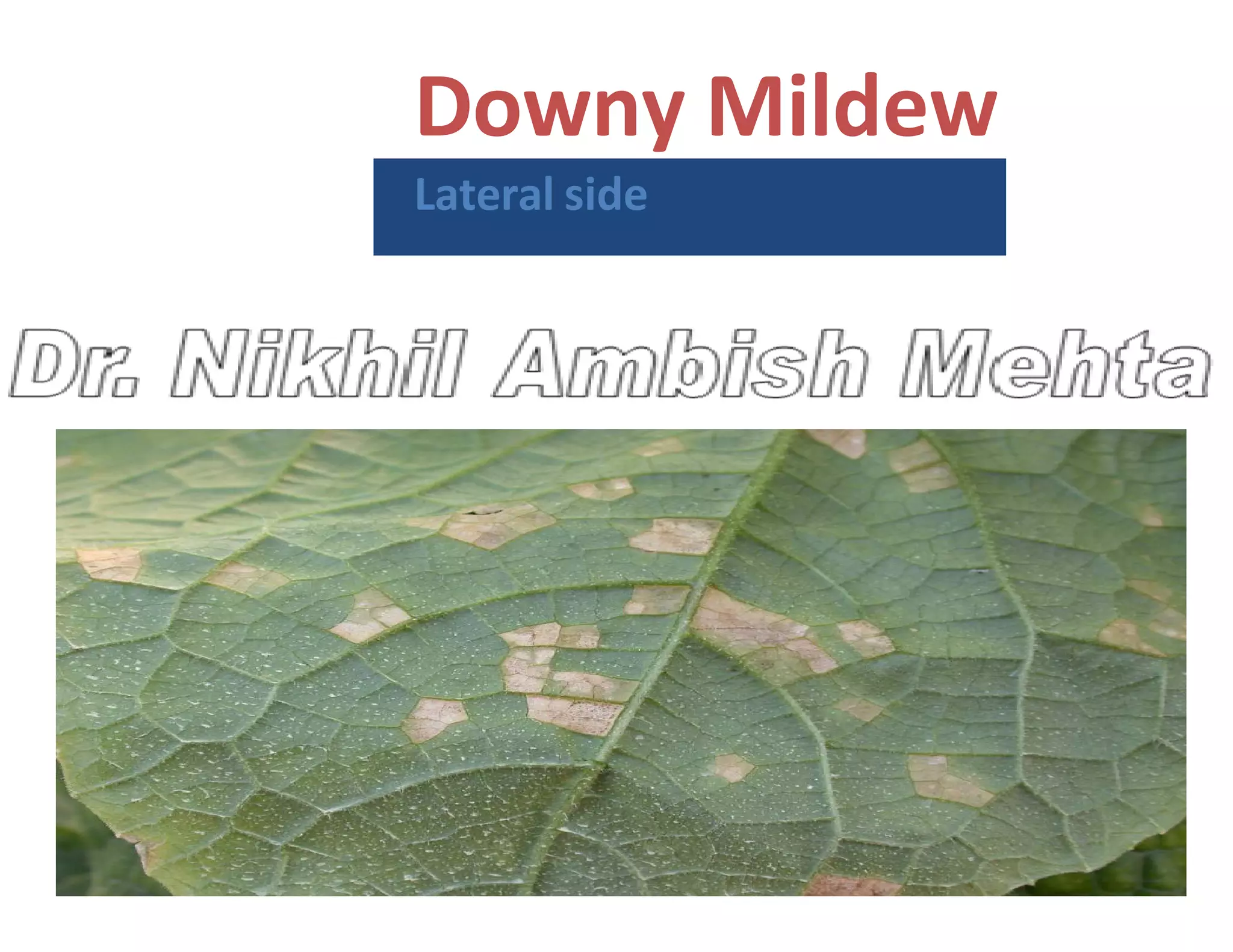
• Downy Mildew
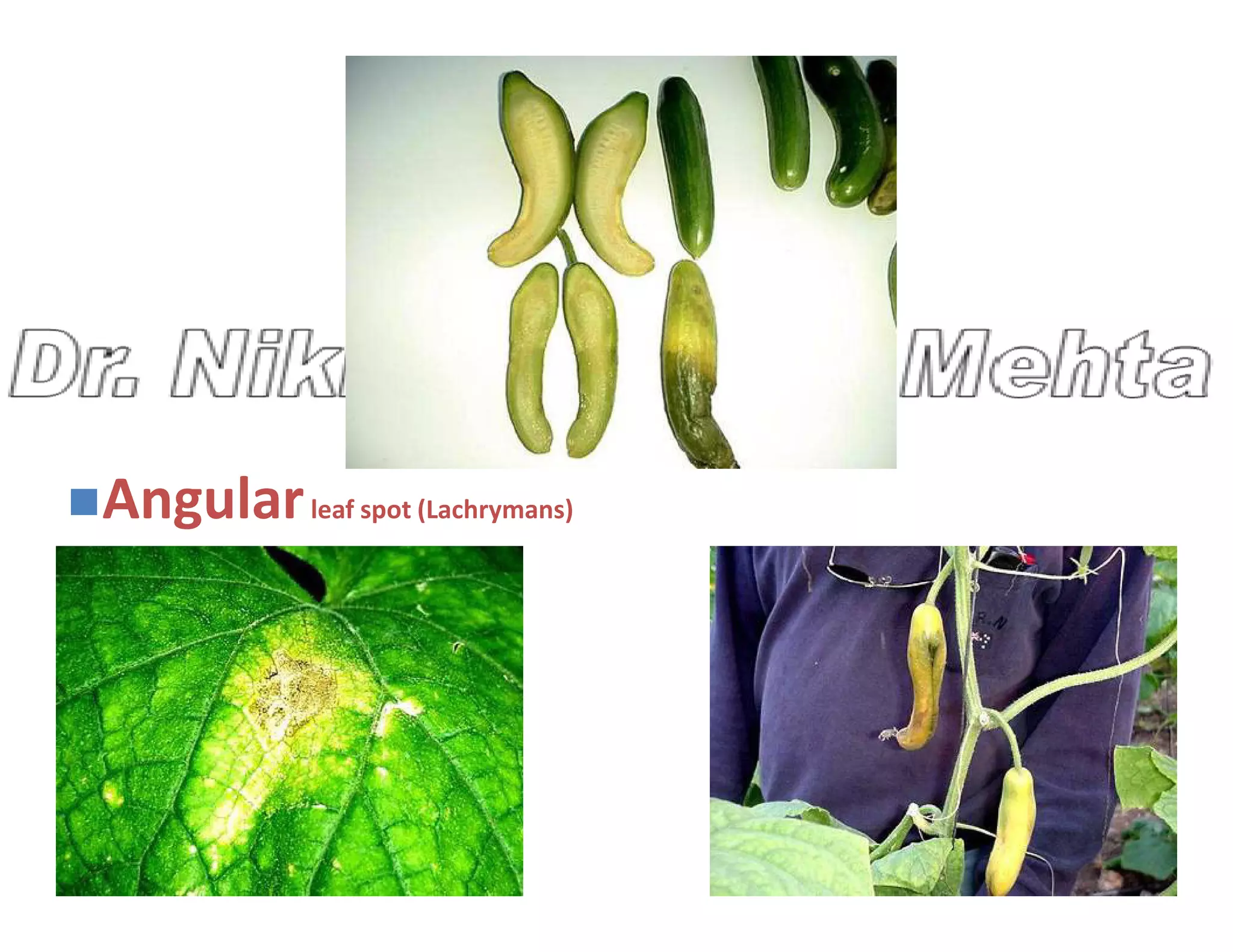
• Angular leaf spot (Lachrymans)
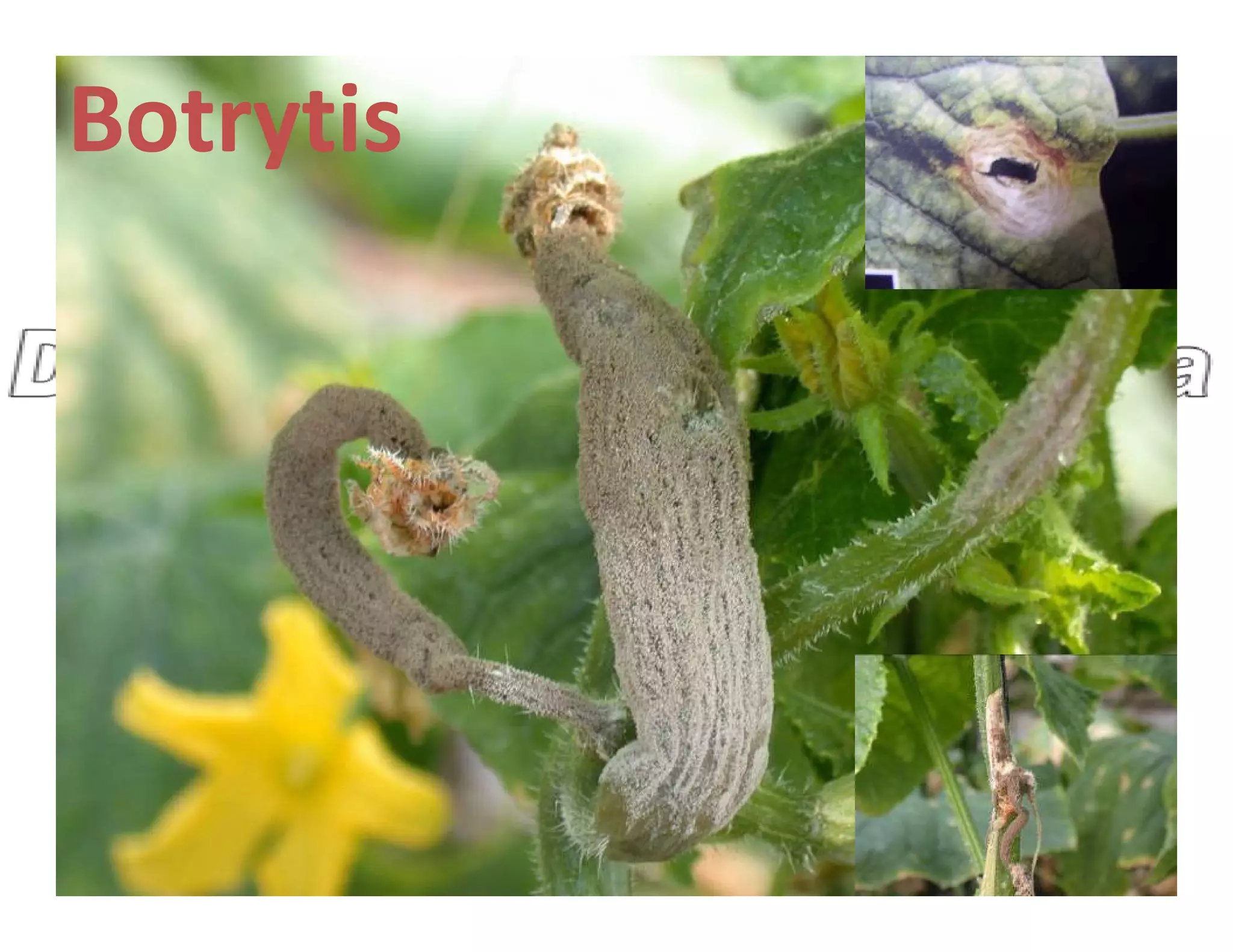
• Botrytis
• Sclerotinia
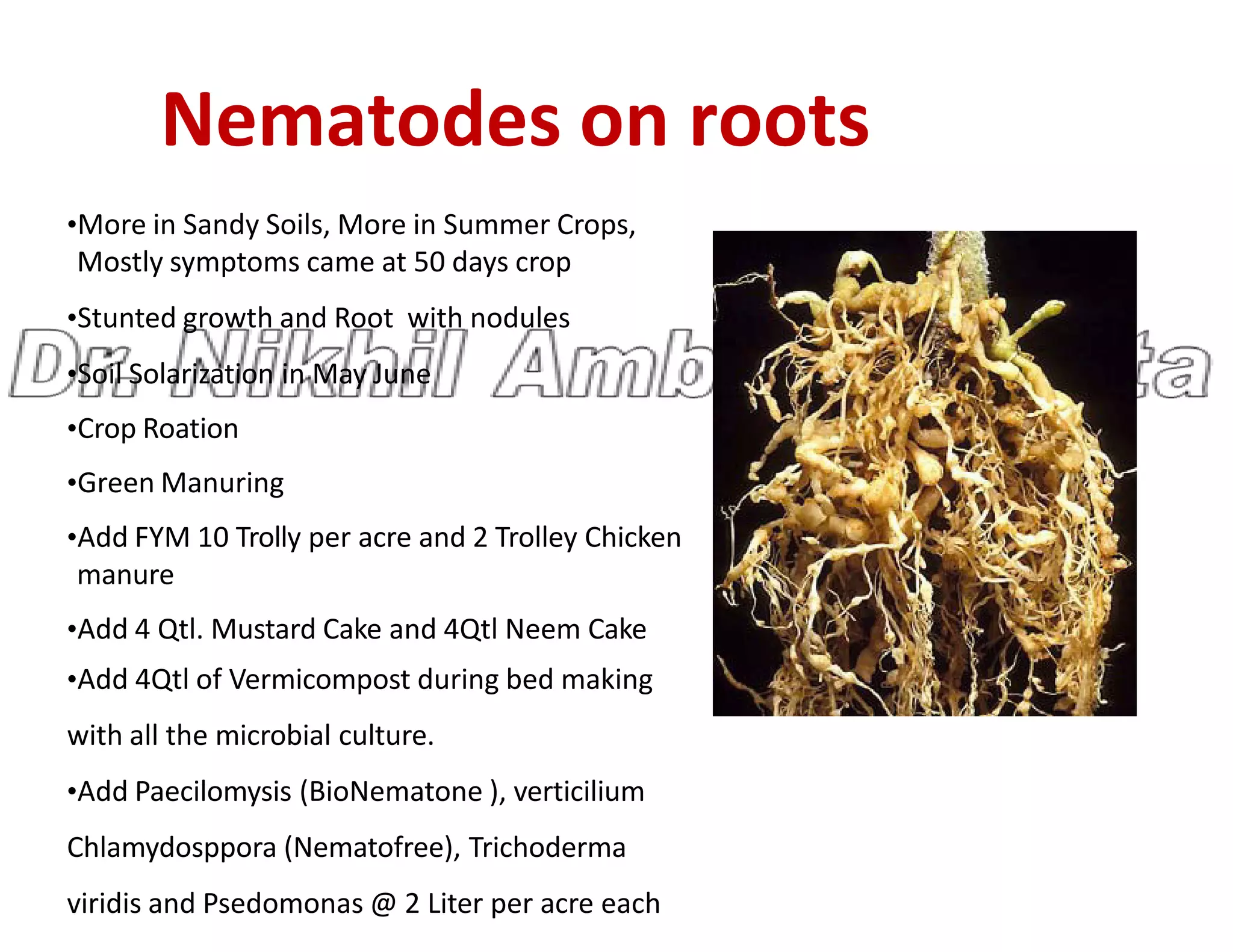
Nematodes on roots
•More in Sandy Soils, More in Summer Crops,
Mostly symptoms came at 50 days crop
•Stunted growth and Root with nodules
•Soil Solarization in May June
•Crop Roation
•Green Manuring
•Green Manuring
•Add FYM 10 Trolly per acre and 2 Trolley Chicken
manure
•Add 4 Qtl. Mustard Cake and 4Qtl Neem Cake
•Add 4Qtl of Vermicompost during bed making
with all the microbial culture.
•Add Paecilomysis (BioNematone ), verticilium
Chlamydosppora (Nematofree), Trichoderma
viridis and Psedomonas @ 2 Liter per acre each
Bio-Control in Basal Application
Sr.No Name of Technical product Brand Name Dosage
1 Trichoderma harzianum De-Tricho 2 Liter per acre
2 Pseudomonas fluorescens De-Pseudo 2 Liter per acre
3 Paecilomyces lilacinus DEPACK or
BioNematone
2 Liter per acre
4 Verticilum Chlamidospora Nematofree+ 2 Kg per acre
5 Phosphorus Solublising Bacteria PSB = De-Phos 2 Liter per acre
6 Potash Solublising Bacteria KSB = De-Potash 2 Liter per acre
7 Vesicular-Arbuscular Mycorrhiza VAM = Rutoz 2 Liter per acre
8 Azotobacter (Nitro-Bacteria) DE-Nitro 2 Liter per acre
1. Mix the above Bio product with 200 kg Vermicopost and sprinkle water on it.
2. Cover the mixture with Gunny Bags for 2 Days
3. Above bio product can given through drenching with @ 5 ml per liter after one month
interval
4. Liquid Formulations are better than powder formulation
5. Take Fresh Products use with in 3 to 6 months.
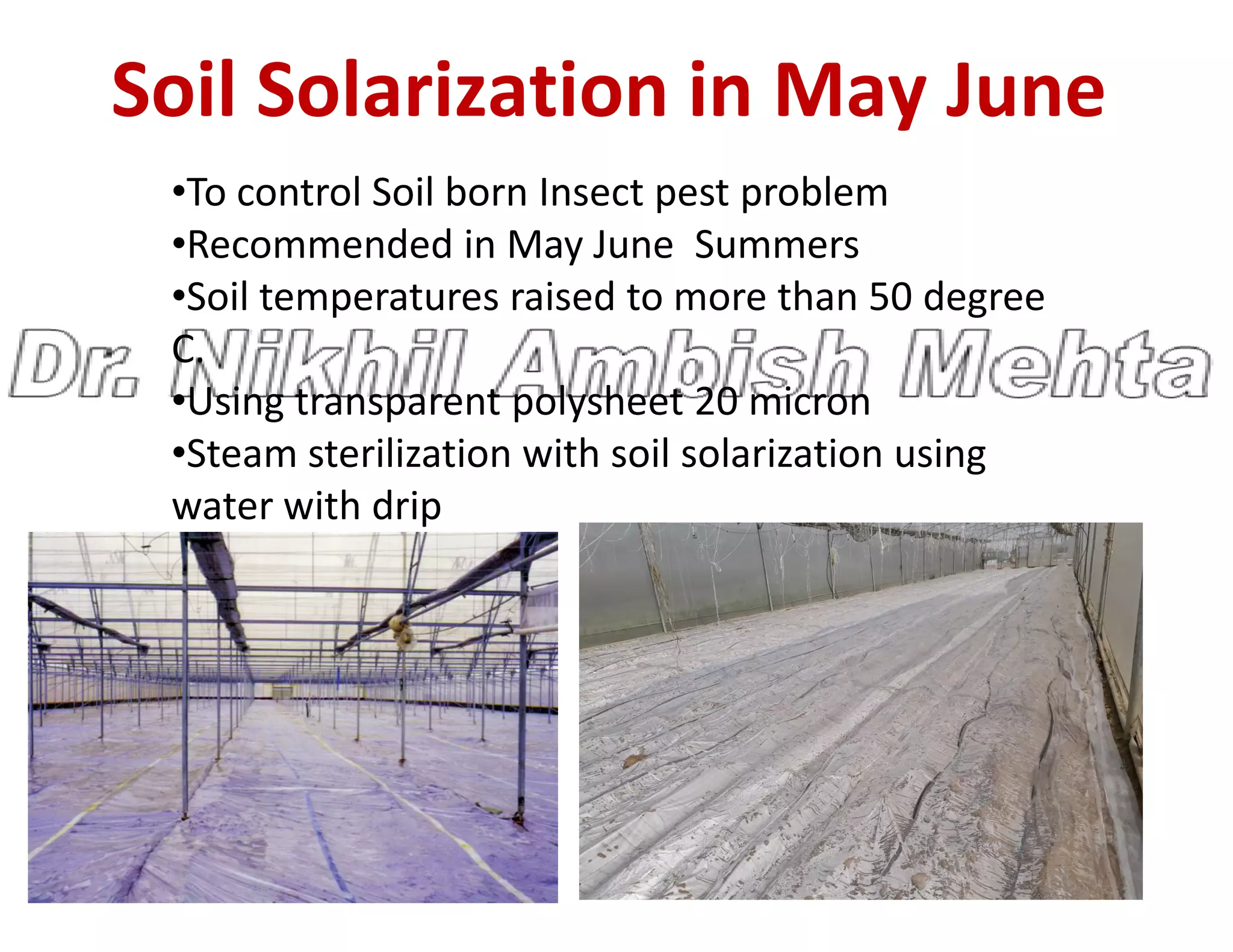
Soil Solarization in May June
•To control Soil born Insect pest problem
•Recommended in May June Summers
•Soil temperatures raised to more than 50 degree
C.
•Using transparent polysheet 20 micron
•Steam sterilization with soil solarization using
water with drip
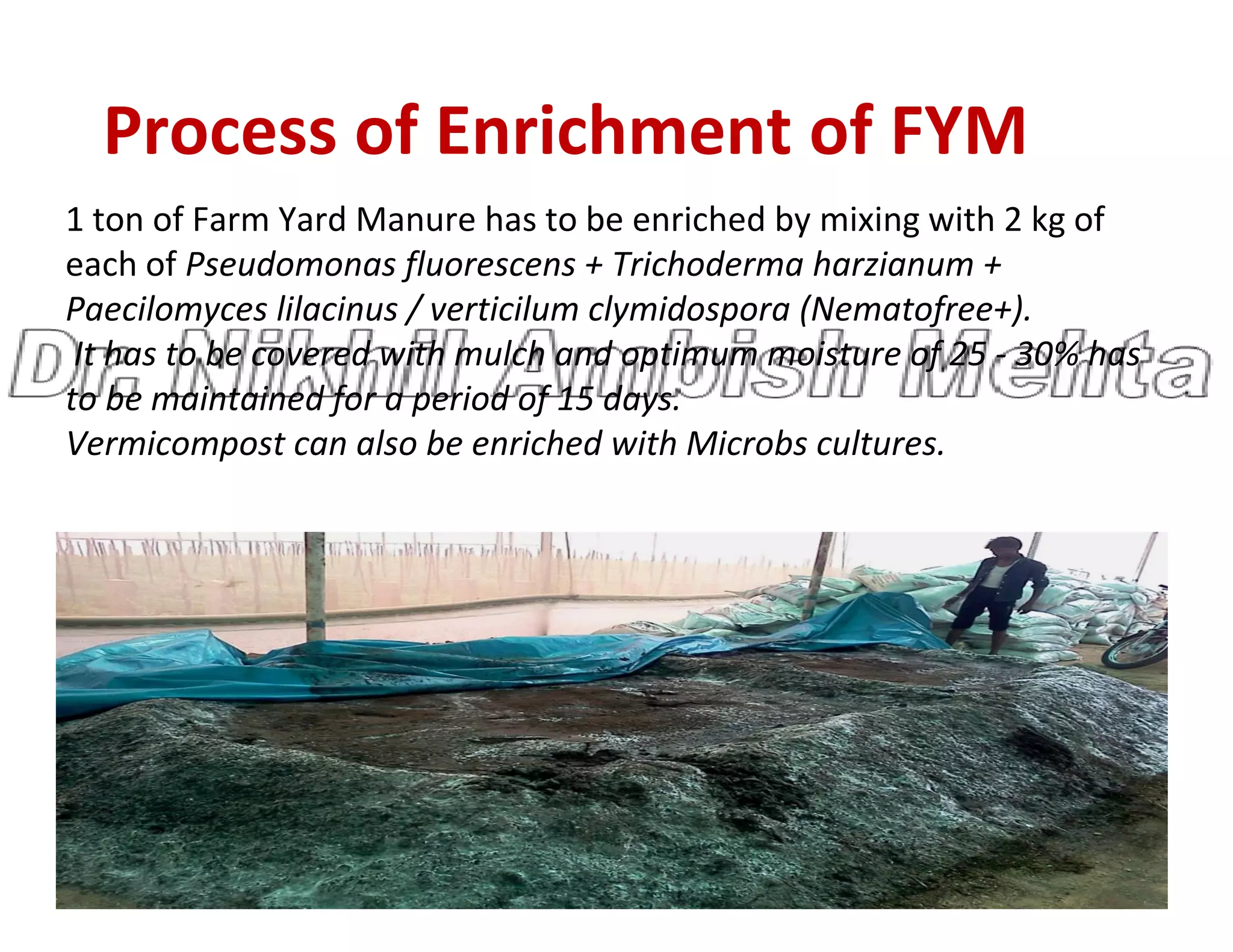
Process of Enrichment of FYM
1 ton of Farm Yard Manure has to be enriched by mixing with 2 kg of
each of Pseudomonas fluorescens + Trichoderma harzianum +
Paecilomyces lilacinus / verticilum clymidospora (Nematofree+).
It has to be covered with mulch and optimum moisture of 25 - 30% has
to be maintained for a period of 15 days.
Vermicompost can also be enriched with Microbs cultures.
Velum Prime for Nematode Control
1. Plants should be 5-6 leaf stage for
application.
2. We can not apply before sowing and after
sowing of seed.
sowing of seed.
3. Soil should be moist and given water with
velum Prime in root zone.
4. Dosage 500 ml per acre . i.e 0.5 ml per liter
in drenching with at least 100 ml drenching
per plant.
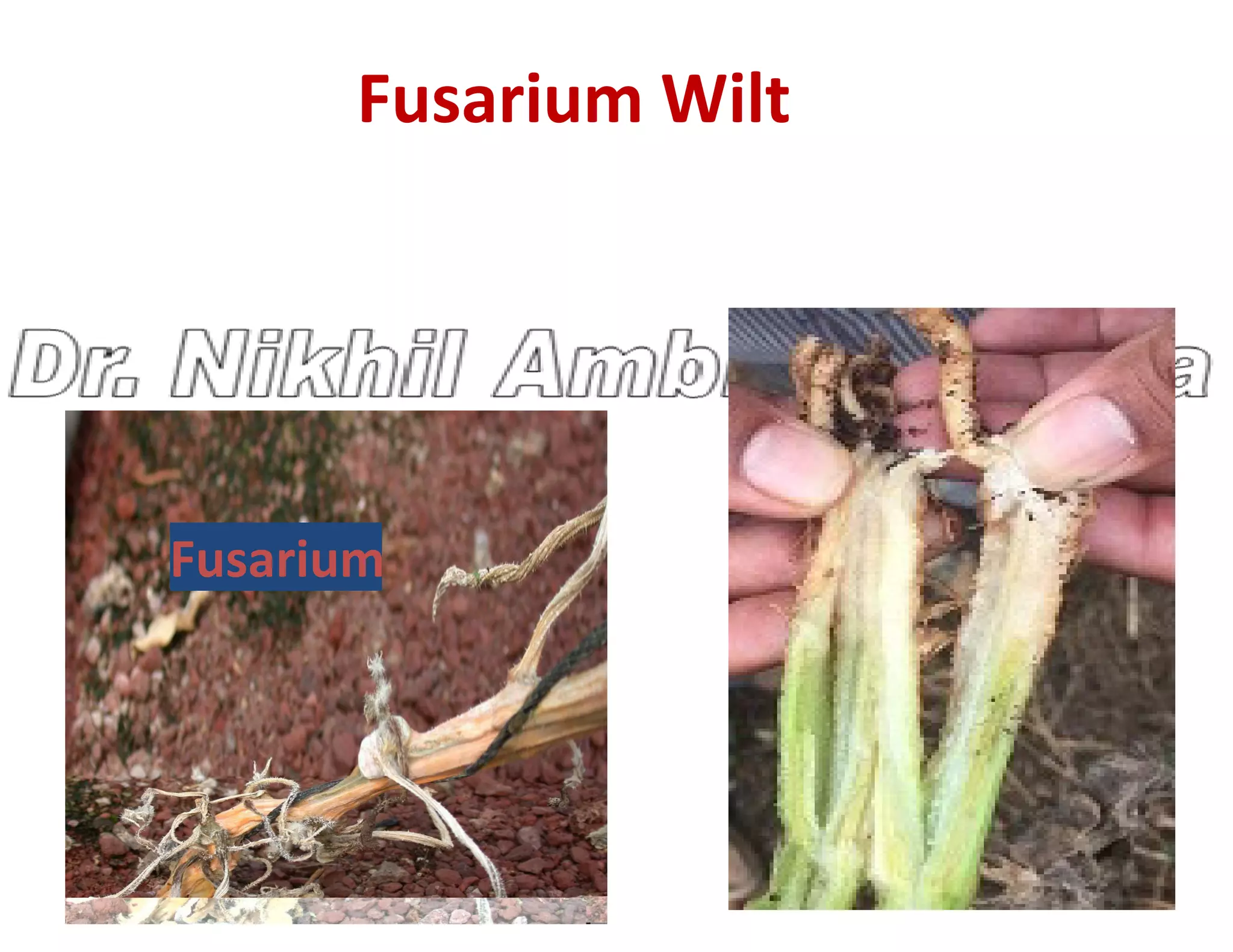
Fusarium Wilt
Fusarium
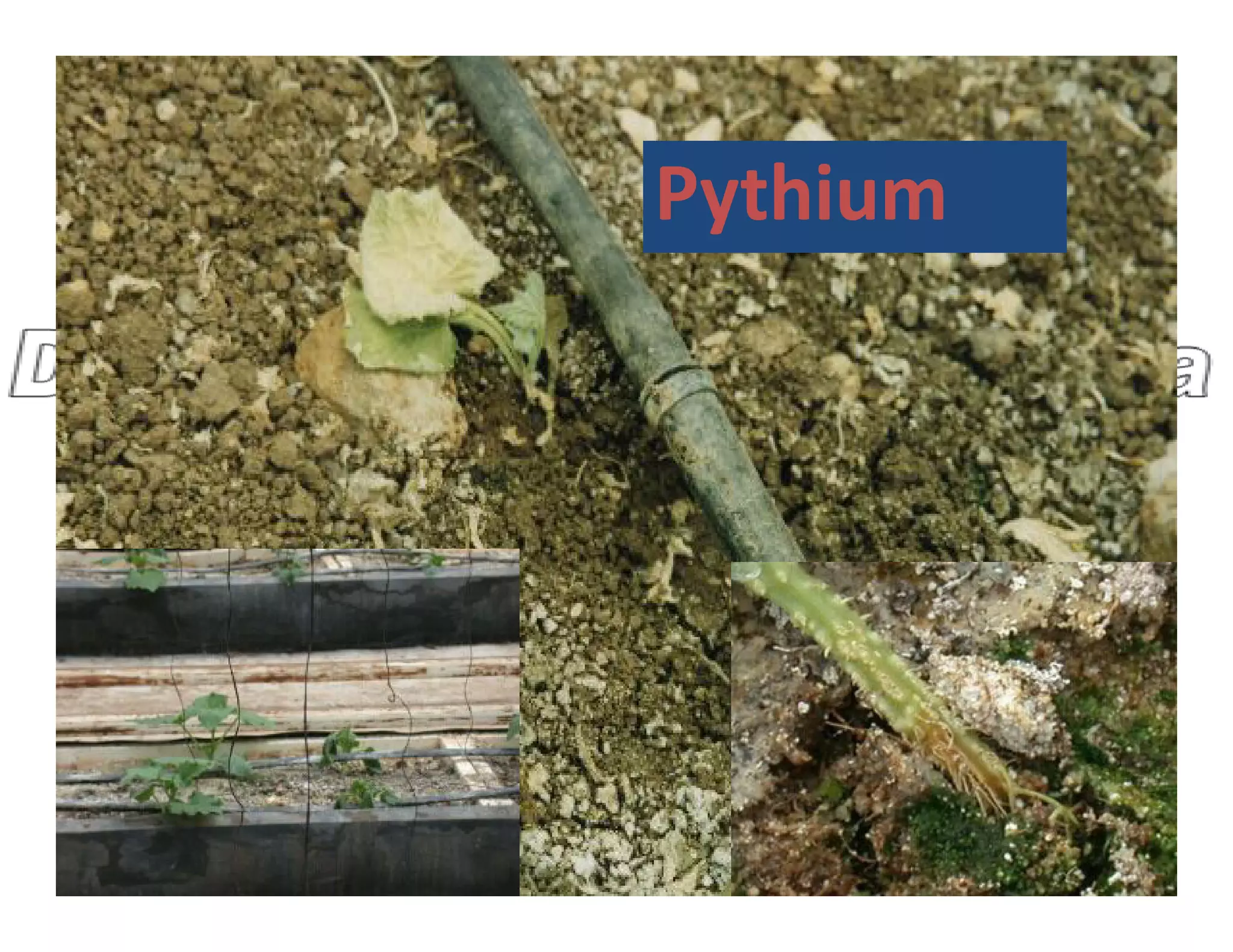
Pythium
2. Foliage diseases in Cucumber
• Powdery Mildew (Sphaerotheca fuligina)
• Downy Mildew (Pseudopernospora cubensis)
• Angular leaf spot (Pseudomonas Lachrymans)
• Gray Mold (Botrytis cinerea)
• Sclerotinia sclerotiorum
• Dedimela Gummy stem (Mycosphaerella melonsis)
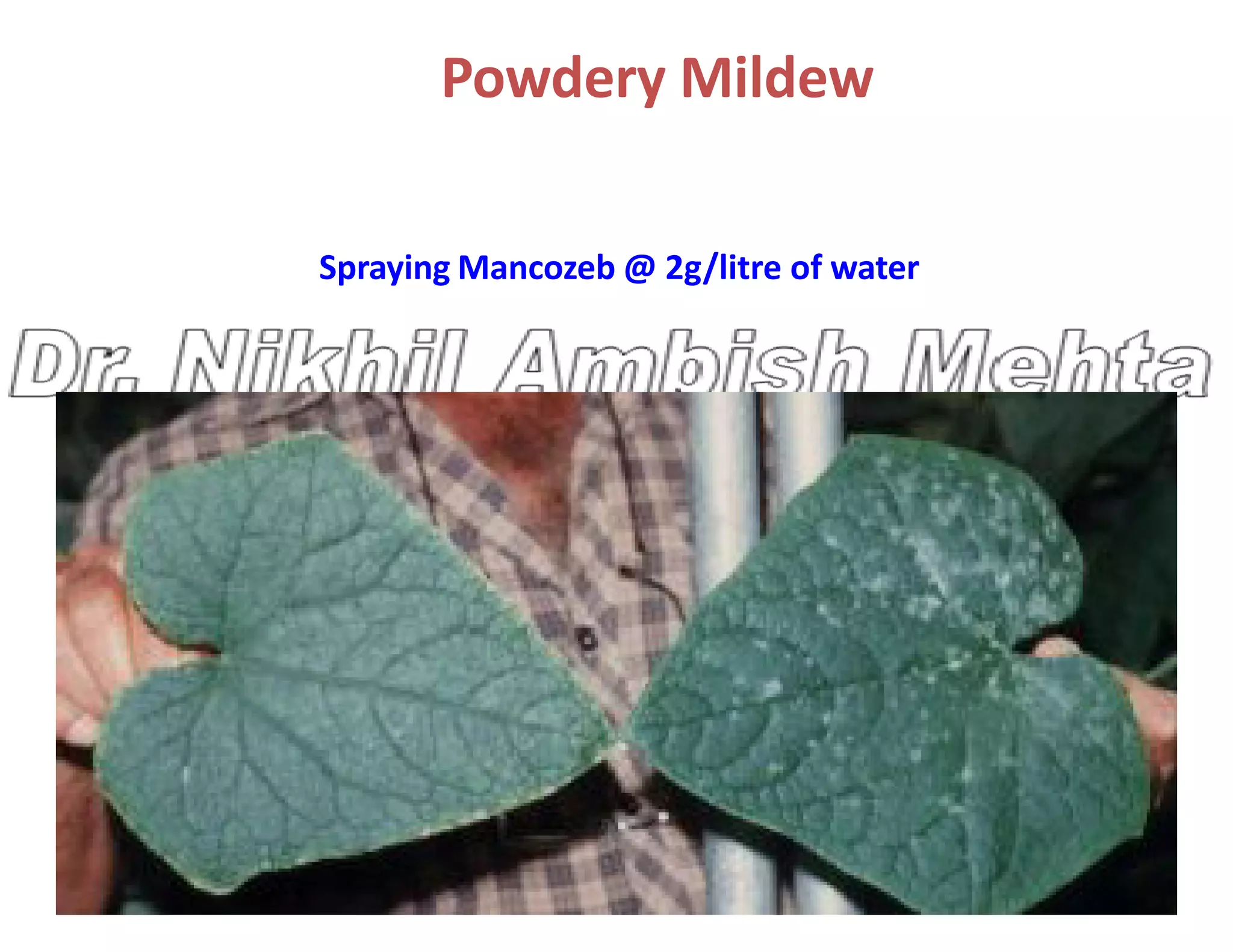
Powdery Mildew
Spraying Mancozeb @ 2g/litre of water
Downy Mildew
Upper side
Downy Mildew
Lateral side
Angular
Angularleaf spot (Lachrymans)
Botrytis
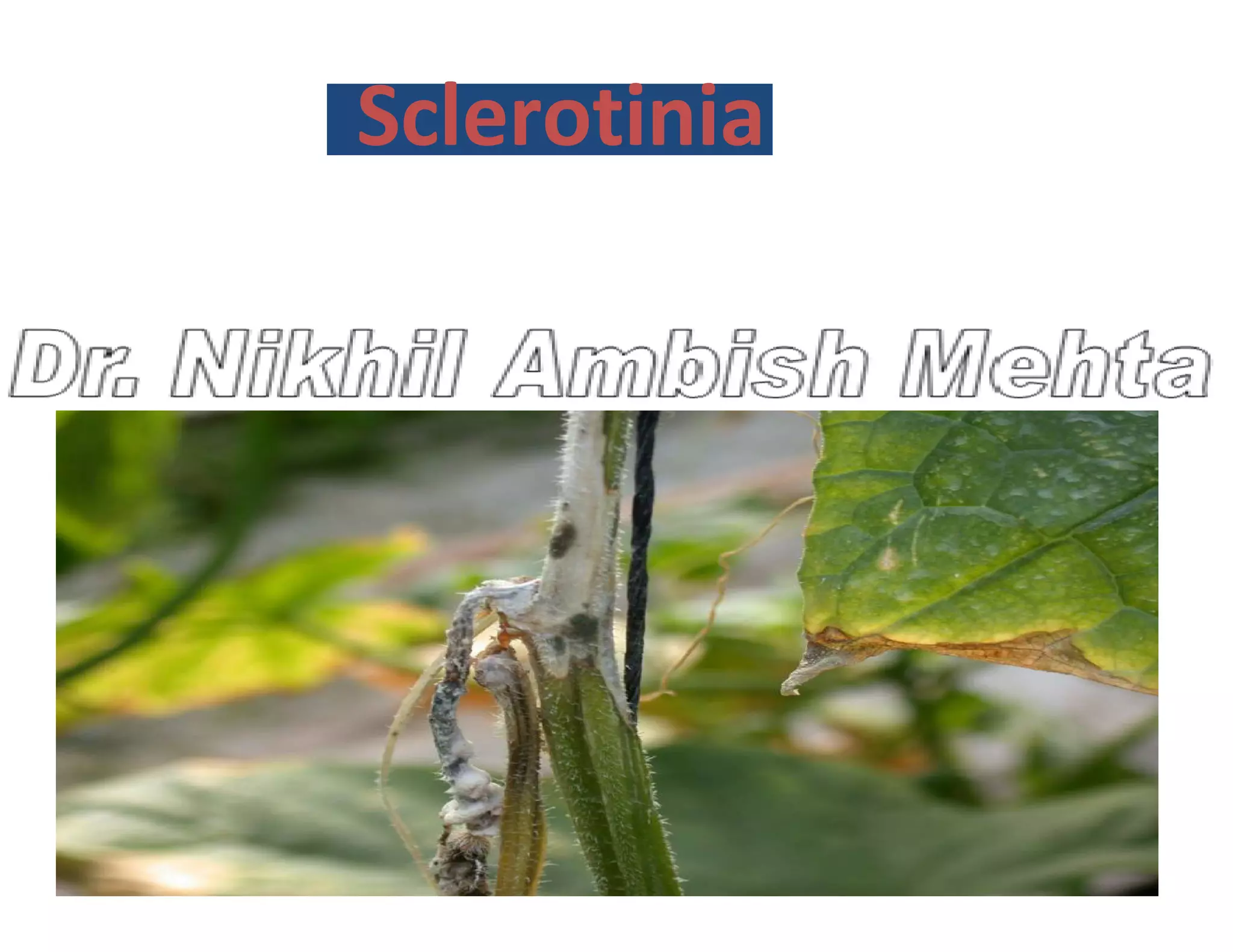
Sclerotinia
Disease management
• Botrytis – M-45 and Roko @ 2 gm per liter
• Sclerotinia – Nativo @ 1 gm per liter
• Downy Mildew – Acrobat @1 gm + M-45@
2gm per liter or Curzet-
Cymoxallin+mencozeb
@ 2 gm per liter
• Powder Mildew – Karathane @ 1 ml per liter
• Angular Leaf Spot – Antracol @ 1 to 2 gm per
liter
Viruses in Cucumber Crop
4. Viruses: CMV, CVYV, CYV,,CGMMV
1. Spray of Virus Killer By Sanjiwani or Virogoud
@ 2ml per liter when there is start of virus
attack
attack
2. Remove the virus infected plant the
spray Control vectors, white fly and
aphids
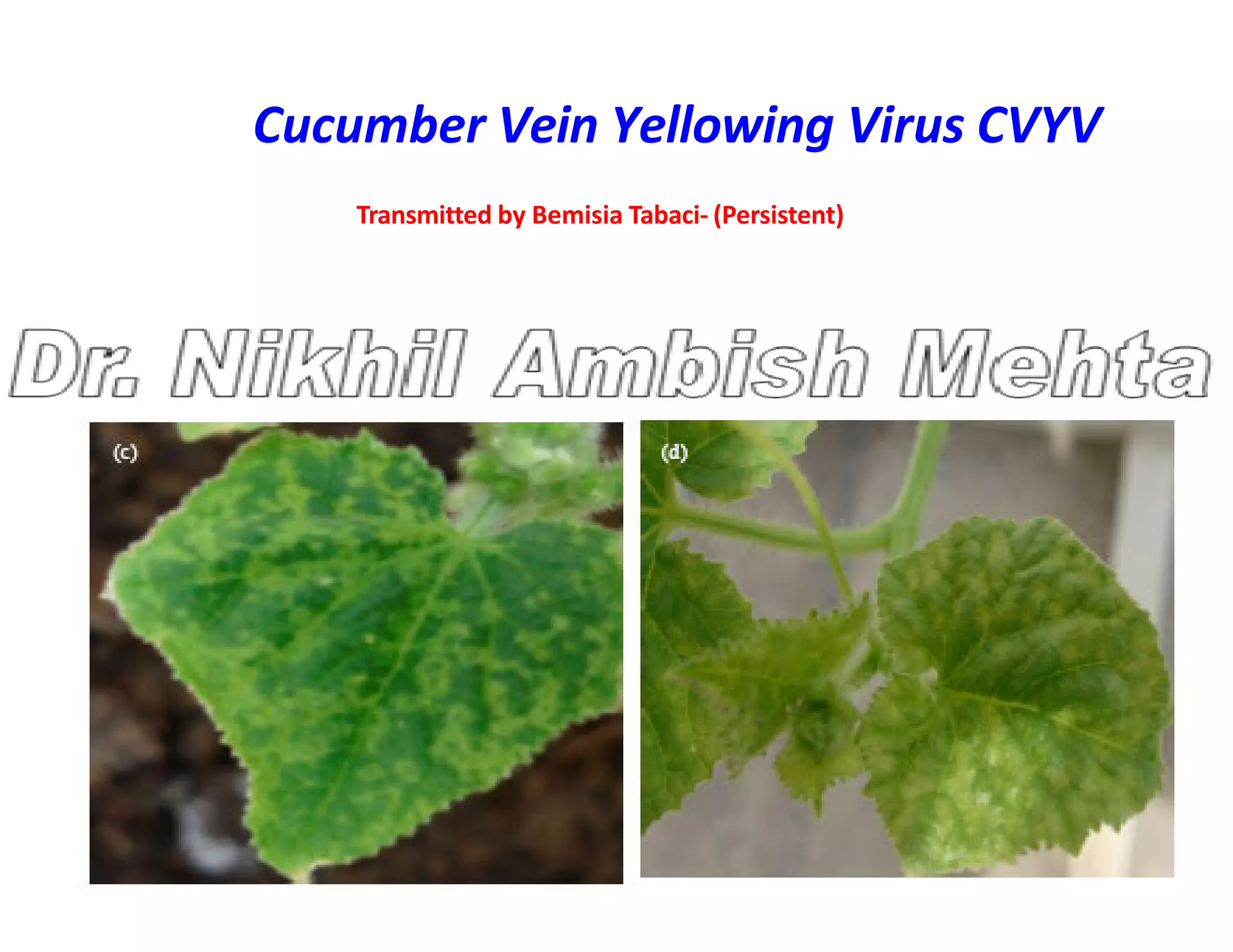
Cucumber Vein Yellowing Virus CVYV
Transmitted by Bemisia Tabaci- (Persistent)
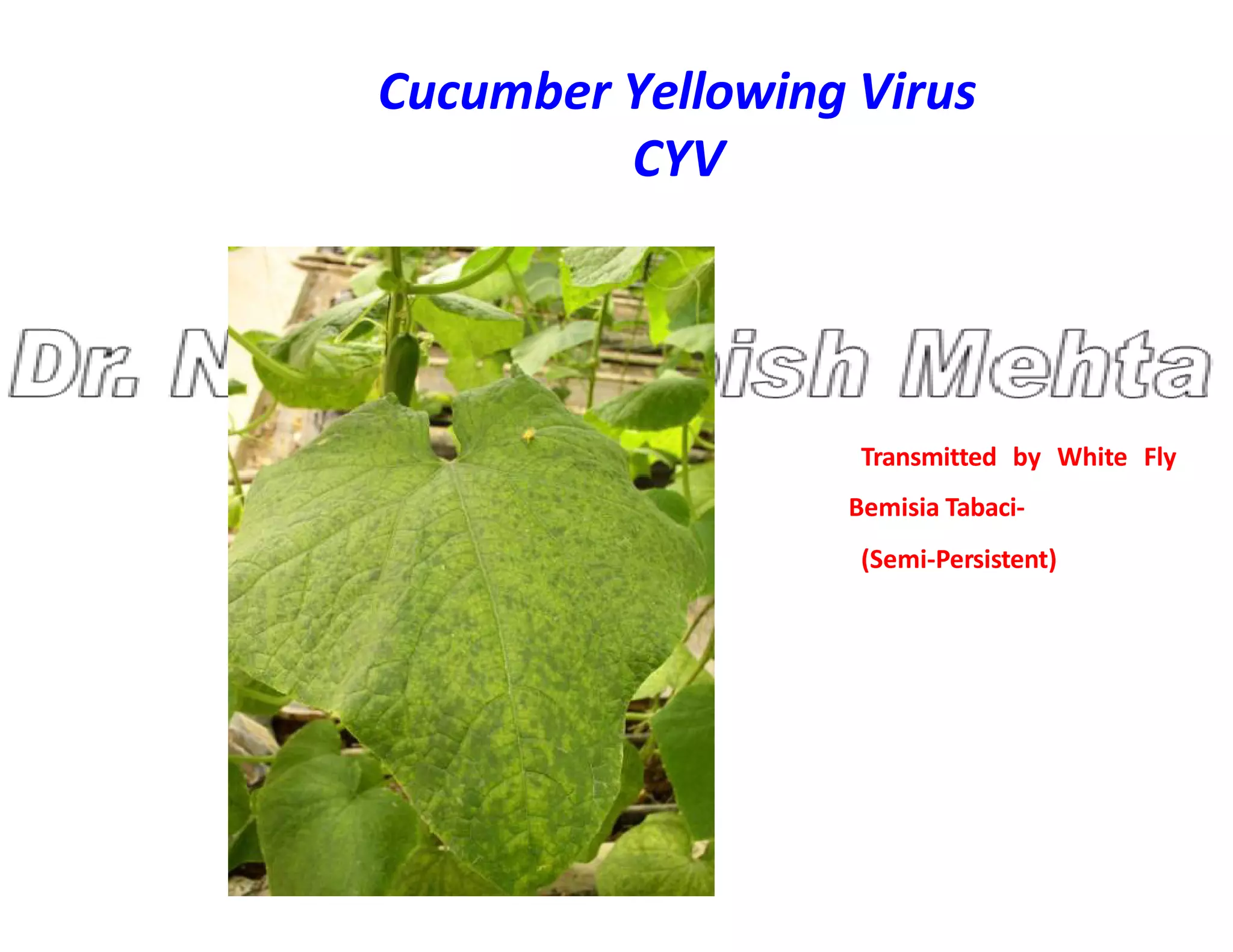
Cucumber Yellowing Virus
CYV
Transmitted by White Fly
Bemisia Tabaci-
(Semi-Persistent)
Major Insects:
1. Red mites,
2. Thrips,
3. White Fly (Bemisia Tabaci)
Pests of Cucumbers in
greenhouses
3. White Fly (Bemisia Tabaci)
4. Leaf miner,
5. Tobbaco Caterpillar :
Spodoptera
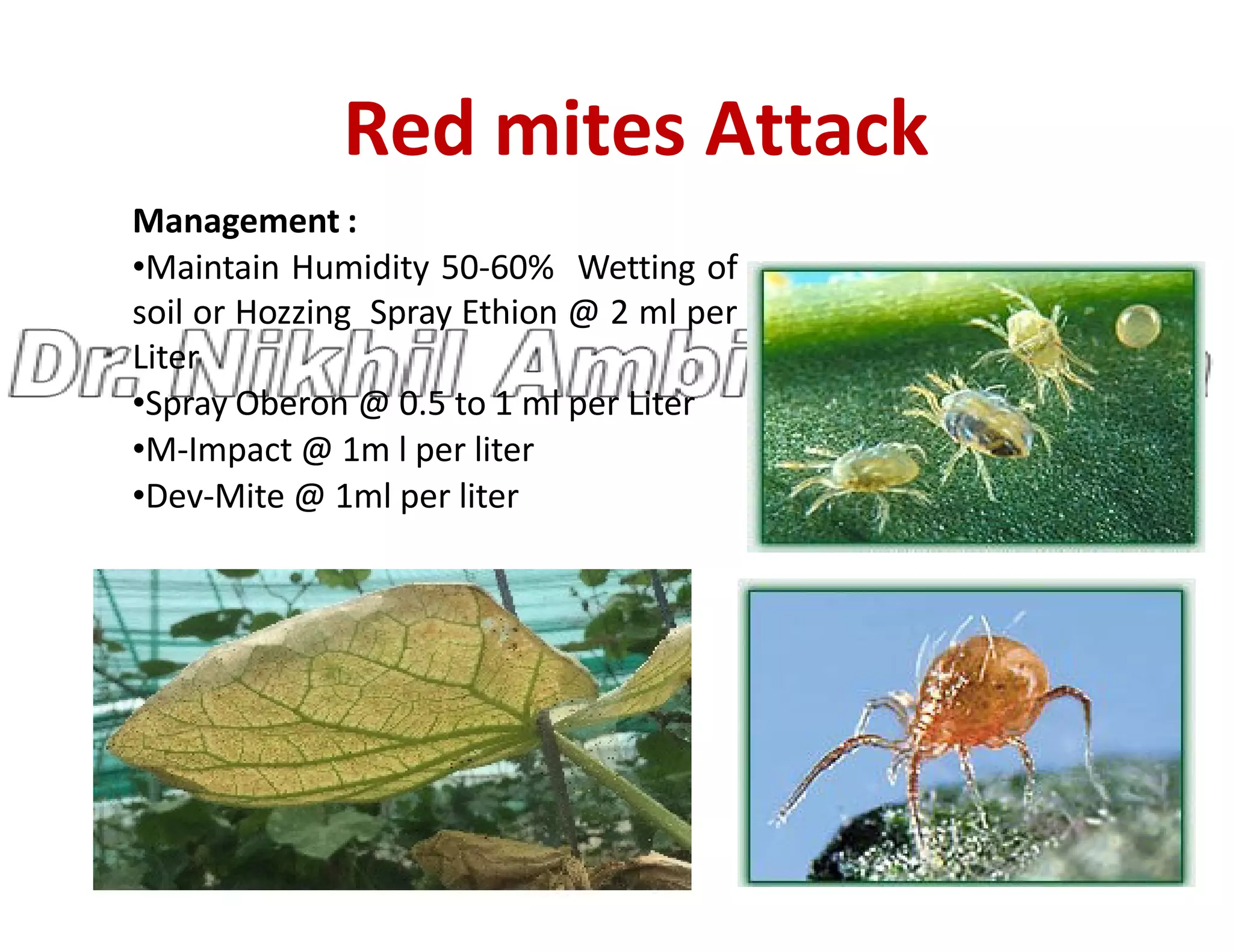
Red mites Attack
Management :
•Maintain Humidity 50-60% Wetting of
soil or Hozzing Spray Ethion @ 2 ml per
Liter
•Spray Oberon @ 0.5 to 1 ml per Liter
•M-Impact @ 1m l per liter
•Dev-Mite @ 1ml per liter
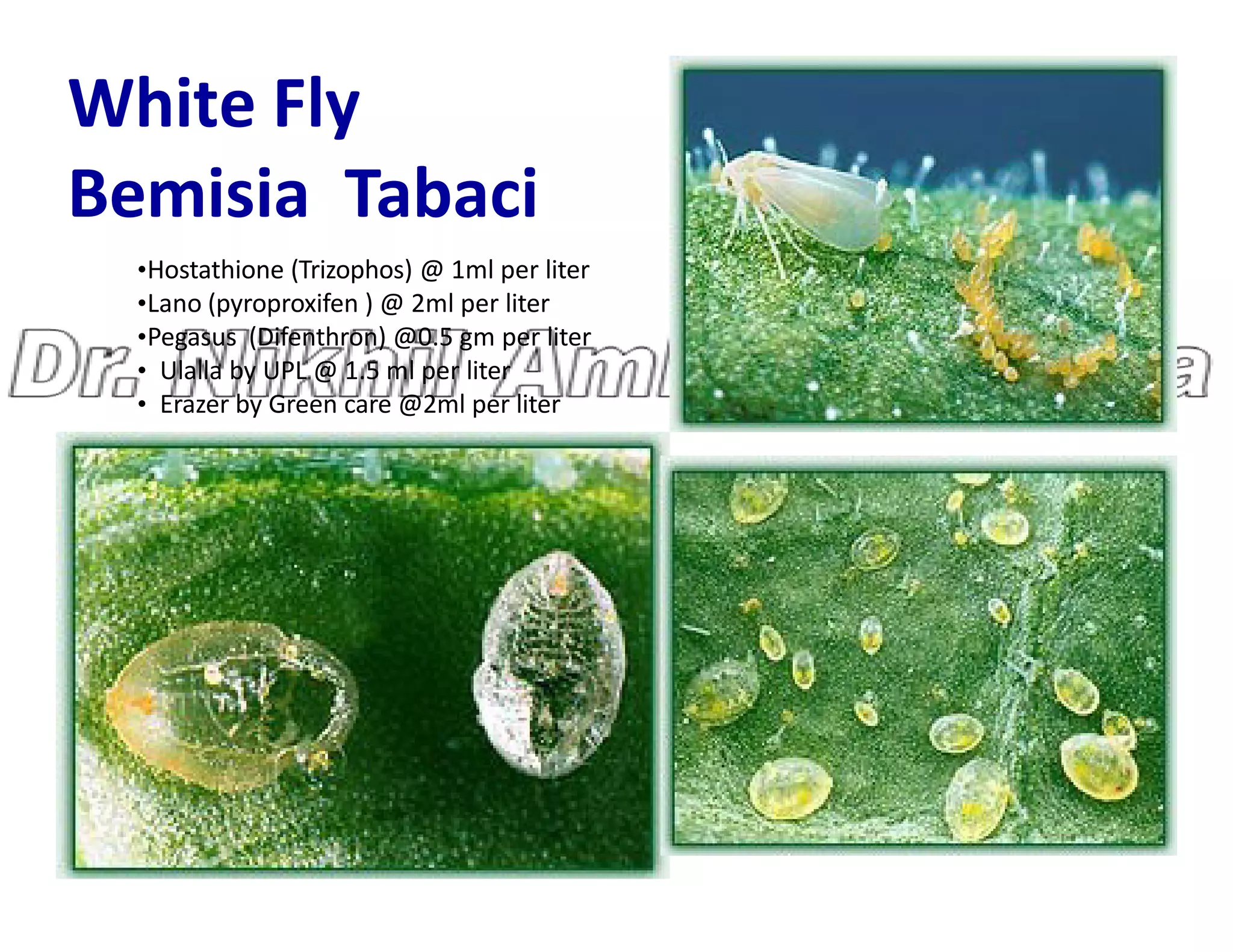
White Fly
Bemisia Tabaci
•Hostathione (Trizophos) @ 1ml per liter
•Lano (pyroproxifen ) @ 2ml per liter
•Pegasus (Difenthron) @0.5 gm per liter
• Ulalla by UPL @ 1.5 ml per liter
• Erazer by Green care @2ml per liter
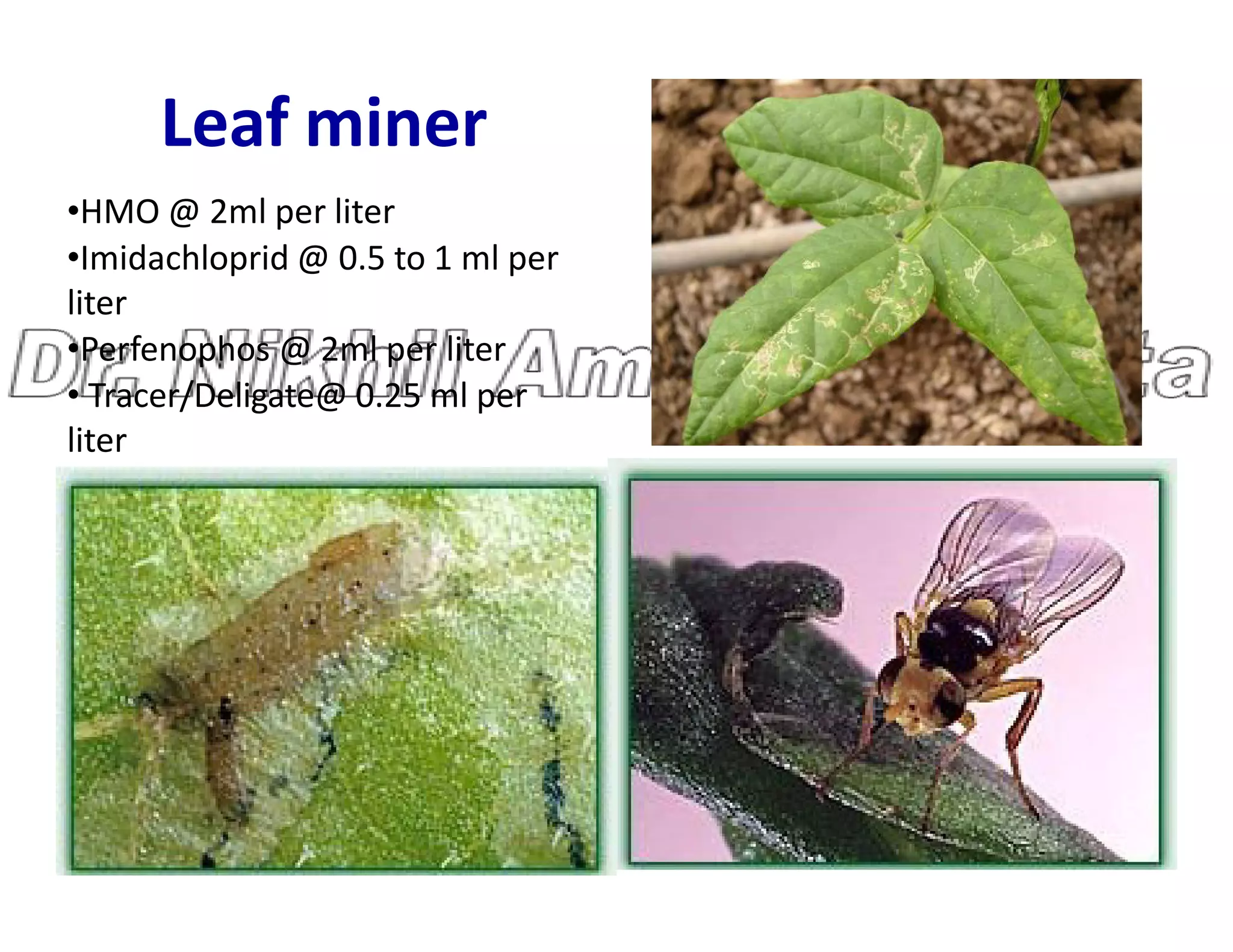
Leaf miner
•HMO @ 2ml per liter
•Imidachloprid @ 0.5 to 1 ml per
liter
•Perfenophos @ 2ml per liter
• Tracer/Deligate@ 0.25 ml per
liter
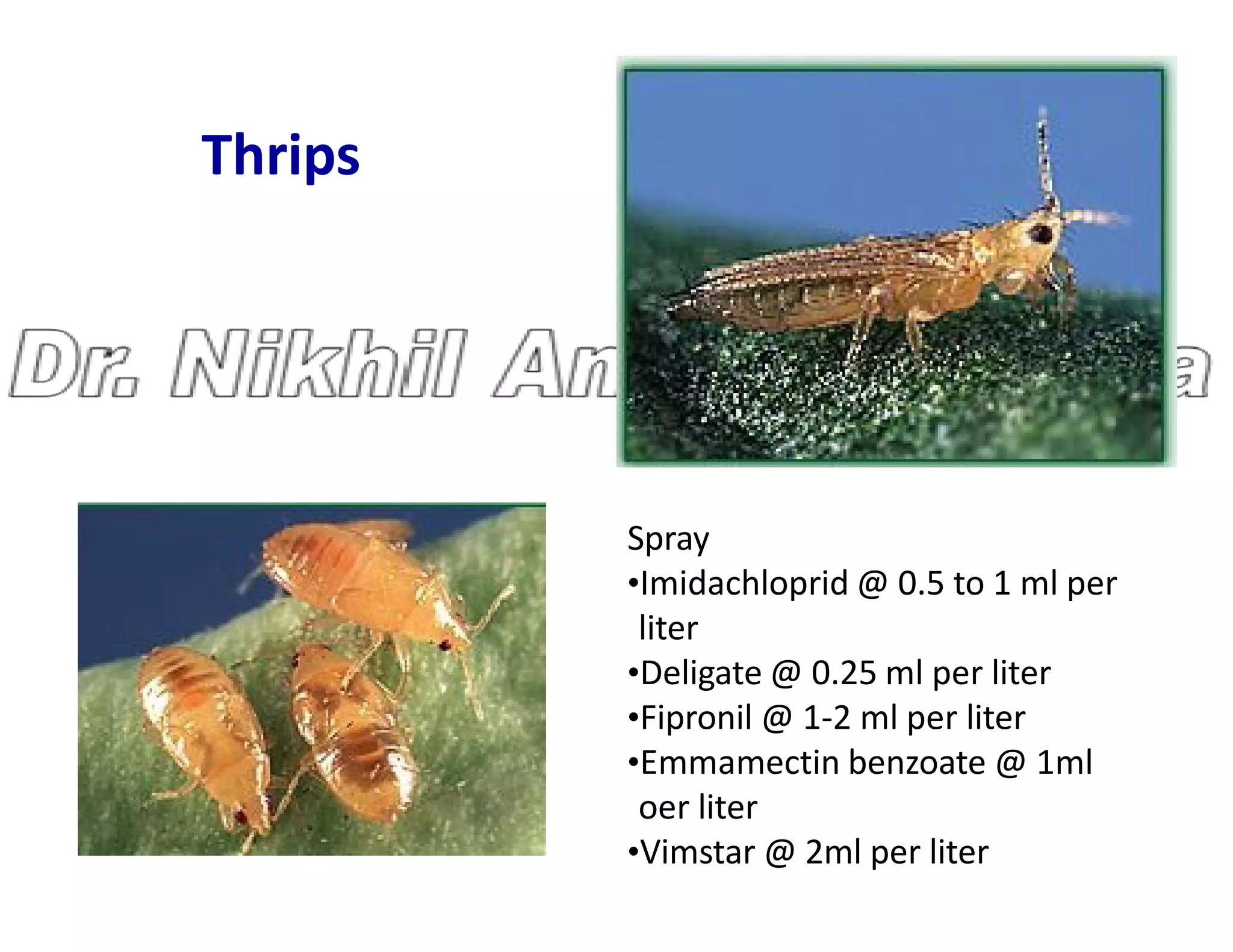
Thrips
Spray
•Imidachloprid @ 0.5 to 1 ml per
liter
•Deligate @ 0.25 ml per liter
•Fipronil @ 1-2 ml per liter
•Emmamectin benzoate @ 1ml
oer liter
•Vimstar @ 2ml per liter
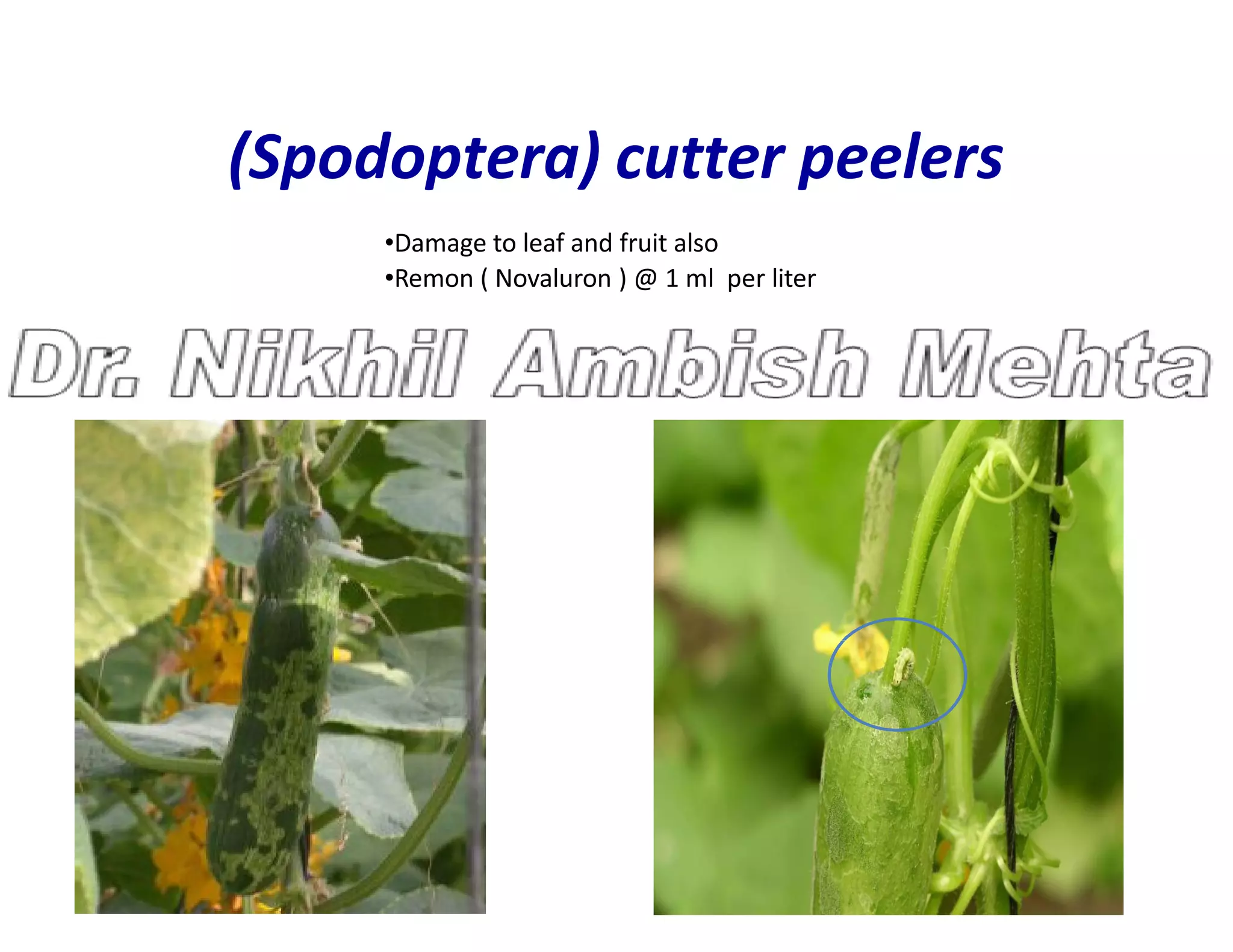
(Spodoptera) cutter peelers
•Damage to leaf and fruit also
•Remon ( Novaluron ) @ 1 ml per liter
Non Pathogenic Disorders
• High salinity
• Fruit Skin creaking (cold injury)
• Herbicides damage
• Herbicides damage
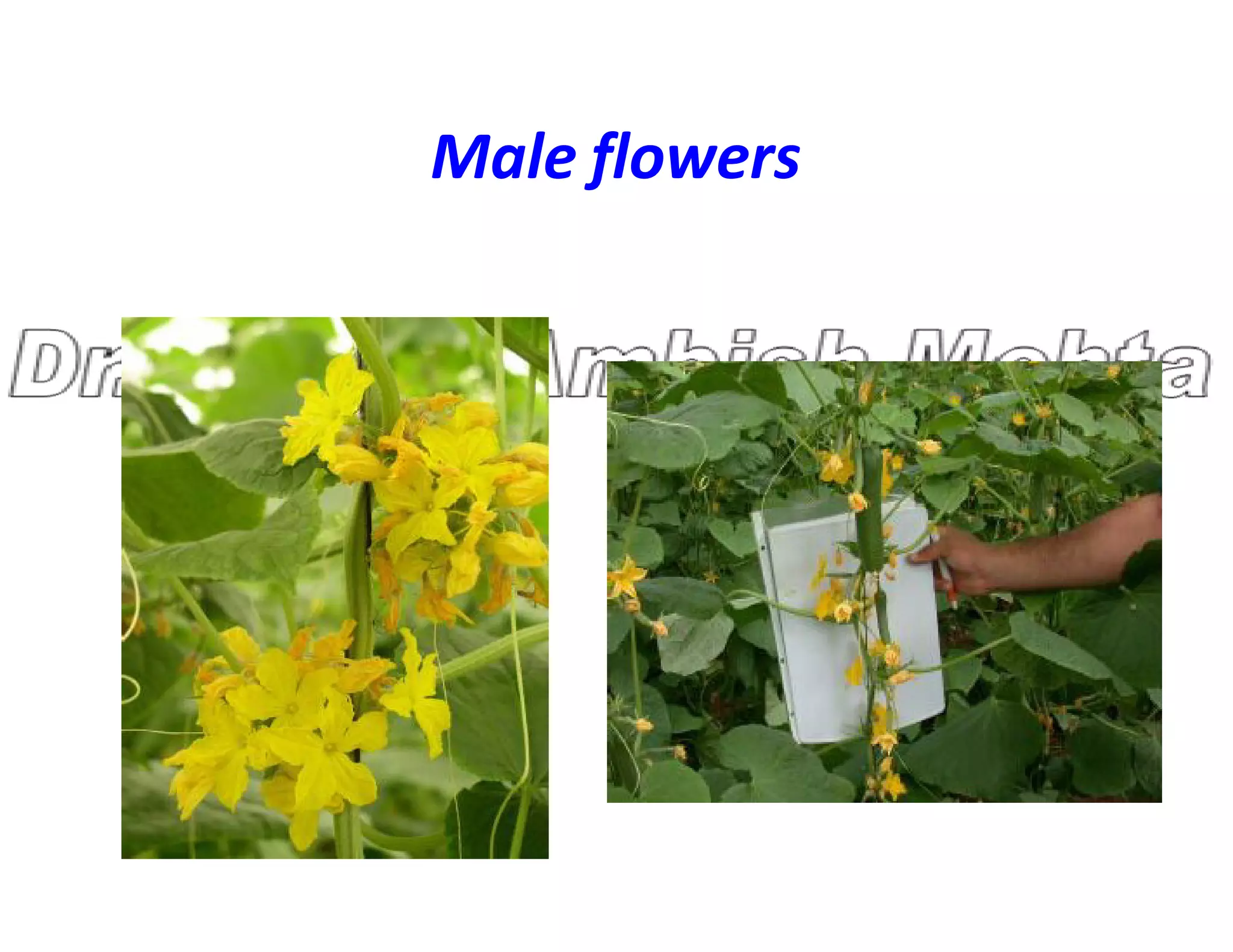
• Male flowers
• Misshaped fruits (temp. and Pollination)
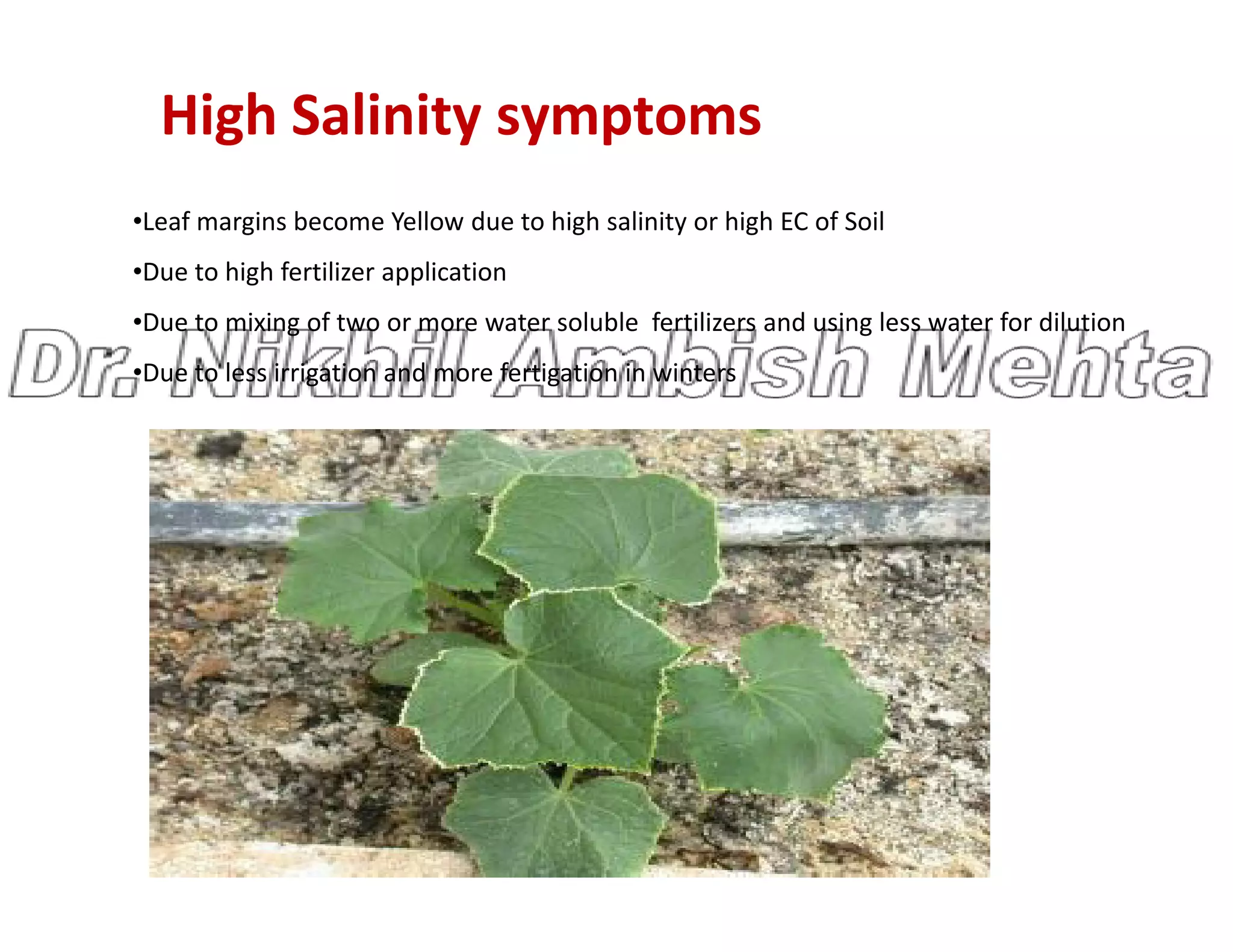
High Salinity symptoms
•Leaf margins become Yellow due to high salinity or high EC of Soil
•Due to high fertilizer application
•Due to mixing of two or more water soluble fertilizers and using less water for dilution
•Due to less irrigation and more fertigation in winters
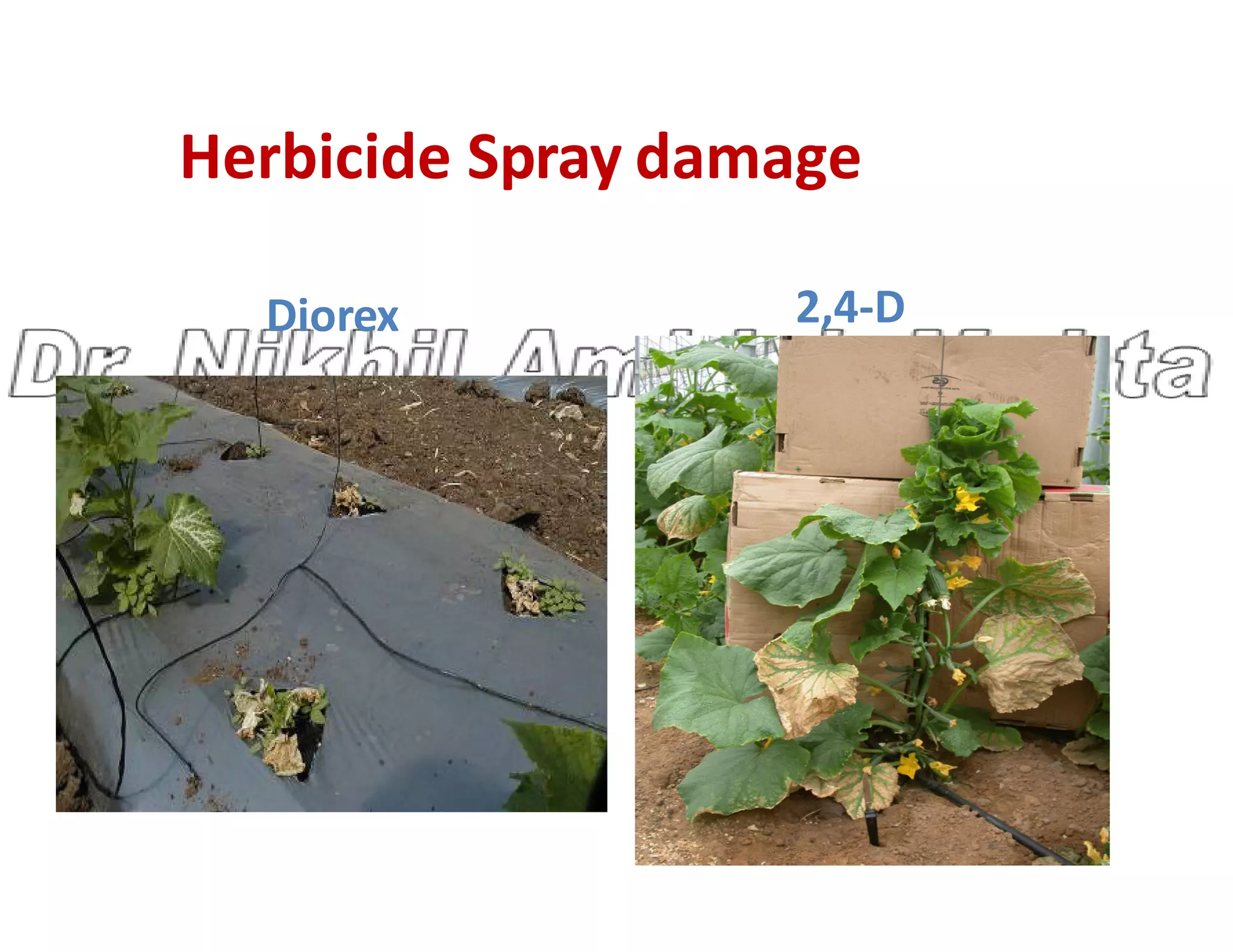
Herbicide Spray damage
Diorex 2,4-D
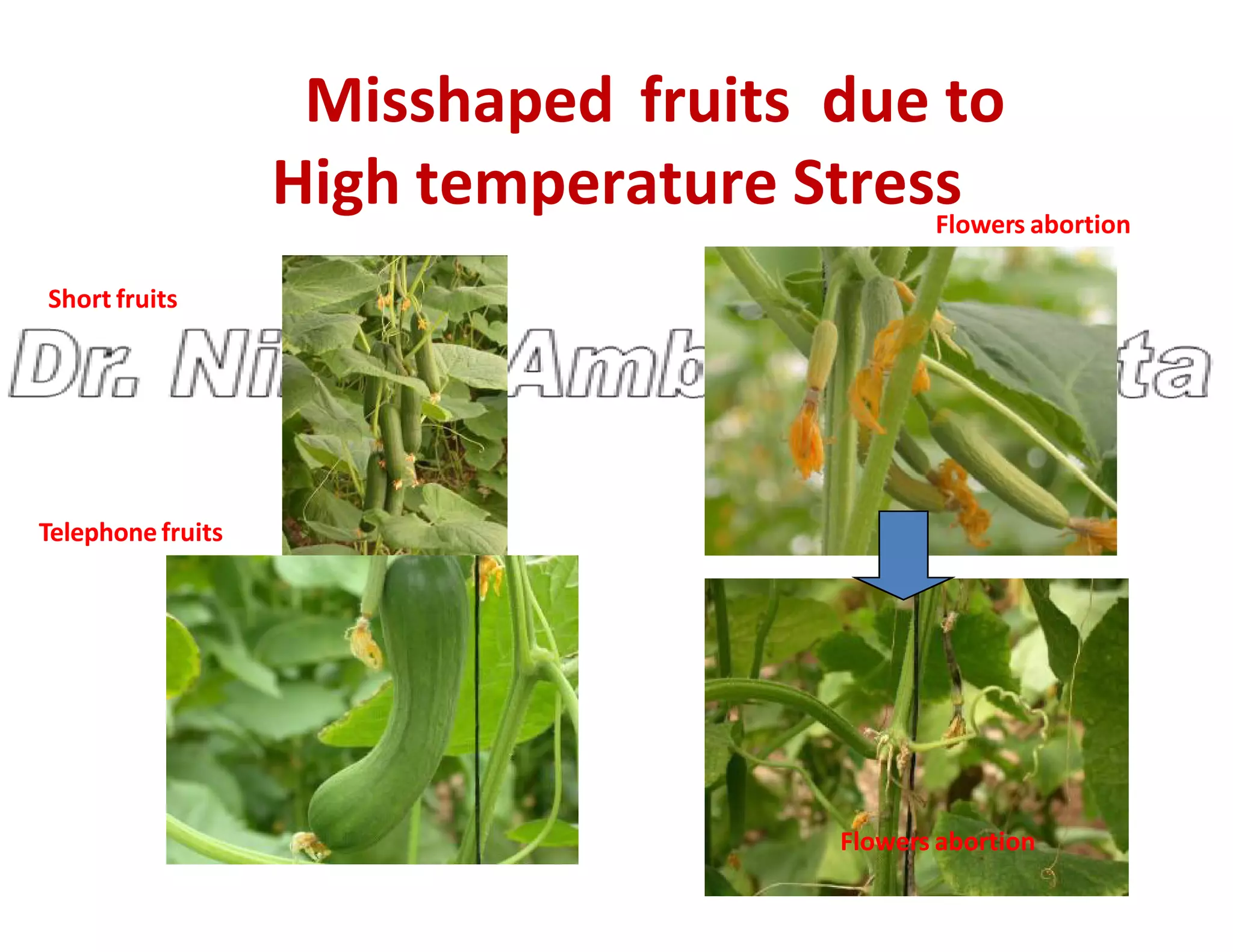
Misshaped fruits due to
High temperature Stress
Short fruits
Flowers abortion
Flowers abortion
Telephonefruits
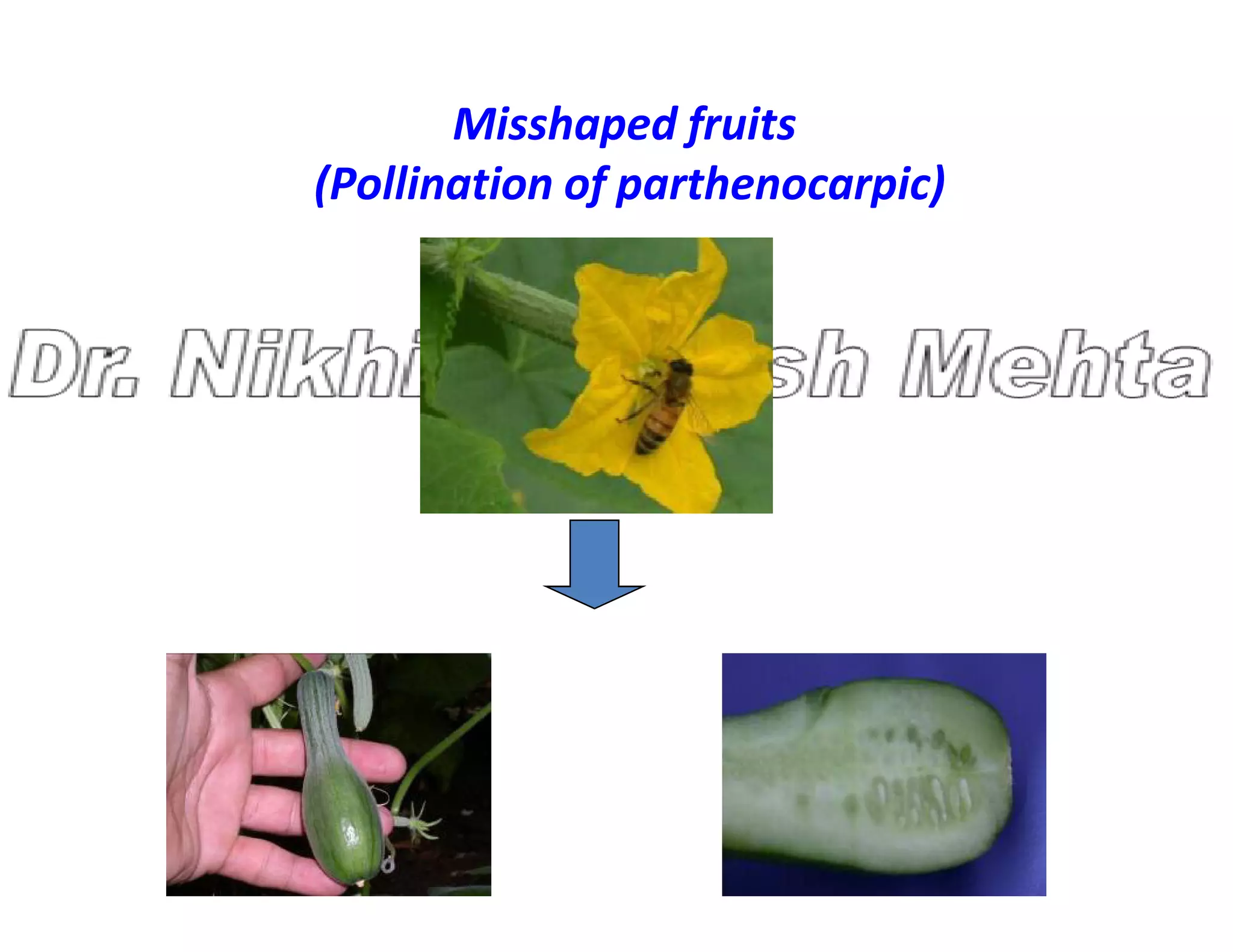
Misshaped fruits
(Pollination of parthenocarpic)
Male flowers
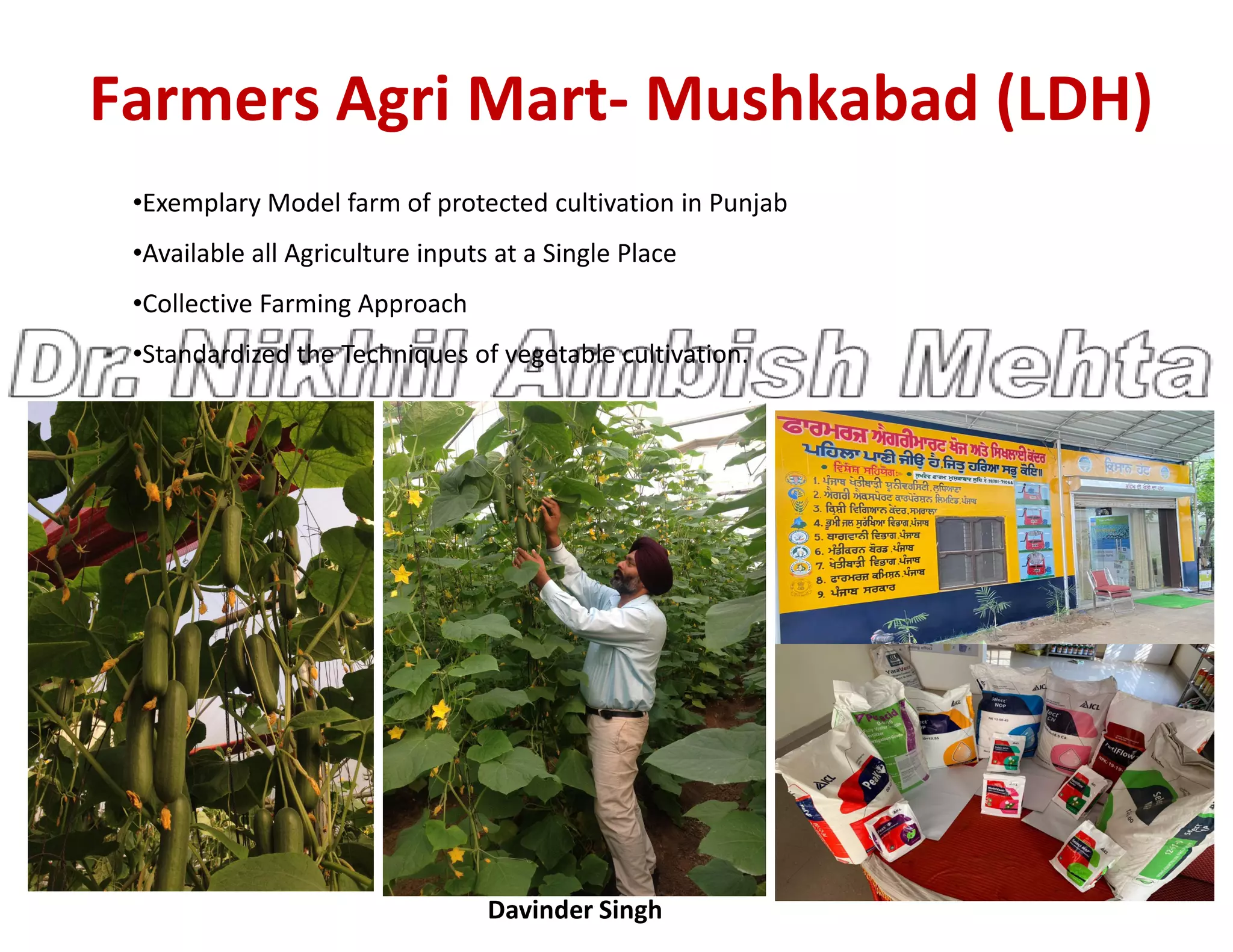
Farmers Agri Mart- Mushkabad (LDH)
•Exemplary Model farm of protected cultivation in Punjab
•Available all Agriculture inputs at a Single Place
•Collective Farming Approach
•Standardized the Techniques of vegetable cultivation.
Davinder Singh
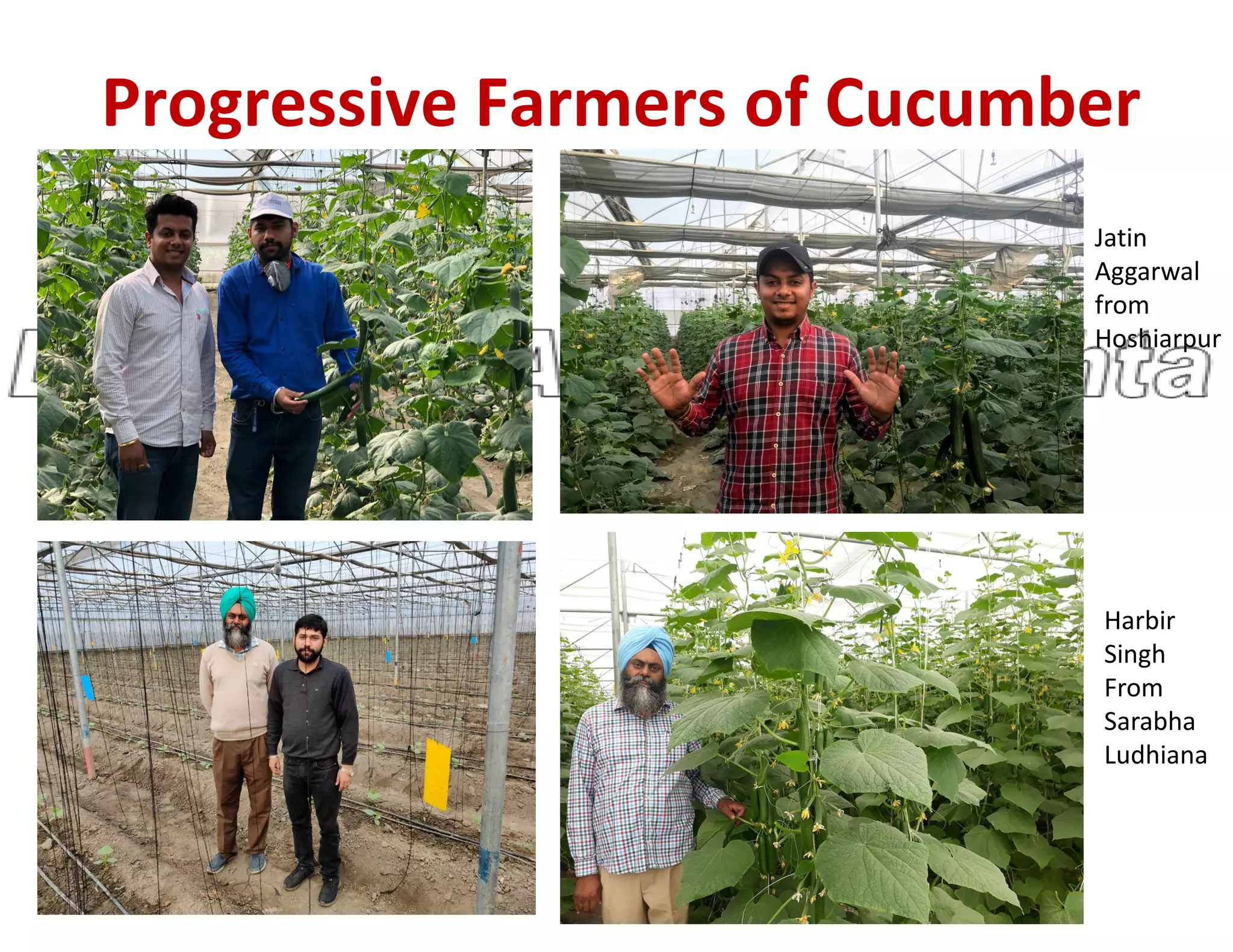
Progressive Farmers of Cucumber
Jatin
Aggarwal
from
Hoshiarpur
Harbir
Singh
From
Sarabha
Ludhiana
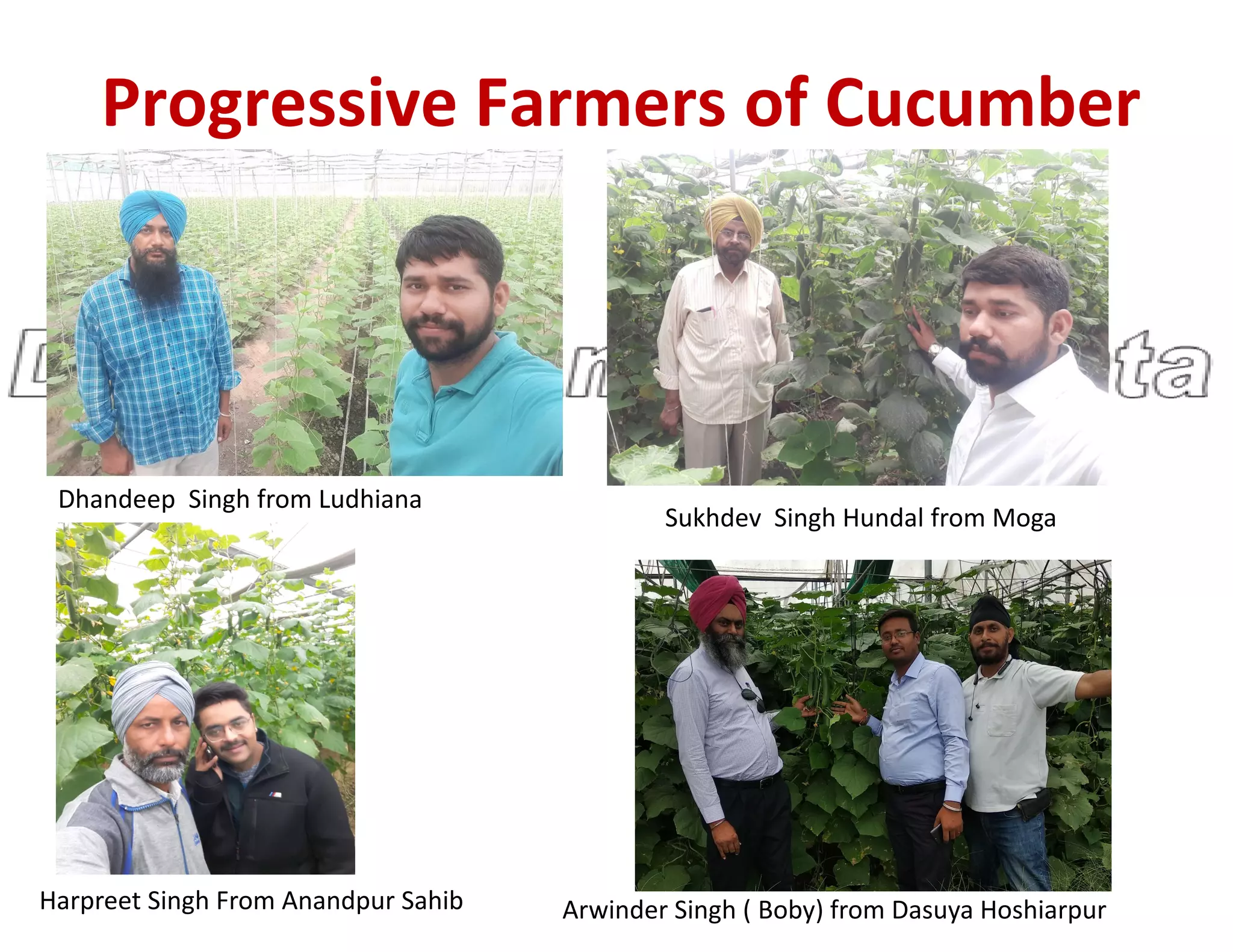
Progressive Farmers of Cucumber
Harpreet Singh From Anandpur Sahib Arwinder Singh ( Boby) from Dasuya Hoshiarpur
Dhandeep Singh from Ludhiana
Sukhdev Singh Hundal from Moga
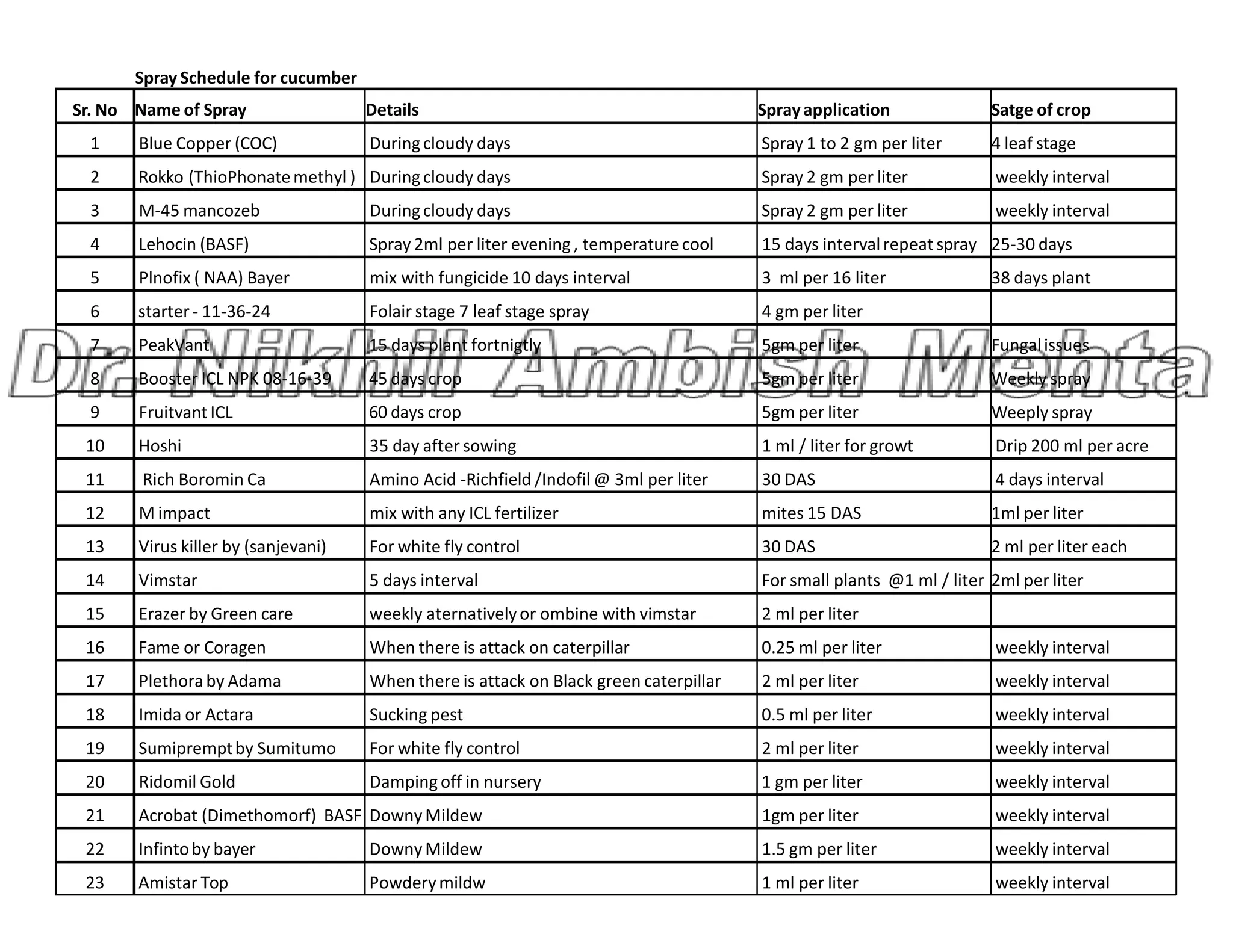
Spray Schedule for cucumber
Sr. No Name of Spray Details Sprayapplication Satge of crop
1 Blue Copper (COC) Duringcloudy days Spray 1 to 2 gm per liter 4 leaf stage
2 Rokko (ThioPhonatemethyl ) Duringcloudy days Spray 2 gm per liter weekly interval
3 M-45 mancozeb Duringcloudy days Spray 2 gm per liter weekly interval
4 Lehocin (BASF) Spray 2ml per liter evening, temperature cool 15 days intervalrepeat spray 25-30 days
5 Plnofix ( NAA) Bayer mix with fungicide 10 days interval 3 ml per 16 liter 38 days plant
6 starter - 11-36-24 Folair stage 7 leaf stage spray 4 gm per liter
7 PeakVant 15 days plant fortnigtly 5gm per liter Fungalissues
8 Booster ICL NPK 08-16-39 45 days crop 5gm per liter Weekly spray
9 Fruitvant ICL 60 days crop 5gm per liter Weeply spray
10 Hoshi 35 day after sowing 1 ml / liter for growt Drip 200 ml per acre
11 Rich Boromin Ca Amino Acid -Richfield /Indofil @ 3ml per liter 30 DAS 4 days interval
12 M impact mix with any ICL fertilizer mites 15 DAS 1ml per liter
13 Virus killer by (sanjevani) For white fly control 30 DAS 2 ml per liter each
14 Vimstar 5 days interval For small plants @1 ml / liter 2ml per liter
15 Erazer by Green care weekly aternativelyor ombine with vimstar 2 ml per liter
16 Fame or Coragen When there is attack on caterpillar 0.25 ml per liter weekly interval
17 Plethoraby Adama When there is attack on Black green caterpillar 2 ml per liter weekly interval
18 Imida or Actara Sucking pest 0.5 ml per liter weekly interval
19 Sumipremptby Sumitumo For white fly control 2 ml per liter weekly interval
20 Ridomil Gold Dampingoff in nursery 1 gm per liter weekly interval
21 Acrobat (Dimethomorf) BASF DownyMildew 1gm per liter weekly interval
22 Infintoby bayer DownyMildew 1.5 gm per liter weekly interval
23 Amistar Top Powderymildw 1 ml per liter weekly interval
Thank You
Dr. Nikhil Ambish Mehta
Research Officer /HDO
M-7508018998
Email : dr.nikhil.hdo@gmail.com

Cucumber Cultivation in Protected Farming

  • 1.
    Cucumber Production in Polyhouse Dr.Nikhil Ambish Mehta Research Officer /HDO
  • 2.
    Why protected cultivationis needed • Protection from insect-pest and diseases • Protection from adverse climate • High productivity • High quality and continuous availability • High quality and continuous availability • Off-season cultivation is possible • Minimum use of pesticides • More income per unit area • Best way for judicious use of natural resoucess
  • 3.
    Climate Requirement • Althoughmaximum growth occurs at a day and night temperature of about 28°C. • Maximum fruit production is achieved with a night temperature of 19-20°C and a day temperature of 20-22°C. temperature of 20-22°C. • The optimum daily average air temperature is 15- 24°C (65-75°F). • Optimum temperatures for growth are at night, about 18°C, and during the day, about 28°C accompanied by high light intensity.
  • 4.
    Planting Time Growing seasonof Cucumbers is relatively short, lasting 90- 120 days for greenhouse varieties. Summer Crop Season Feb sowing with seedling March sowing can be with Direct Seed sowing Winter Crop Season – August September up to December Winter Crop Season – August September up to December Direct Sowing is recommended genrally when temp is Above 15 C. Generally for polyhouse: Parthenocarpic cucumber i.e. they produce fruit without the need of pollination.
  • 5.
    Cucumber Hybrids forPolyhouse • 3 types of cucumbers based on flowering habit: 1. That produces only female flowers Gynoecious 2. The Gyno-monoecious which is predominantly produce female flowers with some male flowers 3. Monoecious: has both male and female flowers 3. Monoecious: has both male and female flowers • Popular hybrids:- February to March - Multistar, Emistar, Captainstar, Falconstar, Judson, Festa, 5232 May June – 2833 (Seminis) , Summer Crown (Hi-gen) September - Multistar, Falconstar, Judson, Feista October - Kingstar
  • 6.
    Duration of Crop •Double row sowing in summer crop and Single row sowing in winter crop recommended • For sandy Loam soil , two drip line recommended, For Clay soil single drip line can be use be use • Plant population 8000-10000 plants per acre. • Flowering at 30 days after sowing. • 45 days for getting first Harvest. • 100-120 days crop cycle.
  • 7.
    Cucumber nursery readyfor transplanting
  • 8.
    Cucumbers Cultivation process 1.Required conditions for the crop. 2. Soil preparation: Fertilizers, beds, Fumigation 3. Distances between plants 4. Vertical growth and pruning 5. Fertilization 5. Fertilization 6. Irrigation 7. Cultivation season & varieties 8. Plant protection: Up soil diseases, Soil born diseases , Insects, Viruses
  • 9.
  • 10.
    Soil Preparation • DeepPloughing of field • Add FYM- Manure @ 10 Trolly per acre • Add Chicken Manure @ 2 Trolly per acre • Add Bi0-Char or Wood Aish @ 4 Trolly Per acre • Add Bi0-Char or Wood Aish @ 4 Trolly Per acre • Add Vermicompost @ 2 MT per acre during bed preperation with Microbs Culture • Microbs like Trichoderma, Psedomonas, Paecilomysis , PSB, KSB , Azotobactor should be added @ 2 Liter per acre each before planting. • Soil should be moist make Soil Alive (Living Soil)
  • 11.
  • 12.
    Transplants quality 15-25 daysto prepare transplant in nursery (depend in temperature)
  • 13.
  • 14.
  • 15.
    Methods of density 1.Single rows (for winter crop and low greenhouses): • 130-150cm between rows • 40-50cm between plants in row • 40cm is recommended for low vigor varieties • The density is 1.7-1.8 plant/m2 • The density is 1.7-1.8 plant/m2 II. Double rows (for high well ventilated greenhouses): • 180-200cm center-center of beds • 50-60cm in between pair rows • 40-50cm between plants in row • Density is 2.4-2.6 plants/m2
  • 16.
    Vertical Support System Parthenocarpiccucumber crop under naturally ventilated greenhouse
  • 17.
    1st internode ofbranch 2nd internode of branch Main stem
  • 18.
    Branches and fruits Topplant branch Low section branch
  • 19.
    Skilled workers engagedin trellising operation in cucumber crop
  • 20.
    The rob andthe cable
  • 21.
  • 22.
    Parthenocarpic variety bearfruits in clusters Self driven trollies are required for training, prunning and picking of fruits
  • 23.
    Crop characteristic: parthenocarpic, gynoecious parthenocarpic,gynoecious varieties. Temperature: night - 18/220 C day - 25/300 C RH: 60-70 %
  • 24.
  • 26.
    Prunning of lowerleaf in Winters
  • 27.
    Fertilizer and WaterRequirement Cucumber needs continuous water supply depends on soil and climate In general, green house cucumbers are irrigated through drip system of irrigation and fertilizers are applied through water: Fertigation water: Fertigation In addition to NPK, calcium is also required for fruit quality and higher yields Calcium should always applied through soil, not spraying Boron Spray is require at the time of Flowering and Fruit Setting.
  • 28.
    EC & pHRequirements •Soil Testing and Water Testing is very important. •In soil testing, Check- EC, pH, Organic matter, Major and Micro nutrients. •Irrigation water should have EC <1 and pH should be 6.5 to 7.0 should be 6.5 to 7.0 •Fertigation water should have EC = 1.5 and pH should be 6.25. •Soil EC should be <0.8 and pH should be 5.5 to 7.5.
  • 29.
    Harvesting and Yield Fromtransplanting to first harvest: 35-40 days in gynoecious cultivars In Good managed crop: Febuary-March Crop Yield = 4-5 Kg/ per Plant August-Sept. Crop Yield =2-3 Kg/ per Plant August-Sept. Crop Yield =2-3 Kg/ per Plant May- June Crop Yield =2 Kg/ per Plant Gynoecious type cucumber Crop takes 3-4 month crop duration
  • 30.
    Nutrient Influence EachOther Antagonism: High levels of one specific element reduce the uptake of an other element In : K and Mg Synergism: High levels of one specific element increase the uptake of an other element K in relation to Fe + Mn
  • 32.
  • 33.
    Pests of Cucumbersin greenhouses 1. Soil Born Diseases: • Nematods spp • Fusarium, Pythium • Rhizoctonia 2. Foliage diseases: 2. Foliage diseases: • Powdery Mildew • Downy Mildew • Angular leaf spot (Lachrymans) • Botrytis • Sclerotinia
  • 34.
    Nematodes on roots •Morein Sandy Soils, More in Summer Crops, Mostly symptoms came at 50 days crop •Stunted growth and Root with nodules •Soil Solarization in May June •Crop Roation •Green Manuring •Green Manuring •Add FYM 10 Trolly per acre and 2 Trolley Chicken manure •Add 4 Qtl. Mustard Cake and 4Qtl Neem Cake •Add 4Qtl of Vermicompost during bed making with all the microbial culture. •Add Paecilomysis (BioNematone ), verticilium Chlamydosppora (Nematofree), Trichoderma viridis and Psedomonas @ 2 Liter per acre each
  • 35.
    Bio-Control in BasalApplication Sr.No Name of Technical product Brand Name Dosage 1 Trichoderma harzianum De-Tricho 2 Liter per acre 2 Pseudomonas fluorescens De-Pseudo 2 Liter per acre 3 Paecilomyces lilacinus DEPACK or BioNematone 2 Liter per acre 4 Verticilum Chlamidospora Nematofree+ 2 Kg per acre 5 Phosphorus Solublising Bacteria PSB = De-Phos 2 Liter per acre 5 Phosphorus Solublising Bacteria PSB = De-Phos 2 Liter per acre 6 Potash Solublising Bacteria KSB = De-Potash 2 Liter per acre 7 Vesicular-Arbuscular Mycorrhiza VAM = Rutoz 2 Liter per acre 8 Azotobacter (Nitro-Bacteria) DE-Nitro 2 Liter per acre 1. Mix the above Bio product with 200 kg Vermicopost and sprinkle water on it. 2. Cover the mixture with Gunny Bags for 2 Days 3. Above bio product can given through drenching with @ 5 ml per liter after one month interval 4. Liquid Formulations are better than powder formulation 5. Take Fresh Products use with in 3 to 6 months.
  • 36.
    Soil Solarization inMay June •To control Soil born Insect pest problem •Recommended in May June Summers •Soil temperatures raised to more than 50 degree C. •Using transparent polysheet 20 micron •Steam sterilization with soil solarization using •Steam sterilization with soil solarization using water with drip
  • 37.
    Process of Enrichmentof FYM 1 ton of Farm Yard Manure has to be enriched by mixing with 2 kg of each of Pseudomonas fluorescens + Trichoderma harzianum + Paecilomyces lilacinus / verticilum clymidospora (Nematofree+). It has to be covered with mulch and optimum moisture of 25 - 30% has to be maintained for a period of 15 days. Vermicompost can also be enriched with Microbs cultures.
  • 38.
    Velum Prime forNematode Control 1. Plants should be 5-6 leaf stage for application. 2. We can not apply before sowing and after sowing of seed. sowing of seed. 3. Soil should be moist and given water with velum Prime in root zone. 4. Dosage 500 ml per acre . i.e 0.5 ml per liter in drenching with at least 100 ml drenching per plant.
  • 39.
  • 40.
  • 41.
    2. Foliage diseasesin Cucumber • Powdery Mildew (Sphaerotheca fuligina) • Downy Mildew (Pseudopernospora cubensis) • Angular leaf spot (Pseudomonas Lachrymans) • Gray Mold (Botrytis cinerea) • Sclerotinia sclerotiorum • Sclerotinia sclerotiorum • Dedimela Gummy stem (Mycosphaerella melonsis)
  • 42.
  • 43.
  • 44.
  • 45.
  • 46.
  • 47.
  • 48.
    Disease management • Botrytis– M-45 and Roko @ 2 gm per liter • Sclerotinia – Nativo @ 1 gm per liter • Downy Mildew – Acrobat @1 gm + M-45@ 2gm per liter or Curzet- 2gm per liter or Curzet- Cymoxallin+mencozeb @ 2 gm per liter • Powder Mildew – Karathane @ 1 ml per liter • Angular Leaf Spot – Antracol @ 1 to 2 gm per liter
  • 49.
    Viruses in CucumberCrop 4. Viruses: CMV, CVYV, CYV,,CGMMV 1. Spray of Virus Killer By Sanjiwani or Virogoud @ 2ml per liter when there is start of virus attack attack 2. Remove the virus infected plant the spray Control vectors, white fly and aphids
  • 50.
    Cucumber Vein YellowingVirus CVYV Transmitted by Bemisia Tabaci- (Persistent)
  • 51.
    Cucumber Yellowing Virus CYV Transmittedby White Fly Bemisia Tabaci- (Semi-Persistent)
  • 52.
    Major Insects: 1. Redmites, 2. Thrips, 3. White Fly (Bemisia Tabaci) Pests of Cucumbers in greenhouses 3. White Fly (Bemisia Tabaci) 4. Leaf miner, 5. Tobbaco Caterpillar : Spodoptera
  • 53.
    Red mites Attack Management: •Maintain Humidity 50-60% Wetting of soil or Hozzing Spray Ethion @ 2 ml per Liter •Spray Oberon @ 0.5 to 1 ml per Liter •M-Impact @ 1m l per liter •Dev-Mite @ 1ml per liter •Dev-Mite @ 1ml per liter
  • 54.
    White Fly Bemisia Tabaci •Hostathione(Trizophos) @ 1ml per liter •Lano (pyroproxifen ) @ 2ml per liter •Pegasus (Difenthron) @0.5 gm per liter • Ulalla by UPL @ 1.5 ml per liter • Erazer by Green care @2ml per liter
  • 55.
    Leaf miner •HMO @2ml per liter •Imidachloprid @ 0.5 to 1 ml per liter •Perfenophos @ 2ml per liter • Tracer/Deligate@ 0.25 ml per liter
  • 56.
    Thrips Spray •Imidachloprid @ 0.5to 1 ml per liter •Deligate @ 0.25 ml per liter •Fipronil @ 1-2 ml per liter •Emmamectin benzoate @ 1ml oer liter •Vimstar @ 2ml per liter
  • 57.
    (Spodoptera) cutter peelers •Damageto leaf and fruit also •Remon ( Novaluron ) @ 1 ml per liter
  • 58.
    Non Pathogenic Disorders •High salinity • Fruit Skin creaking (cold injury) • Herbicides damage • Herbicides damage • Male flowers • Misshaped fruits (temp. and Pollination)
  • 59.
    High Salinity symptoms •Leafmargins become Yellow due to high salinity or high EC of Soil •Due to high fertilizer application •Due to mixing of two or more water soluble fertilizers and using less water for dilution •Due to less irrigation and more fertigation in winters
  • 60.
  • 61.
    Misshaped fruits dueto High temperature Stress Short fruits Flowers abortion Flowers abortion Telephonefruits
  • 62.
  • 63.
  • 64.
    Farmers Agri Mart-Mushkabad (LDH) •Exemplary Model farm of protected cultivation in Punjab •Available all Agriculture inputs at a Single Place •Collective Farming Approach •Standardized the Techniques of vegetable cultivation. Davinder Singh
  • 65.
    Progressive Farmers ofCucumber Jatin Aggarwal from Hoshiarpur Harbir Singh From Sarabha Ludhiana
  • 66.
    Progressive Farmers ofCucumber Harpreet Singh From Anandpur Sahib Arwinder Singh ( Boby) from Dasuya Hoshiarpur Dhandeep Singh from Ludhiana Sukhdev Singh Hundal from Moga
  • 67.
    Spray Schedule forcucumber Sr. No Name of Spray Details Sprayapplication Satge of crop 1 Blue Copper (COC) Duringcloudy days Spray 1 to 2 gm per liter 4 leaf stage 2 Rokko (ThioPhonatemethyl ) Duringcloudy days Spray 2 gm per liter weekly interval 3 M-45 mancozeb Duringcloudy days Spray 2 gm per liter weekly interval 4 Lehocin (BASF) Spray 2ml per liter evening, temperature cool 15 days intervalrepeat spray 25-30 days 5 Plnofix ( NAA) Bayer mix with fungicide 10 days interval 3 ml per 16 liter 38 days plant 6 starter - 11-36-24 Folair stage 7 leaf stage spray 4 gm per liter 7 PeakVant 15 days plant fortnigtly 5gm per liter Fungalissues 8 Booster ICL NPK 08-16-39 45 days crop 5gm per liter Weekly spray 9 Fruitvant ICL 60 days crop 5gm per liter Weeply spray 10 Hoshi 35 day after sowing 1 ml / liter for growt Drip 200 ml per acre 11 Rich Boromin Ca Amino Acid -Richfield /Indofil @ 3ml per liter 30 DAS 4 days interval 11 Rich Boromin Ca Amino Acid -Richfield /Indofil @ 3ml per liter 30 DAS 4 days interval 12 M impact mix with any ICL fertilizer mites 15 DAS 1ml per liter 13 Virus killer by (sanjevani) For white fly control 30 DAS 2 ml per liter each 14 Vimstar 5 days interval For small plants @1 ml / liter 2ml per liter 15 Erazer by Green care weekly aternativelyor ombine with vimstar 2 ml per liter 16 Fame or Coragen When there is attack on caterpillar 0.25 ml per liter weekly interval 17 Plethoraby Adama When there is attack on Black green caterpillar 2 ml per liter weekly interval 18 Imida or Actara Sucking pest 0.5 ml per liter weekly interval 19 Sumipremptby Sumitumo For white fly control 2 ml per liter weekly interval 20 Ridomil Gold Dampingoff in nursery 1 gm per liter weekly interval 21 Acrobat (Dimethomorf) BASF DownyMildew 1gm per liter weekly interval 22 Infintoby bayer DownyMildew 1.5 gm per liter weekly interval 23 Amistar Top Powderymildw 1 ml per liter weekly interval
  • 68.
    Thank You Dr. NikhilAmbish Mehta Research Officer /HDO M-7508018998 Email : dr.nikhil.hdo@gmail.com