POLYHOUSE
TECHNOLOGY
Prepared by –
Ranajeet Shanbhag,
Vigyan ashram ,Pabal ,Pune
• The fruits and vegetables are missing in the diet of poor marginal Indian
because of their overall shortage
Majority of farmers are not ready to shift their crop land to fruits and vegetable
cultivation, hence under such condition poly houses can be the only answer for
this.
 We need promotion of fruits and vegetables cultivation for financial support
to the farmers and total food security to all
The poly house technologies are advanced in Israel, Holland, Spain, Italy, Kenya,
South Africa, Japan and China. But unfortunately much neglected in India.
India and Holland having more or less same land under flower cultivation but in
world’s flower export, Holland’s contribution is 70% and India’s contribution is
just 1% or even less because of advanced technology of poly houses in Holland.
2
WHY POLYHOUSE TECHNOLOGY ?WHY POLYHOUSE TECHNOLOGY ?
Growth and healthy production of plants under controlled
favorable conditions in closed or partially closed space is called
polyhouse.
Polyhouse concept emerged to undertake adverse
environmental conditions such as excess of raining, high
temperature, extreme cold condition, air flow etc.
3
Principle of the PolyhousePrinciple of the Polyhouse
Advantages of polyhouse
1. Protection from excess rainfall, wind current, scorching sunlight and
extreme cold conditions.
2. It can be erected on unproductive soil
3. Under minimum space one can have maximum production of crop plants
4. Humidity is maintained
5. Efficient use of CO2
6. Minimum labor requirement
7. Minimum use of water and fertilizers
8. Maximum use of space
9. A single person can have control over thousands of plants
10. Diseases and pests can be controlled easily
11. Water can be used economically
12. Production of crop throughout the year
13. Protection from birds, animals and human activities
14. Labor cost is reduced
15. Quality of product is best
4
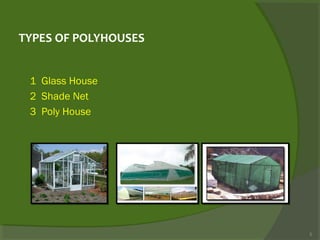
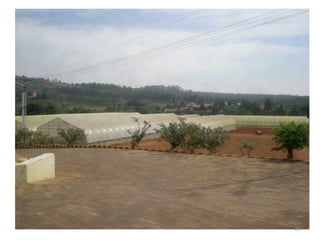
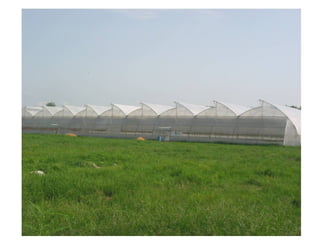
TYPES OF POLYHOUSES
1 Glass House
2 Shade Net
3 Poly House
5
6
CONDITIONS MAINTAINED IN POLYHOUSE
There are five different types of environmental parameters
maintained in a polyhouse.
• CO2
• Temperature
• Light
• Humidity
• Air Flow
7
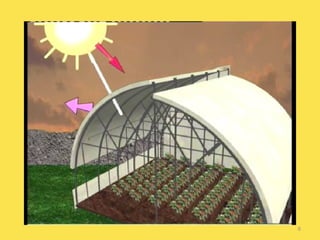
Light is a most critical factor for poly house. The brightness
of light is measured in LUX. For healthy growth of crop in
poly house, minimum requirement of LUX is 50,000 to
60,000. In India, light LUX varies from 40,000 to 1,40, 000
hence in many parts of our country such as Maharashtra,
Karnataka, M.P. the sunlight is bright and has to be
reduced by using shed net. We can reduce sunlight 30%,
50%, 75%. The 50% shed net are common in India.

8
Along with the LUX, the wavelength of light is also
important. On the basis of wavelength, Light is classified
into three types Ultra violate light wavelength 0-400nm,
Visible light wavelength 400-700nm, Infra light wavelength
700 onwards.
From these three types, plants use only visible light for
photosynthesis. In polyhouse technology light is controlled
in such a way that plant receive maximum visible light and
remaining light get reflected back i.e. outside the polyhouse
9
TEMPRATURE
For flowers and vegetables healthy and maximum
growth, the temp requirement is between 26’C to 30’C
during day time and 15’C to 18’C in night. The stele
frame work of poly house is covered by polythene
hence inner temp. can rise up to 40’C. To control the
temp inside the poly house, the ventilation as well as
cooling pads and fans are used. Because of this we can
have continuous quality production of herbs
throughout the year.
10
HUMIDITY
For flowers and vegetables, and their healthy and maximum
growth, we should have proper humidity. Requirement of
humidity for flower production is 65% to 80% and for
vegetables it is 60% to 65%
Because of controlled humidity plant growth remain
continue, flower grow with attractive colors and after
cutting, their shelf life also increases. Humidity helps in color
combination of herbs, vegetable and flowers.
11
 In our surrounding atmosphere CO2 conc. is 0.03% means
300ppm. Plants use this CO2 for photosynthesis. In poly house,
during night time there is no photosynthesis but CO2 is given
out by respiration. This CO2 remain accumulated around plants
hence in night compare to outside, polyhouse always have more
CO2 conc.
This CO2 is again used by plants growing in poly house for rapid
photosynthesis.
It has been proved that if poly house having 1000ppm of CO2,
then herbs, vegetables and flower production increases to 4 to
5 times more compare to normal conditions.
12
CARBON DI OXIDE
If humidity is more in polyhouse, then chances of diseases
and pest increases. Under such condition, side vents of
polyhouse are opened to promote wind movement in
polyhouse. Because of wind movement the humidity
decreases and chances of diseases also reduced.
13
WIND MOVEMENT
TYPES OF POLYHOUSES
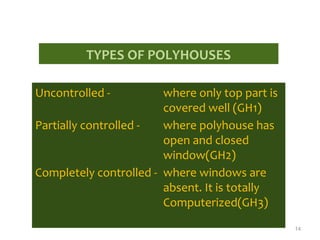
Uncontrolled - where only top part is
covered well (GH1)
Partially controlled - where polyhouse has
open and closed
window(GH2)
Completely controlled - where windows are
absent. It is totally
Computerized(GH3)
14
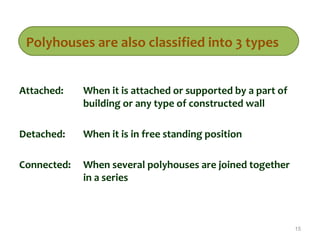
Attached: When it is attached or supported by a part of
building or any type of constructed wall
Detached: When it is in free standing position
Connected: When several polyhouses are joined together
in a series
15
Polyhouses are also classified into 3 types
16
TYPES OF POLYHOUSES
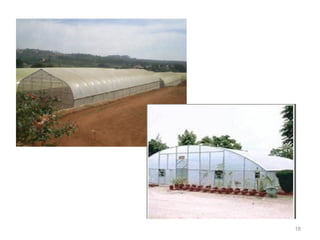
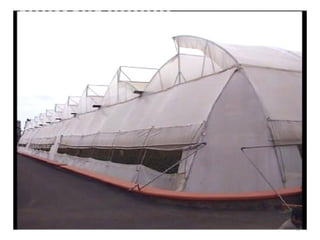
Polyhouses have different shape and sizes and on this basis
they are classified in to three types –
• Barrel shaped
• Ridges and furrow type
• Saw tooth type
Shape and size varies according to the climatic conditions of
the
region/Country
17
18
19
20
21
Selection of site for polyhouse
Following things are taken into account
1 The selection Site should be free from pollution.
2 Water should be available regularly
3 Supply of electricity (Three phase ) should be regular
4 Soil should be properly leveled and drained
5 Poly house should be near to road side means proper approachable road must be
there to go to poly house
6 Some space should be there nearby for further extension
7 Expertise and labors should be available when required.
Direction of Polyhouse
Poly house should have light from all sides and wind current should not damage the
polyhouse.
To overcome these problems, Poly house should be preferably South-North in direction.22
Other Essential things
1. Should have cool chamber (0’C) to accumulate
and store the final product.
2. Water pH should be between 5.5 to 7 & electric
conductivity of water should be 0.01 to 0.1
3. PH of soil should be between 5.5 to 6.5 and
electric conductivity 0.6 to 0.8.
24
 
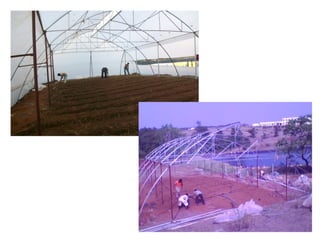
• After construction of poly houses, it is covered by
semitransparent sheet which can be a poly film, Acrylic,
polythene, or polycarbonate material. Use of poly film
is more profitable.
• Poly film protect UV rays to enter in poly house,
transparency is between 80% to 9o%. Gauge varies 200 to
800 micron. Poly film can tolerate 50’C and its life span is
about three years. 1 kg poly film covers 5.38 sq m area of
a poly house.
25
Material used for shading
Preparation of soil
For poly house, soil has to be prepared under strict
supervision. First the floor is leveled properly and
then raise beds are prepared using red soil, fine
sand and well decomposed cow dung or coco-pit.
soil is disinfected using formalin solution and then
used for growing the crops. Crops can be grown
directly on the beds or in pots.
26
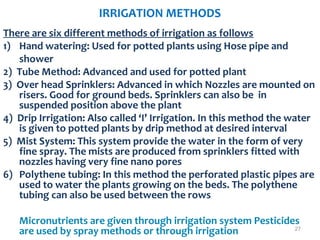
IRRIGATION METHODS
There are six different methods of irrigation as follows
1) Hand watering: Used for potted plants using Hose pipe and
shower
2) Tube Method: Advanced and used for potted plant
3) Over head Sprinklers: Advanced in which Nozzles are mounted on
risers. Good for ground beds. Sprinklers can also be in
suspended position above the plant
4) Drip Irrigation: Also called ‘I’ Irrigation. In this method the water
is given to potted plants by drip method at desired interval
5) Mist System: This system provide the water in the form of very
fine spray. The mists are produced from sprinklers fitted with
nozzles having very fine nano pores
6) Polythene tubing: In this method the perforated plastic pipes are
used to water the plants growing on the beds. The polythene
tubing can also be used between the rows
Micronutrients are given through irrigation system Pesticides
are used by spray methods or through irrigation 27
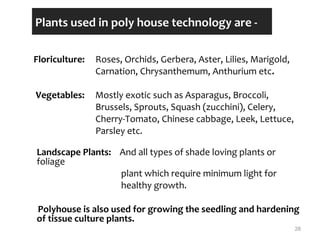
Plants used in poly house technology are -
Floriculture: Roses, Orchids, Gerbera, Aster, Lilies, Marigold,
Carnation, Chrysanthemum, Anthurium etc.
Vegetables: Mostly exotic such as Asparagus, Broccoli,
Brussels, Sprouts, Squash (zucchini), Celery,
Cherry-Tomato, Chinese cabbage, Leek, Lettuce,
Parsley etc.
Landscape Plants: And all types of shade loving plants or
foliage
plant which require minimum light for
healthy growth.
Polyhouse is also used for growing the seedling and hardening
of tissue culture plants.
28
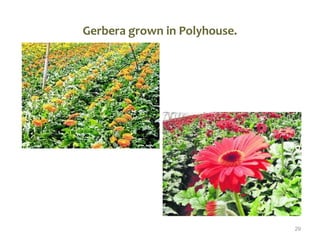
Gerbera grown in Polyhouse.
29
Vigyan Ashram
Pabal, Dist. Pune - 412403
MAHARASHTRA, 
INDIA.
Phone No. : 02138 292326
e-mail : vapabal@gmail.com
30
For more information contact :

Polyhouse technology

  • 1.
    POLYHOUSE TECHNOLOGY Prepared by – RanajeetShanbhag, Vigyan ashram ,Pabal ,Pune
  • 2.
    • The fruitsand vegetables are missing in the diet of poor marginal Indian because of their overall shortage Majority of farmers are not ready to shift their crop land to fruits and vegetable cultivation, hence under such condition poly houses can be the only answer for this.  We need promotion of fruits and vegetables cultivation for financial support to the farmers and total food security to all The poly house technologies are advanced in Israel, Holland, Spain, Italy, Kenya, South Africa, Japan and China. But unfortunately much neglected in India. India and Holland having more or less same land under flower cultivation but in world’s flower export, Holland’s contribution is 70% and India’s contribution is just 1% or even less because of advanced technology of poly houses in Holland. 2 WHY POLYHOUSE TECHNOLOGY ?WHY POLYHOUSE TECHNOLOGY ?
  • 3.
    Growth and healthyproduction of plants under controlled favorable conditions in closed or partially closed space is called polyhouse. Polyhouse concept emerged to undertake adverse environmental conditions such as excess of raining, high temperature, extreme cold condition, air flow etc. 3 Principle of the PolyhousePrinciple of the Polyhouse
  • 4.
    Advantages of polyhouse 1.Protection from excess rainfall, wind current, scorching sunlight and extreme cold conditions. 2. It can be erected on unproductive soil 3. Under minimum space one can have maximum production of crop plants 4. Humidity is maintained 5. Efficient use of CO2 6. Minimum labor requirement 7. Minimum use of water and fertilizers 8. Maximum use of space 9. A single person can have control over thousands of plants 10. Diseases and pests can be controlled easily 11. Water can be used economically 12. Production of crop throughout the year 13. Protection from birds, animals and human activities 14. Labor cost is reduced 15. Quality of product is best 4
  • 5.
    TYPES OF POLYHOUSES 1Glass House 2 Shade Net 3 Poly House 5
  • 6.
  • 7.
    CONDITIONS MAINTAINED INPOLYHOUSE There are five different types of environmental parameters maintained in a polyhouse. • CO2 • Temperature • Light • Humidity • Air Flow 7
  • 8.
    Light is amost critical factor for poly house. The brightness of light is measured in LUX. For healthy growth of crop in poly house, minimum requirement of LUX is 50,000 to 60,000. In India, light LUX varies from 40,000 to 1,40, 000 hence in many parts of our country such as Maharashtra, Karnataka, M.P. the sunlight is bright and has to be reduced by using shed net. We can reduce sunlight 30%, 50%, 75%. The 50% shed net are common in India. 8
  • 9.
    Along with theLUX, the wavelength of light is also important. On the basis of wavelength, Light is classified into three types Ultra violate light wavelength 0-400nm, Visible light wavelength 400-700nm, Infra light wavelength 700 onwards. From these three types, plants use only visible light for photosynthesis. In polyhouse technology light is controlled in such a way that plant receive maximum visible light and remaining light get reflected back i.e. outside the polyhouse 9
  • 10.
    TEMPRATURE For flowers andvegetables healthy and maximum growth, the temp requirement is between 26’C to 30’C during day time and 15’C to 18’C in night. The stele frame work of poly house is covered by polythene hence inner temp. can rise up to 40’C. To control the temp inside the poly house, the ventilation as well as cooling pads and fans are used. Because of this we can have continuous quality production of herbs throughout the year. 10
  • 11.
    HUMIDITY For flowers andvegetables, and their healthy and maximum growth, we should have proper humidity. Requirement of humidity for flower production is 65% to 80% and for vegetables it is 60% to 65% Because of controlled humidity plant growth remain continue, flower grow with attractive colors and after cutting, their shelf life also increases. Humidity helps in color combination of herbs, vegetable and flowers. 11
  • 12.
     In our surroundingatmosphere CO2 conc. is 0.03% means 300ppm. Plants use this CO2 for photosynthesis. In poly house, during night time there is no photosynthesis but CO2 is given out by respiration. This CO2 remain accumulated around plants hence in night compare to outside, polyhouse always have more CO2 conc. This CO2 is again used by plants growing in poly house for rapid photosynthesis. It has been proved that if poly house having 1000ppm of CO2, then herbs, vegetables and flower production increases to 4 to 5 times more compare to normal conditions. 12 CARBON DI OXIDE
  • 13.
    If humidity ismore in polyhouse, then chances of diseases and pest increases. Under such condition, side vents of polyhouse are opened to promote wind movement in polyhouse. Because of wind movement the humidity decreases and chances of diseases also reduced. 13 WIND MOVEMENT
  • 14.
    TYPES OF POLYHOUSES Uncontrolled- where only top part is covered well (GH1) Partially controlled - where polyhouse has open and closed window(GH2) Completely controlled - where windows are absent. It is totally Computerized(GH3) 14
  • 15.
    Attached: When itis attached or supported by a part of building or any type of constructed wall Detached: When it is in free standing position Connected: When several polyhouses are joined together in a series 15 Polyhouses are also classified into 3 types
  • 16.
  • 17.
    TYPES OF POLYHOUSES Polyhouseshave different shape and sizes and on this basis they are classified in to three types – • Barrel shaped • Ridges and furrow type • Saw tooth type Shape and size varies according to the climatic conditions of the region/Country 17
  • 18.
  • 19.
  • 20.
  • 21.
  • 22.
    Selection of sitefor polyhouse Following things are taken into account 1 The selection Site should be free from pollution. 2 Water should be available regularly 3 Supply of electricity (Three phase ) should be regular 4 Soil should be properly leveled and drained 5 Poly house should be near to road side means proper approachable road must be there to go to poly house 6 Some space should be there nearby for further extension 7 Expertise and labors should be available when required. Direction of Polyhouse Poly house should have light from all sides and wind current should not damage the polyhouse. To overcome these problems, Poly house should be preferably South-North in direction.22
  • 24.
    Other Essential things 1.Should have cool chamber (0’C) to accumulate and store the final product. 2. Water pH should be between 5.5 to 7 & electric conductivity of water should be 0.01 to 0.1 3. PH of soil should be between 5.5 to 6.5 and electric conductivity 0.6 to 0.8. 24
  • 25.
      • After constructionof poly houses, it is covered by semitransparent sheet which can be a poly film, Acrylic, polythene, or polycarbonate material. Use of poly film is more profitable. • Poly film protect UV rays to enter in poly house, transparency is between 80% to 9o%. Gauge varies 200 to 800 micron. Poly film can tolerate 50’C and its life span is about three years. 1 kg poly film covers 5.38 sq m area of a poly house. 25 Material used for shading
  • 26.
    Preparation of soil Forpoly house, soil has to be prepared under strict supervision. First the floor is leveled properly and then raise beds are prepared using red soil, fine sand and well decomposed cow dung or coco-pit. soil is disinfected using formalin solution and then used for growing the crops. Crops can be grown directly on the beds or in pots. 26
  • 27.
    IRRIGATION METHODS There aresix different methods of irrigation as follows 1) Hand watering: Used for potted plants using Hose pipe and shower 2) Tube Method: Advanced and used for potted plant 3) Over head Sprinklers: Advanced in which Nozzles are mounted on risers. Good for ground beds. Sprinklers can also be in suspended position above the plant 4) Drip Irrigation: Also called ‘I’ Irrigation. In this method the water is given to potted plants by drip method at desired interval 5) Mist System: This system provide the water in the form of very fine spray. The mists are produced from sprinklers fitted with nozzles having very fine nano pores 6) Polythene tubing: In this method the perforated plastic pipes are used to water the plants growing on the beds. The polythene tubing can also be used between the rows Micronutrients are given through irrigation system Pesticides are used by spray methods or through irrigation 27
  • 28.
    Plants used inpoly house technology are - Floriculture: Roses, Orchids, Gerbera, Aster, Lilies, Marigold, Carnation, Chrysanthemum, Anthurium etc. Vegetables: Mostly exotic such as Asparagus, Broccoli, Brussels, Sprouts, Squash (zucchini), Celery, Cherry-Tomato, Chinese cabbage, Leek, Lettuce, Parsley etc. Landscape Plants: And all types of shade loving plants or foliage plant which require minimum light for healthy growth. Polyhouse is also used for growing the seedling and hardening of tissue culture plants. 28
  • 29.
    Gerbera grown inPolyhouse. 29
  • 30.