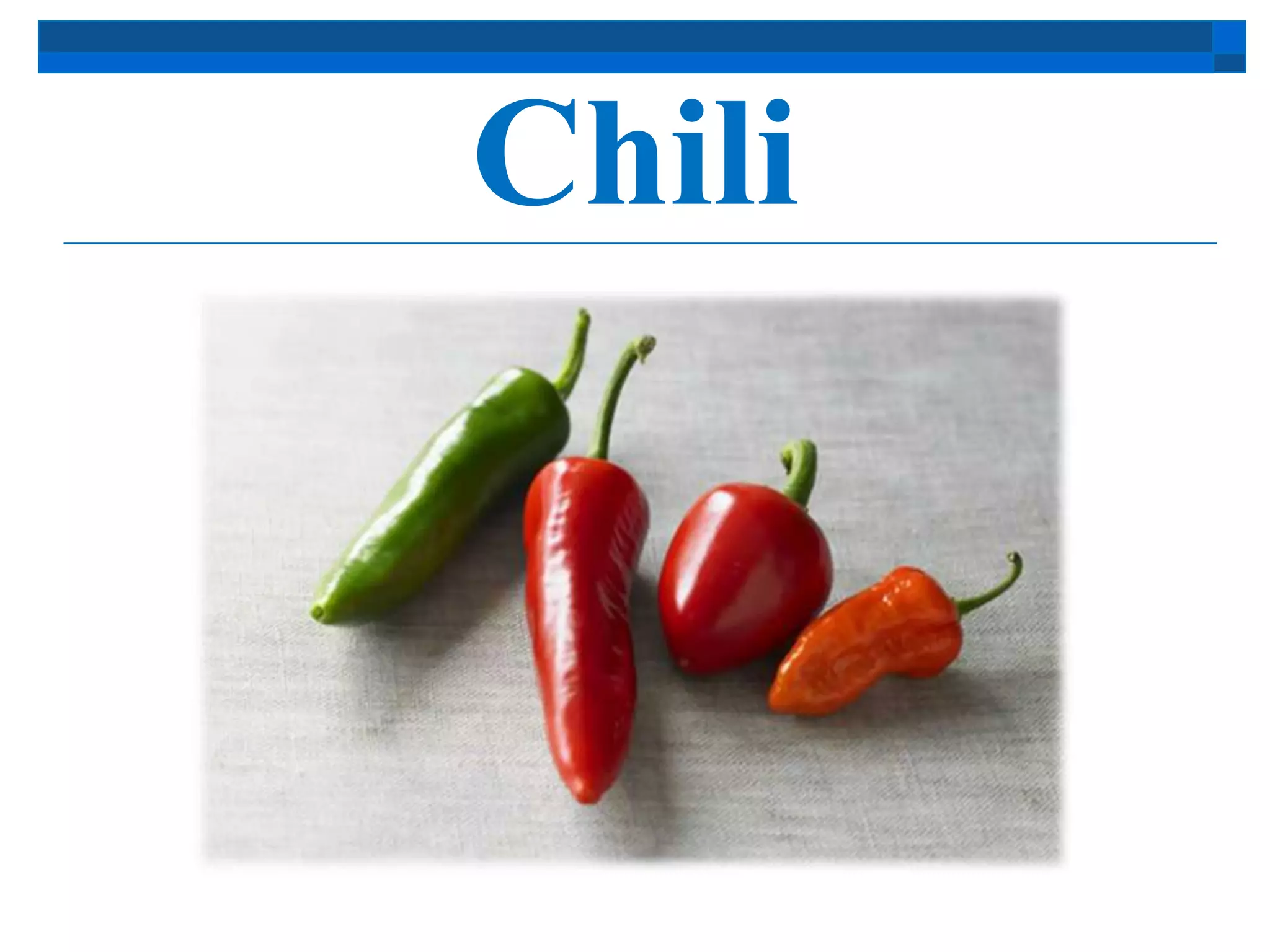
Chili
Origin & Distribution 
 Originated from Mexico & South America. 
 From Mexico, at the time the Spanish colony 
that controlled commerce with Asia, chili is 
spread rapidly into the Philippines and then to 
India, China, Korea and Japan. They were 
incorporated into the local cuisine.
Origin & Distribution 
 Malaysia, 2000: hectarage 3265 Ha with 
production of 30000mt. 
 Main producers: 
i. Johor – 846 Ha 
ii. Pahang – 536 Ha 
iii. Kelantan – 443 Ha 
 Fruit vegetable popular among growers. 
 Short term crop ( 2 ½ months maturity period )
General 
 The pungent principle of chilies is capsaicin, 
C18H27NO3 
 3 types: 
 Bell chili 
 Sweet chili 
 Hot chili 
 Major uses: 
i. Fresh chilies – Green / Red 
ii. Processed – Puree / Dried powder / Sauce
Scientific Classification 
 Family : Solanaceae 
 Genus : Capsicum 
 Species : annum 
 Scientific name : Capsicum annum 
 Common name : Chili, cili, lada, cabai
Scientific Classification 
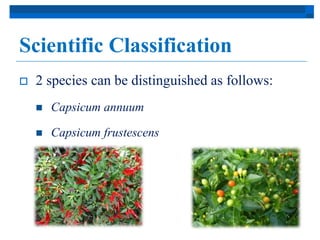
 2 species can be distinguished as follows: 
 Capsicum annuum 
 Capsicum frustescens
Capsicum annuum 
 Plants usually annual. 
 Fruits are borne single, large. 
 Chilies, red and green bell pepper. 
 Sweet & non – pungent. 
 C10 is consumed fresh. 
 C1, C2, Seri Lombok, Cilibangi 3 & Cilibangi 4 are 
processed into sauce or dried form.
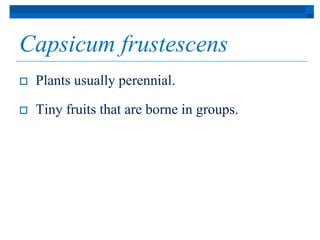
Capsicum frustescens 
 Plants usually perennial. 
 Tiny fruits that are borne in groups.
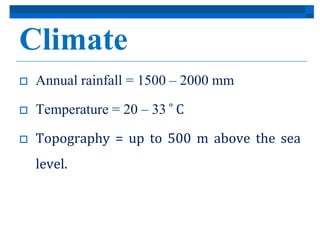
Climate 
 Annual rainfall = 1500 – 2000 mm 
 Temperature = 20 – 33̊C 
 Topography = up to 500 m above the sea 
level.
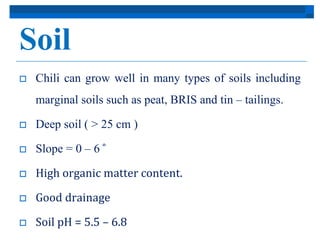
Soil 
 Chili can grow well in many types of soils including 
marginal soils such as peat, BRIS and tin – tailings. 
 Deep soil ( > 25 cm ) 
 Slope = 0 – 6̊ 
 High organic matter content. 
 Good drainage 
 Soil pH = 5.5 – 6.8
Varieties 
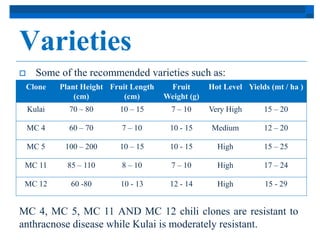
 Some of the recommended varieties such as: 
Clone Plant Height 
(cm) 
Fruit Length 
(cm) 
Fruit 
Weight (g) 
Hot Level Yields (mt / ha ) 
Kulai 70 – 80 10 – 15 7 – 10 Very High 15 – 20 
MC 4 60 – 70 7 – 10 10 - 15 Medium 12 – 20 
MC 5 100 – 200 10 – 15 10 - 15 High 15 – 25 
MC 11 85 – 110 8 – 10 7 – 10 High 17 – 24 
MC 12 60 -80 10 - 13 12 - 14 High 15 - 29 
MC 4, MC 5, MC 11 AND MC 12 chili clones are resistant to 
anthracnose disease while Kulai is moderately resistant.
Propagation 
Planting Materials: 
 Planting material of chili is by using seeds (sexual 
propagation). 
 200 – 300 g / ha 
 Imported hybrid seeds – RM 4000/ kg 
 Seeds are sown in nursery before being transplanting out. 
 Types of nursery: 
 Beds nursery 
 Polyethylene bags 
 Trays nursery 
 Box nursery
Types of Nursery 
 Beds nursery 
 For large scale cultivation. 
 0.9 m width x 7.5 m length x 7 cm height. 
 5 cm between row & 2 cm within row. 
 Polyethylene bags nursery 
 Polybags size 11 cm x 15 cm. 
 Maximum absorption of fertilizers. 
 Costly.
Types of Nursery 
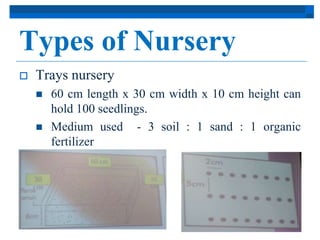
 Trays nursery 
 60 cm length x 30 cm width x 10 cm height can 
hold 100 seedlings. 
 Medium used - 3 soil : 1 sand : 1 organic 
fertilizer
Propagation Method 
Seeds preparation: 
i. Hot water treatment at 50̊C for 30 minutes. 
ii. Mix 3g Thiram / Benomyl (fungicide) with 1000g 
seeds. 
iii. Sow the treated seeds in the rich nutrient medium. 
iv. Watering to be done. 
v. Seeds will germinate after 3- 4 days. 
vi. The germinated seedlings are kept in the nursery for 
6 weeks before field transplanting.
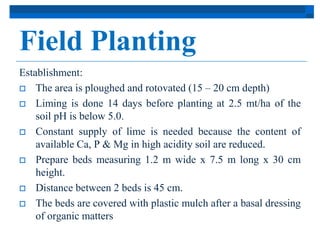
Field Planting 
Establishment: 
 The area is ploughed and rotovated (15 – 20 cm depth) 
 Liming is done 14 days before planting at 2.5 mt/ha of the 
soil pH is below 5.0. 
 Constant supply of lime is needed because the content of 
available Ca, P & Mg in high acidity soil are reduced. 
 Prepare beds measuring 1.2 m wide x 7.5 m long x 30 cm 
height. 
 Distance between 2 beds is 45 cm. 
 The beds are covered with plastic mulch after a basal dressing 
of organic matters
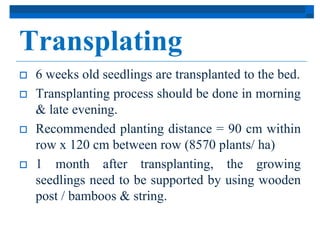
Transplating 
 6 weeks old seedlings are transplanted to the bed. 
 Transplanting process should be done in morning 
& late evening. 
 Recommended planting distance = 90 cm within 
row x 120 cm between row (8570 plants/ ha) 
 1 month after transplanting, the growing 
seedlings need to be supported by using wooden 
post / bamboos & string.
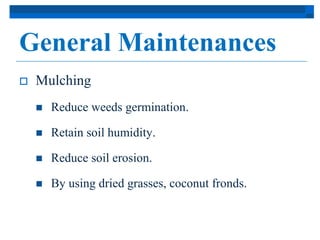
General Maintenances 
 Mulching 
 Reduce weeds germination. 
 Retain soil humidity. 
 Reduce soil erosion. 
 By using dried grasses, coconut fronds.
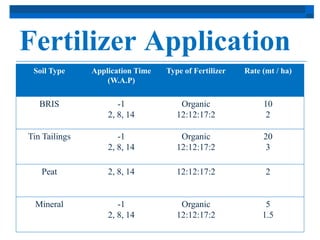
Fertilizer Application 
Soil Type Application Time 
(W.A.P) 
Type of Fertilizer Rate (mt / ha) 
BRIS -1 
2, 8, 14 
Organic 
12:12:17:2 
10 
2 
Tin Tailings -1 
2, 8, 14 
Organic 
12:12:17:2 
20 
3 
Peat 2, 8, 14 12:12:17:2 2 
Mineral -1 
2, 8, 14 
Organic 
12:12:17:2 
5 
1.5
Pests & Diseases Control 
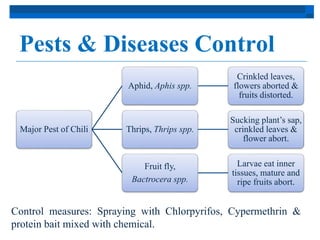
Major Pest of Chili 
Aphid, Aphis spp. 
Crinkled leaves, 
flowers aborted & 
fruits distorted. 
Thrips, Thrips spp. 
Sucking plant’s sap, 
crinkled leaves & 
flower abort. 
Fruit fly, 
Bactrocera spp. 
Larvae eat inner 
tissues, mature and 
ripe fruits abort. 
Control measures: Spraying with Chlorpyrifos, Cypermethrin & 
protein bait mixed with chemical.
Pests & Diseases Control 
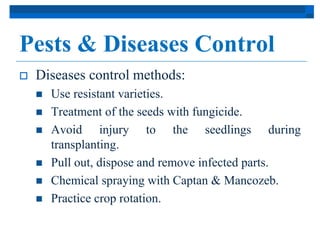
 Diseases control methods: 
 Use resistant varieties. 
 Treatment of the seeds with fungicide. 
 Avoid injury to the seedlings during 
transplanting. 
 Pull out, dispose and remove infected parts. 
 Chemical spraying with Captan & Mancozeb. 
 Practice crop rotation.
Harvesting: Duration 
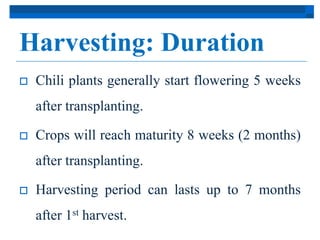
 Chili plants generally start flowering 5 weeks 
after transplanting. 
 Crops will reach maturity 8 weeks (2 months) 
after transplanting. 
 Harvesting period can lasts up to 7 months 
after 1st harvest.
Maturity Index 
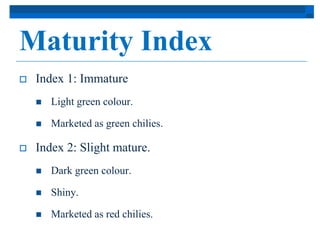
 Index 1: Immature 
 Light green colour. 
 Marketed as green chilies. 
 Index 2: Slight mature. 
 Dark green colour. 
 Shiny. 
 Marketed as red chilies.
Maturity Index 
 Index 3: Near mature 
 Red greenish / green reddish colour. 
 Marketed as red chilies. 
 Index 4: Mature 
 Dark red colour (almost ripe). 
 Still acceptable in market.
Maturity Index 
 Index 5: Fully mature (ripe) 
 Fully red in colour. 
 Index 6: Over ripe 
 Red blackish in colour. 
 Start shrinking.
Harvesting Criteria 
 Harvesting – morning / late evening. 
 Harvesting interval is set at 5 days. 
 Green chilies are harvested with the length reached 8 
– 10 cm. 
 Reddish & dark green colour for fresh market with 
higher prices. 
 Fully red colour for processing purposes.
Average Production 
 Average yield = 16 – 25 mt/ha 
 Birds Chilies production = 500 g per plants 
for the period of 8 to 9 months.
Marketing 
 The harvested chilies undergoes several post – harvest 
operations before being marketed: 
 Selection 
 Washing 
 Grading 
 Packing 
 Storing
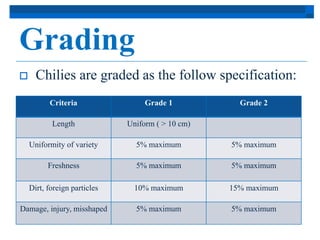
Grading 
 Chilies are graded as the follow specification: 
Criteria Grade 1 Grade 2 
Length Uniform ( > 10 cm) 
Uniformity of variety 5% maximum 5% maximum 
Freshness 5% maximum 5% maximum 
Dirt, foreign particles 10% maximum 15% maximum 
Damage, injury, misshaped 5% maximum 5% maximum
Storage 
 Storage temperature = 5 – 8̊C 
 Relative humidity (RH) = 90 – 95 % 
 With the above condition, the shelf life of the 
fresh chilies can last up to 8 weeks.

Chili

  • 1.
  • 2.
    Origin & Distribution  Originated from Mexico & South America.  From Mexico, at the time the Spanish colony that controlled commerce with Asia, chili is spread rapidly into the Philippines and then to India, China, Korea and Japan. They were incorporated into the local cuisine.
  • 3.
    Origin & Distribution  Malaysia, 2000: hectarage 3265 Ha with production of 30000mt.  Main producers: i. Johor – 846 Ha ii. Pahang – 536 Ha iii. Kelantan – 443 Ha  Fruit vegetable popular among growers.  Short term crop ( 2 ½ months maturity period )
  • 4.
    General  Thepungent principle of chilies is capsaicin, C18H27NO3  3 types:  Bell chili  Sweet chili  Hot chili  Major uses: i. Fresh chilies – Green / Red ii. Processed – Puree / Dried powder / Sauce
  • 5.
    Scientific Classification Family : Solanaceae  Genus : Capsicum  Species : annum  Scientific name : Capsicum annum  Common name : Chili, cili, lada, cabai
  • 6.
    Scientific Classification 2 species can be distinguished as follows:  Capsicum annuum  Capsicum frustescens
  • 7.
    Capsicum annuum Plants usually annual.  Fruits are borne single, large.  Chilies, red and green bell pepper.  Sweet & non – pungent.  C10 is consumed fresh.  C1, C2, Seri Lombok, Cilibangi 3 & Cilibangi 4 are processed into sauce or dried form.
  • 8.
    Capsicum frustescens Plants usually perennial.  Tiny fruits that are borne in groups.
  • 9.
    Climate  Annualrainfall = 1500 – 2000 mm  Temperature = 20 – 33̊C  Topography = up to 500 m above the sea level.
  • 10.
    Soil  Chilican grow well in many types of soils including marginal soils such as peat, BRIS and tin – tailings.  Deep soil ( > 25 cm )  Slope = 0 – 6̊  High organic matter content.  Good drainage  Soil pH = 5.5 – 6.8
  • 11.
    Varieties  Someof the recommended varieties such as: Clone Plant Height (cm) Fruit Length (cm) Fruit Weight (g) Hot Level Yields (mt / ha ) Kulai 70 – 80 10 – 15 7 – 10 Very High 15 – 20 MC 4 60 – 70 7 – 10 10 - 15 Medium 12 – 20 MC 5 100 – 200 10 – 15 10 - 15 High 15 – 25 MC 11 85 – 110 8 – 10 7 – 10 High 17 – 24 MC 12 60 -80 10 - 13 12 - 14 High 15 - 29 MC 4, MC 5, MC 11 AND MC 12 chili clones are resistant to anthracnose disease while Kulai is moderately resistant.
  • 12.
    Propagation Planting Materials:  Planting material of chili is by using seeds (sexual propagation).  200 – 300 g / ha  Imported hybrid seeds – RM 4000/ kg  Seeds are sown in nursery before being transplanting out.  Types of nursery:  Beds nursery  Polyethylene bags  Trays nursery  Box nursery
  • 13.
    Types of Nursery  Beds nursery  For large scale cultivation.  0.9 m width x 7.5 m length x 7 cm height.  5 cm between row & 2 cm within row.  Polyethylene bags nursery  Polybags size 11 cm x 15 cm.  Maximum absorption of fertilizers.  Costly.
  • 14.
    Types of Nursery  Trays nursery  60 cm length x 30 cm width x 10 cm height can hold 100 seedlings.  Medium used - 3 soil : 1 sand : 1 organic fertilizer
  • 15.
    Propagation Method Seedspreparation: i. Hot water treatment at 50̊C for 30 minutes. ii. Mix 3g Thiram / Benomyl (fungicide) with 1000g seeds. iii. Sow the treated seeds in the rich nutrient medium. iv. Watering to be done. v. Seeds will germinate after 3- 4 days. vi. The germinated seedlings are kept in the nursery for 6 weeks before field transplanting.
  • 16.
    Field Planting Establishment:  The area is ploughed and rotovated (15 – 20 cm depth)  Liming is done 14 days before planting at 2.5 mt/ha of the soil pH is below 5.0.  Constant supply of lime is needed because the content of available Ca, P & Mg in high acidity soil are reduced.  Prepare beds measuring 1.2 m wide x 7.5 m long x 30 cm height.  Distance between 2 beds is 45 cm.  The beds are covered with plastic mulch after a basal dressing of organic matters
  • 17.
    Transplating  6weeks old seedlings are transplanted to the bed.  Transplanting process should be done in morning & late evening.  Recommended planting distance = 90 cm within row x 120 cm between row (8570 plants/ ha)  1 month after transplanting, the growing seedlings need to be supported by using wooden post / bamboos & string.
  • 18.
    General Maintenances Mulching  Reduce weeds germination.  Retain soil humidity.  Reduce soil erosion.  By using dried grasses, coconut fronds.
  • 19.
    Fertilizer Application SoilType Application Time (W.A.P) Type of Fertilizer Rate (mt / ha) BRIS -1 2, 8, 14 Organic 12:12:17:2 10 2 Tin Tailings -1 2, 8, 14 Organic 12:12:17:2 20 3 Peat 2, 8, 14 12:12:17:2 2 Mineral -1 2, 8, 14 Organic 12:12:17:2 5 1.5
  • 20.
    Pests & DiseasesControl Major Pest of Chili Aphid, Aphis spp. Crinkled leaves, flowers aborted & fruits distorted. Thrips, Thrips spp. Sucking plant’s sap, crinkled leaves & flower abort. Fruit fly, Bactrocera spp. Larvae eat inner tissues, mature and ripe fruits abort. Control measures: Spraying with Chlorpyrifos, Cypermethrin & protein bait mixed with chemical.
  • 21.
    Pests & DiseasesControl  Diseases control methods:  Use resistant varieties.  Treatment of the seeds with fungicide.  Avoid injury to the seedlings during transplanting.  Pull out, dispose and remove infected parts.  Chemical spraying with Captan & Mancozeb.  Practice crop rotation.
  • 22.
    Harvesting: Duration Chili plants generally start flowering 5 weeks after transplanting.  Crops will reach maturity 8 weeks (2 months) after transplanting.  Harvesting period can lasts up to 7 months after 1st harvest.
  • 23.
    Maturity Index Index 1: Immature  Light green colour.  Marketed as green chilies.  Index 2: Slight mature.  Dark green colour.  Shiny.  Marketed as red chilies.
  • 24.
    Maturity Index Index 3: Near mature  Red greenish / green reddish colour.  Marketed as red chilies.  Index 4: Mature  Dark red colour (almost ripe).  Still acceptable in market.
  • 25.
    Maturity Index Index 5: Fully mature (ripe)  Fully red in colour.  Index 6: Over ripe  Red blackish in colour.  Start shrinking.
  • 26.
    Harvesting Criteria Harvesting – morning / late evening.  Harvesting interval is set at 5 days.  Green chilies are harvested with the length reached 8 – 10 cm.  Reddish & dark green colour for fresh market with higher prices.  Fully red colour for processing purposes.
  • 27.
    Average Production Average yield = 16 – 25 mt/ha  Birds Chilies production = 500 g per plants for the period of 8 to 9 months.
  • 28.
    Marketing  Theharvested chilies undergoes several post – harvest operations before being marketed:  Selection  Washing  Grading  Packing  Storing
  • 29.
    Grading  Chiliesare graded as the follow specification: Criteria Grade 1 Grade 2 Length Uniform ( > 10 cm) Uniformity of variety 5% maximum 5% maximum Freshness 5% maximum 5% maximum Dirt, foreign particles 10% maximum 15% maximum Damage, injury, misshaped 5% maximum 5% maximum
  • 30.
    Storage  Storagetemperature = 5 – 8̊C  Relative humidity (RH) = 90 – 95 %  With the above condition, the shelf life of the fresh chilies can last up to 8 weeks.