Introduction:
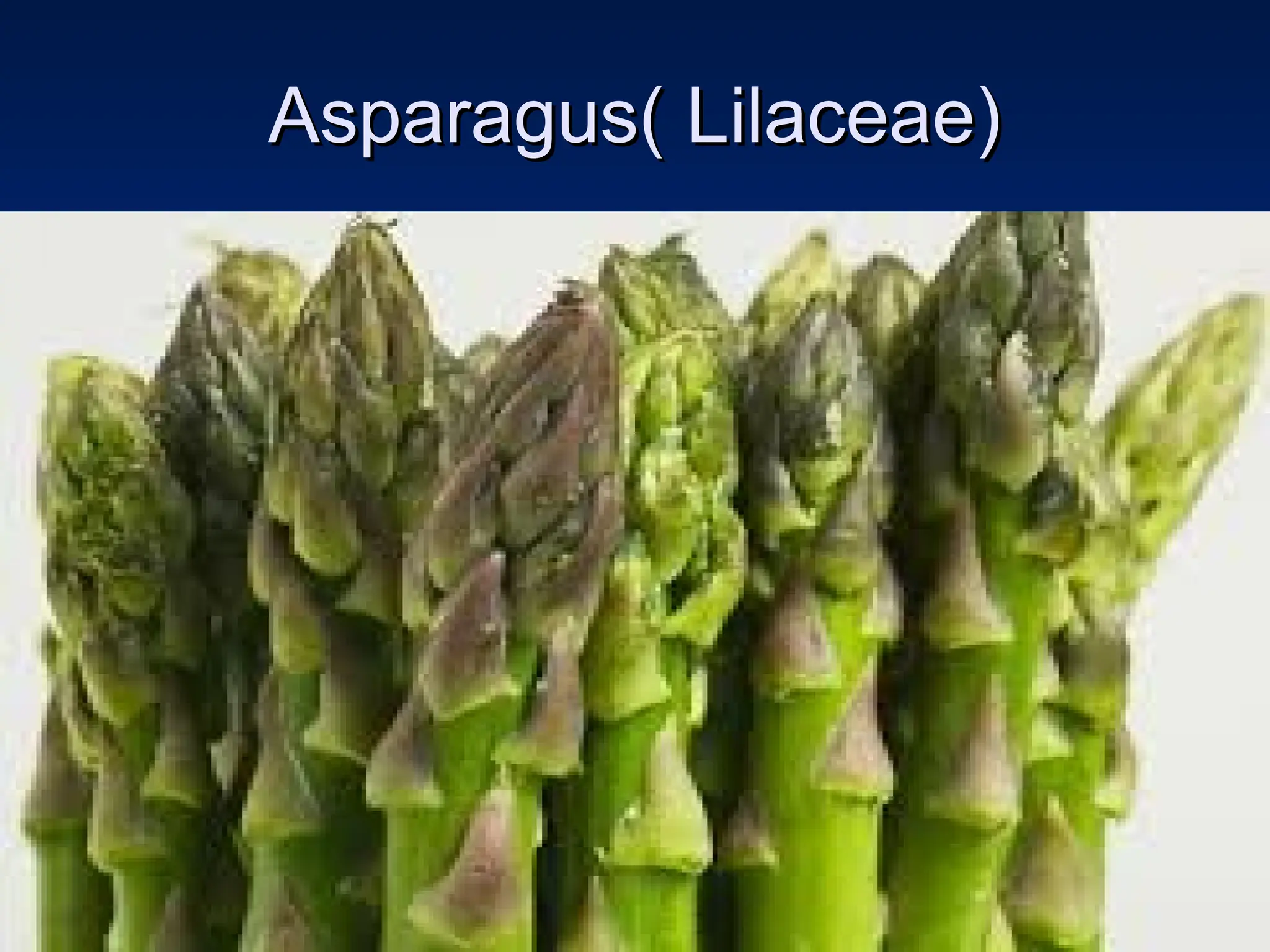
Asparagus is along-lived perennial plant.
The young, immature shoots are cut and
cooked. This is evaluable export crop. One
established asparagus will produce for many
years and will increase in size each year.
4.
Climate Range
Climate Range
Growswell at altitude over 1000m.
Soils: the soil should be well drained and rich in
organic matter. Sandy loam soil are excellent,
irrigation may be necessary.
Varieties: Mary Washington, darbone,huchles
staudenauslese.
Nursery: sow seeds in nursery beds in rows
30cm apart and 3cm deep. Seedlings are
transported at 6 months.
5.
Land preparation: shouldbe done very
thoroughly as the plants will be in the ground
for a number of years.
Transplanting: make trenches 1.2m apart,
20cm deep and 30cm wide. Plant the
seedlings 40cm apart in the rows and 7.5cm
deep, with the roots well spread out.
Fertilizer: apply 30g/sq m of C.A.N. fertilizer
at the beginning of each rains. Apply 30g/sq
m of C.A.N a month before harvesting.
6.
Weeding: keep fieldclean of weeds.
Cultivation: at the end of the first yearcut
and burn the foliage. At the of second year
cover the plants with loose top soil and
compost.
Harvest: when shoots 20-23cm long cut just
below the surface with a saw toothed knife.
Clean the shoots with cold water and trim to
17-22cm in length. Grade shoots according
to length and tie in bundles.
introduction
introduction
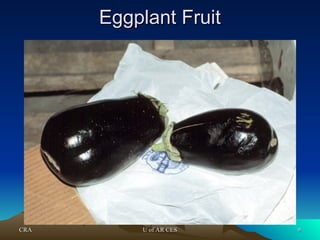
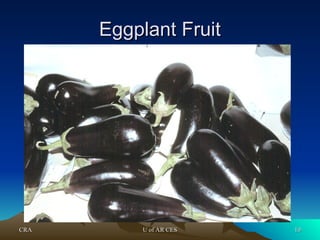
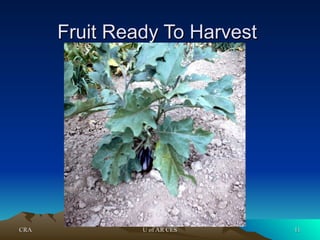
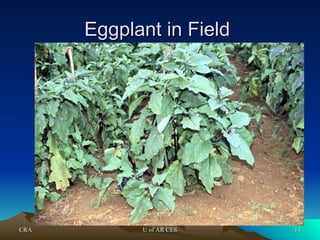
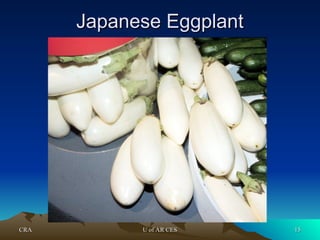
Eggplant(Solanum melongena) isa
member of the nightshade family, making
it a close relative of the tomato, pepper,
and potato.
Eggplant grows in any season of the year.
The first planting is from October to
February and the second is from May to
September.
18.
SITE SELECTION ANDSOIL
SITE SELECTION AND SOIL
TYPE
TYPE
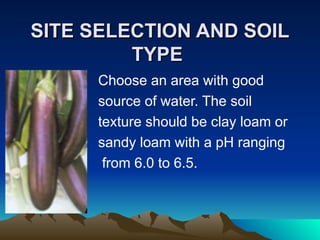
Choose an area with good
source of water. The soil
texture should be clay loam or
sandy loam with a pH ranging
from 6.0 to 6.5.
19.
SEEDLING PRODUCTION
SEEDLING PRODUCTION
Thereare two methods that can be used
to produce seedlings, the seedbed
method and seedling tray method. In both
methods, use a rain shelter to protect the
seedlings.
20.
Land preparation and
Landpreparation and
transplanting
transplanting
Plow the field once and harrow twice. Furrow
the field at a row spacing of 1 meter. Irrigate
the furrows before transplanting. Transplant
30-day-old seedlings at the side of the
furrows with a distance of 50 centimeters
between hills at a depth of 4-6 centimeters
depending on the height of the seedlings.
Replant missing hills 1-2 days after planting.
21.
irrigation
irrigation
The first irrigationshould be done at
planting. Depending on the soil type,
irrigate once a week. However, during
fruiting, irrigate the plants twice a week.
Introduction:
• Pepper isdivided into two categories namely
capsicums also called sweet pepper and chilies
commonly known as hot pepper. Capsicums
unlike the chilies have a mild flavor and are not
pungent. Both are quite rich in vitamin A and C
and are eaten raw in salads and cooked in
various ways. They can also be dehydrate.
24.
Climate Range:
Capsicum likechilies can tolerate a wide range of
climates including hot and dry weather under
irrigation. However, the ideal climate is warm to
hot. The crop thrives in areas with medium rainfall
about 600-1200 mm per annum. Water-logging
even for a short period causes leaf shedding. On
the other hand lack of proper moisture in the soil
may causes flowers and fruits to drop prematurely,
hence irrigation is recommended where rainfall is
insufficient.
25.
Soils:
Light loamy, non-acidic,well-drained soil are
ideal for capsicum growth. The crop responds
well to manure or compost which greatly
increases the yield. Application of up to 50 tons
Farm Yard Manure or compost per hectare in
prepared land or 2 handfuls per planting hole is
recommended.
26.
Varieties: The varietiesgrown
are:
• Yolo wonder
• This is a very popular variety for both export and local
markets, and for processing. The fruits are pendant, shiny
dark green, thick-walled, 3-4 lobed, firm and blocky. The
variety is vigorous, compact, and high yielding. Plants
continues to produce over a long seasn.
• Mercury
• This variety is suitable for home and market gardens.
Plants are rather tall, vigorous, and highly productive.
Fruits are pendant, thick-walled, 4-lobbed, uniform, blocky
and compact. Fruiting continues over a long period.
27.
Mulching:
• Mulch thebeds lightly and water
regularly. Remove the mulch when
seeds have germinated and control
pests and diseases as the need
arises. Transplant when the seedlings
have attained at least four true
leaves.
28.
Nursery preparation:
•Capsicums shouldbe started in the
nursery although direct sowing is
practiced if grown on small scale. Make
raised beds, one meter wide and of
convenient length. Apply manure and
double superphosphates and work these
into the soil. Make drills across the bed
about 10cm apart, sow seeds and cover
lightly with the soil.
29.
Fertilizer/crop rotation:
• Applicationof 250 kg/ha TSP during
transplanting is recommended. The
fertilizer and any FMY or compost should
be well mixed in the soil. Topdressing with
100 kg/ha CAN when plants are about 15
cm and later with 200 kg/ha CAN after 4
weeks.
• Capsicum should not be grown after other
solanaceous plants in the same field.
30.
Spacing:
• The recommendedspacing is 60cm between the
row and 45cm between the plants. Apply grass
mulch to protect the fruits from water splash.
Harvesting:
The fruits will be ready for harvesting 8-12
weeks after transplanting..
Introduction:
The carrot ispopular vegetable with a
high vitamin A potency, and is either
eaten raw or cooked. It requires cool to
warm climate as the roots are sensitive
to very high soil temperatures. They do
best in well drained, friable loam free
from lumps or stones.
34.
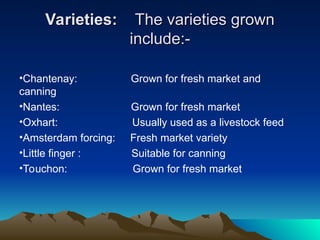
Varieties:
Varieties: The varietiesgrown
The varieties grown
include:-
include:-
•Chantenay: Grown for fresh market and
canning
•Nantes: Grown for fresh market
•Oxhart: Usually used as a livestock feed
•Amsterdam forcing: Fresh market variety
•Little finger : Suitable for canning
•Touchon: Grown for fresh market
35.
Growing:
When growing carrots,avoid using fresh
manure as this causes the roots to fork, a
characteristic undesirable to consumers.
However, double superphosphate at the rate of
220kg per hectare should be used. The crop is
sown directly, into the field and thinned out
later.
Harvesting
Harvesting
• The carrotcrop matures within 3-4 months after planting. However,
carrots intended for dehydration should be allowed to enlarge
beyond the fresh market size in order to increase yields. Yields
depend on the stage at which the roots are lifted. However, canning
requires tender young roots, so yields of about 4 tons per hectare
are possible at this stage. The fresh market requires medium to
large roots, and yields of 8 tons per hectare are possible.
Dehydration plants require large to extra-large roots where yields of
up to 20 tons per hectare can be realized.
• Marketing: Towns, canneries and dehydration factories provide the
main market outlets.
Introduction:
Pumpkins are themost important of all
cucurbits in Kenya from the food point of
view. They have an advantages over most
other vegetables because they can be
stored for several months and can withstand
transportation very well. They can be
cooked as a vegetable and also used in pie
making.
40.
Climatic Range:
They preferwarm to hot climate, and grow
well under irrigation in city areas. They grow
well up to an attitude of 1000 above sea
level, and thrive in many types of soils
provided they are rich and well drained.
41.
Varieties: The majorvarieties grown
are :
• Connecticut Field
• This is an early maturing variety with smooth globe shaped
fruits. They are somewhat ribbed, deep orange in colour and
weigh approximately 7-9 kg. The flesh is thick, yellow-orange
in color.
• Cushaw Golden
• This is very prolific variety that matures in 4 months. The
fruits are crook necked, weighing approximately 5.5kg. The
rind is golden-yellow, hard and smooth. The flesh is thick,
and rick yellow in color with a large seed cavity. It is mainly
used in pie making.
• .
42.
Planting:
Planting:
• Pumpkins aresown directly and never
transplanted. Prepare the land early in the
season and make hills. Sow 2 seeds, on
the hill at a spacing of 240-300cm between
the rows and 120-180cm between the
plants. Add one handfull of manure per
planting hill together with 125gm of double
superphosphate, during the time of sowing.
This is about 200kg of fertilizer per hectare.
43.
Spacing
Spacing:
:
• Sow 2seeds in each hill, at a spacing of
2.4m-3m between the rows and 1.2-1.8m
between the plants. Cover the seeds with
3cm of soil.
• Weeding:
• Weeding should be effected from the time
the plants break through the ground until the
spread of the vines which makes further
weeding unnecessary.
44.
Fertilizer application:
Fertilizer application:
•Nitrogenous fertilizers should be applied in two doses.
The first application is done just before the plants starts
to run at the rate of 110kg of Calcium Ammonium Nitrate
(C.A.N) per hectare or 65gm per planting hill. The
second application is done just before the plants are
about to flower at the rate of 130gm of calcium
Ammonium Nitrate (C.A.N) per hill. This is about 220 kg
of fertilizer per hectare. Slight earthing up may be done
as the vines grow. Late cultivation should be shallow and
away from the plant to avoid damaging the toots or
disturbing the vines.
45.
Maturity:
Maturity:
• The cropis ready in 3 ½-4 ½ months after
sowing. Harvest the fruits when fully
mature, and have changed color to orange
or yellow and skin has become hard. At
this stage the fruits sound hollow when
slapped by hand. Leave about 2.5 cm of
stem on the fruit the fruits can be stored in
a cool, dry place for 4-6 months without
deterioration.
Introduction:
• Watermelon isa popular fruit for fresh
consumption, although they are commonly
grouped into vegetables. Cultivation
technique is similar to that of cucumbers,
sweet melons are also of some
importance in Somalia
48.
Ecological requirements
• Soil:Fertile, sandy soils are most suitable. Well
drained heavy soils can also be utilized. The soil
should be rich in organic matter. Soil pH rang of
6 to 7.5 is preferable.
• Rainfall: Best results are obtained in low to
medium rainfall areas, with additional irrigation.
Optimum rainfall requirement per cropping
season is 600mm, but 400mm is considered
minimum. Excessive humidity may cause leaf
diseases and also affect flowering.
49.
Contineu
Contineu
• Temperature: Theygrow best under hot
temperatures. Water melons do well at optimum
temperatures between 22-28C, stagnation of
growth occurs at temperatures less than 15C.
• Altitude: Water melon can grow at altitudes of
up to 1500m. Best growing areas are the
lowland areas with high temperatures and
relatively low rainfall, where irrigation is
necessary.
Land preparation
: Soilsshould be well cultivated and ridges
or mounds on formed on which seeds are
later planted. If soils do not have enough
organic matter, apply up to 10 tons of
manure.
52.
Planting:
Water melon aregrown throughout the year
in lowland areas but peaks of rain season
should be avoided. At higher elevation,
cultivation should be done only during the
warmer period of the year. The seed rate is
about 3kg/ha. The seeds are sown directly
on ridges or mounds. If sown on ridge, 2-3
are planted at a spacing of 1.50-2mx80cm
and thinned to one after emerging.
53.
continue
continue
One mounds, 5-6seeds are planted per
mound at a spacing of 2mx2m and later
thinned to 2-3 plants. At 25-30 cm high (2-3
weeks after thinning) earthing up around the
plant bases is recommended to prevent
exposure to the sun.
54.
Fertilizers:
For basic topdressing, 200 kg/ha of TSP is
required. CAN is used twice for top dressing,
first when the plants start to `` run``
(100kg/ha) and the second they are about to
flower (200kh/ha).
55.
.
.
• Mulching: Itkeeps the moisture in the soil
and protects fruits from dirt and excessive
moisture. Straw is suitable as mulching
material.
• Pruning: Fruits have to be thinned to 3-4
per plant so as to produce large sized fruits.
• Rotation: Water melon can be ratated with
maize, peans, or cabbage.
56.
.
.
• Weeding: Weedingshould be done regularly to
keep the field clean.
• Yields: The average yields are about 20-30 tons
per hectare depending on harvesting.
• Harvesting: Fruits are harvested when mature.
Sings of maturity are:-
• -Tendrils opposite the fruit die
• -Dull sound when the fruit is tapped with a finger
• -Vegetative parts start drying
• -Changed fruit color.
57.
Marketing
Marketing:
:
• The fruitis cut from the plant leaving a
short stem attached to fruit and the cut part
sprayed with a fungicide to prevent stem-
end rot. For marketing, the fruits are
graded according to size and variety
characteristics. Transport and handling has
to be done carefully to prevent bruised and
other damages to the fruit. Major markets
are local fresh markets in the urban areas.