Amaranthus
Introduction
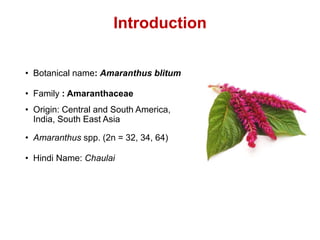
• Botanical name: Amaranthus blitum
• Family : Amaranthaceae
• Origin: Central and South America,
India, South East Asia
• Amaranthus spp. (2n = 32, 34, 64)
• Hindi Name: Chaulai
Nutritional importance
• Good sources of iron (38.5 mg/100g), calcium (350-400
mg/100g), vitamin A and vitamin C
• Absorption of calcium from amaranth is however poor
• The iron availability is only about 15.2 – 53.6% of total iron.
• High oxalate content (1-2%) and nitrate (1.8-8.8 g/ kg dry
matter) levels are reported from leaves of various species.
• Both leaf and grain types play a vital role to combat malnutrition
of poor people.
Botany
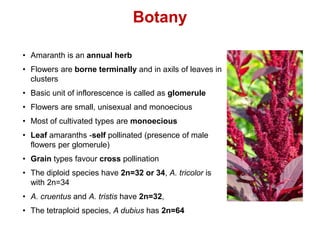
• Amaranth is an annual herb
• Flowers are borne terminally and in axils of leaves in
clusters
• Basic unit of inflorescence is called as glomerule
• Flowers are small, unisexual and monoecious
• Most of cultivated types are monoecious
• Leaf amaranths -self pollinated (presence of male
flowers per glomerule)
• Grain types favour cross pollination
• The diploid species have 2n=32 or 34, A. tricolor is
with 2n=34
• A. cruentus and A. tristis have 2n=32,
• The tetraploid species, A dubius has 2n=64
A. bilutum A. tricolor
Dwarfish with small leaves and
rejuvenate quickly after each
cutting
Tricolor is taller with thick
stems and larger leaves
It is suitable for sowing in
summer
It can be grown in and rainy
and summer seasons
A. Mangostanus and
A. polygonoides
Cultivated - leaf type
A. dubius Cultivated -leaf type
A. blitum (Syn: A.lividus) Cultivated - leaf type
A. spinosus Cultivated grain type
A. cruentus Cultivated grain type
A. caudatus Cultivated grain type
A. tristis Wild - leaf type
A. viridis Wild - leaf type
Different species of Amaranthus
A. caudatus
A. viridis A. giganticus
A. tricolour
A. bilutum A. tristis
A. spinosus
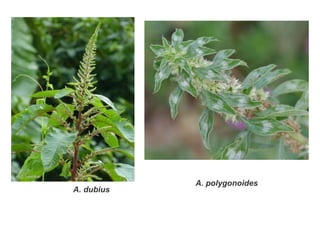
A. dubius
A. polygonoides
1. Arka Varna
2. Arka Samraksha
3. Arka Arunima
4. Arka Suguna
5. Co.1 (Amaranthus dubius)
6. Co.2 (Amaranths tricolor)
Varieties
7. Co.3 (Amaranthus tristis)
8. Co.4 (Amaranthus hypochondriacus)
9. Chhoti chaulai ( Amaranthus blitum)
10.Badi Chaulai (Amaranthus tricolor)
11.Pusa Chaulai (Amaranthus tricolour)
12.Pusa Kiran
13.Pusa Keerthi
Leaf type
1. Amaranthus tricolor/ganetious
2. Amaranthus blitum
3. Amaranthus tristis
4. Amaranthus durbius
5. Amaranthus lividus
6. Amaranthus viridis
Grain type
1. Amaranthus caudatus
2. Amaranthus hypochondriacus
3. Amaranthus cruentus
4. Amaranthus edulis
Climate and Soil
• Leaf amaranth is a warm season crop adapted to hot humid
climatic conditions
• Most of leaf types are day neutral in habit
• Grain types, A. caudatus, A. cruentus and A. edulis are short
day species while A. hypochondriacus is day neutral.
• pH is 5.5-7.5
• Red amaranth requires bright sunlight for colour development.
Seed rate and transplanting
• Seed requirement for transplanted crop is only 500 g/ha
• Seed rate for direct sowing is 2.0-2.5 kg/ha.
• Amaranth seeds, being small in size, are mixed with fine sand and
sown uniformly by broadcasting.
• 20-25 tonnes of FYM and 50:25:20 kg NPK / ha are recommended
as basal dose.
Irrigation and Harvesting
• Grain amaranth is a drought tolerant crop
• leaf amaranth requires frequent irrigation to keep soil moist.
• In the first method, grown up plants are pulled out at 30, 45 and 55 days
after sowing, along with roots
• In multi-cut method, first clipping or cutting is done 25-35 days after sowing.
• Subsequent cuttings are made at weekly intervals in Chhotti Chaulai and
10 days intervals in Badi Chaulai
• 5-9 cuttings can be taken totally
Yield
• 7500 Kg /Ha in a span of 2 months
Thank you

Amaranthus

  • 1.
  • 2.
    Introduction • Botanical name:Amaranthus blitum • Family : Amaranthaceae • Origin: Central and South America, India, South East Asia • Amaranthus spp. (2n = 32, 34, 64) • Hindi Name: Chaulai
  • 3.
    Nutritional importance • Goodsources of iron (38.5 mg/100g), calcium (350-400 mg/100g), vitamin A and vitamin C • Absorption of calcium from amaranth is however poor • The iron availability is only about 15.2 – 53.6% of total iron. • High oxalate content (1-2%) and nitrate (1.8-8.8 g/ kg dry matter) levels are reported from leaves of various species. • Both leaf and grain types play a vital role to combat malnutrition of poor people.
  • 5.
    Botany • Amaranth isan annual herb • Flowers are borne terminally and in axils of leaves in clusters • Basic unit of inflorescence is called as glomerule • Flowers are small, unisexual and monoecious • Most of cultivated types are monoecious • Leaf amaranths -self pollinated (presence of male flowers per glomerule) • Grain types favour cross pollination • The diploid species have 2n=32 or 34, A. tricolor is with 2n=34 • A. cruentus and A. tristis have 2n=32, • The tetraploid species, A dubius has 2n=64
  • 6.
    A. bilutum A.tricolor Dwarfish with small leaves and rejuvenate quickly after each cutting Tricolor is taller with thick stems and larger leaves It is suitable for sowing in summer It can be grown in and rainy and summer seasons
  • 7.
    A. Mangostanus and A.polygonoides Cultivated - leaf type A. dubius Cultivated -leaf type A. blitum (Syn: A.lividus) Cultivated - leaf type A. spinosus Cultivated grain type A. cruentus Cultivated grain type A. caudatus Cultivated grain type A. tristis Wild - leaf type A. viridis Wild - leaf type Different species of Amaranthus
  • 8.
    A. caudatus A. viridisA. giganticus A. tricolour
  • 9.
  • 10.
  • 11.
  • 12.
    1. Arka Varna 2.Arka Samraksha 3. Arka Arunima 4. Arka Suguna 5. Co.1 (Amaranthus dubius) 6. Co.2 (Amaranths tricolor) Varieties 7. Co.3 (Amaranthus tristis) 8. Co.4 (Amaranthus hypochondriacus) 9. Chhoti chaulai ( Amaranthus blitum) 10.Badi Chaulai (Amaranthus tricolor) 11.Pusa Chaulai (Amaranthus tricolour) 12.Pusa Kiran 13.Pusa Keerthi
  • 13.
    Leaf type 1. Amaranthustricolor/ganetious 2. Amaranthus blitum 3. Amaranthus tristis 4. Amaranthus durbius 5. Amaranthus lividus 6. Amaranthus viridis Grain type 1. Amaranthus caudatus 2. Amaranthus hypochondriacus 3. Amaranthus cruentus 4. Amaranthus edulis
  • 14.
    Climate and Soil •Leaf amaranth is a warm season crop adapted to hot humid climatic conditions • Most of leaf types are day neutral in habit • Grain types, A. caudatus, A. cruentus and A. edulis are short day species while A. hypochondriacus is day neutral. • pH is 5.5-7.5 • Red amaranth requires bright sunlight for colour development.
  • 15.
    Seed rate andtransplanting • Seed requirement for transplanted crop is only 500 g/ha • Seed rate for direct sowing is 2.0-2.5 kg/ha. • Amaranth seeds, being small in size, are mixed with fine sand and sown uniformly by broadcasting. • 20-25 tonnes of FYM and 50:25:20 kg NPK / ha are recommended as basal dose.
  • 16.
    Irrigation and Harvesting •Grain amaranth is a drought tolerant crop • leaf amaranth requires frequent irrigation to keep soil moist. • In the first method, grown up plants are pulled out at 30, 45 and 55 days after sowing, along with roots • In multi-cut method, first clipping or cutting is done 25-35 days after sowing. • Subsequent cuttings are made at weekly intervals in Chhotti Chaulai and 10 days intervals in Badi Chaulai • 5-9 cuttings can be taken totally Yield • 7500 Kg /Ha in a span of 2 months
  • 17.