Made By:- Vikram, Ankit, Preeti, Arpan & Vikas
Capital Structure refers to  the combination of mix of debt and equity which a company uses to finance its long term operations.
…  can a company increase its value simply by altering its capital structure? … yes and no … we will see….
The additional risk placed on the common stockholders as a result of the decision to finance with debt. Leverage increases shareholder risk. Leverage also increases the return on equity (to compensate for the higher risk).
There are only two source of finance Debt & Equity, no Preference. No tax. No flotation cost. Assets of a firm remains constant. Business risk remains constant  (that is EBIT remains constant). No retained earnings.
Main objective of financial management is maximization of share holder’s wealth. To be optimum which maximize the  market value of equity shares. Price Earning ratio= Market Price per share earning per share To Increase growth of company
Net Income Approach Net Operating Income Approach Traditional Approach MM( Modigliani-Miller) Approach
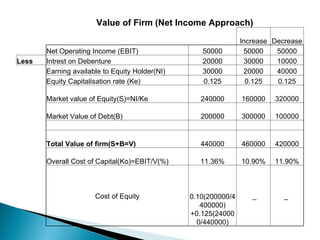
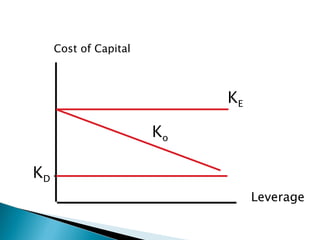
Assumption:- K d  (Cost of Debt) and K e  (Cost of Equity)   remains constant at all level of leverage. This Approach is between leverage, Cost of Capital and Value of firm. There is a straight relationship between capital structure and Value of firm.
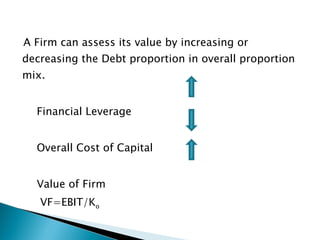
A Firm can assess its value by increasing or decreasing the Debt proportion in overall proportion mix. Financial Leverage  Overall Cost of Capital  Value of Firm VF=EBIT/K o
Value of Firm (Net Income Approach) Increase Decrease Net Operating Income (EBIT) 50000 50000 50000 Less Intrest on Debenture 20000 30000 10000 Earning available to Equity Holder(NI) 30000 20000 40000 Equity Capitalisation rate (Ke) 0.125 0.125 0.125 Market value of Equity(S)=NI/Ke 240000 160000 320000 Market Value of Debt(B) 200000 300000 100000         Total Value of firm(S+B=V) 440000 460000 420000 Overall Cost of Capital(Ko)=EBIT/V(%) 11.36% 10.90% 11.90% Cost of Equity 0.10(200000/4400000) +0.125(240000/440000)   _ _ 
Cost of Capital Leverage K D K E K o
This theory gives the idea for increasing market value of firm and decreasing overall cost of capital. A firm can choose a degree of capital structure in which debt is more than equity share capital. It will be helpful to increase the market value of firm and decrease the value of overall cost of capital. Debt is cheap source of finance because its interest is deductible from net profit before taxes. After deduction of interest company has to pay less tax and thus, it will decrease the weighted average cost of capital. 
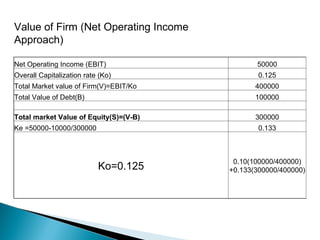
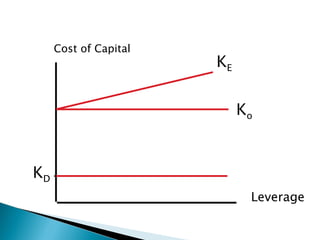
Assumption:- K d  (Cost of Debt) and K o  (Overall cost of capital)   remains constant at all level of leverage. With the increase in leverage (D/E ratio) Debt which has a cost less than cost of equity gain a higher weight but still K o  remains constant at the same level since with the increase in leverage, there is an increase in financial risk. With the increase in leverage debt as a cheaper source of finance gain the higher wealth.
Value of Firm (Net Operating Income Approach) Net Operating Income (EBIT) 50000 Overall Capitalization rate (Ko) 0.125 Total Market value of Firm(V)=EBIT/Ko 400000 Total Value of Debt(B) 100000     Total market Value of Equity(S)=(V-B) 300000 Ke =50000-10000/300000 0.133 Ko=0.125 0.10(100000/400000) +0.133(300000/400000)
Cost of Capital Leverage K D K E K o
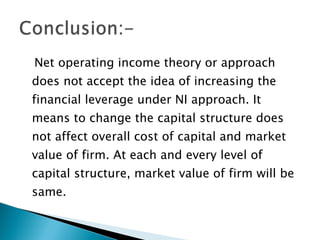
Net operating income theory or approach does not accept the idea of increasing the financial leverage under NI approach. It means to change the capital structure does not affect overall cost of capital and market value of firm. At each and every level of capital structure, market value of firm will be same. 
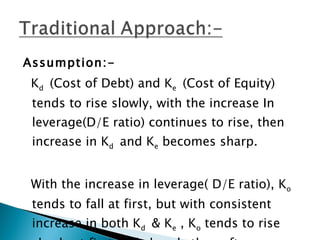
Assumption:- K d  (Cost of Debt) and K e  (Cost of Equity)   tends to rise slowly, with the increase In leverage(D/E ratio) continues to rise, then increase in K d  and K e  becomes sharp. With the increase in leverage( D/E ratio), K o  tends to fall at first, but with consistent increase in both K d  & K e  , K o  tends to rise slowly at first and sharply thereafter.
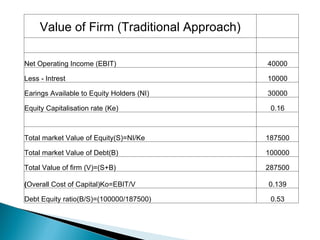
Value of Firm (Traditional Approach)       Net Operating Income (EBIT) 40000 Less - Intrest  10000 Earings Available to Equity Holders (NI) 30000 Equity Capitalisation rate (Ke) 0.16     Total market Value of Equity(S)=NI/Ke 187500 Total market Value of Debt(B) 100000 Total Value of firm (V)=(S+B) 287500 ( Overall Cost of Capital)Ko=EBIT/V  0.139 Debt Equity ratio(B/S)=(100000/187500) 0.53
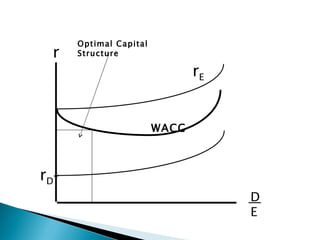
r D E r D r E WACC Optimal Capital Structure
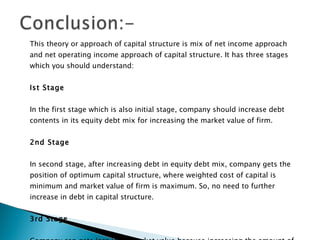
This theory or approach of capital structure is mix of net income approach and net operating income approach of capital structure. It has three stages which you should understand: Ist Stage In the first stage which is also initial stage, company should increase debt contents in its equity debt mix for increasing the market value of firm.  2nd Stage In second stage, after increasing debt in equity debt mix, company gets the position of optimum capital structure, where weighted cost of capital is minimum and market value of firm is maximum. So, no need to further increase in debt in capital structure.  3rd Stage Company can gets loss in its market value because increasing the amount of debt in capital structure after its optimum level will definitely increase the cost of debt and overall cost of capital. 
Modigiliani – Miller model (MM) was presented in 1958 on the relationship between the leverage, cost of capital and the value of the firm. They have shown that the financial leverage does not matter and the cost of capital and value of firm are independent of the capital structure.
The capital markets are perfect and complete information is available to all the investors free of cost. The securities are infinitely divisible. Investors are rational and well-informed about the risk-return of all the securities. All the investors have same probability distribution about the expected future earnings. There is no corporate income tax The personal leverage and the corporate leverage are perfect substitute.
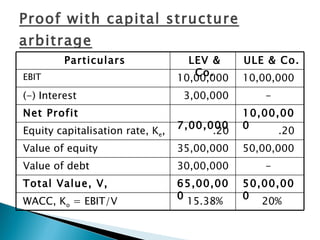
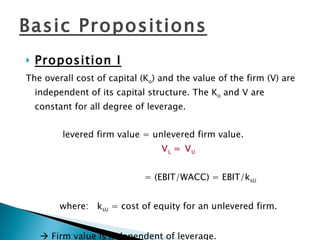
Proposition I The overall cost of capital (K o ) and the value of the firm (V) are independent of its capital structure. The K o  and V are constant for all degree of leverage. levered firm value = unlevered firm value.  V L  = V U     = (EBIT/WACC) = EBIT/k sU where:  k sU  = cost of equity for an unlevered firm.    Firm value is independent of leverage. Basic Propositions
Proof with capital structure arbitrage 20% 15.38% WACC, K o  = EBIT/V 50,00,000 65,00,000 Total Value, V, - 30,00,000 Value of debt 50,00,000 35,00,000 Value of equity .20 .20  Equity capitalisation rate, K e , 10,00,000 7,00,000 Net Profit -  3,00,000 (-) Interest 10,00,000 10,00,000 EBIT ULE & Co. LEV & Co. Particulars
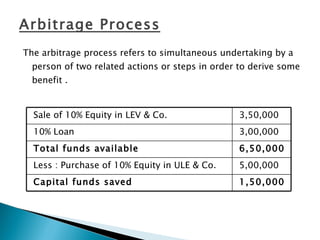
Arbitrage Process   The arbitrage process refers to simultaneous undertaking by a person of two related actions or steps in order to derive some benefit . 1,50,000 Capital funds saved 5,00,000 Less : Purchase of 10% Equity in ULE & Co. 6,50,000 Total funds available 3,00,000 10% Loan 3,50,000 Sale of 10% Equity in LEV & Co.
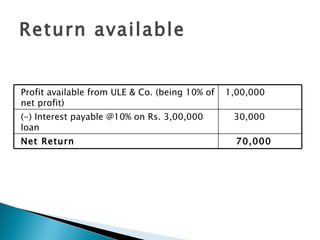
Return available 70,000 Net Return 30,000 (-) Interest payable @10% on Rs. 3,00,000 loan 1,00,000 Profit available from ULE & Co. (being 10% of net profit)
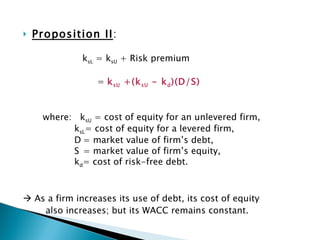
Proposition II : k sL  = k sU  + Risk premium   =  k sU  +(k sU  - k d )(D/S) where:  k sU  = cost of equity for an unlevered firm,   k sL = cost of equity for a levered firm,   D = market value of firm’s debt,   S = market value of firm’s equity,   k d = cost of risk-free debt.    As a firm increases its use of debt, its cost of equity also increases; but its WACC remains constant.
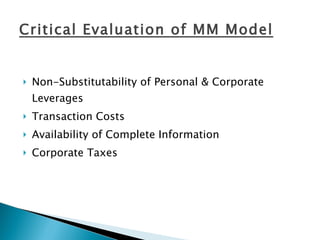
Critical Evaluation of MM Model Non-Substitutability of Personal & Corporate Leverages Transaction Costs Availability of Complete Information  Corporate Taxes

Capital structure analysis

  • 1.
    Made By:- Vikram,Ankit, Preeti, Arpan & Vikas
  • 2.
    Capital Structure refersto the combination of mix of debt and equity which a company uses to finance its long term operations.
  • 3.
    … cana company increase its value simply by altering its capital structure? … yes and no … we will see….
  • 4.
    The additional riskplaced on the common stockholders as a result of the decision to finance with debt. Leverage increases shareholder risk. Leverage also increases the return on equity (to compensate for the higher risk).
  • 5.
    There are onlytwo source of finance Debt & Equity, no Preference. No tax. No flotation cost. Assets of a firm remains constant. Business risk remains constant (that is EBIT remains constant). No retained earnings.
  • 6.
    Main objective offinancial management is maximization of share holder’s wealth. To be optimum which maximize the market value of equity shares. Price Earning ratio= Market Price per share earning per share To Increase growth of company
  • 7.
    Net Income ApproachNet Operating Income Approach Traditional Approach MM( Modigliani-Miller) Approach
  • 8.
    Assumption:- K d (Cost of Debt) and K e (Cost of Equity) remains constant at all level of leverage. This Approach is between leverage, Cost of Capital and Value of firm. There is a straight relationship between capital structure and Value of firm.
  • 9.
    A Firm canassess its value by increasing or decreasing the Debt proportion in overall proportion mix. Financial Leverage Overall Cost of Capital Value of Firm VF=EBIT/K o
  • 10.
    Value of Firm(Net Income Approach) Increase Decrease Net Operating Income (EBIT) 50000 50000 50000 Less Intrest on Debenture 20000 30000 10000 Earning available to Equity Holder(NI) 30000 20000 40000 Equity Capitalisation rate (Ke) 0.125 0.125 0.125 Market value of Equity(S)=NI/Ke 240000 160000 320000 Market Value of Debt(B) 200000 300000 100000         Total Value of firm(S+B=V) 440000 460000 420000 Overall Cost of Capital(Ko)=EBIT/V(%) 11.36% 10.90% 11.90% Cost of Equity 0.10(200000/4400000) +0.125(240000/440000)   _ _ 
  • 11.
    Cost of CapitalLeverage K D K E K o
  • 12.
    This theory givesthe idea for increasing market value of firm and decreasing overall cost of capital. A firm can choose a degree of capital structure in which debt is more than equity share capital. It will be helpful to increase the market value of firm and decrease the value of overall cost of capital. Debt is cheap source of finance because its interest is deductible from net profit before taxes. After deduction of interest company has to pay less tax and thus, it will decrease the weighted average cost of capital. 
  • 13.
    Assumption:- K d (Cost of Debt) and K o (Overall cost of capital) remains constant at all level of leverage. With the increase in leverage (D/E ratio) Debt which has a cost less than cost of equity gain a higher weight but still K o remains constant at the same level since with the increase in leverage, there is an increase in financial risk. With the increase in leverage debt as a cheaper source of finance gain the higher wealth.
  • 14.
    Value of Firm(Net Operating Income Approach) Net Operating Income (EBIT) 50000 Overall Capitalization rate (Ko) 0.125 Total Market value of Firm(V)=EBIT/Ko 400000 Total Value of Debt(B) 100000     Total market Value of Equity(S)=(V-B) 300000 Ke =50000-10000/300000 0.133 Ko=0.125 0.10(100000/400000) +0.133(300000/400000)
  • 15.
    Cost of CapitalLeverage K D K E K o
  • 16.
    Net operating incometheory or approach does not accept the idea of increasing the financial leverage under NI approach. It means to change the capital structure does not affect overall cost of capital and market value of firm. At each and every level of capital structure, market value of firm will be same. 
  • 17.
    Assumption:- K d (Cost of Debt) and K e (Cost of Equity) tends to rise slowly, with the increase In leverage(D/E ratio) continues to rise, then increase in K d and K e becomes sharp. With the increase in leverage( D/E ratio), K o tends to fall at first, but with consistent increase in both K d & K e , K o tends to rise slowly at first and sharply thereafter.
  • 18.
    Value of Firm(Traditional Approach)       Net Operating Income (EBIT) 40000 Less - Intrest 10000 Earings Available to Equity Holders (NI) 30000 Equity Capitalisation rate (Ke) 0.16     Total market Value of Equity(S)=NI/Ke 187500 Total market Value of Debt(B) 100000 Total Value of firm (V)=(S+B) 287500 ( Overall Cost of Capital)Ko=EBIT/V 0.139 Debt Equity ratio(B/S)=(100000/187500) 0.53
  • 19.
    r D Er D r E WACC Optimal Capital Structure
  • 20.
    This theory orapproach of capital structure is mix of net income approach and net operating income approach of capital structure. It has three stages which you should understand: Ist Stage In the first stage which is also initial stage, company should increase debt contents in its equity debt mix for increasing the market value of firm.  2nd Stage In second stage, after increasing debt in equity debt mix, company gets the position of optimum capital structure, where weighted cost of capital is minimum and market value of firm is maximum. So, no need to further increase in debt in capital structure.  3rd Stage Company can gets loss in its market value because increasing the amount of debt in capital structure after its optimum level will definitely increase the cost of debt and overall cost of capital. 
  • 21.
    Modigiliani – Millermodel (MM) was presented in 1958 on the relationship between the leverage, cost of capital and the value of the firm. They have shown that the financial leverage does not matter and the cost of capital and value of firm are independent of the capital structure.

  • 22.
    The capital marketsare perfect and complete information is available to all the investors free of cost. The securities are infinitely divisible. Investors are rational and well-informed about the risk-return of all the securities. All the investors have same probability distribution about the expected future earnings. There is no corporate income tax The personal leverage and the corporate leverage are perfect substitute.
  • 23.
    Proposition I Theoverall cost of capital (K o ) and the value of the firm (V) are independent of its capital structure. The K o and V are constant for all degree of leverage. levered firm value = unlevered firm value. V L = V U = (EBIT/WACC) = EBIT/k sU where: k sU = cost of equity for an unlevered firm.  Firm value is independent of leverage. Basic Propositions
  • 24.
    Proof with capitalstructure arbitrage 20% 15.38% WACC, K o = EBIT/V 50,00,000 65,00,000 Total Value, V, - 30,00,000 Value of debt 50,00,000 35,00,000 Value of equity .20 .20 Equity capitalisation rate, K e , 10,00,000 7,00,000 Net Profit - 3,00,000 (-) Interest 10,00,000 10,00,000 EBIT ULE & Co. LEV & Co. Particulars
  • 25.
    Arbitrage Process The arbitrage process refers to simultaneous undertaking by a person of two related actions or steps in order to derive some benefit . 1,50,000 Capital funds saved 5,00,000 Less : Purchase of 10% Equity in ULE & Co. 6,50,000 Total funds available 3,00,000 10% Loan 3,50,000 Sale of 10% Equity in LEV & Co.
  • 26.
    Return available 70,000Net Return 30,000 (-) Interest payable @10% on Rs. 3,00,000 loan 1,00,000 Profit available from ULE & Co. (being 10% of net profit)
  • 27.
    Proposition II :k sL = k sU + Risk premium = k sU +(k sU - k d )(D/S) where: k sU = cost of equity for an unlevered firm, k sL = cost of equity for a levered firm, D = market value of firm’s debt, S = market value of firm’s equity, k d = cost of risk-free debt.  As a firm increases its use of debt, its cost of equity also increases; but its WACC remains constant.
  • 28.
    Critical Evaluation ofMM Model Non-Substitutability of Personal & Corporate Leverages Transaction Costs Availability of Complete Information Corporate Taxes

Editor's Notes