ITM VOCATIONAL UNIVERSITY
SUBJECT: FINANCIAL MANAGEMENT
UNIT – 2
CAHAPTER- 2
CAPITAL STRUCTURE
FACULTY NAME: KISHOR CHAUHAN
COURSE NAME: BBA – II SEMESTER
SESSION NUMBER:
Meaning and Concept of Capital Structure:
• Capital structure is the combination of
capital from different sources of the
finance.
• It refers to the proportions of equity
share capital, preference share capital,
debentures, long-term loans, retained
earnings and other long-term sources of
funds in the total amount of capital which
a firm raises to run its business
The source and amount of capital is decided keeping in
mind the following factors.
1. Control: Capital structure should be designed in such a
manner that existing shareholders do not lose control.
2. Risk: Capital structure should be designed in such a
manner that it does not increase financial risk
3. Cost: Capital structure should be designed in such a
manner that overall cost of capital remains minimum.
However, practically it is difficult to achieve these three
goals hence a finance manager has to bring a balance
among these three goals.
Meaning and Concept of Capital Structure:
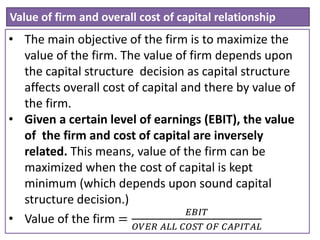
• The main objective of the firm is to maximize the
value of the firm. The value of firm depends upon
the capital structure decision as capital structure
affects overall cost of capital and there by value of
the firm.
• Given a certain level of earnings (EBIT), the value
of the firm and cost of capital are inversely
related. This means, value of the firm can be
maximized when the cost of capital is kept
minimum (which depends upon sound capital
structure decision.)
• Value of the firm =
𝐸𝐵𝐼𝑇
𝑂𝑉𝐸𝑅 𝐴𝐿𝐿 𝐶𝑂𝑆𝑇 𝑂𝐹 𝐶𝐴𝑃𝐼𝑇𝐴𝐿
Value of firm and overall cost of capital relationship
• In general, the optimal capital structure is a
mix of debt and equity that tries to lower the
cost of capital and maximize the value of the
firm.
• To calculate the optimal capital structure of a
firm, we have to calculate the weighted
average cost of capital (WACC) to determine
the level of risk that makes the expected
return on capital greater than the cost of
capital.
Optimal Capital Structure
• Risk-return tradeoff is the relationship between
risk of investing in financial market instruments
and expected return from them.
Risk-return tradeoff
PORTFOLIO
RISK RETURN TRADE OFF
LOW RISK
HIGH RISK
CALCULATING REQUIRED RATE OF RETURN
THE DYNAMICS OF RISK-RETURN TRADEOFF
LOW RISK : The bottom-left corner of the graph shows that there is
low return for low-risk financial instruments. For example,
Government-issued bonds.
HIGH RISK : As we move along the upward sloping line in the graph,
the risk rises and also the potential return.
FINANCING DECISION PROCESS
ASSUMPTIONS
To examine the relationship between capital
structure and value of the firm (or cost of capital),
following assumptions are made.
1.There is no income tax.
2.Firm distributes its all earnings (EBIT) as dividend
to share holders. i.e., 100 % dividend pay out ratio
is assumed.
3.The operating income remains fixed.
4.A firm can change its capital structure without
incurring transaction cost.
Keeping in mind above assumptions, the analysis focuses on the following rates.
1. Cost of debt (rD):
rD =
𝐈
𝐃
=
𝐀𝐍𝐍𝐔𝐀𝐋 𝐈𝐍𝐓𝐄𝐑𝐄𝐒𝐓
𝐌𝐀𝐑𝐊𝐄𝐓 𝐕𝐀𝐋𝐔𝐄 𝐎𝐅 𝐃𝐄𝐁𝐓
2. Cost of Equity (rE):
rE =
𝐏
𝐄
=
𝐄𝐐𝐔𝐈𝐓𝐘 𝐄𝐀𝐑𝐍𝐈𝐍𝐆𝐒
𝐌𝐀𝐑𝐊𝐄𝐓 𝐕𝐀𝐋𝐔𝐄 𝐎𝐅 𝐄𝐐𝐔𝐈𝐓𝐘
(ASSUMING 100 % DIVIDEND PAY OUT RATIO, AND CONSTANT EARNINGS)
3. Overall capitalisation rate or weighted average cost of capital (rA):
rA =
𝐎
𝐕
=
𝐎𝐏𝐄𝐑𝐀𝐓𝐈𝐍𝐆 𝐈𝐍𝐂𝐎𝐌𝐄
𝐌𝐀𝐑𝐊𝐄𝐓 𝐕𝐀𝐋𝐔𝐄 𝐎𝐅 𝐓𝐇𝐄 𝐅𝐈𝐑𝐌
Where, V = D + E = MARKET VALUE OF DEBT + MARKET VALUE OF EQUITY
What happens to rD, rE and rA when financial leverage D/E changes?
Let us discuss this in next sections.
CAPITAL STRUCTURE THEORIES
NET INCOME APPROACH
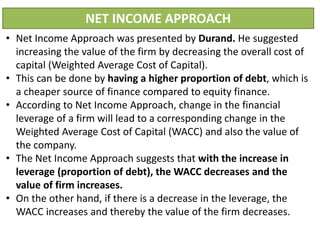
• Net Income Approach was presented by Durand. He suggested
increasing the value of the firm by decreasing the overall cost of
capital (Weighted Average Cost of Capital).
• This can be done by having a higher proportion of debt, which is
a cheaper source of finance compared to equity finance.
• According to Net Income Approach, change in the financial
leverage of a firm will lead to a corresponding change in the
Weighted Average Cost of Capital (WACC) and also the value of
the company.
• The Net Income Approach suggests that with the increase in
leverage (proportion of debt), the WACC decreases and the
value of firm increases.
• On the other hand, if there is a decrease in the leverage, the
WACC increases and thereby the value of the firm decreases.
Below given graph shows that
• with increase in D/E , rA decreases because the proportion of
debt increases in the capital structure.
• Cost of debt and cost of equity assumed remains same.
rA
rE
rD
Leverage or D/E
RATE
OF
RETURN
rE
Illustration: There are two firms A and B similar in all aspects except in the degree of
leverage employed by them. Financial data of both the firms are as follow.
Particulars Firm – A Firm – B
(O) Operating income Rs. 10,000 Rs. 10,000
( I ) Interest on debt Rs. Nil Rs. 3,000
(P) Equity Earnings Rs. 10,000 Rs. 7,000
(rE)Cost of equity capital 10 % 10 %
(rD)Cost of debt capital 6 % 6 %
E Market value of equity Rs. 1,00,000 Rs. 70,000
D Market value of debt Rs. Nil Rs. 50,000
V Total value of the firm(D+E) Rs. 1,00,000 Rs. 1,20,000
Average cost of capital = rD [
𝑫
𝑫+𝑬
] +rE [
𝑬
𝑫+𝑬
]
FIRM - A = 6 % [ 0 / 100000] + 10 % [ 100000/100000]
FIRM - A = 0 + 10
FIRM - A = 10 %
FIRM - B = 6 % [ 50000 / 120000] + 10 % [ 70000/120000]
FIRM – B = 0.025 + 0.0583
FIRM- B = 0.0833 X 100
FIRM - B = 8.33 %
We can see Firm B has used leverage which has reduced its cost of capital to 8.33 %.
Practice exercise: There are two firms X and Y similar in all aspects
except in the degree of leverage employed by them. Financial data of
both the firms are as follow. Calculate overall cost of capital and
comment on result.
Particulars Firm – X Firm – Y
(O) Operating income Rs. 20,000 Rs. 20,000
( I ) Interest on debt Rs. Nil Rs. 3,600
(P) Equity Earnings Rs. 15,000 Rs. 8,000
(rE)Cost of equity capital 10 % 10 %
(rD)Cost of debt capital 6 % 6 %
E Market value of equity Rs. 1,50,000 Rs. 80,000
D Market value of debt Rs. Nil Rs. 60,000
V Total value of the firm(D+E) Rs. 1,00,000 Rs. 1,40,000
Answer= ___________
TRADITIONAL APPROACH
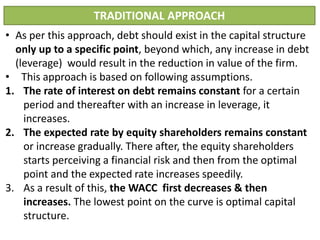
• As per this approach, debt should exist in the capital structure
only up to a specific point, beyond which, any increase in debt
(leverage) would result in the reduction in value of the firm.
• This approach is based on following assumptions.
1. The rate of interest on debt remains constant for a certain
period and thereafter with an increase in leverage, it
increases.
2. The expected rate by equity shareholders remains constant
or increase gradually. There after, the equity shareholders
starts perceiving a financial risk and then from the optimal
point and the expected rate increases speedily.
3. As a result of this, the WACC first decreases & then
increases. The lowest point on the curve is optimal capital
structure.
Main highlight of traditional approach:
1. This approach advocates that there should be a right combination of
equity and debt in the capital structure, at which the market value of
a firm is maximum.
2. The firm should try to reach at the optimal capital structure by using
both debt and capital in a judicial way as at the optimal capital
structure overall cost of capital is minimum and value of firm would
be maximum.
NET OPERATING INCOME APPROACH
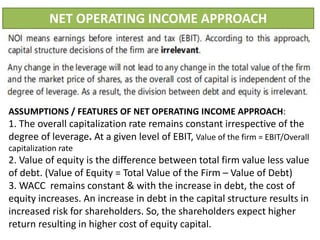
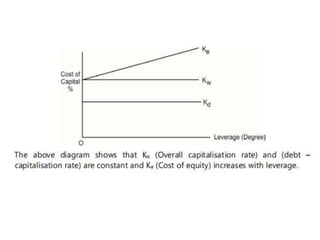
ASSUMPTIONS / FEATURES OF NET OPERATING INCOME APPROACH:
1. The overall capitalization rate remains constant irrespective of the
degree of leverage. At a given level of EBIT, Value of the firm = EBIT/Overall
capitalization rate
2. Value of equity is the difference between total firm value less value
of debt. (Value of Equity = Total Value of the Firm – Value of Debt)
3. WACC remains constant & with the increase in debt, the cost of
equity increases. An increase in debt in the capital structure results in
increased risk for shareholders. So, the shareholders expect higher
return resulting in higher cost of equity capital.
Illustrations: Two firms A and B are similar in all aspects except the degree of leverage.
Relevent financial data for the firms are given below
Particulars Firm – A Firm – B
(O) Net Operating income Rs. 10,000 Rs. 10,000
(rA) Over all capitalisation rate 0.15 0.15
( I ) Interest on debt Rs. 1000 Rs. 3,000
(rD)Cost of debt capital 0.10 0.10
(E) Market value of equity Rs. 56667 Rs. 36667
(D) Market value of debt Rs. 10000 Rs. 30,000
(V) Total value of the firm(D+E) Rs. 66667 Rs. 66667
(D/E) Debt equity ratio 0.176 0.818
The equity capitalisation rates of the firms are as follow;
Firm A = equity earnings / market value of equity
= 9000 / 56667 = 0.159 = 15.9 %
Firm B = equity earnings / market value of equity
= 7000 / 36667 = 0.191 = 19.1 %
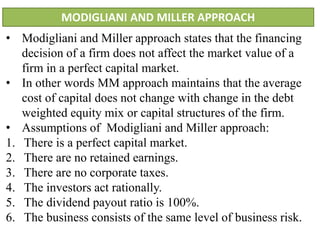
MODIGLIANI AND MILLER APPROACH
• Modigliani and Miller approach states that the financing
decision of a firm does not affect the market value of a
firm in a perfect capital market.
• In other words MM approach maintains that the average
cost of capital does not change with change in the debt
weighted equity mix or capital structures of the firm.
• Assumptions of Modigliani and Miller approach:
1. There is a perfect capital market.
2. There are no retained earnings.
3. There are no corporate taxes.
4. The investors act rationally.
5. The dividend payout ratio is 100%.
6. The business consists of the same level of business risk.
Value of the firm can be calculated with the help of the following formula:
Value of firm = EBIT/KO (1-t)
Where
EBIT = Earnings before interest and tax
Ko = Overall cost of capital
t = Tax rate
EXERCISE: 1
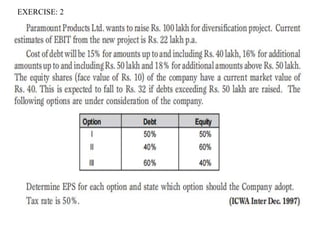
EXERCISE: 2
3
Solution
Both the firms have EBIT of Rs. 18,000.
Company X has to pay interest of Rs. 3600 (i.e., 6% on Rs. 60,000) and
the remaining profit of Rs. 14,400 (18000 – 3600)is being distributed among the shareholders.
The Company Y has no interest liability and therefore is distributing Rs.18,000 among the
shareholders.
The investor will be well off under MM Model by selling the shares of X and shifting to
shares of Y company through the arbitrage process as follows.
If he sells shares of X Company, he gets Rs. 10,800 (9,000 shares @ Rs.1.2 per share).
He now takes a 6% loan of Rs.6,000 and out of the total cash of Rs. 16,800 he purchases 10%
of shares of Company Y for Rs. 15,000; his position with regard to Company Y would be as
follows:

capital structure.pptx

  • 1.
    ITM VOCATIONAL UNIVERSITY SUBJECT:FINANCIAL MANAGEMENT UNIT – 2 CAHAPTER- 2 CAPITAL STRUCTURE FACULTY NAME: KISHOR CHAUHAN COURSE NAME: BBA – II SEMESTER SESSION NUMBER:
  • 2.
    Meaning and Conceptof Capital Structure: • Capital structure is the combination of capital from different sources of the finance. • It refers to the proportions of equity share capital, preference share capital, debentures, long-term loans, retained earnings and other long-term sources of funds in the total amount of capital which a firm raises to run its business
  • 3.
    The source andamount of capital is decided keeping in mind the following factors. 1. Control: Capital structure should be designed in such a manner that existing shareholders do not lose control. 2. Risk: Capital structure should be designed in such a manner that it does not increase financial risk 3. Cost: Capital structure should be designed in such a manner that overall cost of capital remains minimum. However, practically it is difficult to achieve these three goals hence a finance manager has to bring a balance among these three goals. Meaning and Concept of Capital Structure:
  • 4.
    • The mainobjective of the firm is to maximize the value of the firm. The value of firm depends upon the capital structure decision as capital structure affects overall cost of capital and there by value of the firm. • Given a certain level of earnings (EBIT), the value of the firm and cost of capital are inversely related. This means, value of the firm can be maximized when the cost of capital is kept minimum (which depends upon sound capital structure decision.) • Value of the firm = 𝐸𝐵𝐼𝑇 𝑂𝑉𝐸𝑅 𝐴𝐿𝐿 𝐶𝑂𝑆𝑇 𝑂𝐹 𝐶𝐴𝑃𝐼𝑇𝐴𝐿 Value of firm and overall cost of capital relationship
  • 5.
    • In general,the optimal capital structure is a mix of debt and equity that tries to lower the cost of capital and maximize the value of the firm. • To calculate the optimal capital structure of a firm, we have to calculate the weighted average cost of capital (WACC) to determine the level of risk that makes the expected return on capital greater than the cost of capital. Optimal Capital Structure
  • 6.
    • Risk-return tradeoffis the relationship between risk of investing in financial market instruments and expected return from them. Risk-return tradeoff PORTFOLIO RISK RETURN TRADE OFF LOW RISK HIGH RISK CALCULATING REQUIRED RATE OF RETURN
  • 7.
    THE DYNAMICS OFRISK-RETURN TRADEOFF LOW RISK : The bottom-left corner of the graph shows that there is low return for low-risk financial instruments. For example, Government-issued bonds. HIGH RISK : As we move along the upward sloping line in the graph, the risk rises and also the potential return.
  • 8.
  • 9.
    ASSUMPTIONS To examine therelationship between capital structure and value of the firm (or cost of capital), following assumptions are made. 1.There is no income tax. 2.Firm distributes its all earnings (EBIT) as dividend to share holders. i.e., 100 % dividend pay out ratio is assumed. 3.The operating income remains fixed. 4.A firm can change its capital structure without incurring transaction cost.
  • 10.
    Keeping in mindabove assumptions, the analysis focuses on the following rates. 1. Cost of debt (rD): rD = 𝐈 𝐃 = 𝐀𝐍𝐍𝐔𝐀𝐋 𝐈𝐍𝐓𝐄𝐑𝐄𝐒𝐓 𝐌𝐀𝐑𝐊𝐄𝐓 𝐕𝐀𝐋𝐔𝐄 𝐎𝐅 𝐃𝐄𝐁𝐓 2. Cost of Equity (rE): rE = 𝐏 𝐄 = 𝐄𝐐𝐔𝐈𝐓𝐘 𝐄𝐀𝐑𝐍𝐈𝐍𝐆𝐒 𝐌𝐀𝐑𝐊𝐄𝐓 𝐕𝐀𝐋𝐔𝐄 𝐎𝐅 𝐄𝐐𝐔𝐈𝐓𝐘 (ASSUMING 100 % DIVIDEND PAY OUT RATIO, AND CONSTANT EARNINGS) 3. Overall capitalisation rate or weighted average cost of capital (rA): rA = 𝐎 𝐕 = 𝐎𝐏𝐄𝐑𝐀𝐓𝐈𝐍𝐆 𝐈𝐍𝐂𝐎𝐌𝐄 𝐌𝐀𝐑𝐊𝐄𝐓 𝐕𝐀𝐋𝐔𝐄 𝐎𝐅 𝐓𝐇𝐄 𝐅𝐈𝐑𝐌 Where, V = D + E = MARKET VALUE OF DEBT + MARKET VALUE OF EQUITY What happens to rD, rE and rA when financial leverage D/E changes? Let us discuss this in next sections.
  • 11.
  • 12.
    NET INCOME APPROACH •Net Income Approach was presented by Durand. He suggested increasing the value of the firm by decreasing the overall cost of capital (Weighted Average Cost of Capital). • This can be done by having a higher proportion of debt, which is a cheaper source of finance compared to equity finance. • According to Net Income Approach, change in the financial leverage of a firm will lead to a corresponding change in the Weighted Average Cost of Capital (WACC) and also the value of the company. • The Net Income Approach suggests that with the increase in leverage (proportion of debt), the WACC decreases and the value of firm increases. • On the other hand, if there is a decrease in the leverage, the WACC increases and thereby the value of the firm decreases.
  • 13.
    Below given graphshows that • with increase in D/E , rA decreases because the proportion of debt increases in the capital structure. • Cost of debt and cost of equity assumed remains same. rA rE rD Leverage or D/E RATE OF RETURN
  • 14.
  • 15.
    Illustration: There aretwo firms A and B similar in all aspects except in the degree of leverage employed by them. Financial data of both the firms are as follow. Particulars Firm – A Firm – B (O) Operating income Rs. 10,000 Rs. 10,000 ( I ) Interest on debt Rs. Nil Rs. 3,000 (P) Equity Earnings Rs. 10,000 Rs. 7,000 (rE)Cost of equity capital 10 % 10 % (rD)Cost of debt capital 6 % 6 % E Market value of equity Rs. 1,00,000 Rs. 70,000 D Market value of debt Rs. Nil Rs. 50,000 V Total value of the firm(D+E) Rs. 1,00,000 Rs. 1,20,000 Average cost of capital = rD [ 𝑫 𝑫+𝑬 ] +rE [ 𝑬 𝑫+𝑬 ] FIRM - A = 6 % [ 0 / 100000] + 10 % [ 100000/100000] FIRM - A = 0 + 10 FIRM - A = 10 % FIRM - B = 6 % [ 50000 / 120000] + 10 % [ 70000/120000] FIRM – B = 0.025 + 0.0583 FIRM- B = 0.0833 X 100 FIRM - B = 8.33 % We can see Firm B has used leverage which has reduced its cost of capital to 8.33 %.
  • 16.
    Practice exercise: Thereare two firms X and Y similar in all aspects except in the degree of leverage employed by them. Financial data of both the firms are as follow. Calculate overall cost of capital and comment on result. Particulars Firm – X Firm – Y (O) Operating income Rs. 20,000 Rs. 20,000 ( I ) Interest on debt Rs. Nil Rs. 3,600 (P) Equity Earnings Rs. 15,000 Rs. 8,000 (rE)Cost of equity capital 10 % 10 % (rD)Cost of debt capital 6 % 6 % E Market value of equity Rs. 1,50,000 Rs. 80,000 D Market value of debt Rs. Nil Rs. 60,000 V Total value of the firm(D+E) Rs. 1,00,000 Rs. 1,40,000 Answer= ___________
  • 17.
    TRADITIONAL APPROACH • Asper this approach, debt should exist in the capital structure only up to a specific point, beyond which, any increase in debt (leverage) would result in the reduction in value of the firm. • This approach is based on following assumptions. 1. The rate of interest on debt remains constant for a certain period and thereafter with an increase in leverage, it increases. 2. The expected rate by equity shareholders remains constant or increase gradually. There after, the equity shareholders starts perceiving a financial risk and then from the optimal point and the expected rate increases speedily. 3. As a result of this, the WACC first decreases & then increases. The lowest point on the curve is optimal capital structure.
  • 18.
    Main highlight oftraditional approach: 1. This approach advocates that there should be a right combination of equity and debt in the capital structure, at which the market value of a firm is maximum. 2. The firm should try to reach at the optimal capital structure by using both debt and capital in a judicial way as at the optimal capital structure overall cost of capital is minimum and value of firm would be maximum.
  • 19.
    NET OPERATING INCOMEAPPROACH ASSUMPTIONS / FEATURES OF NET OPERATING INCOME APPROACH: 1. The overall capitalization rate remains constant irrespective of the degree of leverage. At a given level of EBIT, Value of the firm = EBIT/Overall capitalization rate 2. Value of equity is the difference between total firm value less value of debt. (Value of Equity = Total Value of the Firm – Value of Debt) 3. WACC remains constant & with the increase in debt, the cost of equity increases. An increase in debt in the capital structure results in increased risk for shareholders. So, the shareholders expect higher return resulting in higher cost of equity capital.
  • 23.
    Illustrations: Two firmsA and B are similar in all aspects except the degree of leverage. Relevent financial data for the firms are given below Particulars Firm – A Firm – B (O) Net Operating income Rs. 10,000 Rs. 10,000 (rA) Over all capitalisation rate 0.15 0.15 ( I ) Interest on debt Rs. 1000 Rs. 3,000 (rD)Cost of debt capital 0.10 0.10 (E) Market value of equity Rs. 56667 Rs. 36667 (D) Market value of debt Rs. 10000 Rs. 30,000 (V) Total value of the firm(D+E) Rs. 66667 Rs. 66667 (D/E) Debt equity ratio 0.176 0.818 The equity capitalisation rates of the firms are as follow; Firm A = equity earnings / market value of equity = 9000 / 56667 = 0.159 = 15.9 % Firm B = equity earnings / market value of equity = 7000 / 36667 = 0.191 = 19.1 %
  • 24.
    MODIGLIANI AND MILLERAPPROACH • Modigliani and Miller approach states that the financing decision of a firm does not affect the market value of a firm in a perfect capital market. • In other words MM approach maintains that the average cost of capital does not change with change in the debt weighted equity mix or capital structures of the firm. • Assumptions of Modigliani and Miller approach: 1. There is a perfect capital market. 2. There are no retained earnings. 3. There are no corporate taxes. 4. The investors act rationally. 5. The dividend payout ratio is 100%. 6. The business consists of the same level of business risk.
  • 25.
    Value of thefirm can be calculated with the help of the following formula: Value of firm = EBIT/KO (1-t) Where EBIT = Earnings before interest and tax Ko = Overall cost of capital t = Tax rate
  • 26.
  • 27.
  • 29.
  • 30.
    Solution Both the firmshave EBIT of Rs. 18,000. Company X has to pay interest of Rs. 3600 (i.e., 6% on Rs. 60,000) and the remaining profit of Rs. 14,400 (18000 – 3600)is being distributed among the shareholders. The Company Y has no interest liability and therefore is distributing Rs.18,000 among the shareholders. The investor will be well off under MM Model by selling the shares of X and shifting to shares of Y company through the arbitrage process as follows. If he sells shares of X Company, he gets Rs. 10,800 (9,000 shares @ Rs.1.2 per share). He now takes a 6% loan of Rs.6,000 and out of the total cash of Rs. 16,800 he purchases 10% of shares of Company Y for Rs. 15,000; his position with regard to Company Y would be as follows: