
Pecking Order Theory
Under the guidance of
Sundar B. N.
Asst. Prof. & Course Co-ordinator
GFGCW, PG Studies in Commerce
Holenarasipura
Ramyashree S
1st M.com
 Introduction
 Components of the Pecking Order Theory
 Pecking Order Theory
 Factors
 Example
 Solution
 Conclusion
 Reference
Content
 The pecking order theory suggests that there is an
order of preference for the firm of capital sources
when funding is needed.
 This theory made popular by Stewart Myers and
Nicolas Majluf in 1984 the theory states that
managers follow a hierarchy when considering
sources of financing.
Introduction
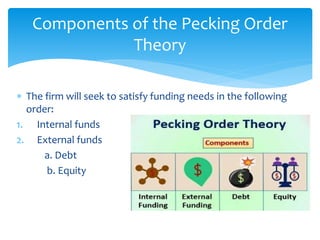
 The firm will seek to satisfy funding needs in the following
order:
1. Internal funds
2. External funds
a. Debt
b. Equity
Components of the Pecking Order
Theory
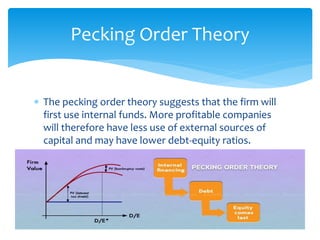
 The pecking order theory suggests that the firm will
first use internal funds. More profitable companies
will therefore have less use of external sources of
capital and may have lower debt-equity ratios.
Pecking Order Theory
Continue..
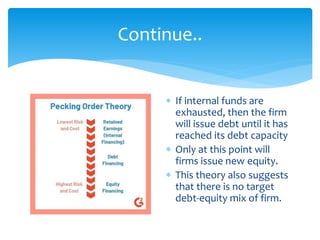
 If internal funds are
exhausted, then the firm
will issue debt until it has
reached its debt capacity
 Only at this point will
firms issue new equity.
 This theory also suggests
that there is no target
debt-equity mix of firm.
 There are three factors that the pecking order theory
is based on and that must be considered by firms
when raising capital.
 Internal funds are cheapest to use and
require no private information release.
 Debt financing is cheaper than equity financing.
 Managers tend to know more about the future
performance of the firm than lenders and investors.
Factors
 Suppose ABC Company is looking to raise $ 10 million for
project. The company’s stock price is currently trading at
$53.77. Three options are available for ABC Company:
1. Finance the project directly through retained
earnings;
2. One-year debt financing with an interest rate of 9%,
although management believes that 7%is the fair rate.
3. Issuance of equity that will underprice the current stock
price by 7%.
Example
 Option 1: If management finances the project directly
through retained earnings, the cost is $10 million.
 Option 2: If management finances the project through
debt issuance, the one-year debt would cost $10.8
million ($10 X 1.08 = $10.8). Discounting it back one
year with the management’s fair rate would yield
a cost of $10.09 million ($10.8 / 1.07 = $10.09 million).
Solution
 Option 3: If management finances the project
through equity issuance, to raise $10 million, the
company would need to sell 200,000 shares ($53.77 X
0.93 = $50, $10,000,000 / $50 = 200,000 shares). The
true value of the shares would be $10.75 million
($53.77 X 200,000 shares = $ 10.75 million). Therefore,
the cost would be $10.75 million.
Continue..
 The capital structure is the particular combination of debt
and equity used by a company to finance its overall
operations and growth.
 The pecking order theory states that a company should
prefer to finance itself first internally through retained
earnings… Finally, and as a last resort, a company should
finance itself through the issuing of new equity.
 This pecking order important because it signals to the
public how the company is performing.
Conclusion
 Pecking order theory (Retrieved from,
https://corporatefinanceinstitute.com/resources/kno
wledge/finance/pecking-order-theory/) Date:-
05/04/2021
 Pecking order theory factors (Retrieved from,
https://slideplayer.com/amp/1474384/) Date:-
10/04/2021
 Pecking order theory of capital structure (Retrieved
by, Murray Z Frank Vidhan K Goyal) Date:-20/04/2021
Reference
Pecking Order Theory - components

Pecking Order Theory - components

  • 1.
    Pecking Order Theory Underthe guidance of Sundar B. N. Asst. Prof. & Course Co-ordinator GFGCW, PG Studies in Commerce Holenarasipura Ramyashree S 1st M.com
  • 2.
     Introduction  Componentsof the Pecking Order Theory  Pecking Order Theory  Factors  Example  Solution  Conclusion  Reference Content
  • 3.
     The peckingorder theory suggests that there is an order of preference for the firm of capital sources when funding is needed.  This theory made popular by Stewart Myers and Nicolas Majluf in 1984 the theory states that managers follow a hierarchy when considering sources of financing. Introduction
  • 4.
     The firmwill seek to satisfy funding needs in the following order: 1. Internal funds 2. External funds a. Debt b. Equity Components of the Pecking Order Theory
  • 5.
     The peckingorder theory suggests that the firm will first use internal funds. More profitable companies will therefore have less use of external sources of capital and may have lower debt-equity ratios. Pecking Order Theory
  • 6.
    Continue..  If internalfunds are exhausted, then the firm will issue debt until it has reached its debt capacity  Only at this point will firms issue new equity.  This theory also suggests that there is no target debt-equity mix of firm.
  • 7.
     There arethree factors that the pecking order theory is based on and that must be considered by firms when raising capital.  Internal funds are cheapest to use and require no private information release.  Debt financing is cheaper than equity financing.  Managers tend to know more about the future performance of the firm than lenders and investors. Factors
  • 8.
     Suppose ABCCompany is looking to raise $ 10 million for project. The company’s stock price is currently trading at $53.77. Three options are available for ABC Company: 1. Finance the project directly through retained earnings; 2. One-year debt financing with an interest rate of 9%, although management believes that 7%is the fair rate. 3. Issuance of equity that will underprice the current stock price by 7%. Example
  • 9.
     Option 1:If management finances the project directly through retained earnings, the cost is $10 million.  Option 2: If management finances the project through debt issuance, the one-year debt would cost $10.8 million ($10 X 1.08 = $10.8). Discounting it back one year with the management’s fair rate would yield a cost of $10.09 million ($10.8 / 1.07 = $10.09 million). Solution
  • 10.
     Option 3:If management finances the project through equity issuance, to raise $10 million, the company would need to sell 200,000 shares ($53.77 X 0.93 = $50, $10,000,000 / $50 = 200,000 shares). The true value of the shares would be $10.75 million ($53.77 X 200,000 shares = $ 10.75 million). Therefore, the cost would be $10.75 million. Continue..
  • 11.
     The capitalstructure is the particular combination of debt and equity used by a company to finance its overall operations and growth.  The pecking order theory states that a company should prefer to finance itself first internally through retained earnings… Finally, and as a last resort, a company should finance itself through the issuing of new equity.  This pecking order important because it signals to the public how the company is performing. Conclusion
  • 12.
     Pecking ordertheory (Retrieved from, https://corporatefinanceinstitute.com/resources/kno wledge/finance/pecking-order-theory/) Date:- 05/04/2021  Pecking order theory factors (Retrieved from, https://slideplayer.com/amp/1474384/) Date:- 10/04/2021  Pecking order theory of capital structure (Retrieved by, Murray Z Frank Vidhan K Goyal) Date:-20/04/2021 Reference