BY:-
DEEPAK KUMAR
DEEPAK KUMAR N
JAIKANTH
• Capital structure is the proportion of all types of
capital viz. equity, debt, preference etc. It is
synonymously used as financial leverage or financing
mix.
• Capital structure is also referred as the degree of
debts in the financing or capital of a business firm.
• It is believed that with the change in capital
structure, the value of a firm can be influenced.
• net income
• net operating income
• traditional
• M&M(Modigliani and Miller Approach)
Net Income Approach
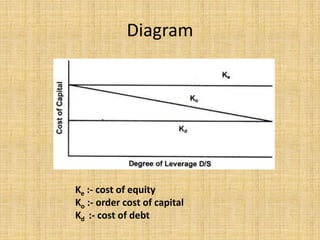
This approach was suggested by Durand and he
was in the favour of financial leverage
decision. According to him, change in financial
leverage would lead to change in cost of
capital. In short, if the ratio of debt in the
capital structure increases, the weighted
average cost of capital decreases and hence
the value of the firm.
ASSUMPTION
• The cost of debt is less than cost of equity
• There is on tax
• Risk perception of investor remains constant
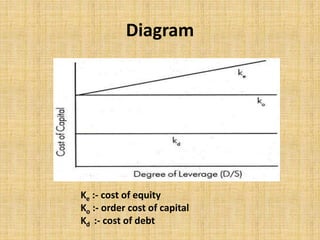
• Net income approach effect of leverage or
cost of capital
Diagram
Ke :- cost of equity
Ko :- order cost of capital
Kd :- cost of debt
• Value of firm(v)= S(Market value of
debt)+D(Market value of equity)
• Ko :- EBIT/V
Formula
Net Operating Income Approach (NOI
Approach)
• Net Operating Income Approach suggests that
change in debt of the firm/company or the
change in leverage fails to affect the total
value of the firm/company.
ASSUMPTION
• The overall capitalization rate remains constant irrespective
of the degree of leverage. At a given level of EBIT, value of
the firm would be “EBIT/Over all capitalization rate”
• Value of equity is the difference between total firm value
less value of debt i.e. Value of Equity = Total Value of the
Firm – Value of Debt
• WACC (Weightage Average Cost of Capital) remains
constant; and with the increase in debt, the cost of equity
increases. Increase in debt in the capital structure results in
increased risk for shareholders. As a compensation of
investing in highly leveraged company, the shareholders
expect higher return resulting in higher cost of equity
capital.
Diagram
Ke :- cost of equity
Ko :- order cost of capital
Kd :- cost of debt
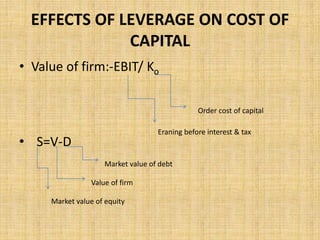
EFFECTS OF LEVERAGE ON COST OF
CAPITAL
• Value of firm:-EBIT/ Ko
• S=V-D
Order cost of capital
Eraning before interest & tax
Market value of equity
Market value of debt
Value of firm
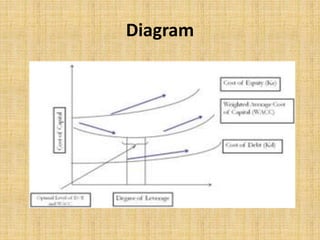
Traditional approach
• Traditional approach to capital structure
advocates that there is a right combination of
equity and debt in the capital structure, at
which the market value of a firm is maximum.
As per this approach, debt should exist in the
capital structure only up to a specific point,
beyond which, any increase in leverage would
result in reduction in value of the firm.
ASSUMPTION
• There are only two sources of funds used by a
firm; debt and shares.
•The firm pays 100% of its earning as dividend.
• The total finance remains constant.
• The operating profits (EBIT) are not expected to
grow.
• The business risk remains constant.
• The firm has a perpetual life.
• The total assets are given and do not change.
• The investors behave rationally.
Diagram
Modigliani & Miller Approach
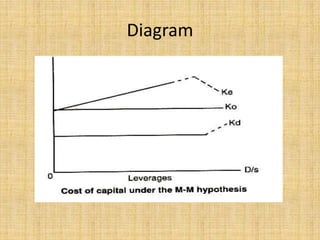
• Modigliani and Miller (M.M) argue that, in the
absence of taxes, a firm’s market value and
the cost of capital remain invariant to the
capital structure changes.
• This theory proof that the cost of capital is not
effected by changes in the capital structure or
says that the debt equity mix is irrelevant in
the determination value of the firm.
ASSUMPTION
• The securities are traded in the perfect
market situation.
• 2. Firms can be grouped into homogeneous
risk classes.
• 3. The expected NOI is a random variable
• 4. Firm distribute all net earnings to the
shareholders.
• 5. No corporate income taxes exist.
Diagram
Proposition I
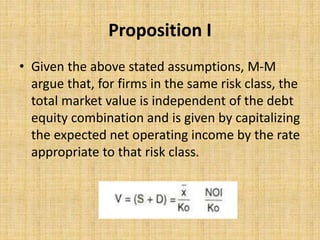
• Given the above stated assumptions, M-M
argue that, for firms in the same risk class, the
total market value is independent of the debt
equity combination and is given by capitalizing
the expected net operating income by the rate
appropriate to that risk class.
THANK YOU

DEEPAK, DEEPAK KUMAR N, JAIKANTH (FA)

  • 1.
  • 2.
    • Capital structureis the proportion of all types of capital viz. equity, debt, preference etc. It is synonymously used as financial leverage or financing mix. • Capital structure is also referred as the degree of debts in the financing or capital of a business firm. • It is believed that with the change in capital structure, the value of a firm can be influenced.
  • 3.
    • net income •net operating income • traditional • M&M(Modigliani and Miller Approach)
  • 4.
    Net Income Approach Thisapproach was suggested by Durand and he was in the favour of financial leverage decision. According to him, change in financial leverage would lead to change in cost of capital. In short, if the ratio of debt in the capital structure increases, the weighted average cost of capital decreases and hence the value of the firm.
  • 5.
    ASSUMPTION • The costof debt is less than cost of equity • There is on tax • Risk perception of investor remains constant • Net income approach effect of leverage or cost of capital
  • 6.
    Diagram Ke :- costof equity Ko :- order cost of capital Kd :- cost of debt
  • 7.
    • Value offirm(v)= S(Market value of debt)+D(Market value of equity) • Ko :- EBIT/V Formula
  • 8.
    Net Operating IncomeApproach (NOI Approach) • Net Operating Income Approach suggests that change in debt of the firm/company or the change in leverage fails to affect the total value of the firm/company.
  • 9.
    ASSUMPTION • The overallcapitalization rate remains constant irrespective of the degree of leverage. At a given level of EBIT, value of the firm would be “EBIT/Over all capitalization rate” • Value of equity is the difference between total firm value less value of debt i.e. Value of Equity = Total Value of the Firm – Value of Debt • WACC (Weightage Average Cost of Capital) remains constant; and with the increase in debt, the cost of equity increases. Increase in debt in the capital structure results in increased risk for shareholders. As a compensation of investing in highly leveraged company, the shareholders expect higher return resulting in higher cost of equity capital.
  • 10.
    Diagram Ke :- costof equity Ko :- order cost of capital Kd :- cost of debt
  • 11.
    EFFECTS OF LEVERAGEON COST OF CAPITAL • Value of firm:-EBIT/ Ko • S=V-D Order cost of capital Eraning before interest & tax Market value of equity Market value of debt Value of firm
  • 12.
    Traditional approach • Traditionalapproach to capital structure advocates that there is a right combination of equity and debt in the capital structure, at which the market value of a firm is maximum. As per this approach, debt should exist in the capital structure only up to a specific point, beyond which, any increase in leverage would result in reduction in value of the firm.
  • 13.
    ASSUMPTION • There areonly two sources of funds used by a firm; debt and shares. •The firm pays 100% of its earning as dividend. • The total finance remains constant. • The operating profits (EBIT) are not expected to grow. • The business risk remains constant. • The firm has a perpetual life. • The total assets are given and do not change. • The investors behave rationally.
  • 14.
  • 15.
    Modigliani & MillerApproach • Modigliani and Miller (M.M) argue that, in the absence of taxes, a firm’s market value and the cost of capital remain invariant to the capital structure changes. • This theory proof that the cost of capital is not effected by changes in the capital structure or says that the debt equity mix is irrelevant in the determination value of the firm.
  • 16.
    ASSUMPTION • The securitiesare traded in the perfect market situation. • 2. Firms can be grouped into homogeneous risk classes. • 3. The expected NOI is a random variable • 4. Firm distribute all net earnings to the shareholders. • 5. No corporate income taxes exist.
  • 17.
  • 18.
    Proposition I • Giventhe above stated assumptions, M-M argue that, for firms in the same risk class, the total market value is independent of the debt equity combination and is given by capitalizing the expected net operating income by the rate appropriate to that risk class.
  • 19.