Contents
• Capital Budgeting
• Methods of Capital Budgeting
– Payback
– Discounted payback
– Net Present Value
– Profitability Index
– Internal Rate Return
• Mutually Exclusive & Independent Projects
• Methods of Financing
• Capital Structure & Cost of Capital
1. Capital Budgeting
• Capital budgeting (or investment appraisal) is the
planning process used to determine whether a
business organization’s long term investments
such as new machinery, replacement machinery,
new plants, new products, and research &
development projects are worth pursuing. It is
budget for major capital, or investment,
expenditures.
• Methods: Payback, Discounted Payback, Net
Present value, Profitability Index, Internal Rate of
Return
2. Independent vs Mutually Exclusive
Projects
Mutually Exclusive Projects
While selecting the most attractive project from among the alternative projects, the
acceptance of one project automatically entails the exclusion of other alternatives.
Independent Projects
The decision regarding any one project has no effect on the decision to accept or
reject another project
3.Payback Period (Conventional)
If the annual receipts are not uniform, the payback period is at that period,
where cumulative cash flows equals zero (using a graph)
Payback period is calculated by dividing the initial payment (Cost) by annual
receipts, if the annual receipts are uniform
The time (years) a Project will take to pay back its cost (initial Investment) is
called the Payback Period, which is a method of project screening.
Illustration Question: 1
Year (n) Cash Inflows (SR) Cash Outflows (SR)
1 0 650,000
2 215,500 53,000
2 215,500 53,000
--- ---- ----
8 215,500 53,000
The Cash flows of a computer-process control
system project is given below. Determine the
payback period for this project
Answer
Initial Cost = SR 650,000
Annual Cash receipt = SR 162,500
Payback Period = Initial Cost
Annual Cash receipt
= 650,000 = 4 Years
162,500
Illustration Question: 2
Period Cash inflow (SR)
1 15,000
2 25,000
3 35,000
4 45,000
5 45,000
6 35,000
Auto numeric's Company has just bought a new spindle
machine at a cost of SR 105,000 to replace one that had a
salvage value of SR 20,000. The projected annual returns
via improved efficiency are as follows. Calculate the
payback period.
Answer
Initial Cost = SR 105,000
Scrap Value (Salvage) = SR 20,000
Calculate the cumulative values (From the initial cost the salvage value
to be subtracted to get the real cost)
Period Cash inflow (SR) Cumulative
Cash Flow
0 -105,000 + 20,000 -85,000
1 15,000 -70,000
2 25,000 -45,000
3 35,000 -10,000
4 45,000 35,000
5 45,000 80,000
6 35,000 115,000
Answer Continues (Graph)
0 1 2 3 4 5 6
1 00,000
1 50,000
50,000
-50,000
-100,000
Cumulative
Cash Flow
Year
Payback period = 3.7 Years
4. Discounted Payback
Discounted Payback
Number of years required to recover the investment
from discounted cash flow
Limitation of the Conventional Payback Period Analysis
Does not cover the time value of money (Cost of
money)
Illustration Question: 3
Auto numeric's Company has just bought a new spindle machine at a cost of
SR 105,000 to replace one that had a salvage value of SR 20,000. The
projected annual savings via improved efficiency are as follows. Calculate the
discounted payback period, if the rate of return is 15%.
Period Cash inflow (SR)
1 15,000
2 25,000
3 35,000
4 45,000
5 45,000
6 35,000
Answer
Period Cash inflow (SR) Time Value
@15%
Discounted
Cumulative
Cash Flow
Remarks
0 -105,000 + 20,000 =
-85,000
- -85,000
1 15,000 -12,750.0 -82,750.0 -85000+ -12750+ 15000
2 25,000 -12,412.5 -70,162.5 -82750.5+-12412.5+25000
3 35,000 -10,524.38 -45,686.88 -70,162.5+-10,524.38+35000
4 45,000 -6,853.03 -7,539.91 -45,686.88+-6853.03+45000
5 45,000 -1130.99 36,329.1 -7539.91+-1130.99+45000
6 35,000 5,449.37 76,778.47 36329.1+5449.37+35000
Answer (Graph)
0 1 2 3 4 5 6
100,000
75,000
50,000
25,000
25,000
50,000
75,000
100,000
Payback period = 4.4 Years
Year
Discounted
Cumulative
Cash Flow
5. Net Present Value
(Net Present Worth)
• The net present value (NPV) of a time series of
cash flows, both incoming and outgoing, is
defined as the sum of the present values (PVs) of
the individual cash flows.
• In the case when all future cash flows are
incoming and the only outflow of cash is the
initial cost, the NPV is simply the PV of future
cash flows minus the purchase price (which is its
own PV).
• Each cash inflow/outflow is discounted back to its
present value (PV). Then they are summed.
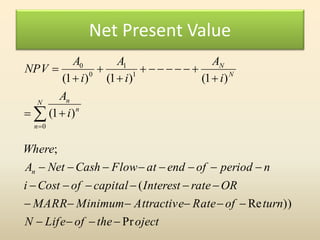
Net Present Value
ojecttheofLifeN
turnofRateAttractiveMinimumMARR
ORrateInterestcapitalofCosti
nperiodofendatFlowCashNetA
Where
i
A
i
A
i
A
i
A
NPV
n
N
n
n
n
N
N
Pr
))Re
(
;
)1(
)1()1()1(
0
1
1
0
0












Business Decision based on NPV
Value of NPV Meaning Business Decisions
NPV > 0
The investment would add value to the
firm
The project may be accepted
NPV < 0
The investment would subtract value
from the firm
The project should be rejected
NPV = 0
The investment would neither gain nor
lose value for the firm
We should be indifferent in the decision
whether to accept or reject the project.
Illustration Question: 1
A corporation must decide whether to introduce a
new product line. The new product will have
startup costs, operational costs, and incoming
cash flows over six years. This project will have an
immediate (n=0) cash outflow of SR 100,000
(which might include machinery, and employee
training costs). Other cash outflows for years 1–6
are expected to be SR 5,000 per year. Cash
inflows are expected to be SR 30,000 each for
years 1–6. There are no cash flows expected after
year 6. The required rate of return is 10%.
Calculate the NPV.
Answer
Year Cash flow Present value (SR)
n = 0 -100,000/(1+0.10)0 -100,000
n= 1 30,000-5000/(1+0.10)1 22,727
n= 2 30,000-5000/(1+0.10)2 20,661
n= 3 30,000-5000/(1+0.10)3 18,783
n= 4 30,000-5000/(1+0.10)4 17,075
n= 5 30,000-5000/(1+0.10)5 15,523
n= 6 30,000-5000/(1+0.10)6 14,112
NPV 8,881.52 
 n
n
i
A
NPV
)1(
Conclusion for the Problem
• Since the NPV is greater than zero, it would be
better to invest in the project than to do
nothing, and the corporation should invest in
this project if there is no mutually exclusive
alternative with a higher NPV.
Illustration Question: 2
Tiger Machine Tool Company is considering acquiring a new
metal-cutting machine. The required initial investment of
SR 76,000 and the projected cash benefits over the
project’s 4 year life are as follows. You have been asked by
the CEO of the company to evaluate the economic merit of
acquisition. The interest rate is 12% .
Year Net Cash Flows (An)
n = 0 76,000
n= 1 35,560
n= 2 37,360
n= 3 31,850
n= 4 34,400
Answer
Year Cash flow Present value (SR)
n = 0 -76,000/(1+0.12)0 -76,000
n= 1 35,560/(1+0.12)1 31,750
n= 2 37,360/(1+0.12)2 29,783
n= 3 31,850/(1+0.12)3 22,670
n= 4 34,400/(1+0.12)4 21,862
NPV SR 30,065
 
 n
n
i
A
NPV
)1(
Since the NPV is greater than zero, it would be better to invest in the Machine
6. Profitability Index
• Profitability index (PI) is the ratio of payoff to
investment of a proposed project.
• It is a useful tool for ranking projects because
it allows you to quantify the amount of value
created per unit of investment.
Calculation of Profitability Index
InvestmentInitial
FlowsCashFutureofPV
Indextyproftabili



The Cash Flow calculated does not include the investment made in the project
A profitability index of 1 indicates breakeven
Rules for selection or rejection of a project:
•If PI > 1 then accept the project
•If PI < 1 then reject the project
Illustration Question-1
Year Cash Flow
1 18000
2 12000
3 10000
4 9000
5 6000
Question: One business man wanted to invest SR
40,000 and the life of the machines is 5 years.
Based on the following information calculate the
NPV at 10% and PI of the project.
Solution
Year Cash flow Present value (SR)
1 18000/(1+0.10)1 16363
2 12000/(1+0.10)2 9917
3 10000/(1+0.10)3 7519
4 9000/(1+0.10)4 6147
5 6000/(1+0.10)5 3727
Total Present Value 43673
Solution (Continues)
Total present value = 43673
Investment = 40000
NPV = Total present value – Investment
= 43673 – 40000 = 3673
PI = Total Present Value/ Initial Investment
= 43673 / 40000
= 1.091
Since the value of PI is >1, accept the project
7. Internal Rate of Return
• The internal rate of return (IRR) is a rate of return used
in capital budgeting to measure and compare the
profitability of investments.
• The term internal refers to the fact that its calculation
does not incorporate environmental factors (e.g., the
interest rate or inflation).
• The internal rate of return on an investment or project
is the "annualized effective compounded return of
rate" or discount rate that makes the Net Present Value
(NPV) of all cash flows (both positive and negative)
from a particular investment equal to zero.
Internal Rate of Return (Continues)
• The IRR of an investment is the Discount Rate at
which the Net Present Value of costs (negative
cash flows) of the investment equals the Net
Present value of the benefits (positive cash flows)
of the investment.
• It is a commonly used as a measure of investment
efficiency.
• The higher a project's internal rate of return, the
more desirable it is to undertake the project.
Calculation of IRR
Given the period (n), cash flow (Cn) total number of
periods (N) and the net present value (NPV), the internal
rate of return (r) is given by in:
0
)1(0


 
N
n
n
n
i
A
NPV
Any fixed time can be used in place of the present
(e.g., the end of one interval of an annuity); the value
obtained is zero if and only if the NPV is zero.
Illustration Question: 1
Question: Calculate the IRR of an investment project
based on the cash flows as indicated below.
Year (n) Cash Flow (An)
0 −4000
1 1200
2 1410
3 1875
4 1050
Answer
Year (n) Cash Flow (Cn) Present Values
i= 5% i = 10% i= 15% i = 20%
0 −4000
=
-4000
=
-4000
=
-4000
=
-4000
1 1200
=
1143
=
1091
=
1043
=
1000
2 1410
=
1279
=
1165
=
1068
=
979
3 1875
=
1620
=
1409
=
1234
=
1085
4 1050
=
864
=
717
=
600
=
506
Net Present Value (NPV) 906 382 -65
-430
0
)05.01(
4000


0
)10.01(
4000


0
)15.01(
4000


0
)20.01(
4000


1
)05.01(
1200
 1
)10.01(
1200
 1
)15.01(
1200
 1
)20.01(
1200

2
)05.01(
1410
 2
)10.01(
1410
 2
)15.01(
1410
 2
)20.01(
1410

3
)05.01(
1875
 3
)10.01(
1875
 3
)15.01(
1875
 3
)20.01(
1875

4
)05.01(
1050
 4
)10.01(
1050
 4
)15.01(
1050
 4
)20.01(
1050

Solution (Continues)
Then the IRR is given by
NPV = -4000 + 1200/(1+i)1 + 1410/(1+i)2 + 1875/(1+i)3 + 1050/(1+i)4 = 0
Graphical Derivation of IRR
R
20%15%10%5%
0
1000
800
600
400
200
-200
-400
-600
14.3%
In this case, the answer is 14.3%.
8. Methods of Financing
Sources of financing
1. Equity financing 2. Debt financing
Source of financing is considered after the
selection of an investment project
Equity Financing
Investment Banker
1. Investment banker will buy the issue from the Company at a discounted price (included in
flotation cost) and determine the market price to sell it to public
Issuing Common Stocks
Flotation Cost is involved: Includes Investment Banker’s fees, lawyer's fees, Accountants’ costs,
etc.
Equity Financing includes
1. Use of retained earnings or paid to
stockholders
2. Issuing stocks (common)
Debt Financing
Bond Financing
Interest is paid annually and the principal amount is
repaid when the bond matures
Debt financing includes
1. Short-term borrowing
from banks
2. Sale of long-term bonds
(fixed period)
9. Capital Structure
Example: A debt ratio of 0.4 indicates that 40% of the
capital is borrowed and remaining from the equity
It shows the percentage of total Capital provided by
borrowed funds
The ratio of total debt to total capital is called as debt ratio
or Capital Structure
Major Factor affecting Capital
Structure Policy of a Company
1. Capital Structure policy involves the trade-off
between risk and return (The optimal capital
structure make a balance between business risks
and expected future earnings).
2. Major reason for using debt is that, interest is a
deductible expense for business operations.
3. Financial flexibility – The ability to raise capital
on reasonable terms from the financial market.
10. Cost of Capital
Cost of Debt
Debt financing includes term loans and bonds
Since interest payments on both are
deductible, the effective cost will be reduced
Cost of Equity
It involves an Opportunity Cost between
retaining or to share with stockholders
Investors (People) are looking for Cash
dividends & gains from rise in share prices
Most Companies finance major portion of their Capital Budget with long-
term debt (Bonds) and may use Preferred Stock as a source of Capital

Capital budgeting

  • 1.
    Contents • Capital Budgeting •Methods of Capital Budgeting – Payback – Discounted payback – Net Present Value – Profitability Index – Internal Rate Return • Mutually Exclusive & Independent Projects • Methods of Financing • Capital Structure & Cost of Capital
  • 2.
    1. Capital Budgeting •Capital budgeting (or investment appraisal) is the planning process used to determine whether a business organization’s long term investments such as new machinery, replacement machinery, new plants, new products, and research & development projects are worth pursuing. It is budget for major capital, or investment, expenditures. • Methods: Payback, Discounted Payback, Net Present value, Profitability Index, Internal Rate of Return
  • 3.
    2. Independent vsMutually Exclusive Projects Mutually Exclusive Projects While selecting the most attractive project from among the alternative projects, the acceptance of one project automatically entails the exclusion of other alternatives. Independent Projects The decision regarding any one project has no effect on the decision to accept or reject another project
  • 4.
    3.Payback Period (Conventional) Ifthe annual receipts are not uniform, the payback period is at that period, where cumulative cash flows equals zero (using a graph) Payback period is calculated by dividing the initial payment (Cost) by annual receipts, if the annual receipts are uniform The time (years) a Project will take to pay back its cost (initial Investment) is called the Payback Period, which is a method of project screening.
  • 5.
    Illustration Question: 1 Year(n) Cash Inflows (SR) Cash Outflows (SR) 1 0 650,000 2 215,500 53,000 2 215,500 53,000 --- ---- ---- 8 215,500 53,000 The Cash flows of a computer-process control system project is given below. Determine the payback period for this project
  • 6.
    Answer Initial Cost =SR 650,000 Annual Cash receipt = SR 162,500 Payback Period = Initial Cost Annual Cash receipt = 650,000 = 4 Years 162,500
  • 7.
    Illustration Question: 2 PeriodCash inflow (SR) 1 15,000 2 25,000 3 35,000 4 45,000 5 45,000 6 35,000 Auto numeric's Company has just bought a new spindle machine at a cost of SR 105,000 to replace one that had a salvage value of SR 20,000. The projected annual returns via improved efficiency are as follows. Calculate the payback period.
  • 8.
    Answer Initial Cost =SR 105,000 Scrap Value (Salvage) = SR 20,000 Calculate the cumulative values (From the initial cost the salvage value to be subtracted to get the real cost) Period Cash inflow (SR) Cumulative Cash Flow 0 -105,000 + 20,000 -85,000 1 15,000 -70,000 2 25,000 -45,000 3 35,000 -10,000 4 45,000 35,000 5 45,000 80,000 6 35,000 115,000
  • 9.
    Answer Continues (Graph) 01 2 3 4 5 6 1 00,000 1 50,000 50,000 -50,000 -100,000 Cumulative Cash Flow Year Payback period = 3.7 Years
  • 10.
    4. Discounted Payback DiscountedPayback Number of years required to recover the investment from discounted cash flow Limitation of the Conventional Payback Period Analysis Does not cover the time value of money (Cost of money)
  • 11.
    Illustration Question: 3 Autonumeric's Company has just bought a new spindle machine at a cost of SR 105,000 to replace one that had a salvage value of SR 20,000. The projected annual savings via improved efficiency are as follows. Calculate the discounted payback period, if the rate of return is 15%. Period Cash inflow (SR) 1 15,000 2 25,000 3 35,000 4 45,000 5 45,000 6 35,000
  • 12.
    Answer Period Cash inflow(SR) Time Value @15% Discounted Cumulative Cash Flow Remarks 0 -105,000 + 20,000 = -85,000 - -85,000 1 15,000 -12,750.0 -82,750.0 -85000+ -12750+ 15000 2 25,000 -12,412.5 -70,162.5 -82750.5+-12412.5+25000 3 35,000 -10,524.38 -45,686.88 -70,162.5+-10,524.38+35000 4 45,000 -6,853.03 -7,539.91 -45,686.88+-6853.03+45000 5 45,000 -1130.99 36,329.1 -7539.91+-1130.99+45000 6 35,000 5,449.37 76,778.47 36329.1+5449.37+35000
  • 13.
    Answer (Graph) 0 12 3 4 5 6 100,000 75,000 50,000 25,000 25,000 50,000 75,000 100,000 Payback period = 4.4 Years Year Discounted Cumulative Cash Flow
  • 14.
    5. Net PresentValue (Net Present Worth) • The net present value (NPV) of a time series of cash flows, both incoming and outgoing, is defined as the sum of the present values (PVs) of the individual cash flows. • In the case when all future cash flows are incoming and the only outflow of cash is the initial cost, the NPV is simply the PV of future cash flows minus the purchase price (which is its own PV). • Each cash inflow/outflow is discounted back to its present value (PV). Then they are summed.
  • 15.
  • 16.
    Business Decision basedon NPV Value of NPV Meaning Business Decisions NPV > 0 The investment would add value to the firm The project may be accepted NPV < 0 The investment would subtract value from the firm The project should be rejected NPV = 0 The investment would neither gain nor lose value for the firm We should be indifferent in the decision whether to accept or reject the project.
  • 17.
    Illustration Question: 1 Acorporation must decide whether to introduce a new product line. The new product will have startup costs, operational costs, and incoming cash flows over six years. This project will have an immediate (n=0) cash outflow of SR 100,000 (which might include machinery, and employee training costs). Other cash outflows for years 1–6 are expected to be SR 5,000 per year. Cash inflows are expected to be SR 30,000 each for years 1–6. There are no cash flows expected after year 6. The required rate of return is 10%. Calculate the NPV.
  • 18.
    Answer Year Cash flowPresent value (SR) n = 0 -100,000/(1+0.10)0 -100,000 n= 1 30,000-5000/(1+0.10)1 22,727 n= 2 30,000-5000/(1+0.10)2 20,661 n= 3 30,000-5000/(1+0.10)3 18,783 n= 4 30,000-5000/(1+0.10)4 17,075 n= 5 30,000-5000/(1+0.10)5 15,523 n= 6 30,000-5000/(1+0.10)6 14,112 NPV 8,881.52   n n i A NPV )1(
  • 19.
    Conclusion for theProblem • Since the NPV is greater than zero, it would be better to invest in the project than to do nothing, and the corporation should invest in this project if there is no mutually exclusive alternative with a higher NPV.
  • 20.
    Illustration Question: 2 TigerMachine Tool Company is considering acquiring a new metal-cutting machine. The required initial investment of SR 76,000 and the projected cash benefits over the project’s 4 year life are as follows. You have been asked by the CEO of the company to evaluate the economic merit of acquisition. The interest rate is 12% . Year Net Cash Flows (An) n = 0 76,000 n= 1 35,560 n= 2 37,360 n= 3 31,850 n= 4 34,400
  • 21.
    Answer Year Cash flowPresent value (SR) n = 0 -76,000/(1+0.12)0 -76,000 n= 1 35,560/(1+0.12)1 31,750 n= 2 37,360/(1+0.12)2 29,783 n= 3 31,850/(1+0.12)3 22,670 n= 4 34,400/(1+0.12)4 21,862 NPV SR 30,065    n n i A NPV )1( Since the NPV is greater than zero, it would be better to invest in the Machine
  • 22.
    6. Profitability Index •Profitability index (PI) is the ratio of payoff to investment of a proposed project. • It is a useful tool for ranking projects because it allows you to quantify the amount of value created per unit of investment.
  • 23.
    Calculation of ProfitabilityIndex InvestmentInitial FlowsCashFutureofPV Indextyproftabili    The Cash Flow calculated does not include the investment made in the project A profitability index of 1 indicates breakeven Rules for selection or rejection of a project: •If PI > 1 then accept the project •If PI < 1 then reject the project
  • 24.
    Illustration Question-1 Year CashFlow 1 18000 2 12000 3 10000 4 9000 5 6000 Question: One business man wanted to invest SR 40,000 and the life of the machines is 5 years. Based on the following information calculate the NPV at 10% and PI of the project.
  • 25.
    Solution Year Cash flowPresent value (SR) 1 18000/(1+0.10)1 16363 2 12000/(1+0.10)2 9917 3 10000/(1+0.10)3 7519 4 9000/(1+0.10)4 6147 5 6000/(1+0.10)5 3727 Total Present Value 43673
  • 26.
    Solution (Continues) Total presentvalue = 43673 Investment = 40000 NPV = Total present value – Investment = 43673 – 40000 = 3673 PI = Total Present Value/ Initial Investment = 43673 / 40000 = 1.091 Since the value of PI is >1, accept the project
  • 27.
    7. Internal Rateof Return • The internal rate of return (IRR) is a rate of return used in capital budgeting to measure and compare the profitability of investments. • The term internal refers to the fact that its calculation does not incorporate environmental factors (e.g., the interest rate or inflation). • The internal rate of return on an investment or project is the "annualized effective compounded return of rate" or discount rate that makes the Net Present Value (NPV) of all cash flows (both positive and negative) from a particular investment equal to zero.
  • 28.
    Internal Rate ofReturn (Continues) • The IRR of an investment is the Discount Rate at which the Net Present Value of costs (negative cash flows) of the investment equals the Net Present value of the benefits (positive cash flows) of the investment. • It is a commonly used as a measure of investment efficiency. • The higher a project's internal rate of return, the more desirable it is to undertake the project.
  • 29.
    Calculation of IRR Giventhe period (n), cash flow (Cn) total number of periods (N) and the net present value (NPV), the internal rate of return (r) is given by in: 0 )1(0     N n n n i A NPV Any fixed time can be used in place of the present (e.g., the end of one interval of an annuity); the value obtained is zero if and only if the NPV is zero.
  • 30.
    Illustration Question: 1 Question:Calculate the IRR of an investment project based on the cash flows as indicated below. Year (n) Cash Flow (An) 0 −4000 1 1200 2 1410 3 1875 4 1050
  • 31.
    Answer Year (n) CashFlow (Cn) Present Values i= 5% i = 10% i= 15% i = 20% 0 −4000 = -4000 = -4000 = -4000 = -4000 1 1200 = 1143 = 1091 = 1043 = 1000 2 1410 = 1279 = 1165 = 1068 = 979 3 1875 = 1620 = 1409 = 1234 = 1085 4 1050 = 864 = 717 = 600 = 506 Net Present Value (NPV) 906 382 -65 -430 0 )05.01( 4000   0 )10.01( 4000   0 )15.01( 4000   0 )20.01( 4000   1 )05.01( 1200  1 )10.01( 1200  1 )15.01( 1200  1 )20.01( 1200  2 )05.01( 1410  2 )10.01( 1410  2 )15.01( 1410  2 )20.01( 1410  3 )05.01( 1875  3 )10.01( 1875  3 )15.01( 1875  3 )20.01( 1875  4 )05.01( 1050  4 )10.01( 1050  4 )15.01( 1050  4 )20.01( 1050 
  • 32.
    Solution (Continues) Then theIRR is given by NPV = -4000 + 1200/(1+i)1 + 1410/(1+i)2 + 1875/(1+i)3 + 1050/(1+i)4 = 0
  • 33.
    Graphical Derivation ofIRR R 20%15%10%5% 0 1000 800 600 400 200 -200 -400 -600 14.3% In this case, the answer is 14.3%.
  • 34.
    8. Methods ofFinancing Sources of financing 1. Equity financing 2. Debt financing Source of financing is considered after the selection of an investment project
  • 35.
    Equity Financing Investment Banker 1.Investment banker will buy the issue from the Company at a discounted price (included in flotation cost) and determine the market price to sell it to public Issuing Common Stocks Flotation Cost is involved: Includes Investment Banker’s fees, lawyer's fees, Accountants’ costs, etc. Equity Financing includes 1. Use of retained earnings or paid to stockholders 2. Issuing stocks (common)
  • 36.
    Debt Financing Bond Financing Interestis paid annually and the principal amount is repaid when the bond matures Debt financing includes 1. Short-term borrowing from banks 2. Sale of long-term bonds (fixed period)
  • 37.
    9. Capital Structure Example:A debt ratio of 0.4 indicates that 40% of the capital is borrowed and remaining from the equity It shows the percentage of total Capital provided by borrowed funds The ratio of total debt to total capital is called as debt ratio or Capital Structure
  • 38.
    Major Factor affectingCapital Structure Policy of a Company 1. Capital Structure policy involves the trade-off between risk and return (The optimal capital structure make a balance between business risks and expected future earnings). 2. Major reason for using debt is that, interest is a deductible expense for business operations. 3. Financial flexibility – The ability to raise capital on reasonable terms from the financial market.
  • 39.
    10. Cost ofCapital Cost of Debt Debt financing includes term loans and bonds Since interest payments on both are deductible, the effective cost will be reduced Cost of Equity It involves an Opportunity Cost between retaining or to share with stockholders Investors (People) are looking for Cash dividends & gains from rise in share prices Most Companies finance major portion of their Capital Budget with long- term debt (Bonds) and may use Preferred Stock as a source of Capital