1
Capital Budgeting
Dr. Rakesh Sharma
2
Capital Budget
Capital budget is the budget of capital expenditures.
Capital Expenditures are those expenditures whose
benefit spread in number of years e.g., purchase of
Plant and Machinery , Land and building and starting
a new factory plant etc.
3
CAPITAL BUDGETING
Capital budgeting: is the planning process for
allocating all expenditures that will have an expected
benefit to the firm for more than one year.
4
Investment Appraisal
Firms normally place projects in the following categories:
• Replacement and maintenance of old or damaged
equipment.
• Investments to upgrade or replace existing equipment
• Marketing investments to expand product lines or
distribution facilities.
• Investments for complying with government or
5
OVERALL AIM
To maximise shareholders wealth..
Projects should give a return over and above the marginal
weighted average cost of capital.
Projects can be;
Mutually exclusive
Independent
6
IDEAL SELECTION
METHOD
• Select the project that maximises shareholders wealth
• Consider all cash flows
• Discount the cash flows at the appropriate market
determined opportunity cost of capital
7
Need for Investment Appraisal
• Large amount of resources are involved and wrong
decisions could be costly
• Difficult and expensive to reverse
• Investment decisions can have a direct impact on the
ability of the organisation to meet its objectives
8
Investment Appraisal Process
Stages:
• identify objectives. What is it? Within the corporate
objectives?
• Identify alternatives.
• Collect and analyse data. Examine the technical and
economic feasibility of the project, cash flows etc.
9
Investment Appraisal Process
Stages:
• decide which one to undertake
• authorisation and implementation
• review and monitor: learn from its experience and try
to improve future decision - making
10
Capital Budgeting - Methods
Traditional Techniques
1. Accounting Rate of return
2. Payback
Modern Techniques
3. Net Present Value
4. Internal Rate of Return
5. Profitability Index
11
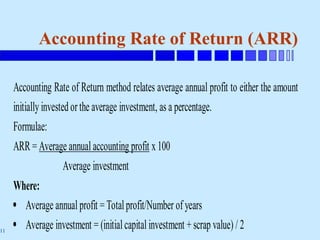
Accounting Rate of Return (ARR)
Accounting Rate of Return method relates average annual profit to either the amount
initiallyinvestedorthe average investment, as a percentage.
Formulae:
ARR = Average annual accounting profit x 100
Average investment
Where:
 Average annual profit = Totalprofit/Number of years
 Average investment = (initialcapital investment +scrap value) / 2
12
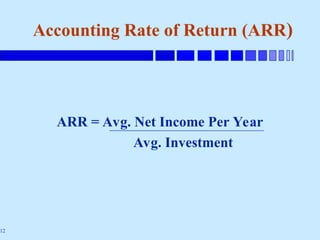
Accounting Rate of Return (ARR)
ARR = Avg. Net Income Per Year
Avg. Investment
13
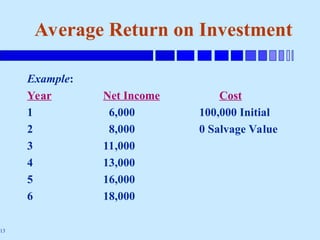
Average Return on Investment
Example:
Year Net Income Cost
1 6,000 100,000 Initial
2 8,000 0 Salvage Value
3 11,000
4 13,000
5 16,000
6 18,000
14
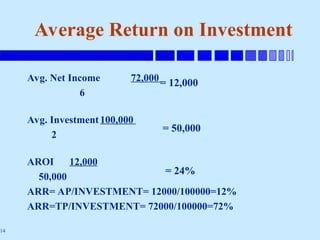
Avg. Net Income 72,000
6
Avg. Investment100,000
2
AROI 12,000
50,000
ARR= AP/INVESTMENT= 12000/100000=12%
ARR=TP/INVESTMENT= 72000/100000=72%
Average Return on Investment
= 12,000
= 24%
= 50,000
15
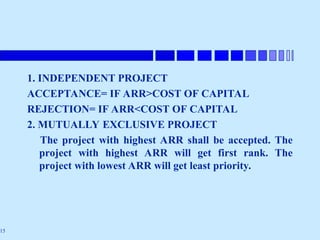
1. INDEPENDENT PROJECT
ACCEPTANCE= IF ARR>COST OF CAPITAL
REJECTION= IF ARR<COST OF CAPITAL
2. MUTUALLY EXCLUSIVE PROJECT
The project with highest ARR shall be accepted. The
project with highest ARR will get first rank. The
project with lowest ARR will get least priority.
16
Advantages
Disadvantages
Average Return on Investment
17
Payback Period Method
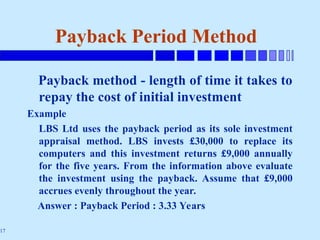
Payback method - length of time it takes to
repay the cost of initial investment
Example
LBS Ltd uses the payback period as its sole investment
appraisal method. LBS invests £30,000 to replace its
computers and this investment returns £9,000 annually
for the five years. From the information above evaluate
the investment using the payback. Assume that £9,000
accrues evenly throughout the year.
Answer : Payback Period : 3.33 Years
18
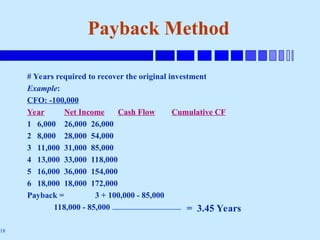
Payback Method
# Years required to recover the original investment
Example:
CFO: -100,000
Year Net Income Cash Flow Cumulative CF
1 6,000 26,000 26,000
2 8,000 28,000 54,000
3 11,000 31,000 85,000
4 13,000 33,000 118,000
5 16,000 36,000 154,000
6 18,000 18,000 172,000
Payback = 3 + 100,000 - 85,000
118,000 - 85,000 = 3.45 Years
19
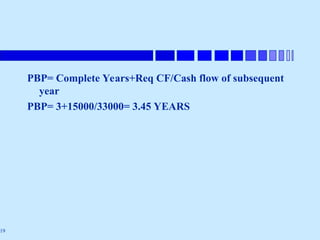
PBP= Complete Years+Req CF/Cash flow of subsequent
year
PBP= 3+15000/33000= 3.45 YEARS
20
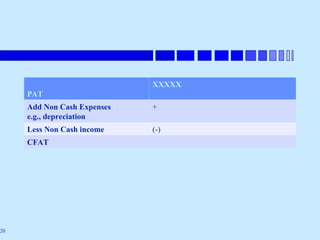
PAT
XXXXX
Add Non Cash Expenses
e.g., depreciation
+
Less Non Cash income (-)
CFAT
21
Payback Method
Advantages
Disadvantages
22
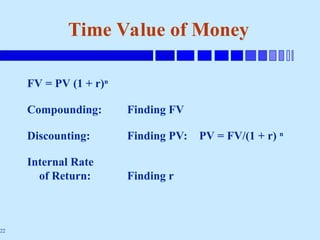
Time Value of Money
FV = PV (1 + r)n
Compounding: Finding FV
Discounting: Finding PV: PV = FV/(1 + r) n
Internal Rate
of Return: Finding r
23
Definitions
• Present value:- the amount of money you must invest
or lend at the present time so as to end up with a
particular amount of money in the future.
• Discounting: -finding the present value of a future cash
flow
24
Net Present Value
• Net Present Value (NPV) - the difference between the
present values of cash inflows and outflows of an
investment
• Opportunity cost of undertaking the investment is the
alternative of earning interest rate in the financial
market.
• NPV is the difference between PV of cash inflows
minus Cash Outflows
25
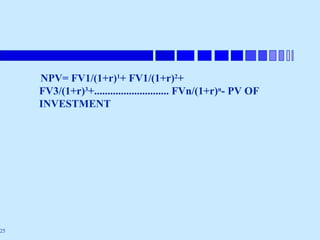
NPV= FV1/(1+r)1
+ FV1/(1+r)2
+
FV3/(1+r)3
+............................ FVn/(1+r)n
- PV OF
INVESTMENT
26
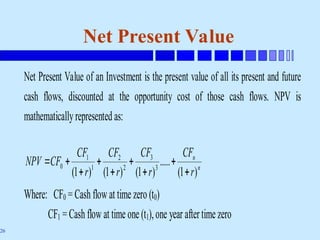
Net Present Value
Net Present Value of an Investment is the present value of all its present and future
cash flows, discounted at the opportunity cost of those cash flows. NPV is
mathematicallyrepresented as:
n
n
r
CF
r
CF
r
CF
r
CF
CF
NPV
)
1
(
.....
)
1
(
)
1
(
)
1
( 3
3
2
2
1
1
0









Where: CF0 = Cash flow at time zero (t0)
CF1 = Cash flow at time one (t1),one year aftertime zero
27
Net Present Value
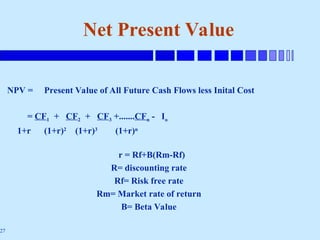
NPV = Present Value of All Future Cash Flows less Inital Cost
= CF1 + CF2 + CF3 +.......CFn - Io
1+r (1+r)2
(1+r)3
(1+r)n
r = Rf+B(Rm-Rf)
R= discounting rate
Rf= Risk free rate
Rm= Market rate of return
B= Beta Value
28
Example-1
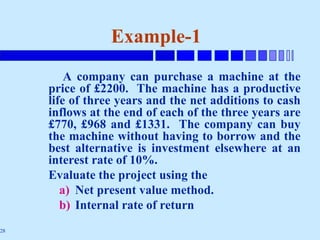
A company can purchase a machine at the
price of £2200. The machine has a productive
life of three years and the net additions to cash
inflows at the end of each of the three years are
£770, £968 and £1331. The company can buy
the machine without having to borrow and the
best alternative is investment elsewhere at an
interest rate of 10%.
Evaluate the project using the
a) Net present value method.
b) Internal rate of return
29
Example-1
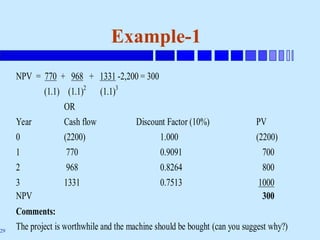
NPV = 770 + 968 + 1331 -2,200 = 300
(1.1) (1.1)2
(1.1)3
OR
Year Cash flow Discount Factor (10%) PV
0 (2200) 1.000 (2200)
1 770 0.9091 700
2 968 0.8264 800
3 1331 0.7513 1000
NPV 300
Comments:
The project is worthwhile and the machine should be bought (can you suggest why?)
30
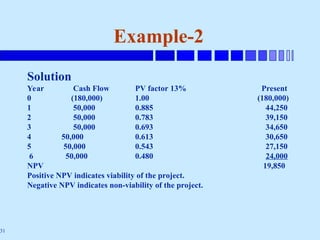
NPV-Example-2
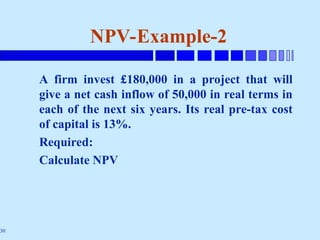
A firm invest £180,000 in a project that will
give a net cash inflow of 50,000 in real terms in
each of the next six years. Its real pre-tax cost
of capital is 13%.
Required:
Calculate NPV
31
Example-2
Solution
Year Cash Flow PV factor 13% Present
0 (180,000) 1.00 (180,000)
1 50,000 0.885 44,250
2 50,000 0.783 39,150
3 50,000 0.693 34,650
4 50,000 0.613 30,650
5 50,000 0.543 27,150
6 50,000 0.480 24,000
NPV 19,850
Positive NPV indicates viability of the project.
Negative NPV indicates non-viability of the project.
32
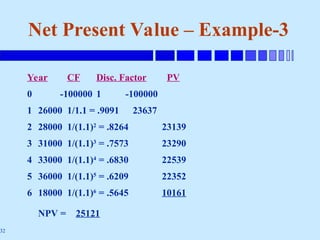
Net Present Value – Example-3
Year CF Disc. Factor PV
0 -100000 1 -100000
1 26000 1/1.1 = .9091 23637
2 28000 1/(1.1)2
= .8264 23139
3 31000 1/(1.1)3
= .7573 23290
4 33000 1/(1.1)4
= .6830 22539
5 36000 1/(1.1)5
= .6209 22352
6 18000 1/(1.1)6
= .5645 10161
NPV = 25121
33
Net Present Value
Advantages
Disadvantages
34
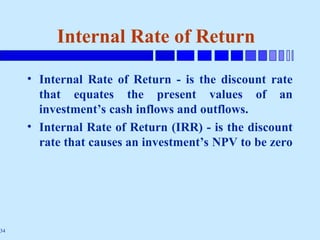
Internal Rate of Return
• Internal Rate of Return - is the discount rate
that equates the present values of an
investment’s cash inflows and outflows.
• Internal Rate of Return (IRR) - is the discount
rate that causes an investment’s NPV to be zero
35
Internal Rate of Return
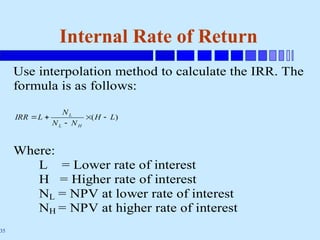
Use interpolation method to calculate the IRR. The
formula is as follows:
)
( L
H
N
N
N
L
IRR
H
L
L





Where:
L = Lower rate of interest
H = Higher rate of interest
NL = NPV at lower rate of interest
NH = NPV at higher rate of interest
36
Internal Rate of Return
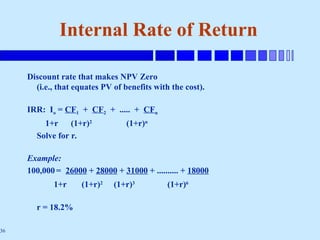
Discount rate that makes NPV Zero
(i.e., that equates PV of benefits with the cost).
IRR: Io = CF1 + CF2 + ..... + CFn
1+r (1+r)2
(1+r)n
Solve for r.
Example:
100,000= 26000 + 28000 + 31000 + .......... + 18000
1+r (1+r)2
(1+r)3
(1+r)6
r = 18.2%
37
Acceptance of project = IRR> cost of capital
Rejection of project = IRR< COST OF CAPITAL
IF BOTH ARE EQUAL = MAY BE ACCEPTED MAY
BE REJECTED
MUTUALLY EXCLUSIVE PROJECTS :
THE PROJECT WITH HIGHER IRR WILL GET
FIRST RANK
38
Internal Rate of Return
Advantages
Disadvantages
39
Example-IRR
Using Lecture example 1(above), calculate the internal
rate of return for the project.
40
Example-IRR
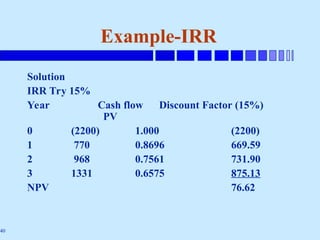
Solution
IRR Try 15%
Year Cash flow Discount Factor (15%)
PV
0 (2200) 1.000 (2200)
1 770 0.8696 669.59
2 968 0.7561 731.90
3 1331 0.6575 875.13
NPV 76.62
41
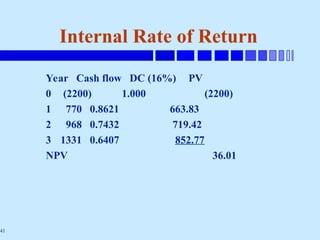
Internal Rate of Return
Year Cash flow DC (16%) PV
0 (2200) 1.000 (2200)
1 770 0.8621 663.83
2 968 0.7432 719.42
3 1331 0.6407 852.77
NPV 36.01
42
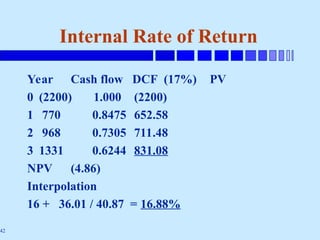
Internal Rate of Return
Year Cash flow DCF (17%) PV
0 (2200) 1.000 (2200)
1 770 0.8475 652.58
2 968 0.7305 711.48
3 1331 0.6244 831.08
NPV (4.86)
Interpolation
16 + 36.01 / 40.87 = 16.88%
43
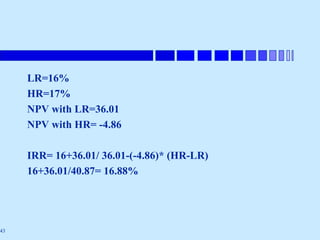
LR=16%
HR=17%
NPV with LR=36.01
NPV with HR= -4.86
IRR= 16+36.01/ 36.01-(-4.86)* (HR-LR)
16+36.01/40.87= 16.88%
44
Profitability Index
What Does Profitability Index Mean?
An index that attempts to identify the relationship
between the costs and benefits of a proposed project
through the use of a ratio calculated as:
45
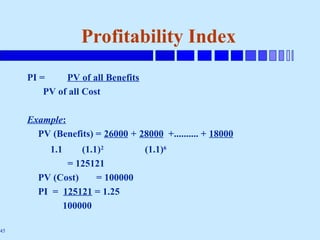
Profitability Index
PI = PV of all Benefits
PV of all Cost
Example:
PV (Benefits) = 26000 + 28000 +.......... + 18000
1.1 (1.1)2
(1.1)6
= 125121
PV (Cost) = 100000
PI = 125121 = 1.25
100000
46
Profitability Index
Advantages:
Disadvantages:
47
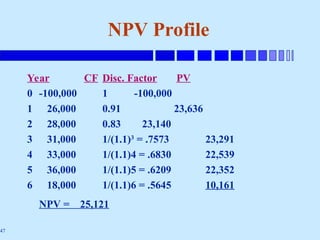
NPV Profile
Year CF Disc. Factor PV
0 -100,000 1 -100,000
1 26,000 0.91 23,636
2 28,000 0.83 23,140
3 31,000 1/(1.1)3
= .7573 23,291
4 33,000 1/(1.1)4 = .6830 22,539
5 36,000 1/(1.1)5 = .6209 22,352
6 18,000 1/(1.1)6 = .5645 10,161
NPV = 25,121
48
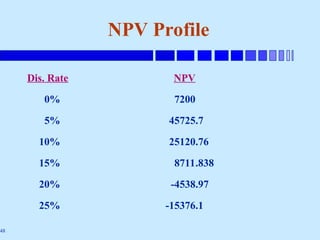
NPV Profile
Dis. Rate NPV
0% 7200
5% 45725.7
10% 25120.76
15% 8711.838
20% -4538.97
25% -15376.1
49
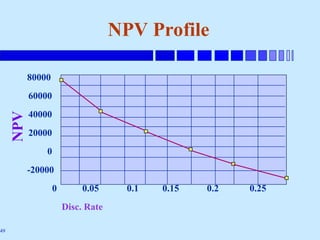
NPV Profile
80000
60000
40000
20000
0
-20000
0 0.05 0.1 0.15 0.2 0.25
Disc. Rate
NPV
50
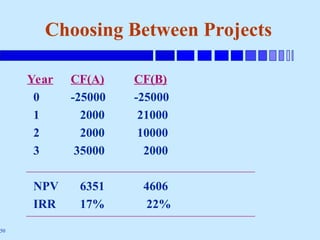
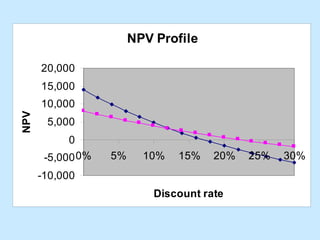
Choosing Between Projects
Year CF(A) CF(B)
0 -25000 -25000
1 2000 21000
2 2000 10000
3 35000 2000
NPV 6351 4606
IRR 17% 22%
NPV Profile
-10,000
-5,000
0
5,000
10,000
15,000
20,000
0% 5% 10% 15% 20% 25% 30%
Discount rate
NPV
52
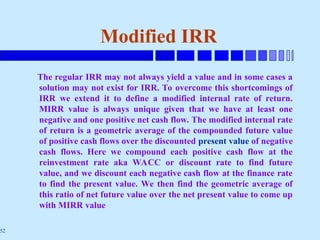
Modified IRR
The regular IRR may not always yield a value and in some cases a
solution may not exist for IRR. To overcome this shortcomings of
IRR we extend it to define a modified internal rate of return.
MIRR value is always unique given that we have at least one
negative and one positive net cash flow. The modified internal rate
of return is a geometric average of the compounded future value
of positive cash flows over the discounted present value of negative
cash flows. Here we compound each positive cash flow at the
reinvestment rate aka WACC or discount rate to find future
value, and we discount each negative cash flow at the finance rate
to find the present value. We then find the geometric average of
this ratio of net future value over the net present value to come up
with MIRR value
53
MIRR Formula
54
MIRR Example
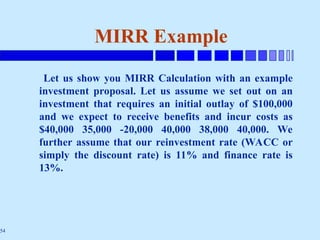
Let us show you MIRR Calculation with an example
investment proposal. Let us assume we set out on an
investment that requires an initial outlay of $100,000
and we expect to receive benefits and incur costs as
$40,000 35,000 -20,000 40,000 38,000 40,000. We
further assume that our reinvestment rate (WACC or
simply the discount rate) is 11% and finance rate is
13%.
55
MIRR Calculation
I will now show you step by step MIRR calculation for
the net cash flows from our example. As you can see we
compound each of the positive net cash flows at the
reinvestment rate and get a net future value. We also
discount each of the negative net cash flows to get a net
present value. Finally we find the geometric average of
the these two values to get the required MIRR value
56
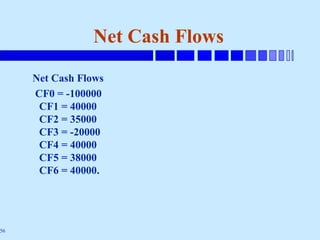
Net Cash Flows
Net Cash Flows
CF0 = -100000
CF1 = 40000
CF2 = 35000
CF3 = -20000
CF4 = 40000
CF5 = 38000
CF6 = 40000.
57
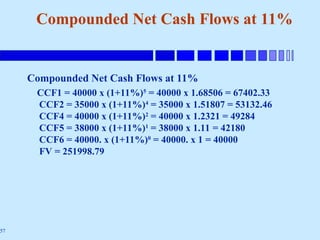
Compounded Net Cash Flows at 11%
CCF1 = 40000 x (1+11%)5 = 40000 x 1.68506 = 67402.33
CCF2 = 35000 x (1+11%)4
= 35000 x 1.51807 = 53132.46
CCF4 = 40000 x (1+11%)2
= 40000 x 1.2321 = 49284
CCF5 = 38000 x (1+11%)1
= 38000 x 1.11 = 42180
CCF6 = 40000. x (1+11%)0
= 40000. x 1 = 40000
FV = 251998.79
58
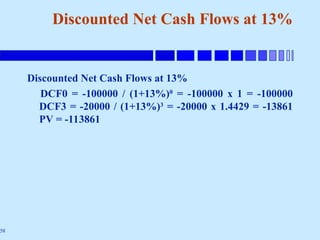
Discounted Net Cash Flows at 13%
DCF0 = -100000 / (1+13%)0
= -100000 x 1 = -100000
DCF3 = -20000 / (1+13%)3
= -20000 x 1.4429 = -13861
PV = -113861
59
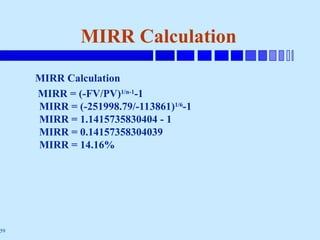
MIRR Calculation
MIRR Calculation
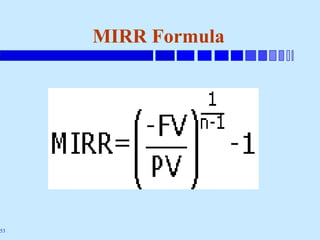
MIRR = (-FV/PV)1/n-1
-1
MIRR = (-251998.79/-113861)1/6
-1
MIRR = 1.1415735830404 - 1
MIRR = 0.14157358304039
MIRR = 14.16%
60
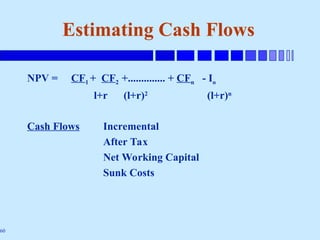
Estimating Cash Flows
NPV = CF1 + CF2 +.............. + CFn - Io
l+r (l+r)2
(l+r)n
Cash Flows Incremental
After Tax
Net Working Capital
Sunk Costs
61
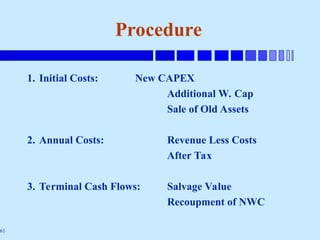
Procedure
1. Initial Costs: New CAPEX
Additional W. Cap
Sale of Old Assets
2. Annual Costs: Revenue Less Costs
After Tax
3. Terminal Cash Flows: Salvage Value
Recoupment of NWC
62
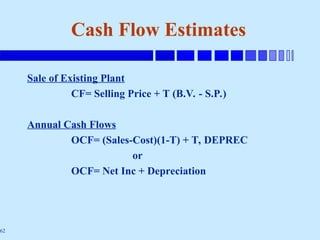
Cash Flow Estimates
Sale of Existing Plant
CF= Selling Price + T (B.V. - S.P.)
Annual Cash Flows
OCF= (Sales-Cost)(1-T) + T, DEPREC
or
OCF= Net Inc + Depreciation
63
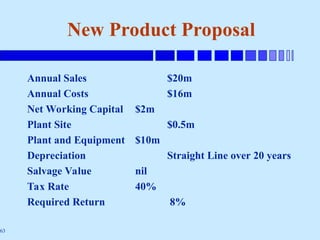
New Product Proposal
Annual Sales $20m
Annual Costs $16m
Net Working Capital $2m
Plant Site $0.5m
Plant and Equipment $10m
Depreciation Straight Line over 20 years
Salvage Value nil
Tax Rate 40%
Required Return 8%
64
New Product Proposal
INITIAL CASH FLOWS
ANNUAL CASH FLOWS
65
New Product Proposal
TERMINAL CASH FLOWS
CALCULATION
66
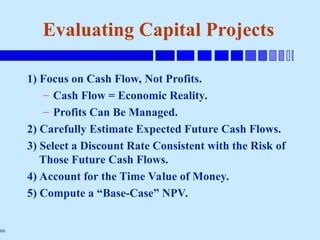
Evaluating Capital Projects
1) Focus on Cash Flow, Not Profits.
– Cash Flow = Economic Reality.
– Profits Can Be Managed.
2) Carefully Estimate Expected Future Cash Flows.
3) Select a Discount Rate Consistent with the Risk of
Those Future Cash Flows.
4) Account for the Time Value of Money.
5) Compute a “Base-Case” NPV.
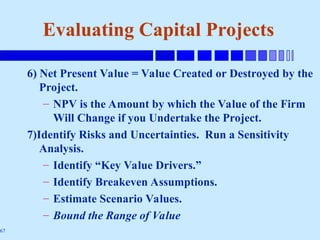
67
6) Net Present Value = Value Created or Destroyed by the
Project.
– NPV is the Amount by which the Value of the Firm
Will Change if you Undertake the Project.
7)Identify Risks and Uncertainties. Run a Sensitivity
Analysis.
– Identify “Key Value Drivers.”
– Identify Breakeven Assumptions.
– Estimate Scenario Values.
– Bound the Range of Value
Evaluating Capital Projects
68
8) Identify Qualitative Issues.
– Flexibility
– Quality
– Know-How
– Learning
9) Decide
Evaluating Capital Projects

5. Capital budgeting engineering third yr.ppt

  • 1.
  • 2.
    2 Capital Budget Capital budgetis the budget of capital expenditures. Capital Expenditures are those expenditures whose benefit spread in number of years e.g., purchase of Plant and Machinery , Land and building and starting a new factory plant etc.
  • 3.
    3 CAPITAL BUDGETING Capital budgeting:is the planning process for allocating all expenditures that will have an expected benefit to the firm for more than one year.
  • 4.
    4 Investment Appraisal Firms normallyplace projects in the following categories: • Replacement and maintenance of old or damaged equipment. • Investments to upgrade or replace existing equipment • Marketing investments to expand product lines or distribution facilities. • Investments for complying with government or
  • 5.
    5 OVERALL AIM To maximiseshareholders wealth.. Projects should give a return over and above the marginal weighted average cost of capital. Projects can be; Mutually exclusive Independent
  • 6.
    6 IDEAL SELECTION METHOD • Selectthe project that maximises shareholders wealth • Consider all cash flows • Discount the cash flows at the appropriate market determined opportunity cost of capital
  • 7.
    7 Need for InvestmentAppraisal • Large amount of resources are involved and wrong decisions could be costly • Difficult and expensive to reverse • Investment decisions can have a direct impact on the ability of the organisation to meet its objectives
  • 8.
    8 Investment Appraisal Process Stages: •identify objectives. What is it? Within the corporate objectives? • Identify alternatives. • Collect and analyse data. Examine the technical and economic feasibility of the project, cash flows etc.
  • 9.
    9 Investment Appraisal Process Stages: •decide which one to undertake • authorisation and implementation • review and monitor: learn from its experience and try to improve future decision - making
  • 10.
    10 Capital Budgeting -Methods Traditional Techniques 1. Accounting Rate of return 2. Payback Modern Techniques 3. Net Present Value 4. Internal Rate of Return 5. Profitability Index
  • 11.
    11 Accounting Rate ofReturn (ARR) Accounting Rate of Return method relates average annual profit to either the amount initiallyinvestedorthe average investment, as a percentage. Formulae: ARR = Average annual accounting profit x 100 Average investment Where:  Average annual profit = Totalprofit/Number of years  Average investment = (initialcapital investment +scrap value) / 2
  • 12.
    12 Accounting Rate ofReturn (ARR) ARR = Avg. Net Income Per Year Avg. Investment
  • 13.
    13 Average Return onInvestment Example: Year Net Income Cost 1 6,000 100,000 Initial 2 8,000 0 Salvage Value 3 11,000 4 13,000 5 16,000 6 18,000
  • 14.
    14 Avg. Net Income72,000 6 Avg. Investment100,000 2 AROI 12,000 50,000 ARR= AP/INVESTMENT= 12000/100000=12% ARR=TP/INVESTMENT= 72000/100000=72% Average Return on Investment = 12,000 = 24% = 50,000
  • 15.
    15 1. INDEPENDENT PROJECT ACCEPTANCE=IF ARR>COST OF CAPITAL REJECTION= IF ARR<COST OF CAPITAL 2. MUTUALLY EXCLUSIVE PROJECT The project with highest ARR shall be accepted. The project with highest ARR will get first rank. The project with lowest ARR will get least priority.
  • 16.
  • 17.
    17 Payback Period Method Paybackmethod - length of time it takes to repay the cost of initial investment Example LBS Ltd uses the payback period as its sole investment appraisal method. LBS invests £30,000 to replace its computers and this investment returns £9,000 annually for the five years. From the information above evaluate the investment using the payback. Assume that £9,000 accrues evenly throughout the year. Answer : Payback Period : 3.33 Years
  • 18.
    18 Payback Method # Yearsrequired to recover the original investment Example: CFO: -100,000 Year Net Income Cash Flow Cumulative CF 1 6,000 26,000 26,000 2 8,000 28,000 54,000 3 11,000 31,000 85,000 4 13,000 33,000 118,000 5 16,000 36,000 154,000 6 18,000 18,000 172,000 Payback = 3 + 100,000 - 85,000 118,000 - 85,000 = 3.45 Years
  • 19.
    19 PBP= Complete Years+ReqCF/Cash flow of subsequent year PBP= 3+15000/33000= 3.45 YEARS
  • 20.
    20 PAT XXXXX Add Non CashExpenses e.g., depreciation + Less Non Cash income (-) CFAT
  • 21.
  • 22.
    22 Time Value ofMoney FV = PV (1 + r)n Compounding: Finding FV Discounting: Finding PV: PV = FV/(1 + r) n Internal Rate of Return: Finding r
  • 23.
    23 Definitions • Present value:-the amount of money you must invest or lend at the present time so as to end up with a particular amount of money in the future. • Discounting: -finding the present value of a future cash flow
  • 24.
    24 Net Present Value •Net Present Value (NPV) - the difference between the present values of cash inflows and outflows of an investment • Opportunity cost of undertaking the investment is the alternative of earning interest rate in the financial market. • NPV is the difference between PV of cash inflows minus Cash Outflows
  • 25.
  • 26.
    26 Net Present Value NetPresent Value of an Investment is the present value of all its present and future cash flows, discounted at the opportunity cost of those cash flows. NPV is mathematicallyrepresented as: n n r CF r CF r CF r CF CF NPV ) 1 ( ..... ) 1 ( ) 1 ( ) 1 ( 3 3 2 2 1 1 0          Where: CF0 = Cash flow at time zero (t0) CF1 = Cash flow at time one (t1),one year aftertime zero
  • 27.
    27 Net Present Value NPV= Present Value of All Future Cash Flows less Inital Cost = CF1 + CF2 + CF3 +.......CFn - Io 1+r (1+r)2 (1+r)3 (1+r)n r = Rf+B(Rm-Rf) R= discounting rate Rf= Risk free rate Rm= Market rate of return B= Beta Value
  • 28.
    28 Example-1 A company canpurchase a machine at the price of £2200. The machine has a productive life of three years and the net additions to cash inflows at the end of each of the three years are £770, £968 and £1331. The company can buy the machine without having to borrow and the best alternative is investment elsewhere at an interest rate of 10%. Evaluate the project using the a) Net present value method. b) Internal rate of return
  • 29.
    29 Example-1 NPV = 770+ 968 + 1331 -2,200 = 300 (1.1) (1.1)2 (1.1)3 OR Year Cash flow Discount Factor (10%) PV 0 (2200) 1.000 (2200) 1 770 0.9091 700 2 968 0.8264 800 3 1331 0.7513 1000 NPV 300 Comments: The project is worthwhile and the machine should be bought (can you suggest why?)
  • 30.
    30 NPV-Example-2 A firm invest£180,000 in a project that will give a net cash inflow of 50,000 in real terms in each of the next six years. Its real pre-tax cost of capital is 13%. Required: Calculate NPV
  • 31.
    31 Example-2 Solution Year Cash FlowPV factor 13% Present 0 (180,000) 1.00 (180,000) 1 50,000 0.885 44,250 2 50,000 0.783 39,150 3 50,000 0.693 34,650 4 50,000 0.613 30,650 5 50,000 0.543 27,150 6 50,000 0.480 24,000 NPV 19,850 Positive NPV indicates viability of the project. Negative NPV indicates non-viability of the project.
  • 32.
    32 Net Present Value– Example-3 Year CF Disc. Factor PV 0 -100000 1 -100000 1 26000 1/1.1 = .9091 23637 2 28000 1/(1.1)2 = .8264 23139 3 31000 1/(1.1)3 = .7573 23290 4 33000 1/(1.1)4 = .6830 22539 5 36000 1/(1.1)5 = .6209 22352 6 18000 1/(1.1)6 = .5645 10161 NPV = 25121
  • 33.
  • 34.
    34 Internal Rate ofReturn • Internal Rate of Return - is the discount rate that equates the present values of an investment’s cash inflows and outflows. • Internal Rate of Return (IRR) - is the discount rate that causes an investment’s NPV to be zero
  • 35.
    35 Internal Rate ofReturn Use interpolation method to calculate the IRR. The formula is as follows: ) ( L H N N N L IRR H L L      Where: L = Lower rate of interest H = Higher rate of interest NL = NPV at lower rate of interest NH = NPV at higher rate of interest
  • 36.
    36 Internal Rate ofReturn Discount rate that makes NPV Zero (i.e., that equates PV of benefits with the cost). IRR: Io = CF1 + CF2 + ..... + CFn 1+r (1+r)2 (1+r)n Solve for r. Example: 100,000= 26000 + 28000 + 31000 + .......... + 18000 1+r (1+r)2 (1+r)3 (1+r)6 r = 18.2%
  • 37.
    37 Acceptance of project= IRR> cost of capital Rejection of project = IRR< COST OF CAPITAL IF BOTH ARE EQUAL = MAY BE ACCEPTED MAY BE REJECTED MUTUALLY EXCLUSIVE PROJECTS : THE PROJECT WITH HIGHER IRR WILL GET FIRST RANK
  • 38.
    38 Internal Rate ofReturn Advantages Disadvantages
  • 39.
    39 Example-IRR Using Lecture example1(above), calculate the internal rate of return for the project.
  • 40.
    40 Example-IRR Solution IRR Try 15% YearCash flow Discount Factor (15%) PV 0 (2200) 1.000 (2200) 1 770 0.8696 669.59 2 968 0.7561 731.90 3 1331 0.6575 875.13 NPV 76.62
  • 41.
    41 Internal Rate ofReturn Year Cash flow DC (16%) PV 0 (2200) 1.000 (2200) 1 770 0.8621 663.83 2 968 0.7432 719.42 3 1331 0.6407 852.77 NPV 36.01
  • 42.
    42 Internal Rate ofReturn Year Cash flow DCF (17%) PV 0 (2200) 1.000 (2200) 1 770 0.8475 652.58 2 968 0.7305 711.48 3 1331 0.6244 831.08 NPV (4.86) Interpolation 16 + 36.01 / 40.87 = 16.88%
  • 43.
    43 LR=16% HR=17% NPV with LR=36.01 NPVwith HR= -4.86 IRR= 16+36.01/ 36.01-(-4.86)* (HR-LR) 16+36.01/40.87= 16.88%
  • 44.
    44 Profitability Index What DoesProfitability Index Mean? An index that attempts to identify the relationship between the costs and benefits of a proposed project through the use of a ratio calculated as:
  • 45.
    45 Profitability Index PI =PV of all Benefits PV of all Cost Example: PV (Benefits) = 26000 + 28000 +.......... + 18000 1.1 (1.1)2 (1.1)6 = 125121 PV (Cost) = 100000 PI = 125121 = 1.25 100000
  • 46.
  • 47.
    47 NPV Profile Year CFDisc. Factor PV 0 -100,000 1 -100,000 1 26,000 0.91 23,636 2 28,000 0.83 23,140 3 31,000 1/(1.1)3 = .7573 23,291 4 33,000 1/(1.1)4 = .6830 22,539 5 36,000 1/(1.1)5 = .6209 22,352 6 18,000 1/(1.1)6 = .5645 10,161 NPV = 25,121
  • 48.
    48 NPV Profile Dis. RateNPV 0% 7200 5% 45725.7 10% 25120.76 15% 8711.838 20% -4538.97 25% -15376.1
  • 49.
  • 50.
    50 Choosing Between Projects YearCF(A) CF(B) 0 -25000 -25000 1 2000 21000 2 2000 10000 3 35000 2000 NPV 6351 4606 IRR 17% 22%
  • 51.
  • 52.
    52 Modified IRR The regularIRR may not always yield a value and in some cases a solution may not exist for IRR. To overcome this shortcomings of IRR we extend it to define a modified internal rate of return. MIRR value is always unique given that we have at least one negative and one positive net cash flow. The modified internal rate of return is a geometric average of the compounded future value of positive cash flows over the discounted present value of negative cash flows. Here we compound each positive cash flow at the reinvestment rate aka WACC or discount rate to find future value, and we discount each negative cash flow at the finance rate to find the present value. We then find the geometric average of this ratio of net future value over the net present value to come up with MIRR value
  • 53.
  • 54.
    54 MIRR Example Let usshow you MIRR Calculation with an example investment proposal. Let us assume we set out on an investment that requires an initial outlay of $100,000 and we expect to receive benefits and incur costs as $40,000 35,000 -20,000 40,000 38,000 40,000. We further assume that our reinvestment rate (WACC or simply the discount rate) is 11% and finance rate is 13%.
  • 55.
    55 MIRR Calculation I willnow show you step by step MIRR calculation for the net cash flows from our example. As you can see we compound each of the positive net cash flows at the reinvestment rate and get a net future value. We also discount each of the negative net cash flows to get a net present value. Finally we find the geometric average of the these two values to get the required MIRR value
  • 56.
    56 Net Cash Flows NetCash Flows CF0 = -100000 CF1 = 40000 CF2 = 35000 CF3 = -20000 CF4 = 40000 CF5 = 38000 CF6 = 40000.
  • 57.
    57 Compounded Net CashFlows at 11% Compounded Net Cash Flows at 11% CCF1 = 40000 x (1+11%)5 = 40000 x 1.68506 = 67402.33 CCF2 = 35000 x (1+11%)4 = 35000 x 1.51807 = 53132.46 CCF4 = 40000 x (1+11%)2 = 40000 x 1.2321 = 49284 CCF5 = 38000 x (1+11%)1 = 38000 x 1.11 = 42180 CCF6 = 40000. x (1+11%)0 = 40000. x 1 = 40000 FV = 251998.79
  • 58.
    58 Discounted Net CashFlows at 13% Discounted Net Cash Flows at 13% DCF0 = -100000 / (1+13%)0 = -100000 x 1 = -100000 DCF3 = -20000 / (1+13%)3 = -20000 x 1.4429 = -13861 PV = -113861
  • 59.
    59 MIRR Calculation MIRR Calculation MIRR= (-FV/PV)1/n-1 -1 MIRR = (-251998.79/-113861)1/6 -1 MIRR = 1.1415735830404 - 1 MIRR = 0.14157358304039 MIRR = 14.16%
  • 60.
    60 Estimating Cash Flows NPV= CF1 + CF2 +.............. + CFn - Io l+r (l+r)2 (l+r)n Cash Flows Incremental After Tax Net Working Capital Sunk Costs
  • 61.
    61 Procedure 1. Initial Costs:New CAPEX Additional W. Cap Sale of Old Assets 2. Annual Costs: Revenue Less Costs After Tax 3. Terminal Cash Flows: Salvage Value Recoupment of NWC
  • 62.
    62 Cash Flow Estimates Saleof Existing Plant CF= Selling Price + T (B.V. - S.P.) Annual Cash Flows OCF= (Sales-Cost)(1-T) + T, DEPREC or OCF= Net Inc + Depreciation
  • 63.
    63 New Product Proposal AnnualSales $20m Annual Costs $16m Net Working Capital $2m Plant Site $0.5m Plant and Equipment $10m Depreciation Straight Line over 20 years Salvage Value nil Tax Rate 40% Required Return 8%
  • 64.
    64 New Product Proposal INITIALCASH FLOWS ANNUAL CASH FLOWS
  • 65.
    65 New Product Proposal TERMINALCASH FLOWS CALCULATION
  • 66.
    66 Evaluating Capital Projects 1)Focus on Cash Flow, Not Profits. – Cash Flow = Economic Reality. – Profits Can Be Managed. 2) Carefully Estimate Expected Future Cash Flows. 3) Select a Discount Rate Consistent with the Risk of Those Future Cash Flows. 4) Account for the Time Value of Money. 5) Compute a “Base-Case” NPV.
  • 67.
    67 6) Net PresentValue = Value Created or Destroyed by the Project. – NPV is the Amount by which the Value of the Firm Will Change if you Undertake the Project. 7)Identify Risks and Uncertainties. Run a Sensitivity Analysis. – Identify “Key Value Drivers.” – Identify Breakeven Assumptions. – Estimate Scenario Values. – Bound the Range of Value Evaluating Capital Projects
  • 68.
    68 8) Identify QualitativeIssues. – Flexibility – Quality – Know-How – Learning 9) Decide Evaluating Capital Projects