M M Rahman & Co.
Chartered Accountants
Level - 10, Padma Life Tower,
115 Kazi Nazrul Islam Avenue,
Bangla Motor, Dhaka - 1000.
IAS 7
Statement of cash flows
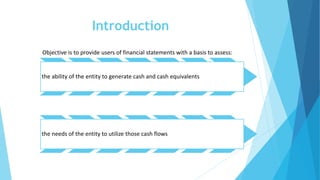
Introduction
Objective is to provide users of financial statements with a basis to assess:
the ability of the entity to generate cash and cash equivalents
the needs of the entity to utilize those cash flows
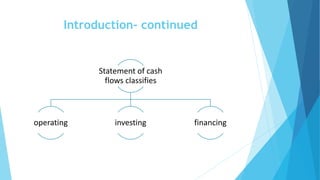
Introduction- continued
Statement of cash
flows classifies
operating investing financing
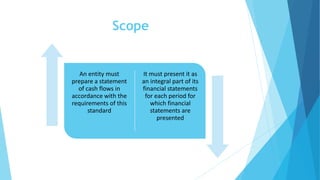
Scope
An entity must
prepare a statement
of cash flows in
accordance with the
requirements of this
standard
It must present it as
an integral part of its
financial statements
for each period for
which financial
statements are
presented
Definitions
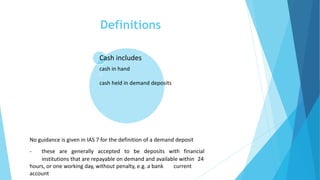
Cash includes
cash in hand
cash held in demand deposits
No guidance is given in IAS 7 for the definition of a demand deposit
- these are generally accepted to be deposits with financial
institutions that are repayable on demand and available within 24
hours, or one working day, without penalty, e.g. a bank current
account
Definition- continued
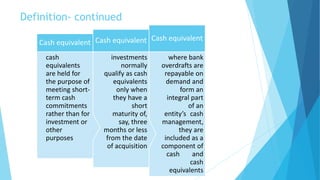
where bank
overdrafts are
repayable on
demand and
form an
integral part
of an
entity’s cash
management,
they are
included as a
component of
cash and
cash
equivalents
Cash equivalent
investments
normally
qualify as cash
equivalents
only when
they have a
short
maturity of,
say, three
months or less
from the date
of acquisition
Cash equivalent
cash
equivalents
are held for
the purpose of
meeting short-
term cash
commitments
rather than for
investment or
other
purposes
Cash equivalent
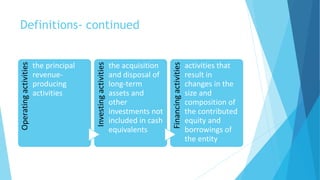
Definitions- continuedOperatingactivities
the principal
revenue-
producing
activities
Investingactivities
the acquisition
and disposal of
long-term
assets and
other
investments not
included in cash
equivalents
Financingactivities
activities that
result in
changes in the
size and
composition of
the contributed
equity and
borrowings of
the entity
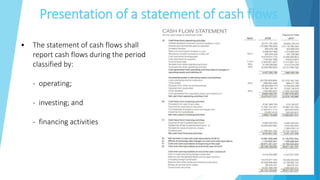
Presentation of a statement of cash flows
• The statement of cash flows shall
report cash flows during the period
classified by:
- operating;
- investing; and
- financing activities
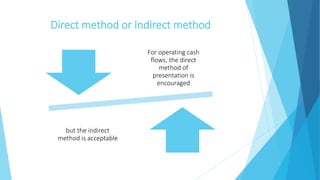
Direct method or Indirect method
For operating cash
flows, the direct
method of
presentation is
encouraged
but the indirect
method is acceptable
Reporting cash flows from operating activities
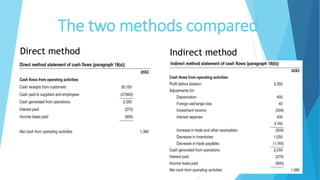
• Cash flows from operating activities must be reported by using either:
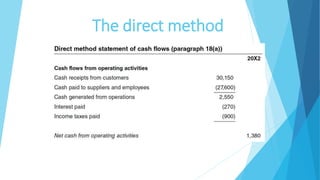
- the direct method
• whereby major classes of gross cash receipts and gross cash payments are
disclosed [7.18(a)]
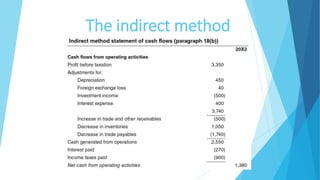
- the indirect method
• whereby profit or loss is adjusted for:
- the effects of transactions of a non-cash nature, any deferrals or
accruals of past or future operating cash receipts or payments,
- items of income or expense associated with investing or financing
cash flows [7.18(b)]
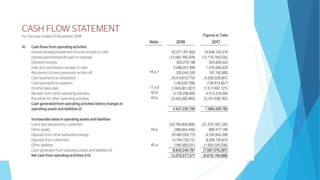
The direct method
The indirect method
The indirect method
Practical considerations
• The indirect method is built around the principle that operating profit for the period
comprises operating activities that were:
- settled in cash
- not yet settled in cash, i.e. receivables, payables, accruals, etc.
- non-cash transactions, e.g.:
◦ depreciation
◦ write-offs and provisions for impairment
◦ profits or losses on disposal of PPE, etc.
• Therefore, if operating profit is adjusted for non-cash transactions and for transactions
that were not yet settled in cash, the result is cash flows from operating activities
The two methods compared
Direct method Indirect method
Reporting cash flows from investing and financing
activities
• An entity shall report separately major classes of gross cash receipts and
payments arising from investing and financing activities except to the
extent that cash flows are reported on a net basis [IAS 7.22-24]:
- cash receipts and payments on behalf of customers when the cash
flows reflect the activities of the customer rather than those of the
entity; and
- cash receipts and payments for items in which the turnover is
quick, the amounts are large, and the maturities are short
Reporting cash flows from investing and financing activities
Reporting cash flows on a net basis
• Examples of cash receipts and payments relating to customer:
- the acceptance and repayment of demand deposits of a bank;
- funds held for customers by an investment entity; and
- rent collected on behalf of, and paid over to, the owners of
properties
• Examples of cash receipts and payments with quick
turnover and short maturities:
- principal amounts relating to credit card customers;
- the purchase and sale of investments; and
- other short term borrowings, for example, those which have a
maturity period of three months or less
Foreign currency cash flows
• Cash flows arising from transactions in a foreign currency
are recorded in an entity’s functional currency [IAS 7.25-28]
- the exchange rate to be used is the exchange rate applicable at the
date of the cash flow
- the cash flows of a foreign subsidiary are translated at the exchange
rates between the functional currency and the foreign currency at the
dates of the cash flows
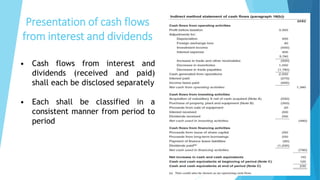
Presentation of cash flows
from interest and dividends
• Cash flows from interest and
dividends (received and paid)
shall each be disclosed separately
• Each shall be classified in a
consistent manner from period to
period
Presentation of cash flows
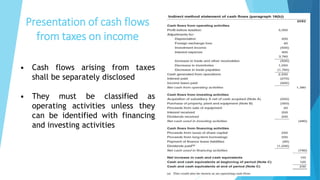
from taxes on income
• Cash flows arising from taxes
shall be separately disclosed
• They must be classified as
operating activities unless they
can be identified with financing
and investing activities
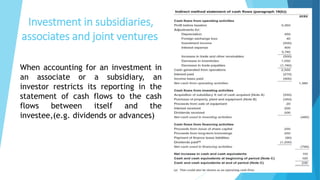
Investment in subsidiaries,
associates and joint ventures
When accounting for an investment in
an associate or a subsidiary, an
investor restricts its reporting in the
statement of cash flows to the cash
flows between itself and the
investee,(e.g. dividends or advances)
Acquisitions and disposals of subsidiaries
and other business units
• The aggregate cash flows arising from acquisitions, and disposals, of subsidiaries or
other business units must be presented separately and classified as investing activities
• Disclosure, in aggregate, of each of the following is necessary:
- the total consideration paid or received;
- the portion of the consideration consisting of cash and cash equivalents;
- the amount of cash and cash equivalents in the subsidiaries or other businesses
over which control is obtained or lost; and
- the amount of the assets and liabilities other than cash or cash equivalents in the
subsidiaries or other businesses over which control is obtained or lost, summarized
by each major category
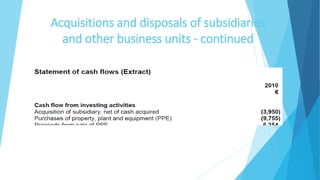
Acquisitions and disposals of subsidiaries
and other business units - continued
Non-cash transactions
• Investing and financing transactions that do not require the
use of cash or cash equivalents are excluded from a statement
of cash flows
-these transactions must however be disclosed elsewhere in the
financial statements in a way that provides all the relevant
information about these investing and financing activities
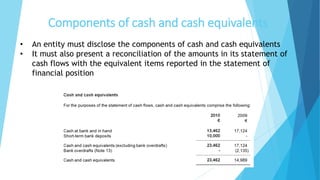
Components of cash and cash equivalents
• An entity must disclose the components of cash and cash equivalents
• It must also present a reconciliation of the amounts in its statement of
cash flows with the equivalent items reported in the statement of
financial position
Preparing a statement of cash flows
Basic principles
• The following items are needed in order to prepare a statement of cash flows:
- Statement of financial position
- Statement of profit or loss and other comprehensive income
- Statement of changes in equity
- Notes supporting investing and financing activities, e.g.:
◦ PPE, investment property and intangible assets notes
◦ investments in subsidiaries, associates and joint ventures
◦ Borrowings
• If there is a casting error in any of the above the statement of cash flows will never agree!
The indirect method
Basic principles: 2 - continued
• The same concept applies to liabilities, i.e.
- an increase in liabilities will have arisen from an aggregated
debit entry against another line item, e.g. cash
- a decrease in liabilities will have arisen from an aggregated
credit entry against another line item, e.g. cash
The indirect method
• Any movement in a line item in the statement of financial position must
either:
- offset a movement in another line item; or
- be presented in the Statement of cash flows; or
- a mixture of the above
Other disclosures
The amount of cash and cash equivalents held by
the entity that is not available for use by the group
should be disclosed, together with a commentary by
management [IAS 7.48]
Thank you 

Ias 7 presentation

  • 1.
    M M Rahman& Co. Chartered Accountants Level - 10, Padma Life Tower, 115 Kazi Nazrul Islam Avenue, Bangla Motor, Dhaka - 1000.
  • 2.
  • 3.
    Introduction Objective is toprovide users of financial statements with a basis to assess: the ability of the entity to generate cash and cash equivalents the needs of the entity to utilize those cash flows
  • 4.
    Introduction- continued Statement ofcash flows classifies operating investing financing
  • 5.
    Scope An entity must preparea statement of cash flows in accordance with the requirements of this standard It must present it as an integral part of its financial statements for each period for which financial statements are presented
  • 6.
    Definitions Cash includes cash inhand cash held in demand deposits No guidance is given in IAS 7 for the definition of a demand deposit - these are generally accepted to be deposits with financial institutions that are repayable on demand and available within 24 hours, or one working day, without penalty, e.g. a bank current account
  • 7.
    Definition- continued where bank overdraftsare repayable on demand and form an integral part of an entity’s cash management, they are included as a component of cash and cash equivalents Cash equivalent investments normally qualify as cash equivalents only when they have a short maturity of, say, three months or less from the date of acquisition Cash equivalent cash equivalents are held for the purpose of meeting short- term cash commitments rather than for investment or other purposes Cash equivalent
  • 8.
    Definitions- continuedOperatingactivities the principal revenue- producing activities Investingactivities theacquisition and disposal of long-term assets and other investments not included in cash equivalents Financingactivities activities that result in changes in the size and composition of the contributed equity and borrowings of the entity
  • 9.
    Presentation of astatement of cash flows • The statement of cash flows shall report cash flows during the period classified by: - operating; - investing; and - financing activities
  • 10.
    Direct method orIndirect method For operating cash flows, the direct method of presentation is encouraged but the indirect method is acceptable
  • 11.
    Reporting cash flowsfrom operating activities • Cash flows from operating activities must be reported by using either: - the direct method • whereby major classes of gross cash receipts and gross cash payments are disclosed [7.18(a)] - the indirect method • whereby profit or loss is adjusted for: - the effects of transactions of a non-cash nature, any deferrals or accruals of past or future operating cash receipts or payments, - items of income or expense associated with investing or financing cash flows [7.18(b)]
  • 12.
  • 13.
  • 14.
    The indirect method Practicalconsiderations • The indirect method is built around the principle that operating profit for the period comprises operating activities that were: - settled in cash - not yet settled in cash, i.e. receivables, payables, accruals, etc. - non-cash transactions, e.g.: ◦ depreciation ◦ write-offs and provisions for impairment ◦ profits or losses on disposal of PPE, etc. • Therefore, if operating profit is adjusted for non-cash transactions and for transactions that were not yet settled in cash, the result is cash flows from operating activities
  • 15.
    The two methodscompared Direct method Indirect method
  • 17.
    Reporting cash flowsfrom investing and financing activities • An entity shall report separately major classes of gross cash receipts and payments arising from investing and financing activities except to the extent that cash flows are reported on a net basis [IAS 7.22-24]: - cash receipts and payments on behalf of customers when the cash flows reflect the activities of the customer rather than those of the entity; and - cash receipts and payments for items in which the turnover is quick, the amounts are large, and the maturities are short
  • 18.
    Reporting cash flowsfrom investing and financing activities Reporting cash flows on a net basis • Examples of cash receipts and payments relating to customer: - the acceptance and repayment of demand deposits of a bank; - funds held for customers by an investment entity; and - rent collected on behalf of, and paid over to, the owners of properties • Examples of cash receipts and payments with quick turnover and short maturities: - principal amounts relating to credit card customers; - the purchase and sale of investments; and - other short term borrowings, for example, those which have a maturity period of three months or less
  • 19.
    Foreign currency cashflows • Cash flows arising from transactions in a foreign currency are recorded in an entity’s functional currency [IAS 7.25-28] - the exchange rate to be used is the exchange rate applicable at the date of the cash flow - the cash flows of a foreign subsidiary are translated at the exchange rates between the functional currency and the foreign currency at the dates of the cash flows
  • 20.
    Presentation of cashflows from interest and dividends • Cash flows from interest and dividends (received and paid) shall each be disclosed separately • Each shall be classified in a consistent manner from period to period
  • 21.
    Presentation of cashflows from taxes on income • Cash flows arising from taxes shall be separately disclosed • They must be classified as operating activities unless they can be identified with financing and investing activities
  • 22.
    Investment in subsidiaries, associatesand joint ventures When accounting for an investment in an associate or a subsidiary, an investor restricts its reporting in the statement of cash flows to the cash flows between itself and the investee,(e.g. dividends or advances)
  • 23.
    Acquisitions and disposalsof subsidiaries and other business units • The aggregate cash flows arising from acquisitions, and disposals, of subsidiaries or other business units must be presented separately and classified as investing activities • Disclosure, in aggregate, of each of the following is necessary: - the total consideration paid or received; - the portion of the consideration consisting of cash and cash equivalents; - the amount of cash and cash equivalents in the subsidiaries or other businesses over which control is obtained or lost; and - the amount of the assets and liabilities other than cash or cash equivalents in the subsidiaries or other businesses over which control is obtained or lost, summarized by each major category
  • 24.
    Acquisitions and disposalsof subsidiaries and other business units - continued
  • 25.
    Non-cash transactions • Investingand financing transactions that do not require the use of cash or cash equivalents are excluded from a statement of cash flows -these transactions must however be disclosed elsewhere in the financial statements in a way that provides all the relevant information about these investing and financing activities
  • 26.
    Components of cashand cash equivalents • An entity must disclose the components of cash and cash equivalents • It must also present a reconciliation of the amounts in its statement of cash flows with the equivalent items reported in the statement of financial position
  • 27.
    Preparing a statementof cash flows Basic principles • The following items are needed in order to prepare a statement of cash flows: - Statement of financial position - Statement of profit or loss and other comprehensive income - Statement of changes in equity - Notes supporting investing and financing activities, e.g.: ◦ PPE, investment property and intangible assets notes ◦ investments in subsidiaries, associates and joint ventures ◦ Borrowings • If there is a casting error in any of the above the statement of cash flows will never agree!
  • 28.
    The indirect method Basicprinciples: 2 - continued • The same concept applies to liabilities, i.e. - an increase in liabilities will have arisen from an aggregated debit entry against another line item, e.g. cash - a decrease in liabilities will have arisen from an aggregated credit entry against another line item, e.g. cash
  • 29.
    The indirect method •Any movement in a line item in the statement of financial position must either: - offset a movement in another line item; or - be presented in the Statement of cash flows; or - a mixture of the above
  • 30.
    Other disclosures The amountof cash and cash equivalents held by the entity that is not available for use by the group should be disclosed, together with a commentary by management [IAS 7.48]
  • 31.